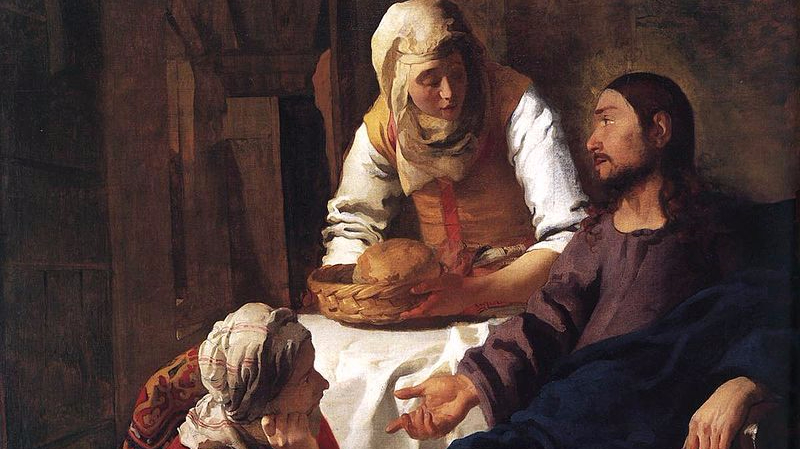
“Martha, Martha, you are anxious and worried about many things. There is need of only one thing. Mary has chosen the better part and it will not be taken from her.” (Lk 10:41-42).
In this statement, Jesus is continuing his message of growth and evolution. Jesus met people in their present wounded condition, and invited them to healing, greater awareness, and ultimately a more authentic and intimate relationship with him, his Father and each other. Jesus recognized, and lived, the standard teachings, social constructs and laws to be a faithful Jew, but he also revealed the deeper meanings of those social and religious constructs.
Jesus is doing the same in this encounter with Martha. Martha is fulfilling the important role of hospitality, and yet, is clearly frustrated.
Luke’s choice of the Greek merimnao for anxiety and thorubazomai for worried, shows that Jesus understands Martha’s inner turmoil. Merimnao, as found in other New Testament writings, is used to express entanglements of life in the world. Martha is clearly anxious that she has much to do, but more so that Mary is breaking the social norm of sitting with the men! The fact that only men are to sit with the teacher as proper etiquette is probably causing even more anxiety for Martha than Mary not helping her. When Jesus stated that Martha was worried, thorubazomai, he is saying that she is putting herself in an uproar, she is twisting herself into knots (Johnson, 174)!
Jesus was not condemning Martha, he was holding up a mirror to her, helping Martha to see that the most important part of hospitality is attending, being present, to the guest and in doing so, also challenging the social convention that she, as Mary had chosen, was not separate but invited to sit with Mary, equally with the men, not to be separated but included.
St Augustine (354-430), Bishop of Hippo, offers an even deeper insight. What Jesus is offering Martha is a foretaste of heaven: “No, there will be none of these tasks there. What you will find there is what Mary chose. There we shall not feed others, we ourselves shall be fed. Thus, what Mary chose in this life will be realized there in its fulness; she was gathering fragments from that rich banquet, the Word of God” (Augustine, 1561).
In essence, Jesus was echoing his message to the Pharisees, which was, “I desire mercy not sacrifice” (Mt 9:13; Hosea 6:6). Jesus was inviting Martha to sit with her sister Mary. I believe Martha received a healing in that moment and she did just that. Martha sat with her sister.
What is important to God the Father, what Jesus taught, what he inspires us to do, is to respect the dignity of the person in all that we do. To be aware of what the true need of the person is in that moment. That includes respecting and recognizing the needs and woundedness within ourselves. What are those inner anxieties and worries that keep us from deeper intimacy with Jesus and one another? We need to reflect on and identify them and bring them to Jesus for our healing.
What is paramount to living as a disciple of Jesus is being present to one another, including one another, supporting and empowering one another. We are called to be people of mercy. We are invited to join Mary and Martha and sit at the feet of Jesus, so we too can find rest, we too can be healed, we too can speak with the boldness of Martha: “Yes, Lord. I have come to believe that you are the Christ, the Son of God, the one who is coming into the world” (Jn 11:27).
—————————————————————————————–
Mass Readings for today, Saturday, July 29, 2017:
http://www.usccb.org/bible/readings/072917.cfm
Johnson, Luke Timothy. “The Gospel of Luke, vol. 3.” In Sacra Pagina, edited by Daniel J. Harrington, S.J., 174. Collegeville, MN: Liturgical Press, 1991.
St. Augustine. Catholic Church. The Liturgy of the Hours: According to the Roman Rite, vol. 3. 1561. NY: Catholic Book Publishing, 1975.
 Spiritual Stepping Stones