When Jesus saw his mother and the disciple there whom he loved he said to his mother, “Woman, behold, your son.” Then he said to the disciple, “Behold, your mother.” And from that hour the disciple took her into his home (Jn 19:26-27).
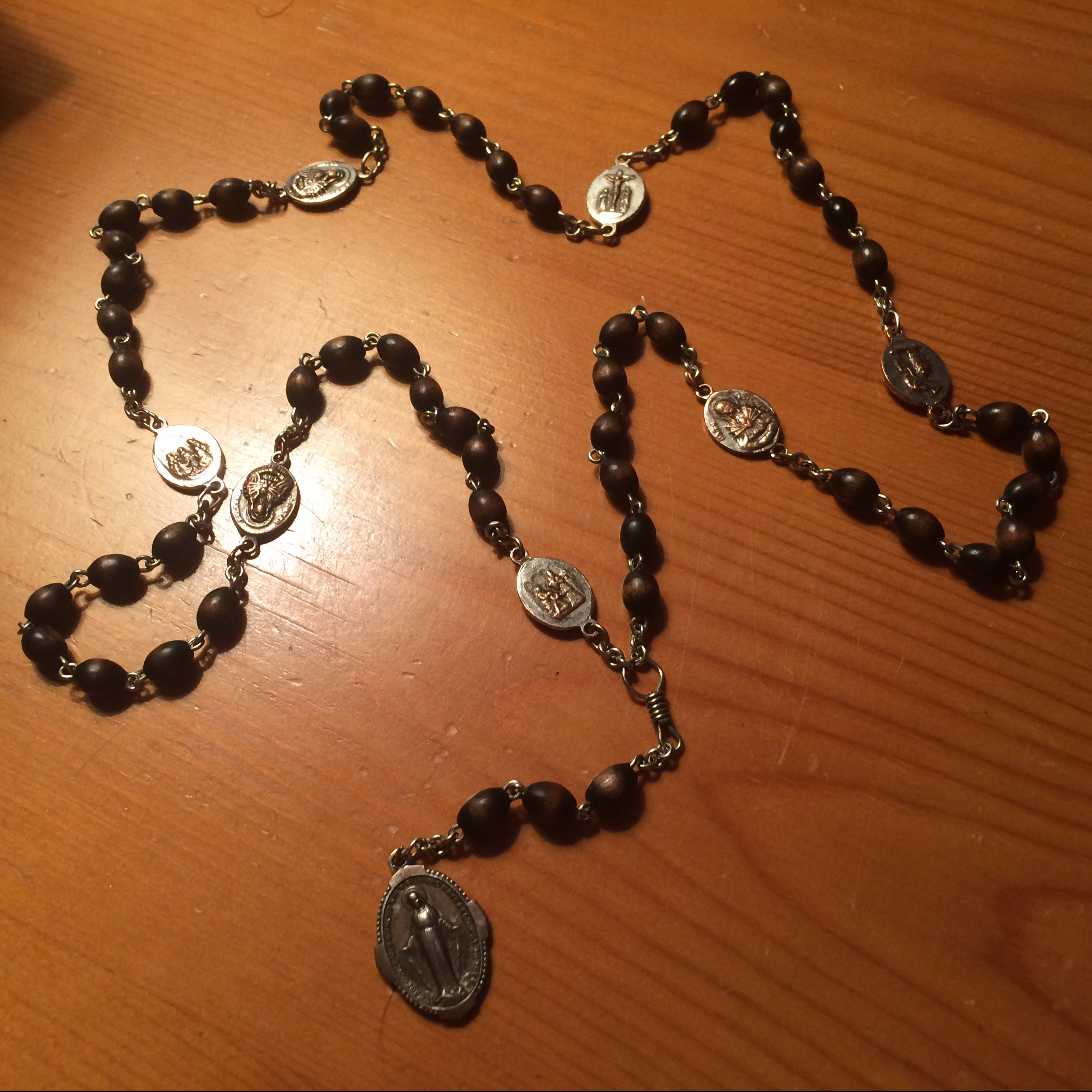
In the summer of 1991 I entered the Franciscans of Holy Name Province as a pre-novitiate and was stationed at Holy Cross Friary in the Bronx. My ministry for that year was working in the friary and the adjoining parish of Holy Cross. Shortly after entering, one of the friars, Br. Paul Goldie, passed away. He had been serving at the friary since 1953 and had been a friar for 54 years. A practice among the friars was to pass on personal items to those in the community when one of their own passed away. I was honored to have been given a picture of St. Francis and Br. Paul’s rosary.
I noticed that the rosary was different from others. Instead of a crucifix it had a Miraculous Medal, instead of five beads there were three beads leading to the decade of beads, and instead of five decades of beads, there were seven groupings of seven beads. In between each of the series of seven beads there was a small medal. On one side was a picture of Mary pierced in the heart seven times, and on the back of each medal was a different scene. I would find out some time later that this was a Rosary of Our Lady of Sorrows. The depictions on the back of the seven medals represented Mary’s seven sorrows: Simeon announces the suffering destiny of Jesus, Mary escapes into Egypt
with Jesus and Joseph, Mary seeks Jesus lost in Jerusalem, Mary meets Jesus as He carries
His Cross to Calvary, Mary stands near the Cross of her Son Jesus, Mary receives into her arms the body of Jesus taken down from the Cross, and Mary helps place the body of Jesus in the tomb.
The fifth mystery, Mary stands near the Cross of her Son Jesus, is from our Gospel reading today. It must have been the most sorrowful of the seven, for Mary to witness her son dying such an agonizing death as the crucifixion. Yet, Mary did not run from the pain, she embraced his and her own pain, the piercing of the lance, pierced her own heart. Because Mary stayed she received a deeper gift of Jesus’ love. “He shows to the very end his love for his own (xiii 1), for symbolically he now provides a communal context of mutual love in which they shall live after he is gone” (Brown, 926). Mary, “Woman, behold your son” and John, “behold your mother” will live and profess that same love of Jesus they experienced with his other followers.
By being willing to love, we risk experiencing and entering into the pain of those we love. So many times we run from love, because we do not want to experience the pain relationships will entail. We are finite and fragile beings, and so we will let each other down, we will make mistakes, say the wrong things, do the wrong things, we will get sick or deal with chronic illness and need care, we will lose patience, we will sin. Jesus though calls us, like Mary and John to love, to will the good of the other and so to experience the fruit of an authentic relationship which is love.
Love is the bond of communion that gives us the strength to move through the crossroads and upheavals that life brings, love is the bond of commitment that draws us out from our selfish focus on ego to learn from one another, to grow stronger together, to be present to one another. This is true because, where there is an authentic relationship, there is love at its foundation. Love is that communion between the two that is the presence of the Holy Spirit in our life, such that we participate in the very same divine communion of the Father, and the Son, and the Holy Spirit. Is there pain in love, yes, is there conflict in relationship, yes, but when we commit to one another, to be present to one another, through the pain, and are willing to seek reconciliation through the conflict, we form a greater depth, a bond, and experience a fulfillment and joy that words cannot convey.
Mary and John entered into the full encounter of love in their relationship with Jesus when in the climax of the crucifixion they encountered a depth of pain and sorrow at the cross that we cannot imagine, yet they remained, and so they were able to mourn, heal, and experience the full joy of the Resurrection. At the coming of the Holy Spirit at Pentecost, they embraced the divine communion of love between the Father and the Son, and passed on that same love and commitment with the community of Jesus’ followers that they touched. Br. Paul’s rosary, which I still carry with me each day and pray with, was passed on to me. It is a reminder for me of the brotherhood I shared with the friars, the commitment to build relationships in love, in Christ. A reminder that there will be sorrows in this life, but when we enter into them and embrace the sorrows, we will find Jesus present in the midst of them with his arms wide open. May we remember, as did Mary and John, to lean on each other, to be present to one another, to support one another, and to love one another.
Link for today’s readings:
http://www.usccb.org/bible/readings/091517.cfm
Brown, Raymond E. The Gospel According to John XIII-XXI. Anchor Bible. NY: Doubleday, 1970.
 Spiritual Stepping Stones