“Jesus walked by the Sea of Galilee, went up on the mountain, and sat down there. Great crowds came to him, having with them the lame, the blind, the deformed, the mute, and many others. They placed them at his feet, and he cured them” (Mt 15:29-30).
There is a key yet subtle point before Jesus began to heal that might be missed. Before great crowds came to him, Jesus “went up on the mountain, and sat down there.” This is no insignificant sentence. The posture of sitting on the mountain would have been recognized right away by the people of Jesus’ time, especially those who were Jewish. This was the posture of the teacher. The sitting on the mountain to teach, was a reference to Moses. Prior to the healing in this setting, as he did throughout the Gospels, Jesus most likely taught about the reign of God. In fact time and again, Jesus’ “works of healing took place in this context of his preaching of the kingdom of God” (Lohfink, 58).
A great multitude of people came to Jesus to hear his message, they also came with a full range of needs. Jesus accepted them, restoring that which they needed to be healed. He encountered them as they came in their need. There is no record in this Gospel account that Jesus asked for any identification, that he discussed their belief system before healing them, nor did he ask if they were Jewish or Gentile, and no where in the account did Jesus deny anyone who came to him. Jesus encountered each person and provided for their need. Their response to being healed and restored was that “they glorified the God of Israel“. This is because, “where God is master, there is salvation and healing” (Lohfink, 62).
These recorded accounts of mass healings, are but a foretaste of the heavenly realm of eternal communion with the Father. Jesus is the kingdom of heaven at hand, for as St Irenaeus wrote, “Jesus opened up heaven for us in the humanity he assumed.” Jesus though was not done. The whole process took some time, which is probably an understatement, and as people were getting ready to leave, Jesus shows compassion on the people yet again. He seeks the disciples assistance because he does not want to send the people away hungry.
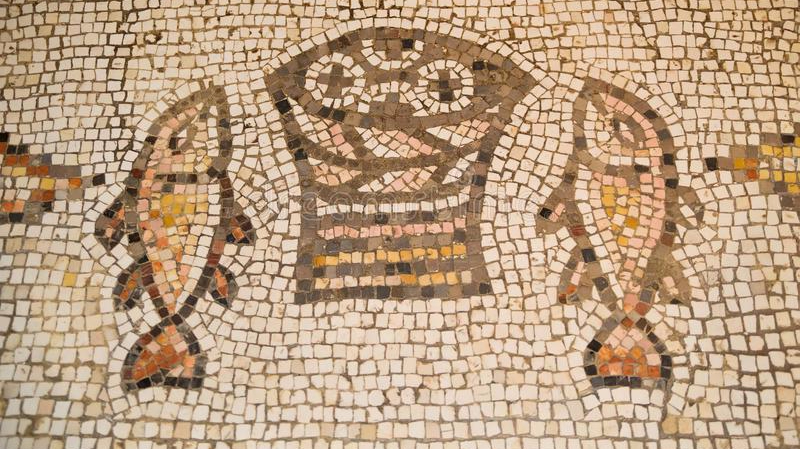
The disciples of course are taken aback as to how they could possibly feed the four thousand gathered. Jesus asked what they had with them and they shared just some bread and fish. Jesus took “the seven loaves and the fish, gave thanks, broke the loaves,
and gave them to the disciples, who in turn gave them to the crowds. They all ate and were satisfied. They picked up the fragments left over–seven baskets full” (Mt 15:36-37).
Again, Jesus met the needs of the people, not in a way of bare subsistence either, but he cured and healed those that came to him and provided enough food for all to eat so that everyone was satisfied. Not only that; Jesus started out only with seven loaves, but finished with seven baskets full of leftovers! Jesus is showing quite clearly to the disciples and all gathered, that God is a God of mercy, love, and abundance.
May our response, day in and day out, be the same as was those in the Gospel today. May we make time to sit at the teacher’s feet and learn from the master. We can do so by reading and seeking how to apply the Gospel to our daily life. May we pray and meditate with an openness to be led, to be present, and to learn from Jesus and those he sends into our life. May we seek healing from Jesus through our prayers of petition and bring the names of those who need healing before him in our prayers of intercession. May we not stop there.
This Advent let us trust in Jesus, believe in Jesus, have faith in Jesus, and glorify God the Father. Let us surrender our will to God and live for him as Jesus did, and may we serve as he did. Not stopping to ask for identification, religion, race, gender, creed, or political affiliation. And no matter how little we have, let us give it to Jesus in solidarity for his purpose, as did the disciples with the seven loaves and fish, so to experience with those we serve, the abundance, love, and grace of our loving God and Father.
Image from loaves and fish mosaic found in the Church of the Multiplication in Tabgha, Israel on the northwest shore along the Sea of Galilee. Picture from link:
https://www.dreamstime.com/stock-photography-ancient-mosaic-tabgha-image9375762
Lohfink, Gerhard. No Irrelevant Jesus: On Jesus and the Church Today. Collegeville, MN: Liturgical Press, 2014.
Link for today’s Mass readings:
http://www.usccb.org/bible/readings/120617.cfm
 Spiritual Stepping Stones
I saw this mosaic in Israel and the photo does it justice. There are many similar, if not identical, ones all over the Roman Empire….
Sent from my iPad
>
LikeLiked by 1 person
Wow, must have been awesome to see!
LikeLike