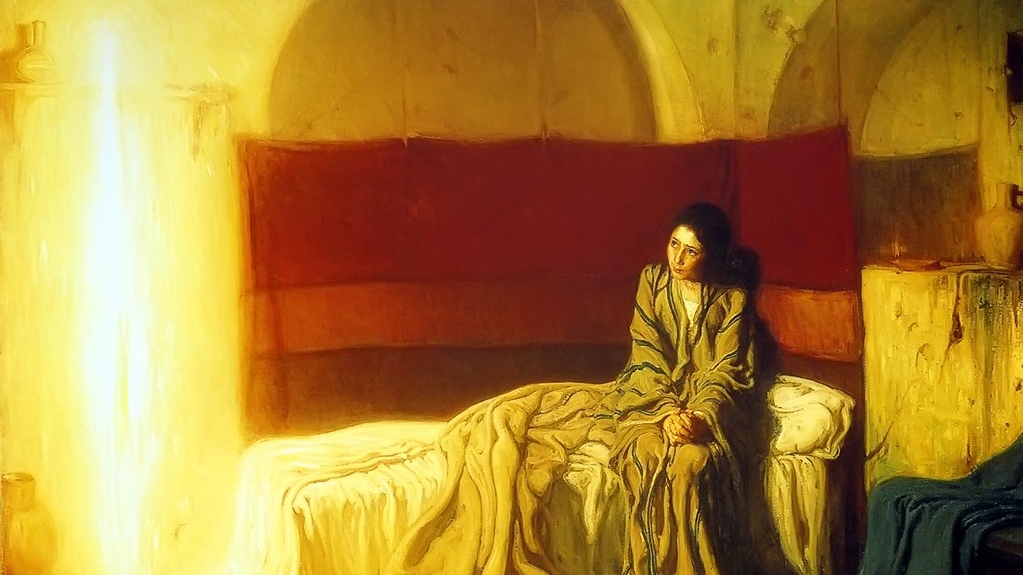
Today, on the fourth Sunday of Advent, we return to the Annunciation. Gabriel, an angel, a messenger of God, a spiritual being, interacts with a human being; though Mary is not the first one to experience such an encounter. There are personal encounters with God and his messengers throughout the Bible. This is how the God of Israel, the God of Jesus Christ acts, person to person through invitation, either directly himself or indirectly through one of his angels. We saw examples of such encounters during this week’s readings with the mother of Sampson, Hannah, the mother of Samuel, and Zechariah and Elizabeth, the parents of John the Baptist. Going back to Genesis we can see where God originally called a people to himself through his invitation to Abraham, and similar to Elizabeth and Zechariah, he and Sarah would give birth to a son, Isaac, past the time of child bearing years. Moses, the judges, David, and the prophets all would hear and answer God’s invitation. God communicates, reaches out to his created beings in history, in time.
But with Mary this announcement is different, for at this appointed time, the Son of God himself would become, while remaining fully divine, a human being in the womb of Mary. The God who is. Period. Full stop. He is not a being, not a human or even a supreme being. He is Infinite Act of Existence, and he the totally Transcendent will take on flesh and dwell among his created beings. This is the message that Mary receives, and we can understand why Gabriel would say to her:
“Do not be afraid, Mary, for you have found favor with God” (Lk 1:30).
Mary, who knew the arch of salvation history, knew of the encounters God had with his people, her ancestors, knew of the promised coming of the Messiah, would now be the bridge between heaven and earth, the bridge between the old and the new covenant, the bridge between a people lost and a people found. Mary in her fiat, her yes, would become Theotokos, the God bearer.
This is what we prepare to celebrate tonight and tomorrow: The Son of God will be born to us because Mary said yes. Yet, her yes is not in isolation. It is made possible by so many who had gone before her. Joachim and Anna, Mary’s parents who provided care and guidance, as well as the many named above and not named though out the Biblical tradition who said yes to God and played a part in making this moment possible. Mary is not alone in the Annunciation, not alone in this definitive moment. This is the distinctive feature of Judaism and Christianity: We cannot save ourselves. We are not God. Our very life as created beings are a gift from God and we are in need of constant help and support from God and one another (cf. Lohfink, 254).
Now the invitation comes to us. Christmas is not just another day, even another holiday. It is a day to ponder, to wonder, to be still, to be in awe. The Son of God, the second Person of the Trinity, loved us so much, more than we can imagine, more than we can ever even begin to conceive, that he became one with us. Us, you reading this, me writing this, and each unique person taking a breath on this earth. No matter how much we have messed up, no matter how distant we feel we may be from him, no matter how confused, overwhelmed, disillusioned, he is present for and with us. We are going to be invited tomorrow to play our part in the ongoing wonder of salvation history. Mary’s answer: “Behold, I am the handmaid of the Lord. May it be done to me according to your word” (Lk 1:38) is a definitive yes. What will our response be?
——————————————
Painting: Henry Oswana Tanner, The Annunciation, 1898
Lohfink, Gerhard. No Irrelevant Jesus: On Jesus and the Church Today. Collegeville, MN: Liturgical Press, 2014.
Link for today’s readings for Sunday, December 24, 2017:
 Spiritual Stepping Stones