A leper came to him and kneeling down begged him and said, “If you wish, you can make me clean” (Mk 1:40).
The term of leprosy, used during the time of Jesus, was a more general way to describe various issues pertaining to the skin such as, open wounds, sores, skin flaking, as well as much more severe and chronic conditions. Today we use it more specifically to refer to Hansen’s disease, a chronic infectious disease caused by a rod-like bacterium named Mycobacterium leprae (PubMed Health).
Those dealing with such skin conditions were deemed as unclean. They were to live outside of their village, town, or city; wear ragged clothes, their hair needed to be unkempt. If anyone came close to them, they were to yell out that they were unclean, so there would be no chance of human contact. Lepers were exempt from any communal religious practice and the common opinion held was that those in this situation deserved it because of some sin that they committed. Those with chronic or recurring conditions could be in a state of exile for the entirety of their life. The experience was like a living death because they were being isolated from all societal interaction.
When Jesus comes within distance of the leper he is quite aware of the cultural and societal context. This leper does not keep his place, he does not follow the societal norms. Instead of warding off Jesus and urging him to keep his distance, because any contact with Jesus would then make him unclean, he approaches Jesus and kneels before him. Jesus does not reprimand him, and he, like the leper, also does not follow social protocol: “Moved with pity, he stretched out his hand, touched the leper, and said to him, ‘I do will it. Be made clean'” (Mk 1:41).
The leper is healed at the moment of contact, his death sentence is commuted, his opportunity for worship and communal life is restored. This simple act of healing the leper is in fact a microcosm of the Jesus’ ministry. The Son of God, moved with compassion, touched us in the most intimate of ways by becoming one of us in our humanity. In embracing our human condition, he provides the opportunity for restoring us from our exile from God and one another, building a bridge to cross the wide chasm of our sin that separated us. In his willingness to touch the leper, Jesus was a living icon of how he, as the Son of God was willing to walk among us, accompany us, experience our pain, suffering, and separation, while offering us healing, so we in turn could become instruments of healing for one another.
We are to not shun those on the peripheries, nor, God forbid, are we to support social prejudices, injustices, and structures that isolate and exile others. We are called by Jesus to be open to walking in solidarity with our brothers and sisters. We need to be asking ourselves, who are the ones that are living on the peripheries among us today, those we push into positions of shouting unclean when we come near?
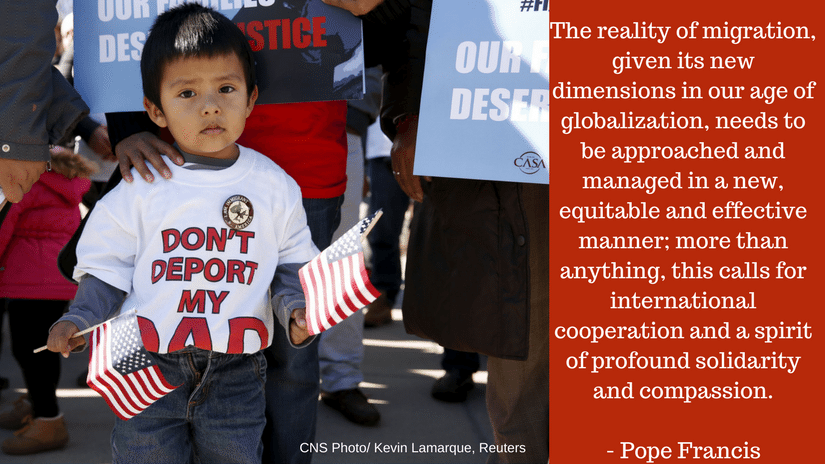
As the Church recognizes National Migration Week this week from January seventh to the thirteenth, may we spend some time to imagining the plight of the too many “migrants, including immigrants, refugees, children, and victims and survivors of human trafficking” (Justice) that are struggling for basic subsistence, seeking to belong, to be a part of a community. Unfortunately, many find themselves in the same place as the leper in today’s biblical account, feared, exiled, pushed to the peripheries, and kept at arm’s length.
May we pray to have the compassion of Jesus to see migrants and all those who are on the outside looking in, not as others, but as one of us. May we open our hearts and minds to see the dignity of one another and like Jesus not shy away, but embrace the opportunity to reach out to touch another, to accompany another. May we be open to ways in which we can, leave our protective shells, risk going out to the margins within our own communities with “a spirit of profound solidarity and compassion” (Pope Francis).
Photo: Accessed from:
https://justiceforimmigrants.org/migrationmonday/
PubMed Health. “Hansen’s Disease (Leprosy).” https://www.ncbi.nlm.nih.gov/pubmedhealth/PMHT0027942/
Justice for Immigrants. “National Migration Week 2018 (January 7-13).” https://justiceforimmigrants.org/take-action/national-migration-week/
Link for Mass readings for Thursday, January 11, 2018:
 Spiritual Stepping Stones