“The sabbath was made for man, not man for the sabbath. That is why the Son of Man is lord even of the sabbath” (Mk 2:27-28).
In making the above statement, Jesus is not discrediting or devaluing the observance of the Sabbath. He is entering a common debate about what is considered work, and thus what can and cannot be done on the Sabbath. Jesus is also going deeper to address the origin of the Sabbath observance in that it, “commemorates God’s creative and saving action for humanity, and alleviating hunger might be an example” (Donahue and Harrington, 112).
God created us, formed us, and breathed life into us. There is an intimacy and closeness between God the Father and us his created beings, his children. God is our source and we are interconnected in our relationship with him and with one another. God continues to deal with us in a personal way. The Torah, the Law or the Teachings, is meant to enhance the intimacy and closeness of that relationship with God and one another, to provide boundaries and definition so that we can resist going astray. Jesus has come to fulfill the Law, to restore it from distortion, while at the same time bring it to the next level.
When asked what commandment is the greatest, Jesus announced that we are to Love God with all our heart, soul, mind, and strength and we are to love our neighbor as our self (cf. Mk :29-31). To live out this commandment then, we need to foster our relationship with God so to experience his love, mercy, and forgiveness, to fill up to overflowing, to then share with others, otherwise we have nothing to give. With or without a relationship with God we can experience emptiness, anxiety, fear, and loneliness. Without of a relationship with God, and the community of the Church, we are more vulnerable to the temptations to quench our thirst with material, finite false goods, that are readily available, and thirsting more and more, fall deeper into the lures of power, pride, prestige, ego, and addiction. We then dig in more and more to protect that false sense of self at all cost, deepening our thirst and increasing our fear. We buffer our self off from the very one we have been created for, and those we consider as other.
May we embrace the gift of life we have been blessed with, open our heart, mind, soul, and strength to our Loving God and Father, so to see the dignity of Jesus present in other human beings in our midst. Let us not fall into the temptation that the Pharisees did, to prevent food for those who are in need through a false interpretation of the law. May we align ourselves with Pope Francis who said this past Sunday in his homily: “Having doubts and fears is not a sin. The sin is to allow these fears to determine our responses, to limit our choices, to compromise respect and generosity, to feed hostility and rejection. The sin is to refuse to encounter the other, the different, the neighbour, when this is in fact a privileged opportunity to encounter the Lord.”
Let us who have access, not fear our neighbor but seek to encounter, accompany, and work to empower and provide means of access for the most vulnerable among us. May we work to see each person as God sees us, as human beings endowed with dignity, worth, potential, and diverse gifts, created in his image and likeness.
Let us align ourselves with the Lord of the Sabbath and start a discourse of respect and dignity, allow no evil talk to pass our lips and say only the good things that people need to hear (cf. Ephesians 4:29). Let us resist speaking words that delegitimize, degrade, and dehumanize, but instead speak to empower, encourage, and support. We must also call out, stand against, and denounce any words that belittle or dehumanize another, hold accountable those who make disparaging comments, while at the same time resist attacking the person. We are to love, to will their good, even those who speak and act with hate, and pray for their healing. Otherwise we perpetuate the poison that is injected into our discourse. Let us choose this day and each day, with Dr. Marin Luther King, Jr., to resist darkness by choosing light, to resist hate by choosing love, to resist staying silent by choosing to speak up for things that matter. If we have trouble with being human, with loving another, may we look to the One who walked with his disciples among a field wheat one day, and who is now our Bread of Life this day!
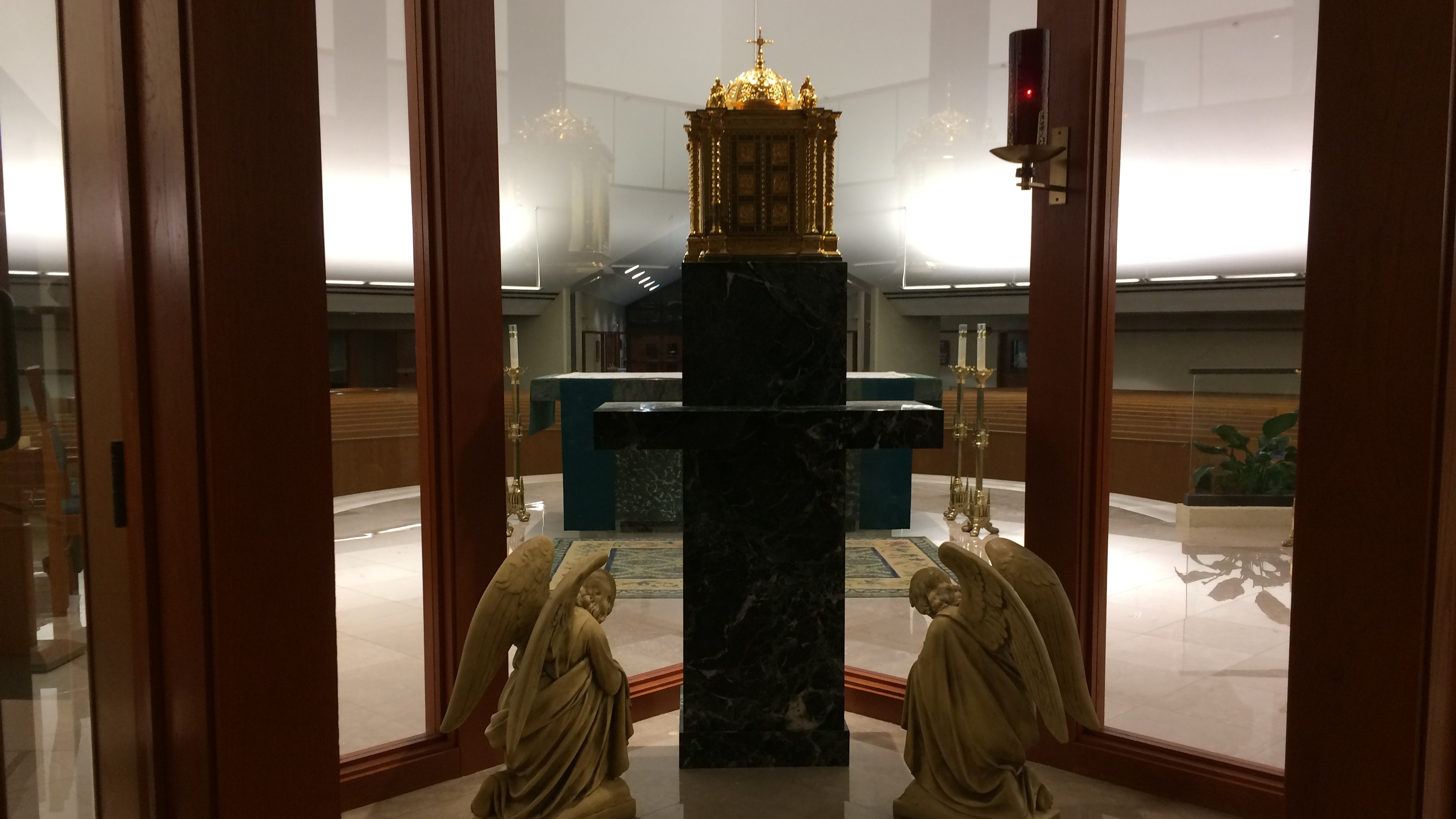
Photo: Tabernacle, St Peter Catholic Church, Jupiter, FL
Donahue, S.J., John R., and Daniel J. Harrington, S.J. The Gospel of Mark in Sacra in Sacra Pagina Series, vol. 2. Collegeville, MN: Liturgical Press, 2002.
Pope Francis full text of homily at Mass on World Day of Migrants and Refugees, Sunday January 14, 2018:
http://saltandlighttv.org/blogfeed/getpost.php?id=79091
Link for readings for Mass readings for Tuesday, January 16, 2018:
http://www.usccb.org/bible/readings/011618.cfm
 Spiritual Stepping Stones