Beginning with the miracle of the multiplication of the fish and the loaves in our first week, to Jesus then saying to the crowd that he is the bread of life, and that all who come to him will never hunger, and whoever will believe in him will never thirst, in the second, and as our journey continued last week, Jesus left off with the cliff hanger of saying that he is the bread that he will give and that his flesh is to be given for the life of the world. With each layer of Jesus’ presentation, he invited the people to follow, and yet, they have increasingly become more uncomfortable. The resistance to his message has increased.
All that Jesus has been building up to is now coming to a climax. Any silent shock of disbelief or quiet murmuring has now escalated to those who quarreled among themselves, saying, “How can this man give us his flesh to eat” (Jn 6:52)? Jesus hears the growing concern and disbelief. If he was speaking in a figurative or symbolic way, this would be the moment to clarify his point.
Jesus continues and yet, he does not walk back or qualify his comments. Instead, Jesus doubles down: “Amen, amen, I say to you, unless you eat the flesh of the Son of Man and drink his blood, you do not have life within you” (Jn 6:53). Jesus does not only repeat that his followers are to eat his flesh, but he also insists also that they are to drink his blood. Drinking or even eating meat with the blood of an animal was inconceivable for devout Jews. Also, the Greek used here in John’s Gospel for eat is trogein, or trogo, which is used to describe how an animal eats, by gnawing, munching, or tearing at the flesh.
The exposition that Jesus is using here is more graphic than the customary use of phagein, which would be used for chewing, as a human would chew their food. This was no attempt to assure the crowd that he was just speaking figuratively or metaphorically. With this recent insertion, he had absolutely repulsed his listeners sensibilities.
Jesus continues to make his point that whoever does eat his flesh and drinks his blood, will not only remain in him, but also Jesus will remain in them, and they will have eternal life. A wonderful end goal, but would any be able to make the leap of faith to get there?
Jesus said that he is “the living bread that came down from heaven”. In doing so he was equating himself with God the Father as his Son. He is saying in no uncertain terms that he is God – blasphemy to devout Jews to say that one is God. On top of that, Jesus is now stating that as the Son of God, he is to give his flesh to be eaten and his blood to be drunk, and this will give his listeners eternal life? Really?
Yes. John will record Jesus saying in just a few more chapters: “Before Abraham came to be, I AM” (John 8:58). These are the words God spoke to Abraham at the burning bush when Moses asked God his name. This language demands a choice. Either Jesus is who he says he is, and they are to give their lives to him and worship him for he is God, or he has now reached the height of blasphemy or insanity, in which the penalty is death. Next week we will come to the end of our journey of the bread of life discourse, and we will see who will leave and who if any will remain with Jesus.
The last lines we hear proclaimed for this week are: “This is the bread that came down from heaven. Unlike your ancestors who ate and still died, whoever eats this bread will live forever.” Jesus is inviting the crowd to receive that which is their deepest longing, eternal life. This has been the choice since the creation of man. We are given the choice to eat of the tree of knowledge that will bring death or the tree of life that will bring, life.
Before us today at this altar, we will be presented with the same invitation. We will be offered the Bread of Life that will come down from heaven, the bread and wine that will become the Body and Blood, Soul and Divinity of Christ. We will be invited to participate again in the source and summit of our faith.
Lady Wisdom, from our first reading from Proverbs, has invited us to a feast, “she has spread her table.” And we are invited to eat of her food, and drink of her wine. When we eat of her banquet we receive the gift of wisdom, which is to know the difference between the apparent good and the true good, we come to understand the difference between the lie and the truth, and we come to see what leads to death and what leads to life.
Lady Wisdom’s banquet is a type, a foretaste of the eternal meal we share at the Eucharistic banquet. What is hidden in the Old Testament is revealed in the New. Jesus is the Good, the Truth, and the Life. And yet:
That we are to eat the Flesh and Blood of Jesus may sound just as bizarre as it did to Jesus’ followers. The term we have for this miraculous transformation of bread and wine that takes place during the Mass is transubstantiation. What happens at the calling down of the Holy Spirit and the words of institution invoked by the priest is that the substance, the reality, of the bread and wine is transfigured into the Body and Blood of Jesus, while the accidental form or appearance remains the same. We consume Jesus’ unbloody, acceptable sacrifice.
Jesus is giving all of who he is corporally, fully, holding nothing back of himself so we can receive all of him. In consuming Jesus, we become divinized as he permeates our whole being. We are then sent, as the Father sent his Son to be one with us in our humanity so that we can become with him in his divinity, at the end of the Mass to go out. We are sent like Mary, to bring Jesus to others. We are to love others as Jesus has loved us.
He loves us by having given his life on the Cross, so that he can give us his life again and again in the miracle of the Eucharist at each Mass. As we receive him, we are to love, sacrifice, and serve those he sends us to serve, and so experience Jesus in each other. For what we do to the least of our brothers and sisters, we do to him (cf. Mt 25:40).
We are sent forth to bring the Good, the True, and the Life we have received into our corner of the world, person by person, and then return to receive the Body and Blood of Christ to be nourished and renewed and sent out again and again.
——————————————————–
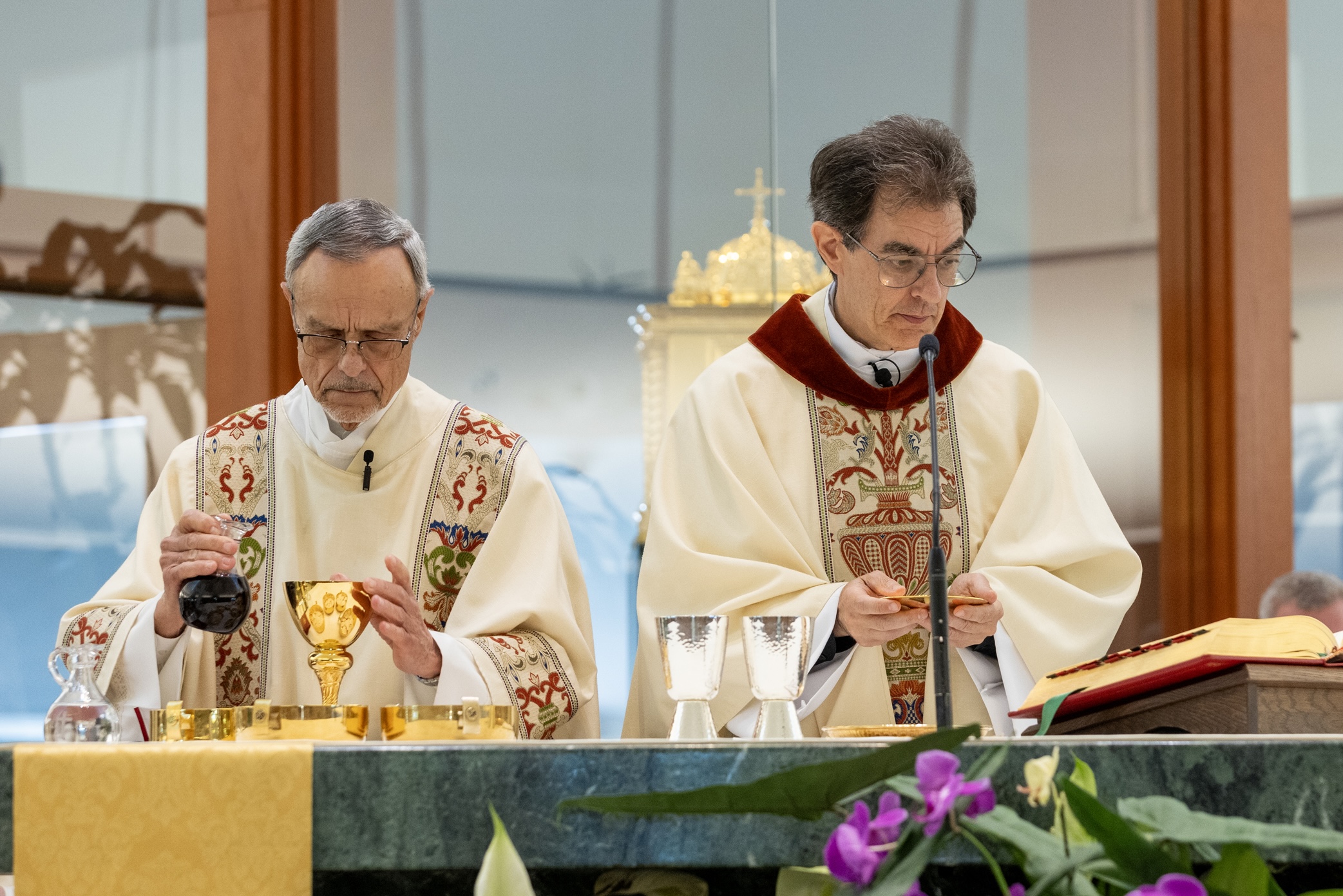
Photo: Celebrating my first Mass of Thanksgiving with Dcn. Stephen at St. Peter Catholic Church, Jupiter, FL.
Link for the Mass readings for Sunday, August 18, 2024
 Spiritual Stepping Stones