Herodias’ own daughter came in and performed a dance that delighted Herod and his guests (Mk 6:22).
Mark paints a word picture of a family: Herod, Herodias, and their daughter: ancient manuscripts differ as to whether she was Herod’s or Herodias’ daughter. Also, two times, in Mk 6:22 and 6:28, she is referred to in the Greek as korasion, meaning a young woman, as young as twelve years old (Donahue 2002, 198). The setting is the banquet hall of Herod, the tetrarch or prince of Galilee. His high officials, military commanders, and the elites of Galilee were all gathered to celebrate Herod’s birthday. This is a royal, opulent family.
The daughter comes out to dance for Herod. Her dance delights Herod and he grants her anything she wants, even up to half his kingdom. Following the counsel of Herodias, she asks for the head of John the Baptist on a platter. The reason for this request was because Herodias held a grudge toward John because he stated to Herod that it “is illegal for you to be married to your brother’s wife” (Mk 6:18). Herod was distressed at the daughter’s request but granted John’s death sentence to save face before his honored guests. The execution was swift, the head of John was brought on a platter, given to the girl, who then brought it to her mother.
This is not the ideal image of the family that we hopefully aspire to. John’s upbringing as we learn from Luke had a different experience. His mother, Elizabeth, and father, Zechariah, were devout Jews. They raised their son as a person of integrity, and we can see from today’s reading of Mark the extent to which he was willing out his prophetic role in speaking truth even if it would mean his death. John was willing to give his life, rather than compromise his principles. This stands in stark contrast to Herod Antipas who, with little contemplation about what he was doing, acted quickly in giving the order to end the life of John in such a brutal fashion.
Could there be any two starker images of family life than in today’s Gospel? One family as corrupt, conniving, and malicious as can hardly be imagined and another as faithful, pure, and holy as can be hoped for. Families are not perfect, and life together is a bit messy. May we support and love one another the best we can. Hopefully, most of our families fall somewhere in between, and hopefully closer to John’s family than to the Herod’s.
Even when life goes well, familial relationships can be difficult and challenging. We are at our best when we strive to accept, support, and see each other as God sees each of us: as a unique and unrepeatable gift. Even though sometimes we would like to return the gift to sender, we need to consistently pray for one another and pray together when possible, commit to be present and encourage, forgive, keep the lines of communication open, (which means listening as well as speaking), and even when we disagree, respect one another, and give each other space as needed.
No matter how bumpy the road of life gets or how high the waves of trials and tribulations toss us about, may we follow the lead of St John the Baptist and strive to be faithful to God and his will for our lives. May we stand up for each other, those in our families by blood as well as those relationships God has given to us by his grace. Even in our imperfections, may we commit to accompany, love, and be there. Remaining steadfast in our trust in God, we will grow closer to him as well as each other.
For all families, and especially those who are struggling with their own unique challenges right now, in any and all forms, we ask St. John the Baptist on this his feast day to pray for us and our families.
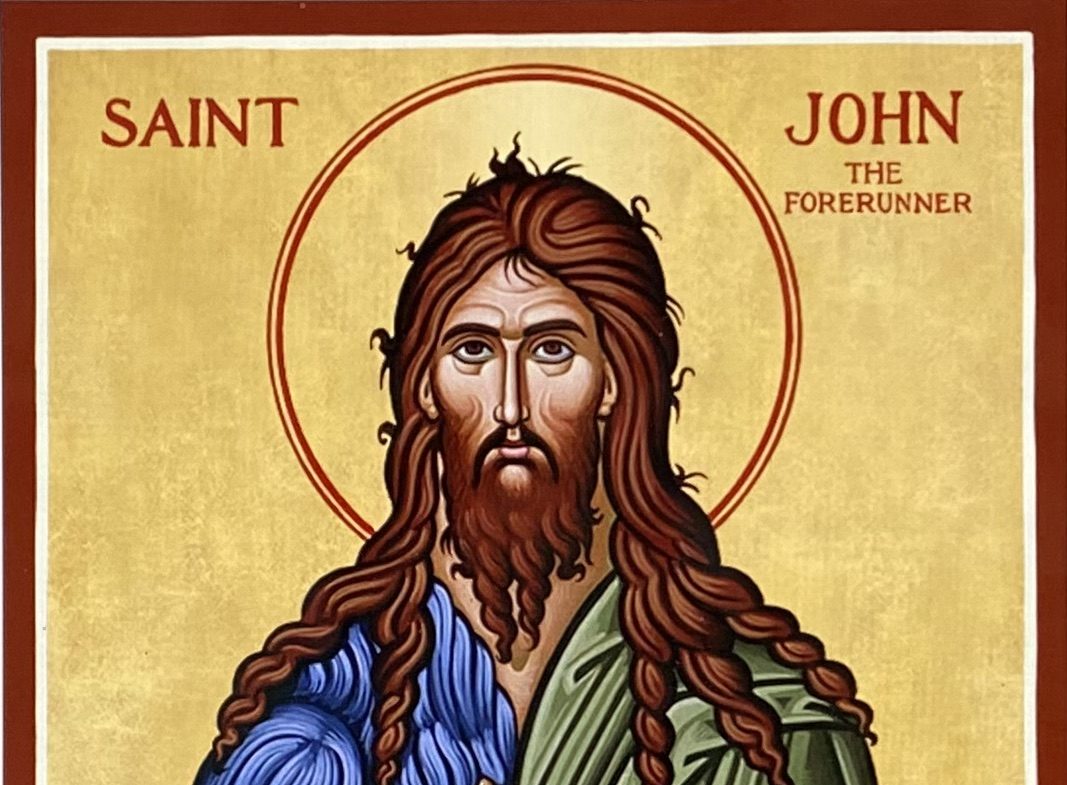
Photo: Icon of St. John of the Baptist, Monastery Icons.
Donahue SJ, John R. and Daniel J. Harrington SJ. The Gospel of Matthew, in Sacra Pagina Series, vol. 1. Ed. Daniel J. Harrington. Minnesota: Liturgical Press, 2002.
 Spiritual Stepping Stones