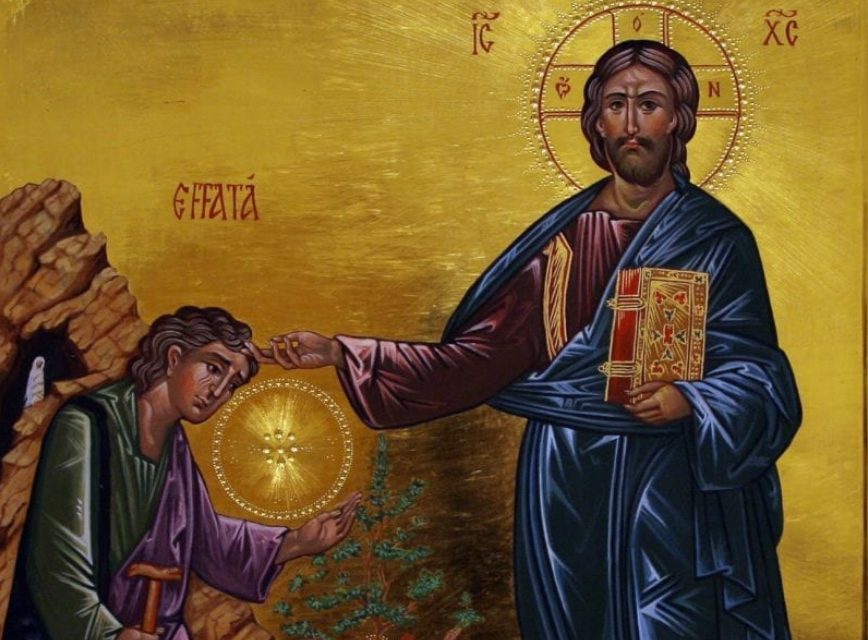
With that Aramaic word preserved by Mark (Mk 7:34) who most likely received it from Peter, we are invited to experience an incredible miracle in which a man without the ability to hear at all or speak was able in that instant to do both clearly. Jesus has again shown the importance of the individual person. He could have healed with a word among the crowd and moved on. Instead, he takes the man off to the side.
When Jesus healed, he did so for a specific purpose. First and foremost, to address the deepest need of the person specifically and individually. But there is also a deeper reality he wants to reveal, a deeper spiritual truth to convey, as well as to show that he truly is God by doing only those things that are possible for God alone.
Hopefully, we can see the direct fulfillment of Isaiah’s prophecy in Jesus’ healing of this man whose ears are now “cleared” and that“the tongue of the mute will sing.” Throughout the Gospel accounts, Jesus has been healing the blind and the lame as well. Yet this miracle is even more extraordinary in that this man is instantly able to speak. For those who have experienced infants grow, they wait for just under or over a year for those first words to be spoken. If you have ever attempted to learn a new language, it definitely does not happen in a moment or a month!
That this man can hear and speak in an instant is amazing and wondrous! The graphic nature in the way that this is done is also curious. Jesus is not seeking to gross out his onlookers. He is doing something very specific. In sticking his fingers in the man’s ears, looking up to God, and spitting on his fingers and touching the man’s tongue, Jesus is imparting upon him his divine life. He is also enacting what God did in creating Adam from the dust of the earth and breathing life into him.
Jesus is showing again the intimacy of our being created in the image and likeness of God out of an outpouring of his love for us. God is willing to come so close in creating man from the dust of the earth, as a potter forms a bowl from clay, with this important distinction. Unlike the potter, God breathes his very life into Adam’s being. At the appointed time, he sent his Son to do the same. In this act of healing, Jesus is also showing his divinity. For there were miraculous healers at the time and still are today, but nothing like this.
Jesus then requested that the man and the others do not say anything about this miracle because he knows that the sensationalization of the event is what will be given priority. The miracle certainly wakes up those who have been blind, but Jesus wants to lead them deeper into spiritual reality, deeper than the physical signs of healing. As he would tell Philip later, “Philip if you have seen me, you have seen the Father” (cf. Jn 14:8). The visible act of this miracle as with all of Jesus’ miracles are signs pointing to the invisible. It is the physical sign that is pointing the spiritual reality.
This is what we believe as Catholics is happening with the sacraments, which are physical signs revealing spiritual realities. Jesus did not come to heal everyone physically. He did come to heal all from spiritual blindness and deafness so that we can see each other with God’s eyes, as St. James points out. We are not to see each other with our prejudice and partiality but to instead see each other as brothers and sisters in Christ.
Just as Jesus took this man “away from the crowd” he invites us to do the same at each Mass. We are to step away from our everyday to enter the sacred space of church to receive a word of life he has prepared to give us. May we be willing to listen and to hear that individual word or phrase that God is waiting to share with us for our particular situation in life. A unique gift presented to convict or comfort, to console or encourage.
May we be willing to see with the eyes of faith the Body and Blood of Christ substantially present for each and every one of us in the acceptable presence of the simplest of elements, bread and wine. In the words we hear, “The Body of Christ”, may we hear and know this is Jesus made present again for us individually that we may be healed and have life.
This is not only true in the Eucharist but in Baptism as well. The one baptized appears to be the same before and after, but in baptism we have spiritually died with Christ and are born again and are now a unique part of his new creation, made new and now a part of the Body of Christ. The miracle of the Sacrament of Reconciliation is even more profound than a dead person being brought to life because in Reconciliation we experience a spiritual resurrection. We are cleansed of that sin which separates us from our union with God, and we are not only purified but empowered by God’s grace. A person brought back to life physically but not spiritually could actually be in a worse situation. Just read Stephen King’s, Pet Cemetery, if you would like a taste.
This physical pointing to the invisible is true for all of Jesus’ miracles as well as each of the sacraments he instituted. Jesus is revealing a deeper spiritual wisdom and reality that goes beyond mere physical hearing and sight. If we are leaving Mass each week remembering not one word or phrase from any of the prayers, readings, the music, or the homily; if we aren’t even sure if we really received the Body and Blood of Jesus in the Eucharist, we are like this man in need of healing.
The good news is that Jesus came not for the righteous and the perfect, he came to heal those in need. If we are humble enough to acknowledge we need his healing touch, are willing to be led by Jesus, and to be still and silent long enough for him to say to us, “Ephphatha! – be opened!”, we too can be healed, we too can hear with spiritual ears God’s word proclaimed, see with spiritual eyes the Eucharist we consume as his Body and Blood, and experience the grace of God’s forgiveness received in the words of absolution that we have heard.
Having received the healing touch and experienced the closeness of Jesus, may we see each other not through the darkened lenses of partiality and prejudice, but through the new lenses of God’s love. May we open our ears and really listen to God when he shares, “I love you, you are my beloved daughter, or, you are my beloved son.” And really sit with and ponder that truth.
By doing so, we may be more willing to pray for one another’s healing, as well as be willing like Jesus to come close, to sit with, listen and hear one another when we disagree, in our pain, and in our struggles. And then, just maybe, like the man with a speech impediment, we too can begin to speak. We can speak the good that people need to hear: “I am sorry.” “Please forgive me.” “I need help.” “What do you need. How can I help?” “I understand.” “I hear you.” “I forgive you.” “I love you.”
Photo: Icon of Jesus healing the deaf and mute man, public domain.
 Spiritual Stepping Stones