Say yes to God and rejoice!
Mary said, “Behold, I am the handmaid of the Lord. May it be done to me according to your word.” Then the angel departed from her (Lk 1:38).
Whether this is the first or thousandth time you have read or heard this verse, the more important question is how many times have you said to God, “May it be done to me according to your word”? How would it be for us to begin each day with this prayer and then at the end of the day reflect on how well we have heard and answered yes to God’s will?
Mary’s yes changed the course of human history. Her willingness to bear the Son of God who would dwell among us in our wounded human condition was for the purpose to heal and to lead us home to communion with his Father and each other. Jesus is the gift that keeps giving – and we receive his gift each time we say yes to him. When we do so, we become less, as he becomes more, and the kingdom of God continues to expand.
Along with Mary, the yes that we make is not a one-time, yes, but we are to affirm a daily, moment by moment yes. As St Paul wrote to the Church of Thessalonica, we are to: “Rejoice always. Pray without ceasing” (1 Thessalonians 16-17). We are able to rejoice always and pray without ceasing when we say, “Yes,” to God by developing and sustaining our relationship with him such that even when we experience pain, suffering, and struggles, we are not overcome or overwhelmed. We can even feel joy in the midst of them because we experience Jesus’ closeness. He does not abandon us to random fate. He is our source, our refuge, and our strength, present to us in all that we experience.
Our prayers of petition for ourselves and intercession for others are another yes to God’s will because they are an “admission of one’s own helplessness” (Lohfink 2014, 240). Prayer is a, “No,” to pride. We cannot get through this life on our own, nor are we meant to. We are all interconnected and interdependent on each other and God is the foundation and source of our very being.
Our willingness to ask for help and to help others are also practical ways of saying yes to God. There is no such thing as a “Lone Ranger Christian”. Even the Lone Ranger had Tonto. Two by two, just as Jesus sent his disciples. Prayer is a yes to our acknowledgment that we need Jesus to guide and help us, also to save us from ourselves! Service is a yes to the love we have received from him and a willingness to share this love with others.
We are to rejoice as we begin this fourth week of Advent because we draw ever closer to celebrating the birth of Jesus who is Emmanuel, God with us. May we have the grace to experience his love in our time of meditation, prayer and serving one another. This reality was made possible by the handmaid of the Lord. Say yes to Jesus as Mary did and rejoice!
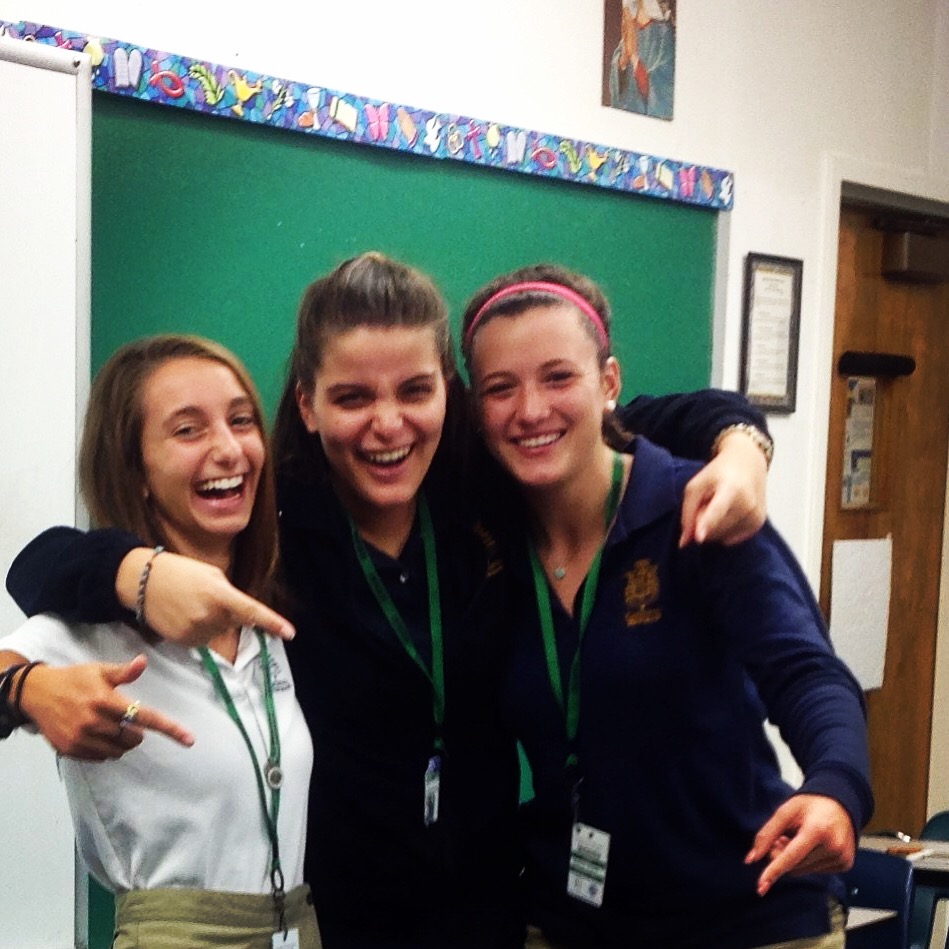
Photo: Who says that you can’t experience joy in Religion Class?
Lohfink, Gerhard. No Irrelevant Jesus: On Jesus and the Church Today. Collegeville, MN: Liturgical Press, 2014.
Link for the Mass readings for Monday, December 21, 2021
Rejoice, for God is with us!
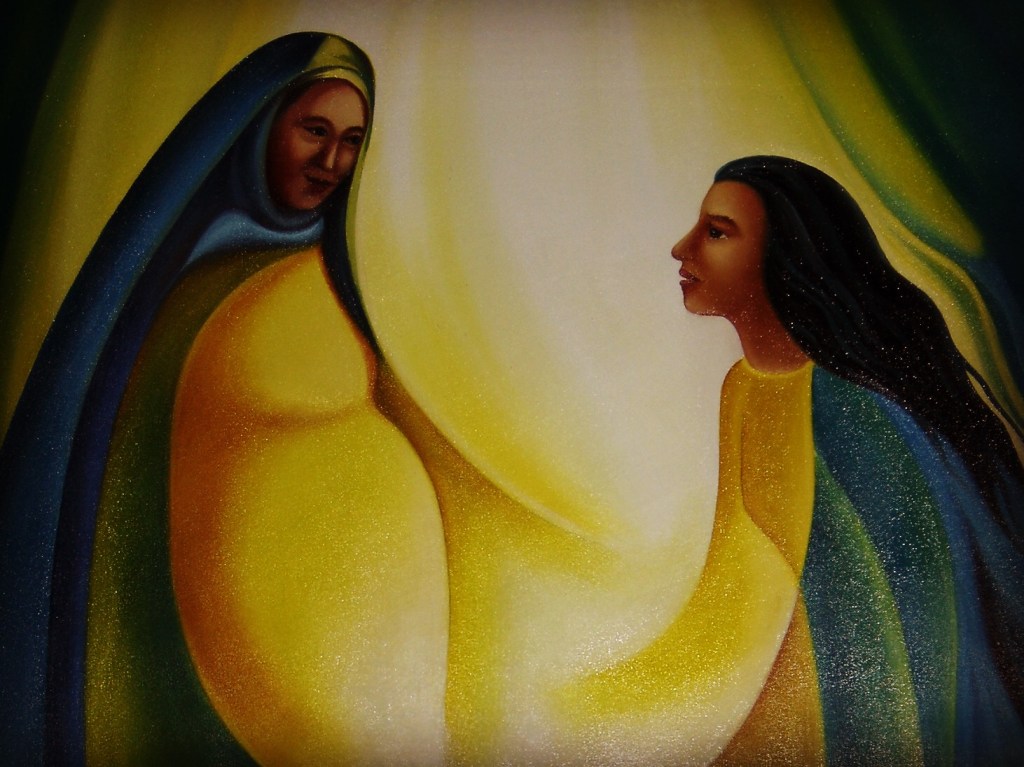
Today’s Gospel account in Luke is one of joy. Mary and Elizabeth are celebrating the gift of new life that each of the women are experiencing in their wombs. Certainly this is a cause for celebration, but there is a deeper more profound reason for their expression of joy. The leaping of Elizabeth’s child at Mary’s greeting is certainly a catalyst. For when John leapt with joy, Elizabeth was filled with the Holy Spirit.
Elizabeth closes today’s reading with the words: “Blessed are you who believed that what was spoken to you by the Lord would be fulfilled” (Lk 1:45).
Mary and Elizabeth are celebrating that they are to bear sons that will provide the fulfillment of the one who the prophets foretold and Micah speaks about in the first reading today, “one who is to be ruler in Israel” (cf Micah 5:1-4), the Messiah. This was a blessed moment of communion. The Love that is shared between God the Father and God the Son, is God the Holy Spirit, who is present in the sharing between John and Jesus, Elizabeth and Mary. The kingdom of God is at hand! This is what Mary and Elizabeth are celebrating, the savior of the world has come and they are to be collaborators in salvation history.
Imagine if we made some time to really ponder the significance of this wonderful event of the Incarnation of Jesus as seriously as Mary and Elizabeth did in their joyful encounter as recorded in today’s Gospel. What joy we too will experience when we open ourselves up, mind, body, soul, and spirit, to the invitation of the Holy Spirit who is revealing to us the reality that the Son of God became one with us in our humanity so that we can become one with him in his divinity.
May we ponder the reality of the gift that God has given us, his Son, and so rejoice with Elizabeth and Mary today. Blessed will we be when we believe that the word spoken to us in today’s Gospel has been fulfilled! And so we too are to go in haste and share the good news!
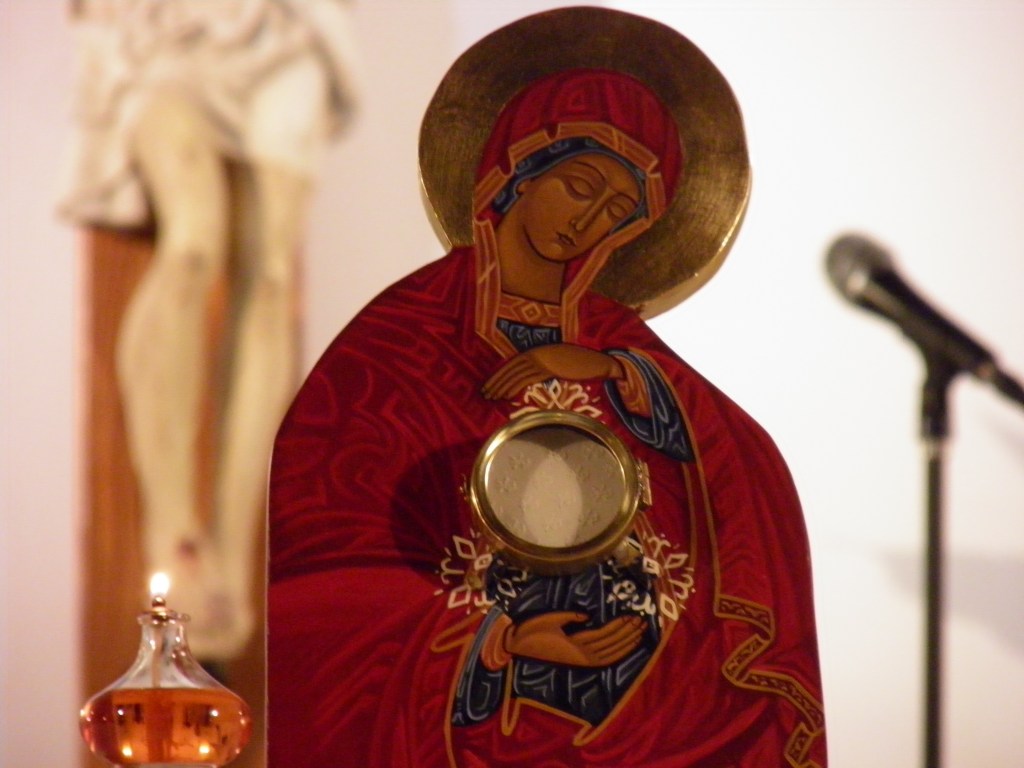
Photo credit: Rita Laura – Parroquia San Miguel Arcángel, Recreo, Santa Fe, Argentina – from cathopic.com
Link for the Mass readings for Sunday, December 19, 2021
We are not alone.
Joseph heard the news that Mary, his betrothed, was with child. He clearly knew the child was not biologically his. Scripture does not account for the thoughts or emotions of Joseph, but whatever inner turmoil he did have, he came to a decision that would not expose Mary to shame. He was not going to make a public spectacle of Mary, but divorce her quietly. Before he made his final decision though, Joseph made an excellent choice when discerning serious matters. He slept on the idea before acting.
During Joseph’s sleep, the angel of the Lord delivered a message. “Joseph, son of David, do not be afraid to take Mary your wife into your home. For it is through the Holy Spirit that this child has been conceived in her. She will bear a son and you are to name him Jesus, because he will save his people from their sins” (Mt 1:20-21). When Joseph awoke, he did as the angel of the Lord had commanded him and took his wife into his home (Mt 1:24). From their encounter with God’s messengers, both Mary and Joseph trusted in God’s will, and “that has made all the difference” to quote Robert Frost’s poem, “The Road Not Taken.” Because of Mary and Joseph’s yes to God and to family, the Son of God became man and opened up heaven for us in the humanity he assumed.
God often works in the same way when dealing with us. What may appear to be absurd, unimaginable, or downright impossible, is indeed possible when we align our will with God. This is the week of Joy in Advent. Joy is more than pleasure or happiness. Pleasure ends when the sensate experience ends. Happiness is experienced with pleasure and can last longer, in that we can recall the pleasurable experiences for a time, but happiness too will fade. Joy, though, like hope, is a gift of the Holy Spirit that wells up from within, from the depths of our soul.
The source of joy does not come from external experiences but from an encounter with and acceptance of God’s invitation. Joy is an experience of communion with the love of God. This has been given to us in greater measure because Jesus became one with us, and so upon his ascension into heaven, we too can experience the loving communion he experiences with his Father. We also experience the love of the Holy Spirit in our encounter with family and friends, this exchange of giving and receiving of ourselves in conversation, shared experiences, and in resolving challenges and conflicts together.
Mary and Joseph both received incredible news, that neither of them fully comprehended. They could have easily responded in a different way. Instead, they trusted in God, they chose family, and because they did so, we can rejoice not this week but all of our days!
Mary and Joseph followed God’s lead and were willing to allow their unborn child, Jesus, to come to full term. Because they risked public ridicule and worse, Jesus entered into our human condition. We may feel on our own, see no way out, and/or no help on the horizon, but God will make a way and reveal it to us through his Son. We may not understand either, but like Mary and Joseph, we are to trust in God and one another and so come to experience that we are not alone.
Jesus, Mary, and Joseph, please intercede on our behalf this Advent Season such that we may better be able to resist the temptation of taking each of our family members for granted, but instead choose to be appreciative and thankful for one another. Help us to react less and breathe deeply more. Help us to be more understanding, patient, and willing to forgive, such that even though we have experienced past hurts, conflicts, disagreements, and different perspectives, we may ultimately experience time and again the joy of being there for one another, through thick and thin.
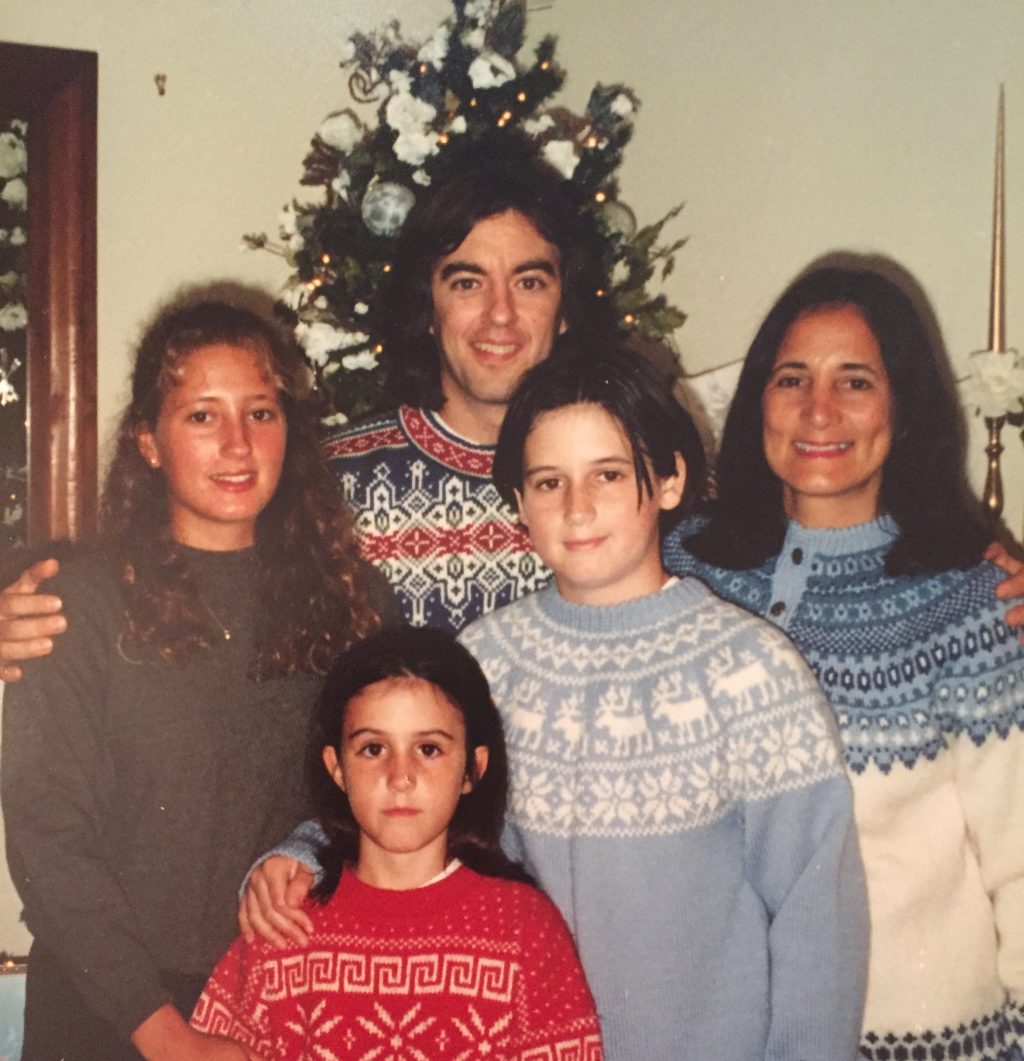
Photo: Our first Christmas picture together as a family about twenty-six years ago, actually taken in late summer so it would be ready for our first Christmas card!
Link for the Mass readings for Saturday, December 18, 2021

“God loves you. Let yourself be gazed upon by him!” – St. Francis
Today’s Gospel account is from Matthew’s record of the genealogy of Jesus. Jesus, the Son of God, is fully divine, while at the same time he is also fully human. Here Matthew presents the lineage of Jesus’ human line from Abraham to his foster father Joseph and his mother Mary. Jesus is part of a people and a family. If you go through this genealogy with a fine-tooth comb, there are gaps, but Matthew is more concerned with the line of faith than a strict historical account. Matthew also includes women in this listing, which is not common in ancient patriarchal societies. Looking at their stories in Scripture will also show that they were not at all the most virtuous, but more importantly, they played a significant part in God’s plan of salvation.
This is our heritage as well. We are spiritual Semites. Genealogies have become more popular in recent years as can be seen by the different advertisements for DNA test kits. The draw for these is that we want to belong, to be a part of a group. To understand who we are, we seek to understand where we have come from. To be able to go forward, we need to reach behind. Jesus was born in time, to the people of Judah, and is a part of the succession from Abraham and his clan, to the twelve tribes of Jacob, to the unified nation of Israel under David. Jesus continues to bring God’s movement of grace beyond a nation to a universal invitation for all.
Through our Baptism, we are part of the lineage of Jesus. We are not alone, no longer estranged, no longer separate, or on the peripheries. Yet many, even those who profess their belief in Christ, are missing his greatest gift of faith, which is developing a relationship with him now. Too many of us are Christian in name only.
We are now in the final two weeks of Advent. A good practice is to spend time drawing close to Jesus who made himself close to us in becoming one of us. Pope Francis can help. The Pope encountered a young man who told him that he didn’t believe in anything. He said, “I don’t have the gift of faith! What do you have to say to me?”
“Don’t be discouraged,” I said. “God loves you. Let yourself be gazed upon by him! Nothing else.”
May we too be willing to receive the gift of Jesus: “What is important is to find the way best suited for you to be with the Lord, and this everyone can do; it is possible for every state of life.” Pope Francis also offered these two questions for him and for us to ponder: “Do I find time to remain in his presence, in silence, to be looked upon by him? Do I let his fire warm my heart” (Francis 2014, 16)?
We are never alone if we remember Jesus is present in our everyday experiences. We just need to be aware of his loving gaze, to rest in it, and then to return ours. We are also invited to embrace his radiating fire, his love to warm and expand our hearts. In doing each, we become more open to the gift of his presence in our lives. When we allow him to lead us to encounter one another and support each other in our weaknesses, we too will experience the love of the Holy Spirit shared between Father and Son.
Photo: Many ways to allow God’s gaze to all upon you and for us to gaze upon God. Rainbow over CNHS.
Francis, Pope. The Church of Mercy: A Vision for the Church. Chicago: Loyola Press, 2014.
Link for the Mass readings for Friday, December 17, 2021
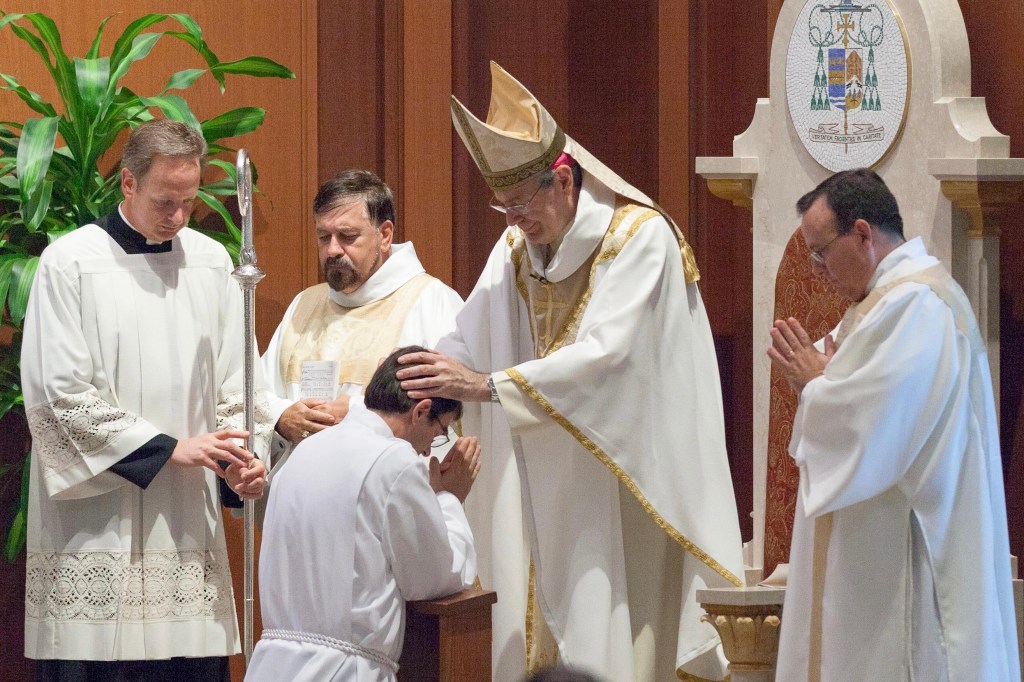
We are to surrender so that it is no longer we who live, but Jesus who lives in us!
Are we willing to expand beyond our finite, limited point of view? Are we willing to see beyond our biases and prejudices? Are we willing to risk and step beyond what is safe and comfortable? Some of the scribes and Pharisees that experienced the preaching and teaching of Jesus were not. They dug in their heels and refused to see God in their midst as we see expressed in today’s Gospel account from Luke.
Yet, the questions today are not addressed to them but to us. We are moving through the mid-point of Advent. John the Baptist called for repentance, Jesus followed with the same message, and sent the Apostles to proclaim the same message. We are being invited today to allow the infinite God of all creation to dwell within us and be open to allowing him to expand us, so that we can grow, and develop beyond anything we can ever imagine on our own. With each breath we are to follow the lead of John and decrease so that Jesus can increase.
We are to accept this invitation each day and let God happen. To do so, we need to be willing to let go of our need to control, to grasp, and surrender our self-centered way of life and open ourselves to the love of God. This is how “the least in the Kingdom of God is greater than” John the Baptist, because in surrendering to the Son of God, it is no longer we who live, but Jesus who lives in us. Jesus has come to us in our humanity so that we can become one with him in his divinity!
Peace and all God’s good!
Photo: God invites each of us to serve in our own unique way.
Link for the Mass readings for Wednesday, December 16, 2021

“Jesus has opened up heaven for us in the humanity he assumed.” – St. Irenaeus
At that time Jesus cured many of their diseases, sufferings, and evil spirits; he also granted sight to many who were blind (Luke 7:21).
Once the public ministry of Jesus began, a big part of his ministry was healing. This healing often brought people from a posture of being on the outside looking in, to returning to become again part of the community socially and spiritually. Typically, those with physical ailments were considered to have offended God in some way or ritually unclean. Many in this state, such as lepers were even required to keep at a distance, away from others, for to touch someone in this state would render them ritually unclean.
The healing touch of Jesus brought more than physical renewal as it also opened the door for people’s relationships with family, friends, and God to be restored. The healing miracles of Jesus were also a foretaste of the eternal kingdom of his Father where there is no longer pain, suffering, and separation, where our relationship with God will ultimately be reconciled.
People may wonder if Jesus still heals today. I say absolutely! There are many accounts of people who have been physically, mentally, and spiritually healed, even beyond scientific explanation by calling upon his name. There are also many, like myself, who have prayed for a healing that was not granted in the way we sought in prayer. Though my wife, JoAnn, was not healed from pancreatic cancer in this life, she is now free from her suffering and pain. She has received the ultimate healing so as to be experiencing a deeper relationship with God on her eternal journey and interceding on our behalf.
The physical healings of Jesus were precursors of the ultimate healing he came to bestow upon each and every one of us. Even death is not an end nor does it have the final word. The Son of God entered into our human condition to become one with us in our humanity so that we can become one with him in his divinity in this life, where he conquered death, so that we can continue our relationship with him for eternity where we will experience more intimately the love of the Holy Spirit and look upon God the Father face to face.
Photo: JoAnn, in her early twenties, experiencing the light of the sun, and now hopefully experiencing the radiance of the Son.
Mass readings for Wednesday, December 15, 2021
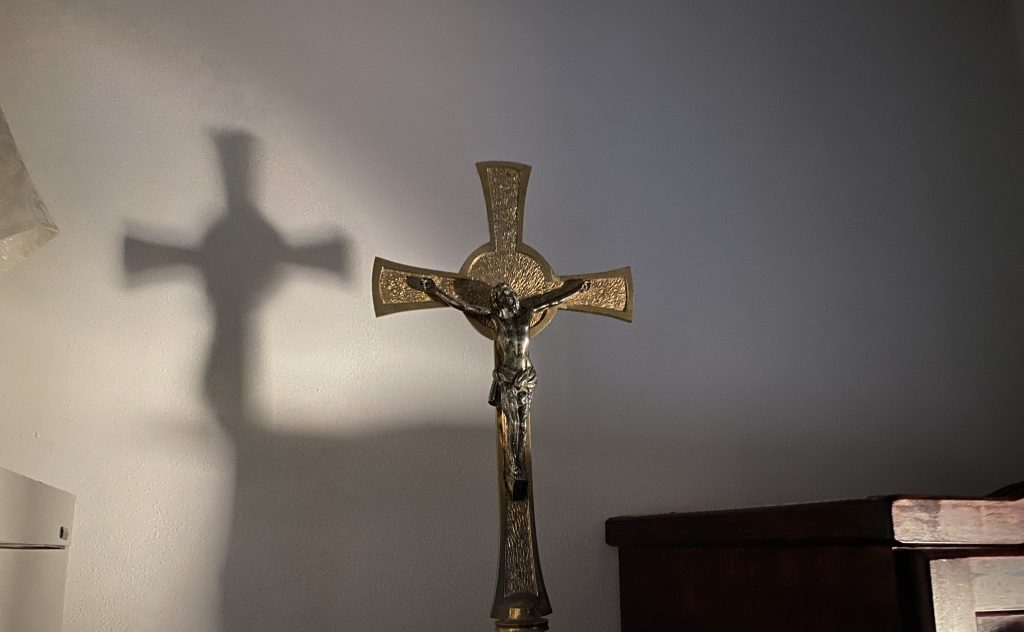
Will we take up our cross today to participate in our work in the vineyard?
In today’s Gospel, Jesus offers a parable of two sons who are each asked by their father to work in the vineyard. After Jesus shares this short account he asks: “Which of the two did his father’s will?”
They answered, “The first” (cf. Mt. 21:28-32).
The first did his father’s will even though initially he said no. Jesus then goes on to share how tax collectors and prostitutes are like this son. They are because they believed in what John the Baptist was requiring of them, they were preparing for the coming of the Messiah and so they were able to recognize him when he was in their midst. They said no initially to God’s offer but they have said yes now and followed through.
Regarding the chief priest and the elders, Jesus compared them to the son who said yes initially but then did not follow through on their promise.
The question for us today is, “How are we answering to God’s invitation?” Are we saying yes and then not following through, no but now on track, or no and no, or yes and yes?
Advent is the time to discern where we are in our walk with God. This is not a time to be mopey and guilt ridden if we don’t believe we are living up to our potential. If we do that, then we are still not putting God’s love into action. We are still focused on ourselves. The key is to recognize where we are, say yes to the invitation to begin again and start moving with God to be about the work in the vineyard. It is not as important what we say as what we do.
We may have many grand plans and ideas, but until we begin to put those ideas into action, nothing happens.This is also true in our spiritual life. If we are not consistently moving forward, we are moving backward. If we want to improve our relationship with God and be better disciples of Jesus, our first step is to commit to turning our hearts and minds to God in prayer and meditation daily, to slow down, open our ears to hear his word, and then show up.
Starting small by setting a short period of time in the same place each day and then showing up is how we begin our work in the vineyard. By doing so, we are able to hear what God is asking of us. Once we hear his voice, then we have a choice to say yes or no. If yes, then we have a choice to act or not.
Which son or daughter are you? The first, the second, or an un-offered third who says yes and then acts? What we have or have not done, where we are now, is not as important as how are we going to act going forward? Each moment is a yes or no to taking up our cross and following Jesus or not.
Photo: Processional cross as the sun rose a few days ago before morning liturgy.
Mass readings for Tuesday, December 14, 2021
It is important to authentically share what we believe while allowing others to do the same.
The question raised by “the chief priests and the elders of the people” regarding what authority Jesus was teaching was not an uncommon question. Rabbis and teachers often began their presentations by sharing with their listeners who was their teacher. It would have been from the authority they received from them that they taught.
Jesus did not do so for his authority came directly from God. Those questioning Jesus knew this and wanted Jesus to say it publicly so as to charge him with blasphemy by putting himself on the same level as God. Jesus did not give them the satisfaction. Instead of answering their question, Jesus asked one of his own. “Where was John’s baptism from? Was it of heavenly or of human origin” (Mt: 21:24)?
The answer given by the chief priests and elders to the question posed by Jesus showed their weakness. They were the shepherds of the people of Israel, yet they would not speak the truth. Instead, they offered an answer that was calculated and weighed out by taking a quick opinion poll among themselves. Their answer was lukewarm, “We do not know.”
In answering this way, their authority as leaders was diminished. For if they were the religious guardians and guides, why could they not answer the simple question regarding the origin of John’s baptism?
Do we weigh our answers solely on a perceived response or do we speak the truth? We want to be liked, respected, to belong and to fit in, which is healthy, but sometimes we feel uncomfortable speaking what we know because we fear another’s reactions. If we are to be people of integrity, if we are to live out our baptismal call as prophets, there will be times that we need to resist the perceived and real pressures we feel, face the conflicts that arise, and speak what we know God would have us say at the moment.
As we do so, we need to remember to speak from a place of understanding and love. It is better to engage in a dialogue, not just mutually imposed monologues. Also, a good reminder is to follow the lead of Jesus and ask more questions rather than offer more pronouncements. Our goal in any encounter is not to impress but to express the truth and allow others to do the same. We can grow from one another when we are willing to listen. We can actually move from talking past or shouting over one another, or the other extreme of avoiding talking altogether, when we are willing to engage in respectful dialogue even when we disagree.
Jesus, please forgive us for the times when we have not spoken honestly or not been open to listening and hearing the perspective of another. Help us to call on you to guide us and give us the courage and words to speak with charity no matter what pressures we face and give us the ears to hear as well.
———————————-
Let us pray for one another that we may think, listen, speak, and act in each situation as God directs us. Photo credit: Jack McKee
Link for the Mass readings for Monday, December 13, 2021
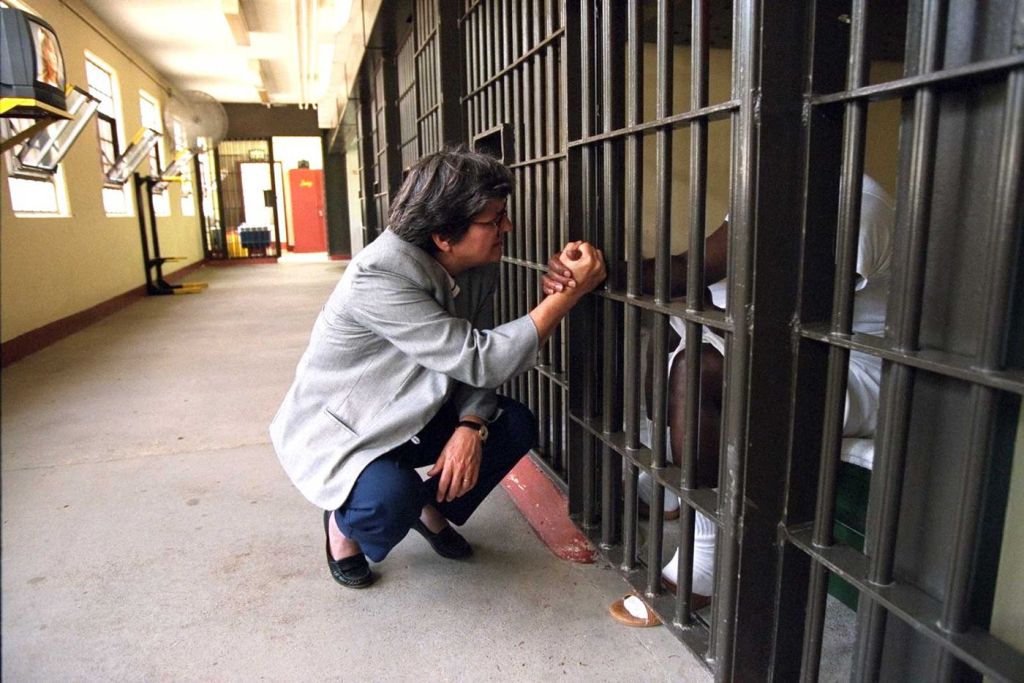
 Spiritual Stepping Stones