Christianity “is to be practiced.”
Today is the last Sunday in Ordinary Time. Next Sunday will begin the new liturgical year in the Church calendar as we begin Advent. In today’s Gospel from John, Jesus faces the Roman procurator, Pontius Pilate:
“So Pilate said to him, “Then you are a king?” Jesus answered, “You say I am a king. For this I was born and for this I came into the world, to testify to the truth. Everyone who belongs to the truth listens to my voice” (Jn 18:37).
Clearly, Jesus is a king, yet not in the way of other kings who have gone before him or followed after. As Jesus said before his above statement, “My kingdom does not belong to this world” (Jn 18:36). The Son of God came among us to re-orient, to re-align the worldly order. Leadership is to not to be about the aggrandizement of self nor at the expense of others. God was very aware of the suffering of his people. He sent Moses to free his people from slavery from Egypt and he sent his Son to free all humanity from our slavery to sin.
Yet this freedom has a cost. Today we are reminded that we have a choice to make. Who are we to serve? Are we to serve Pharaoh or Moses, Pilate or Jesus, our self or God. If we seek to be free from the shackles of our slavery to sin, the choice is clear that we are to listen to the voice of the king of the universe, the truth of Jesus the Christ.
We can see in our own actions who we serve and whose voice we listen to in the action or inaction we direct toward one another. Are we indifferent, blind to another’s suffering or are we aware and willing to get involved, to be merciful, as Fr. James Keenan, S.J. wrote, “willing to enter the chaos of another.”
The reign of Jesus is about personal encounter. We serve Christ the King when we are willing to be aware of and accompanying one another. We are not to be about bringing world peace, ending hunger, providing homes for all in some abstract utopian pursuit. We are instead to be about treating each person we meet with dignity, we are to see Jesus in our midst: “For I was hungry and you gave me food, I was thirsty and you gave me drink, a stranger and you welcomed me, naked and you clothed me, ill and you cared for me, in prison and you visited me” (Mt 25:35-37). Jesus our king, commands us to act as he lived, to be aware, to accompany, and to make a difference, one life at a time.
We may feel overwhelmed with our own struggles, let alone the present state of our country or weight of the world, but we do not have to bear the weight alone, nor are we expected to change the world. We begin each day with ourselves. We are invited to resist the temptation to turn within and instead adjust our attitude and focus outward, while at the same time making a commitment to serve Jesus in one another. God is guiding us already through the love of the Holy Spirit he shares with us, we just need to be willing to receive his love, and have eyes to see, ears to hear, and a willingness to participate in his will.
On this feast day of Christ the King, let us remember who is in control and allow Jesus to re-orient and re-align the order of our life. Are we willing to allow Jesus to lead us such that we are willing to enter the chaos of another? May we, in this final week of Ordinary Time, choose who we will serve. What may help is to spend some time reading and meditating on the Beatitudes (Mt 5:1-12) and chapter 25 of Matthew. Jesus gives us not only this blueprint on how to be collaborators with him, he empowers us to accomplish that which he guides us to do.
As Pope Francis said in a 2014 homily these are: “Few words, simple words, but practical for all. Because Christianity is a practical religion: it is not just to be imagined, it is to be practiced. If you have some time at home today, take the Gospel, Matthew’s Gospel, chapter five. At the beginning there are the Beatitudes; in chapter 25 the rest. And it will do you good to read them once, twice, three times. Read this programme for holiness. May the Lord give us the grace to understand his message.”
——————————————————————-
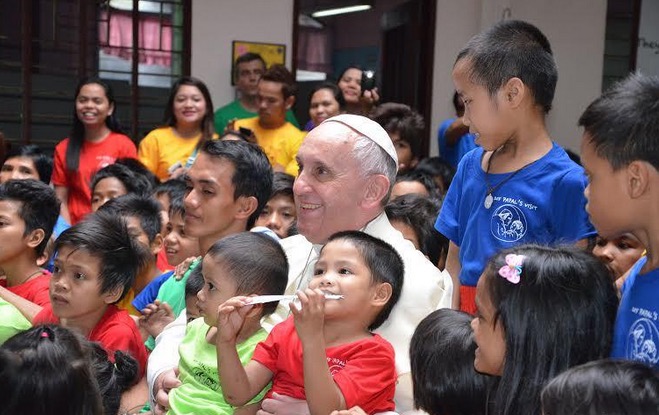
Pope Francis meeting with street kids in Manila, credit catholicnewsworld.com
Fr James Keenan article on Mercy:
http://www.thinkingfaith.org/articles/scandal-mercy-excludes-no-one
Pope Francis homily, 6 September 2014: http://en.radiovaticana.va/news/2014/06/09/pope_the_beatitudes,_a_practical_programme_for_holiness/1101553
Link to the Mass readings for Sunday, November 21, 2021

May we slow down and experience the God of the living.
The Sadducees present an absurd scenario for Jesus to respond to: a woman’s spouse died leaving her childless and then successively married her husband’s six brothers who all died, also leaving her childless. The question from the Sadducees was, “Now at the resurrection whose wife will that woman be? For all seven had been married to her.” (Lk 20:33)? The Sadducees sought to have Jesus weigh in on whether or not there was a resurrection of the dead.
The Sadducees did not believe in a resurrection of the dead because they only believed in a literal interpretation of the Torah, the law, or the teachings, which we as Christians today recognize as the first five books of the Old Testament. In the Torah, there is no overt reference to the resurrection. The Pharisees recognized the written Torah, but also acknowledged an oral tradition beyond the written text, and thus acknowledged the resurrection of the dead. Jesus deftly answered the question by keying in on the verse from Exodus: “That the dead will rise even Moses made known in the passage about the bush, when he called ‘Lord’ the God of Abraham, the God of Isaac, and the God of Jacob; and he is not God of the dead, but of the living, for to him all are alive” (Lk 20:37-38).
Jesus clearly pointed out that God was not a God of the dead but of the living. The deeper reason for the question was ultimately, and is the question that also arises today, “What goes on in heaven? What do we do all day?” Jesus’ response to the Sadducees then and to us today is: “The children of this age marry and remarry; but those who are deemed worthy to attain to the coming age and to the resurrection of the dead neither marry nor are given in marriage. They can no longer die, for they are like angels; and they are the children of God because they are the ones who will rise” (Lk 20:34-36).
What Jesus means is that heaven is a different reality than we experience here on earth. Heaven is a different dimension of existence without temporal time as we know it. We will no longer marry because we will be living eternally, there will be no death, no more need to procreate.
Also, heaven is not so much a geographical place as it is a relationship and experience of an intimate and deep communion with God and those present with us. We want to know what we are going to do there because we are attached to what we have and what we do here. In heaven, we will experience the fulfillment of that which we have been created for, that which we truly crave and hunger for, that which will fulfill our deepest longing, which is to look upon God face to face, what theologians call the beatific vision.
Many would scoff and say, “That’s it?” I am sure there is more, but if that was all, there would be more joy, more acceptance, more totality of being than we could ever imagine or embrace in just a second of that eternal gaze. As the psalmist wrote: “Better one day in your courts than a thousand elsewhere” (Psalm 84:11).
Definitively speaking, heaven is a mystery to us. Again, the Mystery of God is not a problem to be solved but a relationship to experience and develop. This is why prayer, worship, encounter, relationships, and experiencing God’s creation are so important. Each one is an encounter with the living God, each is a foretaste of heaven. If we are only tied to the material, the finite, our self apart from others, we will succumb to attachments and addictions that will create walls of division and separation such that we cannot even begin to conceive of the eternal or spiritual ground and foundation of our existence.
A good daily practice is to be more mindful and more present in what we do. This can begin when we pray. We can slow down our breath and allow our mind to be more still. We can reread today’s Gospel slowly, multiple times, pondering it, wondering about the gift of eternal communion with God, the God of the living, and what it would be like to see God face to face. We can worship with a community of faith this weekend, and actually sing during the service. God does not implore that we sing well, but only that we make a joyful noise unto the Lord (cf Psalms 98, 100).
During the Mass, heaven and earth become one through the presence of Jesus in his people gathered, his word proclaimed, and his real presence in the Eucharist. In our homes and in our everyday experiences, it is important to focus on what we are doing at the moment instead of allowing ourselves to be overwhelmed by thinking of twenty other things such that we walk into the next room and forget why we went in there in the first place. It is especially important to really experience, accompany, and be with the people around us, talking with and listening to one another.
It is also helpful to seek a ministry of service in which we can participate in regularly as well as invite someone to join us. We can spend some time immersed in the wonder of God’s creation, whether taking a walk, taking long deep breathes while looking at the starry night, or just sitting and watching all the gifts of life unfolding before us by, birds, otters, bobcats, or whatever may cross our path. Each one of these practices provides us with an opportunity to encounter the God of all creation, the God of the living, and to experience a foretaste of heaven!
Photo: A family of bobcats JoAnn noticed playing in our backyard a few years ago. Witnessing the living interconnectedness between the three: A living icon of the Trinity?
Link for the Mass readings for Saturday, November 20, 2021
Jesus, come and cleanse us from all that would keep us from receiving the love of God and sharing it with one another.
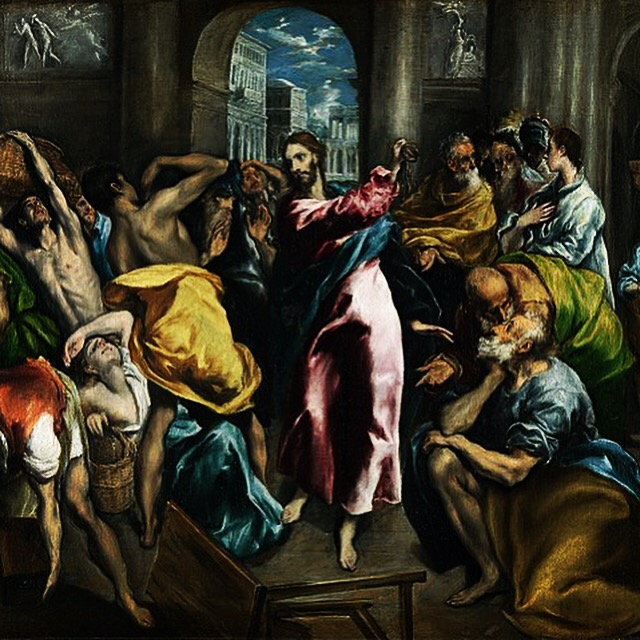
Jesus entered the temple area and proceeded to drive out all those who were selling things, saying to them, “It is written, My house shall be a house of prayer, but you have made it a den of thieves” (Lk 19:45-46).
Luke’s account of Jesus casting out the money changers is the most succinct of all four Gospels. Luke uses the Greek term for “drive or cast out” – ekballō, eight other times. Each time he used it, Luke was making reference to exorcising demons and unclean spirits. The profanation of the body through possession of evil is equivalent to the desecration of the Temple precincts.
Jesus justified his actions of driving the sellers out of the Temple precincts by saying: “Destroy this temple, and in three days I will raise it up” (Jn 2:19). Jesus showed the dignity of our humanity, in that as the Son of God he entered our humanity. He entered into the chaos of our lives, our faults, and foibles, our sins while remaining sinless himself. He showed that even though we have turned away from God, we are not destroyed. He reminds us that what God has created is good and that includes us. Even when we turn away, he continually and infinitely reaches out to us in love and calls us home.
One of the wonderful features of the upcoming holidays is that families seek to come together, to return home. For some it has been a long time because of Covid and some may still not be able to do so in person but will be able to so through phone, email, or the other avenues of media platforms we now have available. But there are those, we may even experience this ourselves, who have recently lost someone who has died, or we may be estranged, or those who no longer have a family. There are those suffering today that are homeless, displaced, refugees and immigrants, or living in fear of deportation. May we pray for them and be avenues of solidarity and reconciliation when and where we can.
No matter who or where we are, Jesus is present. He became one with us to restore our communion with God and one another. He provides the living water that quenches the thirst of our deepest longings. Jesus, our Temple, our new covenant, the dwelling place of God, is alive and present to each one of us in every condition, situation, time, and the place we find ourselves. Through his resurrection, ascension, and our participation in his life, he has made us temples of the indwelling of God the Holy Spirit.
Jesus meets us where we are and loves us as we are, yet he wants more for us. Jesus, please cast out, as you did in the temple precincts, all from our being that would defile us and keep us bound in sin. Send the Holy Spirit to reign in our hearts that we may embody and bear his love with all we meet so to be reconciled with God and one another.
Painting: By El Greco, 1600 – Christ Driving the Traders from the Temple
Link for the Mass readings for Friday, November 20, 2021
“If this day you only knew what makes for peace -“
As Jesus drew near Jerusalem, he saw the city and wept over it, saying, “If this day you only knew what makes for peace– but now it is hidden from your eyes” (Lk 19:42).
What Jesus foretold in these words would arrive some thirty years after his death. Jewish and Roman conflicts increased until it spilled over in 66 AD. A Jewish rebellion amassed such force that the Roman occupying military was pushed out of Jerusalem. This triggered a predictable and overpowering response from Rome which would result in the horrific deaths of over a million Jewish people. Jerusalem fell in August of 70 AD, and the Temple was destroyed. The only remnant was some of the retaining walls. The western retaining wall, still present today, is often called the Wailing Wall.
Jesus knew that peace would not come from violence. We can glean from his teachings that peace is not just the absence of war, but a change of mind and heart. A metanoia or conversion of the mind must take place. There must be peace within before there will be peace without or as Thomas Merton wrote, “If you are yourself at peace, then there is at least some peace in the world.”
The words of Jesus from today’s Gospel ring just as true today: “If this day you only knew what makes for peace– but now it is hidden from your eyes.” If Jesus walked across the northeast border of Israel into Syria, he would witness the horrific violence and devastation as far as the eye could see. Yet, is there anywhere he could walk and not experience violations of human dignity? I am sure he weeps as he approaches the US border from the south or walks among the dead who lost their lives from our rampant epidemic of gun violence.
How about even a little bit closer to home? If Jesus were approaching the border of our mind and heart, how would he react? Would he smile or would he weep?
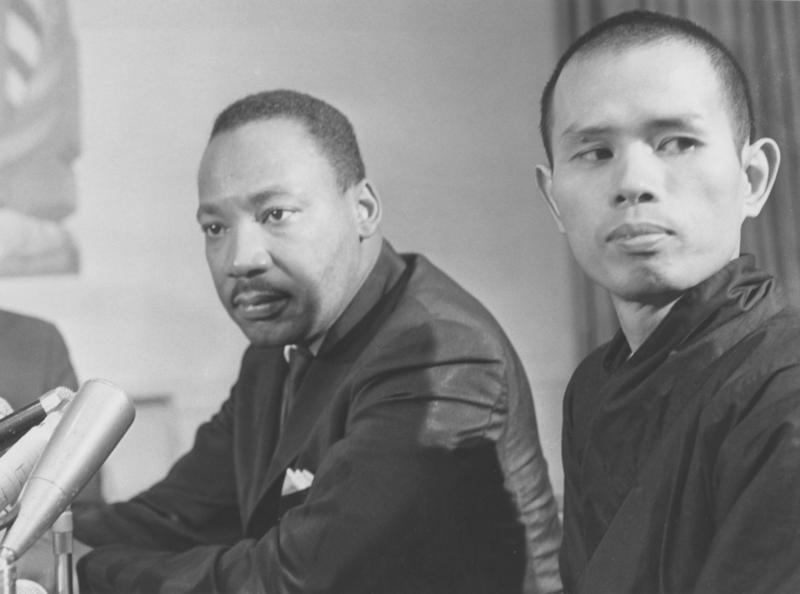
Others have wept at the disharmony, dehumanization, and division in our world. Mohandas K. Gandhi marshaled a non-violent movement that defeated the colonizing grip of the English Empire. Dr. Martin Luther King, Jr. applied both the teachings of Jesus and Gandhi by shining a light that exposed the dark night of segregation, poverty, and our military presence in Vietnam. Vietnamese Buddhist monk, Thich Nhat Hahn, has dedicated his life to advocating for world peace and has stated that: “If in our daily life we can smile, if we can be peaceful and happy, not only we, but everyone will profit from it. This is the most basic kind of peace work.”
Through the bold witness and preaching of the Gospel through his words, writings, and presence, Pope St. John Paul II played his part in inspiring the fall of the oppressive regime of the USSR. So many others throughout our world history known and unknown have worked for peace in our violent and weary world. As we near the end of the liturgical calendar let us allow the love of Jesus to transform our hearts and minds such that each of our thoughts, words, and actions may, in collaboration with people of other faith traditions and good will, reflect that peace that Jesus gives, that peace that surpasses all understanding (cf Philippians 4:6-7).
Photo of Dr. Martin Luther King, Jr. and Thich Nhat Hahn.
Link for the Mass readings for Thursday, November 18, 2021
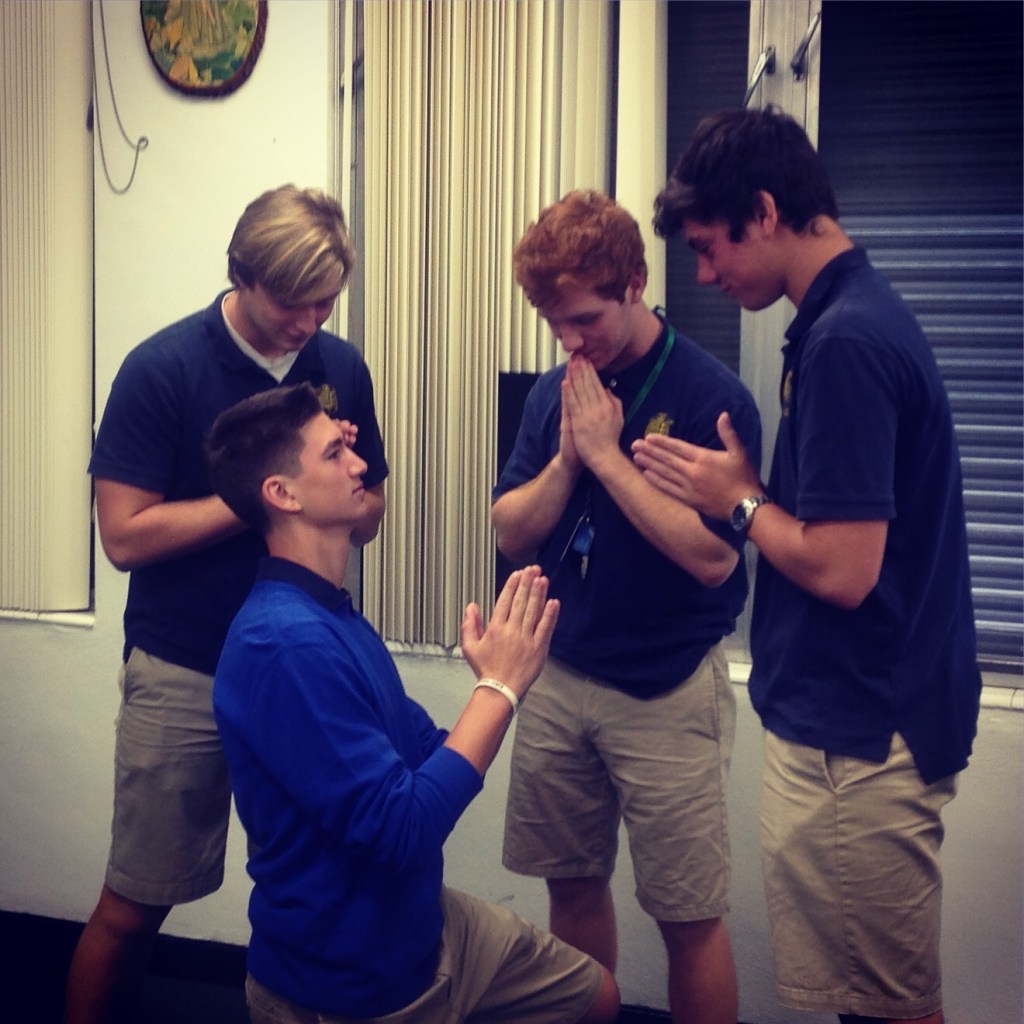
We will surrender to fear or God?
In today’s Gospel, we have available to us the parallel to The Parable of the Talents from Matthew 25:14-30, which is the Parable of the Ten Gold Coins from Luke 19:11-28. There are some differences. A key opening point is that in Matthew’s account, we do not know why or where the master goes after he entrusted three of his servants with talents; five, two, and one respectively. In Luke’s account the man is a noble and he “went off to a distant country to obtain the kingship for himself and then to return” (Lk 19:12). He called ten servants to invest a gold coin he gave each of them. The theme that is similar in both accounts is that when the man returns, two of the servants invested well and brought about a greater return on their investment, and one hid what he was given out of fear of his lord.
Another added feature in Luke’s account was the fellow citizens of the nobleman that did not want him to be king and openly opposed him. The nobleman after attaining his kingship and returning successfully, dealt harshly, to say the least, with those who opposed him, having them slain. Those listening to Jesus tell the parable would understand this outcome, as it was not uncommon in the ancient Near East for a ruler to slay those who would oppose his rise.
The readings over this week continue in this vein of eschatological talk, references to the second coming of Jesus, and final judgment because we are in the final two weeks of the liturgical year. The readings present us with the reality that there will be a judgment by God, but what Jesus makes clear is that we are not the judge and jury, though many appropriate this role for themselves. We are only accountable for the talent or gold coin we have been entrusted with.
There is a unique gift that God has given each of us, and we are called by him to put this gift into action to be a part of building up the kingdom of God. We need to resist burying this gift or wrapping it in a handkerchief and hiding it away. Doubts, fears, and anxieties will arise in our hearts and minds. We may say to ourselves, “I don’t even know where to begin.” One place to begin is to pray with the one who calls us to participate in his work.
How we respond will be different for each one of us. Our starting point though will be the same. We are to trust in God guidance regarding how best we can serve and open ourselves to the love of the Holy Spirit such that in the words of Pope Francis we may: “Have the courage to go against the tide of this culture of efficiency, this culture of waste. Encountering and welcoming everyone, [building] solidarity – a word that is being hidden by this culture, as if it were a bad word – solidarity and fraternity: these are what make our society truly human” (Pope Francis 2014, 61).
We are to share the love that God gives us with one another, but we are not mere social workers. We are to be contemplatives in action. We are invited to begin each day in prayer, receiving the Eucharist whenever and as often as possible, and ask God for guidance regarding how we are to put into action the gift of his love that he has given us. We can trust that Jesus will be with us each step of the way. He will sustain, guide, and give us the strength to accomplish the task before us.
Photo: An icon of prayer for discernment in solidarity and fraternity
Francis, Pope. The Church of Mercy: A Vision For the Church. Chicago: Loyola Press, 2014.
Link for the Mass readings for Wednesday, November 17, 2021

Grumbling keeps us divided. Loving and understanding brings us together.
Yet again, as in the Gospel from yesterday, the crowd gets in the way of someone seeking access to Jesus. The wall of people does not appear to be overtly keeping Zacchaeus from seeing Jesus, as they may be so focused on seeing him themselves that they are not aware. There is also the possibility that the people were aware of that this man was trying to get through. They knew Zacchaeus, and many judged him to be the sinner of sinners. He was the chief tax collector of the area and that meant he was most likely reviled by most in his community. Each time Zacchaeus nudged by to get through a gap to get a better look, the individuals may have time and again closed each gap such that he could not get through.
Zacchaeus was not thwarted. He ran ahead and climbed a sycamore tree. From his perch he was not only able to see Jesus, Jesus saw him and said, “Zacchaeus, come down quickly, for today I must stay at your house” (Lk 19:5). Jesus did not see a tax collector or a sinner, he saw a seeker. One who was also willing to humble himself by climbing a tree, much like a child.
Jesus does not see the 99% nor the 1%. Jesus sees people in need of compassion and mercy. Jesus did not meet Zacchaeus with judgment but with love and compassion, and that made all the difference for conversion.
Jesus acknowledged the one who so many despised, and by inviting himself to dine with Zacchaeus in his own home, Zacchaeus must have felt overwhelmed with emotion. Maybe for the first time in his life, he felt like a person with dignity. He then repented on the spot as a response to the love he had received, with the words: “Behold, half of my possessions, Lord, I shall give to the poor, and if I have extorted anything from anyone I shall repay it four times over” (LK 19:8).
The encounter of Jesus and Zacchaeus offers us an inspiring model to start seeing each other as human beings. One way to do so is to resist the temptation to “grumble”, to gossip, to pre-judge, and/or to dehumanize one another. Jesus invites us instead to see beyond the exterior and to be willing to go deeper to the heart and character of the person. To do that, we need to be willing to encounter one another with a posture of understanding and a willingness to spend time with one another.
When we do so, we will move from being people who seek to define and limit ourselves by our identity, and instead open ourselves up to being people of integrity. This means resisting the temptation of building walls that protect ourselves from others and instead building bridges of dialogue to embrace the wonderful gift of our God-given diversity.
Integrity means that we will be more present and aware, we will stand with and stand up for someone who is ignored, belittled, dehumanized, harassed, discriminated against, ridiculed, abused, objectified, persecuted, segregated, and prevented access no matter their gender, sexual orientation, race, ethnicity, income level, class, political party, religion or none.
Life is hard enough, so let’s stop grumbling and start healing. Let’s stop preventing access and start opening up opportunities, and let’s stop closing ourselves off and begin to open our arms wide to embrace and accompany one another as we allow Jesus to love others through us. Not only will they be loved and healed, but so will we in the process.
Photo by Belle Co from Pexels.com
Link for the Mass readings for Tuesday, November 16, 2021
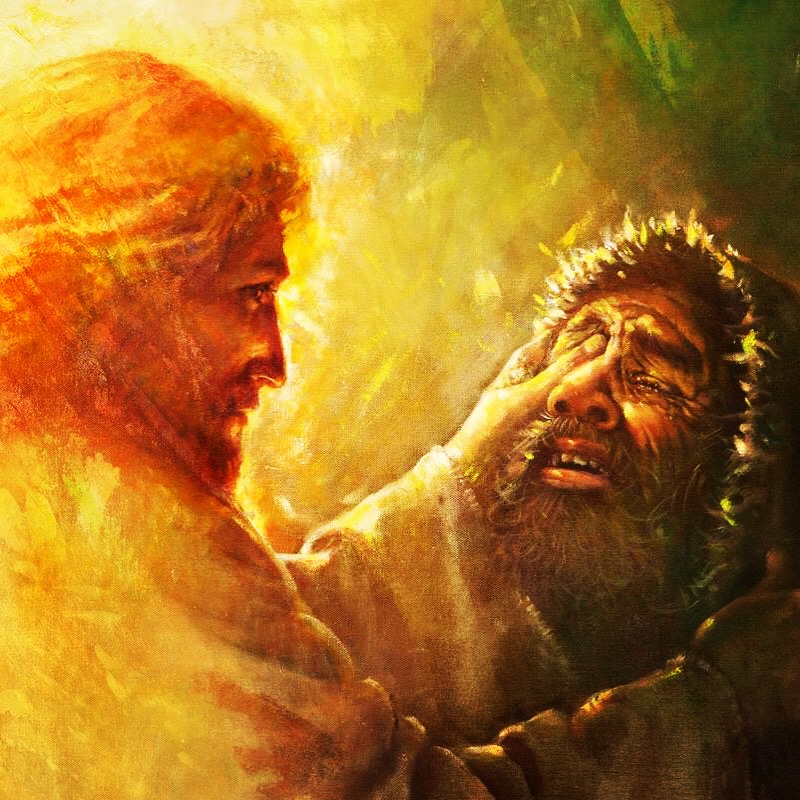
Are we willing to see?
He shouted, “Jesus, Son of David, have pity on me!” The people walking in front rebuked him, telling him to be silent, but he kept calling out all the more, “Son of David, have pity on me” (Lk 18:38-39)!
The difference between the blind man who shouted to Jesus and the people walking in front of Jesus was that the man knew he was blind. Those preventing access to Jesus were not aware of their spiritual blindness. Luke does not say why the people were preventing access to Jesus, just as Jesus in his parable of the Good Samaritan did not say why the priest or the Levite did not help the man dying on the road to Jericho.
Why would the people prevent the man from having access to Jesus? Especially since he was asking for pity or mercy. One practical reason could be time. They were on the way to Jericho, their mind was set to get there, and stay on the schedule they would. Another could be that the man was a beggar. He was not seen to have dignity and worth, so they attempted to quiet him so he could go back to being invisible. The Jericho road was a dangerous road, maybe this was just a setup, a way to lure Jesus into an ambush.
Ultimately, we do not know why they attempted to prevent the man access. The more important question is how often do we prevent others from accessing Jesus for similar reasons? We do not have the time, they are other, we may not see their dignity and worth as human beings, and/or we are afraid of difference so we keep others at arm’s length. Could it be we are just indifferent to the suffering of others?
Jesus responded differently to the call of the beggar in today’s Gospel account. He stopped and had the blind man brought to him. He made the time, saw him as a fellow brother with dignity and worth, and he took the risk to reach out to someone in need, and healed him. As Pope Francis has said, “[Jesus] understands human sufferings, he has shown the face of God’s mercy, and he has bent down to heal body and soul. This is Jesus. This is his heart” (Francis 2014, opening page).
This is to be our response as well. Even if we do not understand the suffering of another, Jesus does. We are invited to stop, to be present, to enter the chaos of another, and trust that Jesus will be present through us to provide mercy. Are we willing to resist indifference and fear and instead see each person we encounter, not as other, but as a fellow human being? We do this best by making the time and being present. Are we willing to ask Jesus to heal our blindness that we may be willing to see the dignity and worth of each person that we meet so that those we encounter see in us the face of God’s mercy?
Photo: Healing the Blind Man by Yongsu Kim
Link for the Mass readings for Monday, November, 15, 2021
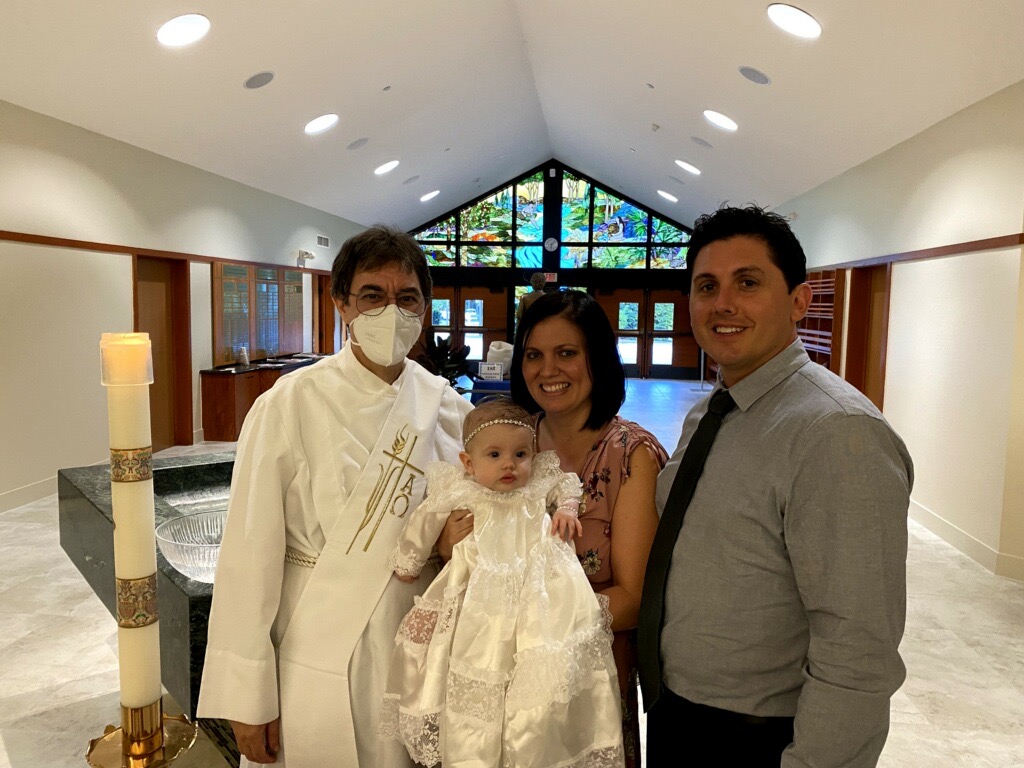
Respectful dialogue builds healthy and diverse relationships!
There are only two weeks left of the liturgical year and so our readings are focused on the eschatological or end times. These writings are also called apocalyptic because they unveil or reveal hope to a people in dark times of oppression. They are addressing the issue of where is God in the midst of our suffering. Their focus is not that we are to know the exact time and hour of the end, as Jesus revealed in the Gospel: “But of that day or hour, no one knows, neither the angels in heaven, nor the Son, but only the Father” (Mk 13:32).
The focus instead is, as recorded in our first reading from Daniel: whose name is written in the book (Daniel 12:1)? and in Hebrews10:12, that Jesus took his seat at the right hand of God forever.
What our readings reveal for us today is that what is important is relationship. We are not written in the book of life by some predestined oracle such that we are merely pawns on God’s chessboard. We are written in the book of life because we have been saying yes to the invitation of building our relationship with Jesus and his Father through the love of the Holy Spirt.
Today, we, as have those in the times of the Bible and throughout every generation of human history, are experiencing division, polarization, abuse, and violence, such that it appears like our church, society, and government are coming apart at the seams. This reality is not an invitation for indifference, cynicism, despair, or to retaliate with more hatred or violence. We need to remember our first love. We need to deepen our relationship with Jesus who conquered death and is now seated at the right hand of God the Father. We need to be open to building relationships with each other.
Viktor Frankl in his book Man’s Search for Meaning wrote:
“We who lived in the concentration camps can remember the men who walked through the huts comforting others, giving away their last piece of bread. They may have been few in numbers but they offer sufficient proof that everything can be taken from a man but one thing: The last of his freedoms – to choose one’s attitude in any given set of circumstances, to choose one’s own way.’
An answer to the growing division and polarization is not to curve in upon oneself, to hide in our shell, and/or to put our head in the sand.
Jesus built the Church one person, one relationship at a time. We are to do the same. At our parish of St Peter we have been inviting our parishioners to gather weekly in small groups. This practice has provided opportunities to come together to learn more about our faith and share our journey. One of the strengths of the small group JoAnn and I joined is that we respect the diversity of each of our viewpoints. We each see issues from our unique perspectives and often do not agree with each other but we afford one another the opportunity to share our viewpoints freely and openly, listen to each other, while respecting and loving each other in the process.
Even on the nights when we were too tired to attend, JoAnn and I felt blessed when we went. We grew closer over the years, so much so, that each person in our small group played a significant part in JoAnn’s funeral Mass. Even through this time of pandemic we continue to meet together through ZOOM, although I have only recently returned as I continue to recover from pneumonia. The latest blessing came on September 25, when I was able to bless Katie and Michael’s daughter Marcella!
Differences do not have to mean division. By engaging in authentic and respectful dialogue, we can vent, listen, encourage, provide support, share advice, and lean on each other with each of the struggles that we face and the joys we experience. As we do so, we can dismantle walls of division and dehumanization and instead build bridges of encounter by broadening our experiences and perspectives so to be more willing to listen to, care for, and serve one another.
Photo: Marcella, one of the newest members of St. Peter Catholic Church!
Link for the Mass readings for Sunday, November 14, 2021
 Spiritual Stepping Stones