
A way to alleviate our suffering, is to help another who is suffering.
What we think, say, do or do not do, has consequences for ourselves and others. The smallest act of kindness, like suggesting, as Jesus did in today’s Gospel, of giving someone a drink of water goes a long way. The reality that 771 million people do not have adequate access to the most basic of needs, safe drinking water (water.org), is an amazing and saddening statistic. The most serious of sins in this regard is not bothering to care. Jesus shared clearly, in the Gospel of Matthew (cf. chapter 25), that what we do to the least of our brothers and sisters, we do to him.
We have a choice to act in ways: that limit or provide access for people seeking such basic necessities as food, water, and shelter; that harm or hurt; that divide or unify. Jesus uses graphic, hyberbolic words in today’s Gospel, such as “If your hand causes you to sin, cut it off. It is better for you to enter into life maimed than with two hands to go into Gehenna, into the unquenchable fire” (Mk 9:41-50). Jesus does not literally mean that we are to cut off our hand or foot, or pluck out our eye, but he is showing us the seriousness and cost of our sin in this life and the next. Whether we refuse to give or provide someone a drink has consequences.
Life is hard, people suffer. When we choose to shut ourselves off from others and the wonders of creation, and retreat into our own self-made world, keeping the need of others at arm’s length; when we engage in thoughts, words, and actions that are divisive, dehumanizing, and self serving; when we rationalize and justify behavior that goes against our Gospel values and our conscience, we play a part in contributing to the condition of original sin that plagues our world. When we act in these ways, we are going against God’s plan that we pray for each day: “May your kingdom come, may your will be done on earth as it is in heaven.”
Jesus is not calling us to leap out of bed today to amass heroic acts of virtue, nor is he asking us to enact massive change alone and all at once. The disciples took time to get his message and get on board, so it will take time for us as well. As followers of Jesus, we need to resist the temptations of turning in upon ourselves and of being self-centered, looking out for our own concerns alone. Instead we need to experience the truth of how Jesus loves us more than we can ever imagine. We do so when we open our hearts and minds to receive his love and share it by willing the good of each other and as we do so we will be transformed.
——————————————————————
Photo: Jesus frees us from our suffering when we align ours with his. Crucifix at St Peter Catholic Church, Jupiter, FL.
Link for the Mass readings for Thursday, February 24, 2022

Let us be still and listen to the voice of God in the quiet of our hearts and follow his lead.
An elitist posture can be dangerous in that others are excluded that ought to have access. There are those areas in which there will be limited access. Select positions such as a principal, CEO, or manager. At higher levels of sports, the arts, and civic leadership, there are limited positions available as well. Yet access ought to be granted for the most qualified. Artificial impositions regarding racial, ethnic, gender, or religious litmus tests are to be avoided. Regarding having access to God, worshipping as a community, and spreading his love and word, an elitist approach has no place.
Jesus addresses this concern in today’s Gospel from Mark. The Apostle John approaches Jesus to complain that someone who does not belong to their inner circle of disciples was healing in the name of Jesus. John even shared that they attempted to prevent this person from healing. Jesus replied, “Do not prevent him. There is no one who performs a mighty deed in my name who can at the same time speak ill of me. For whoever is not against us is for us” (Mk 9:39-40).
Jesus shared in words what he modeled in action throughout his life and that is that the kingdom of God is open to all those who were willing to receive his invitation to enter into a relationship his Father. That relationship was to then be a spark that lit a fire in those of his followers to reach out to teach, preach, cast out demons, heal, and be present to others in their need in his name. The kingdom of God is not for the select few, not for the frozen chosen, and not to be an elite club. The depth of active participation is only limited by one’s willingness to be engaged in participating in the life of Jesus.
Jesus again offers us a universal message today. May we strive to work toward seeking that which unifies us more than what divides us. May we embrace his message that “whoever is not against us is for us.” This can be translated outward beyond our tradition as Catholics as well. There is much that we can do together with Christians of other denominations, people of other faith traditions, and people of good will as well.
There are many who are in dire need of support in our communities, our states, countries, and world. May we resist the us vs. them mentality that tempts us on so many levels. May we resist the temptations of indifference or feeling like we have nothing to contribute. Jesus calls us to be contemplatives in action, to be open to the leading of the Holy Spirit and to act as he leads us.
Jesus, invites us to spend time in prayer to better know God our Father and his will for our life. He encourages us to slow down so that we can listen and be still so that we will recognize his voice in the silence of our hearts and come to know how we can best act each day to be of help and support. In our own unique ways, let us meet division, polarization, and dehumanization, with the healing balm of unity, dialogue, and empowerment.
———————————————————————
Photo: CN contemplatives in action!
Link for the Mass reading for Wednesday, February 23, 2022
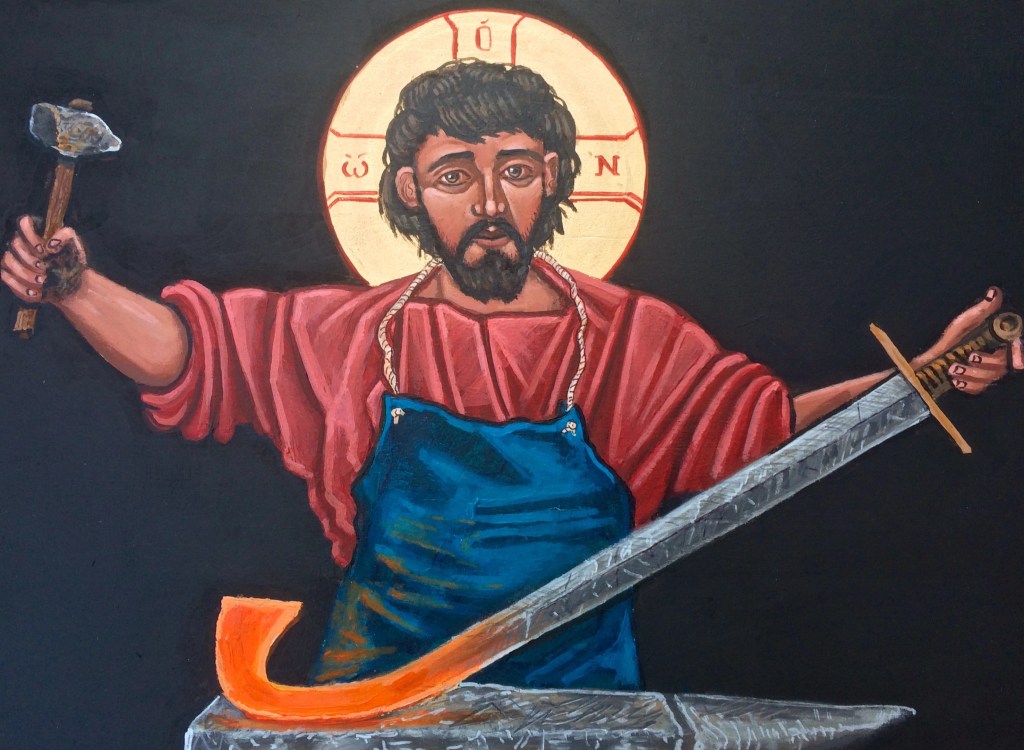
No to war and yes to turning swords into plowshares.
Jesus asked, “Who do people say that the Son of Man is” (Mt. 16:13)? Peter answers Jesus by saying that Jesus is: “The Messiah, the Son of the Living God” (Mt: 16:16). In other words, Jesus is Emmanuel, God with us.
When we dig a little deeper, another question that might overshadow the question of who Jesus is, is where is Jesus, especially as tensions between Russia and Ukraine rise, the instability in Afghanistan, Syria, and Yemen remain and other areas of the world continue to experience increasing violence as well.
What does Peter’s response that Jesus is the Christ the Son of the living God have to do with the above examples of ongoing and escalating violence? This means Jesus is one with us. The infinite reality of God is present within each human being that exists because Jesus became one with us so that we can be one with him. We have been created in God’s image and likeness and this is true from the moment of our conception through each stage of life until natural death. The unfortunate effects of Orignal sin are that our image has been distorted and our likeness to God has been lost. The fact that we continue to dehumanize and delegitimize the dignity of each other only continues to fuel this divide between us and God. We continue to choose self over God and continue to perpetuate the loss of our dignity.
Does Jesus care? Yes, just as Jesus said, “Saul, Saul why are you persecuting me” (Acts 9:4)?, he asks the same to all who would take up arms to maim and destroy the dignity of his Body and spill his Blood. Jesus experiences the death of each and every life that is lost to violence, whether in war torn regions of the world as well or in our own escalation of violence in our own country. How does Jesus the Christ, the Son of God, experiences these horrific tragedies? For what you do to the least of these, my brothers and sisters, you did it to me (cf. Mt 25:31-46).
Violence will continue as long as we refuse to see the dignity present in each and every life. Each and every one of us is interconnected and what effects one of us effects all of us. Human beings are not: to be disposed of as political pawns, collateral damage, illegal, to be objectified, property to be used, and/or to be abused. As we prepare for this Lent let us pray and fast, that the conflict between Russia and Ukraine de-escalates, that hearts and minds throughout the world may moved to lay down their weapons, walk away from violence, turn our swords into plowshares, our spears into pruning hooks, and no longer to lift our swords up to each other and choose instead reconciliation over war (cf. Isaiah 2:4).
We need to place our trust in Jesus Christ, the Son of the living God, and turn to him in prayer, offering him our anger, our doubt, our pain, and our yearning for justice, mercy, peace, and a will to seek healing and forgiveness instead of violence. We also can take heart in knowing that pain, injustice, violence, and death do not have the last word. Jesus suffered violence and died a brutal death, and conquered death to give us another way. As we pray and work for change, may we find some comfort in the words of Fr. James Martin, S.J.: “Life is stronger than death. Love stronger than hatred. Hope is stronger than despair. Nothing is impossible with God.”
—————————————————————————–
Painting: Icon of Christ: Swords Into Plowshares by Kelly Latimore
The final quote came from a talk given by Fr. James Martin, S.J. given on April 22, 2014, titled On Pilgrimage with James Martin, SJ, Fordham University.
Link for Mass readings for Saturday, February 22, 2022
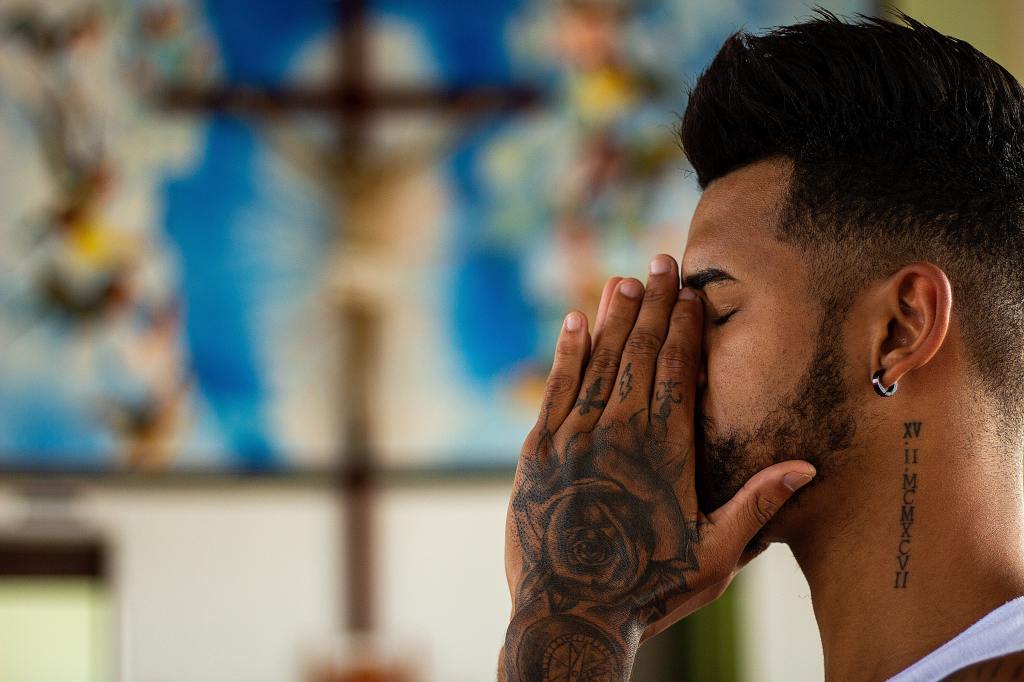
“I do believe, help my unbelief.”
In the opening of today’s Gospel, we witness Jesus, Peter, James, and John returning from the experience of the transfiguration. As they draw closer they witness a commotion, for while they were away, a man had brought his son to the other disciples to expel a demon from him but they could not. As they draw closer, the father appeals to Jesus: “But if you can do anything, have compassion on us and help us.” Jesus said to him, “‘If you can!’ Everything is possible to one who has faith.” Then the boy’s father cried out, “I do believe, help my unbelief” (Mk 9:22-24).
Jesus’ response to the man is clear and consistent with his teaching, miracles, exorcisms, and healings. We see that the key ingredient over and over again throughout the Gospels is an appeal to Jesus’ help and the person’s faith. What may be unclear is the man’s response, “I do believe, help my unbelief!” This statement not only addresses his experience but those of his disciples who were not able to heal the boy.
The man did have faith in Jesus to a point, for he brought his son to him believing that he could possibly heal him. His words reveal the maturity of his faith, “But if you can do anything…” This request shows some doubt. This is much different than the woman with the hemorrhage who believed if she but just touched the tassel on his cloak she would be healed or the Canaanite woman who sought to have her daughter exorcised even though Jesus initially dismissed her for being a Gentile.
The father’s statement, “I do believe, help my unbelief!”, is beneficial to us all. The father believes in Jesus to a point, but recognizes he needs help to go further in his faith. Jesus confirms that what is important in maturing in our faith life is being people of prayer. When his disciples talked to him in private, they asked him why they were not able to heal the boy and Jesus replied, “This kind can only come out through prayer.”
Prayer is not a magic formula. Prayer is about becoming aware of God’s invitation to develop and sustain a relationship with him. When we make time for God in our day and recognize his presence in every aspect of our life, we come to know him and know his will in each situation. The exorcism of the young boy happened because the father of the boy appealed to Jesus that he needed his help to believe. The disciples could not heal because they sought to do so through their own will power alone instead of drawing on the infinite source of Jesus.
The good news is that even though time and again they fell short, and we see plenty of examples of this, they persisted in their faith, in their belief in Jesus. They grew in their trust in him such that the disciples did mature, and they recognized that apart from Jesus they could do nothing,
So much so, that we see Peter, who had denied Jesus, reconciled with him after his Resurrection, would some time after the Ascension of Jesus, come to encounter a man crippled from birth who was begging for alms. Peter said to the man: “I have neither silver nor gold, but what I do have I give to you: in the Name of Jesus Christ the Nazorean, [rise and] walk” (Acts 3:6).
Peter’s faith grew over time, through failure, sin, and unbelief, but he, like the father in today’s Gospel, gives us a model to follow each and every day. We can mature in our faith as well. Let us begin our day with this prayer and return to if often: Jesus “I do believe, help my unbelief.”
—–
Photo by Pic Rodrigues at Pexels.com
Link for the Mass readings for Monday, February 21, 2022

“Forgive and you will be forgiven.”
As Christians, we are called by Jesus to live lives of holiness, with the end goal of being saints. Saints are those who are about one thing. They know what God requires of them and they do it. Each on of us are invited to live lives of sanctity as well, no matter our age or our vocation. What we need to realize is that we cannot attain holiness on our own. For apart from Jesus we can do nothing, yet in participation with Jesus all things are possible. We also need to understand that Jesus is not “just an idea but a person” (Barron 6, 2016).
We receive a demanding challenge from this person in our Gospel reading from Luke today in an excerpt from Jesus’ Sermon on the Plain. This provides a nice opportunity for us to assess how we are doing in living our life as a Christian.
Let’s look at the first two. How many of us this week have been regularly loving our enemies or doing good to those who hate us? Let’s look at these two points a little more concretely, how did you react the last time you were cut off in traffic? Did you bless them with the sign of the cross or offer another gesture? What was your internal reaction the last time you perceived that someone was rude or impatient with you? Were you rude and impatient in return, did you stew within, or were you understanding and patient?
How many people have you blessed this week that have cursed you and how many people did you pray for that mistreated you? I could go on, but I encourage you to read the entire account prayerfully and reflectively. Resist the temptation to slip into rationalizations and defensiveness or to throw your Bible or computer across the room.
Jesus is helping us to understand the kind of love he calls us to engage in. This love is not about emotion, mere sentiment, or about feeling good about ourselves because we have done something nice for someone else. This love is not about giving to get something in return. This love that Jesus is imploring us to live in and share, is about willing the good of other as other and realizing that apart from placing ourselves in a position of receiving and experiencing the unconditional and merciful love of Jesus, we are not capable of loving others.
Jesus also shares that we are to: “Forgive and you will be forgiven.” We do not do forgiveness well. Thus, we do not experience forgiveness, and so remain stuck in a this growing cycle of unforgiveness, bitterness, division, polarization, separation, and isolation. If we instead put more effort into consciously practicing forgiveness and asking Jesus to forgive us, for what we have done and have failed to do, I am convinced that we will experience his love and mercy and be better agents of healing and reconciliation.
Lent is almost upon us. Lent is a good time to participate in the healing power of the sacrament of Reconciliation. By doing so we experience the love of being forgiven. Once we experience God’s tender love and forgiveness, we will be able to begin to love our enemies, do good to those who hate us, bless those who curse and mistreat us. We will begin to offer the other cheek to the one who strikes us, do to others what we would have them do to us, and be merciful because we have received the mercy of our Father in heaven.
Jesus calls us for a purpose, to be holy and set apart, to live as saints, to live as Jesus calls us to live in his Sermon on the plain, which is to be about one thing, opening our hearts and minds, applying our faith and reason, as we receive the love of Holy Spirit so as to love God, ourselves and our neighbors as ourselves.
Photo: from an evening walk two nights ago.
Quote from Francis Cardinal George from the forward to: Barron, Robert. The Priority of Christ: Toward a Postliberal Catholicism. Grand Rapids, MI: Baker Academic, 2016.
Link for the Mass readings for Sunday, February 20, 2022
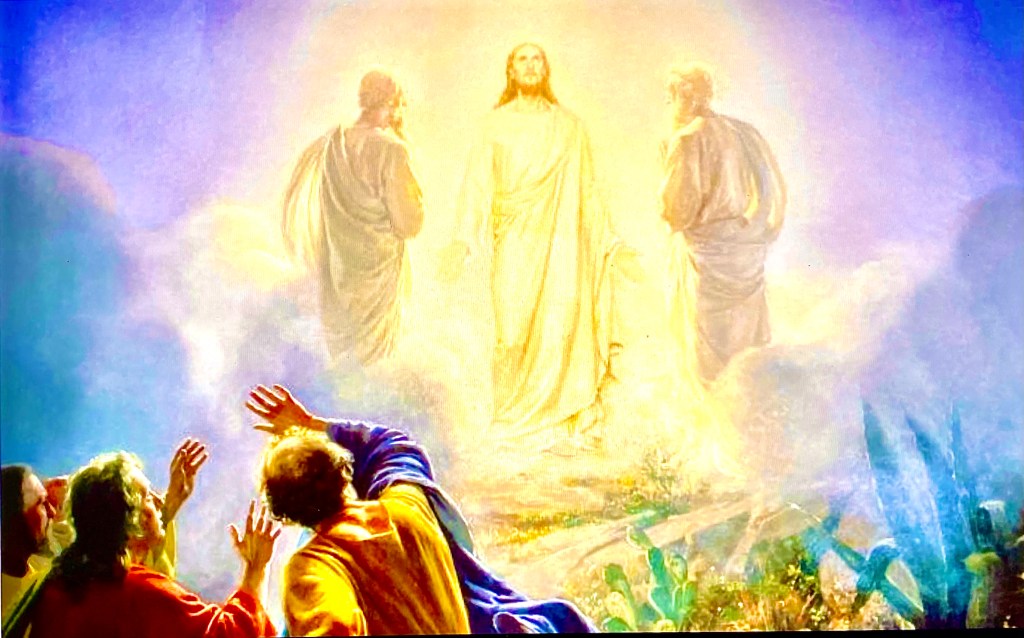
In the transfiguration, Jesus reveals for us our deepest longing.
Jesus took Peter, James, and John and led them up a high mountain apart by themselves. And he was transfigured before them, and his clothes became dazzling white, such as no fuller on earth could bleach them (Mk 9:2-3).
Peter, James and John experienced Jesus’ teachings with authority, his powerful signs and wonderous works, they also witnessed his healings, casting out of demons, and forgiveness of sins, all of which, helped them to experience the divine working through the flesh. Peter had just acknowledged Jesus as the Messiah, yet he and Jesus’ inner circle were still working out what that meant. In the encounter of Jesus transfigured, Jesus revealed, not only a foretaste of what was to come in heaven, but a glimpse of his actual divinity.
Jesus is not 50% God and 50% human. Jesus is fully God and fully man. This is the Mystery of the Incarnation; the reality that the second Person of the Trinity took on flesh and became human. This is an important reality, because in this very act of Infinite Grace, Jesus, in the words of St. Irenaeus, opened up heaven for us in the humanity he assumed. The Son of God became one with us so that we can become one with him. Through our participation in the life of Jesus the Christ we can restore our relationship with his Father.
“By revealing himself God wishes to make [us] capable of responding to him, and of knowing him, and of loving him far beyond [our] own natural capacity” (Catechism of the Catholic Church 1997, 52). This reality of the invitation of communion with the Loving God and Father of all creation is for all, everyone, not just a select few. Our joy and fulfillment is achieved through saying yes to the invitation from the Holy Spirit and developing a relationship with the loving God and Father of our Lord Jesus Christ.
Many may say they are happy and living a good life without having a relationship with Jesus or apart from God or his Church, and I would not disagree with them. I would only add that if we are honest with ourselves, there is more to life than the mere material and finite reality we see and experience with our senses. When we slow down enough, when we are actually still enough, we can sense a deeper yearning for more.
Even with great achievement, mastery, honor, and accumulation, there is still a lingering question, “Is this all that there is?” We experience, mostly unconsciously, a restlessness. We continually search to fill this unease, feeling satisfied for the moment, but eventually in short order, we are left empty, time and time again. This unease is our soul’s yearning, our transcendent nature longing for more, and that longing is for the infinite that the finite cannot provide. St Augustine of Hippo (354-430) articulated this desire and yearning well in the opening chapter of his autobiography, Confessions: “Thou dost so excite him that to praise Thee is his joy. For Thou has made us for Thyself and our hearts are restless until they rest in Thee.”
The Transfiguration of Jesus is an invitation, not to reject our humanity, but to embrace the fullness of what it means to be human, to be one with God as the Son of God is. Through his willingness to be sent, to be one with us, while remaining fully divine, we are invited to embrace the fullness of our humanity; the reality that we are physical, emotional, intellectual, while at the same time, spiritual beings. Our fulfillment and joy comes from a balance of nurturing each aspect of who we are in participation with Jesus.
Peter, James and John, as well as Augustine and the saints, said yes to this invitation from Jesus. They nurtured this relationship and that has made all the difference. The Holy Spirit, the love shared between the Father and the Son, invites us to experience the same wonder, to explore the full breadth, depth, and width of all that our reason and faith can open for us, and go even further, to embrace the deepest yearning of our soul, which is to draw ever deeper into the intimacy of a loving relationship with God, ourselves, and each other.
———————————————————————–
Painting: Transfiguration of Jesus, Carl Bloch – 1872
Quote from Confessions by St. Augustine, Word on Fire Classics translated by F. J. Sheed
Mass Readings for Saturday, February 19, 2022

Are we willing to take up our cross?
Jesus summoned the crowd with his disciples and said to them, “Whoever wishes to come after me must deny himself, take up his cross, and follow me” (Mk 8:34).
Our life is not about us, about what we can accumulate. It is not about placing as our primary goal, achieving power, fame, wealth, and pursuing pleasure. Nor are we here on this earth to merely exist, to just get by, and live in survival mode. We exist to be loved by God and to love others as we have been loved.
The challenge before us, is, are we willing to truly deny ourselves, take up the cross of Jesus, and follow him? Are we willing to change the question and process of discernment from asking what we want to do, so instead to ask, “God, what do you want me to do?” How and in what way does he want us to serve and participate in his plan?
As we draw closer to the season of Lent, which begins March 2, Jesus’ invitation and these questions are a good way to ponder and begin to prepare.
Photo: Erike Fusicki from Pexels
Link for the Mass readings for Friday, February 18, 2022
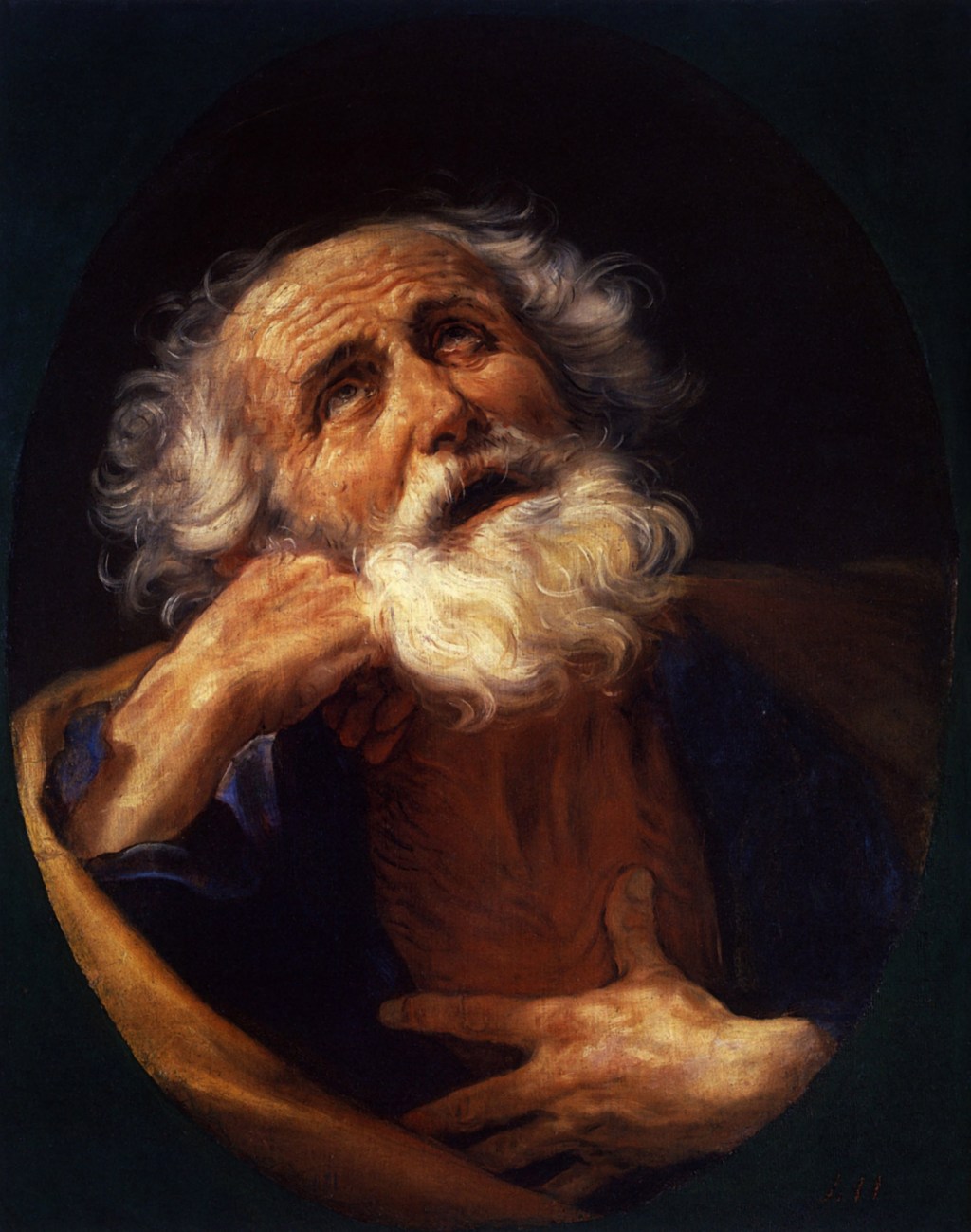
We will learn if we have the humility to make and learn from our mistakes.
“Get behind me, Satan. You are thinking not as God does, but as human beings do” (Mk 8:33).
Peter received this rebuke from Jesus only moments after he recognized Jesus as the Christ. Acknowledging Jesus as the Anointed One was a significant insight inspired by God, but Peter still saw Jesus from his limited perspective, his preconceived notion of who the Messiah was to be. Peter was not alone in this presumption. For some five hundred years the chosen people were awaiting the promise and coming of the Messiah. The greater majority sought a Messiah in the mold of a new King David. One who politically and militarily would liberate the people from their Roman oppression.
The Messiah would set things right. The Messiah would restore proper order politically as well as spiritually. Many of the Jews were not happy with the alliance that the Sadducees, who held control over the Temple, had with Rome.
Peter got the first part right when he answered the question Jesus asked, “Who do people say that I am” (Mk 8:27), but he saw not the suffering servant of Isaiah 53 but most likely some other view of the Messianic hope of Israel. When Jesus began to build on Peter’s first insight by sharing how he would suffer, be rejected, and killed, Peter probably did not even hear anything about Jesus rising on the third day. He pulled Jesus aside and began to rebuke him!
We can learn from Peter’s boldness and misstep. In both instances, Peter confidently shared what he believed. In the first insight, that Jesus is the Christ, he was on target. In the second, he was off the mark by not understanding the reality of Jesus’ impending suffering and death and was corrected. Peter stated what he believed, sometimes insightful, sometimes shortsighted, yet through each experience, he learned. Sometimes they were hard lessons, such as when he later rejected Jesus three times. Yet Peter kept coming back to Jesus. Peter was not lukewarm and/or indecisive.
Too many times I tend to be more cautious and often indecisive. Being reflective is good, but I could use more of Peter’s boldness. What doesn’t work is being afraid of making mistakes. Jesus shared a key lesson with Peter that we need to fully appreciate, and that is, we need to understand things from God’s perspective instead of our own. Our discernment in this area will only improve, as did Peter’s when we build our relationship with God.
Making mistakes, sinning, and being tripped by our temptations is not so much the problem as much as trying to rationalize or justify them, and staying in a state of self-justification when we become aware of them. We need to face them with contrition, seek forgiveness, and learn from them if we are to mature in our relationship with God. The good news is that we are not alone. Jesus walks with us each step of the way. Will he convict us and rebuke us as he did with Peter? Absolutely, because he loves us and seeks the best for us, but he will also provide the support and empowerment we need to get the most effective balance of boldness and humility.
——————————————————————-
Painting: St Peter – Guido Reni, 1634
Link for the Mass readings for Thursday, February 17, 2022
 Spiritual Stepping Stones