

Are we willing to be as dependent and vulnerable on God as an infant is with his/her parents?
“Let the children come to me, and do not prevent them; for the Kingdom of heaven belongs to such as these” (Mt 19:14).
Again we see the disciples refusing access to Jesus. The scriptures are not clear why they consistently act this way. We see them doing so with the blind man Bartimaeus, the tax collector Zacchaeus, and the Canaanite woman. In today’s reading, they are refusing access to children. The characteristic of each of those being refused is that they are considered to be on the periphery of Jewish society.
Children, paidia in Greek, especially so. Paidia could represent a child from infancy to twelve years of age. In ancient Palestine, children were particularly vulnerable, had no status and were completely dependent on their families for survival. Luke goes even further than Mark and Matthew by using, brephē, meaning infant, to describe the children. It is to these children and infants that Jesus states the Kingdom of heaven belongs.
Just as consistent as the disciples are in turning away those in need, Jesus is just as consistent in his ministry of paying particular interest to the individual person in their particular need. He welcomes the children and blesses each one of them. Jesus continually acknowledges and affirms the dignity of each person he meets, especially those neglected and ignored. Those who have been on the other side of the glass looking in, Jesus gives admittance to. Jesus bridges the divide of separation through his presence and healing touch.
To enter the Kingdom of heaven, we must be willing to trust and place, as children, even more so, as infants, our total dependence on God alone, instead of relying on our own initiative or effort. There is nothing we can do to earn our way into heaven. The entrance into the Kingdom of heaven is a free gift of God’s grace. This gift is not about our worthiness, for all of us fall short. It is about our willingness to acknowledge our utter dependence on our loving God and Father and accept the invitation he offers all of us to be in relationship with him. As we do so, we are to resist the temptation to prevent others from having access to this wonderful gift, but instead we are to share the same invitation we have received with others.
Photo: A stained glass image of Jesus with children at Our Lady of the Angels Cathedral, Los Angeles, CA.
Link for the Mass readings for Saturday, August 15, 2021

With this ring, I thee wed.
Some Pharisees approached Jesus, and tested him, saying, “Is it lawful for a man to divorce his wife for any cause whatever” (Mt 19:3)?
The question about divorce came from an already existing debate within Jewish circles of interpretation and schools of thought. Testing Jesus arose from time to time to better understand who he would side with. Regarding the issue of divorce, there was a range of interpretations. On one end of the spectrum, there was the School of Shammai, which permitted divorce only in the event of some sexual misconduct. At the other end, was the School of Hillel, which would allow a man to divorce his wife if she cooked a bad meal (cf. Harrington 2007, 275).
The Pharisees sought to understand the perspective of Jesus in this debate. Jesus responded: “Have you not read that from the beginning the Creator made them male and female and said, ‘For this reason a man shall leave his father and mother and be joined to his wife, and the two shall become one flesh'” (Mt 19:4-5)? This response negated both schools as well as rejected the precept that Moses set for allowing divorce, explaining that, “from the beginning it was not so” (Mt 19:8). Jesus’ defense went back to God’s original intent recorded in the Book of Genesis, which allowed no provision for divorce.
In God’s plan, marriage is a covenantal relationship, as is the relationship between God and his people. A covenant is a sacred bond that is not to be broken. In the Sacrament of Matrimony, a man and a woman who give themselves freely to one another and are open to children as the fruit of their union mirror the Trinitarian communion of Father and Son and the eternal love between them the Holy Spirit.
The ideal of marriage then is to be a lifelong commitment; for God does not break his covenant with us, nor should we. The goal is clear, yet we live in a fallen world and we do not often live up to what God has planned for us. For many reasons, there are times where a marriage does not work as intended but that does not mean we are to give up on marriage. Even though Jesus holds the standard high, he remains with us when we are wounded and in our fallibility. He reminds us: “Those who are well do not need a physician, but the sick do. I did not come to call the righteous but sinners” (Mk 2:17).
We are to resist the temptation to settle for anything less than what God has in store for us, which is a covenant relationship with himself and each other. Relationships are not easy and we don’t naturally know what we are supposed to do. We need to learn how to develop healthy friendships. As we do so, we might be able to better help those not only preparing for marriage but also continue to mentor and guide them during their marriage. And when a relationship breaks down, we need to be present to and walk with those who suffer through the pain of such a rupture. We are not to abandon one another for Jesus does not abandon us and instead bestows his mercy upon us, which is his willingness to enter into the chaos of our lives.
Photo: JoAnn and my hand on my breviary. We dedicated our lives to God and each other, and on the inside of each of our rings is etched the word eternally.
Harrington, S.J., Daniel J. The Gospel of Matthew in Sacra Pagina, vol. 1. Edited by Daniel J. Harrington, S.J. Collegeville, MN: Liturgical Press, 2007.
Link for the Mass readings for Friday, August 13, 2021

Forgiving seventy-seven times – mission impossible or possible?
Peter approached Jesus and asked him, “Lord, if my brother sins against me, how often must I forgive him? As many as seven times” (Mt 18:21)?
Peter’s initial question of asking to forgive seven times may sound pretty generous to us, because the usual question most of us ask is, “Do I have to forgive at all?” Many of us do not do forgiveness well, even if we recognize that it is a virtue. If someone says to us they are sorry, do we reply, “I forgive you?” Often our automatic response is, “That’s alright”, “It’s ok”, or “No problem”. When we are convicted of a mistake, error or offense, do we ask for forgiveness or operate from a defensive posture to explain why we did what we did, or defend what we did as right, not willing to admit any inappropriate action?
We are very habitual creatures, and much of what I shared above is learned behavior. We are conditioned and shaped since the time of our youth and even from our time in the womb. That is why when we hear Jesus’ answer to Peter, “I say to you, not seven times but seventy-seven times”, we may dismiss Jesus’ statement as mission impossible. Another thought that may come to our minds is those cases or positions in which we feel justified in our stance of unforgiveness. Jesus is yet again raising the bar for us.
We are to strive to forgive as our heavenly Father forgives. Forgive the same person seventy-seven times? Yes. If someone is seeking forgiveness, we are called to forgive. Jesus does not mean that we don’t hold people accountable, remain in a dangerous or life-threatening situation, or enable people in their self-destructive behavior. Forgiveness has to do with not holding on to the hurt, not allowing the offense to fester as a grudge that builds to hate and negative or violent behavior. Forgiveness is also not a curse but a blessing. For when we forgive, it is an antidote to the poison someone has injected us with. If we refuse to forgive, we allow the person who has injured us to do so over and over again. In our unwillingness to forgive we allow that poison to continue to fester.
If you are struggling with holding onto a grudge and/or past hurts. One approach that may be helpful is to visualize yourself approaching the person you have the issue with and saying to them, “I forgive you”. You may also find it helpful to visualize Jesus standing beside you while you do this exercise. Repeat the process each day in your time of prayer until you start to feel yourself coming to a place of forgiveness, and can imagine that reconciliation is indeed possible.
If you find visualizing difficult, sit down and talk to Jesus. Be honest with him, tell him the situation and share with him that you do not want to forgive the person. Then ask for Jesus to help you. Embrace the sacrament of Reconciliation and confess your unwillingness to forgive. When ready, determine how best to reach out to the person to say that you forgive them; a phone call, email, text message, or in person.
A third idea that may work is to write the person a letter, whether you send it or not. Each of these practical ways provides an opportunity to approach the great gift that Jesus offers us, to forgive seventy-seven times, or to forgive each and every time we are given the opportunity to do so.
We don’t do forgiveness well. But with Jesus, we can begin again. Let us practice saying each morning, “Please forgive me, (Name)” and think of a few thoughts, words, or actions you need to be forgiven for. Then say, “I forgive you (Name), for…” and think of a few words, actions, or inactions to insert. Also, Jesus gave us a pretty good prayer: “Forgive us our trespasses as we forgive those who trespass against us.” We are not alone. Remember, Jesus asked God to forgive those who crucified him. We can ask God to forgive those who have offended, hurt, or abused us. Then we can actually move to the point where we begin to develop the freedom to say to others, “I forgive you”, and “Please forgive me.”
Photo was taken by JoAnn. When we are open to receiving, God’s forgiveness cleanses us like an ocean breeze.
Link for the Mass reading for Thursday, August 12, 2021
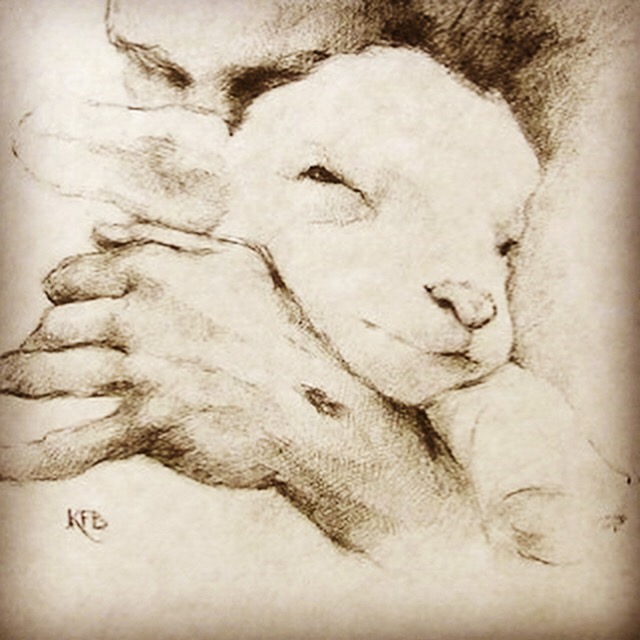
Resist the lure of gossip that divides and instead choose reconciliation that unites.
Gossip is a seductive and enticing poison. Many of us fall for its lure and its intoxication. There are many different reasons we engage in gossip. We may think we feel better about ourselves by putting someone else down, we may be jealous of what another has, envious because we wish someone ill, or maybe someone just rubs us the wrong way. The reason that we may feel justified in choosing to gossip is when someone has hurt, offended, or wronged us in some way. Even in that instance, we observe Jesus offering a different approach in today’s Gospel.
Jesus said to his disciples: “If your brother sins against you, go and tell him his fault between you and him alone” (Mt 18:15). Jesus is drawing on his Jewish heritage. Leviticus 19:17 warns against holding hate in your heart and instead encourages seeking to reason with your brother. Jesus is redirecting us from adding fuel to the fire by seeking revenge or stewing in our own hurt, which will build resentment and hate. Instead, he is inviting us to seek reconciliation.
Pope Francis, in his September 9, 2016, General Audience was very clear: “[G]ossip is a ‘terrorist’ who throws a grenade – chatter – in order to destroy,” he added. “Please, fight against division, because it is one of the weapons that the devil uses to destroy the local Church and the universal Church.” Let us refuse to be a weapon of the devil in his plot to divide us with our thoughts or our words, but instead, seek to be a disciple of Jesus by advocating for forgiveness and reconciliation.
To do so, we need to commit to being more discerning with our tongue. With our words, we can cut, wound, and destroy, or we can convict, reconcile, and heal. Let us choose to lift up and empower one another. It is indeed much easier to grumble about someone than to approach them in love and hold them accountable. If we are not quite ready for that, Pope Francis invites us to “bite our tongue” instead or we can choose to pray about the situation with someone we trust: “For where two or three are gathered together in my name, there am I in the midst of them” (Mt 18-20). In seeking the help of Jesus, we will have a better chance of choosing reconciliation over gossip.
Image credit: “Jesus and the Lamb” by Katherine Brown
Link for Pope Francis’ comments
Link for the Mass readings for Wednesday, August 11, 2021
Are we willing to die to ourselves to be there for others in need?
Jesus said to his disciples: “Amen, amen, I say to you, unless a grain of wheat falls to the ground and dies, it remains just a grain of wheat; but if it dies, it produces much fruit. (Jn:12:24).
In reading this verse, I was transported back to Middle School. Our sixth-grade class was dismissed to head to the cafeteria for the Science Fair. As I drew closer I could hear some unintelligible chanting going on. Of course, I was curious and craned my neck to see over the other students filing in as we entered our destination. As I drew closer and saw a circle of kids taunting and circling someone, I stopped. I heard muffled groans and then saw one of my friends standing in the center of the circle, his forearms pulled up to cover his face. No one was laying a hand on him, but the heckling was inflicting enough damage. I froze not knowing what to do or how to act.
I don’t remember how the situation was resolved, but I do remember how badly I felt that day, and still do for not doing anything. I also withdrew from my friend when I saw him later because I felt so bad for not speaking up or stepping in. I wasn’t there for him as he was harassed nor did I provide comfort later because I was still only thinking of myself, my shame, and not his feelings or his need. That day, I remained just a grain of wheat that did not fall to the ground and die. I was unwilling to die to myself, unwilling to stand up for my friend, and unwilling to provide any comfort.
When we find ourselves in situations when another human being’s dignity is being diminished, Jesus implores us to resist loving our life, assessing first our own self-interest, or we will lose it. Instead, we are to “hate our life” in this world (cf. Jn 12:25) by thinking of others first, instead of ourselves.
We will be in a better position to serve as Jesus did when we are willing to die to self, like the grain of wheat that falls to the ground and dies. We will grow and mature to bear fruit as God’s mouthpiece, when we speak truth to power, work to change systems in our culture and society that oppress and devalue others, prevent and defend attacks against the dignity of people. As we strive for change within ourselves, others, and society, we need to also, at the same time, accompany and provide support, person to person, for those who have been ignored, disrespected, devalued, objectified, or abused in any way.
Jesus, please grant us the courage to love, to will the good of the other. Give us the eyes to see and the ears to hear the cry of the poor; those who are demeaned, belittled, or dehumanized. Holy Spirit, inspire us to to be that grain of wheat that dies to our own self-centered and fallen self, such that we are not just silent bystanders. Loving God and Father, empower us to stand, speak up, and act on behalf of the dignity of those who are vulnerable, those who do not have access, and/or the avenue to speak up for themselves.
———————————————————————–
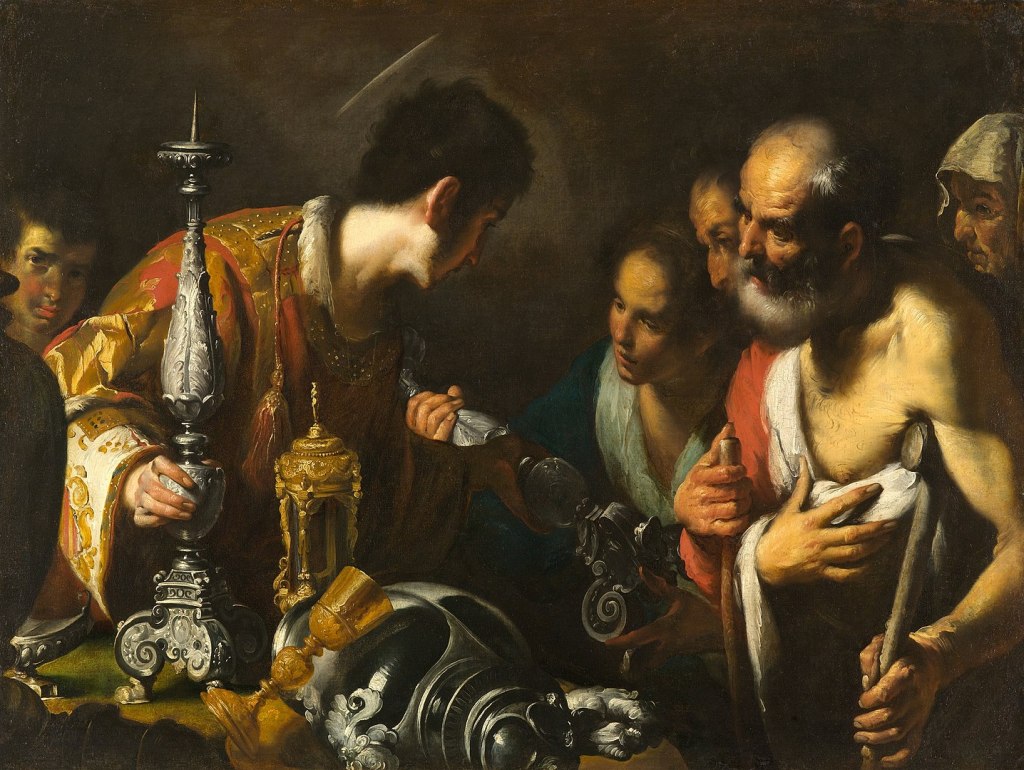
Painting by Bernardo Strozzi of St Lawrence, the third-century deacon and martyr. Lawrence was asked by the Roman prefect to bring the wealth of the church to help maintain the Roman army. Three days later, Lawrence returned with the blind and lame, lepers, orphans, and widows and said to the prefect, “These are the treasure of the Church.” St Lawrence on this your feast day, pray for us!
Link for the Mass readings for Monday, August 10, 2021

Looking upon the crucifix, we are reminded that death does not have the final answer.
Jesus said to them, “The Son of Man is to be handed over to men, and they will kill him, and he will be raised on the third day.” And they were overwhelmed with grief (Mt 17:22-23).
This is the second time in the Gospel of Matthew that Jesus shares with his disciples that he will die soon. They are overwhelmed with grief because their focus is on the first part of Jesus’ statement that he will be handed over to death. They do not understand or yet comprehend the second part about how he will be raised on the third day. How could they? There was no point of reference for them. Jesus did bring three people back to life during his ministry, but Jesus would not be merely resuscitated as they were and just die again. Jesus would resurrect and conquer death.
For us, we can read today’s Gospel about the impending death of Jesus and gloss over it a bit too easily. Because we celebrate Easter each year, we celebrate that Jesus has risen. Yet, do we really take in what this means? Does the fact of the Resurrection, the reality that Jesus has conquered death and become the firstborn of the new creation really have relevance in our lives?
The life, death, and Resurrection of Jesus matters! The missing piece for those for whom this statement doesn’t register any relevance may be that they do not want to think about death all that much. To be honest, none of us really want to come face to face with our own mortality, and most of us don’t until we or a loved one is forced to.
Beginning the summer after my freshman year of college, I began working the second shift in a nursing home as a CNA. It was the first time that I experienced death up close through the care of the residents I worked with. They were not merely patients but became family. What happened when I was present when some of them died was surprising. I was blessed with an experience of peace. This was in contrast to another time that I thought another resident, Richard, had died when I arrived on my shift. I was distraught until I found out only his room was changed.
The most important lesson I learned from these moments of grace and more to follow when experiencing death, was to not take life for granted. Life is fragile and when we are able to contemplate and face the impending reality of our own deaths as well as those we love, I do believe that we live more fully. And when we experience this practice with the One who conquered death, the possibilities in our lives become unlimited.
Jesus understands each of our struggles and tribulations, our sins and our failings, as well as our deepest hopes and dreams. Jesus also knows about our deepest fear of death, for he, as a human being, experienced it too in the Garden of Gethsemane. The gift of the crucifix, the beautiful sacramental object of Jesus on the Cross, is a reminder to us all that death does not have the final answer, Jesus, fully human and fully divine, does.
Photo: Crucifix I have had with me since my early twenties. I brought it with me when JoAnn and I moved to CA after she was diagnosed with pancreatic cancer.
Link for the Mass readings for Monday, August 9, 2021

Jesus will be there for us, no matter what.
In our first reading from the first Book of Kings we hear that Elijah is sitting under a broom tree asking God to take his life. How is it that Elijah, one of the greatest prophets in the Old Testament, is sitting there asking God to take his life?
This is especially surprising, since just in the chapter before, CH 18 of 1 Kings, there is the account of the powerful story of a showdown of faith between Elijah and the 450 prophets of Baal, who he humiliates and has put to death. Yet when news reaches Ahab and Jezebel, the king and queen of Israel, Jezebel sends word to Elijah that she has called for his death. Elijah is running for his life.
Yet in Elijah’s fear and despondency, God leads Elijah to a broom tree, one of the few types of bushes that grew tall enough to provide shade in the Palestinian desert. Elijah is then awaken to find a hearth cake and a jug of water. An angel of the Lord is also sent to encourage Elijah to eat and drink. God provides for Elijah in his time of need. If we read on we will see how God helps to restore Elijah’s courage and deepen his faith and trust.
In our Gospel today we continue with chapter 6 of John. To quickly summarize some of the key points of what we have heard from the past few Sundays. Jesus has miraculously fed the five thousand, they sought to make him king, Jesus retreated from them, and they would track him and his apostles down the next day. Jesus then began his Bread of Life Discourse.
Jesus is the One from above, the One who has seen and has been sent by the Father, the One who is fully divine, as well as fully human speaking to those who have come to him. He has responded to the people’s request regarding how they were to “accomplish the works of God” and his response was that they are to believe in him, he who had been sent by God. They were to “work for food that endures for eternal life, which the Son of Man will give”. Jesus himself, as he did with the multiplication, will provide the food that will endure for eternal life. Jesus shared that he is this food, the bread from heaven, that will give life to the world.
What Jesus has shared thus far and what he shares in today’s Gospel has been given to him to say from his Father and is for everyone who is willing to accept his invitation. Then he adds: “I am the living bread that came down from heaven; whoever eats this bread will live forever; and the bread that I will give is my Flesh for the life of the world” (Jn 6:51).
It is at this moment in his presentation that Jesus and his followers come to a crossroads. Jesus has been talking about the reality that he is the bread of life, which his listeners are struggling to understand, yet, they are willing to follow along to see where he is going. Once he states, at the end of today’s reading, that this bread “is my Flesh”, those in the crowd who only the day before sought to unanimously make him king by popular acclamation, with these three words began to grow very uncomfortable.
This discourse is moving away from a figurative discussion to a more dramatic and concrete presentation with horrific implications. After an initial gasp or two, some murmuring would have begun, centering around such questions such as:
“Did he really just say he would give us his flesh?”
“Is he equating himself with the bread from heaven, and the bread he is offering is his flesh?”
“Is he saying what I think he is saying?”
Yes! The Son is saying all these things because the Father has given all that he is, holding nothing back, emptying himself into the Son. The Son has received all that the Father is and returns himself, giving all that he is, holding back nothing to the Father. This eternal communion of Love shared between the Father and the Son is the Holy Spirit. Jesus is offering all that he is to his disciples and to us, FOR OUR CONSUMPTION. He is holding nothing back of himself in his offer.
We are invited to this intimacy of relationship, to receive all that Jesus is. We are invited to participate in the divine communion of Love, the Holy Trinity.
God provided shade, a cake, and water for Elijah, Jesus provided the multiplication of the loaves and fish for the multitude, now Jesus is stating that he will provide his very self. Jesus is stating that God is present for us, no matter what.
Here is a true story that may help us to get a glimpse of the depths of God’s love for us.
On December 7, 1988 an earthquake devastated the northwestern section of Armenia, killing an estimated 25,000 persons. In one small town, directly after the earthquake, a father rushed to his son’s school only to find that the school had been flattened and there was no sign of life.
But he had no thought of turning back. He had often told his son, “No matter what, I’ll always be there for you when you need me!”
Though the prospects appeared hopeless, he began feverishly removing rubble from where he believed his son’s classroom had been. Other forlorn parents only wailed hopelessly. “My son!” “My daughter!” Some told the father to go home, that there was no chance that any of the pupils could be alive. To which this loving father replied, “I made my son a promise that I’d be there for him anytime he needed me. I must continue to dig.”
Courageously, he proceeded alone. No one volunteered to help him. He simply had to know for himself: “Is my boy alive or is he dead?”
With strength and endurance beyond himself, the faithful, loving father continued to dig… for 8 hours… for 12 hours… 24 hours… 36 hours. Then in the 38th hour, as he heaved away a heavy piece of rubble, he heard voices. “Armand!” he screamed.
A child’s voice responded: “Dad! It’s me,… Armand!” Then, “I told the other kids not to worry. I told ’em that if you were alive, you’d save me, and when you saved me, they’d be saved. You promised you would always be there for me! You did it, Dad!”
Moments later, the dad was helping his son Armand and 13 other frightened, hungry, thirsty boys and girls climb out of the debris. Free at last! When the building collapsed, these children had been spared in a tent-like pocket. The father lovingly carried his son home to his mother, where he was given the care he needed.
When the townspeople praised Armand’s dad, his explanation was, “I promised my son, ‘No matter what, I’ll be there for you!'”
This is what Jesus is saying to those gathered around him in today’s Gospel. This is what Jesus is saying to us today. My Father is here for you. I and the Father are one, and I will not leave you orphans, I will give you my very self to eat, so that as I and the Father are one, we too can be one.
No matter what we are going through, no matter who has let us down, Jesus is here for us. We can come anytime, receive him in the Mass, look at him as he looks at us from the tabernacle, but also in our everyday lives and interactions with one another Jesus is present.
We will receive Jesus in the Eucharist today so as to be more conformed to him, but this is not just for ourselves. This is so that we may go and bring Jesus to others in our lives. We do this by following Paul’s guidance to the Ephesians from our second reading.
– Put away falsehood and speak the truth
– Be angry but do not sin, do not let the sun set on your anger
– Do not steal but do honest work so to share with one who has need
– No foul or evil language is to come out of our mouths, but we are only to say the good things people need to hear
– All bitterness, fury, anger, shouting, and reviling must be removed from you, along with all malice
– be kind to one another, compassionate, forgiving one another as God has forgiven you in Christ.
Like Armand’s Dad, no matter what, God is here for us, just exponentially multiply his presence. God loves us more than we can ever mess up, more than we can ever imagine. May we turn back to him, let us receive Jesus today, let us receive and savor his love in the depths of our minds, hearts, and souls. May we go forth to be imitators of God, as beloved children, and live in love and share his love with one another.
Photo: Artistic representation of the Shroud of Turin
Link for the Mass reading for Sunday, August 8, 2021
“Faith always entails a relationship between persons.”
Then the disciples approached Jesus in private and said, “Why could we not drive it out?” He said to them, “Because of your little faith.” (Mt 17:19-20).
How do the disciples get from this recurring theme of having little faith in the Gospel accounts to Peter healing a crippled beggar by saying with boldness, “I have neither silver nor gold, but what I do have I give you: in the name of Jesus Christ the Nazorean, [rise and] walk” (Acts 3:6)?
A helpful definition “is to say that faith always entails a relationship between persons which stands or falls with the credibility of the person who is believed” (Rahner and Vorgrimler 1965, 164). Faith is not just an intellectual exercise, it is a lived experience. Christian faith is the conviction, belief, and relationship experienced with Jesus the Christ. The disciples learned from Jesus but more importantly developed an intimate relationship with him, such that the love they received and shared became so strong that there was no more room for doubt, distraction and/or fear, such that they would align themselves with the will of God and do what Jesus did and by his power working through them they would do even greater deeds than he (cf. Jn 14:12-14)!
We are invited to do the same. If we only read the Gospels or hear them read we may know something about Jesus, but our life will for the most part remain unchanged. When we read, meditate, and pray with the Gospels and put into practice what we read, we will encounter Jesus as did his disciples and we will come to know and develop a relationship with Jesus and be conformed to him. In this way, we are not just reading a dead letter but encountering the living Word, the Son of God, who invites us to share in the infinite dance of Love that he participates in with God the Father and God the Holy Spirit.
As our relationship and intimacy with Jesus grows and matures we too will be able to say with conviction the words of Paul: “I live by faith in the Son of God who has loved me and given himself up for me” (Galatians 2:20). The best barometer of how we are doing with our relationship with Jesus, is how do we think, speak, and act toward each other?
———————————————————————–
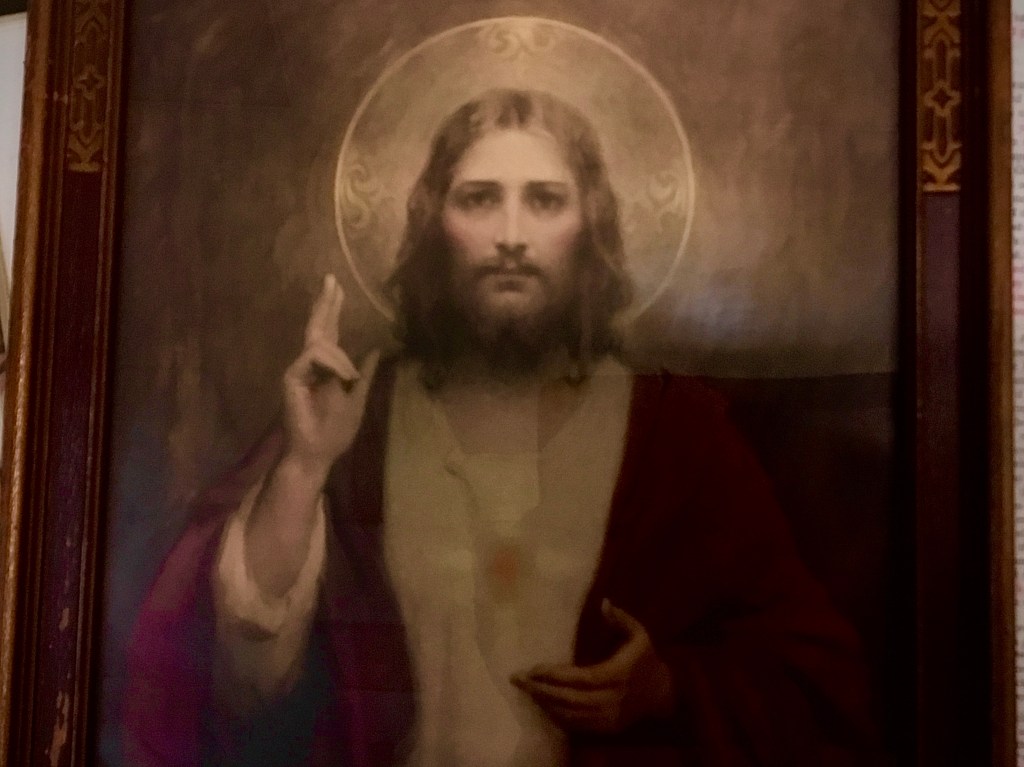
Painting credit: CB Chambers, Sacred Heart of Jesus, a gift given to me by Jim and Christine Zoeller, now hangs in my classroom at CN!
Rahner, Karl and Vorgrimler, Herbert. Theological Dictionary. New York: Herder and Herder, 1965.
Link for the Mass readings for Saturday, August 7, 2021
 Spiritual Stepping Stones