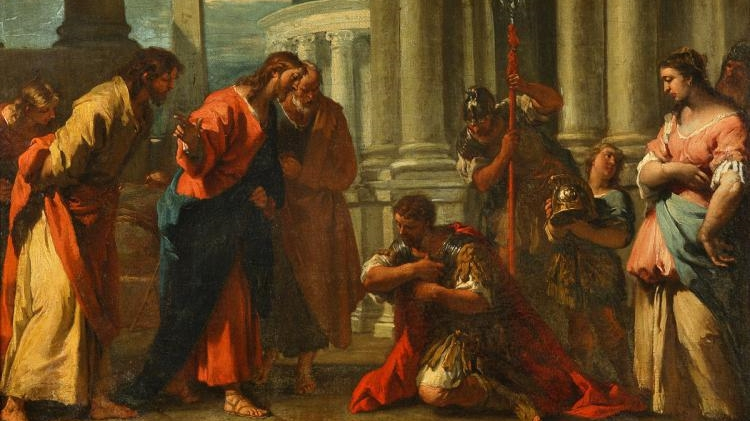

We are most like Jesus, most human, when we are willing to come close.
“Lord, if you wish, you can make me clean.” He stretched out his hand, touched him, and said, “I will do it. Be made clean” (Mt 8:2-3).
Jesus could have healed the man with a word from a distance. Instead, he chose to come close and to reach out and touch the leper. In doing so, he risked contamination, risked being deemed ritually unclean. Yet, Jesus came close anyway and touched the man such that he was healed. The Son of God, from his reality of divinity with his Father, beyond all space and time, was sent by his Father, to come close to us and become human. He became one with us in our humanity so we could become one with him in his divinity.
There are many ways in which we consider others to be unclean and so deemed to be kept at arm’s length. Doing so cuts us off from entering into a relationship with one another AND God. We then begin to believe the stirring of thoughts swirling around in our minds about the other person or persons instead of getting to know another human being with their imperfections yes, but also their gifts.
Getting to know someone beyond first appearances or prejudgements happens when we spend time together. There is a lot more to who we are than the caricatures we may have had imposed upon us or we have imposed upon others. This is also true regarding our relationship with God. We so often attempt to reduce God to what we can understand. God is not about limitation but expansion. He comes close to us in his Son so through Jesus we can get to know the love of the Holy Spirit shared between them and once we have experienced this love we are to reach out to others in their need.
Jesus continues to come close, to touch and heal us as he did the leper in today’s Gospel. If we are willing, he seeks to be intimately a part of every aspect of our lives. He seeks to accompany us in our fears, struggles, and pain. He also celebrates with us when we overcome, repent, experience joy, and especially when we love one another. When we are willing to close the gap and come close, willing to be a conduit of accompaniment and reconciliation, we will begin to see healing in ourselves, our families, communities, and beyond our bubble wrap of comfort. The question is: Are we, like the leper, willing to allow Jesus to come close and like Jesus, willing to draw near to others?
Photo: Willing to come close and build friendships!
Link for the Mass readings for Friday, June 25, 2021
Having a sense of identity is important, while being persons of integrity is paramount.
“No. He will be called John” (Lk 1:60).
With these simple words, three inter-related points arise. First, Elizabeth is beginning to shift the momentum of original sin. Eve was tempted by the serpent to eat of the fruit that God had told her and Adam not to eat of, yet she did. Adam did not support her nor step in during her dialogue but remained silent in the face of the pressure placed upon Eve. Both of them slipped into sin by not following the will of God.
At the time of the birth of Elizabeth’s son, there was even more cause for celebration, for Elizabeth was past child-bearing years. The day had come to have the boy circumcised and named, her relatives and neighbors had gathered around with great excitement and there appeared to be a unanimous decision to name the boy after his father. Elizabeth did not, like Eve, cave to the pressure and temptation surrounding her. Unlike Adam who lost his voice at the time he needed to speak up, Zechariah found his voice, had Elizabeth’s back. Both Elizabeth and Zechariah knew what God wanted them to do and were faithful to follow through despite any cultural pressure and established norm to the contrary.
The second point is already alluded to in the first, and that is how Elizabeth and Zechariah were faithful to God amidst the familial and social pressure placed on them. Some may be removed by such familial pressure when naming a child, but for this time, Elizabeth despite the pressure held her ground and stood firm that the boy would be named John. Ignoring her, the people deferred to Zechariah, the boy’s father, thinking he would have more sense, but he, ignoring the paternal cultural pressure, supported Elizabeth. The point here is not so much the name, but the following of the will of God in the face of pressure to do the opposite.
This brings us to the third point and that is the maturation in moving from identity to integrity. Culture and traditions are not sacred, but God is. Elizabeth and Zechariah faced a lot of familial and social pressure to conform, yet they chose to be true to God, to be true to themselves, and they chose integrity over their identity.
The very simple account of Elizabeth and Zechariah naming their child John in opposition to the pressure offers for us a way to counteract the rising tide of polarization and conflicts that we face in our own country today. Identity provides safety, support, and security. It fuels one of our deepest pangs of hunger and that is to belong, to be a part of something bigger than ourselves. We can find our identity in family, friendships, our religious traditions, culture, political affiliations, common interests, clubs, activities, and hobbies. But our identity, which provides us with security and stability is good but can also be a trap.
We want to belong so much, the drive is so strong, that we may have made decisions, acted in ways, and supported others, that go against who we are just so that we can belong. We may have known what God wants from us, heard the whispers of his voice in our conscience, yet were pulled by the louder voices of our group. We are sometimes so ingrained by our identity that we are being strangled and suffocated by it.
In today’s Gospel account, Elizabeth and Zechariah were true to the will of God and won over those placing pressure on them by their family and neighbors. More often though, being a person of integrity does not go so well. Their own son, who would grow up to be John the Baptist, would lose his life by speaking truth to power.
John would also show his integrity when he said, “I must decrease and he must increase” (cf. John 3:30). John was talking about Jesus who embodies the moral courage that we all need today. Though more than just a model of a life well-lived, more than just a word on the page, Jesus is the Word of God. Jesus is present to us now, to guide and lead us, to empower us with the same love that he embodies, such that when we invite him into our lives, we too can be transformed to live a life of truth, moral courage, and integrity.
Becoming less, like John the Baptist, and allowing Jesus to be more by working through us, will help us to act and speak up for those that are being belittled, demeaned, and/or dehumanized. We can then transcend the ranks of identity and rise to the heights of integrity, especially when it means standing up to those in our “group.” Protecting police officers, priests, and/or political leaders who have abused their power at the expense of others for the sake of protecting the identity of the institution or our place in it not only adds further abuse but weakens the institution. While at the same time, casting a net of guilt by association over all in any group is also unjust. We also may be shaming those who could be the very ones to help to bring about necessary and sustainable change.
Being people of integrity, we are to speak for those who have been abused and not afforded basic human dignity. We are to protect those who might be at risk and/or those who have been or are being abused, oppressed, and/or prevented equal access. This provides a necessary step in providing support for those needing healing, allows for the planning and enacting of the necessary reforms to end the risk of further abuse and create more equitable access.
All of which will also strengthen the integrity of those within the construct of institutions that are put in place to empower the very people they serve. We are to hold each other accountable while at that same time be willing to work toward a reconciliation that will arise through mutual respect, openness to dialogue, collaboration, and reconciliation.
————————————————————————–
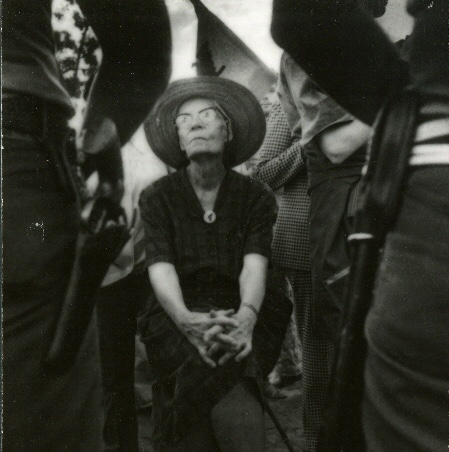
Photo: Dorothy Day speaking with police officers during her time picketing for the rights of farmworkers in California in 1973. Credit – Bob Fitch.
Link for the Mass readings for Monday, June 24, 2021
Reading, meditating and praying with the Gospels daily will lead us to encounter the living Word, Jesus the Christ.
“Beware of false prophets, who come to you in sheep’s clothing, but underneath are ravenous wolves. By their fruits you will know them” (Mt 7:15-16).
So as not be taken in by false prophets within in our Church and society, and most importantly, so as not to be wolves in sheep’s clothing ourselves, we need to know the Shepherd. We need to know, as St Irenaeus (whose feast we celebrate on Monday the 28th) described: Jesus, “who did, through His transcendent love, become what we are, that He might bring us to be even what He is Himself” (p. 526 Against Heresies, Book V, Introduction). Jesus Christ, the second person of the Trinity, who entered and embraced our fallen and wounded condition to become fully human while remaining fully divine, came to shine a light on that which causes division and disunity. Jesus came to reveal those sinful acts which estrange us from God and one another. Jesus came to show us the value of our unique dignity as human beings, the wonder of God’s creation that we are, and empower us so as to restore our relationship with God and one another.
How can we know Jesus today as we are removed from the time of the Apostles?
One way is that we can begin by following the lead of Pope Francis who has been encouraging us to read and prayerfully reflect upon the Gospels each day.
This does not mean that we just read the words on the page with the sole intent to finish it and move on to something else, so as to complete one more task. Instead we are to read slowly, reflectively, spending time with Jesus by mediating on a word or phrase from the Gospel that peaks our attention. We may receive an insight, an intuition, a confirmation, a sense of excitement, or a question as we are reading. We can also be confused, perplexed and frustrated. A helpful practice is to place ourselves in the scene as if we are watching a movie. Then we can imagine our senses coming alive and pay attention to what arises.
Another gift of encountering Jesus in the Gospels, that some may not recognize as a gift, is that we will naturally be drawn to examine our conscience as we read and ponder the life and teachings of Jesus. As we are able to see those fruits of selfishness, greed, judgment, gluttony, lust, pride, indifference, sloth, envy, wrath, and/or any others that we are bearing. We can then seek God’s forgiveness so to begin to prune those branches within us that lead to such fruits. This discipline will provide more energy and nourishment for the fruits of love, joy, peace, patience, kindness, chastity, goodness, generosity and self-control, to grow and mature in our life.
It is important to sit with the encounters we experience from a reflective and meditative reading of the Gospels and not just blow off what arises. We need to pay attention, meditate for a time on that word, phrase, insight, or other experience that has arisen. We need to also be open to wrestling with passages that may challenge us, that we do not understand, or disagree with. Each experience provides us with the opportunity to ponder and discern what God may be revealing to us.
Through a daily commitment of praying with, meditating upon, and allowing the Gospels to come alive, we will not only know about Jesus but come to encounter and know him and his voice as his disciples did, personally. We will in time begin to bear the fruit that arises from the nourishment the living Word of God provides that will shape our thoughts, words, and actions.
As we experience the Gospels critically as well as prayerfully, we will come to know Jesus and his voice, we will begin to recognize, through the fruits that others bear, those false prophets who seek to lead us astray, and so be better able to resist their temptations, as well as our own temptations. We will better know the truth of who we are and who God calls us to be. More importantly, we will not lead others astray but as we bear the fruits of the Holy Spirit we will help others through word and deed to experience the Shepherd in their lives.
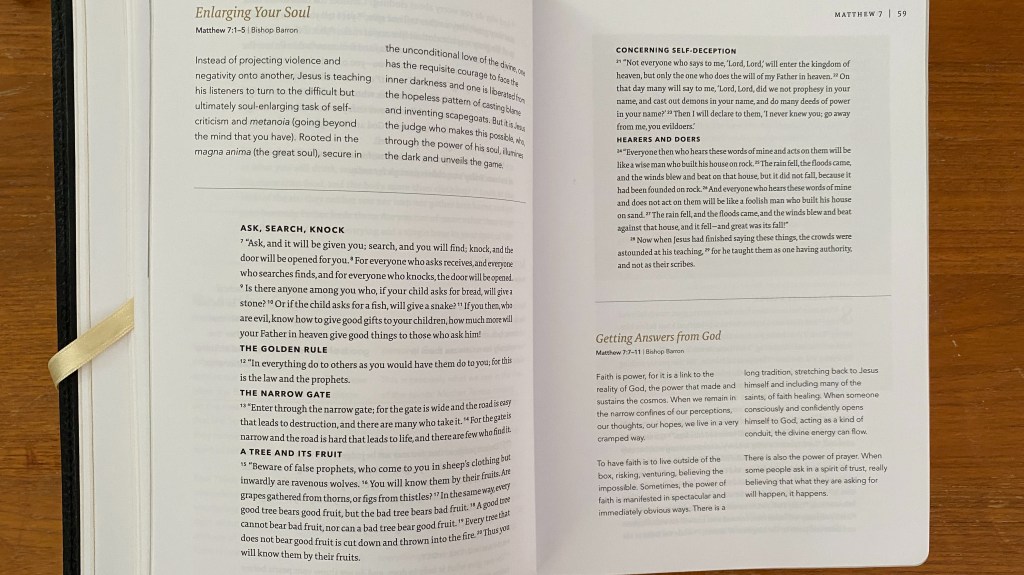
Photo: I recently purchased The Word on Fire, Volume I – The Gospels. It is an awesome resource that provides rich commentaries from the Church Fathers, the saints through the ages, contemporary authors, and Bishop Robert Barron, whose Word on Fire team produced it. There are excellent artistic representations of the Gospel accounts to aid in mediation as well. A great resource for the journey!
Link for the Mass readings for Wednesday, June 23, 2021

Daily discernment and examination of conscience can help us enter the narrow gate and stay on the road to eternal life.
“Enter through the narrow gate; for the gate is wide and the road broad that leads to destruction, and those who enter through it are many. How narrow the gate and constricted the road that leads to life. And those who find it are true” (Mt 7:13-14).
Jesus meets us where we are in our present state of life. He accepts us as we are at this very moment. At the same time, Jesus does not want us to just settle, to be minimalists, and to merely get by, surviving day by day. Instead, he encourages and guides us to be fully actualized. He calls us to perfection, to holiness, to be saints! He sees in us, as he did in his disciples and apostles, the promise of our potential and who his Father calls us to be. We each have a unique gift or gifts to offer to the world, each and every one of us.
One way of interpreting entering the narrow gate is that we need to say no to those apparent goods that we find initially inviting but soon realize that they are empty promises, can burden us, weigh us down, and worse lead us to addiction and enslavement. To pass through the narrow gate, we need to say yes to that which will truly bring us happiness, fulfillment, and true freedom and this means we need to say no to supporting our false ego and turning the focus in upon ourselves. We need to instead be willing to expand and go out of ourselves and will the good of and accompany others.
Jesus will help us in seeking and discerning his will. Spending time to pray together can often provide the opportunity for worry, anxiety, or fear; pride, judgment, or prejudice; sinful actions, harmful habits, or addictions to surface. We need not deny or run from them. Instead, acknowledge whatever arises with Jesus, and then allow him to provide healing and transformation. This will not be a one-time, done now for all activity, but a daily, disciplined commitment and practice of discernment and examination of our conscience.
We need to continually open our hearts to the Holy Spirit such that he will give us the courage to discern between apparent and authentic goods in our lives. In our time of prayer, imagine placing our hand in Jesus’ hand as if we were a small child and allowing him to lead us to experience the love, mercy, and grace of our ever-present God and Father. What Jesus leads us to do, he will also give us the strength and resources to bring to completion, which ultimately will be a life of communion with God and one another in this life and the next.
———————————————————————-
Photo credit: Photo by Rene Asmussen from Pexels
The Mass readings for Tuesday, June 22, 2021
Experiencing the love of God will help us to move from judging others to empowering others.
For many of us, judging one another is almost as automatic as breathing. As we encounter someone we have instant internal judgments. We judge looks, clothes, actions, inactions, homes, cars, and material items. We judge our family, spouses, friends, colleagues, classmates, leaders, enemies, celebrities, as well as those different from us and those on the peripheries. Much of what gets our attention when we take the time to think about it is what Jesus is addressing in today’s Gospel, negative judgments.
Jesus said to his disciples: “How can you say to your brother, ‘Let me remove that splinter from your eye,’ while the wooden beam is in your eye? You hypocrite, remove the wooden beam from your eye first; then you will see clearly to remove the splinter from your brother’s eye” (Mt 7:4-5).
There are positive judgments that bring about effective change for the good. In a court case, our hope is that the judge is learned in the law and guides the lawyers and jury in ways of sound judgment such that justice with mercy is served. For us to do likewise in our everyday interactions with one another, Jesus shares that we need to remove the wooden beam from our eye first before we are able to remove the splinter in another’s.
Jesus is leading us to experience transformation. He is inviting us to change our hearts such that they are no longer hardened by negative judgments of others based on our biases and prejudices, but softened, such that they are open to the mercy and love of Jesus. This does not mean that we accept any and all behaviors, actions, and inactions from ourselves and others. Jesus does not do this. Jesus accepts ALL people as we are and where we are, with mercy. He is willing to enter our chaos, to embrace any and ALL of us who will receive the invitation of his healing embrace, and through his love Jesus accompanies and walks with us, leading us from our slavery of sin to that which is True, Good, and Beautiful.
We participate in the life of Jesus when we allow him to heal us from our own limitations of self-centered perceptions, from the denial and suppression of our anxieties and fears that lead to the developing of our biases and prejudices. Then we will begin to see others as God sees them, as human beings endowed with dignity because ALL people have been created in the image and likeness of God.
We participate in making our realm of influence a better place when we allow God to love and to bestow his mercy upon others through us. We participate in Jesus’ work of redemption when our judgments toward ourselves and others are not condemnations but convictions that help to empower, build, and lift up our brothers and sisters.
We participate in taking the log out of our own eye and assisting to remove the splinter in another’s eye when we are willing to admit to our shortcomings, weaknesses, and failures, and then learning and growing from those experiences. We are then in a better position to be able to accompany others in their own chaos, to journey side by side, willing to help each other to be transformed into who God is calling us to be.
These steps will begin when we first are willing to lay down our gavels of judgment, biases, and prejudices and instead, with open hearts on fire with the love and mercy of the Holy Spirit, offer our hands to one another with an invitation to walk hand in hand, arm in arm, so to be about building each other up.
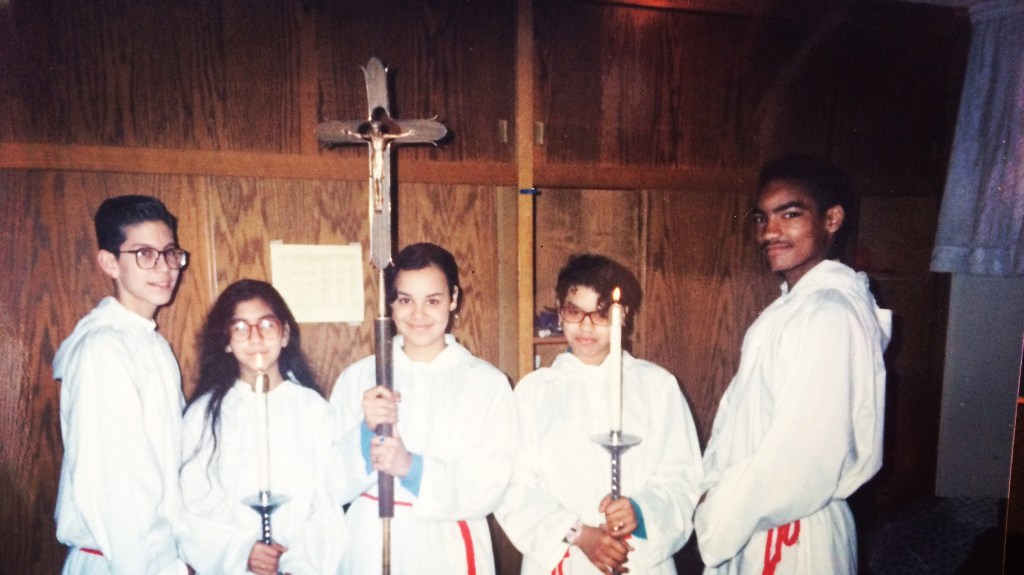
Photo: One of the best altar server teams of over one hundred altar servers that I was blessed to train and serve with at Holy Cross Parish in the Bronx, NY, around 1991.
Link for the Mass readings for Monday, June 21, 2021

Jesus cares and is present when tempests arise.
One element on display in this recounting of the calming of the storm at sea is the humanity of Jesus. He has finally succumbed to the exhaustion from being pulled and touched, challenged and accused, the constant interaction through his service of teaching, healing, forgiving, and exorcising, that he not only fell asleep on the boat but was in such a deep sleep that he was as if dead, even through the height of the storm tossed the boat. Also, we see his divinity expressed when his disciples wake him and he calmed the storm immediately with just his word: “Quiet! Be Still” (Mk 4:39)!
The disciples have grasped his uniqueness and have accepted him as their rabbi, their teacher, but they are still having trouble comprehending that he is also the Son of God. The disciples will continue to experience his miracles, but it will not be until after the resurrection and ascension, that their faith will find the maturity to participate in the fullness of the ministry Jesus was grooming them for. When the Holy Spirit came upon them at Pentecost, they were tried and true.
Storms arise in our lives, sometimes just as unannounced and as quickly as the squall in today’s Gospel. A health issue, an injury, an economic shift, a conflict in a relationship, the effects of a mistake in judgment or a sinful choice… All can arise at a moment’s notice just as we have been experiencing with this pandemic. We, like the disciples, can sometimes only hold on so as not to be tossed into the sea, or bail out water so we don’t sink. Sooner or later though we may just want to turn to Jesus to seek his aid. A helpful point to keep in mind is one that I learned from one of our past retreat directors, Fr. RB when he offered in one of his homilies: “Sometimes the Lord calms the storm, and sometimes the Lord lets the storm rage on and calms his child.”
I have taken great comfort in those words as well as the words of Pope Francis who has said time and time again, especially during the height of the pandemic in April of 2020, that Jesus cares. No matter the severity of the storm, we can trust that Jesus does care and that he is just as present with us, as he was with his disciples in the boat. Even if we brought the storm upon ourselves, Jesus will not abandon us.
Having experienced a storm or two with Jesus then, we are better able to guide others. We can be like Mary and bear Christ to others, allowing him to be present through us for those who are in need. We can embody the words of Jesus, “Quite be still”, when we are willing to remain during another’s storms, to let another know we care with a hug of support, an active listening ear, a heart open with understanding, and our ongoing and enduring presence.
We can trust that Jesus will calm whatever tempest that rages or our minds to guide us through.
Photo: Afternoon storm clouds
Link for the Mass readings for Sunday, June 20, 2021

Our faith grows when we befriend our fears and one another.
In today’s Gospel from Matthew, Jesus draws a direct correlation between our level of worry and our faith. Having faith is a common theme throughout Jesus’ teaching. How many times have we read or heard, “O you of little faith” (Mt 6:30). At its core faith is that we trust what Jesus says is true. If we are feeling anxious or worried our focus may be on dwelling on the past, rehashing something we did or did not do, not sure if we made the right decision, or we could be anxious about the future for our minds plague us often with the worst case scenarios of what might be or what could happen. We also may react to another’s actions or words, not fully understanding the context or source of the hurt or struggle they may be going through that caused those words or actions. When we stay focused and become fixated on our own reaction, and/or stay stuck in our emotions of the situation, instead of seeking to understand the other person, our insides can churn.
In each of these occasions we are not focusing on God, we are not trusting in him, we are exercising little faith because our focus is on our self. Jesus is telling us that, “No one can serve two masters” (Mt 6:24). Either we place our self first or we place God first. Jesus is guiding us to put God first in our lives and to trust in him.
Anxiety, worry, and fear, can be debilitating and paralyzing and that downward spiral inward, that curving in upon one self creates expressions of the worst of our humanity. Native Americans, African Americans, Irish, Germans, Catholics, Japanese, and now Latinos have over the years been demeaned, dehumanized, abused and killed, instead of accompanied, heard and encountered. Difference and diversity, terrorists, increased violence, job loss, out right self interests, prejudice and racism have fed and continue to feed the dark side of our fallen nature.,
Jesus’ life, words and actions provide a starting point for shifting the momentum of the cycle of enslavement to our anxieties, worries, fears, and prejudices. In each of our individual circumstances and situations, we need to be aware of, identify, and embrace them and instead, “seek first the Kingdom of God and his righteousness, and all these things will be given you besides” (Mt 6:33).
On a national level, there is a way that we can bring about immigration, prison, and police reform without politicization and dehumanization, but we must begin by resisting the temptation to label and demonize and instead acknowledge each other as human beings that are to be afforded dignity and justice. We need to trust that God will provide for all who have needs, and collaborate with him to bring about reconciliation and solidarity.
One of the greatest perpetuations of injustice is that too many of us isolate ourselves. We retreat into our own bubbles, associate only with our own self-defined groups, resist embracing the gift of our diversity, and thus do not get to know one another. We give in to the fears that support our prejudices, we don’t want to rock the boat or deal with conflict head-on, so we don’t listen and speak to each other, or at the other extreme, we shout at or over one another. There really can be a middle ground of respectful dialogue.
To embrace our faith in Jesus, means we are to acknowledge and befriend our anxieties, worries, and fears when they arise, trust in God, and together face them. In this way, we will be better able to resist the impulse of isolation and instead work for unity, resist the language of dehumanization and hate, and instead promote compassion and love. When we trust in the transforming fire of the Holy Spirit, we can arise from our defensive postures, come from the shadows to reach out, encounter, and spend time with one another. The first step comes when we truly begin to believe that what we do to the least of our brothers and sisters, we do to Jesus, meaning we are to embrace our mutual human dignity and the gift of our diversity.
———————————————————-
Photo: First Communion prep class, Bronx, NY early 90’s.
Link for the Mass readings for Saturday, June 19, 2021
We may be able to better appreciate the gift of this life if we embrace preparing for the next one at the same time.
During this time of year, my mind often turns to house and yard upkeep and repair. Time indeed goes quickly. It felt like only a few years ago that we were moving into our Florida home which was newly built in 1999. Over the past twenty-two years, how much updating our house needed and is still in need of! Before we found out that JoAnn was sick we were planning to move to California to be closer to our adult children, so we stepped up our efforts a notch and tore up the original rugs, sealed leaks and filled cracks in the floor, dusted, spackled, sanded, and painted, put in new flooring and kitchen counter tops. At the same time, as we had to move items around, we realized how much we have been weighed down with that which we gathered, saved, and held on to, more than was necessary and so in addition to the above improvements we began to purge, sell, and give away items.
Since we have been here in our home, our three Golden Retrievers are no longer with us, JoAnn’s mother and all of her aunts, and all of my grandparents have also died and a year and a half ago JoAnn also died. Though we did move temporarily to Los Angeles to be closer to our “kids” for the final months of JoAnn’s life, I returned our Florida home in December of 2019.
These opening thoughts are a sketch of the practical reality expressed in my life that highlights the words of Jesus from the first section of our Gospel from Matthew this morning: Jesus said to his disciples: “Do not store up for yourselves treasures on earth, where moth and decay destroy, and thieves break in and steal. But store up treasures in heaven, where neither moth nor decay destroys, nor thieves break in and steal. For where your treasure is, there also will your heart be” (Mt 6:19-21). Jesus is helping his disciples then and us today to be aware of the reality of our world. All that exists is finite and material. Each thing, each being, has a beginning and an end. We need to resist the temptation to be attached to anything, even to our family and friends, because in this life nothing lasts forever.
Adopting an attitude of non-attachment to material things can be freeing as long as we do not embrace the opposite extreme of placing no value in created things, thinking that we can destroy and abuse the environment, exploit each other, because neither will not last. We can also be tempted to see all things not spiritual as corrupt and bad, even our material reality as human beings, such that our soul is imprisoned until we die. This extreme will not bring us happiness, joy, or fulfillment either.
Living a life directed by the Gospel is to embrace a more balanced life of recognizing that much of what is material and finite is good, yet each has a time and a season. We have the opportunity and invitation to be participants in God’s eternal plan of salvation, and we can embrace and enjoy the wonders and gifts of his creation when we don’t hold onto the things of this world too tightly.
We need to resist grasping at and clutching anything material and finite. In this way, we can be freer to embrace the steady movement of the Holy Spirit, which is ever fresh and new. The Holy Spirit seeks to lead us to deepen and to grow in our relationship with our loving God and Father and one another, so to store up our true treasures which are in heaven.
When we embrace the reality that our time here on earth is limited, we might not take it for granted as much, we might realize how precious this life is, and we may give up the urge to belittle, demean, and dehumanize one another. Instead, let us show greater appreciation for each other, strive to be present and accompany one another, seek to be kinder, more supportive, and patient with one another. We need to let the petty things go and embrace the love that Jesus inspires us to live, so to be there for one another through thick and thin.
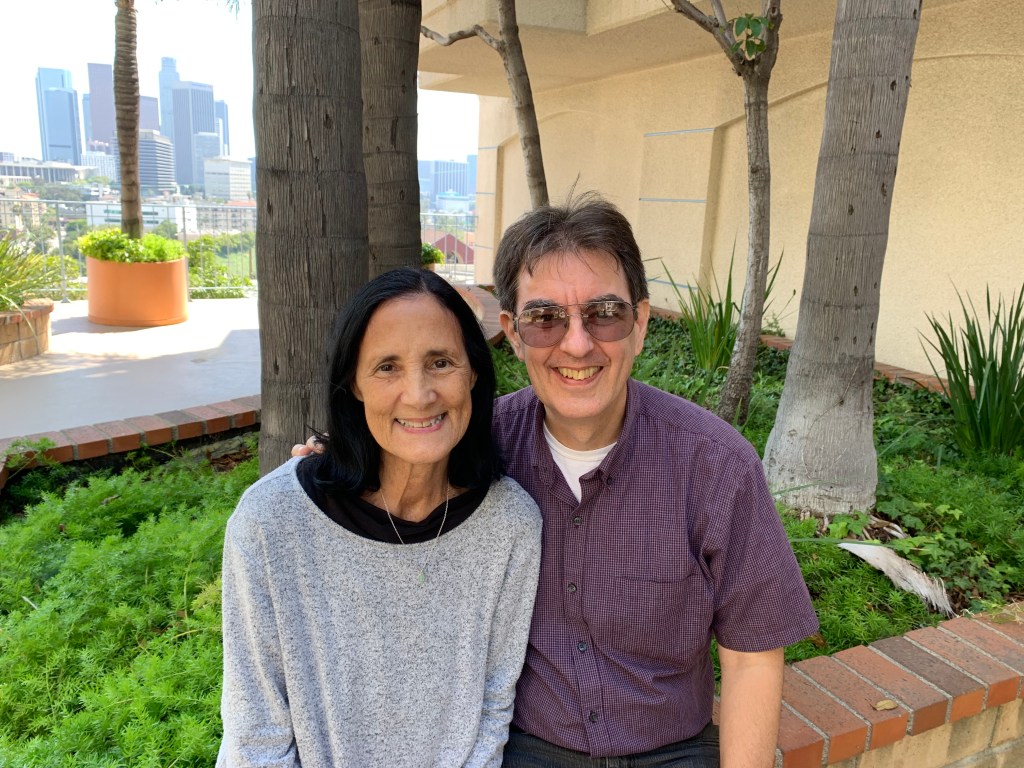
What helped JoAnn and me during her last months was accepting the gift of knowing that her time was short. We appreciated each moment together more. We had the time to get our affairs in order in this life, so JoAnn could be free to prepare for the next. Death is not easy when we have time to prepare nor when it comes unexpectedly in a flash. Trusting that death does not have the final answer but Jesus does helps. As we all continue our journey together, may we enjoy the goodness of this life while at the same time “store up treasures in heaven where neither moth nor decay destroys, nor thieves break in and steal” (Mt 6:20).
———————————————————————–
Final weeks in LA. We leaned on each other and Jesus each step of the way! Photo credit: Giovanna Christian
Link for the Mass readings for Friday, June, 18, 2021
 Spiritual Stepping Stones