Jesus is holding up a mirror, who do we see?
In our Gospel reading from Mark, there appear to be two separate accounts. In the first, we witness Jesus’ critique of the scribes, and in the second, the generosity of a poor widow is emphasized. There could not be a starker contrast between the two. Jesus points out those scribes with the primary motivation of self-aggrandizement, “who like to go around in long robes and accept greetings in the marketplaces, seats of honor in synagogues, and places of honor at banquets” (Mk 12:38-39). They make a lofty show of themselves, yet, what is worse is the following verse. “They devour the houses of widows and, as a pretext, recite lengthy prayers” (Mk 12:40).
The implication is that certain scribes used their position not to edify, provide care for, and lead widows closer to God, but instead chose to exploit them for their own selfish gain. As Jesus finished his rebuke of the scribes, he then observed those making contributions at the treasury of the Temple. A poor widow donated two coins. No one, except Jesus, noticed. Jesus called his disciples to him and said, “Amen, I say to you, this poor widow put in more that all the other contributors to the treasury. For they have all contributed from their surplus wealth, but she, from her poverty, has contributed all she had, her whole livelihood” (Mk 12:43-44).
Jesus commends this woman for her generosity. She does not make a fancy show of what she is doing, she quietly and simply gives all that she has. Is Jesus sharing his critique of the scribes just moments before related to this expression of generosity by the widow? Could she have done so through the influence of one of these scribes? We are not told why she gives all she has, but her willingness to do so is clearly on display.
Often in the Gospels, Jesus holds up a mirror, especially to those in positions of religious authority who place their focus on themselves, their own gain, and prestige, instead of their service to the poor and those in need. Those like Matthew and Zacchaeus, though not scribes but tax collectors, embraced Jesus’ invitation of repentance, were willing to make a 180 degree turn from their old ways of self-service, and instead were willing to change and begin anew.
Will we be like the unnamed scribes and Pharisees who were not willing to look in the mirror that Jesus held before them, more interested in supporting their place of entitlement and privilege, and be unwilling to change? Or, will we, as did Matthew and Zacchaeus, allow our consciences to be convicted, be willing to repent and rend our hearts so to be moved and more willing to love, so to stand alongside our brothers and sisters in need?
We are receiving a clear message through this pandemic and from Jesus that what affects one of us, affects all of us or as Bruce Lee stated, “Under the sky, under the heavens, there is but one family.” If one among us is hurting, we are all hurting. We can do better to help one another.
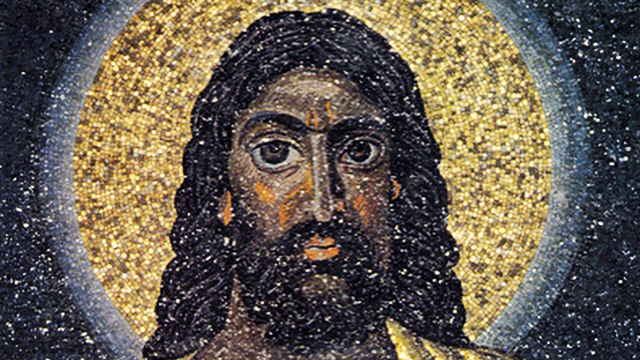
Photo: Closeup of a mosaic of Jesus in the apse of the Basilica of St Cosmas and Damien in Rome.
Link for the Mass readings for Saturday, June 5, 2021
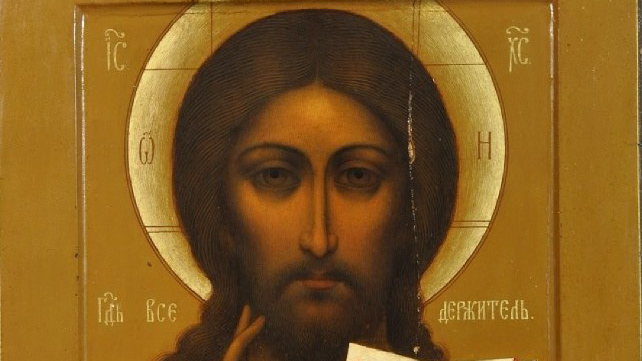
Iesous Kyrios – Jesus the Christ is our Lord.
The opening scene from today’s Gospel from Mark opens with Jesus teaching in the temple area. He poses this question to those gathered, “How do the scribes claim that the Christ is the son of David” (Mk 12:35)? The question that Jesus is offering engages in the Jewish debate regarding the promise of the Messiah or Mashiach in Hebrew, the Christ or Christos in Greek. Messiah or Christ is not a surname but a title meaning anointed one.
One interpretation of the long-awaited Messiah was a kingly figure descended from King David. Son of David is a common Messianic title. The blind Bartimaeus called out to Jesus using this title (cf. Mk 10:46-48). Jesus then quotes the beginning of Psalm 110 as he goes deeper. “David himself, inspired by the Holy Spirit, said: The Lord said to my lord, ‘Sit at my right hand until I place your enemies under your feet’” (Mk 12:36).
This statement can be a little confusing, especially if you are hearing this word proclaimed and not reading it closely. The first Lord referred to by Jesus has a capital letter “L”and the second lord has a lower case “l”. The reason for this is that in the original Hebrew the sacred name of God was not to be uttered or written. Instead, the Hebrew Adonai, meaning Lord, would be used to refer to God. The use of the word lord with a lower case “l” could refer to a military leader like King David.
In this very short account from Mark today, Jesus deftly addresses some of the titles floating around about him, Messiah, Son of Man, Son of David, and with his final question, “David himself calls him ‘lord’; so how is he his son” (Mk 12:37). This One to follow David would be even greater than the expectations of these messianic titles because he actually preceded David and so is even greater than the genetic heir to David. Jesus is saying that he is the Son of God and he is Lord.
This not only far surpasses even the highest ideal of messianic hope but would also be a direct challenge to the occupying Romans. For in the ancient Greek, of which Mark is written, Kyrios, means Lord. For the Romans, Caesar is Lord. Jesus is challenging the worldly establishment by saying that he, not Caesar, is Lord.
Jesus, soon after these words, will participate in his suffering, death, resurrection, and ascension, where he will return to be seated at the right hand of God his Father. The enemies that will be subjected under his feet will be sin and death, each of which he will defeat.
This is why Jesus is our hope even and especially during our troubled times. Jesus is our Lord not any emperor, president, or worldly leader. It is he to whom we are to place our trust, to follow. It is Jesus as our Lord who will lead us to freedom from our bondage to addiction, racism, sin, suffering, and ultimately even our death.
Photo of an icon of Jesus accessed from link
Link for the Mass readings for Friday, June 4, 2021
When we put God first, our relationships with ourselves and each other fall into place.
In today’s Gospel from Mark, one of the scribes approached Jesus and asked him, “Which is the first of all the commandments” (Mk 12:28). This may have been a challenge to Jesus or it may just have been a valid question of one seeking the Truth. Scribes were the experts in securing and making known the Torah. They could read and write, a skill not only used for protecting and passing on the faith, but also for the daily tasks of commerce and contract writing.
This question of the scribe was one that was asked often by those who sought how best to live out the Torah. Not only were there the Ten Commandments, but throughout the Torah, there were 613 prescribed laws! A common debate that was often entered into was which were the most important to follow to be faithful, as well as the minimalist approach, being, which were the most important to be followed so someone could just get by?
Jesus replied, “The first is this: Hear, O Israel! The Lord our God is Lord alone! You shall love the Lord your God with all your heart, with all your soul, with all your mind, and with all your strength. The second is this: You shall love your neighbor as yourself. There is no other commandment greater than these.” With this response, Jesus drew first on Deuteronomy 6:4-5 and then regarding loving your neighbor, Leviticus 19:18. By answering in this way, Jesus stated that when we orient our lives to who God has created us to be, which is to Love God first, place God at the center instead of ourselves, we can then better love our neighbors and ourselves.
St Augustine, the bishop of Hippo (354-430), echoed Jesus’ “Greatest Commandment” by stating that we can love God and do whatever we want. The order of that statement is aligned to the commandment Jesus gave. God is first. The problem many of us have is that we place ourselves first, and seek to bend God’s will to our own. We look to flip the words to, do what I want and God will love me. It is true that God will love us, but we will not experience his love, for when we place ourselves first we will have disconnected ourselves from our relationship with him.
When we shift our orientation to seeking God first, such that he is the foundation of our life, our world opens up. Many of us are wounded by our own sin and the sin of others. We retreat into defensive postures and actualize defense mechanisms to survive. These may be good and necessary at the moment, but the challenge is that if we continue to live in a posture of survival mode, we are merely existing.
God wants us to strive to be fully alive by actualizing our vocation and the truth of who we have been created to be. This becomes a reality when we recognize our need for and open ourselves up to receive God’s love. When we do so, we can then receive his healing balm of forgiveness, love, and mercy. Once we begin to experience each we will begin to see ourselves and others, not from our own limited perspectives where we can slip into defensive postures that may feed our biases and prejudices, but from the greater breadth and depth of how God sees us as his children, made in his image.
God reaches out to us in so many ways to tell us that he loves us more than we can ever imagine. Unfortunately, when we are diverted and distracted by other false pursuits apart from his will we limit our experience of this love. Yet, God’s love for us remains unconditional. God loves us as we are, right now, right at this moment. We just need to take some time to sit, breathe, and be willing to accept the gift of being loved for who we are as well as embrace the fullness of who he has created us to be as mental, physical, emotional, sexual, and spiritual human beings. We need to resist repressing any aspect of who we are and allow God access to all aspects of ourselves, so as to become more whole and more alive.
Through embracing God’s healing forgiveness, love and mercy and being engaged in the fullness of our humanity, we can begin to relax our defensive postures. We can become advocates for healing the division, dehumanization, and polarization in our realm of influence in person and online. By not being limited by our biases and prejudices and refusing to project blame and/or shame on others we can be more open to encounter and accompany one another as human beings, and then better be able to experience our differences not as obstacles but gifts for our mutual growth.
Photo: We are all called to love God, ourselves, and our neighbors as ourselves by willing each other’s good!
Link for the Mass readings for Thursday, June 3, 2021
We become more aware of God’s closeness when we care for one another.
In today’s account from the Gospel of Mark, Jesus faces another challenge, but this time and the only time recorded in Mark, it is the Sadducees that confront Jesus. They present a hypothetical case based on the provision of Deuteronomy 25:5-6, which states that if a man dies and leaves a widow who has not as yet given birth to a son, that she is not to marry outside of the family, but she is to marry her husband’s brother. The reason was so that the first-born son would “continue the line of the deceased brother”(Donahue 2002, 352).
This was the starting point of the presentation. The representative of the Sadducees, then presented the absurd case in which six brothers die, all before the woman gives birth to a son. “Last of all the woman also died. At the resurrection when they arise whose wife will she be? For all seven had been married to her” (Mk 12:22-23). The logical presentation was presented in this way to prove their point that there is in fact no resurrection of the dead. The Sadducees did not believe in a resurrection of the dead because they saw no overt mention of it in the Torah, the Law or the Teachings, or what we as Christians would call the first five books of the Old Testament.
The reply of Jesus aligns him with the belief of the Pharisees, as they believed in a resurrection of the dead, that is not a mere resuscitation, but that “the whole person will be restored to life” (Donahue 2002, 352). Jesus counters the claim of the Sadducees by inferring that they did “not know the Scriptures or the power of God” (Mk 12:24). Jesus shares, not if, but when the dead rise, they will not marry as they had done during their life on earth, but that they will be like the angels. Jesus also cites an account in Exodus when Moses encounters God. During their exchange, God states that he is the God of Abraham, Isaac, and Jacob. “He is not God of the dead but of the living. You are greatly misled” (Mk 12:27).
God our Father is the God of the living. He is the source and sustainer of our life and that life is to continue beyond the temporal reality of our present experience and on into eternity. God has created us to yearn for communion with him, to find our true fulfillment in our relationship with him. In this life and in the next, we will not ever be able to exhaust that hunger and desire to be one with him. His love beckons us ever on.
We limit ourselves and the gift of wonder, as the Sadducees did if we reduce the mystery of heaven to a problem to be solved. It is natural to think and ask questions like what do we do in heaven, who will we meet, and will…, fill in the blank here. In our present state of three-dimensional reality though, there are probably no words or descriptions that would suffice. A better way to exert our energy is to realize that heaven is not so much a place as it is a communal state of unity with God. We are better able to do so when we open and prepare our hearts, minds, and souls to receive the one who has loved us into existence and continues to invite us into deeper communion with him. We can also ponder the gift that he is present in all aspects of our lives now and that we just need to attune our awareness of his presence in our lives.
As we become more aware of the presence of God and begin to experience his closeness, his love. We are to share it by being present to others in our interactions and beyond to those we may have closed ourselves off to in the past. If we are to learn to get along with one another, we need to spend time with and experience each other beyond our comfort zones. God comes closest to us in our relationships. As we are loved by God and share our love with others, love increases, the source of which will never run dry.
God, please reveal yourself to us and help us to be open to encounter you in our experiences with each other today. Help us to remember to turn to you as anxieties, conflicts, and struggles arise, especially during our continuing pandemic, polarization, episodes of violence, and tragic loss of life. Help us to realize that in seeking you we will be found by you because you have already been present waiting for us, inviting us to come to you. It is in our encounter with you that we experience the foretaste of heaven.
Allow us to experience your peace, that peace that surpasses all understanding in this exchange such that we are inspired to commit to acting in ways today and all days that respect the dignity, not of a select few, but of each person we encounter, through our thoughts, words, and actions in person and online. It may not seem like much, but small acts of love do matter to those we interact with, and as we begin to treat each other as part of one human family, as brothers and sisters, God’s love will ripple out from us to become an antidote to the hatred, racism, and violence that plagues us in all its forms.
Photo: Mutual respect builds relationships.
John R. Donahue, SJ and Daniel J. Harrington, SJ. The Gospel of Mark, vol. 1 of Sacra Pagina. Edited by Daniel J. Harrington, SJ. Collegeville, MN: Liturgical Press, 2002.
Link for the Mass readings for Wednesday, June 2, 2021
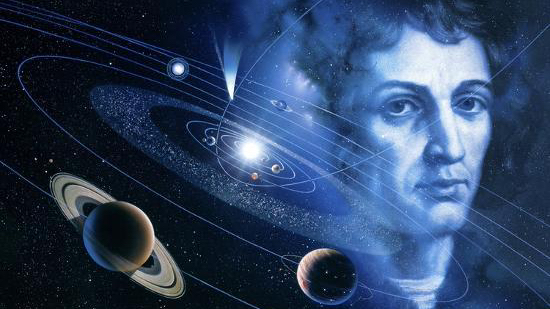
We are at our best when we use both wings, faith and reason, to explore life’s wonders.
Two groups who are generally opposed to one another, the Herodians and the Pharisees, appear to have formed an alliance. The Herodians, most likely supporters of the Galilean tetrarch Herod Antipas, have acquiesced and allied themselves with the Roman occupation so that their “party” can be in leadership. The Pharisees, are opposed to Roman occupation and certainly do not support Caesar’s self-imposed status as a god. Mark indicates that representatives of each group are sent to Jesus to “ensnare him in his speech.” They are seeking to gain evidence to bring charges against him.
They come up with an elaborate plan that seems foolproof. A representative from these groups asks Jesus, “Is it lawful to pay the census tax to Caesar or not? Should we pay or should we not pay” (Mk 12:14). If Jesus answers that they ought to pay, then the Pharisees can bring charges against him for idolatry. If Jesus refuses to pay, the Herodians can then bring charges against him for disobeying Caesar’s tax. Jesus asks for a denarius, a Roman coin, and asks what image is on the coin, the response is Caesar. So Jesus said to them, “Repay to Caesar what belongs to Caesar and to God what belongs to God.” They were utterly amazed at him (Mk 12:17).
Jesus bested them at their own game, in thinking outside of the limitations that were imposed on him by his questioners. Our faith is built on Jesus’ response. Not in the modern distinction of church and state, but more often than not we are to follow Jesus’ model and guidance of how we are to live in the world but not be of it. In most cases, we are to embrace not an either/or response, but a both/and response. Ultimately, the final determiner is God.
One example of such a false dichotomy which is often displayed is whereby one is placed in a position to choose either faith or reason. One could approach Jesus today, as did the representative for the Herodians and the Pharisees, and ask, “Rabbi, should we follow faith or reason?” We are more authentic in actualizing and pursuing the greater breadth, depth, and width of understanding who we are as human beings and our place in the cosmos when we embrace both faith and reason. Our science and intellect are spurred on by our sense of wonder and awe in that we seek to understand our world around us. Using our ability to reason, to hypothesize, and ask why have lead humanity to some wonderful discoveries. Reason and science though can only take us so far.
God’s grace builds upon nature. The gift of faith helps us to go beyond the ability to solve problems in the sensory or physical realm alone and to enter into the ground of Mystery by entering into a relationship with God and the spiritual realities of his creation that transcend our physical world and capacity to measure it. God has created all things visible and invisible.
Just a few of the many examples of practicing Catholics from our past who have shown this both/and approach are Copernicus (1473-1543), who developed the theory of heliocentrism, meaning that the earth is not the center of the universe but instead revolves around the sun; Nicolas Steno (1638-1686), who excelled in the study of anatomy, geology and is considered the founder of the study of fossils; Laura Bassi (1711-1778), first female professor of physics; Gregor Mendel (1822-1844), who was an Augustinian friar and is considered to be the father of genetics; and Fr. Georges Lemaitre (1894-1966), who is considered the father of the Big Bang Theory.
The Catholic Church is not opposed to science but discourages the concept of a hyper-scientism, which states that we can only believe something to be real or to exist if it can be measured by the senses or experimentation alone. This is a limitation to the gift of wonder. As St. Pope John Paul II wrote in his encyclical Fides et Ratio: “Faith and reason are like two wings on which the human spirit rises to the contemplation of truth; and God has placed in the human heart a desire to know the truth—in a word, to know himself—so that, by knowing and loving God, men and women may also come to the fullness of truth about themselves.” We need to continue to embrace the gift of wonder and rise to meet its invitation by soaring aloft with both wings of faith and reason.
Photo: of Nicholas Copernicus, considered to be the father of modern astronomy from all posters.com
Link for the Mass readings for Tuesday, June 1, 2021
The following link lists an article by Shaun Mcafee regarding 11 Catholic scientists through the ages: https://epicpew.com/11-amazing-catholic-scientists-you-should-know/
Link for the Mass readings for Tuesday, June 2, 2020

John, Jesus and many we remember today have given their lives for us, so let us not take the precious gift of life for granted.
Mary “traveled to the hill country in haste” (Lk 1:39) and as she drew close and called out to announce her arrival: Elizabeth heard Mary’s greeting, [and] the infant leaped in her womb, and Elizabeth, filled with the Holy Spirit, cried out in a loud voice and said, “Most blessed are you among women, and blessed is the fruit of your womb” (Lk 1:41-42). This is an encounter of joy. Elizabeth’s response is a confirmation to Mary’s yes to the angel Gabriel, that she has indeed conceived in her womb the Son of God who was taking on flesh and becoming one of us, a human being, as she traveled to the hill country. Elizabeth’s son recognized him, and in leaping with joy, helped to get the celebration started!
The encounter and interaction between Mary and Elizabeth, Jesus and John, at the Visitation is a model for us of discipleship. Touched by the Holy Spirit we are to go out to share the Good News that God our Father loved us so much that he sent his Son to be one with us. He was willing to enter into our humanity. Some of the earliest heresies in the Church, which are still perpetuated today, were birthed because of an unwillingness to accept this gift, that God entered into and embraced our humanity, that God would become human was and is still for too many inconceivable.
Yes, we have been wounded by sin, but we have not been destroyed. The coming of the Son of God as one of us is an opportunity to be healed, to be born again from above, and this can happen through the same love of the Holy Spirit that inspired John to leap and Elizabeth to rejoice.
Resist the mind noise from within, and without from other people who tell us overtly and/or covertly that we are worthless or nothing. Not true! Through our very being, we are created in the image and likeness of God, we have been created by Love, to receive and to share love. We are a living craving hunger and desire to be in communion with God and one another. This is true for the atheist and the believer alike. We are called to will the good of the other as other as they are, unconditionally. If we have fallen short, a little or a lot, in the way we have been treating ourselves or others lately, today is a new day to take Jesus’ hand and begin anew. Let us celebrate with Jesus, Mary, Elizabeth and John.
We are celebrating that Jesus was born for us, he lived that we might not only be shown a better way, but know that he is the Way. Jesus became vulnerable for us, a key ingredient in unconditional love: to be willing to risk being authentic to who God called him to be, even to being willing to be rejected, even if that meant that all might walk away from him. May we be willing to be vulnerable, to risk, to share with others who we are, free of masks and pretense. May we be present to, and also walk and accompany one another. Being there for our family and friends is important, and if we take our Christianity seriously, we must come to acknowledge, in concrete ways, person to person, that we are all brothers and sisters, that in Christ we are all related.
Just as the sun shines on the good and the bad alike, Jesus died for each and every human being, all of us. After his Resurrection and Ascension into heaven, he sent the Holy Spirit, the Love shared between the Father and the Son, to empower us to live as he did, in communion with his Father, so to better actualize our communion with one another.
An invitation for the transformation of all humanity and creation happened at the Galilean hill side when two simple women said yes to God and embraced with joy. They came to embrace not only each other, but their vocation. May we join them in saying yes to God, follow his will with joy as Mary and Elizabeth did and with them, celebrate the gift of life, because as each of these mothers would experience all too soon, life can be taken quicker than they could or we can ever imagine.
Today is Memorial Day. We remember the men and women who have given their lives to defend our freedom. They sacrificed their lives as did Jesus and John. Each answered their call in their own way such that we all could have life and live it to the full. Let us resist the temptation to take this life, any moment that we have been given, for granted. The life we have may not be perfect, many suffer, many grieve, and many are in pain. Our life is fragile but it is a precious gift. That is why we have much work to do to help to provide better care and access to so many who are in need. Each of us have a unique way to do so. We can begin with the guidance of J.R.R. Tolkien who put these words into the mouth of his character Gandalf, “All we have to decide is what to do with the time that is given to us.”
We do not know the time or the hour, so let us like Mary go in haste to tell those we care about that we love them. Let us make that call, send that card, email, or text, and/or invite that person for a walk, to sit down and visit. Especially amidst the rising tide of divisive and polarizing darkness, may we be a light to all we encounter. Empowered by the love and joy of Jesus, may we encourage, empower, and lift one another up so as to treat each other with dignity, respect, kindness and understanding. The easiest way to start is when you catch the eye of another, smile. In that simple gesture, we say to the other person that we care enough about them to make the time for them, to acknowledge their dignity, their worth, and to let them know that they exist and have meaning.
On this feast day of the Visitation and Memorial Day, may Mary and Elizabeth intercede on our behalf that we may honor those lives given by better appreciating and respecting the dignity of each other a bit more today than we did yesterday.
——————————————————————–
Photo: Los Angeles National Cemetery, Getty Images
Link for today’s Mass reading for Monday, May 31, 2021

May we put the Sign of the Cross into practice in our lives.
Before the pandemic, when we entered a Catholic church to pray or participate in the celebration of the Mass we would stop by a holy water font, dip our finger in the holy water and make the sign of the Cross. We may also say orally or silently the words that go along with the gesture, “In the name of the Father, and of the Son, and of the Holy Spirit.” When we do this mindfully, we are recalling our Baptism, we are recommitting ourselves to our baptismal vows which is to live our lives as followers of the God of Jesus Christ. This God is one God, subsisting in three Persons, God the Father, God the Son, and God the Holy Spirit. We also affirm this reality in the Creed we say each Sunday, where we affirm individually, while at the same time in communion with one another, that I believe in one God the Father Almighty, I believe in one Lord Jesus Christ, the only begotten Son who is consubstantial with the Father, I believe in the Holy Spirit the Lord the giver of life, who proceeds from the Father and the Son.
We also may bring this sacramental practice into our everyday lives. This gesture we can also make when driving past a Catholic church out of reverence for the true presence of Jesus in the tabernacle. We can also make this gesture and say the accompanying words, at the beginning and end of prayers, before and after we eat, in private as well as in public. We can see this movement of crossing one’s self at sporting events, before taking tests, when passing an accident, or when some one cuts us off in traffic. This gesture being a much better choice than a few others we might otherwise be tempted to use.
This hand gesture and accompanying words are one of the most basic prayers we learn and when we practice it consciously, we call to mind the very foundation of our existence. God within himself is a communion of three Persons, Father, Son, and Holy Spirit. God is a reality that always has been, is, and always will be. God the Father loves his Son eternally and fully, he is the Lover; God the Son receives the Love offered from the Father, he is the Beloved, and the Holy Spirit is the infinite breath, expression, and mutual sharing of the infinite love between the Father and the Son. This is why we can say without hesitation that God is Love because of this eternal self giving, receiving, and willing the good of the other.
The Son of God, the Second Person of the Trinity, coming from beyond time and space, has entered into our three dimensional realm, our temporal time and reality, to become a human being, while remaining fully divine. He came close to us in person so we could draw close to him and become partakers in the same communal exchange of love that he shares with his Father. Having spent thirty-three years on earth, before he would Ascend back to the Father, he then commissioned the eleven Apostles: “All power in heaven and earth has been given to me. Go, therefore, and make disciples of all nations, baptizing them in the name of the Father, and of the Son, and of the holy Spirit, teaching them to observe all that I have commanded you” (Mt 28:18-20). The followers of Jesus did just that and we have the invitation and opportunity to continue that rich Tradition today.
We who have been baptized in the name of the Father, and of the Son, and of the Holy Spirit, are called to be partakers in the life of the Trinity. We are to be participants in the love of God through our thoughts, words, and actions. As we have been loved into existence, so we are to love others, “of all nations.” We need to resist the urge to withhold our love from, those closest to us, yes, but also those we consider as other, those we fear, and those we would judge as lesser and/or label as an enemy.
When we withdraw into ourselves, keep others outside, when we build up walls, we go against how God has made us. We separate and isolate ourselves from one another. We wound our interconnectedness and become less than human when we dehumanize, degrade, and belittle. By actually being engaged with and willing to interact with one another, by willing each other’s good, through participation in the corporal and spiritual works of mercy, the external labels, judgments, and prejudices may begin to fall away. We can begin to see each other as human beings again. We can then experience the love of God flowing back and forth between one another and grow as brothers and sisters.
Pope Francis tweeted on September 12, 2015, that “Every time we make the sign of the Cross, we draw closer to the great mystery of the Trinity.” May we ponder the mystery of God today, ponder and so enter into the mystery of his Trinitarian Love. Each encounter with a person is to be a mirroring of Trinitarian communion in that having been loved by God we are to love and so experience the love that is shared between us. This is when we are at our best as Church. May we live the deep reality of what making the Sign of the Cross means in our lives. If you are not sure where to start, begin with a smile, a simple hello, and/or a kind word. We are all interconnected with a Trinitarian Love that surpasses all understanding. As we engage in sharing the love of God, we remember who we are and whose we are.
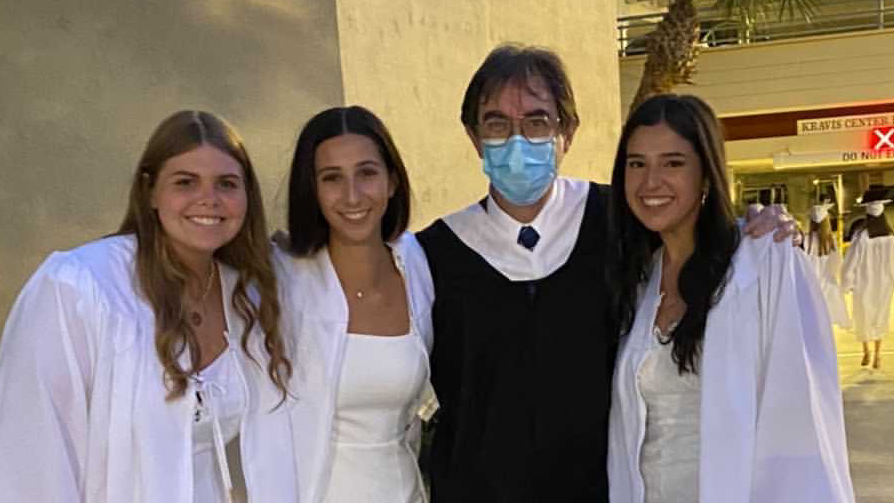
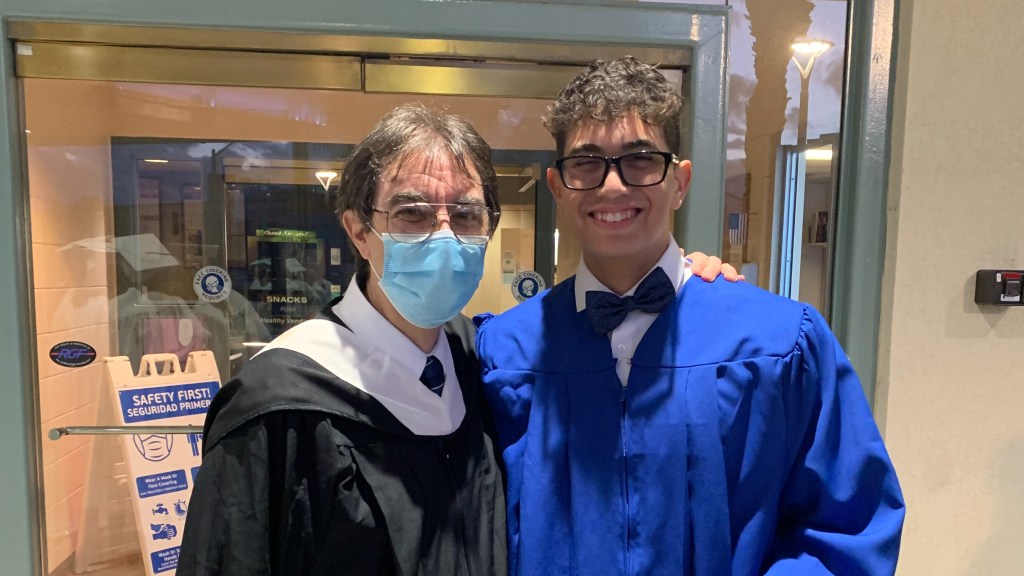
Photo: May the Cardinal Newman graduating class of 2021 be bearers of God’s love.
Mass readings for Sunday, May 30, 2021

Do we give ourselves time to be still and know God?
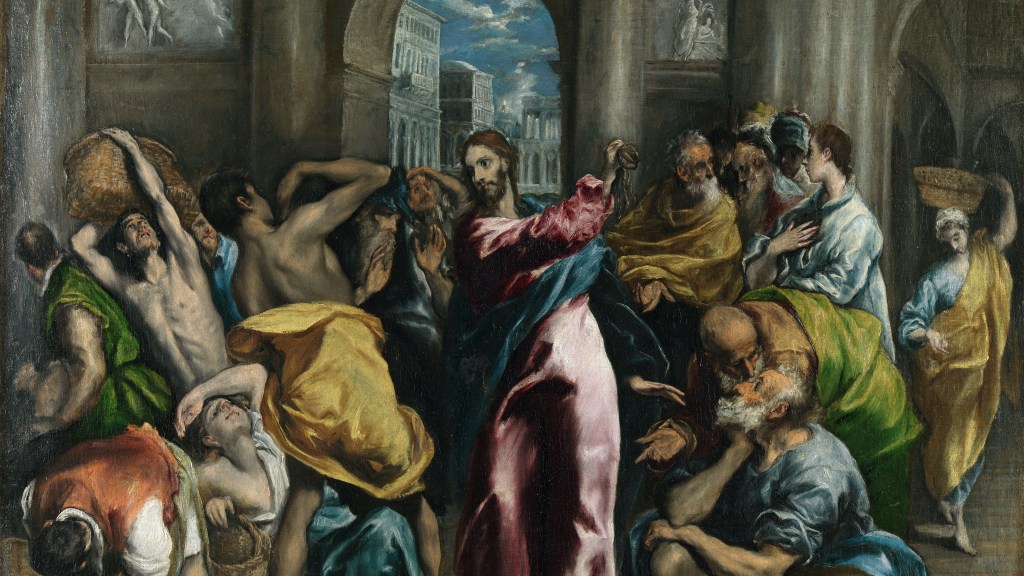
Jesus had not only created a scene when he turned over the tables literally in the Temple, but since the beginning of his public ministry, Jesus had been figuratively turning the tables on the religious leadership regarding how to worship and live out their faith. The conflicts between Jesus and those in leadership were not subsiding but only growing, especially now that Jesus was present at the Jewish spiritual center of the Temple, the very seat of God. The chief priests, the scribes, and the elders, are becoming more concerned about the teachings and actions of this itinerant preacher, and believe him to be a false prophet. They approach him when he returns to the Temple and ask, “By what authority are you doing these things? Or who gave you this authority to do them?” (Mark 11:28)?
Jesus deftly turns the table on them again. In doing so, they reveal that they do not believe that John or Jesus are operating under the authority of God, but they fear the reaction of the people gathering around their discussion. This is the time of the Passover, and many pilgrims have come to Jerusalem to celebrate. The area is teeming with people. The last thing that the Jewish leaders want is another scene as Jesus had staged from his turning over the tables the day before. The last thing they wanted was for the Roman centurions to get involved.
They refuse to answer Jesus’ question. Jesus follows like fashion then and does not answer theirs. This episode and exchange, as with the other conflicts with Jesus leaves them frustrated and even angrier at Jesus. They believe Jesus to be a false prophet, yet they are not willing to call him out publicly, so their indecisiveness fuels their resentment. Jesus is at peace because he knows that he is following the will of his Father and so he has nothing to prove.
How do we do with conflict? Are we as surefooted and confident as Jesus? If not, there can be many reasons, but foundationally, are we following the will of the Father in all that we do? The peace that surpasses all understanding that Jesus promises comes from the assurance that he is with us, he has our back, and supports us. It also comes with the confidence that we have a clear conscience. The challenge is to be clear in our discernment that we know the difference between God’s and our own will, as well as when our decisions are in accord with or opposed to God’s.
From time to time we may receive absolute clarity. Many other times we are indecisive. The answer to knowing God’s will is knowing God intimately. We encounter and develop a relationship with God as we would with any other person. Though until we develop a deeper faith life, that is easier said than done. As many of the saints attest, the closer they grew in relationship the more distant he appears. This is true because God invites us to go deeper, so we come to the point that we resist relying on our emotions, inspirations, our capacity to make sense of what we are asked. God wants us to come to the point to where he leads and we follow without hesitation. Just as the sheep knows the voice of the shepherd, we strive to recognize and hear the voice of God speaking to us in the silence of our hearts.
Photo: Starting to return to taking a quiet walk in the early evening. Ten minutes, still need to take things slow.
Link for the Mass readings for Saturday, May 29, 2021
 Spiritual Stepping Stones