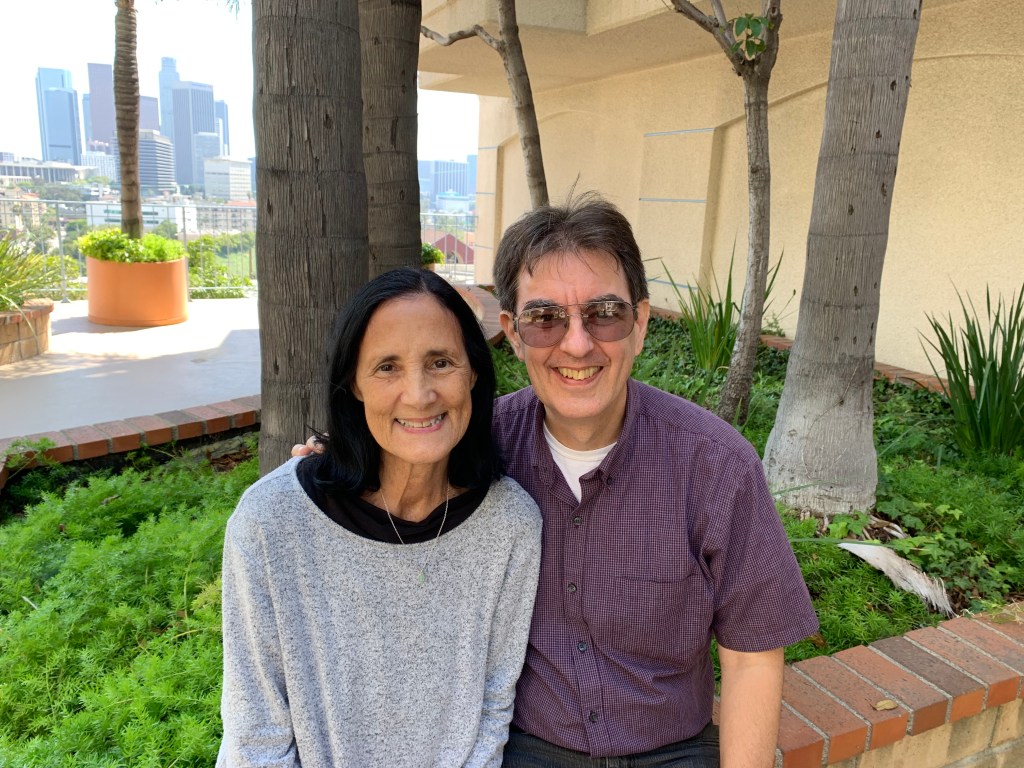
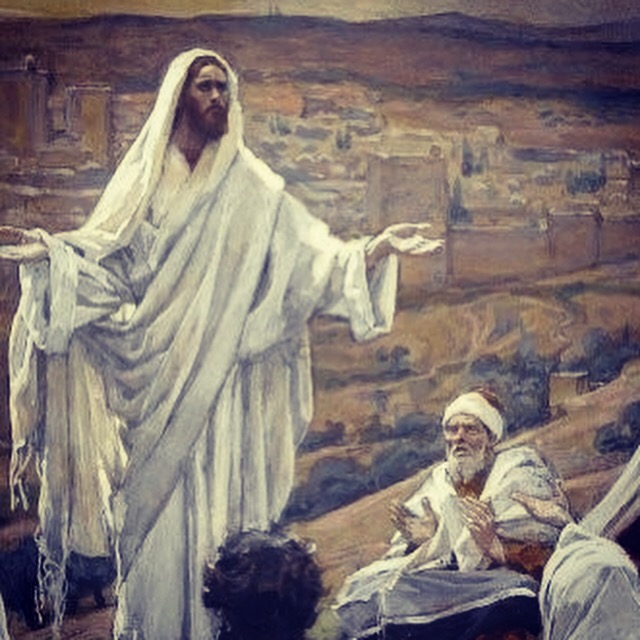
The Sign of the Cross and imagining Jesus by our side can help us to realize that prayer is about developing a relationship with God.
Prayer is not so much about bending God’s will to our will, but it is about our transformation and conformation, freeing our sole focus from ourselves as the center of the universe. The world actually does not revolve around us. We are invited to build a relationship with the One who is the creator and sustainer of all that exists.
Jesus guides his disciples on this point when he teaches them how to pray. Jesus said to his disciples: “In praying, do not babble like the pagans, who think that they will be heard because of their many words. Do not be like them. Your Father knows what you need before you ask him” (Mt 6:7-8). Jesus is sharing that words matter and have meaning in everyday life as well as in prayer. The words that we speak are to be honest and transformative, not just mindlessly evoked or invoked. Formulaic expressions and the mere volume of words mean very little compared to a few words said with clear intent, focus, and in a mindful and heart filled way.
Jesus is helping us to understand that the form prayer takes or the actual words used do not so much matter as understanding why we pray. We pray to deepen and develop our relationship with the Trinitarian communion of God the Father, God the Son, and God the Holy Spirit. The very desire to pray is a prayer in itself because we are hearing the invitation of God to be one with him. The first step is to acknowledge this invitation and then to turn our hearts and minds to God. Thomas Dubay, in his book, Fire Within, paraphrases St. Teresa of Avila, the 16th-century doctor of the Church, in saying that “one vocal prayer, even so little as one petition of the Our Father, if well said, is better than many recited thoughtlessly or hurriedly” (Dubay 1989, 76).
Reciting the Our Father, or Lord’s Prayer, that Jesus shares with his disciples in today’s Gospel of Matthew, can be a struggle, because the biggest challenge to a life of prayer is taming, what some Buddhists call, the “monkey mind”. Our thoughts can be actively engaged, random, distracting, and even anxiety inducing within one minute. To overcome the challenge of an unsettled mind we can return to St Teresa again. When we begin to pray, St. Teresa of Avila suggests that we begin “with self-examination and the sign of the Cross” (Dubay 1989, 77).
In this way, we can bring to awareness some issues, struggles, temptations, and sins that we have been dealing with. We can settle into them, instead of run away from them and seek God’s help to be healed and reconciled. In making the sign of the Cross, we bring our self, as we are, into the presence of the Trinity. We receive and experience the love, acceptance, and mercy of God and recognize that we are loved as we are and that we are not alone because we belong and are a part of this infinite community of love. In this simple gesture, we are also uniting our body, mind, and soul with the One who will lead us in our prayer.
The next step is to imagine that Jesus is with us to guide and lead us in our prayer. “Imagine that this Lord Himself is at your side and see how lovingly and how humbly he is teaching you” (Dubay 1989, 77). By mindfully engaging with our breath and our body, we slow down and allow ourselves to become more still.
Finally, we can imagine Jesus teaching us the Our Father as if for the first time, as he did his disciples. Going slowly, one word, one verse at a time, allow Jesus to not only share his words with us, but we can also pause and add our own words. By doing so, we begin to discipline the focus of our mind and can enter into a dialogue with God and receive the blessing of his mercy and love. “Focusing on the indwelling presence, says Teresa, is for wandering minds ‘one of the best ways of concentrating the mind’ in prayer” (Dubay 1989, 77).
—————————————————————–
Photo: James Tissot, The Lord’s Prayer by Online Collection of Brooklyn Museum
Dubay, S.M., Thomas. Fire Within: St. Teresa of Avila, St. John of the Cross, and the Gospel on Prayer. San Francisco: Ignatius, 1989.
Link for the Mass readings for Thursday, June 16, 2021

Prayer, fasting and almsgiving aren’t just for Lent.
In the Gospel from Matthew, we hear Jesus continuing his Sermon on the Mount. The teachings of the Beatitudes as well as the six antitheses are powerful lessons that can transform our lives when we put them into action. Today, Jesus presents common practices of living a life of faith. The key point he is making though has again to do with our end goal. As discussed yesterday, as his disciples we are called to be “perfect just as [our] heavenly Father is perfect” (Mt 5:48). Again perfection here is that our end goal is to be one with God. We are striving to become holy, to be saints, for the purpose of deepening our bond and relationship with God and each other.
Our being perfected in Jesus is a process whereby we become less and Jesus becomes more. What decreases is our focus on self, especially the ego-self, our sense of self-centeredness. Jesus provides for us three ways in which we can practice drawing closer into communion with God and one another. We are to give alms, pray, and fast. We may remember these as being the three pillars of Lent that we put extra emphasis on during that penitential season.
Jesus informs us that when we give alms, pray, and fast, our intent must be properly ordered. If we give alms with the intention to “win the praise of others” (Mt 6:2), pray in a public display “so that others may see” us (Mt 6:5), and in our fasting “look gloomy” and “neglect [our] appearance, so [we] may appear to others to be fasting” (Mt 6:16), then we are seeking to do so in such a way that the focal point is to be on us. We think to ourselves, how holy and pious we are. Instead, we are hypocrites because, in each of these actions, we are not seeking to improve our relationship with God, nor to build up his kingdom. The intent is to build up our own pride and ego by seeking to direct the focus is on ourselves.
Jesus calls us to be holy. What that means is that we are to give ourselves to others, to serve out of love, so that others may be healed, empowered, strengthened, and fulfilled. We are to seek Jesus in prayer with the intent of receiving the purifying fire of the Holy Spirit that we may be purged from that which feeds our false selves so that we can be freed of the dross of our accumulated sin, selfishness, and that which we are attached. In our time of prayer and examination of conscience, Jesus wants to reveal to us those apparent goods that lead us away from what will truly fulfill us. It is to these areas that we can fast. In these conscious acts of the will, we are to freely choose God over self and continue to mature into who he calls us to be.
In our prayer today, let us ask Jesus to reveal to us one way that we are putting ourselves before God, for him to reveal to us a pattern or habit of sin that keeps us bound to our own pride and prejudice, and/or something that we are attached to that we can fast from. And then one way we can reach out and give ourselves to someone else. Prayer, fasting, and almsgiving are not only for Lent. There are many people that are in need of God’s support and help right now. We become the hands and feet of Jesus when we are willing to allow him to lead us to serve others with the love of the Holy Spirit and simply allow God to happen in our encounters.
—————————————————–
Photo: A young friend saying hello. Time experiencing God’s creation is prayer and a wonderful way God can help to expand our hearts.
Link for the Mass readings for Wednesday, June 16, 2021
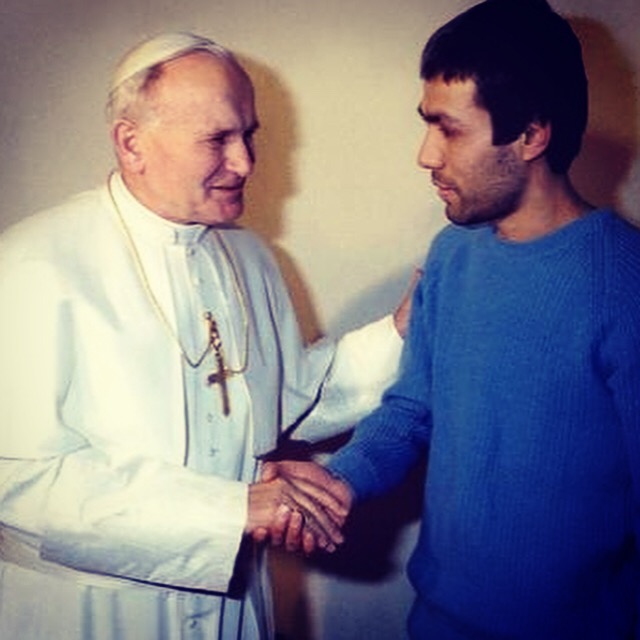
In choosing love, we bring healing to ourselves and others.
The sixth antithesis may be the most challenging of them all. “You have heard that it was said, You shall love your neighbor and hate your enemy. But I say to you, love your enemies and pray for those who persecute you, that you may be children of your heavenly Father” (Mt 5:43-45). The parable of the Good Samaritan provides a nice parallel to this verse. It can be found in Luke 10:25-37. For in that parable Jesus shows our enemy and our neighbor to be one and the same.
A good examination of conscience would be to read the above verse, ponder who would come up for us as an enemy, and then read the Parable of the Good Samaritan. Whenever the word Samaritan comes up, we drop the word Samaritan and insert the person or persons who came up for us. When we have finished this exercise, then, may we pray for the person or persons defined by us as our enemy, for if we only love those who love us, what makes us any different than anyone else? If we are to be disciples of Jesus, if we are to be children of our heavenly Father, we are not only to love those who love us, but we are to also love our enemies. We are to love those for whom there is little chance of being loved in return.
Jesus offers us the way to be able to accomplish this seemingly impossible feat: “So be perfect, just as your heavenly Father is perfect” (Mt 5:48). We are able to love our enemy as ourselves by being perfect. This is not much help unless we understand that the English word used here is translated from the Greek word telios, which means complete, whole, to reach one’s goal or purpose in life. As a Christian, our end goal, our purpose, our fundamental option, is to be in full communion with God our Father, who is Love. God the Father is not just loving, not just a lover, but the Love. God is Love.
God as Love, “makes his sun rise on the bad and the good, and causes rain to fall on the just and the unjust” (Mt 5:45). We strive in our life to attain the end goal of being perfected by Jesus the Christ, when we, through an act of our will, allow ourselves to become transformed into becoming agents of his love. The most challenging of enemies is facing the enemy within. To love as God loves, we are to follow the words and actions of Jesus and the prophets.
Each day we are given a choice. We can choose to deny our fear, seek revenge, dig in our heels, embrace our ego, react in kind to negativity, and/or remain indifferent to the suffering in our midst. We may refuse to love our enemies, we may withdraw our love, but know that when we do so, we contribute to the condition of separation, polarization, violence, and dehumanization that plagues our communities, nation, and our world.
We can choose instead to live out our inheritance as children of God and assist Jesus in the ushering in of the reign of our Father’s kingdom. This means speaking truth to power, using our access and means to advocate for the voiceless, or comforting the afflicted while afflicting the comfortable. This begins by calling out hatred within ourselves, so as not to meet hate with hate, for in doing so we will only contribute to more hate.
We are at our best when we are willing to be perfected by Jesus, brought into alignment with his Father’s will, and collaborate with the love of the Holy Spirit so as to be agents and models of love, mercy, forgiveness, and justice in our realm of influence. By loving our enemies, we will help to diffuse the power of hate.
As we embrace instead of denying our fear it can become a valuable ally, like purifying fire that can be channeled and directed for healing ourselves and others. By continuing to be open to being healed and transformed, we can disarm by willing the good of and praying for those who contemplate, participate in, and perpetuate division, hatred, racism, and violence in all its forms. By following this path, our enemies can become our brothers and sisters.
—————————————————————-
Photo: Pope St. John Paul II met, prayed with, and forgave Mehmet Ali Agca at Rebibbia prison on December 27, 1983, for shooting and attempting to kill him on May 13, 1981. ARTURO MARI/AFP/Getty Images
Link for the Mass readings for Tuesday, June 15, 2021
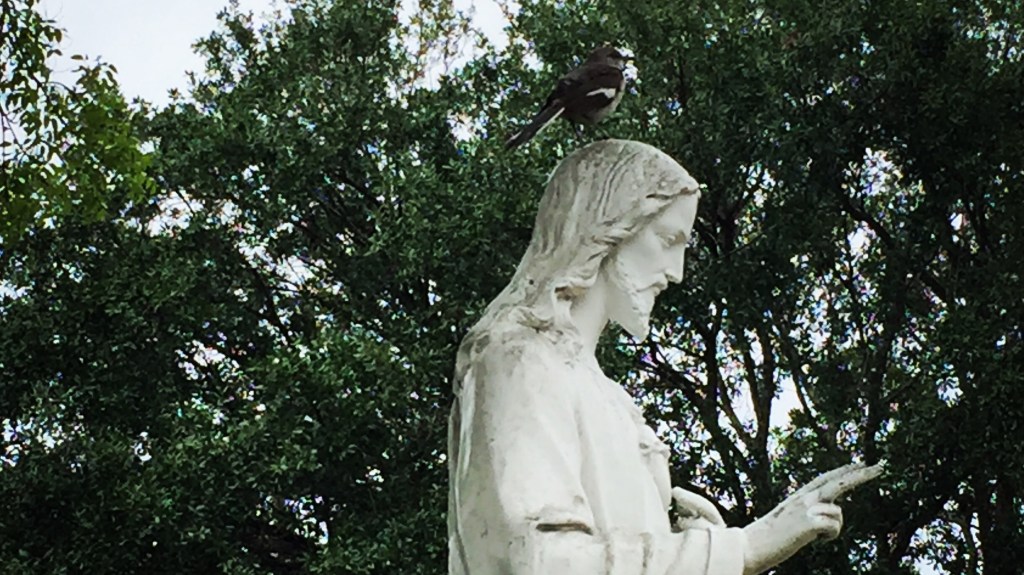
Turning the other cheek is another way to go deeper into forgiveness.
Today we receive the fifth antithesis, in which, Jesus said to his disciples: “You have heard that it was said, An eye for an eye and a tooth for a tooth. But I say to you, offer no resistance to one who is evil” (Mk 5:38-39). The Mosaic law, an eye for an eye, that Jesus first addressed was originally an attempt to curb the emotive response of revenge. If someone had killed a clan or tribal member, there would have been those who would choose to retaliate by inflicting as much carnage as possible to the people responsible, even up to and including the death of the whole clan or tribe, even the women and children. The rationale behind this was that there would then be no one to come back for revenge. The idea of seeking instead an eye for an eye was to temper the retribution to a more measured response.
Jesus though is saying that “an eye for an eye” does not go far enough, and raises the challenge of being his disciple to a higher level, being that even the thought of revenge is not to be considered. Jesus is not just seeking to lessen the cycle of violence, he is giving us the means to end it. Forgiveness is the cornerstone of the teachings of Jesus. Instead of seeking revenge, Jesus is commanding that we seek to forgive those who have harmed us. We who pray the Our Father or the Lord’s prayer, are to take to heart and be mindful of the words we pray, “forgive us our trespasses as we forgive those who trespass against us.“
The urge for revenge is powerful and primal. Revenge is wired into our survival instinct to protect ourselves. Jesus invites us to grow beyond our mere instinctual responses and survival instincts. He is calling us to be a people who do not merely survive, but thrive. Jesus is seeking to infuse us with his divine life so that we will be transformed. This is true not only for ourselves but for those who would seek to do us harm. Instead of striking back with revenge, we are to be flexible and adept enough to instead appeal to their conscience. We are to take all that others throw at us, and meet them with the courage to stand and receive their worst, and disarm them with the blinding light of the love and forgiveness of Jesus.
This is no easy task, especially when we experience ongoing injustice and needless loss of life. To put into practice such teachings as the turning of the other cheek, we need to start small. We need to resist the immediate thoughts of revenge that arise for the smallest of offenses. When someone makes a snide remark, and/or offers demeaning or dehumanizing comments directed at us or others, we are to resist retaliating in kind. Although, we are to hold them accountable by reminding the person of our dignity and/or the dignity of the person they seek to demean. By not adding more fuel to the fire, our hope is to lead them away from the perception of another person as being somehow other, to one of being a brother or sister.
To be a disciple of Jesus means we need to be contemplatives in action especially in today’s current climate of division. We need to ground ourselves in prayer, return to these challenging teachings of the Beatitudes and antitheses often, believe in them, meditate on them, keep them at the forefront of our mind and, with the courage and guidance of the Holy Spirit, put them into practice. We will best be able to do so when we resist reactionary responses and see people, not as cardboard cutouts but in their complexity. In seeking to understand and being willing to engage in dialogue we might be better able to move together in a way to bring about accountability, reconciliation, and structural change.
Some would say this is naive and impossible. It is true that we will not be able to resist thoughts and acts of revenge and walk the path of forgiveness on our willpower alone. We need to surrender our ego and pride to Jesus, who as the Son of God became one with us so that we can be one with him. As we do so, he will begin to transform us as he forgives and loves in and through us.
———————————————————–
Photo: A peaceful moment on the grounds of St Peter
Link for the Mass readings for Monday, June 14, 2021

A practice of prayer best begins small, like the planting of a seed.
Today we return to the Gospel of Mark and his recording of the two parables dealing with seeds sown and the planting of a mustard seed. The purpose of each of these parables is that Jesus is showing us how God works within our lives. A lot of the initial work of God is unnoticed, like the planting of a seed in the ground. Over time, with nourishment and water the seed will germinate and sprout but still none of this is seen.
This can be compared to our prayer life. Often times people give up praying because after they make some initial attempts they do not experience any emotional reactions, have any mystical encounters, do not see any tangible results, nor do they feel any closer to God than when they began to pray in the first place. With so many demands on their time, they may then feel that prayer is a waste of time and they give up, or are distracted by other more alluring pursuits.
When someone has prepared the soil, planted the seed, waters as directed, but then sees no immediate results, and then is distracted by other activities, forgets to water, there is still the process of germination, there may even be some sprouting, but without the water, the development will be stifled and could indeed die.
Our desire to pray is already a response to God’s planting of the seed of his kingdom in us, but just as in the analogy of the seed, we need to be consistent and persistent in our life of prayer. Even though there may be no sensation or evidence that anything is happening, whenever we turn to God in prayer, something is happening. When we have responded to God’s invitation, he will bring to fruition our response. This is also true when we are praying for others. We are living in a time of instant gratification and unfortunately are not as patient as we need to be. The ways of God’s kingdom works on God’s timing, not our own.
Each of us have distinct personalities and interests, so there are many ways to pray that will suit our uniqueness. Another reason that we may feel prayer is not working for us is that we may be praying in a way that is not conducive to our personality. Instead of ceasing to pray altogether, put into practice a different technique until the right fit is attained.
What has personally worked for me is the praying of the Liturgy of the Hours, the Rosary, reciting the names of persons and the intentions for those whom I am aware have needs, quiet times of meditation and contemplation, reading Scripture, and writing this blog each day. I have also slowly begun to walk again in the evenings. Though I do not necessarily notice any profound insights or luminous encounters day to day, I have had a few but what I have noticed over the past ten years of more daily commitment to prayer is that there has been a transformation in my life for the better.
If a daily commitment of prayer has been a struggle, my invitation is to choose a comfortable place that is as free of distractions as possible, and commit to spending five to ten minutes in that same place each day. If you are more visual, add a candle, the crucifix, an icon, or religious statue. If you feel more of a connection to God’s creation, a place outside might work well too. Then choose a prayer practice that appeals to you, schedule that time to be spent in your sacred space each day, and let God happen.
Whether sitting or walking. Once you determine you are beginning to pray, I have found taking some slow deep breaths is a good way to begin. This small act lets us know we are leaving our fast pace and slowing ourselves down. Then as you sit or walk in silence just be still, ask God to guide you and listen. After a minute or two of silence, you may remain silent or if drawn to: read a passage of scripture and meditate upon in, review your day or the prior day, pray slowly with beads in hand the mysteries of the rosary, the chaplet of Divine Mercy, the Jesus Prayer, pray for others, share your intentions, struggles, questions, hopes, and dreams, and if outside just be open to the wonder of creation. When you come to a close, end as you started, returning to your breath, be still, be open, and be thankful for this time.
Just as a seed is planted and watered, it will soon germinate, and sprout, followed by the “first the blade, then the ear, then the full grain in the ear. And when the grain is ripe, he wields the sickle at once, for the harvest has come” (Mk 24: 28-29). We just need to be consistent and persistent with our prayer life as we would taking care of a plant and trust that the invitation Jesus offers us, the seed he has planted in us, in God’s time, will sprout and grow.
Photo: Quiet time porch view Saturday evening. Please feel free to share a prayer practice that has been helpful for you.
Link for the Mass readings for Sunday, June 13, 2021

Mary, please help us to react less and be open to authentic dialogue more.
There are two points that struck me in today’s Gospel from Luke. The first is what Jesus was doing when Mary and Joseph found him. After three days they found him in the temple, sitting in the midst of the teachers, listening to them and asking them questions, and all who heard him were astounded at his understanding and his answers (Lk 2:46-47). Other than his infancy, this is the only other account we have of Jesus in his youth. Jesus was listening to his teachers and asking them questions.
One of the greatest joys that I experience is when I am teaching. There are times when I actually feel like I step out of my body and I am watching the exchange along with the students. These are times when the students are asking questions, they are listening and engaged, and I believe that in that exchange the Holy Spirit is present.
The second point was Mary’s response. After three days of anxiety trying to find Jesus, then his response that they ought to have known where he was, that he was about his Father’s business, and then their lack of understanding of what Jesus said, all did not lead to Mary giving Jesus a slap to the back of the head, instead she “kept all these things in her heart” (Lk 2:51). Mary did the same with the news from Gabriel and with the news of the shepherds at the birth of Jesus. Mary’s response was to ponder.
We learn best when we enter into an exchange of dialogue where we listen to each other and ask each other questions. We commit an egregious sin when we stifle questions, inquiry, critical thought, and dialogue and slip into monologue and demagoguery. We are encouraged not to talk about faith, politics, and the social hot button issues, but if we don’t talk about these issues, which are the core and foundation of a healthy society, we will never be able to improve or make effective and healthy change.
We are wired for the practice of wondering from a very young age. If you have been around a three or four-year-old for any length of time, the question of, “Why?” will come up more than once. Unfortunately, this natural curiosity is often tamped down, because answering questions takes time. Questions can challenge our own beliefs, they also help us to recognize what we know and do not know. It is one thing to think we understand something, and it is another to articulate it.
In our present climate of polarization, we may find that we do not understand certain issues or perspectives and are afraid to ask to better understand, we also may not know what to do when our ideas or beliefs are challenged, we may feel uncomfortable to pose a different perspective, and we may be presented with a response that we did not expect or agree with. How are we to respond? A good beginning step could be to resist the temptation to react and lash out, or the opposite, to resist remaining silent. Instead we can assume the posture of Mary and be more willing to ponder.
We can also resist defensiveness and instead seek to understand, to open our hearts and minds and listen to the question or the statement, and ask questions as to why someone believes what they believe. Taking a few slow breaths, praying for some guidance, and coming from a place of empathy instead of being so quick to impose our view, may help to provide fertile ground for mutual understanding.
In taking these initial steps, we can then honestly engage in the discussion from what we know and feel, as well as having the humility to express what we don’t know, and what we are struggling to understand. Our part to play is to educate ourselves, to be open to wonder, to meditate and ponder about what we believe, and engage in respectful dialogue allowing others to do the same and then be willing to journey together to seek that which is true, good, and beautiful. Then we will be in a better position to begin to work to bring about change and reform that will be more lasting and fruitful in our realm of influence.
Painting: “The Black Madonna with Dove”, by Sue Ellen Parkinson – Immaculate Heart of Mary, pray for us!
Readings for the Mass for June 12, 2021
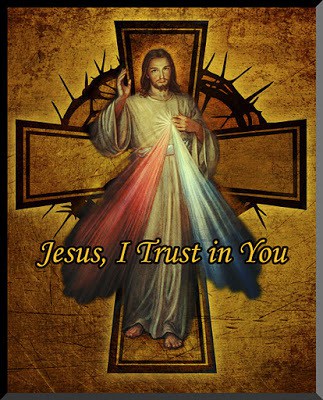
In our trials and tribulations: Jesus, I trust in you!
But when they came to Jesus and saw that he was already dead, they did not break his legs, but one soldier thrust his lance into his side, and immediately blood and water flowed out (Jn 19:33-34). With that thrust of the centurion’s lance it appeared that all was lost. The long sought for messiah, the promise of Jesus appeared to be no more. His healings, exorcisms, words, and teachings were now nailed to the cross, that dismal sign of torture. Rome continued to brutally occupy Israel. Might appeared to continue to triumph over right. Darkness and the fullness of it, pride, betrayal, weakness, fear, corruption, and ego, all seemed to have won the day.
We ourselves, may have, may presently, or will be in a similar situation, from our own perspective or experience, as the disciples were. A place where all may appear to be hopeless, where what was promised and what has been hoped for seems to be dashed to pieces, where the rug may feel like it has been pulled out from under us, where up seems to be down and down up, where all may appear to be lost.
But the event of the crucifixion is not the end of the story, but the continuation of the Paschal Mystery. The Son of God, the second Person of the Trinity became one with us in our humanity, lived our life, experienced our life in all things but sin, yet through his Passion, he became a magnet. Like moths attracted to light, Jesus took upon himself the sin of the world, and entered into the most unique of human experiences, our death. With the piercing of his side, even his heart was pierced for us and blood and water flowed.
The Son of God, even in his death mirrored the reality of God within himself; where the Father pours himself out, all that he is to the Son, and the Son receiving all the Father is, returning, giving all he has received, all that he is to the Father holding nothing back. Jesus, repeated this same act of exchange on earth as he does in heaven. Jesus gave all that he is to us, for us. He loved us into existence, then came to save us from ourselves, becoming one with us, so we could truly and fully be redeemed, by loving us into his death.
Into his death, he experienced utter God forsakenness to the brink of complete abandonment, complete emptiness, just as the blood and water poured forth from his side, Jesus was pouring all he was out of himself for us. In that act, his grace poured out on the world, building upon the natural order of his creation. He would experience, with those who had totally turned within themselves and separated themselves from their birthright, their relationship with God, to win them back by giving himself to them in love. Then, from that very moment of complete emptying, he was pulled back by the Love of God the Holy Spirit, who is the Love shared between God the Father and God the Son, the divine unity of the Holy Trinity.
Jesus rose again. He conquered death and the grave. This was no mere resuscitation but a new birth. Jesus is the first born of the new creation, and we who share in his Baptism become indelibly marked, conformed to this new creation. We are part of the story of Salvation History. We have a part to play in the redemption of the world. All was not lost on the cross that day on Golgotha, the hill of the skull. That day was the beginning of our rebirth.
When we face trials and tribulations, when all seems lost, may we look to the Crucifix, and see not a morbid death, but the infinite love of God. In that wound on the side may we see the pouring out of Jesus’ mercy. May we see in the image of the Sacred Heart of Jesus the totality of how much he understands what we are going through, because he went through it for us. When we are going through our own time of the cross, know that the same power of love that brought the Son back from the brink of separation from the Father, is only a word or phrase away from our accessing the same power as well. Jesus, I Trust in You!
May we not take the gift of Jesus giving his life for us for granted. May we resist the temptations of despair, fear, and anxiety, and the lures of power, pleasure, wealth, and honor. Let us not pull within ourselves, bury our head in the sand, or keep others at arm’s length. Let us instead open our mind and heart to receive the love of the Father, and so love him and our neighbor in return. Let us pour out ourselves for one another, will each other’s good, and seek to empower one another. May we strive to be people of integrity and courage, to stand up for the welfare of those on the peripheries, to embrace the will of God and live it.
May we call on the name of Jesus when tempted, meditate on the crucifix or image of the Sacred Heart, so to receive his strength. In this way we can say with the same confidence and assurance as Paul, “Who can separate us from the love of Christ? Trial, or distress, or persecution, or hunger, or nakedness, or danger, or the sword?… Yet in all this we are more than conquerors because of him who has loved us” (cf. Romans 8:35-37). Let us also resist seeking grandiose acts of love, so to draw attention to ourselves, but instead, today and each day, seek the path of the little way of St. Therese of Lisieux and echoed by St. Mother Theresa, “Do little things with great love.”
—————————————————–
Photo: Sacred Heart of Jesus, pray for us!
Link for the Mass readings for Friday, June 11, 2021, Feast of the Sacred Heart of Jesus

Our thoughts, words, and/or actions can rupture or build up relationships.
The Sermon on the Mount was most likely not one long discourse, but a gathering together of Jesus’ teachings. Just as with itinerant preachers, speakers, and lecturers of today, this material recorded in Matthew most likely was not only shared at one time. Jesus probably shared different segments of these teachings at different locations throughout his ministry, and in slightly different ways depending on the group he was speaking with. Also, the Gospel writers would want to highlight different aspects of his teachings for their audiences.
As was presented yesterday, Jesus made it clear that he did not come to abolish the law or the prophets but he came to fulfill them. With the beatitudes, Jesus offered practical ways in which we can find fulfillment and happiness. In today’s account, he introduces the first of six antitheses. With these apparent contrasting statements, Jesus is providing for his disciples the way to avoid the trap that some of the religious leaders of his time fell into: “I tell you, unless your righteousness surpasses that of the scribes and Pharisees, you will not enter into the Kingdom of heaven” (Mt 5:20).
The scribes and Pharisees that Jesus was talking about were those who believed that they were following the letter of the law, but their hearts were not changed. They may have been adhering to the external provisions of the law, but were not changed themselves, their hearts were hardened, they were focused more on their own access to honor and power. They were also imposing strict adherence to the law without providing the support or means for others to achieve what the law imposed. The law became more important than the dignity or value of the person. Jesus recognized the law, but also realized that it was in place to help to provide guidance and discipline so one could better resist the temptations of our fallen nature. The law was to be a foundation to be built upon, not the end goal in and of itself.
Just as children need clear boundaries and structures in place to provide a clear path toward healthy development, this is also true for those of us growing and maturing in our faith. We need to learn to crawl, to build strength and balance before we can take those first wobbly steps. With continued support, we are then able to walk and soon run. Jesus is not only providing the means to go through each of these stages in our faith life, figuratively teaching each of his disciples and us today to not only crawl, walk, and run but to also be able to fly!
The Beatitudes and six antitheses are challenging because each one of them goes counter to much of the way the structure of our fallen world has been governed for centuries. If we are to catch the fire that Jesus has come to set, we need not only to read, pray, meditate, and contemplate upon on the teachings of the Sermon on the Mount, we need to also see their relevance and practicality to our time and place today, and begin to put them into practice. As Christians, our faith ought not to be shaped and informed by our culture, but we are to be shaped and conformed by the Gospel of Jesus the Christ, so to shape and inform our culture.
Today we start with the first antithesis: “You have heard that it was said to your ancestors, You shall not kill; and whoever kills will be liable to judgment. But I say to you, whoever is angry with his brother will be liable to judgment, and whoever says to his brother, Raqa, will be answerable to the Sanhedrin, and whoever says, ‘You fool,’ will be liable to fiery Gehenna (Mt 5:21-22). The seeds of anger begin to sprout in our mind from our knee jerk reaction to a perceived or actual threat, from our hearts hardened by prejudgments, prejudices, and/or a reflection of our level of spiritual immaturity.
Jesus addresses the known provision against murder. He then builds a hedge around the Torah. If one does not want to break the law, another is imposed so as to protect one from even getting close to breaking the first. If we can resist the temptations of our reactions and instead make decisions based on mindfulness and loving one another, such that we resist the temptation to criticize, judge, demean or dehumanize another, then there is little chance for our anger to grow into wrath, that left unbridled could lead to murdering someone.
Jesus is saying that our words matter, that they have the power to destroy or to create. Calling someone Raqa, Aramaic for a block-head or idiot, and then calling someone a fool, would “be liable to fiery Gehenna” (Mt 5:22). How much more egregious are we today? How polarized we have become inside and outside of the Church because of the level of demeaning words, tone, and language that is spoken, condoned, and justified? This has a ripple effect that poisons our culture, politics, and Church with growing hateful rhetoric, overt expressions of prejudice, and violence?
Instead of painting two dimensional caricatures of one another, we can change for the better when we are willing to spend time with and get to know each other. Jesus challenges us to encourage, empower, and respect the dignity of each person. When we resist a pharisaical approach to the law and instead recognize the value and dignity of each person, we will have a better chance of building relationships and so be more willing to serve, support, and accompany one another. We will also be more apt to reform policies and structures that are not just for a select few but that respect the dignity of each person in the womb, after birth, and at each stage and condition of life until natural death.
May we all take some time today to reflect on Jesus’ teaching about how we think, speak to and about, and act toward one another. May we examine our conscience and seek forgiveness for those times we have thought, condoned, or justified thoughts, words, and/or actions that have been belittling, dehumanizing, and demeaning directly from us or others and we said nothing to hold others accountable.
Jesus, please impart within us your infusing power of justice, love, and mercy so that we will be more inspired to live out your teachings in our daily lives. Help us to strive to build bridges of encounter grounded in mutual respect, support, empowerment, and accompaniment with our brothers and sisters, no matter our race, ethnicity, creed, and/or gender, and to commit to building a culture of life and dignity for all, not in some abstract utopian way, but in the concrete moments of our everyday experiences, one person and one encounter at a time.
——————————————————————–
Photo: Living the Gospel by building a bridge of friendship
Link for the Mass readings for Thursday, June 10, 2021
 Spiritual Stepping Stones