Jesus submits his human will to his divine so that we can participate in his divinity.
In yesterday’s reading, Caiaphas and the Sanhedrin plot to bring about the death of Jesus. The results of their planning will be on full display today in the Gospel account of Mark. Though long, these verses are well worth the time and effort to read (cf. Mark 11:1-10, 14:1-15:47).
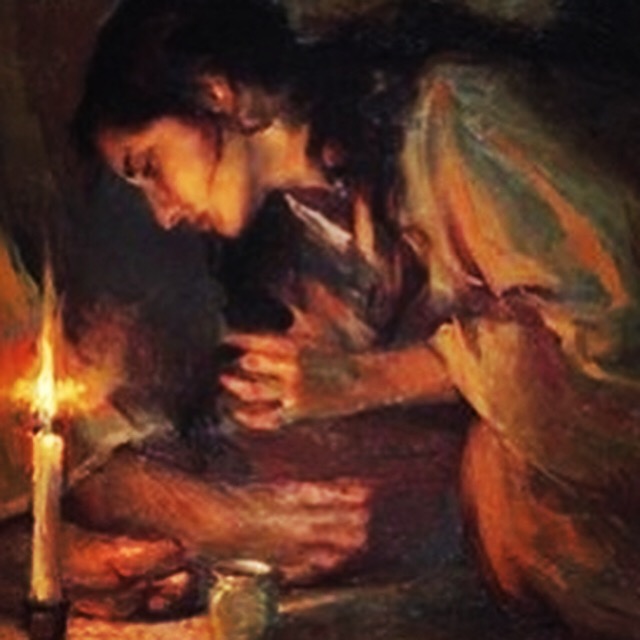
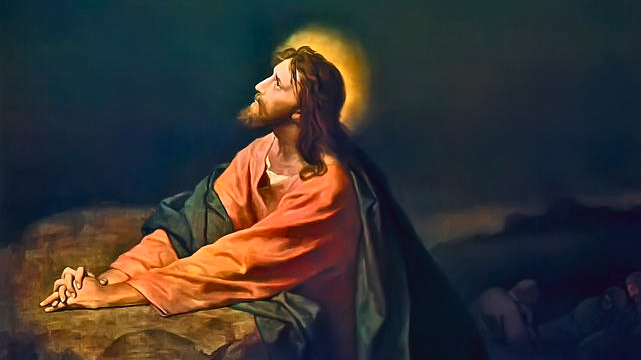
The scene from the Passion account that I would like to reflect upon is Jesus in the Garden of Gethsemane (Mk 14:32-42). Jesus invited Peter, James, and John, the same three apostles that witnessed the raising of Jairus’ daughter and the Transfiguration of Jesus on Mt. Tabor to be with him again, this time in his hour of dire need. As Jesus entered the garden, he expressed to them that he felt “sorrowful even unto death”, reflecting the full weight of what was about to transpire. Jesus asked the closest of his inner circle to watch and pray while he went off at a distance. Through Mark’s account we are able to read the fullness of Jesus’ humanity and divinity on display.
The most primal of our human instincts is the preservation of our life. Jesus, faced with his imminent death, acknowledged this primal urge by requesting, “Abba, Father, all things are possible to you. Take this cup away from me”. The agony is palpable. Jesus has done all that the Father asked of him, he has preached, taught, healed, exorcised demons, followed his Father’s will, and now finds himself on death’s door. He can probably sense Judas and the Temple guards drawing close. He will be turned over to those who have turned their back on his Father. All appeared to be hopeless.
Yet, Jesus was not done, he continued, “but not what I will but what you will.” With these words of surrender Jesus echoed the verse from Psalms 42 and 43: “Hope in God, I will praise him still, my savior and my God.” Even faced with his death, Jesus accepted the will of his Father, his Abba. He trusted that there would be a greater good to transpire through his death, through the giving of his life. With those words, Jesus surrendered his human will to that of his divine will. With each and every yes to his Father’s will through his life, his human nature was more and more conformed to his divine nature. What is on full display for us in the garden is that Jesus is one divine person, the Son of God, while at the same time having two natures and two wills, the human and divine.
As Jesus arose, he came to Peter, James, and John. He found them asleep. He said to Peter, “Simon, are you asleep? Could you not keep watch for one hour? Watch and pray that you may not undergo the test. The spirit is willing but the flesh is weak.” Jesus returned to prayer and returned two more times to find his three closest disciples asleep each time. Jesus was ready to face the cross even if they were not. As with the apostles, Jesus commands us to watch and pray this Holy Week. How will we do?
Though our flesh too is weak, and we too have sinned, Jesus has faith in us that we will actualize who his Father calls us to be, as he still had faith in his apostles who persisted despite their failures and fulfilled their role in God’s plan. No matter what trial or tribulation arises before us, may we meet it head on, placing our trust in God, as Jesus did in the Garden of Gethsemane. We are to follow the lead of Jesus to give over our will to God the Father in participation with his Son through the Love of the Holy Spirit. Let us hope in God, let us praise him still, our savior and our God!
Painting: Heinrich Hoffman, Christ in Gethsemane, 1886
Link for the Mass reading for Sunday, March 28, 2021

The twilight of Lent is upon us.
A core group within the leadership of Israel has decided. They will not deny themselves, their power, prestige, their place. They will not take up their cross and follow Jesus, the way, the truth, and the life. They will not allow the teaching and momentum of the growing number of those following Jesus to continue unchecked. As Passover drew nearer, thousands of people were coming to Jerusalem to purify themselves for the great feast.
This meant the Romans would have many more centurions in place to keep the peace. The division and commotion that Jesus was causing could cause conflict and unrest and then swift and violent retribution from the Roman presence. The Sanhedrin, the Jewish High Council, followed the lead of the high priest, Caiaphas, who said, “You know nothing, nor do you consider that it is better for you that one man should die instead of the people, so that the whole nation may not perish” (Jn 11:49-50). With these words, they began to plan how to put to death the carpenter of Nazareth.
With the words of Caiaphas, the sun began to set on the life of Jesus. These words even affect us still today as they usher in the sunset of our Lenten observance. The gift of our liturgical readings allows us to relive the story of our faith. Lent has given us a time to reflect, to meditate on who Jesus is. Is he just a carpenter, another teacher, or a holy man from the past, or is he each of these, but someone so much more, the Son of God who became one with us in his humanity so that we can become one with him in his divinity?
Do we see his teachings and life as a threat as did the Sanhedrin? Do we like our life the way it is, such that we do not want Jesus to come into our home and start turning over the tables and disrupting our order and comfort? Or do the Gospels cut us to the heart and inspire us to shake off our complacency, our indifference, our cynicism, so to be inspired to acknowledge our sins, to repent, and to begin anew? Are we willing to have our hearts opened such that we see the needs of our brothers and sisters in need and so be moved with compassion to help?
As Holy Week begins with the Vigil Mass for Passion Sunday may we meditate on the words of Caiaphas, “consider that it is better for you that one man should die instead of the people, so that the whole nation may not perish” (Jn 11:49-50). Caiaphas did not know that what he proclaimed would be so true, that the one, Jesus, would die, not only so the nation would not perish, but that all humanity would not perish.
Jesus died for each and everyone of us that we might have life and have it to the full. As the sun sets this Saturday evening, may it not be just another rotation of the earth on its axis, but an opportunity to commit once again to die to our false selves, our egos, our self-centered postures, so to take up our cross and follow Jesus into Holy Week.
———
Photo: Drove to the canal Friday night for the sunset.
Link for the Mass readings for Saturday, March 27, 2021
Blasphemer or Son of God?
Two groups of Jews emerged in today’s Gospel account. There were those about to stone Jesus for blasphemy and those who began to believe. The first group did not recognize the good works that Jesus did as coming from God, nor his reasoning that “even if you do not believe me, believe the works, so that you may realize and understand that the Father is in me and I am in the Father” (Jn 10:38). They listened to the claim that Jesus was making but they refused to accept the fulfillment of the assertion: Jesus did the works of his Father because he was then and still is today the Son of God.
The more that Jesus sought to help them to understand that he was who he says he is, the more they dug in their heels. They left the stones on the ground but then moved to have him arrested. Jesus evaded their grasp and moved on to the region across the Jordan where John first baptized. John did not preach in the Temple precincts either, even though he was the son of a priest. John followed the lead of God to prepare the way for Jesus and his eternal priesthood. The Temple had not been the seat of God for some time. Jesus would become the new living Temple.
Jesus returned to the place of his baptism, where he joined in solidarity with sinful humanity. This visible image of consecration revealed what happened silently in his conception and birth: the Son of God took on flesh and became man to open up heaven for us in the humanity he assumed. As people came to John in the Jordanian wilderness, so too, people came to Jesus. Not all rejected his message. Many came to him and said, “John performed no sign, but everything John said about this man was true.” And many there began to believe in him (Jn 10:41-42).
The question that arises for us as our steps take us closer to Palm Sunday and Holy Week is to which group of Jews recorded in today’s Gospel account will we align ourselves with? Will we label Jesus as a blasphemer or accept that Jesus is the Son of God? The scriptural record does not reveal indifference as an option, the accounts do not leave any room for Jesus being only human; a good teacher, a wise man, or a revolutionary radical.
We either accept Jesus is fully human and fully divine or we don’t. If he isn’t who he claimed to be, God, then Christianity is just another philosophical, theological pursuit. If we accept that Jesus is the Christ, the Son of the Living God, then our lives ought to be aligned to his. Our thoughts, words, actions, and even our faces need to reflect that truth.
A good way to begin each day is affirming this fact by stating with an attitude of prayer, “Jesus I believe in you, I need you,” and asking him what works of the Father he would have us offer in his name this day? In what ways can we be of help and support even while limiting our social interactions during this pandemic. May we have the openness of mind and heart to hear his words and the courage to act upon his guidance, so to be the precious, living stones we are, radiating the light from our source, Jesus the Christ, the Son of the Living God.
————————————————————————-
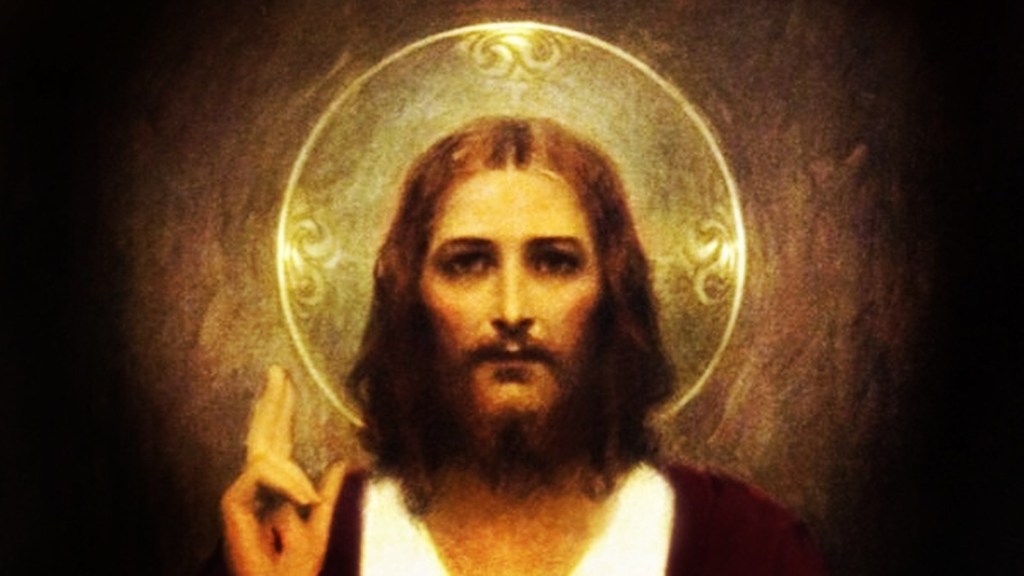
Painting credit: Sacred Heart of Jesus by CB Chambers
Link for the Mass readings for Friday, March 26, 2021
Mary said yes, will we?
Why celebrate the Annunciation at the beginning of the third week of Lent? Simple math. If we celebrate the birth of Jesus on December 25, it is logical to celebrate his conception nine months earlier on March 25.
Gabriel, an angel, a messenger of God, a spiritual being, interacts with a human being; though Mary is not the first one to experience such an encounter. There are personal encounters with God and his messengers throughout the Bible. This is how the God of Israel, the God of Jesus Christ acts, person to person, through invitation, either directly himself or indirectly through one of his angels.
We can read such encounters going back to Genesis. God invited Abraham to be the father of a people that God would call to be his own. This reality would come to be with the birth of Isaac, while Sarah was well past child-bearing years. Jacob would wrestle all night with an angel and become the father of the twelve tribes of Israel, during the time of the Judges the mother of Sampson and Hannah, the mother of Samuel, both barren women would encounter angels bearing the message that each would give birth to those who would grow to lead the people Israel in their time of need. Moses, the judges, David, and the prophets all would hear and answer God’s invitation. Zechariah had an encounter in the temple and his wife Elizabeth, also barren and older, would give birth to John the Baptist. God has communicated and reached out to his created beings in history, in time, and in specific places.
With Mary, this announcement and encounter was different, for, at this appointed time, the Son of God himself would become, while remaining fully divine, a human being in the womb of Mary. The God who is. Period. Full stop. He is not a being, not a human, or even a supreme being. Infinite Act of Existence, the Sheer Act of to Be, who took on flesh and dwelt among his created beings. This is the message that Mary receives, and we can understand why she might be “troubled”. Yet Mary, the model of discipleship, pondered what this might mean as Gabriel said to her:
“Do not be afraid, Mary, for you have found favor with God” (Lk 1:30).
Mary, who knew the arch of salvation history as briefly sketched above, knew of the encounters God had with his people, her ancestors, knew of the promised coming of the Messiah, would now be the bridge between heaven and earth, the bridge between the old and the new covenant, the bridge between a people lost and a people found. Mary in her fiat, her yes, would become Theotokos, the God-bearer.
This is why we celebrate this feast each year: The Son of God has been born to us because Mary said yes. Yet, her yes is not in isolation. It is made possible by so many who had gone before her. Joachim and Anna, Mary’s parents who provided care and guidance, as well as the many named above and not named throughout the Biblical tradition who said yes to God and played a part in making this moment possible. Mary is not alone in the Annunciation, not alone in this definitive moment. This is the distinctive feature of Judaism and Christianity: We cannot save ourselves. We are not God. Our very life as created beings is a gift from God and we are in need of constant help and support from God and one another (cf. Lohfink, 254).
God invites us, not just today as we celebrate the feast day of the Annunciation, but every day. Each day is a day to ponder, to wonder, to be still, to be in awe. The Son of God, the Second Person of the Trinity, loved us so much more than we can ever imagine, more than we can ever even begin to conceive, that he became one with us so that we can become one with him. Us, you reading this, me writing this, and each unique person taking a breath on this earth.
No matter how much we have messed up, no matter how distant we feel we may be from him, no matter how confused, overwhelmed, disillusioned, he is present for and with us. The question is not whether we are worthy, for none of us are worthy, the question is, “Are we willing?”
We are invited to play our part in the ongoing drama of salvation history. Mary’s answer to this invitation was: “Behold, I am the handmaid of the Lord. May it be done to me according to your word” (Lk 1:38). This is her definitive yes. We too are called. What will our response be?
——————————————
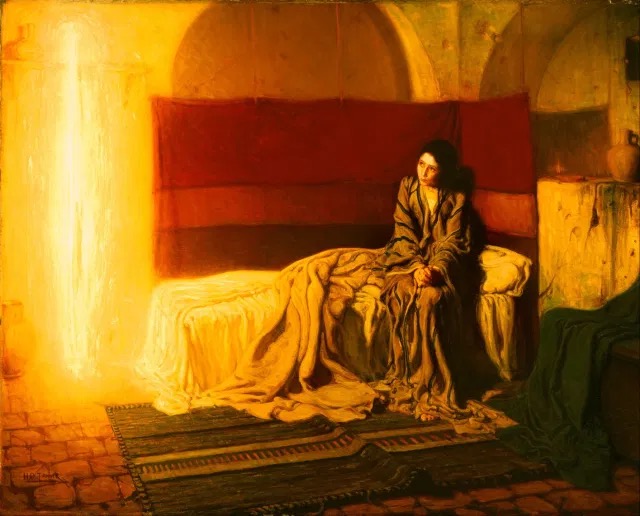
Painting: Henry Oswana Tanner, The Annunciation, 1898
Lohfink, Gerhard. No Irrelevant Jesus: On Jesus and the Church Today. Collegeville, MN: Liturgical Press, 2014.
Link for today’s readings for Wednesday, March 25, 2021
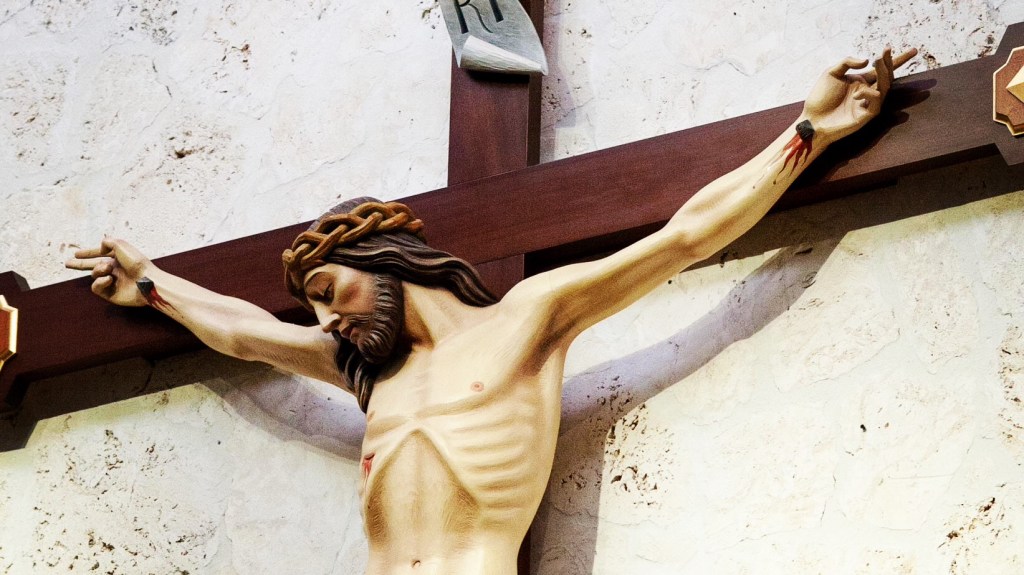
Jesus mounted the wood of the Cross to set us free from our sin.
It is interesting to note that in today’s Gospel reading from John, Jesus spoke to those who “believed in him” (Jn 8:31). But the more he talked, the less they seemed to understand who he was: “If you remain in my word, you will truly be my disciples, and you will know the truth, and the truth will set you free.” His listeners balked at the word “free”, asserting that because they were ancestors of Abraham they have never been enslaved by anybody.
In the United States of America, freedom is also highly valued. Many of us would probably react very much in the same way. We may have different ways of expressing why we feel that we are free, but we would certainly assert that we are not enslaved to anybody or anything.
Jesus’ words ring just as true then as they do today: “Amen, amen, I say to you, everyone who commits sin is a slave of sin.” Jesus shined his light on the truth that many of us do not see, which is our enslavement to sin. If we truly seek to be free, then we need to acknowledge this point. What many of us claim to be freedom, doing whatever we want to do, when we want to and how we want to do it, is not true freedom. We cannot even hear the clanking of the chains or feel the weight of the shackles chaffing at our skin as we raise and shake our fists to assert our freedom of indifference!
Our response to Jesus’ statement: “who commits sin is a slave of sin” ought not to be one of hiding, denying, rationalizing, attacking or fleeing. It is better to embrace the truth that Jesus is placing before us. In this way, we allow his light to expose the darkness in our heart where sin speaks and we realize that we have said yes. Becoming aware of our fault for those things we have done and have failed to do is the first step in becoming truly free.
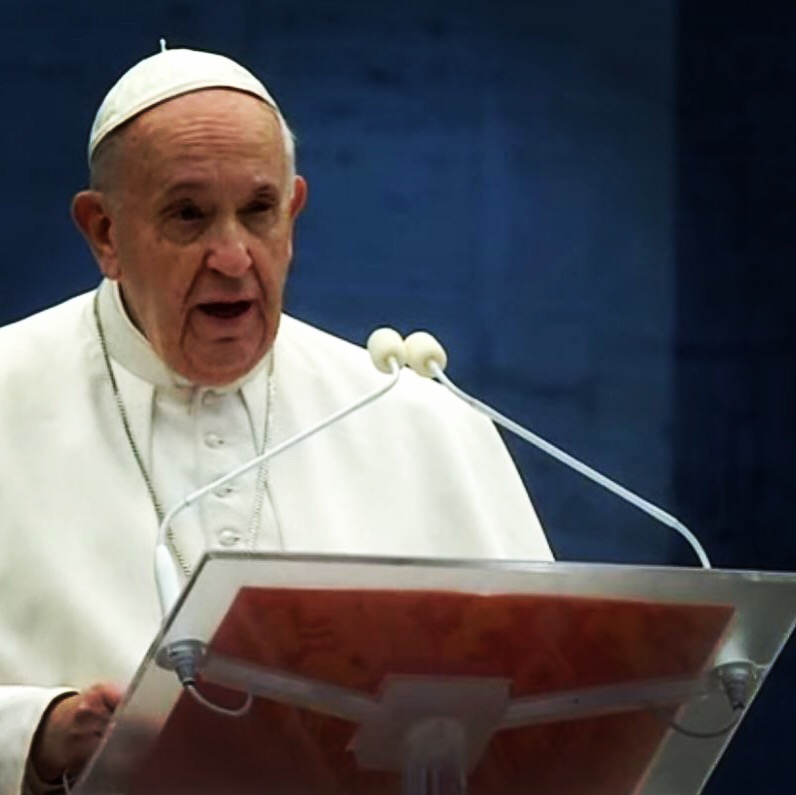
When Pope Francis was asked in an interview, “Who is Jorge Mario Bergoglio?” he answered, “I am a sinner, but I trust in the infinite mercy and patience of our Lord Jesus Christ, and I accept in a spirit of penance.” We are all sinners because of the fact that we all in some form or fashion place idols before God. This is not a negative or defeatist attitude, quite the contrary. When we call out our sin in truth, we can be free from it. When we think our life is about us first and foremost, and ignore or rationalize our sin then we are enslaved, such that it chokes and threatens to undo us. Then we experience its debilitating effects and succumb or attempt to free ourselves, yet the process becomes likened to a Chinese finger trap. The more we pull to escape, the tighter the grasp.
We become free from our sins by acknowledging that we are sinners. This does mean we are awful people. It just means that we have fallen for an apparent good instead of the true Good that God wants for us. We also cannot ultimately be freed by our efforts alone. We need to work in collaboration with the mercy of Jesus. We need a savior. Jesus accepts us as sinners, as we are. We do not have to be perfect or have our house in order for him to come to be present with us, for he is already waiting for us. We do not need to be worthy, we just need to be willing to open the door when he knocks, and invite him into the chaos of our lives so he can heal us with his grace, love, and mercy. “So if the Son frees you, then you will truly be free.” Let Jesus in today, and each day so to be free for excellence!
——————————————————————
Photo: Crucifix in the sanctuary of the cathedral, St Ignatius of Loyola, PBG, FL
Link for the interview with Pope Francis from America Magazine, September 30, 2013
Link for the Mass readings for Wednesday, March 24, 2021
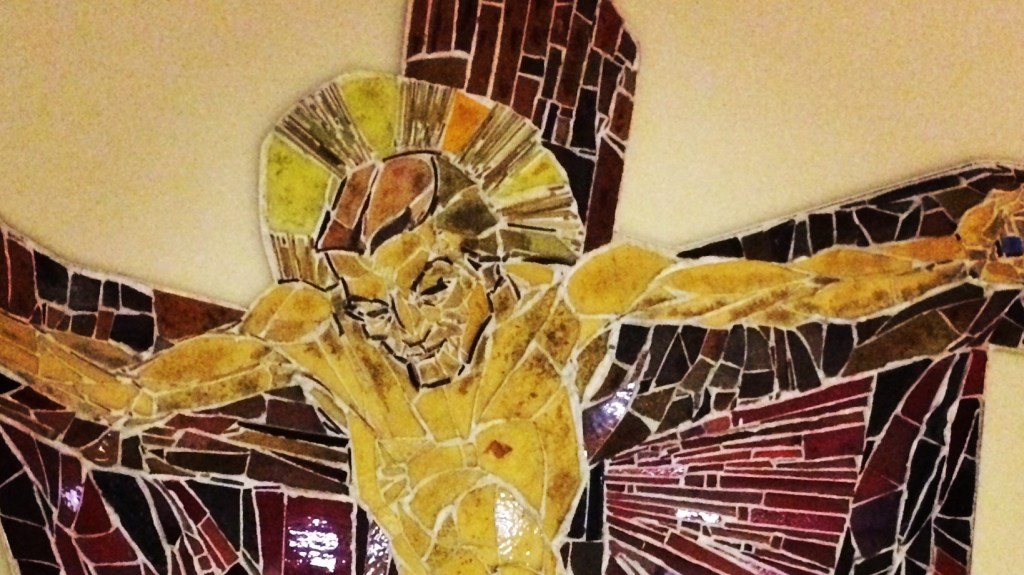
Let us follow Jesus to the cross.
Jesus seeks again to help the Pharisees understand who he is. In the preceding section of today’s Gospel of John, the Pharisees do not believe in his claim of being “the light of the world” because he testifies on his “own behalf, so [his] testimony cannot be verified” (Jn 8:13). The point being made here is that for verification there must be support given by two or three valid witnesses (cf. Deuteronomy 19:15). Jesus states that he testifies on his own behalf as does his Father who sent him (cf. Jn 8:19). His witness in this matter is God.
Jesus continues in today’s Gospel account to attempt to help the Pharisees and those gathered around them to understand who he is and what is about to transpire regarding his crucifixion. Jesus shared that God his Father sent him and continues to be with him. He has not left Jesus alone because Jesus maintains the intimacy of their relationship as he follows the will of his Father and will continue to do so all the way to being lifted up on the Cross.
Those listening to Jesus do not understand. They asked if he was talking about killing himself. Often throughout the ministry of Jesus many, even his Apostles, do not understand what Jesus taught, and that was because they were trying to make sense of what he said from this purely material and finite reality. Jesus invited them to seek a deeper understanding by sharing that he is from above and they were from below. They were needing to be born from above, to open their minds and hearts to him, as Simon Peter did when he came to realize that Jesus was the Christ, the Son of the living God. Jesus gave those he taught a choice. They could die in their own sin or repent and choose to live in participation with him.
Discipleship is a journey. We will not come to understand Jesus from one instance or encounter. Even Saul, who had an amazing experience and encounter with Jesus and changed his name to Paul, would take about three years to digest the significance of what happened to him that day on the road to Damascus. It will be so with us as well. We need to resist the world’s craving for instant gratification, especially regarding the growth of our discipleship and spiritual maturity.
We will develop on our faith journey as we acknowledge and repent from our sin, hear his call, believe in Jesus, remain committed to him, and walk with Jesus day by day and follow the will of his Father as he did. The gift of the liturgical seasons is that as we walk each year with Jesus and assess our growth, we will, like a finger making an upward spiral motion, come again and again to the same point each year, and hopefully, we are higher up that spiral each time.
Sometimes it is hard to see our changes in our day to day reality, but over time with the gift of hindsight, we can discover that we indeed have made a closer walk with Jesus a reality. When we can honestly assess that this is not so, it is not too late to begin again, to repent from that which keeps us bound to this world and turn our gaze to that which is above. Jesus made his choice to follow the will of his Father, to be lifted up, and to die on the cross for us. We too have been given a choice. We can hold tight to our selfish nature and curve in upon ourselves or we can open our heart to the cross and be free.
——————————————–
Picture: Mosaic of Crucifixion from Our Lady of Florida Spiritual Center, Palm Beach Gardens, FL
Link for the Mass readings for Tuesday, March 23, 2021
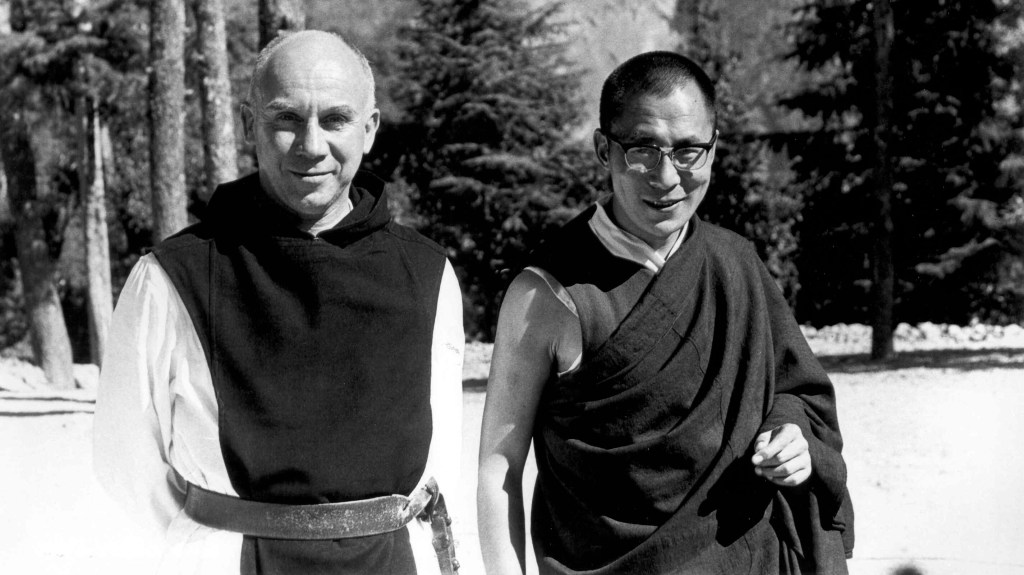
Healing and freedom comes when we are willing to encounter, dialogue, and experience one another.
“Let the one among you who is without sin be the first to throw a stone at her” (Jn 8:7).
As these words came forth from the mouth of Jesus, there must have been a deafening stillness. A mob had gathered around a woman seeking to stone her for being caught in the act of adultery. Had this woman actually been caught in the “very act”? Were there those that were scheming so scrupulously that they would spy on her at that moment, or like our first reading from the Book of Daniel was this a false accusation because the woman refused the advancement of someone who wanted to commit adultery with her and she refused? Either way, Jesus helped to restore the dignity of this woman by showing the common shortcoming of our fallen humanity.
Today’s Gospel account from John helps us to come to terms with the reality that we are all unified in the reality that we all fall short of the glory of God that we were originally created for. Fortunately, there was no one present who thought himself so self-righteous that he had not committed any sin. All left and only Jesus and the woman remained. It was only then that he spoke to her.
Jesus’ goal for each person he encounters is that we come to terms with our own sin, to repent and believe in the Gospel. Yet, he does so not by condemning us but by showing us how we are off the mark and bestowing his mercy and love upon us. In this way, he guides us to the path that will lead to what is truly good, not the false allures of apparent goods that may glitter at the moment, but then fade.
Jesus does not define us by our worst mistakes, but he does not want us to remain in our sin. By doing so, we are separating ourselves from a more real and intimate relationship with God and one another. Jesus is about healing those aspects of our choices, behaviors, habits, prejudices, and vices that keep us separated. Lent is a more intense period where we make the time to become more aware of that which separates us and in humility admit to and confess these patterns of behavior so that through the love and mercy of God and in collaboration with him, we can be transformed.
May we examine our conscience, call to mind those areas in which we have fallen short of the glory of God in our lives, where we have sinned, and with humility share them with Jesus. In this way, we with the woman caught in adultery may also hear his words, “Neither do I condemn you. Go, and from now on do not sin any more” (Jn 8:11). As we find healing and come to a better place of wholeness, we need to resist the urge to look at others as scapegoats. We are all interconnected and need to stand up for and speak on behalf of the dignity of one other.
The recent escalation in negative rhetoric, violence, hate crimes, and deaths committed against Asians, Asian Americans, and Pacific Islanders is wrong. Those perpetrating these acts must be held accountable but we also must pray and work to transform hearts and minds to help those with hatred in their hearts to experience the dignity of those they would seek to harm. As Bruce Lee said in an interview, “under the sky, under the heavens, there is but one family.” Isolation can be a poison that breeds contempt and indifference. We need to be willing to encounter one another in our differences, engage in dialogue with each other, and then we will begin to see each other as human, begin to build relationships, and recognize each other as family.
—————————————
Photo: After Thomas Merton and HH Dalai Lama met after one of their three meetings in November 1968.
Link for the Mass readings for Monday, March 22, 2021
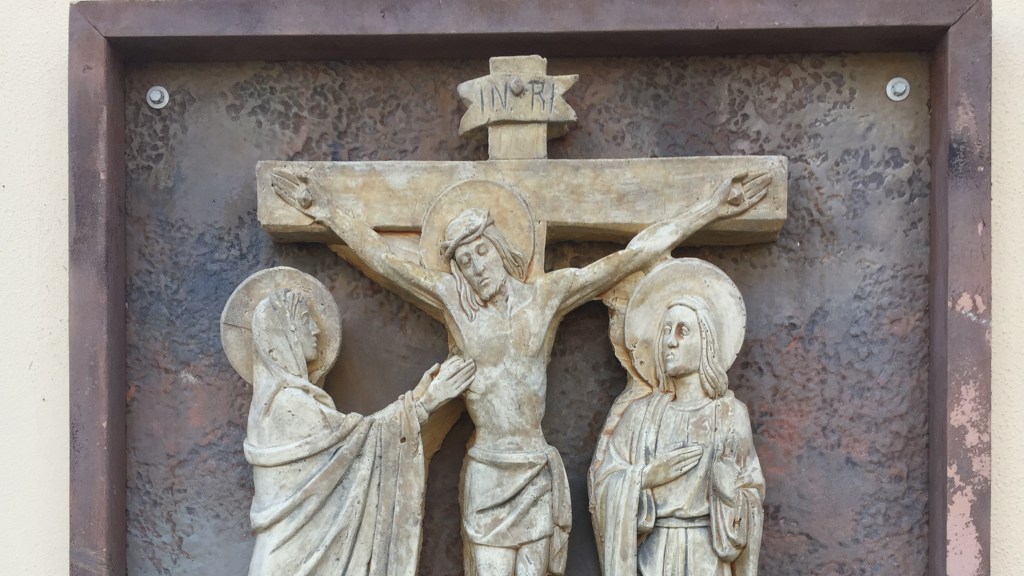
Jesus died for us, so that we may die to ourselves, and love others as he loves us.
We are now beginning the fifth week of Lent. We are coming closer to the cross, to remembering the suffering, crucifixion and death of Jesus. In today’s Gospel Jesus is sharing with those in his midst that he will lose his life in fulfillment of his Father’s will: “I am troubled now. Yet what should I say? ‘Father, save me from this hour’? But it was for this purpose that I came to this hour. Father, glorify your name” (Jn 12:27-28). Jesus has come among us, to be one with us and to experience the fullness of being human. In becoming human, he is opening the door for us to experience his divinity.
To be able to experience the divinity of Jesus, we have to die to our self. Death is not a partial thing, it is a total surrender. As Christians, our first experience of this death is Baptism. In Baptism we die with Christ, and we rise to new life with him. We are purified from the condition of Original Sin as we are born again in water and Spirit. We are conformed to and indelibly marked to Jesus and incorporated into the living organism of the Church, the Body of Christ. We become a part of his new creation.
In Confirmation, we continue the path of giving more of our life to Jesus. We are sealed with the gift of the Holy Spirit, we are empowered through the imposition of the laying on of hands and the anointing with chrism. We join in the apostolic mission of those who were and continue to be sent by Jesus to proclaim the Gospel, the Good News, that Jesus has become one with us so that we can be one with him. Jesus has given his life and returned to the Father in the fullness of his humanity, so to unleash the power and fullness of the love that he shares with his Father.
This is possible because what one human being experiences, sin or grace, all people experience. God has created us, as with all of his creation, as interconnected. Each one of us are distinct and unique, one of a kind, while at the same time in communion with God and one another and all of creation. The Son of God, in becoming human, and in his willingness to experience our suffering and death, has risen from that experience and returned to the Father in the fullness of his humanity. What he experiences with the Father, we have access to in our life, to the degree that we are willing to accept our humanity, participate in his life, and his invitation to receive his divinity.
When we reject our humanity, reject the fact that we are created beings, not totally self sufficient within ourselves; when we assume, grasp at, and appropriate for ourselves, self autonomy and stand firm that we need no help from God, we assume that we are the center of the universe and all revolves are us instead of God, we separate ourselves from the source of the very communion we live, crave, and hunger for.
Any act of the will that we place before God must be rejected, must die. To the extent that we can surrender our whole mind, heart, soul, and strength to Jesus, is the extent to which we will participate in his life and divinity. Jesus died for us so that he can also be with us always. We are not orphans, for he continues to be with us in the Mass. We come to receive him, Body and Blood, Soul and Divinity, during each liturgical celebration. We consume him and so continue to be nourished, to be transformed into his Body. We participate in this reality as well spiritually, when we are not able to attend Mass in person. We are dismissed from our time of worship and communion as bearers of Christ. We are sent to bring him to those we encounter in our realm of influence through the corporal and spiritual works of mercy. At the very least we are to respect the dignity of each person we interact with.
By participating in the Sacraments of Initiation; Baptism, Confirmation, and Eucharist, we become the grain of wheat that dies, germinates in the ground, then sends forth roots and shoots. As we continue in our daily surrender to God and participate in the disciplines of prayer, fasting, worship, study, service, and almsgiving we begin to bear fruit. For whoever serves Jesus, must follow him, and wherever he is, there his servants will be. The Father will honor whoever serves his Son (cf. Jn 12:26). Surrendering our lives in this way to Jesus we can say with St. Mother Teresa of Calcutta: “Each time anyone comes into contact with us, they must become different and better people because of having met us. We must radiate God’s love” (Mother Teresa, pp. 18-19). Let us, like the grain of wheat, die to our false self, allow the shell of our ego to be cracked open, so as to rise with Christ in his glory of being fully alive in him, to actualize who he calls us to be, and to bear the fruit of his mercy and love with others!
Photo: Twelfth Station of the Cross on the grounds of Cardinal Newman HS.
Mother Teresa and Devananda, Brother Angelo, ed. Total Surrender. Ann Arbor, MI: Servant Publications, 1985.
Link for the Mass readings for Sunday, March 21, 2021
 Spiritual Stepping Stones