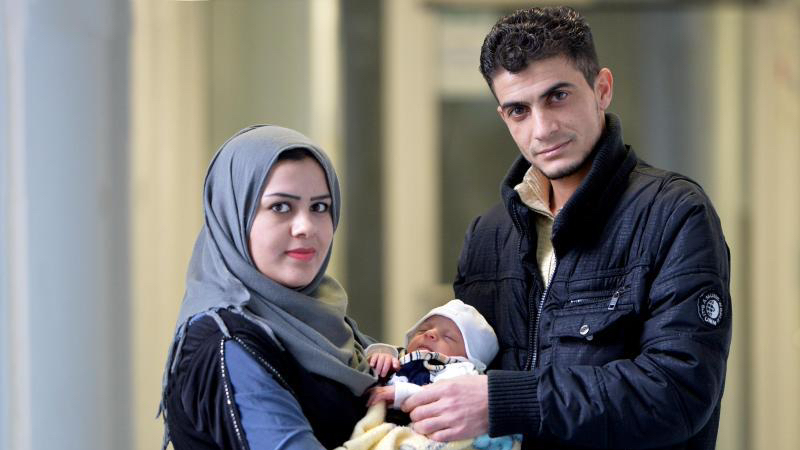
As we develop our relationship with God, our relationships with each other will improve.
In today’s account, Luke presents the faithfulness of Mary and Joseph. They followed the prescripts of the law by bringing Jesus to the Temple to have him consecrated to the Lord. We read of the prophecy of Simeon that Jesus is the promised hope of Israel and the light to the Gentiles, and also that he will lead to, “the fall and rise of many in Israel, and to be a sign that will be contradicted – and you yourself a sword will pierce – so that the thoughts of many hearts may be revealed” (Lk 2:34-35). The prophetess Anna gives thanks to God and shares how the long-awaited redemption of Israel has come with the presence of this child. The scene closes with Joseph, Mary, and Jesus heading back home.
Mary and Joseph have had a lot to take in, from being told about Jesus’ miraculous birth to having to relocate for the census, the coming of the shepherds and the magi from the East and now Simeon’s and Anna’s prophecy. Though they did not fully comprehend the fullness of all they were presented with, what the Holy Family, whose feast we celebrate today, model for us is that they are open to the process of God’s leading. They ultimately placed their trust in and remained faithful to following God’s will.
We are invited to do the same. The family is called to be the domestic Church. It is the place where we learn our faith, where we learn about God, learn to pray, to worship, to serve, to trust in God, and to learn how to be in relationship God and one another. This is especially true in our fallen world. We romanticize the early life of the Holy Family at our own peril. In the midst of the joy of new birth, and a birth that will bring about the redemption of Israel, there is the gift of myrrh, an oil used to anoint the bodies of the dead, and there are Simeon’s haunting words to Mary, “and you yourself a sword will pierce” (Lk 2:35). In the midst of the words of wonder about this child being the prince of peace is the reality that he will die a brutal death.
The reason we hold up the Holy Family as a model is not just Mary’s willingness to bear Jesus and Joseph’s willingness to protect and provide for his their care. They were willing to continue to follow the will of God no matter what challenge arose before them and they stuck together and supported one another.
There are no guarantees for families in this life other than that there will be conflict and growing pains. Any true relationships that are authentic will come to crossroads which will demand a choice. One or both individuals can either not face the conflict, in which case the relationship will weaken or they can work together to resolve the conflict and grow stronger together. What will also help in our familial relationships is an understanding of the love that God calls each of us to embrace which is unconditional love. What is important to realize is that unconditional love is more than mere sentimentality or emotion. This love is what St. Thomas Aquinas defines as “willing the good of the other as other.”
This understanding of unconditional love allows us to be authentic to ourselves and who we are in the richness of our diversity while respecting the other to do the same. That means we will see life differently and we will disagree even quite emotionally and passionately. While doing so, we also need to commit to respecting one another and have the presence of mind to listen to each other’s perspective and point of view and bring God into the conversation so we can be influenced beyond our own limited view. Then when all is said and done, with love and respect , and hopefully in our openness to God working through us, we will have learned a bit more because our limited view points have been expanded.
There is this wonderful scene from the 1989 film “Lean on Me.” Morgan Freeman plays a principal that is brought in to save a failing school in New Jersey by Robert Guillaume who plays the school superintendent. Both of the characters have the same goal of seeing this school succeed. Then one meeting comes about because of some of the principal’s questionable practices. For a couple of minutes they engage in a heated, emotionally charged argument. When it ends, the principal matter of factly asks, “Do you want to get some lunch.”
That is an expression of the beauty of love. Each are fully transparent and honest with one another, both have the same goal yet vehemently disagree on some of the ways this principal is going at bringing about change. The bottom line is that they are friends and dedicated to their school and one another. They passionately disagree about particular points while at the same time hear each other and work through their conflict together.
There has been a lot going on in the world, our own country, as well as our own personal lives. We have been pulled and stretched in so many directions over the last few years. To say many of us are anxious, stressed, and/or worn out is an understatement. What helped Mary and Joseph face the challenges they had can help us as well. We will grow together and remain united by resisting the urge to curve in upon ourselves and be willing to face our challenges together with God.
Let us follow the lead of the Holy Family this Christmas Season by sharing with one other the gifts of understanding, patience, presence, kindness, respect, caring, and love. We will be most effective when we are committed to God and one another first and foremost. Instead of fearing the wonderful gift of diversity, we can embrace it in all its messiness and chaos. When we are committed to listening to one another even when speaking passionately, instead of shouting past each other, then when the emotions subside the respect and care for each other will remain.
What can help each of us from slipping into a defensive posture and instead remain more open and willing to grow in relationships beyond the limitations of our biases and prejudices is to spend some time each day breathing slowly and meditating about who this season is all about.
Close your eyes and imagine yourself coming upon Joseph and Mary as they leave the Temple. You see cradled in the crook of Mary’s arms the infant Jesus. Smell the dust in the air from people walking by. As a few more people pass by their speech begins to fade. All about you becomes still. Recall the wonder of this moment that the Son of God came into the midst of our chaos in such a humble and vulnerable way. Your eyes are then drawn to Mary.
Mary invites you with a welcoming smile. Imagine yourself stepping closer and reaching out your hand to Jesus and watch as he reaches out to you. Feel the gentle grasp of his tiny fingers as they wrap around your finger. Allow your breath to slow as you feel his grace, love, and peace fill your whole being. Then raise your head ever so slightly and allow your eyes to be drawn deep into his tiny dark eyes. In that gaze, see the face of God looking back with the assurance that you are not alone, you are not defined by your worst mistakes, you are loved more than you can mess up, and more than you can ever imagine. Rest in the closeness of his unconditional love for you, just as you are with all your imperfections. Also allow yourself to experience the fullness of who God is calling you to be.
As your time of intimate stillness comes to a close, embrace the gift that each person you will meet from now on will be like this encounter with the infant Jesus. For in each person we encounter, we encounter Jesus. We will see each other as God sees us as the beloved children of his family. When this becomes our starting point of encounter, we will relate to each other a little better and grow in love from there.
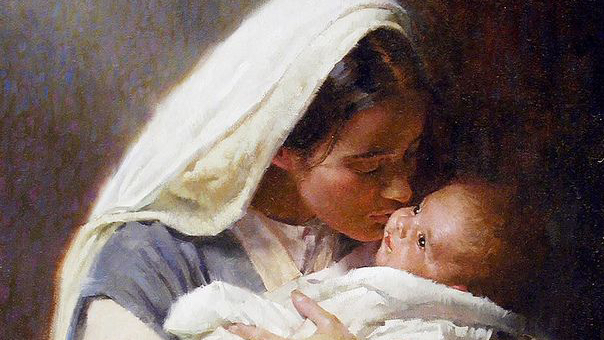
Painting: Kissing the Face of God by Liz Lemon Swindle
Link for today’s Mass readings for Sunday, December 27, 2020
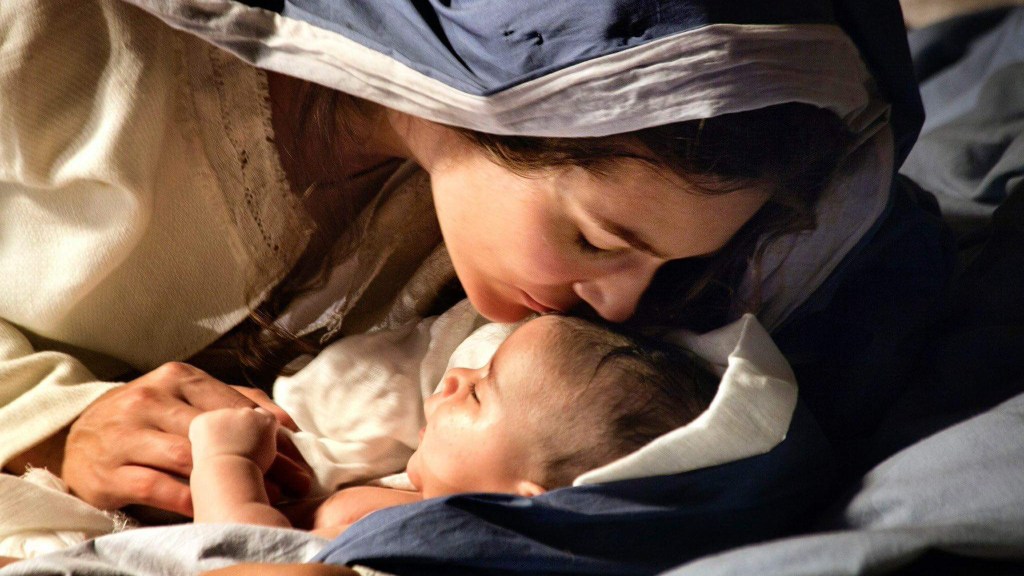
Are we willing to come close to the Christ child and be transformed?
“You will be hated by all because of my name, but whoever endures to the end will be saved” (Mt 10:22).
Why are we talking about being hated the day after Christmas? Because Jesus, this baby whose birth we just celebrated is “the light that shines in the darkness” (Jn 1:5). The very reality of Jesus is that he is the light that exposes darkness, he is the very embodiment of Love that exposes hatred.
Jesus exposes the truth of those dark places within our own hearts, minds, and the very depth of our being. Yet many of us turn away or reject the light, not aware that it is an invitation to healing and to wholeness. We wince at the luminous brightness of his light and resist the intimacy of the love he seeks to share. We have so often faced so much of the opposite; hurt, pain, betrayal, and lack of understanding or acceptance, that we assume a defensive crouch to protect our false sense of self, and as time passes we become ingrained in our pride and our posture of protecting our ego.
Yet, to be fully alive, we need to embrace the light, not hide from it. When we are open to the healing touch of Jesus and receive the gift of his light in our lives, we begin to die to our ego, we begin to replace our actions of vice with actions of virtue. Once we allow ourselves to be loved by Jesus, we begin to recognize that we are turned in upon ourselves, and then we can adjust our posture and begin to open ourselves to him. We also begin to recognize that we are not the center of the universe. We then will be able to love, to will the good of the other.
As we follow the model of John the Baptist and become less so that Jesus becomes more in our lives, we will face the same rejection that Jesus faced. We will be labeled crazy, out of step, simple-minded, irrational, and worse, as St Stephen found out, whose martyrdom we celebrate today. Yet we are to resist returning to a defensive posture, we are to refuse to react in kind, but instead, be present and allow God to happen. We are to assume a posture of openness, accepting the person where they are and as they are, and share the same transformative mercy, love, and forgiveness of Jesus we have received from our attacker.
Change, maturation, and growth are not easy. That is why we are called disciples. We are to be disciplined and persevere, while at the same time remember that our redemption does not come from our own doing or willing it to be so on our own efforts alone. Our healing, restoration, and transformation come first and foremost from a willingness to accept the invitation to receive the blessing of Jesus, an invitation to receive the healing salve of his love, mercy, and forgiveness. May we be willing to be healed and transformed from our bias, prejudice, hatred, and selfishness. May we be willing to be conformed to Jesus and so step out of our comfort zones, and with courage be more loving, merciful, and forgiving with our family, friends, and enemies.
Transformation is not a one-time event, Christmas is not just a day, it is not just a season. Christmas is a way of allowing Jesus to enter into and transform our lives each and every day, each and every moment, with each and every decision. When we are tempted with impatience, call on the name of Jesus and take a few deep breaths. When we are tempted to judge, may we see the baby Jesus in the manger, weak, vulnerable, and in need, so to see the one we are about to judge with understanding, mercy, and love that wills their good. When we are tempted to react negatively or defensively, let us visualize ourselves kneeling before the Christ child as we surrender our will, our ego, so to share our point of view as an invitation, not as an imposition, and allow others to do the same.
May we be more committed each day going forward into the new year to being open to receiving the light, love, mercy, and forgiveness that Jesus has come to bring, so to be healed by him and so to be willing to grow in our relationship with him and one another.
————————————————————————–
Photo credit: Il ragazzo cathopic.com
Link for today’s Mass readings for Saturday, December 26, 2020
Merry Christmas!
“God came into the world as a child to make us children of God. What a magnificent gift! This day, God amazes us and says to each of us: “You are amazing.” – Pope Francis.
For many of us, this year may not be the Christmas we envisioned or hoped for. Let us remember why we celebrate. Jesus, the Son of God entered into our humanity to remind us that we are children of God, created in his image and likeness, each as unique gifts and invited to express in our own unique ways his divinity flowing through us into our world. Jesus reminds us again that there never has been nor ever will be anyone like you. You are amazing, unique, and beautiful. May we see each other as God sees us and love each other as God loves us!
Merry Christmas!
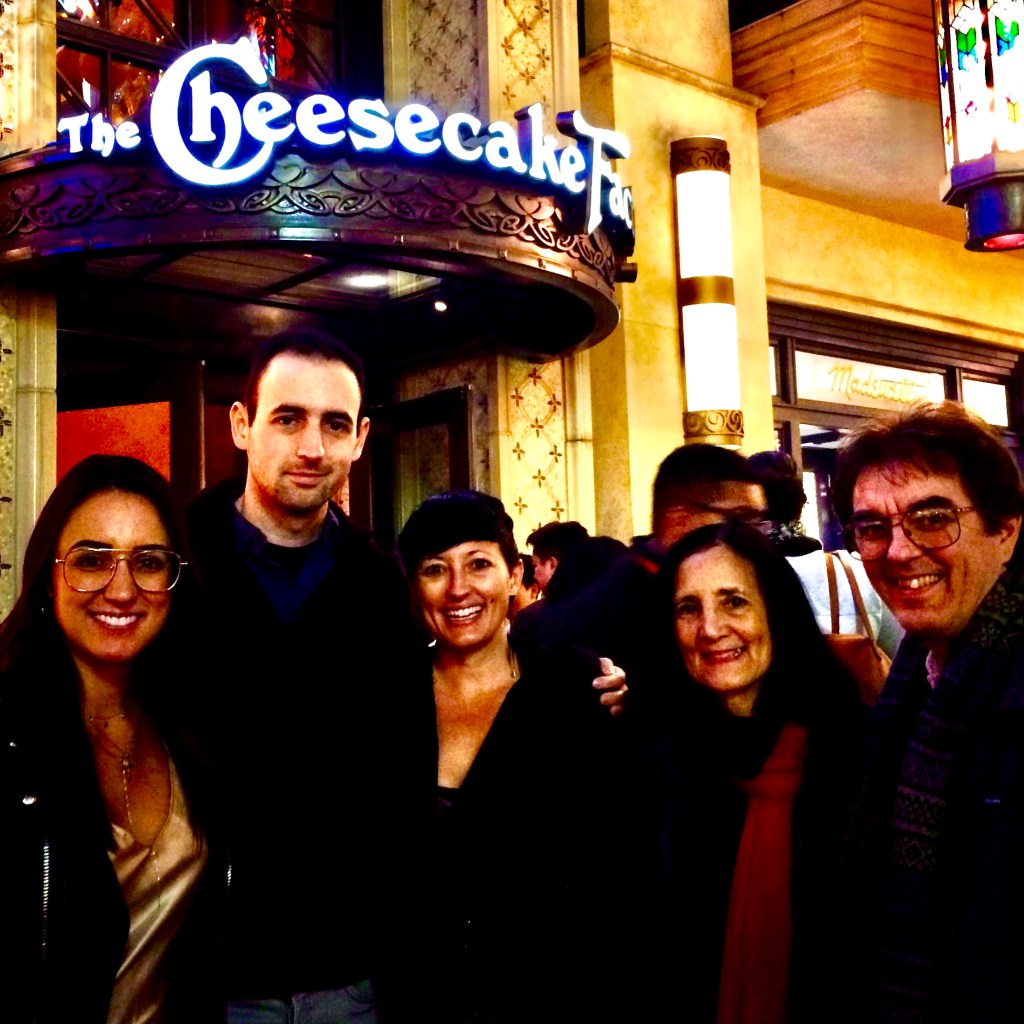
Photo: A few years ago, altogether in Los Angeles for Christmas.
A child is born to us to help us recognize the gift of our human dignity, diversity, and interconnectedness.
“And the Word became flesh and made his dwelling among us” (Jn 1:14).
If there are ever words to meditate and ponder upon these are them! The danger is becoming complacent or indifferent to the reality that they present, or to the idea that this is just any other day that we just endure and go on to the next day. Instead, may we embrace the promise and invitation they are meant to convey to us as individuals, as a people, and for all of creation.
The Word, Logos in the Greek, who was, who is, and who always will be, the Second Person of the Holy Trinity, has become one with us. We are the minutest of minutest speck of specks present in the whole of the cosmos. And yet, we have been graced by the presence of God who became man for each and every one of us, each individual person, so we can be one with him. He became human that we might become divine through our participation in his life.
The Mystery we celebrate today is that God took on flesh, becoming fully human, while at the same time, remaining fully divine. He did not just appear to be a man for a time and cast off his humanity like a cloak. The Son was conceived in the womb of Mary, developed as you and I did, and when born let out a gasp and a cry indicating that the savior was born to us. Joseph and Mary gazed in wonder at the gift of their son, the gift of the Incarnation for the whole world.
Christmas Day is the celebration of new life. Not just the birth of any baby, but through his coming into the world, a new beginning for humanity and creation. We do not just celebrate the baby who would become a great teacher and moral template, but the coming of our Savior, the reality and the hope that we may be wounded and even a bit been broken, but not undone, not unmade, not destroyed but saved from our slavery to sin. God’s grace is greater than our worst mistakes, misjudgments, and most grievous faults.
Though darkness may appear to reign through the midst of another wave of increasing cases of COVID, ongoing wars, political and racial division in our country, and though there may be tempted to fight our anxiety, fear, and desperation, today we celebrate that “A light shines in the darkness and the darkness did not overcome it” (Jn 1:5). This is a day to rejoice, to reconcile, a day to recommit to the light, to the baby who would later call himself, “the way, and the truth, and the life” (cf. Jn 14:6).
Let us embrace the gift of our humanity, the gift of our diversity and interconnectedness, the gift of our families, biological and beyond, as we embrace this baby wrapped in swaddling clothes, for he shows to us the truth and realization that: “We cannot save ourselves. We can only open ourselves to the hope that comes to us from without, from others, ultimately from one Other” (Lohfink 2014, 255). The One whose birth we celebrate today: “The Light of the human race” (Jn 1:4).
——————————————————–
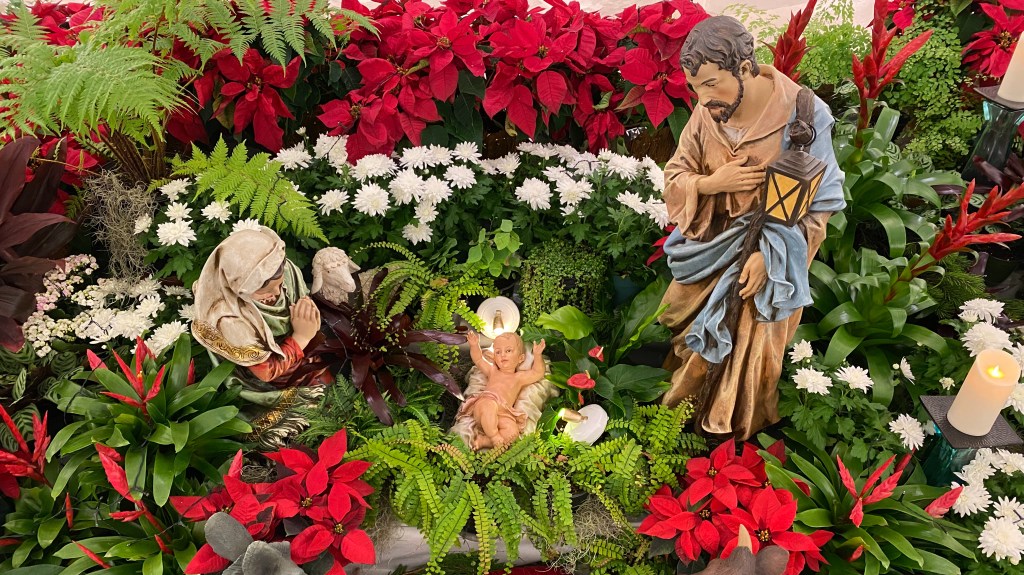
Photo: The Nativity scene before our altar at our parish of St Peter.
Lohfink, Gerhard. No Irrelevant Jesus: On Jesus and the Church Today. Collegeville, MN: Liturgical Press, 2014.
Link for today’s Mass readings for the Mass of the day for Friday, December 25, 2020

“…The dawn from on high shall break upon us…”!
“In the tender compassion of our God, the dawn from on high shall break upon us, to shine on those who dwell in darkness and the shadow of death, and to guide our feet into the way of peace” (cf Luke 1:78-79).
This promise of the Holy Spirit is spoken through the father of John the Baptist, Zechariah, and this evening at the Christmas Vigil we begin to celebrate the fulfillment of those beautiful words.
God’s tender compassion has surrounded us and has been a part of us since before our conception. He knows the number of hairs on our head and he knows each one of us by name. Totally transcendent, infinite beyond our comprehension, beyond all space and time, yet God knows each one of his created beings intimately. He cares for us, guides us, and invites us to experience his joy and the fulfillment of who he has created us to be.
The ultimate love he expresses is that our relationship is based on our free will, our choice to say yes or no to the relationship with him he offers us. He gives us the freedom to choose anything but him. Some would say, he should just make us follow him. That would not be love, but oppression and tyranny. The light of God enters our being when we say yes to God’s will and invitation for relationship. It is then magnified by the light of his Son. We can recede back into the darkness or walk into his brilliant light to be empowered and transformed by his love for us.
When we accept the invitation to enter into a relationship and to follow God’s guidance we will better be able to see the darkness within ourselves that prohibits us from experiencing the fullness of the light that brings us his grace that builds on our nature as well as his peace. We need to choose to allow the light to dawn in every aspect of our being, our wounds, our prejudices, our defense mechanisms, our comfort, all those areas where we deny the truth or where we are supporting false realities or apparent goods.
May we prepare our hearts and minds as we celebrate the gift of the incarnation one more time. Let us resist withdrawing or running from and instead run to the “dawn from on high,” that shines on us, “who dwell in darkness and the shadow of death,” so that God may “guide our feet into the way of peace.” The closer we are to God, the more we experience his peace, that peace that surpasses all understanding, and the more we can share his light and peace with others in this new year to come.
Photo: Taken last year while at home in CT. The sun rises and sets on all of us, just as the love of God’s Son radiates out to each of us.
Link for the Mass readings for Thursday, December 24, 2020
Prepare!
Zechariah has not spoken since the time he encountered the angel Gabriel. Gabriel shared with Zechariah that his wife Elizabeth, though barren and past childbearing age, would give birth to a son and his name would be called John. The time for the fulfillment of Gabriel’s prediction has now come to pass, Elizabeth has given birth and with friends and relatives gathered around on the eighth day for his circumcision and naming, Elizabeth announces that her son will be named John. Those gathered balk as they say, “There is no one among your relatives who has this name” (Lk 1:61).
There may also be some hesitancy because John, or יוֹחָנָן, Yôḥanan in Hebrew, means one who is graced by God. The people may be wondering who this child might become. Then they turn to Zechariah, who writes on a tablet that “John is his name.” Zechariah confirms Elizabeth’s words and “Immediately his mouth was opened, his tongue freed, and he spoke blessing God” (Lk 1:63-64).
Filled with the Holy Spirit, Zechariah speaks what we call today the Benedictus or Canticle of Zechariah, the beginning lines of which read: “Blessed be the Lord, the God of Israel; for he has come to his people and set them free. He has raised up for us a mighty Savior, born of the house of his servant David” (Lk 1:68-69).
Zechariah did not proclaim that John was the Messiah. John became the herald of the Messiah. He prepared the way for the coming of the Lord. The Benedictus, like the Magnificat, is a song of great promise. This is why the Church proclaims that they are to be prayed every day in the recitation of the Book of Christian Prayer or the Liturgy of the Hours. We are living in the time of its fulfillment. The year 2020 A.D. does not stand for after the death of Jesus, it stands for anno domini, in the year of our Lord. We live in times of great joy, for no matter what the external circumstances our Lord Jesus the Christ is present with us, to accompany us, to give us guidance and strength!
To counter violence, war, polarization, endless forms and acts of dehumanization, fear, and growing anxiety, we will celebrate again this Christmas the reality that we are an alleluia people, a people of great joy. We are preparing in these final days of Advent to remember and celebrate again the reason for the season, the fulfillment of the Magnificat and the Benedictus, the birth of our Savior.
Each and every day, we are invited to celebrate with great joy the reality that Jesus has come to set us free. May we be open to and receive this gift of freedom this Christmas Season and turn away from our pride and the sins that tempt to enslave us. Jesus who granted us his mercy by being willing to enter into our chaos and bring us healing and reconciliation, invites us from his humble beginnings, wrapped in swaddling clothes, and resting in straw, to do the same. Let us put into practice and live out our heritage, our faith, and our hope, and be a people, who even in the midst of darkness, inhumanity, and pandemic, have not only seen a great light but bask in and embrace it, so to share the light of Jesus with concrete acts of mercy, joy, and love.
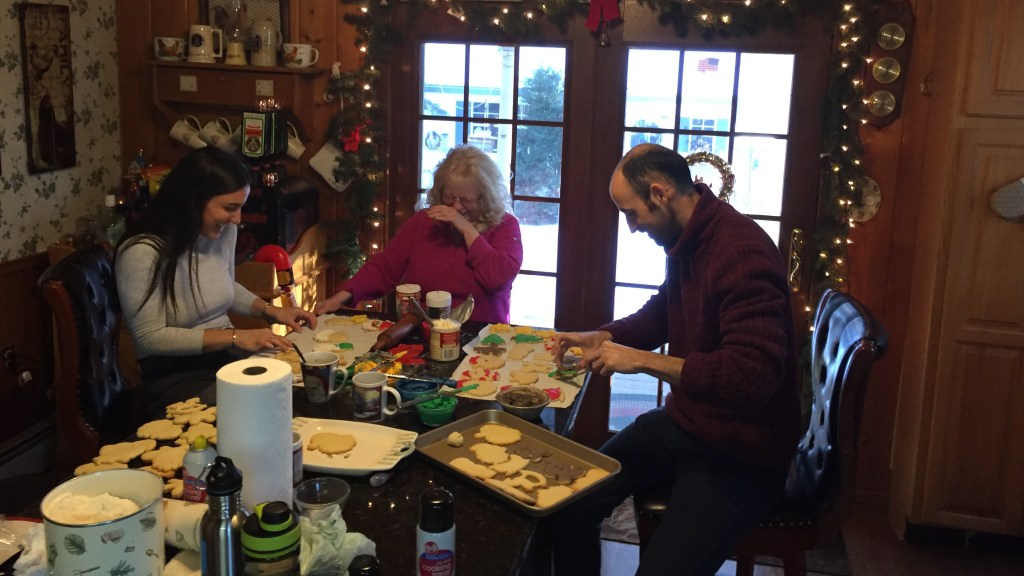
Photo: Preparing for Christmas by enjoying making cookies last year with my mother.
Link for the Mass readings for Wednesday, December 23, 2020
“The Almighty has done great things for me and holy is his name.”
“My soul proclaims the greatness of the Lord; my spirit rejoices in God my savior, for he has looked upon his lowly servant. From this day all generations will call me blessed: The Almighty has done great things for me, and holy is his Name.” (Lk 1:46-49).
These verses from Luke are the beginning of the Canticle of Mary also known as the Magnificat. These words are recited or chanted daily each evening for those who pray Vespers or Evening Prayer for the Liturgy of the Hours. We are still able to read and recite these words, again and again, generation after generation because Mary and Elizabeth were moved by the Holy Spirit and acted upon his leading. They did not remain silent, they did not hold back their words for fear of being rejected. Mary went in haste to come to be with Elizabeth, she did not hesitate and think things over. She was clear and she went.
Mary’s words of greeting were heard by John and he leaped in the womb of Elizabeth who then, moved by the Holy Spirit, confirmed the encounter of the Annunciation when she said: “Most blessed are you among women, and blessed is the fruit of your womb” (Lk 1:42). Mary then responded glorifying the Lord for what God had done for her, for us, for the whole created order.
Present in this hymn of praise, thanksgiving, and hope, are words that we can make our own. We too can proclaim “the greatness of the Lord”. We do so by thanking God for what he has done in our lives, as St Irenaeus did so when he recognized this and wrote that God sent his Son to open up heaven for us in the humanity he assumed.
Mary is called blessed because she followed the will of God and points all generations to her Son, directing not only the attendants at the wedding feast of Cana but all of us as well to “do whatever he tells you” (cf. Jn 2:5).
We have the opportunity to rejoice with Mary today by reading and praying with Mary’s Magnificat (Lk 1:46-56). The best way to prepare and celebrate the birth of Jesus is to be willing to hear and do whatever Jesus tells us, such as: “You shall love the Lord your God with all your heart, with all your soul, with all your mind, and with all your strength. The second is this: You shall love your neighbor as yourself” (Mk 12:30-31).
Loving our neighbors also means loving our enemies. This includes anyone that really gets under our skin. We need to learn again how to have civil and respectful dialogue. We can disagree but still respect one another without belittling or dehumanizing. We can listen to one another’s points of view, without shouting at or over one another. By doing so, maybe we can learn from one another again. How about packaging up a nice fruit basket made up of love, joy, peace, patience, kindness, goodness, gentleness, self-control, and understanding, and placing it under the tree this year for Christmas?
———————————————————————-
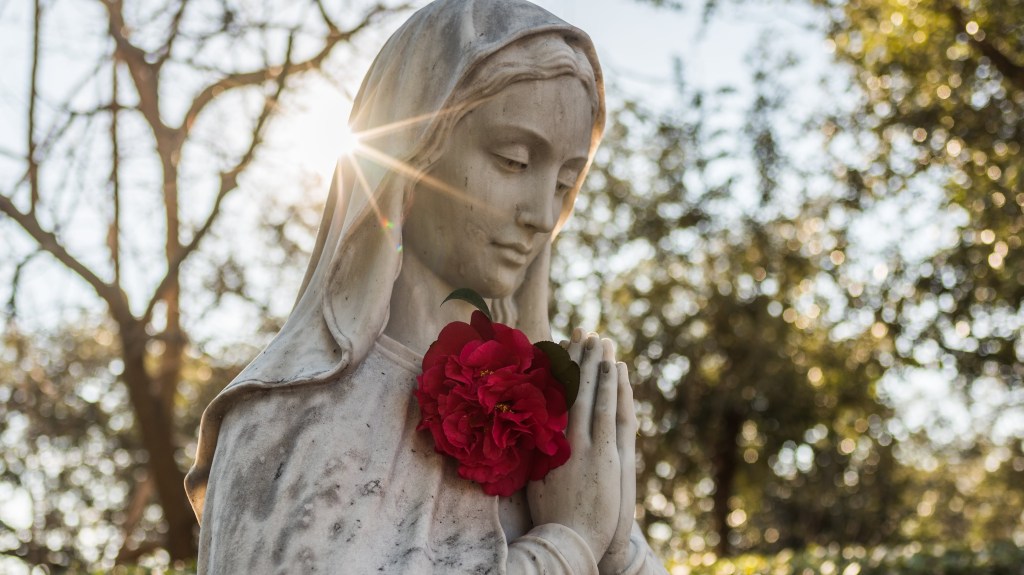
Photo of Mary by Moisés Becera. Roma, Italy cathopic.com
Link for the Mass readings for, Tuesday, December 22, 2020
Let us accompany and be present to one another.
Mary “traveled to the hill country in haste” (Lk 1:39) and when she and Elizabeth got together they rejoiced in the gift of new life that God had blessed them both with. We are to rejoice too, as we remember the gift of the conception and birth of Jesus. Jesus invites us to experience a new life. What we are about to celebrate in a few days had never happened before in human history. The Son of God, the second person of the Trinity, fully divine, became one of us. He became a human being, fully human, just like one of us. That affirms that we are not junk, not someone’s trash to be kicked around. Our life has purpose and meaning because we are loved by God more than we can ever imagine!
We are all invited to be recreated, each and every day. Have you ever wanted a fresh start, a do-over? Well, here you go. Don’t believe the mind noise or other people who will actually tell you in subtle or overt ways that you are worthless or nothing. Not true! Just by our very being, the reality that we exist, says something. We have been created in the image and likeness of God and we have been created by Love to receive and to share the love we have received. We are a living craving hunger and desire to be in communion with God and one another. This is true for the atheist and the believer alike. We are called to will the good of the other as other and as they are, unconditionally. If we haven’t been all that loving lately, today is a new day to take Jesus’ hand and begin anew.
We are about to celebrate a baby’s birth. Not just any baby, but he who has always been, became the most vulnerable, who took on flesh as an embryo, developed as an unborn fetus, and was born as an infant, and wrapped in swaddling clothes. Mary’s Son would continue to grow, mature, and thirty-three years later, return to an even more vulnerable position on the Cross, beaten, scourged, naked, and crucified. He was born and tabernacled, made his dwelling, among us, to be one with us, so that when he died he could take our sin upon himself. Original Sin did not destroy us. We were wounded, but by his stripes, the scourging that Jesus endured for us, we have been healed. He conquered even death, that we could have life and have it to the full, now and through all eternity.
Jesus was born for us and he is still with us that we might not only be shown a better way but to know him, who is the Way. Jesus became vulnerable for us, being authentically who God called him to be, even when that meant rejection, time, and time again. May we too be willing to be vulnerable, to risk, to share with others who we are, free of masks and pretense. May we be present, and also walk and accompany one another. Being there for our family and friends is important, and if we take our Christianity seriously, we must come to acknowledge, in concrete ways, person to person, that we are all brothers and sisters. Just as the sun shines on the good and the bad alike, Jesus died for us all. After his Resurrection and Ascension into heaven, he sent the Holy Spirit, the Love shared between the Father and the Son, to empower us to live as he did, in communion with his Father, to better actualize our communion with one another.
Mary and Elizabeth celebrated the joy of new life, they rejoiced together at the announcement that each of them would conceive and bear a son. The other message they share with us because they realized it all too soon, is that life goes by too fast. Each of their sons would die a brutal death, yet God brought about a greater good from their willingness to sacrifice their lives for us. They gave us a new beginning for humanity.
Let us not take the gift of this life we have been given, any moment of it, for granted. Let the people we care about know that we love them. Make that call, send that card, and/or invite that person for a walk and when you are together, be present, be there with each other. Put the phone down, leave work at work, face conflicts and work through problems that arise together, and as best as we are able just be present to one another.
May we be respectful, kind, and caring in our interactions with each person we encounter in our daily moments. If you catch the eye of another, smile. In that simple gesture, we say to another that we care enough about them to acknowledge that they exist and that they have worth. Even behind our masks, our eyes smile. Let the joy of Mary and Elizabeth catch like wildfire in us this Advent and let us share with haste the joy of Jesus we have experienced in our life!
————————————————————————————
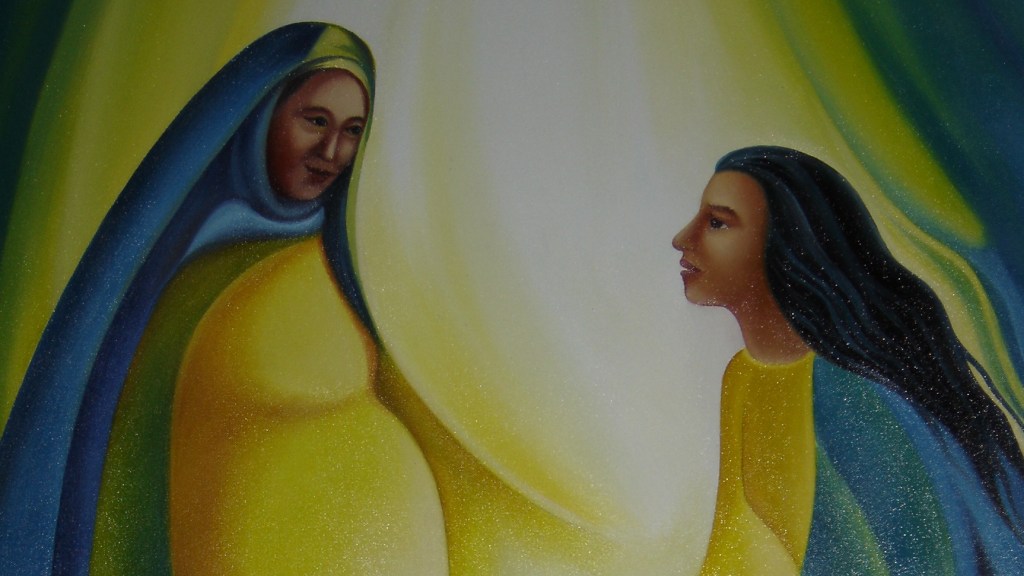
Painting of Elizabeth and Mary in the church of El Sitio, Suchitoto, El Salvador
Link for the Mass readings for Monday, December 21,2020
 Spiritual Stepping Stones