Mary’s, “Yes” has made all the difference.
Mary, full of grace and the model of discipleship, is on display in today’s reading from Luke’s Gospel. In a mystical encounter, the angel Gabriel shared with Mary that she would bear the “Son of the Most High” (Lk 1:32). Mary heard clearly what Gabriel said though she did not fully comprehend. Who could? So Mary asked, “How can this be, since I have no relations with a man” (Lk 1:34)?
This is a different question than what Zechariah, the father of John the Baptist, asked of Gabriel in a similar situation: “How shall I know” (Lk 1:18)? Zechariah was looking for a sign, he sought proof. Mary, through her faith in God, sought to understand what God required of her, so she combined her faith and her reason. While she pondered Gabriel’s response, the whole of the cosmos held its breath for her response.
When Mary said, “Behold, I am the handmaid of the Lord. May it be done to me according to your word” (Lk 1:38), a weary world, wounded by sin exhaled with relief, for the long-awaited savior could now come to redeem what had been lost. Mary, in her obedience, undid the Sin of Origin committed by Adam and Eve in their disobedience.
Mary, help us to ponder your yes, your willingness to follow the will of God and to give birth to our savior. Help us to ponder what this reality means to us and our lives. Help us to be disciples like you, resisting a knee jerk reaction of rejecting outright what we do not understand and choose instead to be open to the possibilities available to us that are beyond the realm of our senses and limitations.
May we too, like you, seek understanding instead of demanding proof. Help us to understand that this surrender is not a practice in limiting ourselves to mere superstition but an embracing of the fullness of what it means to be human, so to embrace the reality of our physical as well as our spiritual natures, and allowing ourselves to be expanded by God beyond our finite limitations.
——————————————————————–
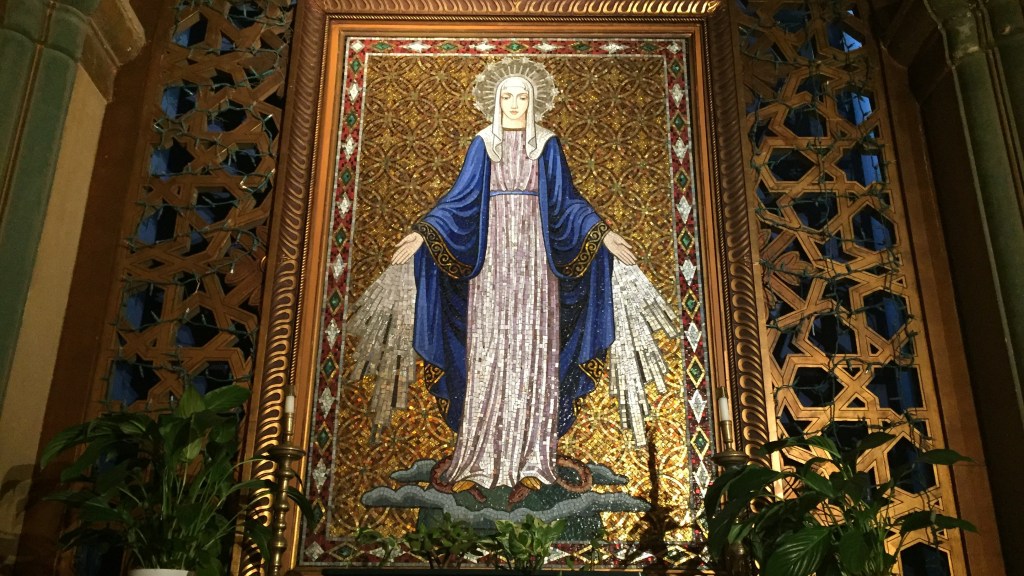
Photo of Mary, side altar at the Mission Dolores Cathedral, San Francisco from visit there, last year.
Link for the Mass readings for Monday, December 8, 2020
Advent is a season to be forgiven and to forgive.
Have you ever locked yourself out of your house or car? Have you ever needed to get somewhere and were stuck in traffic? Have you ever needed to mail something at the post office and when you arrived the line was already out of the door? Have you been sick and not been able to get to a doctor? Have you or are you dealing with a chronic or debilitating health condition? Are you aware of recurring sin, that you just can’t seem to get past?
If you have experienced any, many, or all of the situations above, you may have some empathy for the man in today’s Gospel of Luke who is paralyzed. Word has come to him that Jesus of Nazareth is close by. He heard that Jesus had helped the blind to see, the deaf to hear, and the lame to walk. Could he receive healing? How though could he get to him? Somehow men came forward to bring the man, we don’t know if they were family, friends, or neighbors. In Mark’s account (cf. Mk 2:1-12) he wrote that there were four men. The key point is that they bothered to care, they made the time, carried him on a stretcher, and brought the man to Jesus.
When they arrived they could not find “a way to bring him in because of the crowds” (Lk 5:19). Unfortunately, “the crowds” could not be bothered to move, to adjust their positions, or to make a way for them to get through. We can imagine the man’s anguish. He had come this far but would be able to get no closer. Maybe some of his bearers were getting frustrated with the lack of willingness of others to make way. Yet, one of the five, maybe even the man himself, was able to think outside of the box.
They maneuvered the man, still on the stretcher, up to the roof, removed some tiles, and let him down before Jesus. Jesus witnessing their faith said, “As for you, your sins are forgiven” (Lk 5:20). Before the man could even fully take in the wonderful gift of mercy he had received, the scribes and Pharisees challenged Jesus’ words, accusing him of blasphemy. Only God could forgive sins. Jesus not missing a beat doubled down: “Which is easier, to say, ‘Your sins are forgiven,’ or to say, ‘Rise and walk’? But that you may know that the Son of Man has authority on earth to forgive sins”– he said to the one who was paralyzed, “I say to you, rise, pick up your stretcher, and go home” (Lk 5:23-24).
The man, who, with the aid of four others, met every obstacle placed before him to get to Jesus. Then he faced his last obstacle, the one that put him in this position in the first place, his sins. He was ready, willing, and able to face his sins and relinquish them in the healing words of Jesus. Just to be clear, not everyone who is dealing with a physical or chronic condition does so because of sin. This man had, for it was so deep in his being, and for how long we do not know but, he was paralyzed by them. We can beat ourselves up pretty good, and be so unforgiving of others and ourselves, that sin often has debilitating effects.
The passage regarding the Healing of the Paralytic is a wonderful account to meditate upon. I invite you to read it through a couple of times. Who do we at the moment of our reading see ourselves to be in the story? Are we one of the four men that offer help to the paralyzed man, the many onlookers in the crowd who prevent access to Jesus, the scribes and Pharisees, or are we the man paralyzed by sin? Is there something that is preventing us from getting to Jesus, is there a recurring sin that we keep repeating, are we are unwilling to forgive someone, are there particular attachments we cling to?
Let nothing prevent you from coming to Jesus. There may be those blocking access to him. You may have gone in the past to Confession and had a horrible experience with a priest who may have actually berated you, or the opposite. You may have had a sin that was totally discounted or brushed over. You may have even encountered an indifferent priest who appeared not to give you the time of day. Those are unfortunate experiences, hurtful, and inexcusable. You may have had others say to you or you may say to yourself, I do not need to go to a priest, I can just go to God. You can. The practice of examining your conscience and doing that is a wonderful spiritual discipline. I would encourage you to continue!
I also invite you to come to Jesus. He is present in the sacrament of Reconciliation as he is in all the sacraments. This is a personal encounter with Christ. As the paralyzed man needed aid getting to Jesus, so do we. The priest is a minister of God’s mercy and grace, present to us so that we can hear the words of Christ: “Your sins are forgiven” and “I absolve you from your sins in the name of the Father, and of the Son, and of the Holy Spirit.” There is something about hearing these words that are freeing and healing. Just as the man heard Jesus say he was forgiven and left praising God, so too may we come to Jesus so that we may also encounter his mercy, and also leave healed, filled with joy, and praising God!
————————————————————————————
If you happen to be in the Jupiter area this Wednesday, December 16, priests will be available to hear confession at 9 am and we will also be having a communal penance service and personal confessions at 4:00 pm and 7:00 pm. Both services will be held in the main sanctuary. St. Peter Catholic Church is located at 1701 Indian Creek Parkway, Jupiter, FL 33458. If you are reading this from places afar, I am sure that you can access a parish near you this Advent. If you are not Catholic, you can still reach out to God and one another!
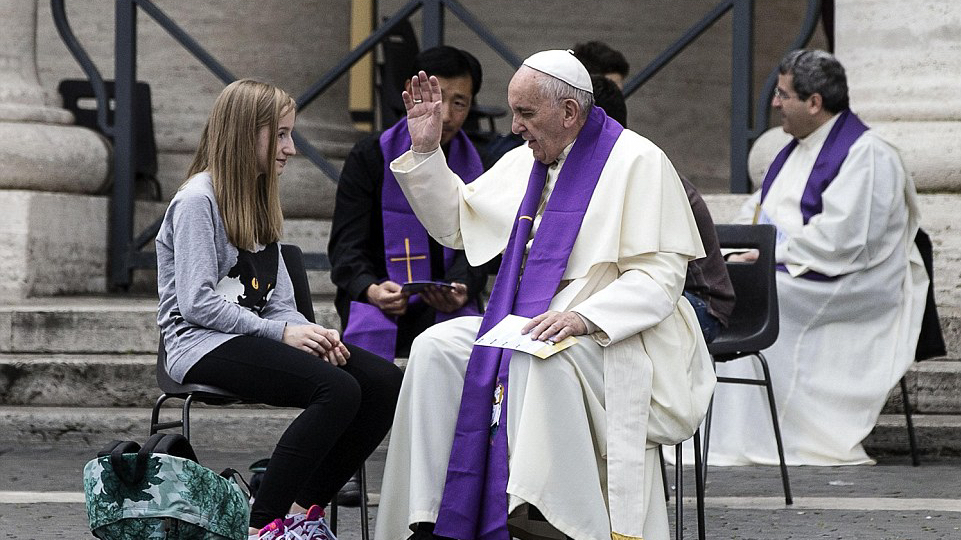
Photo: Pope Francis giving absolution to a young teen
Link for the Mass readings for Monday, December 7, 2020
Repent and be reconciled.
Today we begin the second week of Advent. John the Baptist, standing on the shoulders of the prophets like Isaiah, has “appeared in the desert proclaiming a baptism of repentance for the forgiveness of sins” (Mk 1:4). People living in Jerusalem and from the whole Judean countryside came to repent of their sins. There was an authenticity that drew the people to John. He was clear and consistent with his message and he lived a life of simplicity and totality for God that backed up what he preached.
How are we doing in our life? In what ways are we living with God, spending time in prayer, in his Word, in worship, and for God by sharing our faith through service and specific ministry? In what areas are we putting other things before God? The seasons of Advent and Lent are times of invitation to reflect and examine our consciences. God has called us, as he did John the Baptist, to prepare a way for the Lord in our hearts and minds and for others by our witness.
Discernment on how he is calling us to draw closer to him in a relationship, and how and who we can reach out to is a good daily practice. He is also inviting us to be honest and humble to acknowledge those ways in which we put others and other things before him. For each of the aspects in our lives in which we can readily echo St. Paul: “For I do not do the good I want, but I do the evil I do not want” (Romans 7:19), and we do so with certain actions and behavior regularly, we have the opportunity to participate in the gift of the Sacrament of Reconciliation.
A gift of mercy that is much misunderstood and woefully unused. Each sin we commit does not just affect ourselves alone, but also all of humanity and creation. A sinful act ripples out like a pebble thrown in a pond and subtly touches all around us because we are all interconnected. Conversely, when we avail ourselves to the healing of reconciliation we are forgiven, we are healed, our relationship with God and one another is strengthened instead of weakened, it too ripples out and strengthens the Church. Recall those times in your life when you were estranged from someone you cared for because of a fight or something you had done that harmed the relationship. Then you recognized the hurt you caused and were truly sorry. You approached the person and apologized and they forgave you. That anxiety, angst, and sick feeling of separation in the pit of your stomach just all evaporated in the moment of embrace. Reconciliation brought healing to the relationship.
Reconciliation is a wonderful gift that we can share with one another this Advent. To take time to be still with the intent to allow the pains and hurts that are churning under the surface to bubble up and be acknowledged. May we have the humility to admit what we have done, the part we have played in causing any hurt that has contributed to any distancing of ourselves between God and one another. The Sacrament of Reconciliation is a wonderful place to start. We are not confessing to the priest, we are confessing to Jesus who then absolves us from our sin through the priest.
Hearing the words that we are forgiven and absolved is a powerful counter to those wicked accusations that will arise in our minds soon after, maybe even as soon as we kneel in the pew to pray, that our sins can’t be forgiven. We can shout back with full confidence, “Get behind me Satan!” For through the love and tender mercy of God, our loving Father, we have been forgiven. Restored in our relationship with God, we can then approach one another to seek forgiveness and the embrace of reconciliation. Life is too short to hold grudges. May we relinquish our pride and ego that imprisons us, and instead invite the Love of the Holy Spirit to reign in our hearts. Let us follow the lead of Isaiah and John this Advent and “prepare the way of the Lord!”
If you happen to be in the Jupiter area this Wednesday, December 16, priests will be available to hear confession at 9 am and we will also be having a communal penance service and personal confessions at 4:00 pm and 7:00 pm. Both services will be held in the main sanctuary. St. Peter Catholic Church is located at 1701 Indian Creek Parkway, Jupiter, FL 33458. If you are reading this from places afar, I am sure that you can access a parish near you this Advent. If you are not Catholic, you can still reach out to God and one another!
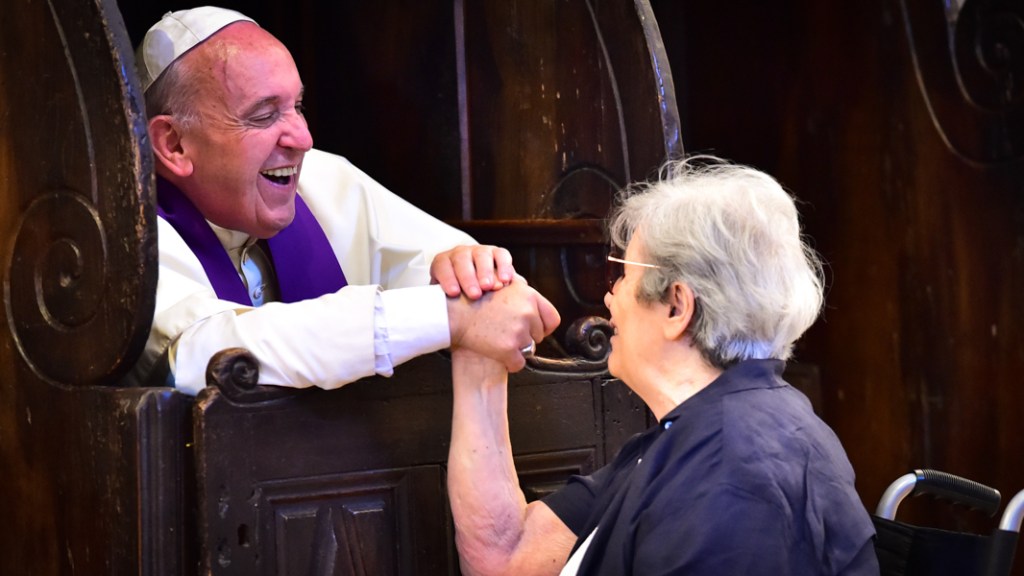
Photo: Pope hears a woman’s confession, photo credit – Giuseppe Cacace, AFP
We are people of joy because “we are infinitely loved.”
Jesus sent out these twelve (Mt 10:5).
Jesus sent out his Apostles to minister in his name and share the Gospel as he did, declaring that the “Kingdom of heaven is at hand.” Our faith tradition is one of evangelizing, sharing the Good News. That means that first and foremost we need to be people of joy. We may share the most wonderful words about our faith, but if they are not backed up by a life of radiating joy, then our words will have little if any impact.
This does not mean that we are happy and buoyant every second of the day, it does not mean that we will not experience hardship, sorrow, and loss. What it does mean is that we are not defined by our suffering but by our hope as we experience each of our adversities, conflicts, and challenges.
What defines us is the joy of knowing that we are not alone in our trials and that we are loved by God more than we can ever imagine. Jesus experienced the darkness of the human condition all the way into the deepest depths of God forsakenness. He did not just suffer on the cross but he went all the way to experience death. Yet, through the binding force of the love of the Holy Spirit, he was drawn back to life and conquered death not only for himself but for us all.
This is good news to share. How we live our lives each day and interact with others may be the only Bible that someone else will ever read. “Joy adapts and changes, but it always endures, even as a flicker of light born of our personal certainty that, when everything is said and done, we are infinitely loved.” – Pope Francis from his apostolic exhortation, Joy of the Gospel, line 6.
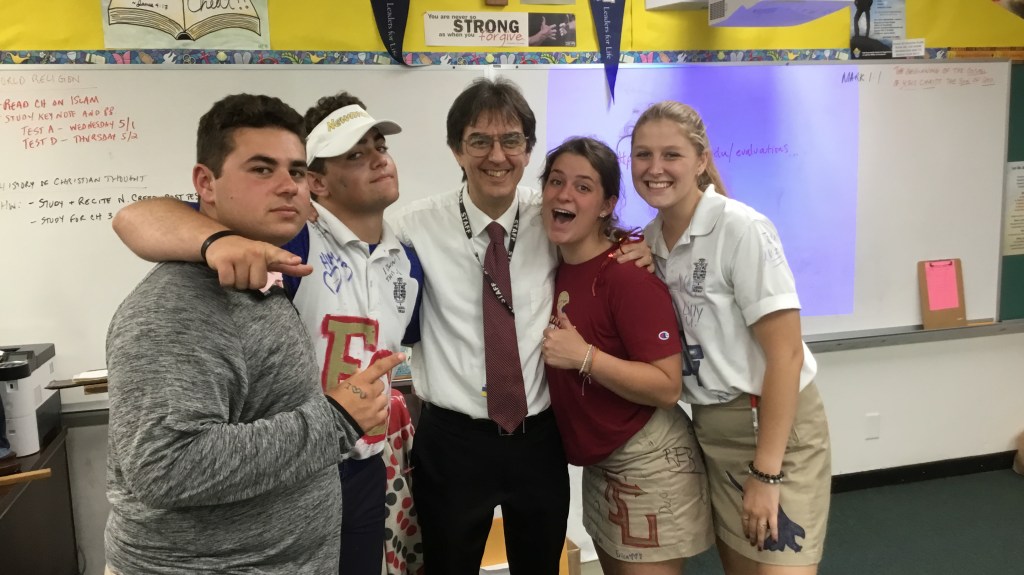
Photo: Teaching is one of my greatest joys!
Link for the Mass readings for Saturday, December 5, 2020

Jesus, please help us to see with the eyes of your love.
In today’s Gospel, Jesus is followed by two blind men asking him to heal them. They continued to follow even after Jesus entered the house. When they had done so, Jesus turned and said to them, “Do you believe that I can do this” (Mt 9:28)? The pair said in unison that they did. Jesus touched their eyes and said, “Let it be done for you according to your faith” ((Mt 9:29). Both men were healed.
Though the pair were blind physically, they had faith that Jesus was the Son of David. This term was a title for the Messiah. The two blind men believed that Jesus was who he said he was and then collaborated in their healing, for as Jesus touched their eyes, they had faith and believed that Jesus could heal them and they were healed.
Though we may have eyes to see and ears to hear, do we see and hear with the faith of the two blind men in today’s Gospel? Jesus came into the world just over two thousand years ago as the visible reality of the embodiment of God’s Love. Jesus calls us to be conformed to this same love. No easy task, for more often than not, we are blind and deaf to this gift.
The saints are those who followed through the narrow gate as did the two blind men. They encountered Jesus, had faith in him and believed. Will we follow the same path? Do we believe that Jesus is truly who he said he is, the Son of God, the second Person of the Trinity who became one with us so that we can become one with him? Let us pray together:
Jesus, this Advent, I choose to walk on your path of love. Free me from my blindness such that I may experience the grace of your Father, so to know the safety and security of your presence. I believe and have faith that you will provide for my every need and will be present through my pain and struggles, the everyday moments, as well as my joys and successes. Expand my heart and mind that I may more fully experience your love so as to have the courage to surrender the false self of my ego, my fears, prejudices, pride, and indifference. Help me to begin anew in small ways to love others as you love me, recognizing that your Love is not merely a feeling or an emotion, but a conscious act of the will. As I participate in your life and love, please help me to be more present to those people I encounter and give me the courage to will their good, without conditions and without counting the cost.
Photo from pexels.com
Link for the Mass readings for Friday, December 4, 2020
God invites each of us to play our part in his theodrama. The saints have accepted, will we?
Jesus said to his disciples: “Not everyone who says to me, ‘Lord, Lord,’ will enter the Kingdom of heaven, but only the one who does the will of my Father in heaven” (Mt 7:21).
I have written quite often, quoting and paraphrasing one of my favorite quotes from St. Irenaeus, that Jesus came to be one with us so that we can be one with him. In his becoming one with us in our humanity he invites everyone, no one is excluded, to participate in his divinity. Yet if everyone is invited, how can Jesus say that not everyone will enter the Kingdom of heaven?
The answer to that question is in the line that follows. The one who will enter heaven is, “the one who does the will of my Father in heaven.” If this verse does not help, then it might be helpful to understand a little about heaven, as best as we can, as the mere mortal, finite beings that we are.
Heaven is not so much a place but a state of being in relation to God. Heaven is the state of being in which we are privileged to share communion and a deeper intimacy with God for all eternity. We will still not know everything about God because God is infinite and we will still be finite in heaven. God is without limit, we are limited. We will never exhaust our relationship, never get bored with God.
Maybe a more three dimensional, an earthly example may be of help. If we were invited to play a sport, an instrument, or to act in a play, with the end goal being that we would play in the upcoming game, concert, or performance, we might feel pretty excited about the offer. We tell the coach, conductor, or director “That’s great news!” Yet, in the days that follow, we do not attend any of the practices, we do not practice the skills required to play the position, instrument, or role and we don’t return any of the follow-up invitations by phone, email, or text. The day of the big game, concert, or performance comes, we gather our self together and head on over to the arena or hall. We arrive to see the coach, conductor, or director but are denied entrance. We might say, “I don’t understand, you invited us to play!” The reply is, “Not everyone who says to me coach, coach (conductor, conductor, or director, director) is ready and prepared.”
Jesus indeed invites us to play a part in God’s theodrama, everyone. Some say yes and some say no. Some say yes, and then don’t do anything, some say yes and do some things, some say yes and dive in. Most of us take a few steps forward and a step or two back. Just like preparing to play in the big game or perform in the big concert, or play, we need to be committed, disciplined, and persistent with our faith life. Unlike a missed opportunity to participate in a game or performance, that we can correct and make another attempt down the road, we don’t want to miss the opportunity to spend eternity with Jesus in heaven.
The above analogy does not imply in any way that we earn our way into heaven, or we can do so on our own effort and will power. The bottom line is that Jesus gave his life for all of us and through his grace, we have been saved. This is a free gift. Yet, we have to be willing to receive and open the gift. Our time here on earth is the time we are given to work out our salvation, to put into practice his teachings, and be about building a relationship with Jesus, being conformed to him, so that we can come to know his Father as he does and help others to open their gift as well and invite them to play their part.
If we want to know God’s will, we need to come to know God. Advent is a time of preparation, to place ourselves in a position before God so we can come to know him and his will. Jesus helps us to recognize when we are off the target in our attempt to conform his Father’s will to our small reality. Instead, we need to reorient ourselves such that we allow our minds and hearts to be expanded by his love.
This happens when we are quiet and still, through mediation and prayer, spending time in his word, spending time in worship and fellowship, and in doing so we will be more open to be led by the Holy Spirit to step out of our comfort zone and reach out to others in an act of service for another’s sake and not just our own. For we are here not only to actualize the grace we have been given for our salvation, but we are also here to help others to do the same.
——————————————————————————
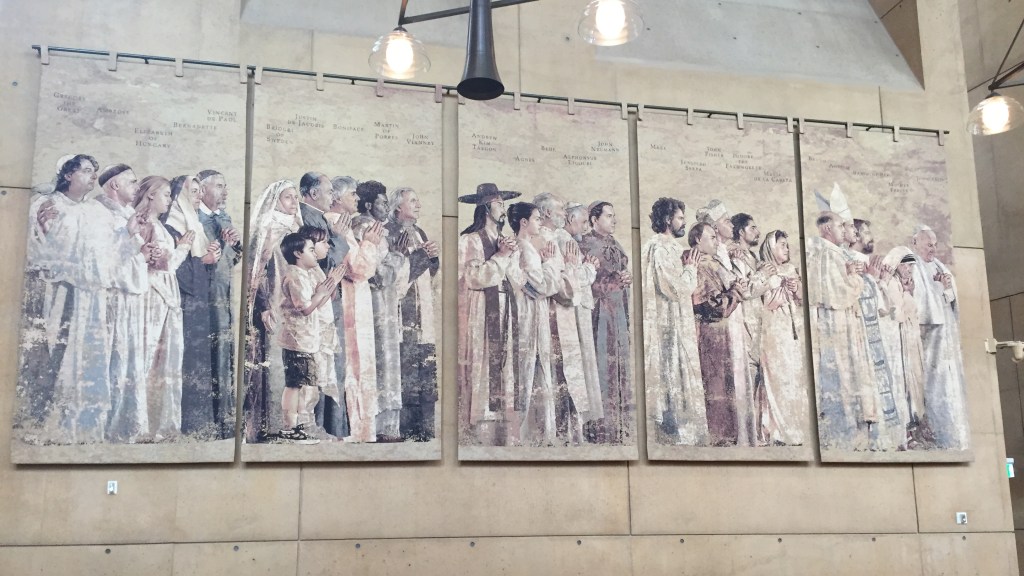
Photo: Tapestry hanging in the sanctuary of the Cathedral of Our Lady of the Angels, Los Angeles, CA. Some of the saints who practiced their part in God’s theodrama and are now with God in heaven.
Link for the Mass reading for Thursday, December 3, 2020
We too are to give what we have to Jesus to multiply and satisfy the needs of others.
“Jesus walked by the Sea of Galilee, went up on the mountain, and sat down there. Great crowds came to him, having with them the lame, the blind, the deformed, the mute, and many others. They placed them at his feet, and he cured them” (Mt 15:29-30).
There is a key yet subtle point before Jesus began to heal that might be missed. Before great crowds came to him, Jesus “went up on the mountain, and sat down there.” This is no insignificant sentence. The posture of sitting on the mountain would have been recognized right away by the people of Jesus’ time. This was the posture of the teacher and sitting on the mountain a reference to Moses. Prior to the healing in this setting, as he did throughout the Gospels, Jesus most likely taught about the reign of God. In fact, time and again, Jesus’ “works of healing took place in this context of his preaching of the kingdom of God” (Lohfink 2014, 58).
A great multitude of people came to Jesus to hear his message and also brought with them a plethora of needs. Jesus made himself available, restored, and healed those who were brought to him. He encountered them as they were in their present condition. There is no record in this Gospel account that Jesus asked for any identification, that he discussed their belief system before healing them, nor did he ask if they were Jewish or Gentile, and nowhere in this account did Jesus deny anyone who came to him. The response of those to being healed and restored was that “they glorified the God of Israel“. This is because, “where God is master, there is salvation and healing” (Lohfink 2014, 62).
The recorded accounts of mass healings in today’s Gospel are but a foretaste of the heavenly realm of eternal communion with the Father. Jesus is the kingdom of heaven at hand, for as St Irenaeus wrote, “Jesus opened up heaven for us in the humanity he assumed.” Jesus though was not done. The whole process took some time, which is an understatement, and as people were getting ready to leave, Jesus showed compassion yet again. He sought the assistance of the disciples because he did not want to send the people away hungry.
The disciples, of course, are taken aback because of the reality of the undertaking Jesus proposed. Jesus asked what they had with them and they shared just some bread and fish. Jesus took “the seven loaves and the fish, gave thanks, broke the loaves, and gave them to the disciples, who in turn gave them to the crowds. They all ate and were satisfied. They picked up the fragments left over–seven baskets full” (Mt 15:36-37).
This Advent let us make an extra effort to surrender our will to God, to pray with and meditate on the Gospels such that they become a living teaching that is relevant in our lives, that moves us to serve those in need as Jesus did. Identification, religion, race, gender, creed, or political affiliation does not matter. What matters is that we are willing to see in each person before us a human being with dignity and worth.
Neither are we to be dismayed with how little we believe we might have to give. We are to offer what we have to Jesus in solidarity for his purpose, just as the disciples with the seven loaves and fish did. In so doing, the Holy Spirit will work through us to provide those we serve not only with their immediate need, but also an abundance of grace, mercy, love, and healing to overflowing.
—————————————————————————
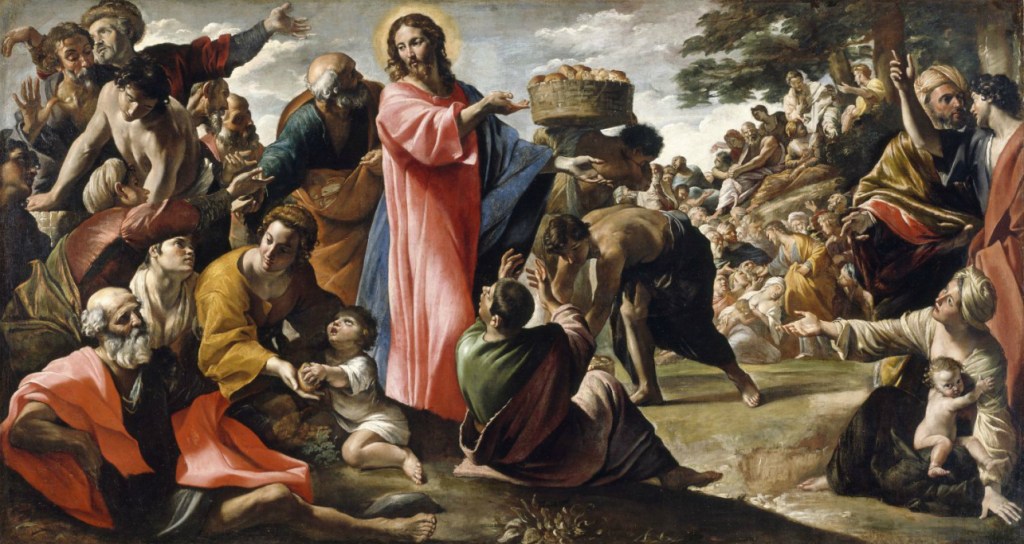
Painting: The Multiplication of the Loaves by Giovanni Lanfranco between 1620-1623
Lohfink, Gerhard. No Irrelevant Jesus: On Jesus and the Church Today. Collegeville, MN: Liturgical Press, 2014.
Mass readings for Wednesday, December 2, 2020

God reveals himself in the wonders of his creation.
“All things have been handed over to me by my Father. No one knows who the Son is except the Father, and who the Father is except the Son and anyone to whom the Son wishes to reveal him” (Lk 10:22).
God the Father knows God the Son and God the Son knows God the Father. They do not just know about each other, they know each other with a deep intimacy that is far beyond our human comprehension. Contemplating this reality can fill us with hope especially when we come to realize that Jesus is the Son of God who has come into our lives so that we can participate in this trinitarian communion of the Father and the Son and the love shared between them, the Holy Spirit!
Jesus has come as an agent of reconciliation, to restore our relationship with God, to undo the effects of the sin of separation that has so ruptured and wounded our relationship with him, each other, and his creation. Our hope this Advent is that we can come not just to a better understanding of God, but to intimately know and restore our relationship with God through our participation in the life of his Son.
We need to be careful that the Advent season does not get away from us before it even starts because of the material, commercial, and busyness that tempts to distract and divert us. A good practice is to be still and spend some time in the gift of creation, to enter into its natural rhythm, and bask in the wonder and vast expanse of it all.
This past Saturday morning I arose early to meditate and pray before heading off to serve at the 8:00 am Mass. As I sat in my chapel area, I looked out the window and I saw setting in the low western sky, in Lakota, Tayamni Cankahu, the ribs of the animal or the buffalo (more commonly known as the belt of Orion). A site sorely missed, because I have not been spending any time recently looking at the stars.
All of creation echoes the wonder and adoration of the gift that the season of Advent offers: Jesus, who became one with us so we can become one with him, invites us to participate in a deeper walk with his Father, the creator of heaven and earth, the one who knit us together in our mother’s womb, and who knows us better than we know ourselves!
———————————————————————————–
Photo of buffalo I took while driving in South Dakota in between Pine Ridge and Rosebud reservations around 1990 – a moment of quiet wonder, God’s creation on full display as the buffalo appeared to be walking right out of the sun.
Link for the Mass readings for Tuesday, December 1, 2020
 Spiritual Stepping Stones