
Let us be open to the gifts of our diversity and working together.
The Apostle John attempted to prevent someone from casting out demons in Jesus’ name because he was not one in their “company”, he was not one of those handpicked by Jesus as one of the Twelve. This person casting out demons in Jesus’ name was not like Simon the Magician (see Acts 8:9-25) who sought to buy the power of God from the Apostles to perform feats to boost his own fame and ego, this person was doing what the apostles were doing and in the proper way, by invoking the name of Jesus.
Jesus said to him, “Do not prevent him, for whoever is not against you is for you” (Lk 9:50). The important part about being a disciple is surrendering ourselves into and following the will of God. This was a consistent point Jesus pointed out to his followers time and time again. Being a disciple of Jesus had nothing to do with whether or not someone was in or out of their company, or whether or not they were related to Jesus, as is recorded just in the last chapter of Luke 8:21, “My mother and my brothers are those who hear the word of God and do it.”
Jesus, in today’s Gospel, is pointing out the danger of groupthink for its own sake. This is something we desperately need to get in our present-day and age. What is important is not putting our self, our family, our tribe, our party, our nation first. What is important is putting God first.
The man in today’s Gospel did not rely on his own strength or will power but called on the name of Jesus to cast out demons. John was getting hung up that this man wasn’t one of them, wasn’t in their company, and he was doing what they were called to do. John may have also been a bit miffed that this man was doing a better job of it as well.
I say the more the merrier! There is much that needs to be done, there is too much pain and suffering in the world, and we are losing precious resources and hours by fighting amongst ourselves, instead of actualizing the unique and diverse gifts each of us has. We have much more in common with one another than we have differences.
There are ways to diminish the growing polarization and division within and without of the Church and the best way to begin is we need to be willing to cast aside our protective and defensive postures, make a commitment to respect the dignity of each person we encounter and strive ourselves to be people of virtue, integrity and holiness. Whoever is not against us is for us.
Photo by burak kostak from Pexels
Link for the Mass readings for Monday, September 28, 2020
God speaks. Do we hear? Do we act?
“Which of the two did his father’s will?” They answered, “The first” (Mt 21-31).
The first son followed his father’s request to go out into the vineyard and work after having first said no. Jesus does not elaborate on why the son denied the request but certainly emphasizes that what was important was that the son, in the end, did follow through on his father’s will. Another point that is clear in the parable is that both sons heard clearly the command of the Father. Would that we could hear the direction of God so clearly! God is family, our Father in heaven, and he has also invited us to work in his vineyard.
The challenge is discernment. How are we able to know what God is calling us to do? I can look back through my life and see those spiritual stepping stones, the foundational experiences along the path on my journey thus far. Sometimes with hindsight, God’s leadings are clearer now than they were at the time. Each of us have moments of encounter in our life with God that we may or may not have recognized.
We each have different ways that help us to discern God’s will. God speaks to us through our dreams and desires. It is good to ponder them when they do arise. We also need to take time to meditate in silence, step out of our busyness to be still. As St Mother Teresa has said, “God speaks in the silence of the heart.” He also speaks through his word proclaimed at Mass, our reading the Bible, spiritual writing, on our own through personal study, and prayer.
Author, speaker, and founder of Dynamic Catholic, Matthew Kelly, suggests that reading a minimum of five to ten minutes a day will make a huge difference in our coming to know God’s will. “Our lives change when our habits change.” God speaks to us in so many ways, through music, creation, our relationships, as well as all aspects of our lives. The key is placing ourselves in a posture of a heart and mind open to the movement of the Holy Spirit in our lives. God reveals himself and his will to us through our intellect, through our senses, experiences, and through the depths of our soul.
Karl Rahner, in his Hearer of the Word, wrote: “As spirit, we stand before the living, free God, the God who speaks or the God who keeps silent” (72,73). Once we do hear his word or his silence, we need to then be willing to take the risk to act upon his will. You may be thinking right now about something that has been coming to you and wondering if it is God’s will for you. Follow through on the leading and see what happens.
Another key step is to speak to someone about your insights. Speak to those you know and trust, those with experience in the area where you may be feeling led, get information and continue your research. This is where spiritual direction can be very helpful. Continue to pray about the desire, then step out in faith. If you find you have made a mistake, you can change course, reassess, and learn from the process.
What is not helpful is indifference. We need to take the time to actively engage in discernment and once we believe God is leading, act. There is much work to be done in the vineyard of the Lord, and we have a key part to play in the kingdom. God will inspire, lead, and provide the means for us to accomplish what he has called us to. Go and announce the Gospel of the Lord, in your own unique way and expression!
Link for the Mass readings for Sunday, September 27, 2020
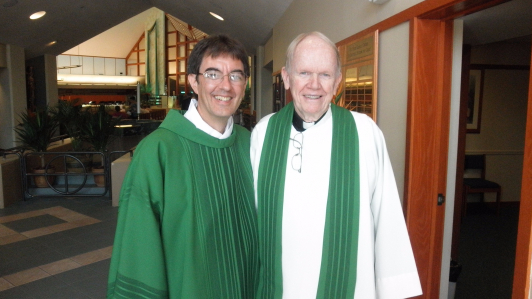
Photo: Fr Ed O’Brien from CT and me during my first weekend of Masses after my ordination. Fr Ed played a key part in my journey. He led me through the RCIA program and to confirmation in my mid-twenties.

Death is on the horizon and so is life.
The term horizon is often defined as where the earth and sky meet. This is actually an apparent horizon or sensible horizon because we see an apparent plane based on our observation point. If we are able to broaden our viewpoint and look beyond the present location we are standing at on the earth, say from the space shuttle, we could then experience a rational or celestial horizon: where the great circle of the celestial sphere whose plane passes through the center of the earth is parallel to the celestial horizon of a given position. Journeying deeper into space we could discuss event horizons, the boundaries marking the limits of black holes.
Before delving any deeper and getting lost in space, let’s return to earth and today’s Gospel where Jesus stated: “Pay attention to what I am telling you. The Son of Man is to be handed over to men” (Lk 9:44). What Jesus is doing with this statement is presenting the horizon of the cross, the place where heaven and earth meet, where the physical and the spiritual, where the finite and infinite meet.
Many of Jesus’ followers were and are still confounded by the cross. As Paul wrote to the Church at Corinth: “For Jews demand signs and Greeks look for wisdom, but we proclaim Christ crucified, a stumbling block to Jews and foolishness to Gentiles, but to those who are called, Jews and Greeks alike, Christ the power of God and the wisdom of God” (1 Cor 22-23).
Paul echoes what Jesus was talking about in today’s Gospel and that was his imminent fate and our ultimate horizon, death. None of us will be able to avoid the result of our mortality. Jesus taught both through his words and in his death that to be truly free we need to be willing to lose our life to gain it. We have to face and walk through our deepest fears to grow. Our life is not lived until we give it away.
I have come to experience that the more willing we are to face the reality of our own death, the less likely we are to take the time we have for granted, and the better we can live our lives here and now. During the final four months with JoAnn we experienced God’s grace because we faced the reality that her time was near, we embraced the gift of the time we had together, and through the prayers of so many, we experienced the infinite presence of the love of God in our midst.
There is so much we can experience and enjoy through the world around us, but if we only limit ourselves to the merely empirical, only to that which we can experience with our physical senses, we limit ourselves. We are transcendental beings. We have a rational soul that allows us to encounter and experience a different plane of existence, that of the spiritual. What makes us fully human, alive, and fulfilled is an embrace of both the physical and the spiritual, of both reason and faith, the horizon where the finite and infinite meet, where earth and heaven are one. This union happens in Jesus Christ, fully human and fully divine, and those who die with him will also rise with him.
————————————————
Photo: by Josh Sorenson from Pexels
Link for the Mass readings for Saturday, September 26, 2020
Keep Jesus Christ at the center
Jesus asked his disciples about who people said that he was and Peter, through the revelation of God answered, “the Christ of God” (Lk 9:20). Jesus then responded that “The Son of Man must suffer greatly and be rejected by the elders, the chief priests, and the scribes, and be killed and on the third day be raised” (Lk 9:22).
Jesus is indeed the Christ, the Messiah, the Son of the Living God. Yet, that meant many things to many people who were awaiting the coming of the Messiah. For most, they were hoping for a military leader to come to lead them and overthrow the Roman occupiers. As soon as Peter made his statement, Jesus clarified what kind of Messiah that he would be, a suffering servant.
The reality that the Messiah, Jesus, was the suffering servant, willing to give his life on the Cross for all of humanity and creation, is also true for all who have followed him and would walk the path following him today. If we seek to be a disciple of Jesus, our steps will also lead us to the Cross. We must be willing to be martyrs, witnesses of our faith, in our everyday experiences and encounters. This does not necessarily mean that we will give our life, but it does mean that we are to empty ourselves so as to be more available to the needs of others.
Our discipleship will be ultimately expressed in love, in our willing the good of the other who is in need. We must resist the temptation to turn in on ourselves such that we embrace our ego, our anxiety, fear, prejudices, and biases. Instead, we are to keep our mind and heart open to the leading of the Holy Spirit who will reveal to us the ways, no matter how small, that we can love and serve.
We also need to resist seeking to conform God to our will and our image. Jesus calls us not to contract but to expand, to go out from ourselves to love God with our whole mind, heart, and strength and to love our neighbors as ourselves. This dying to self, to be crucified with Christ, is to be expressed in all aspects of our lives. We are not to be one way for one hour at Church on Sunday and the rest of our time live like Sunday never happened. We are to surrender ourselves to Jesus and be Jesus for others in every action, decision, and encounter we engage in. Christianity is not about compartmentalization, but it is about transformation and conformation to the Body of Christ!
—————————————-
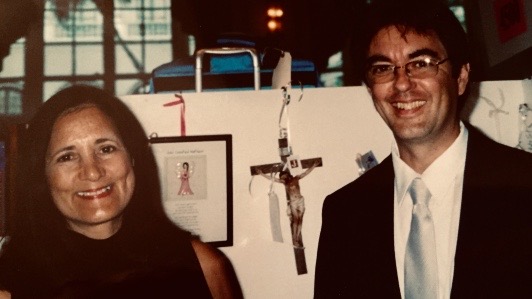
Photo: Volunteering at Rosarian Academy Auction some time ago. Keeping Jesus, the crucified Messiah, at the center of our lives helped us to grow in our love for God, each other and those he sent us to serve.
Link for the Mass readings for Friday, September 25, 2020
Jesus brings joy even in the midst of our sorrow because he loves us through each other.
‘Who then is this about whom I hear such things?'” And he kept trying to see him” (Lk 9:9).
Herod Antipas, the ruler over Galilee and Perea, heard stories about Jesus. The range of his thoughts, expressed by Luke, is confusion to curiosity. Herod may have started to feel concern over the possibility of a growing revolt, some guilt for his execution of John the Baptist, or just curiosity to see what this man was all about. Could this Jesus accomplish even half of the things Herod had heard about him. One question that did not seem to cross Herod’s mind was, did he have any interest in changing his life and becoming a follower of Jesus?
Herod was not the only one in Luke’s Gospel who asked questions about who this man Jesus was. Nor did the asking of those questions die with Jesus on the cross. They continued after his resurrection and ascension, they continued into the first centuries of the Church, which led to the calling of the first ecumenical councils which dealt directly with who Jesus was, and they continued in each following century and continue today. There are even at present in some academic circles, the question arising as to whether Jesus even existed at all. The answer to whether or who Jesus is matters.
One could ask why this question about Jesus persists? One answer is that we are finite beings seeking to understand an infinite Mystery. The full comprehension of the reality of Jesus existing as fully human and fully divine, dying on the cross, conquering death through his resurrection and ascending to the Father transcends even the wonderful intellect and ability to reason that we have been blessed with. Also, Jesus’ invitation is a universal but personal one. Each person has to encounter Jesus for her or himself.
Jesus called the Twelve, one by one as well as Mary Magdalene, St. Irenaeus, St Thomas Aquinas, St Francis and Clare of Assisi, St Catherine of Siena, St Teresa of Avila and St John of the Cross, St Ignatius, St Mother Teresa, Thomas Merton, Dorothy Day, and he calls each one of us as well. He did not call us to just merely embrace a new philosophy, a new ethical way of life, or even a new religion. Jesus called and calls us to be a part of his Body, the Mystical Body of Christ.
Who is Jesus, Herod asks in today’s Gospel? It is a good question for us to ask as well. For me, Jesus is the Christ, the Son of the living God, who became incarnate, becoming one with us in our humanity so that we could become one with him in his divinity. This same Jesus who called others through the ages invites us to follow him today as well and he continues to walk this journey with us whether we say yes or no to his invitation. We are just aware of and receive more of his help when we say yes.
Life with Jesus isn’t perfect and we will at times echo St Teresa of Avila, who stated after she was thrown from a carriage into a mud puddle, “If you treat your friends this way, it is no wonder you have so few.” But we will also experience moments of inexpressible joy, of wonder and exhilaration, and feel blessed when Jesus works through us and loves through us.
The question of why JoAnn died has come up off and on over the past year, though I do not entertain it so much. I am not sure that in this life the answer would be sufficient anyway. I will certainly make a point to sit down with Jesus when he calls me home and we can discuss it then with more perspective.
I have been focusing more on seeking what Jesus and JoAnn want me to do now. JoAnn was often concerned, especially during the school year, that I did not get enough rest. I am sure that she is still concerned! In the middle of the night a few days before she died, I heard her ask the hospice nurse if I was sleeping. She wasn’t concerned about herself but again looking out for my welfare.
I can still hear her gentle and loving voice from that night and maybe I need to listen better to her and Jesus speaking through her. It was one of the last phrases I remember JoAnn saying. There is a lot of work to do but seeking a better balance in our lives is important. Rest and enough sleep are important, as is being kinder and gentler with ourselves and each other.
—————————————————————————
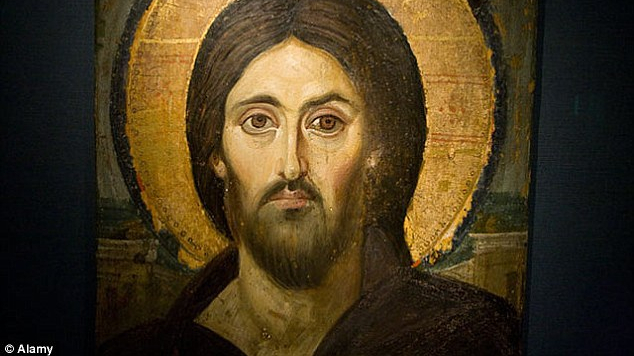
6th-century icon of Jesus
Trust where God is leading
“Jesus summoned the Twelve and gave them power and authority” (Lk 9:1).
Jesus summons us as he did the Twelve and empowers us for ministry in his name. The expression of our service is unique to each of us. Many resist exploring or entering into a deeper commitment to their faith because they are anxious or afraid that God may call them to something that they would never want to do, or that they couldn’t conceive they were capable of. Initially, there may be some trepidation even when we are clear of the direction God wants us to move in, but that may come more from our hesitancy to change and move out from our comfort zone. Ultimately, God wants for us what we want for ourselves; to live a life of fulfillment, joy, and meaning.
God knows what and with whom we will experience fulfillment. The challenge for us is to come to know this for ourselves as well. The work of discipleship begins by accepting the invitation of God to walk with him and trust that he knows what he is doing and where he is leading us! No matter what our age, we are never too young or too old to begin or recommit to the journey along the path of discipleship. One good practice is to reflect on our dreams and desires, bring them to God in prayer, and imagine ourselves embracing what we desire.
When I first joined the Franciscans to study for the priesthood in the early ’90s, I would imagine from time to time my ordination day, especially in our second year as we were thinking about taking temporary vows. When I did so, a puzzling result consistently arose. I did not imagine feeling any excitement or joy. So, a year and a half into formation, I decided to take a leave of absence. I had asked to take off a year, but the minimum time for a leave of absence was two.
Though I balked at first about the two-year time frame required, I came to respect the wisdom of my formation director. It was in my second year away, that I realized that my vocational path was leading me to the Sacrament of Matrimony and not Holy Orders. About eighteen months after I made that decision I met JoAnn. As our relationship grew and we began to talk about marriage, whenever I envisioned our wedding day I felt excitement and joy. Each year together has been better than the one before. Though JoAnn left this life far too soon, knowing what I know now after twenty-three years of marriage, I would ask her to marry me all over again!
God has a plan for each and every one of us, he knows what will fulfill us, and he loves us more than we can ever imagine. When we ponder our dreams and desires, and as we investigate, research, explore potential outcomes and continue to pray and discern each step, we will come to see that as we align ourselves with God’s will that makes all the difference. We are not alone in this process and we have a God who can see the full picture, where we see only a small part.
There will be fits and starts, missteps and slips, doubts as well as confirmations, and desolations as well as consolations. The key through it all, is to remain faithful, to continue to trust in Jesus who called us. He will continue to accompany us along the way, he will give us the resources and strength we need, and he will send the Holy Spirit to empower and transform our lives. We need to remember that this process is not just for ourselves alone. We are transformed by the gift of God’s love to go out and share the invitation we said yes to with others.
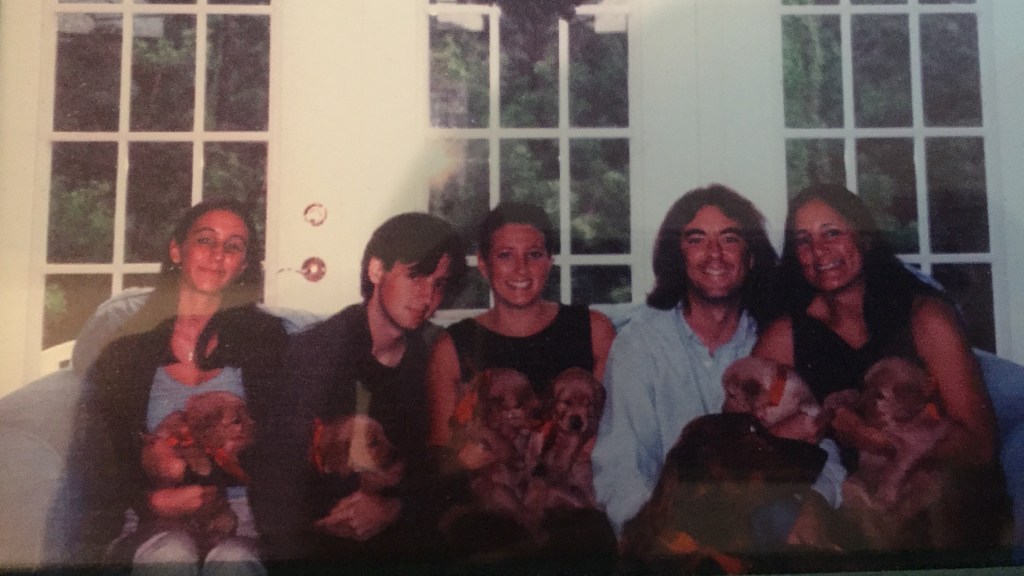
Photo: Following God’s discernment led me to JoAnn, family, and puppies! Picture from Christmas about 2002.
Link for the Mass readings for Wednesday, September 23, 2020
Do we hear the word of God and act upon it?
He said to them in reply, “My mother and my brothers are those who hear the word of God and act on it” (Luke 8:21).
There are many popular genetic testing kits that are advertised on TV and through the internet. People have asked me is it possible to be a blood relation to Jesus. Jesus’ reply today can help you to save some money. Asking if we are a blood relation with Jesus is missing the point of Jesus’ ministry. What is important are “those who hear the word of God and act upon it.” God is to be first, even before family. We may experience a subtle shudder from this statement but to those of Jesus’ time, it would have been apoplectic. Family meant everything in the Ancient Near East.
Jesus is not making the point that we disregard family, he is instead teaching us that if we are to be authentically present to our family this will come about best by following the will of God. As we deepen our relationship with Jesus and put his teachings into action, we begin to bear the relational fruits of the Spirit. Would not our familial relationships be much better if we were more loving, joyful, peaceful, patient, kind, generous, faithful, gentle and practiced self-control? Jesus taught and showed from his own life that the path to fulfilling and intimate relationships flourish best when we put God first because as we grow closer in relationship with him, we also do so with those around us.
Another point we can glean from Jesus’ response in today’s Gospel is that our “family” is to transcend bloodline, tribe, and nation. Any of “those who hear the word of God and act upon it” is spiritually akin to Jesus the Christ. The point is not that we may have a genetic, lineal relation with Jesus, but that when we live and act according to his Father’s will, we are part of the universal family of God’s grace and mercy and our relationship with him and one another grows as we continue to bear the fruits of the Spirit. As brothers and sisters in Christ, we can act with more caring and kindness, seek common ground through dialogue, be more willing to walk and accompany one another and seek to understand instead of judging those who are different. The bottom line is that we are to love one another as Jesus loves us!
I have been blessed to experience the fruits of this teaching first hand. As I have grown closer to Jesus, I have not only grown closer in relationship with my immediate family but have also been blessed with a larger extended family through the communities of St. Peter Catholic Church, the Diocese of Palm Beach, Rosarian Academy, and Cardinal Newman High School. So many of whom JoAnn and I have been so grateful for in their outpouring of love, prayer, and support through JoAnn’s illness and most recent death just over a year ago.
————————————
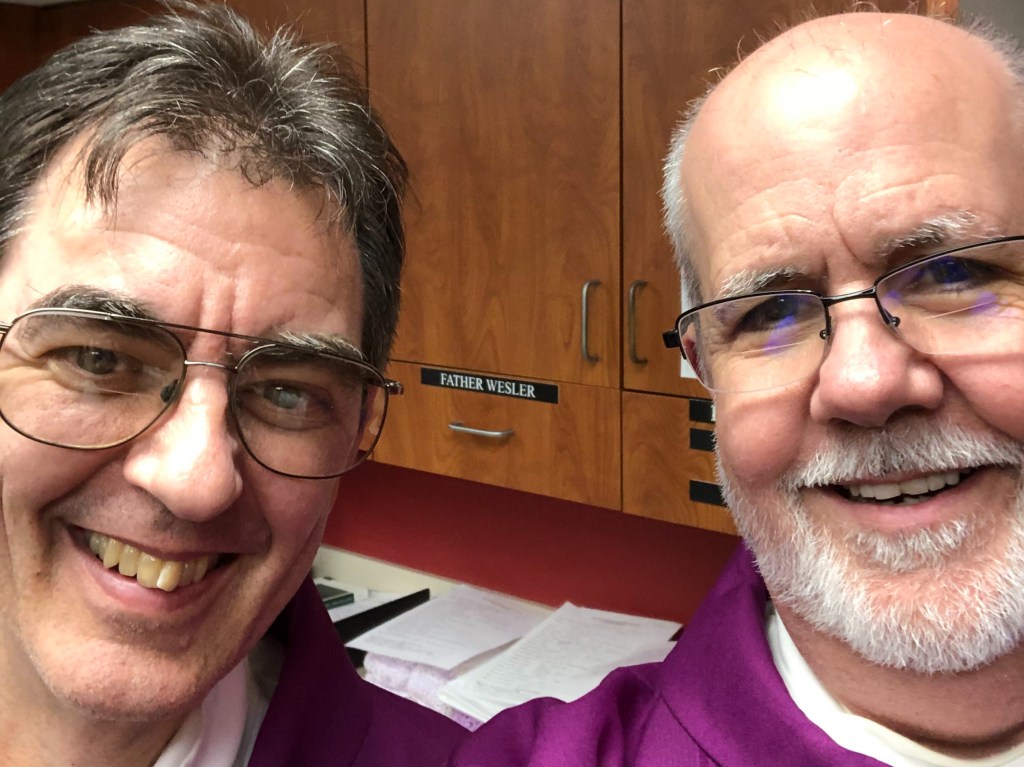
Photo: Being welcomed back to my first Mass since my return from CA last December from by brother in Christ, Deacon Steve.
Jesus built relationships with others. Are we willing to do the same?
“While he was at table in his house, many tax collectors and sinners came and sat with Jesus and his disciples” (MT 9:10).
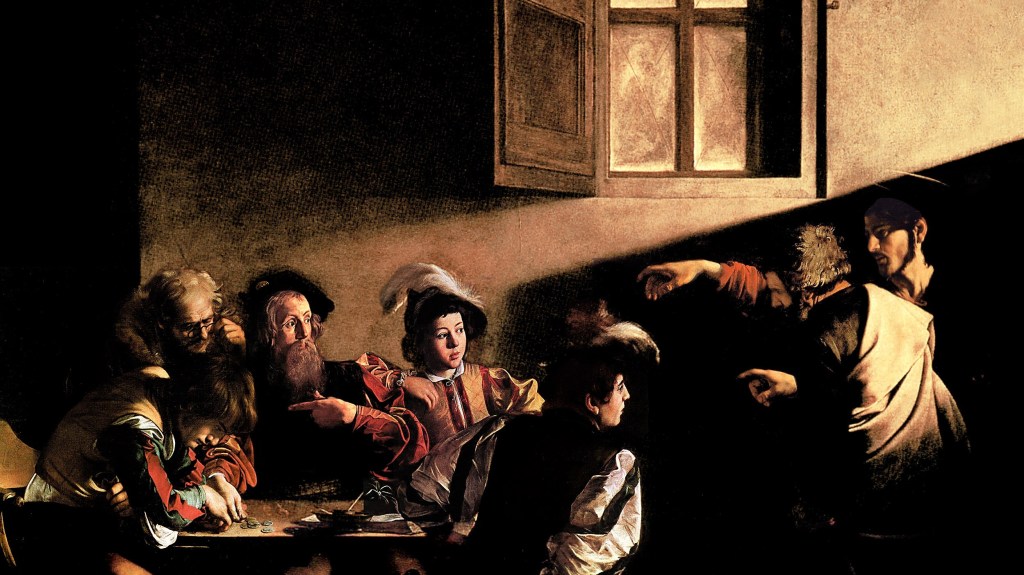
We as the Church, we as followers of Jesus, still have much to learn from him. Today’s reading provides another wonderful example. Once Jesus begins his public ministry he is constantly on the go. Going to where? Meeting people where they were, in the midst of their daily lives as he did with Matthew in today’s Gospel reading. And what is the response to Jesus calling Matthew, a tax collector, and then partaking in table fellowship with other tax collectors and sinners? The Pharisees question the disciples about his practice and curious onlookers follow at a distance. But to those who have, maybe for the first time in their lives, been respected as fellow human beings, feel hope. A hope that there actually may be a path leading in from the peripheries. A hope that they no longer have to be on the outside looking in. A hope that they, for the first time in their lives might finally belong.
Jesus is shown time and again encountering the person as they are in their present circumstances and the chaos of their lives. He welcomes, is present to, and embraces the person as they are. He invites people to be part of something greater than their self-absorbed posture, to actualize their potential and embrace a life of meaning and purpose. The only requirement is that they are willing to: be loved, be human, be free, and once experiencing this encounter, share what they have received with others.
Do we: deny or mask our own fears, stoke our own pride believing that we can take care of ourselves without the help of anyone else, seek false truths and the glittering lures of power, wealth, pleasure, and honor for our security and satisfaction, that in the end leave us empty, attached, and/or addicted? Or are we willing to have: the humility to recognize our sinfulness, our need for Jesus and receive his love, so to let go of our bondage to false illusions of security, and realize that we are, at the deepest core of our being, a living, craving hunger and desire to be loved by God and others, so to love in return?
If we are willing to risk being vulnerable and will open our hearts to Jesus we will experience the love, fulfillment, and belonging we seek in the very depths of our soul. This is the fulfillment that no other pursuit or person can bring. We do this best as Jesus did, by being willing to enter into the lives of others, by resisting judgment and accepting another as they are for who they are, by being present and willing to accompany our fellow brothers and sisters. For as Jesus said, “I desire mercy, not sacrifice” (Mt 12:7). Mercy, as I have quoted Fr. James Keenan, S.J., before, “is the willingness to enter into the chaos of another.” Jesus is willing to do so for us. Are we willing to be loved by him, to be called by Jesus like Matthew, so we can love others and enter into the midst of their chaos as well?
——————————————————
Painting: The Calling of St. Matthew, Michelangelo Merisi da Caravaggio, 1600
Link for the Mass readings for Monday, September 21, 2020

God will give us a just wage.
At dawn, nine, noon, three, and five o’clock the landowner hired day laborers to go into the field to work and bring in the harvest. Many familiar with this parable may side with those working since dawn and may also grumble, against the landowner, saying, “These last ones worked only one hour, and you have made them equal to us, who bore the day’s burden and the heat'” (Mt 20:11-12). Instead of being grateful for the wages they received and had agreed upon before the job began, those grumbling focused on what they perceived as an unfair allocation of payment. The landowner attempted to clarify with one of the obstinate ones saying, “My friend, I am not cheating you” (Mt 20:13).
In essence, the landowner sought to draw this laborer from his self-centered view to the broader context and reality of the situation. Each of the laborers in the parable were day laborers, they did not have a regular stable salary. They worked and received wages and provided for their family only when someone gave them an opportunity. It wasn’t that the landowner was favoring the last over the first, he was just being generous with the opportunity to provide work and pay for those who answered yes to his invitation. And in the end, he asked “am I not free to do as I wish with my own money? Are you envious because I am generous” (Mt 20:15)?
Jesus presented the parable of the workers in the vineyard (Mt 20:1-16) as he did with the parable of the prodigal son (Lk 11:15-32) to show his listeners and us the generosity of God’s love and mercy. We must resist the temptation to be envious and begrudge those, who having less, have received from God what is their due. Instead, we who have been blessed, need to be aware of the generosity God has bestowed upon us, to be thankful for his blessings, and so collaborate with God by sharing with others who are less fortunate than ourselves, for “the harvest is abundant, but the laborers are few” (Lk 10:2).
We have been invited to work for the Landowner in his vineyard. We are to be about his work building and restoring relationships and not worrying about seeking reward. Comparing what we have to what others have will only end in frustration and separation, for as the prophet Isaiah said, “For my thoughts are not your thoughts, nor are your ways my ways, says the LORD. As high as the heavens are above the earth, so high are my ways above your ways and my thoughts above your thoughts” (Isaiah 55: 8-10). The just wage for our work is God’s mercy and we are not to refuse or be jealous of anyone else receiving his mercy. Instead of judging God’s forgiveness and mercy, we are to seek to emulate it!
Photo by Pixabay from pexels.com
 Spiritual Stepping Stones