Nurture the seeds God has sown and we will bear fruit!

“The seed is the word of God” (Lk 8:11).

Jesus expressed in his parable of the sower the ways in which we lose the germination opportunity or coming to bear fruit of the seed that has been sown. The devil “comes and takes away the word from their heart that they may not believe or be saved.” Another way is with those who fixate on mere scientism or empiricism, and so denounce any spiritual or transcendental experience as a coincidence, or dismissed as offering no empirical substance, no proof, thus explaining away any trace of spirit. Others “receive the word with joy but have no root.” Some encounter God, experience a deep emotional connection at the moment but once the emotion wanes, they move onto other pursuits, other experiences. Still, others receive for a time God’s word, come to a place of germination and sprouting, experience new growth but “are choked by the anxieties and riches and pleasures of life, and they fail to produce mature fruit.”

We still fall prey to each of the above examples Jesus offers in his parable today. Each of them at different times. We are distracted, we are busy, we seek merely accomplishing and moving on to the next activity or item on the list, but if we ever want to experience mature fruit, we must “embrace [the word] with a generous and good heart, and bear fruit through perseverance.”

Do we read a book just to finish it, do we go to church just to say we went, do we visit or call relatives, friends, to say we have accomplished our duty, do we go to work or school just to get to Friday? To be fully alive we need to be present in the experience of what we are doing, we need to embrace a deeper experience of what we do, and to do that we need to slow down and breathe. Then maybe we can read to come to understand and put into practice what we may have learned. This is true for good fiction, non-fiction, as well as poetry. This is even truer still when we are reading the Bible. We need to meditate and contemplate upon, not just read a passage, close the cover and move on as if nothing ever happened.

When we go to church, in person or online, may we absorb one or two lessons from a prayer, a hymn, the word, or preaching, that we can take with us, think about and put into practice in the coming week. In this way, when we leave we are not just going but going forth to proclaim the Gospel in our lives. When we communicate and visit with friends and family, may we be more present, and open to their needs, willing to hear their stories, their experiences. May we also be willing to be present to those friends and family we have not yet met and in the past have just walked by or over. In our work, our dedication to school as a student, our entry into retirement, let us resist the attitude of just getting through the day and instead seek meaning in what we do. Let us embrace the joy of the gift of life we have been given.

I invite you to stop, take some deep breathes, and be present and more mindful in your daily activities. Look for the seeds that God has sown, nurture them, be patient with the process of germination and growth, and persevere in your discipline of prayer, worship, service, and relationship to allow good, firm roots to take hold. Soon you will begin to experience the harvest of some beautiful fruit from those seeds God has sown!


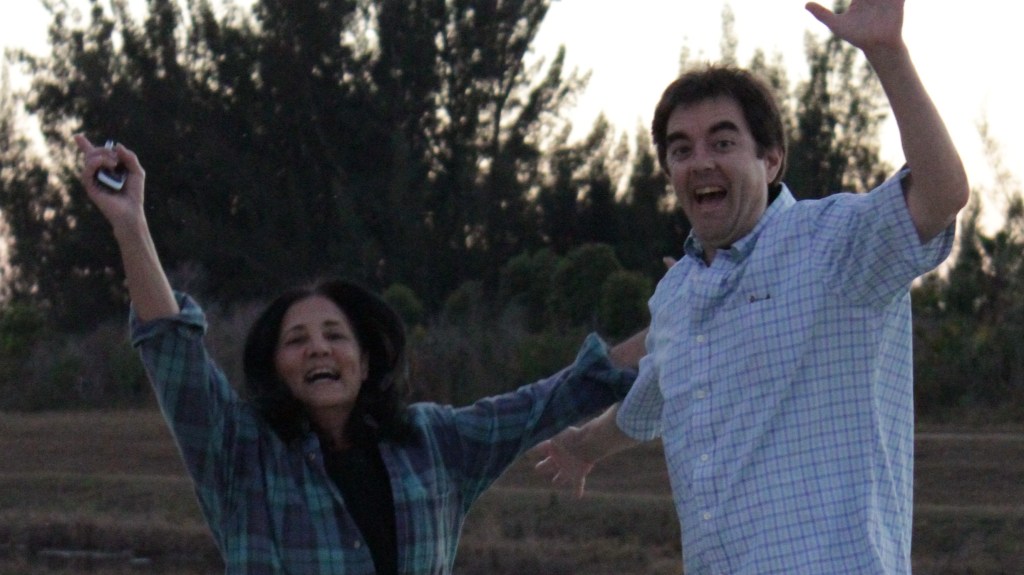
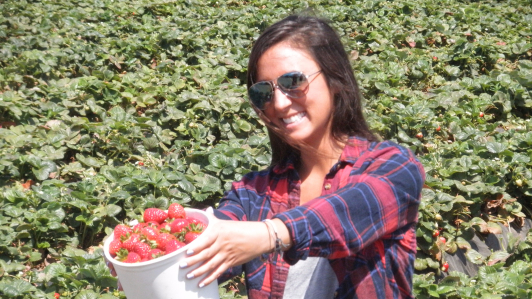
Photo: Strawberry picking with Christy in California 2014
Link for the Mass readings for Saturday, September 19, 2020

Jesus chooses us for relationship with him and others.

Accompanying him were the Twelve and some women (Lk 8:1-2).
A simple statement to be sure, but very significant in how Jesus again is showing us how to live our lives as followers, disciples of him. Jesus, as I have written many times, is fully human and fully divine. What he has done and is doing as the Son of God incarnate is to draw close to us in our humanity, as a human being, so that we can enter into a relationship with him and his Father through the love of the Holy Spirit, thus becoming one with him in his divinity.
From the beginning of his public ministry and throughout, he is inviting people to participate in his life and the kingdom of Heaven which is at hand in his very presence. Time and time again Jesus does so by building relationships with people. This is how Luke can write the verses that Jesus was accompanied by the Twelve and Mary Magdelene, Joanna, and Susanna. These were real people with whom Jesus developed real relationships with.
Jesus invited people to experience and build a relationship with him. Christianity is not a Lone Ranger religion, it is not the survival of the fittest, and Jesus did not teach that we have to pull ourselves up by our own bootstraps. We are created by God to be in communion, to be in a relationship with him and one another, and that means we need to accompany and empower each other.
We are to go out, encounter, and make time for each other by exchanging the stories of our tragedies and our triumphs. Even during a pandemic, we are to resist the temptation of withdrawing into our own bubbles. Instead, we need to take the risk to be vulnerable with one another, obviously to do so more carefully and prudently during this pandemic. Relationships are messy but with commitment, God, and an open heart and mind, we can grow closer together.
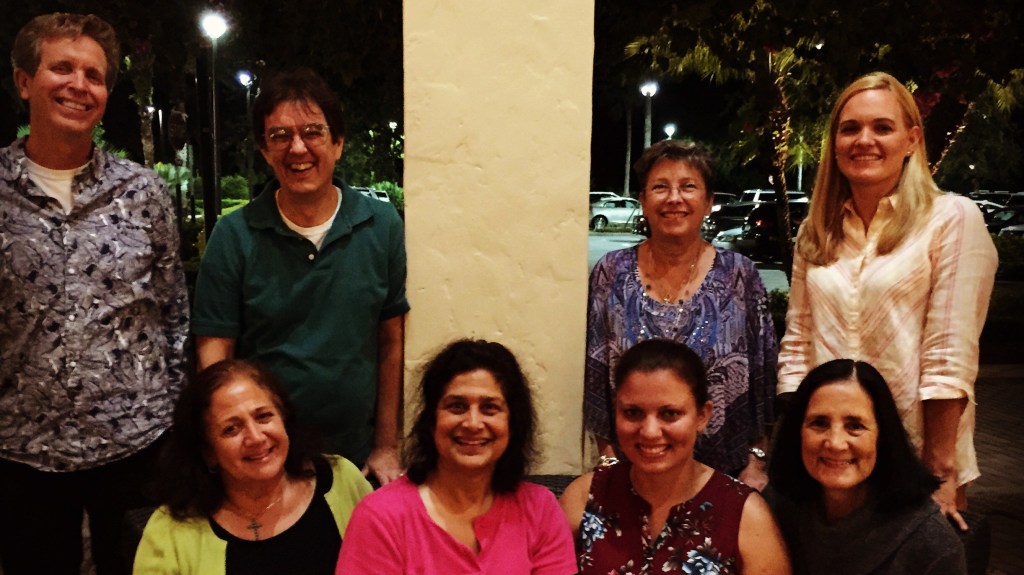
JoAnn and I experienced this gift of fellowship in a powerful way over the past, what will be four years next week. Eight of us have been meeting almost every week. We have been learning about and growing in our faith, yes, but more importantly building relationships grounded in our mutual respect for one other even when we disagreed. We have shared stories, exploring the good, the bad, and the ugly, of our lives.
We forged such a bond that JoAnn and I agreed without hesitation that each one of the members of our group would play a significant and intimate part in JoAnn’s funeral Mass. JoAnn is still a part of our group as she prepares the way for us to follow and still reminds Giovanna that we need to break by 8:30 because it is a school night and I need to get to sleep.
Jesus chooses each one of us to accompany him and to forge relationships grounded in mutual respect, where no one is last and where no person is left behind. This is what our faith is all about and this is why we are a joyful people, an alleluia people, even while it appears sometimes the world is coming apart at the seams.

Photo: Our small group celebrating two years of fellowship.

Link for the Mass readings for Friday, September 18, 2020

We can learn much from the woman with the alabaster jar.

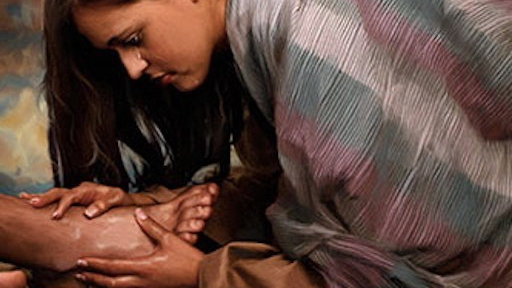
Bringing an alabaster flask of ointment, she stood behind him at his feet weeping and began to bathe his feet with her tears. Then she wiped them with her hair, kissed them, and anointed them with the ointment (Lk 7:37-38).
Logistically, to our modern minds, the setting of this verse may appear to be confusing. How could this “sinful” woman be standing behind Jesus such that her tears would fall on his feet? This could be confusing to us because when we think or imagine someone sitting and eating, they do so by sitting in a chair. Thus the feet would be toward the front of the person.
During the time period Jesus lived, the customary practice when eating was not to sit at all but to recline. Thus, the woman was standing behind the feet of Jesus as he reclined, and her tears fell on his feet. She then knelt down, dried his feet with her hair, and then anointed Jesus’ feet with the ointment she brought for him.
Today’s Gospel account is a simple but powerful scene of contrition. This is the posture we are to approach Jesus when we have sinned. We are not to rationalize, deny, ignore, or come grudgingly forward when we are caught and held accountable for our sin. We are to feel true contrition or sorrow for the sins we have committed because the healing presence of Jesus leads us to a place of compassion and understanding for the hurt we have caused others through our sinful actions.
Unfortunately, there are too many leaders in the secular as well as the church who assume the posture of Simon the Pharisee in this account. They puff up their chests in righteous indignation over the sins of others, while not being transparent and forthcoming with their own sinful choices and behavior. Using instead their means of power, prestige, and places of honor, not to serve and empower others but to hide and protect themselves from being held accountable, and/or justifying and rationalizing their own weaknesses and vices.
In so doing though, they are not aware of the depth of their own sin and thus to “the one to whom little is forgiven, loves little” (Lk 7:47). One is not forgiven because God is not willing to forgive but because he will not go against our free will. If we are unaware or unwilling to bring our sins forward in a contrite manner, we are cutting ourselves off from the healing forgiveness of God that he so much wants to share with us. But if we, like the woman in today’s Gospel account, are willing to bear our soul with humility and sorrow we will not only be forgiven but experience a deeper outpouring of God’s love. The one who confesses contritely more is forgiven more and thus is able to love more.
Would that each of us really grasped this gift of grace that God offers. What if instead of hiding from, being in denial of, rationalizing, or justifying our sins, we acknowledged them and sought the healing forgiveness of Jesus. In opening up our hearts and minds to the forgiving and purifying love of the Holy Spirit there is a pain, as there is in any healing, but also freedom, when we are able to do as the woman in the Gospel did today. When we trust Jesus as she did with our deepest and darkest sins, we too can be healed so to be freed of the shackles that bind us and to love as we have been loved. God loves us more than our worst mistakes and we will know and experience God’s love more fully when we confess and are forgiven of them.

Photo: accessed online
Link for the Mass readings for Thursday, September 19, 2020

“To live is to change, to be perfect is to have changed often.”

“To what shall I compare the people of this generation? What are they like? They are like children who sit in the marketplace and call to one another, ‘We played the flute for you, but you did not dance. We sang a dirge, but you did not weep'” (Lk 7:31-32).
In today’s Gospel, Jesus convicted those who held a narrow view of who was a true follower of God. He illustrated this by sharing the image of a flute being played and no one danced, thus when times of joy arose, there was no celebration, and when the funeral dirge was sung, they did not weep, they did not mourn. Jesus then tied the analogy to his present condition where there were those who did not accept the ascetical practices of fasting and the call to repentance from John the Baptist, nor did they accept the inclusive table fellowship of Jesus.
In our own time, we have encountered those that are not pleased beyond their own narrow focus and who suffer from tunnel vision. Anything that hints at even a slight variation of change sends tremors of discontent. If we are honest, we all have some resistance to change, but if we are to authentically live the Gospel, St. John Cardinal Newman’s quote is an apt barometer: “To live is to change and to be perfect is to have changed often.” JoAnn was one to embrace change much more easily than I. She consistently helped me, even when I didn’t feel it was helpful, to be more open to change instead of getting too comfortable in a set routine. She has done so again in “changing her address” to a heavenly zip code. Jesus and JoAnn have helped me to adjust to this whopper of a change as well.
The Church, at her best, is a balance between the rock foundation of our core beliefs, such as the Nicene Creed, which provides stability, assuredness, and identity, and being open to the life-giving movement of the Holy Spirit. Each generation must make the Gospel relevant in our own time. We must be flexible and resist rigidity, legalism, and clericalism, so to avoid molding the Church in our image, while at the same time be authentic to renewal, integrity, and embracing the Mystery of God’s movement such that we are molded, transformed, and conformed in the image and likeness of Jesus, who is the embodiment of Love.
We can live a life of joy when we are not threatened by those who are different. The gift of Catholicism is the universal call and invitation of Jesus open to all of humanity. As Catholics, we are to embrace the gift of unity AND diversity, the foundation of the deposit of faith AND the variety of cultural expression. The collaboration of the divine and the human is messy but this both/and not either/or approach is what Jesus guides us to participate in. Is this challenging? Yes. Hard? Yes. Impossible? On our own, and from our own egoistic perspective, yes. When we are willing to surrender our will to the Father, our heart and mind to the Son, and allow our soul to be led by the Holy Spirit, all things are possible!

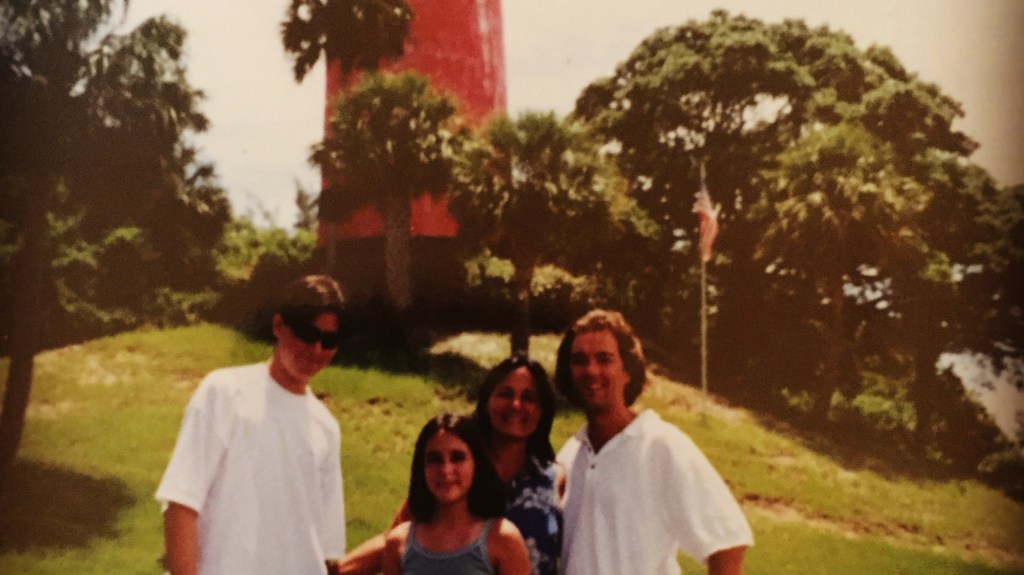
Photo: At the base of the Jupiter Lighthouse in 1997, I have been truly blessed in my willingness to embrace two big changes in my life, marrying JoAnn in 1996 and moving to Florida in 1997.

Link for the Mass readings for Wednesday, September 16, 2020

Like Mary and John, let us comfort one another in our time of sorrow.

When Jesus saw his mother and the disciple there whom he loved he said to his mother, “Woman, behold, your son.” Then he said to the disciple, “Behold, your mother.” And from that hour the disciple took her into his home (Jn 19:26-27).
In the summer of 1991, I entered the Franciscans of Holy Name Province as a pre-novitiate and was stationed at Holy Cross Friary in the Bronx. My ministry for that year was working in the friary and the adjoining parish of Holy Cross. Shortly after entering, one of the friars, Br. Paul Goldie, passed away. He had been serving at the friary since 1953 and had been a friar for 54 years. A practice among the friars was to pass on personal items to those in the community when one of their own passed away. I was honored to have been given a picture of St. Francis, that hangs in my classroom and Br. Paul’s rosary.
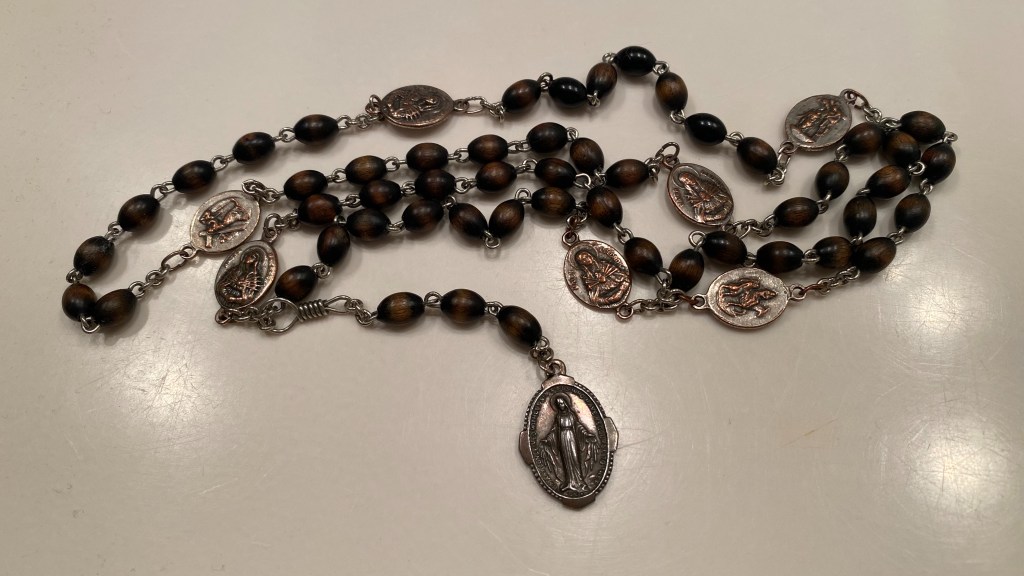
I noticed that the rosary was different from others. Instead of a crucifix it had a Miraculous Medal, instead of five beads there were three beads leading to the decade of beads, and instead of five decades of beads, there were seven groupings of seven beads. In between each of the series of seven beads there was a small medal. On one side was a picture of Mary pierced in the heart seven times, and on the back of each medal was a different scene. I would find out some time later that this was a Rosary of Our Lady of Sorrows. The depictions on the back of the seven medals represented Mary’s seven sorrows: Simeon announces the suffering destiny of Jesus, Mary escapes into Egypt
with Jesus and Joseph, Mary seeks Jesus lost in Jerusalem, Mary meets Jesus as He carries his Cross to Calvary, Mary stands near the Cross of her Son Jesus, Mary receives into her arms the body of Jesus taken down from the Cross, and Mary helps place the body of Jesus in the tomb.
The fifth mystery, Mary stands near the Cross of her Son Jesus, is from our Gospel reading today. It must have been the most sorrowful of the seven, for Mary to witness her son dying such an agonizing death as the crucifixion. Yet, Mary did not run from the pain, she embraced his and her own pain, the piercing of the lance, pierced her own heart, the depths of her own soul. Mary, though free of sin, was not free of the pain of a fallen world. In fact, Mary like Jesus, felt it more deeply.
By being willing to love, we risk experiencing and entering into the pain of those we love. So many times we run from love, because we do not want to experience the pain relationships entail. We are finite and fragile beings, and so we will let each other down, we will make mistakes, say the wrong things, do hurtful things, we will get sick or deal with chronic illness and need care, we will lose patience, we will sin, and those we care about will die. Jesus though calls us, like Mary and John present at the Cross, to remain present to one another, to love, to will the good of the other, and so to experience the fruit of an authentic relationship which is grounded in the unimaginable love that God the Father has for us.
Love is the bond of communion that gives us the strength to move through the crossroads and upheavals of life, love is the bond of commitment that draws us out from our selfishness so to learn from one another, to grow stronger together, to be present to one another. Where there is an authentic relationship, there is love at its foundation. When we love one another we participate in the communion of the Holy Trinity, we participate in the very same divine communion of the Father, and the Son, and the Holy Spirit.
Is there risk of rejection in inviting another? Yes. Is there pain in love? Yes. Is there conflict in relationship? Yes. Yet to be fulfilled, to be fully alive, for love to be real, we must be willing to take the risk to love and be rejected, just as God does with us. As we enter relationships or strive for better authenticity in our present relationships, we must be willing to love, to commit to one another, to be present to one another, to share our pain and experience another’s pain. We must be willing to accompany each other in our imperfections as well as be humble and willing to offer and seek forgiveness and reconciliation.
I do not know if we can ever come close to imagining what Mary and John experienced with Jesus at the climax of his crucifixion. Each of them embraced horrific pain and sorrow at the foot of the cross, yet they remained, and so they were able to mourn, heal, and experience the full joy of the Resurrection. At the coming of the Holy Spirit at Pentecost, they also experienced the divine communion of love between the Father and the Son, and shared that same love and commitment with the community of Jesus’ followers and those who had never met him.
Br. Paul’s rosary, which I still pray with, was passed on to me. It is a reminder for me of the brotherhood I shared with the friars. It is also a reminder to be present to others in their pain and struggles. There will be sorrows in this life. As we resist running from them and instead embrace them, we will find Jesus waiting with his arms wide open to receive, hear, comfort, and assure us that he is with us. May we also remember to lean on, be present to, support, and love one another as Mary and John did.

Photo: Br Paul’s Rosary of Our Lady of Sorrows
Link for the Mass readings for Tuesday, September 15, 2020

Today we celebrate the triumph of the Cross!

“No one has gone up to heaven except the one who has come down from heaven, the Son of Man. And just as Moses lifted up the serpent in the desert, so must the Son of Man be lifted up, so that everyone who believes in him may have eternal life” (Jn 3:13-15).
The reference to Moses lifting up the serpent can be found in Numbers 21:4-9. The people, worn out by their journey in the desert began to complain instead of trusting in God’s deliverance. The people sought a return to their prior condition of slavery rather than forge ahead and endure the trials of gaining freedom. Venomous snakes came into the camp and began to bite many who then died. The people recognized their sin and implored Moses’ intercession. Moses prayed for the people and lifted up a bronze serpent on a pole and whoever looked upon the serpent was healed.
There is a difference between seeking understanding from God, seeking to understand why something is happening in our lives, and complaining from a posture of self-centeredness. The Israelites were looking at their present condition of suffering and missing the point that they were free from slavery. They were not trusting in God’s providential care and support present to them in the moment.
How often do we, with our ease of access, slip into the same whining and complaining mode when something doesn’t go quite right. St Paul reminds us through his words to the Corinthians: “Let us not test Christ as some of them did, and suffered death by serpents” (1 Cor 10:9). From the first moment that JoAnn and I received the diagnosis that she had pancreatic cancer, we placed ourselves in the Garden of Gethsemane. We did not seek our will but the Father’s. We followed the lead of what the medical field had to offer but also recognized that healing in this life was not coming.
There is a gift of knowing your time is limited. In fact, all of our time here is limited. We live our lives better by acknowledging instead of denying that reality. We did not become bitter or angry, we accepted each stage of JoAnn’s decline as it came and appreciated the time we were given, our last seven months, our twenty-three years of marriage, is a blessing to cherish because we spent it growing closer to God and each other.
Nothing about the journey we may have experienced or are experiencing with the death of a loved one is easy.  What all of us are given are precious moments to experience with each other. We need to resist taking them for granted. Paul reminds us that no matter what arises, no matter if the circumstances are inconvenient or dire, “God is faithful and will not let you be tried beyond your strength; but with the trial he will also provide a way out, so that you may be able to bear it” (1 Cor 10:13).
Today, we celebrate the Feast of the Triumph of the Cross. It is a good reminder that, when trials and tribulations arise, instead of grumbling, we are invited to look to the crucifix. The sacramental reminder that the Son of God came to be one with us, to experience the fullness of our human experience, even our pain and suffering, even man’s inhumanity and deepest levels of injustice, to lead us to freedom through his death, resurrection, and ascension into Heaven. JoAnn may have died to this earthly life but through the saving grace of Jesus the Christ, through the triumph of his Cross, she is now born from above and is participating in his new creation.
What used to be a symbol of oppression, torture, and capital punishment is no more. Let us embrace and “glory in the cross of our Lord Jesus Christ; in him is our salvation, life and resurrection. Through him we are saved and set free” (Gal 6:14). Is the life of the disciple easy? Absolutely not but with Jesus walking by our side we shall overcome.

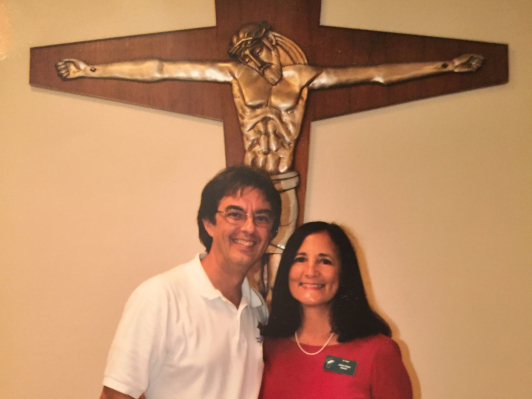
Photo: JoAnn and me at Our Lady of Florida Spiritual Center on a formation weekend. We did not know at that time that her experience of and participation in the triumph of the Cross would come as soon as it did.
Link for the Mass readings for Monday, September 14, 2020
 

There is freedom in forgiveness!

“So will my heavenly Father do to you, unless each of you forgives your brother from your heart” (Mt 18:35)

Unfortunately for many of us, we do not do forgiveness well, yet, Jesus is very clear with this parable that we need to. Our salvation depends on it! Go ahead, click the link below and read the parable. We are to forgive because God has forgiven us, over and over again, and he will continue to over and over again. If we repent and are contrite, showing genuine sorrow for our sin, God will forgive us. As I learned from Pastor Barry Johnson when he was still the pastor at Jupiter First Church: “God loves us more than we can ever mess up.”

Jesus is clear throughout the Gospels and in today’s parable that God will forgive us, the issue at hand though is that we need to also forgive as God has forgiven us. The servant in this parable was forgiven his massive debt by the king. Shortly thereafter this same servant had the opportunity to forgive someone who owed him a much smaller debt, a no brainer that the servant would act in kind, yet, he did no such thing. He strangled his debtor, and when asked to be patient, he offered none and had the man placed in prison.

Our lives are emblematic of this parable. God has not only had compassion on us, and set us free, as does the king, he has forgiven us our debts as sinners. More amazing he paid our debts through offering the death of his Son. Through that payment, we are the recipients of such mercy, grace, and forgiveness that we will never fully grasp and comprehend, and it is in an unlimited, infinite wellspring that we can draw from again and again.

Waking up each day with gratitude for the gift of our life is a good start, yet, how many of us actually take the time to be thankful for the life we have? Jesus reminds us that not only are we to be thankful but we are also to be forgiving, remembering the forgiveness that we have received. We are to be patient with one another, we are to assume a stance of understanding and support, not one of condemnation and hardness of heart.

We don’t do forgiveness well, but we need to. Maybe we don’t do so well because we do not avail ourselves of the wonderful gift we have been given. We stay mired in our own self-guilt or pity, we stay too busy to be aware, or we compare – I am not as bad as…

Wallowing in our guilt is not what Jesus asks of us. He calls us to humility and a healthy awareness of when we miss the mark of living a life of service and following the will of God. We are to examine our conscience daily to acknowledge what we have done and what we have failed to do, confess, commit to do better and begin again. For those who have access to the Sacrament of Reconciliation – which is a gift of mercy, not a dress down, there is great healing available.

There have been times I have walked out of the confessional feeling as if a massive weight has been lifted. A comparison I can think of is when I had an asthma attack that was not being relieved by my normal intake of inhaler. After receiving a shot of adrenaline from the doctor, within minutes I felt such relief and peace. Even though there have been a few grace-filled confessions that surpassed even that visit to the hospital, I still stay away from the healing sacrament for months.

When we begin to experience God’s forgiveness more we might be better able to offer more understanding and forgiveness with one another. There is a lightness and a peace when we let go of a grudge or hurt we have held onto, especially those we have held onto for a long time. One small action that can help us to better forgive is to change the habit of saying, “That’s alright” to “I forgive you” when someone apologizes.

If you are wondering now, as did Peter, how much are we to forgive? The answer is the same for us, “Seventy-seven times seven”, or every opportunity we can. Hopefully, we will begin to let go of the tight grip we have on our biases, prejudices, and judgments and unlike the wicked servant recognize that in heaven and under heaven we are all brothers and sisters and say yes to our loving God and Father’s invitation of love. Will we receive his love, and will we share his love?

————————————————————————-

Photo credit: Jack McKee

Link for the Mass readings for Sunday, September 13, 2020

From the adundance of our hearts may we share that which is good.

“A good person out of the store of goodness in his heart produces good, but an evil person out of a store of evil produces evil; for from the fullness of the heart the mouth speaks” (Lk 6:45).

We can experience hardships, trials, and suffering. We may have experienced traumas, and even come face to face with evil. Yet, we are not evil ourselves because of what happens to us, how we are tempted, nor are we defined by any trauma, suffering, or abuse. We have been created good by a loving God.

Negativity, sin, hate, and evil, can be seductive, can lure us to rationalize and come to make a decision for what we may think of as a good in the moment, yet it is just an apparent good. To encounter or experience a word or act of unkindness, negativity, or even violence, we may feel justified in retaliation, yet if we speak or act in this way we become the negativity or evil we seek to stand up against. In The Strength to Love,  a collection of Dr. Martin Luther King’s sermons he wrote:

“Returning hate for hate multiplies hate, adding deeper darkness to a night already devoid of stars. Darkness cannot drive out darkness; only light can do that. Hate cannot drive out hate; only love can do that. Hate multiplies hate, violence multiplies violence, and toughness multiplies toughness in a descending spiral of destruction.”

We need to be aware from the moment we have a thought in our mind as to what we will do with that thought. Many thoughts come from ourselves but others come externally from our experiences, our observations, our concupiscence – our tendency to sin, and yes even demonic influences.

What we listen to, read, and/or watch on a regular basis matters. We need to discipline ourselves so as not to entertain every thought or influence that comes our way. We need to be discerning, otherwise once we allow ourselves to regularly consume negative ideas, especially those that support our fears and anxieties, we will soon begin to speak and act on those ruminations.

As followers of Jesus Christ we need to meditate on the things from above (cf. Colossians 3:1) and aspire in our lives to bear the fruits of the Spirit of “love, joy, peace, patience, kindness, generosity, faithfulness, gentleness, self-control” (Galatians 5:22-23). We need to prune that which is deadening and nourish that which gives life. Examining our conscience with honesty daily will help the pruning process. Seeking God’s strength and support is just the fertilizer that we need.

Each day, with humility, we need to allow the light of God’s truth to shine within our own darkness as well as that darkness that gathers around us. Then we will better be able to commit to rooting out any fear, hatred, and/or dehumanization. With a heart that is filled with the love of the Holy Spirit we can better think, speak, and act in ways that convict, provide healing, understanding, empowerment, and love so to be the good that God created us to be!


Photo: Fr. Ray, a man of God, of goodness and a good friend who will be missed. I am sure JoAnn, along with many, welcomed him home this week.

Link for the Mass reading for Saturday, September 12, 2020

We need people in our lives who love us enough to tell us the truth.

“Can a blind person guide a blind person? Will not both fall into a pit” (Lk 6:39)?
This phrase from today’s Gospel appears to be one of Jesus’ simple teachings. It seems to be straightforward, practical and makes sense. Yet, as with much of what Jesus teaches, there is a deeper level. The are many degrees of spiritual blindness that we can succumb to, and follow others, thinking we are improving, yet allowing them to lead us to fall into a pit.
Succumbing to a cult of personality is very tempting to many of us. Who are our models, our heroes? Who is it that we seek to emulate. Are they people who are seeking all that is good, true and beautiful? Are they people who are guiding us to our highest hope and good to actualize our potential, or do they constantly lead us astray?
We need people in our lives that are not afraid to tell us the truth, or who respect us enough to guide us in such a way that they do not manipulate and take advantage of our blind spots but instead, help reveal to us our shortsightedness and give us the light to see a clearer path to avoid the pitfalls along the way.
My wife, JoAnn, was a person who did just that. She spoke openly and freely about what was on her mind. She was open to hear about her own weaknesses and faults and was willing to help me see mine as well. When I had time to digest her insights, I agreed with her assessment the majority of the time. JoAnn helped me to move beyond my comfort zones as well as pull me back when I would overextend myself by helping me to learn to say no. I often discerned God’s will through her redirection or confirmation.
My heart continues to be heavy with JoAnn no longer in my life while at the same time full of gratitude for having been blessed to have spent twenty-three years of marriage together. I became a much better person with JoAnn in my life and I believe she continues to guide me to better understand and discern God’s will going forward each day.
For JoAnn, Fr. Ray, my cousin Serge, JoAnn’s aunt Rose, my Godmother Claudette, Brigette, those you may know who have also recently died, and especially those we commemorate today on 9/11, let us remember that death does not have the final answer – Jesus does.

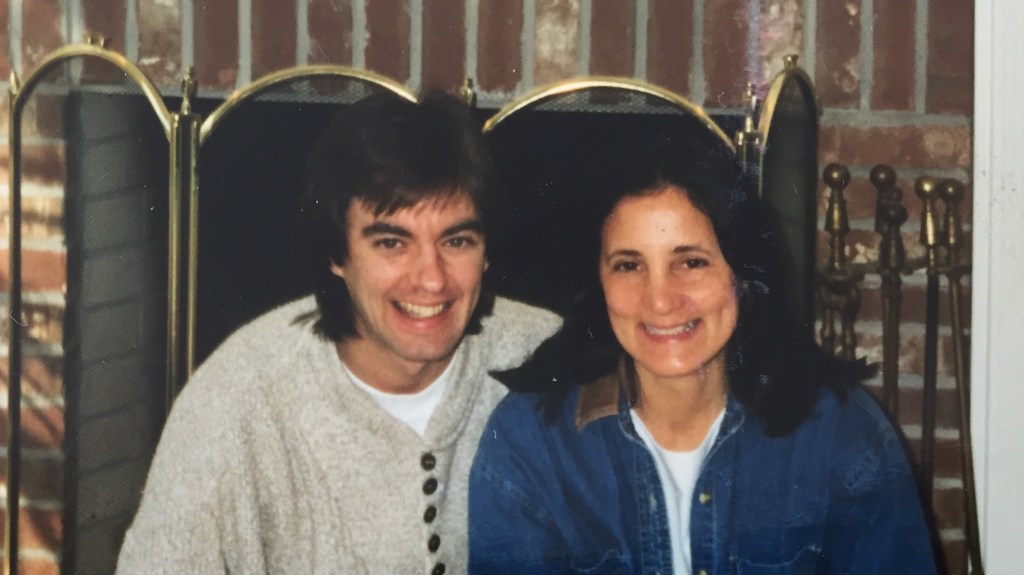
Photo: One of the earliest pictures from when JoAnn and I began dating.
Link for the Mass readings for Friday, September 11, 2020

A return to respectable argument is not only possible but necessary for growth.

Jesus said to his disciples: “To you who hear I say, love your enemies, do good to those who hate you, bless those who curse you, pray for those who mistreat you” (Luke 6:27-28).
Certainly, this is as hard of a teaching as any of us have ever heard, yet this is the path to peace. Peace that is not just an absence of violence but a peace that is grounded in mutual respect and unity. No matter where we might look, there are very few examples or models for us to see this Gospel being put into practice. We instead see a consistent engagement in rhetoric, language, and outright hostility that promotes division and polarization not only in through secular and political voices but those within the Church as well.
Nor do I believe in the temptation of the pendulum swing that would threaten to counter and go the other way, where what we think and say has the substance of milk toast, meaning, that we are so careful not to offend that we don’t share our ideas or what we truly believe. Staying away from hot button issues and the taboos of talking religion and politics is not a way to bring about peaceful coexistence nor solve important issues. Neither approach is helpful to mature growth.
Neither an overly aggressive nor a lukewarm engagement is what Jesus is presenting in today’s Gospel. Jesus is inviting us to proclaim what we think and believe but in our interactions with one another, the primary starting point is respecting the dignity of the other person. We can have a dialogue and disagree without it devolving into disparaging, demeaning and belittling attacks, shouting at and over people. We can agree to disagree, while still stating clearly what we believe, even boldly doing so, while at the same time being willing to listen to the others do the same. In this way, we each can be heard, we can exchange ideas, and quite possibly learn and grow from our encounter with one another.
We are able to have a constructive argument when we come to the table willing to love our “enemy” instead of making another person into a monster. We can clearly point out the actions of others that can even be abhorrent, and unconscionable without disparaging the person. Otherwise, if we meet hate with hate, violence with violence, darkness with darkness, we will only beget and increase that which we denounce. Jesus offers a different way, by loving, by willing the good of the other, we don’t have to even like the person but we can love the other as other. In so doing, we counter darkness with light, violence with nonviolent resistance, and hate with love.

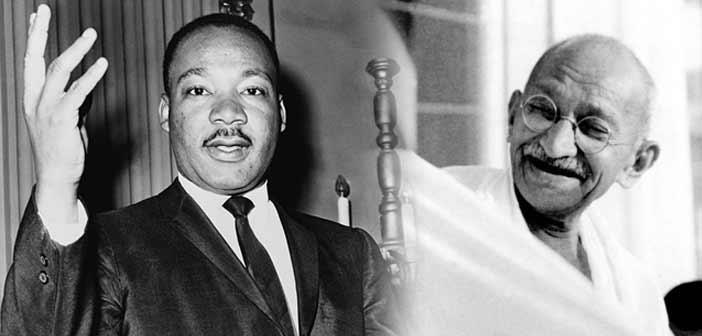
Mahatma Gandhi and Dr. Martin Luther King, Jr., models for us who lived today’s Gospel by loving their enemies. Photo accessed from publicradiotulsa.org.
Link for the Mass readings for Thursday, September 10, 2020