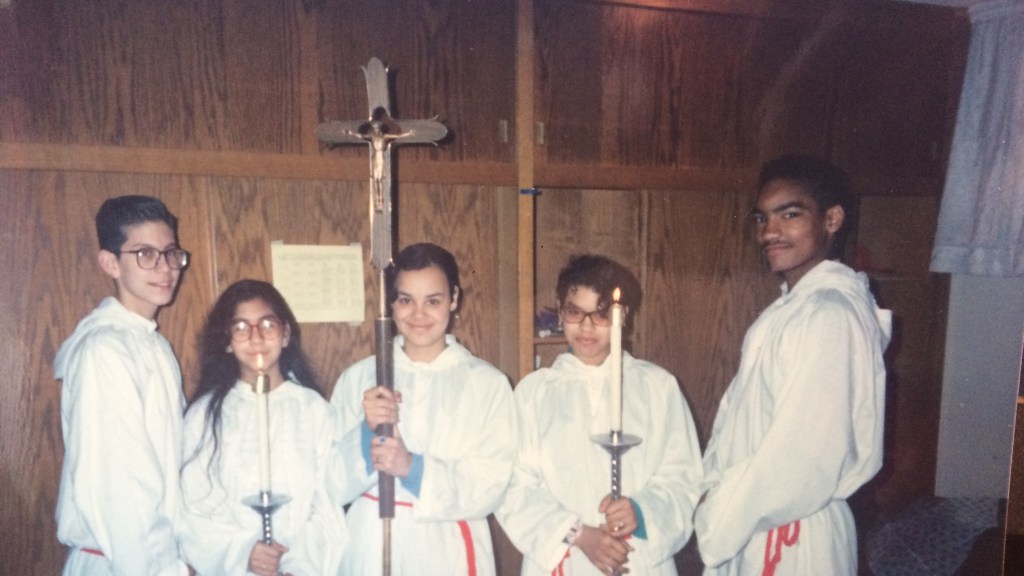

God the Father is closer to us than we are to ourselves.
“Are not two sparrows sold for a small coin? Yet not one of them falls to the ground without your Father’s knowledge. Even all the hairs of your head are counted. So do not be afraid; you are worth more than many sparrows” (Mt 10:29-31).
Jesus is encouraging his followers in today’s Gospel account as he does so with us today. What may seem insignificant to his hearers, two small sparrows, Jesus is saying has great significance to God. What has greater significance still is us as human beings because we are created in God’s image and likeness.
It was in the parallel verses to today’s Gospel from Matthew found in Luke 12:2-9, that I first remember God speaking to me in my late teens. I had returned home from a high school party. I vaguely remember feeling bored and not quite fitting in and wondering what direction my life would lead as graduation loomed on the horizon. I opened my Bible for some guidance and read the verses above.
Then I heard in the quiet of my mind God encouraging me not to worry. He then followed by telling me that I would not win the lottery, but that he would provide work for me. God has remained true to his word over these past thirty-five plus years. Life hasn’t been perfect, and there have been some rough moments, especially over the past year, but through it all, God has not only consistently provided a means for me to make a living, but more importantly, I have felt his comfort, his guidance, but above all his quiet, rock-solid presence, especially during times when I did not feel I had the strength to go on.
No matter what you may be struggling with or what may be troubling you now, no matter what may be tempting you to buy into worry, anxiety, or even fear, don’t give in to the mind storm, because we are never alone. When Jesus says that even all “the hairs of your head are counted”, he is assuring us that God knows each and every one of us that intimately, that closely. He knows us better than we know ourselves and ultimately, that he is with us for the long haul. God our Father will guide and provide the means we need to not only survive but thrive.
Photo: Some quiet time with God, early evening walk last night.
Link for the Mass readings for Sunday, June 21, 2020
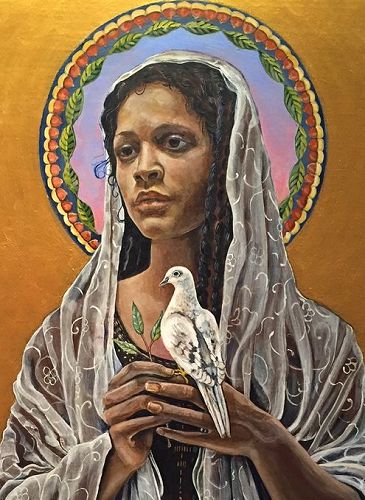
Immaculate Heart of Mary, pray for us!
There are two points that struck me in today’s Gospel from Luke. The first is what Jesus was doing when Mary and Joseph found him. After three days they found him in the temple, sitting in the midst of the teachers, listening to them and asking them questions, and all who heard him were astounded at his understanding and his answers (Lk 2:46-47). Other than his infancy, this is the only other account we have of Jesus in his youth. Jesus was listening to his teachers and asking them questions.
One of the greatest joys that I experience is when I am teaching. There are times when I actually feel like I step out of my body and I am watching the exchange along with the students. These are times when the students are asking questions, they are listening and engaged, and I believe that in that exchange the Holy Spirit is present.
The second point was Mary’s response to the whole affair. After three days of anxiety trying to find Jesus, Jesus’ response that they ought to have known where he was, that he was about his Father’s business, and their lack of understanding of what Jesus said, Mary did not meet Jesus with a head slap to the back of the head, instead she “kept all these things in her heart” (Lk 2:51). As Mary did with the news of the shepherds at the birth of Jesus, Mary’s response was to ponder.
We learn best when we enter into an exchange of dialogue where we listen to each other and ask each other questions. We commit an egregious sin when we stifle questions, inquiry, critical thought, and dialogue and slip into monologue and demagoguery. We are encouraged not to talk about faith, politics, and the social hot button issues, but if we don’t talk about these issues, which are the core and foundation of a healthy society, we will never be able to improve or make effective and healthy change.
We are wired for the practice of wondering from a very young age. If you have been around a three or four-year-old for any length of time, the question of, “Why?” will come up more than once. Unfortunately, this natural curiosity is often tamped down, because answering questions takes time. Questions can challenge our own beliefs, they also help us to recognize what we know and do not know. It is one thing to think we understand something, and it is another to articulate it.
Especially now in our present moment, when we come to realize that we do not understand certain issues or perspectives, when we are challenged, when we are uncomfortable, and when we are presented with a response that we do not expect or agree with, the better course of action would be to resist the temptation to react and lash out. Instead, may we assume the posture of Mary and ponder. Actually, to open our hearts and minds and listen to the question, the statement, seek a posture of empathy and a willingness to seek to understand the other’s point of view instead of being so quick to impose our view. Take a few deep, slow breaths and pray for discernment.
In taking these initial steps, we can then honestly engage in the discussion from what we know and feel, as well as what we don’t know, and what we are struggling to understand. Our part to play is to educate ourselves, to be open to wonder, to meditate and ponder about what we believe, and engage in respectful dialogue allowing others to do the same and then be willing to journey together to seek that which is true, good, and beautiful. Then we will be in a better position to begin to work to bring about change and reform that will be more lasting and fruitful in our realm of influence.
Painting: “The Black Madonna with Dove”, by Sue Ellen Parkinson
Readings for the Mass for June 20, 2020
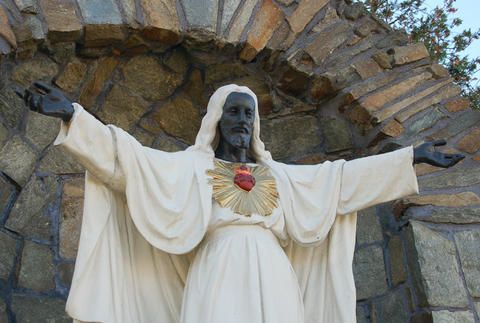
We can find rest for our soul in the Sacred Heart of Jesus.
“Come to me, all you who labor and are burdened, and I will give you rest” (Mt 11:28).
Many of our minds are distracted, diverted, and anxious and our hearts are restless. Many times what we seek does not fulfill and what we gather does not satisfy. Jesus, who is more than a wise teacher, for he is also the Son of God, invites us to enter into his rest. This rest is not determined by our external circumstances, but in finding fulfillment for that which we seek. St Augustine came to realize some sixteen hundred years ago that, “You made us for yourself, O Lord, and our hearts are restless until they rest in you.”
In 1672, St. Mary Alacoque experienced this feeling as well when she received a series of visions of Jesus. Jesus shared with St Mary that not only was his heart wounded on the cross but continues to be wounded by the ingratitude of his sacrifice especially through humanity’s inhumanity toward each other. The devotion to the Sacred Heart of Jesus was to be a practice to experience his Divine love and mercy. This devotion and practice became recognized by the Church as a Solemnity in the liturgical calendar in 1856. It has been celebrated each year nineteen days after the Solemnity of Pentecost.
The practices of devotion to his Sacred Heart that St Mary received were to participate in the Sacrament of Reconciliation once a month, receive the Eucharist often, and as a special devotion to the Sacred Heart of Jesus to do so on each first Friday. Putting these practices into place, one was promised that they would come to experience Jesus’ love and mercy. This special grace once received is a gift to be shared. We are to go out and bring the life, love, and mercy we have received to effect change in our world.
The practices of the devotion to the Sacred Heart of Jesus are disciplines to help us to find our meaning and rest in him. We are invited to dwell in his presence to receive his acceptance and love and so once loved we are to love others as he loves us. In that grace, we can find our rest, meaning, and peace that surpasses all understanding no matter the external challenges.
Dr. Martin Luther King Jr. expressed the rest that can be experienced in a close walk with Jesus even during turbulent times when in 1965 he gave a speech looking back at the bus boycott of 1955-56: “But today as I stand before you and think back over that great march, I can say, as Sister Pollard said—a seventy-year-old Negro woman who lived in this community during the bus boycott—and one day, she was asked while walking if she didn’t want to ride. And when she answered, “No,” the person said, “Well, aren’t you tired?” And with her ungrammatical profundity, she said, “My feets is tired, but my soul is rested.”
Amid our disunity and polarization, amidst the call for much-needed change and reform, we can see hope from the past in the fact that today is also Juneteenth day. This is the date commemorating the announcement by General Gordon Granger in Texas on June 19, 1865, two years after the Emancipation Proclamation was signed by Abraham Lincoln, that, “The people of Texas are informed that, in accordance with a proclamation from the Executive of the United States, all slaves are free.”
Two hundred forty-six years it would take for slavery to be abolished in all 35 states by 1865. It would take eighty-seven years for the Jim Crow laws to be turned over by the signing of the Civil Rights Act of 1964. We are still not where we need to be today in this country regarding equity and justice for all. The Solemnity of Jesus’ Sacred Heart falls on Juneteenth this year. His heart was pierced that all might be freed from the scourge of our slavery to sin and unfortunately continues to bleed for those who continue to be unjustly demeaned, dehumanized, and continue to lose their lives.
As Christians, we are to draw close to his Sacred Heart, to draw close to those who suffer to hear their voices, their stories, to lean into the difficult conversations to actually listen to one another. The issues before us are complex, multilayered, and nuanced, yet the arc of change that we have seen in our dark history will continue to move toward equity for all the more we are willing to see each other as human beings with dignity and value and the more we are willing to encounter, spend time with, and accompany one another.
Photo: Black Jesus at the Sacred Heart Seminary in Detriot
Link for the Mass readings for Friday, June 19, 2020
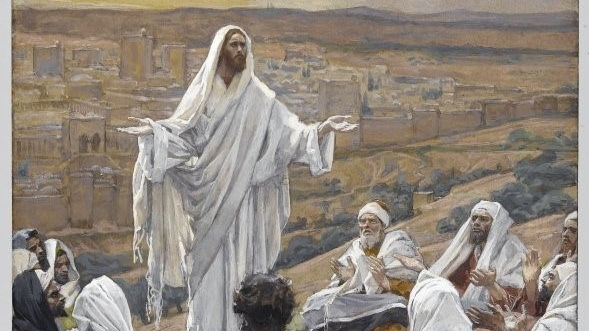
With a little help from Jesus and St. Teresa of Avila, we can calm our minds.
Prayer is not so much about bending God’s will to our will, but it is about our transformation and conformation, freeing our sole focus from ourselves as the center of the universe. The world actually does not revolve around us. We are invited to build a relationship with the One who is the creator and sustainer of all that exists.
Jesus guides his disciples on this point when he teaches them how to pray. Jesus said to his disciples: “In praying, do not babble like the pagans, who think that they will be heard because of their many words. Do not be like them. Your Father knows what you need before you ask him” (Mt 6:7-8). Jesus is sharing that words matter and have meaning in everyday life as well as in prayer. The words that we speak are to be honest and transformative, not just mindlessly evoked or invoked. Formulaic expressions and the mere volume of words mean very little compared to a few words said with clear intent, focus, and in a mindful way.
Jesus is helping us to understand that the form prayer takes or the actual words used do not so much matter as understanding why we pray. We pray to deepen and develop our relationship with the Trinitarian communion of God the Father, God the Son, and God the Holy Spirit. The very desire to pray is a prayer in itself because we are hearing the invitation of God to be one with him. The first step is to acknowledge this invitation and then to turn our hearts and minds to God. Thomas Dubay, in his book, Fire Within, paraphrases St. Teresa of Avila, the 16th-century doctor of the Church, in saying that “one vocal prayer, even so little as one petition of the Our Father, if well said, is better than many recited thoughtlessly or hurriedly” (Dubay 1989, 76).
Reciting the Our Father, or Lord’s Prayer, that Jesus shares with his disciples in today’s Gospel of Matthew, can be a struggle, because the biggest challenge to a life of prayer is taming, what some Buddhists call, the “monkey mind”. Our thoughts can be actively engaged, random, distracting, and even anxiety inducing within one minute. To overcome the challenge of an unsettled mind we can return to St Teresa again. When we begin to pray, St. Teresa of Avila suggests that we begin “with self-examination and the sign of the Cross” (Dubay 1989, 77).
In this way, we can bring to awareness some issues, struggles, temptations, and sins that we have been dealing with. We can settle into them, instead of run away from them and seek God’s help to be healed and reconciled. In making the sign of the Cross, we bring our self, as we are, into the presence of the Trinity. We receive and experience the love, acceptance, and mercy of God and recognize that we are loved as we are and that we are not alone because we belong and are a part of this infinite community of love. In this simple gesture, we are also uniting our body, mind, and soul with the One who will lead us in our prayer.
The next step is to imagine that Jesus is with us to guide and lead us in our prayer. “Imagine that this Lord Himself is at your side and see how lovingly and how humbly he is teaching you” (Dubay 1989, 77). By mindfully engaging with our breathe and our body, we slow down and allow ourselves to become more still.
Finally, we can imagine Jesus teaching us the Our Father as if for the first time, as he did his disciples. Going slowly, one word, one verse at a time, allow Jesus to not only share his words with us, but we can also pause and add our own words. By doing so, we begin to discipline the focus of our mind and can enter into a dialogue with God and receive the blessing of his mercy and love. “Focusing on the indwelling presence, says Teresa, is for wandering minds ‘one of the best ways of concentrating the mind’ in prayer” (Dubay 1989, 77).
—————————————————————–
Photo: James Tissot, The Lord’s Prayer by Online Collection of Brooklyn Museum; Photo: Brooklyn Museum, 2006, 00.159.167_PS1.jpg, Public Domain, https://commons.wikimedia.org/w/index.php?curid=10904489
Dubay, S.M., Thomas. Fire Within: St. Teresa of Avila, St. John of the Cross, and the Gospel on Prayer. San Francisco: Ignatius, 1989.
Link for the Mass readings for Thursday, June 18, 2020

Even during Ordinary Time we can fast, pray, and give alms.
Jesus continues his Sermon on the Mount today. We have been graced thus far with the teachings of the Beatitudes, being salt and light, as well as the six antitheses which we have been reflecting upon over the past week. Today, Jesus presents common practices of living a life of faith. The key point he is making though has again to do with our end goal. As discussed yesterday, as his disciples we are called to be “perfect just as [our] heavenly Father is perfect” (Mt 5:48). Again perfection here is that our end goal is to be one with God. We are striving to become holy, to be saints, for the purpose of deepening our bond and relationship with God and each other.
Our being perfected in Jesus is a process whereby we become less and Jesus becomes more. What decreases is our focus on self, especially the ego-self, our sense of self-centeredness. Jesus provides for us three ways in which we can practice drawing closer into communion with God and one another. We are to give alms, pray, and fast. We may remember these as being the three pillars of Lent that we put extra emphasis on during that penitential season.
Jesus cautions his disciples and us. When we give alms, pray, and fast, our intent must be properly ordered. If we give alms with the intention to “win the praise of others” (Mt 6:2), pray in a public display “so that others may see” us (Mt 6:5), and in our fasting “look gloomy” and “neglect [our] appearance, so [we] may appear to others to be fasting” (Mt 6:16), then we are seeking to do so in such a way that the focal point is to be on us. We think to ourselves, how holy and pious we are. Instead, we are hypocrites because, in each of these actions, we are not seeking to improve our relationship with God, nor to build up his kingdom. The intent is to build up our own pride and ego by seeking to direct the focus is on us.
Jesus indeed calls us to holiness. What that means is we are to give of ourselves to others in a service of love, so that others may be empowered, strengthened, and grow in their faith life, so they too may join us in building up God’s kingdom. We are to seek Jesus in prayer with the intent of receiving the purifying fire of the Holy Spirit that we may be purged from that which feeds our false self so that we can be freed of the dross of our accumulated sin, our imperfections, and that which we are attached to. In our time of prayer and examination of conscience, Jesus reveals to us that which we have an unhealthy attachment to. It is to these areas that we can fast from. In these conscious acts of the will, we choose God over self and continue to mature into who he calls us to be.
In our prayer today, let us ask Jesus to reveal to us one way that we are putting ourselves before God, for him to reveal to us a pattern or habit of sin that keeps us bound to our own pride and prejudice, and/or something that we are attached to that we can fast from. And then one way we can reach out and give of ourselves to someone else. Prayer, fasting, and almsgiving are not only for Lent. There are many people that are in need of God’s support and help right now. We become the hands and feet of Jesus when we are willing to allow him to lead us to serve others with the love of the Holy Spirit and simply allow God to happen in our encounters with others.
—————————————————–
Photo: Spending some time enjoying a Sandhill Crane family on my evening walk about a week ago. Time experiencing God’s creation for me is prayer.
Link for the Mass readings for Wednesday, June 17, 2020
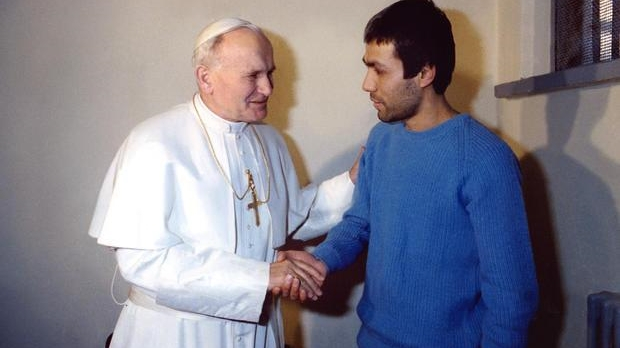
We can bring about change when we love our enemies and pray those who persecute us.
The sixth antithesis may be the most challenging of them all. “You have heard that it was said, You shall love your neighbor and hate your enemy. But I say to you, love your enemies and pray for those who persecute you, that you may be children of your heavenly Father” (Mt 5:43-45). The parable of the Good Samaritan provides a nice parallel to this verse. It can be found in Luke 10:25-37. For in that parable Jesus shows our enemy and our neighbor to be one and the same.
A good examination of conscience would be to read the above verse, ponder who would come up for you as an enemy, and then read the Parable of the Good Samaritan. Whenever the word Samaritan comes up, drop the word Samaritan and insert the person or persons who came up for you in reading the first verse. When we have finished this exercise, then, may we pray for the person or persons defined by us as our enemy, for if we only love those who love us, what makes us any different than anyone else? If we are to be disciples of Jesus, if we are to be children of our heavenly Father, we are not only to love those who love us, but we are to also love our enemies. We are to love those for whom there is little chance of being loved in return.
Jesus offers us the way to be able to accomplish this seemingly impossible feat of loving our enemies as follows: “So be perfect, just as your heavenly Father is perfect” (Mt 5:48). We are able to love our enemy as ourselves by being perfect. This is not much help unless we understand that the English word used here is translated from the Greek word telios, which means complete, whole, to reach one’s goal or purpose in life. As a Christian, our end goal, our purpose, our fundamental option, is to be in full communion with God our Father, who is Love. God the Father is not just loving, not just a lover, but the very embodiment of Love. God is Love.
God as the embodiment of Love, “makes his sun rise on the bad and the good, and causes rain to fall on the just and the unjust” (Mt 5:45). We strive in our life to attain the end goal of being perfected by Jesus the Christ, when we, through an act of our will, allow ourselves to become transformed into becoming agents of his love. The most challenging of enemies is facing the enemy within. To love as God loves, we are to follow the words and actions of Jesus and the prophets.
Each day we are given a choice to make. We can choose to embrace our fear, seek revenge, dig in our heels, and embrace our ego, react in kind to negativity, and/or remain indifferent to the suffering in our midst. We may refuse to love our enemies, we may withdraw our love, but know when we do so, we contribute to the condition of sin, polarization, violence, and dehumanization that plagues our culture, nation, and our world.
We can choose instead to live out our inheritance as children of God and assist Jesus in the ushering in of the reign of our Father’s kingdom. This means speaking truth to power, using our access and means to advocate for the voiceless, or comforting the afflicted while afflicting the comfortable. This means calling sin, sin, but doing so without falling into sinning ourselves. Calling out hate, with hate, we will only contribute to more hate.
We can instead choose to diffuse the power of hate by loving our enemies and being perfected by Jesus the Christ. We can choose to align ourselves with the will of his Father and collaborate with the Holy Spirit to be agents and models of love and forgiveness in our realm of influence. We can choose to love today, person to person, brother to brother, sister to sister, enemy to enemy.
Let us pray, provide support and understanding, while at the same time hold up mirrors to appeal to the consciences of those who would seek to harm, persecute, demean and dehumanize us and others. We need to refuse to lower ourselves into the darkness of fear and hate, and instead disarm our enemies with the light of Jesus as we will the good of and pray for those who contemplate, participate in, and perpetuate hatred, racism, and violence in all its forms. We need to continue to be open to being transformed and healed so to better channel our energies to promote justice, mercy, and peace.
—————————————————————-
Photo: Pope St. John Paul II met, prayed with, and forgave Mehmet Ali Agca at Rebibbia prison on December 27, 1983, for shooting and attempting to kill him on May 13, 1981. ARTURO MARI/AFP/Getty Images
Link for the Mass readings for Tuesday, June 16, 2020
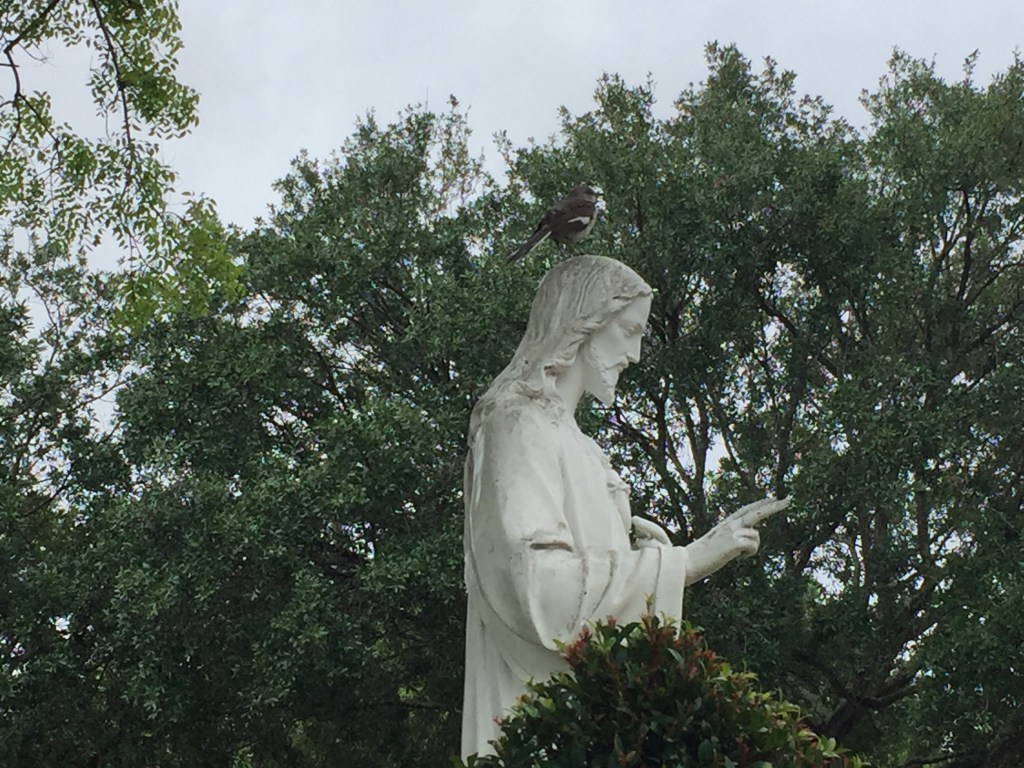
Revenge is not the answer Jesus gives us to bring about lasting change to injustice.
Today we receive the fifth antithesis, in which, Jesus said to his disciples: “You have heard that it was said, An eye for an eye and a tooth for a tooth. But I say to you, offer no resistance to one who is evil” (Mk 5:38-39). The Mosaic law, an eye for an eye, that Jesus first addressed was an attempt to curb the emotive response of revenge. If someone had killed a clan or tribal member, there would have been those who would choose to retaliate by inflicting as much carnage as possible to the people responsible, even up to and including the death of the whole clan or tribe, even the women and children. The rationale behind this was that there would then be no one to come back for revenge. The idea of seeking instead an eye for an eye was to temper the retribution to a more measured response.
Jesus though is saying that “an eye for an eye” does not go far enough, and raises the challenge of being his disciple to a higher level, being that even the thought of revenge is not to be considered. Jesus is not seeking to lessen the cycle of violence, he is giving us the means to end it. Forgiveness is the cornerstone of the teachings of Jesus. Instead of seeking revenge, Jesus is commanding that we seek to forgive those who have harmed us. We who pray the Our Father or the Lord’s prayer, are to take to heart and be mindful of the words we pray them, “forgive us our trespasses as we forgive those who trespass against us.“
The urge for revenge is powerful and primal. Revenge is wired into our survival instinct to protect ourselves. Jesus invites us to grow beyond our mere instinctual responses and survival instincts. He is calling us to be a people who do not merely survive, but thrive. Jesus is seeking to infuse us with his divine life so that we will be transformed. This is true not only for ourselves but for those who would seek to do us harm. Instead of striking back with revenge, we are to be flexible and adept enough to instead appeal to their conscience. We are to take all that others throw at us, and meet them with the courage to stand and receive their worst, and disarm them with the blinding light of the love and forgiveness of Jesus.
This is no easy task, especially when we experience ongoing injustice and needless loss of life. To put into practice such teachings as the turning of the other cheek, we need to start small. We need to resist the immediate thoughts of revenge that arise for the smallest of offenses. When someone makes a snide remark, and/or offers demeaning or dehumanizing comments directed at us or others, we resist retaliating in kind, yet, we do hold them accountable, and remind the person of our dignity and/or the dignity of the person they seek to demean with the intent to lead them away from the perception of another person as being somehow other, to one of being a brother or sister.
To be a disciple of Jesus, to be a peacemaker, we need to be contemplatives in action even and especially in today’s current climate of unrest and dis-ease. We need to ground ourselves in prayer, return to these hard teachings of the Beatitudes and antitheses often, believe in them, meditate on them, keep them at the forefront of our mind and, with the courage and guidance of the Holy Spirit, put these teachings into action and practice. We will best be able to do so when we resist reactionary and hyperbolic responses so we are better able to see the truth and root of the challenges we face and then we can begin to bring about accountability, reconciliation, and structural change.
Some would say this is naive and impossible. It is true that we will not be able to resist thoughts and acts of revenge and walk the path of forgiveness on our will power alone. We need to surrender our ego and pride to Jesus, who as the Son of God became one with us so that we can be one with him. As we do so, he will begin to transform us as he forgives and loves in and through us.
———————————————————–
Photo: After Mass on the grounds of St Peter a few weeks ago
Link for the Mass readings for Monday, June 15, 2020
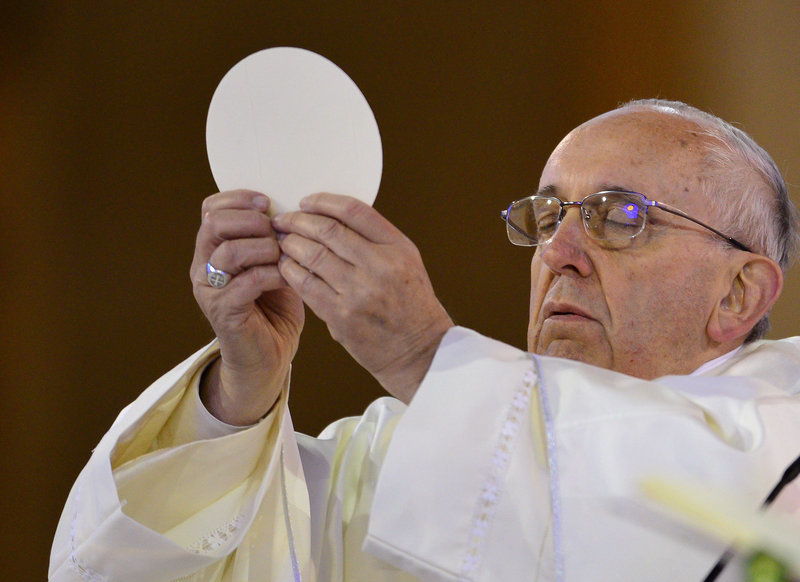
Jesus through your Body and Blood, please help us to be instruments of healing, peace, and reconciliation.
We celebrate Corpus Christi Sunday each year to remember why we celebrate the Eucharist. We remember that we really are receiving Jesus. Though he is in the appearance of simple bread and wine, Jesus is substantially present, Body and Blood, Soul and Divinity.
Jesus promised that he would not leave us orphans. This is why he returns to us during each consecration of the bread and wine at each Mass in such an intimate way that as we consume him we are transformed into his Mystical Body. This is why we are encouraged to receive him as often as possible, at least each Sunday. If we truly believe that Jesus is the Christ the Son of the Living God and that he is present here at Mass such that we can receive him into our very being to become one with Him who became one with us, why would we stay away?
Jesus loves us and desires a relationship with us so much so that he makes himself food for us. This wonderful gift of himself is not just for us alone. We are dismissed at the end of Mass to go and announce the Gospel of the Lord, to bring Jesus whom we have received to those who are in need of his love.
We are to carry the light of Jesus into the suffering we are experiencing from the ongoing effects of the pandemic, polarization, and racial unrest in our country. Jesus calls us not to add fuel to the fire of that which seeks to divide and separate us but instead he invites us to provide his healing balm and to be instruments of his peace, that peace that surpasses all understanding to those in our realm of influence.
Jesus, please heal us from our own prejudices, biases, and contributions to divisiveness and give us the courage to stand up to racism in all its forms. Please, help us to experience the fullness of your true presence in the Eucharist on this Solemnity of Corpus Christi so that we can be more open to experience the beauty of the uniqueness and diversity you have given each of us, the dignity you have endowed us with, and regardless of our race, ethnicity, creed, gender, or political party, help us to see others as you see us, as your children made in your image and likeness. Amen.
Photo – July 24, 2013 – Getty Images: “In the Eucharist, he offers himself as spiritual strength so as to help us put into practice his commandment – to love one another as he loved us – building communities that are welcoming and open to the needs of all, especially the most frail, poor and needy people.” – From 2017 Corpus Christi Homily by Pope Francis
Link for the Mass readings for Sunday, June 14, 2020

 Spiritual Stepping Stones