
We are to forgive seventy-seven times.
Peter approached Jesus and asked him, “Lord, if my brother sins against me, how often must I forgive him? As many as seven times” (Mt 18:21)?
Peter’s initial question of asking to forgive seven times may sound pretty generous to us, because the usual question most of us ask is, “Do I have to forgive at all?” Many of us do not do forgiveness well, even if we look at it as a virtue. If someone says to us they are sorry, do we reply, “I forgive you?” Often our automatic response is, “That’s alright”, “It’s ok”, or “No problem”. When we are convicted of a mistake, error or offense, do we ask for forgiveness or operate from a defensive posture to explain why we did what we did, or defend what we did as right, not willing to admit any inappropriate action?
We are very habitual creatures, and much of what I shared above is learned behavior. We are conditioned and shaped since the time of our youth. That is why when we hear Jesus’ answer to Peter, “I say to you, not seven times but seventy-seven times”, we may dismiss Jesus’ statement as mission impossible. Another thought that may come to our minds is those cases or positions in which we feel justified in our stance of unforgiveness. Jesus is yet again raising the bar for us.
We are to strive to forgive as our heavenly Father forgives. Forgive the same person seventy-seven times? Yes. If someone is seeking forgiveness, we are called to forgive. Jesus does not mean that we don’t hold people accountable, remain in a dangerous or life-threatening situation, or enable people in their self-destructive behavior. Forgiveness has to do with not holding on to the hurt, not allowing the offense to fester as a grudge that builds to hate and negative or violent behavior. Forgiveness is also not a curse but a blessing. For when we forgive, it is an antidote to the poison someone has injected us with. If we refuse to forgive, we allow the person who has injured us to do so over and over again. In our unwillingness to forgive we allow that poison to continue to fester.
If you are struggling with holding onto a grudge and/or past hurts. One approach that may be helpful is to visualize yourself approaching the person you have the issue with and saying to them, “I forgive you”. You may also find it helpful to visualize Jesus standing beside you while you do this exercise. Repeat the process each day in your time of prayer until you start to feel yourself coming to a place of forgiveness, and can imagine that reconciliation is indeed possible.
If you find visualizing difficult, sit down and talk to Jesus. Be honest with him, tell him the situation and share with him that you do not want to forgive the person. Then ask for Jesus to help you. Embrace the sacrament of Reconciliation and confess your unwillingness to forgive. When ready, determine how best to reach out to the person to say that you forgive them; a phone call, email, text message, or in person.
A third idea that may work is to write the person a letter, whether you send it or not. Each of these practical ways provides an opportunity to approach the great gift that Jesus offers us, to forgive seventy-seven times, or to forgive each and every time we are given the opportunity to do so.
We don’t do forgiveness well. But with Jesus, we can begin again. Let us practice saying each morning, “Please forgive me, (Name)” and think of a few thoughts, words, or actions you need to be forgiven for. Then say, “I forgive you (Name), for…” and think of a few words, actions, or inactions to insert. Also, Jesus gave us a pretty good prayer: “Forgive us our trespasses as we forgive those who trespass against us.” We are not alone. Remember, Jesus asked God to forgive those who crucified him. We can ask God to forgive those who have offended, hurt, or abused us. Then we can actually move to the point where we begin to develop the freedom to say to others, “I forgive you”, and “Please forgive me.”
Photo was taken by JoAnn. When we are open to receiving, God’s forgiveness cleanses us like an ocean breeze.
Link for the Mass reading for Thursday, August 13, 2020
Walk away from gossip and instead seek to bring healing and reconciliation.
Gossip is a seductive and enticing poison. Many of us fall for its lure and its intoxication. There are many different reasons we engage in gossip. We may think we feel better about ourselves by putting someone else down, we may be jealous of what another has, or maybe someone just rubs us the wrong way. The reason that we may feel justified in choosing to gossip is when someone has hurt, offended, or wronged us in some way. Even in that instance, we observe Jesus offering a different approach in today’s Gospel.
Jesus said to his disciples: “If your brother sins against you, go and tell him his fault between you and him alone” (Mt 18:15). Jesus is drawing on his Jewish heritage. Leviticus 19:17 warns against holding hate in your heart and instead encourages seeking to reason with your brother. Jesus is redirecting us from adding fuel to the fire by seeking revenge or stewing in our own hurt, which will build resentment and hate. Instead, he is inviting us to seek reconciliation.
Pope Francis, in his September 9, 2016, General Audience was very clear: “[G]ossip is a ‘terrorist’ who throws a grenade – chatter – in order to destroy,” he added. “Please, fight against division, because it is one of the weapons that the devil uses to destroy the local Church and the universal Church.” Let us refuse to be a weapon of the devil in his plot to divide us with our thoughts or our words, but instead, seek to be a disciple of Jesus by advocating for forgiveness and reconciliation.
To do so, we need to commit to being more discerning with our tongue. With our words, we can cut, wound, and destroy, or we can convict, reconcile, and heal. Let us choose to lift up and empower one another. Yes, it is much easier to grumble about someone than to approach them in love and hold them accountable. If we are not quite ready for that, Pope Francis invites us to “bite our tongue” instead or we can choose to pray about the situation with someone we trust: “For where two or three are gathered together in my name, there am I in the midst of them” (Mt 18-20). In seeking the help of Jesus, we will have a better chance of choosing reconciliation over gossip.
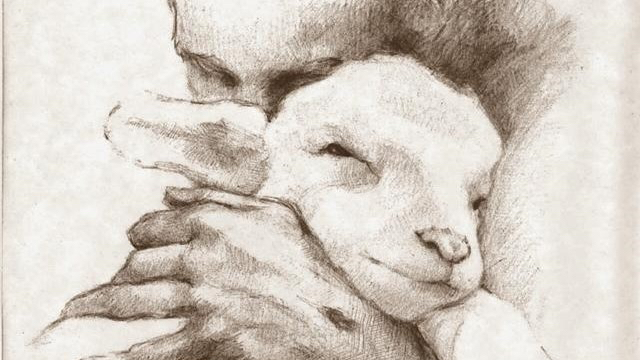
Image credit: “Jesus and the Lamb” by Katherine Brown
Link for Pope Francis’ comments
Link for the Mass readings for Wednesday, August 12, 2020

May we come to see that we are all children of God.
“Amen, I say to you, unless you turn and become like children, you will not enter the Kingdom of heaven. Whoever becomes humble like this child is the greatest in the Kingdom of heaven. And whoever receives one child such as this in my name receives me (Mt 18:3-5).
The above response Jesus gave was to the disciple’s question regarding who is the greatest in heaven. Jesus offers an unexpected response, as children had no esteem, honor, or greatness in his society. Jesus was not pointing out so much the innocence of children, but emphasizing that children were completely dependent on others for their very survival.
If we are to embark or stay on the journey that will lead us to the Kingdom of heaven, we need to do the same. We need to give our control and apparent, self-sufficiency over to God and place our dependence on him alone. We need to depend on God as would an infant or young child depends on their parents.
Very young children have not developed a defensive filter and they say what is on their mind, often with precise insights! How often do we do the opposite by automatically responding in a defensive manner, thinking about how we will be received or fearing an ulterior motive from the question? Jesus has taught us that our yes is to be yes, and our no is to be no, and anything more is from the evil one (cf. Mt 5:37). As his disciples, Jesus calls us to be humble, to admit to our sins, our mistakes, to confess, correct, and learn from them.
We grow in humility when we take responsibility for our actions, turn away from that which we place before God, and release those biases and idols that can lead us down the path of prejudice. We also do so when we resist the allures of material, apparent goods, and our own self-centered postures, which so often can lead us to the imprisonment of addiction. We can avoid many of these pitfalls when we follow the instruction of Jesus to “become like children”. This is more likely to happen when we depend more on God, surrender our control, and place our trust in him. By doing so, we can build a firmer foundation of truth and humility, we will begin to find that we will be more satisfied, fulfilled, and be less defensive and more present to those in need.
We live in a fallen world and there is a temptation to buy into the idea that “might makes right” and “the prize belongs to the survival of the fittest”. This attitude supports a belief in separateness and diminishes the reality of our interconnectedness. We are all wounded, a bit beaten up by life, emotionally, physically, and spiritually, and in need of God’s healing touch. Instead of assuming a defensive posture or taking offense when presented with negativity and thus contributing to the growing division and darkness, may we instead align ourselves with God and ask him to love others through us, even those who may not appear to be so loveable. We could all use a little more support, empathy, and kindness especially now. We are all children of God and whoever receives one child in Jesus’ name receives him (cf. Mt 18:5). Let us be that healing balm to each other that is so needed.
Photo: One of my favorite pictures of my nephew Nicholas and me some time ago. He is now 24! Life goes very fast. Make the time to tell and show those you love that you love them.
Link for the Mass reading for Tuesday, August 11, 2020
Willing to die to ourselves, we will be more available to respect and defend the dignity of others.
Jesus said to his disciples: “Amen, amen, I say to you, unless a grain of wheat falls to the ground and dies, it remains just a grain of wheat; but if it dies, it produces much fruit. (Jn:12:24).
In reading this verse, I was transported back to Middle School. Our sixth-grade class was dismissed to head to the cafeteria for the Science Fair. As I drew closer I could hear some unintelligible chanting going on. Of course, I was curious and craned my neck to see over the other students filing in as we entered our destination. As I drew closer and saw a circle of kids taunting and circling someone, I stopped. I heard muffled groans and then saw one of my friends standing in the center of the circle, his forearms pulled up to cover his face. No one was laying a hand on him, but the heckling was inflicting enough damage. I froze not knowing what to do or how to act.
I don’t remember how the situation was resolved, but I do remember how badly I felt that day, and still do for not doing anything. I also withdrew from my friend when I saw him later because I felt so bad for not speaking up or stepping in. I wasn’t there for him as he was harassed nor did I provide comfort later because I was still only thinking of myself, my shame, and not his feelings or his need. That day, I remained just a grain of wheat that did not fall to the ground and die. I was unwilling to die to myself, unwilling to stand up for my friend, and unwilling to provide any comfort.
When we find ourselves in situations when another human being’s dignity is being diminished, Jesus implores us to resist loving our life, assessing first our own self-interest, or we will lose it. Instead, we are to “hate our life” in this world (cf. Jn 12:25) by thinking of others first, instead of ourselves.
We will be in a better position to serve as Jesus did when we are willing to die to self, like the grain of wheat that falls to the ground and dies. We will grow and mature to bear fruit as God’s mouthpiece, when we speak truth to power, work to change systems in our culture and society that oppress and devalue others, prevent and defend attacks against the dignity of people. As we strive for change within ourselves, others, and society, we need to also, at the same time, accompany and provide support, person to person, for those who have been ignored, disrespected, devalued, objectified, or abused in any way.
Jesus, please grant us the courage to love, to will the good of the other. Give us the eyes to see and the ears to hear the cry of the poor; those who are demeaned, belittled, or dehumanized. Holy Spirit, inspire us to to be that grain of wheat that dies to our own self-centered and fallen self, such that we are not just silent bystanders. Loving God and Father, empower us to stand, speak up, and act on behalf of the dignity of those who are vulnerable, those who do not have access, and/or the avenue to speak up for themselves.
———————————————————————–
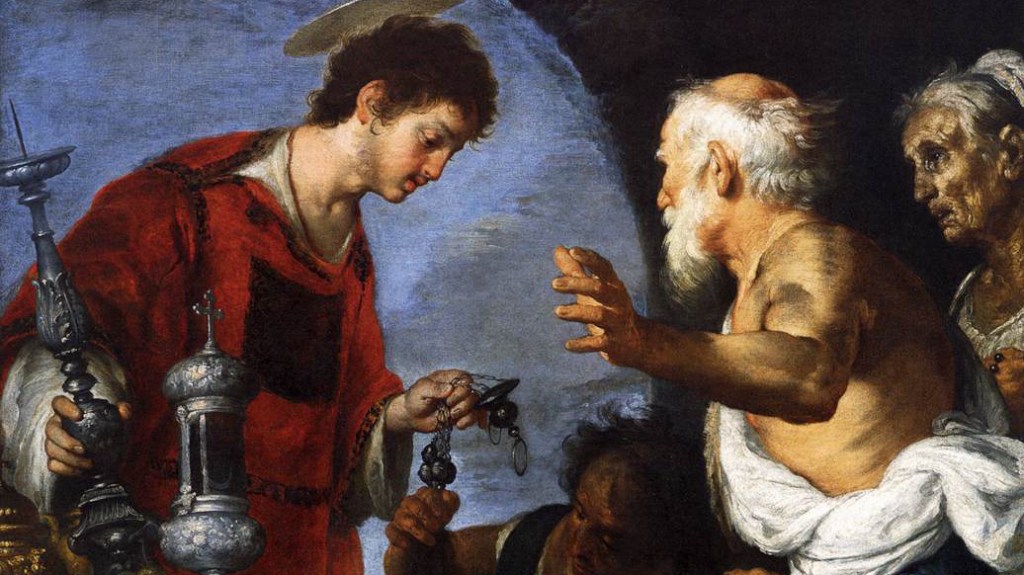
Painting by Bernardo Strozzi of St Lawrence, the third-century deacon and martyr. Lawrence was asked by the Roman prefect to bring the wealth of the church to help maintain the Roman army. Three days later, Lawrence returned with the blind and lame, lepers, orphans, and widows and said to the prefect, “These are the treasure of the Church.” St Lawrence on this your feast day, pray for us!
Link for the Mass readings for Monday, August 10, 2020
Show up and God will take care of the rest.
After doing so, he went up on the mountain by himself to pray. When it was evening he was there alone (Mt 14:23)
“After doing so,” is referring immediately to the preceding verse where Jesus dismisses the five-thousand after he had fed them and forced his disciples to go ahead of him and sail off to the other side of the Sea of Galilee. Jesus was now alone, which was the reason he originally came to this deserted place but the people had followed him. Weary, and worn, for we need to remember that Jesus was fully human as well as divine, Jesus “went up on the mountain by himself to pray.”
We need to do the same. In the midst of our business, we need to make time to be alone and pray. Like Jesus, we have many demands on our time. We may have many obligations, many people, and many challenges pulling at us. We also may have many diversions, anxieties, and fears that tempt us when we do move in the direction of making time to pray. The very act of being quiet, of being still, can be a fearful exercise. It is here we are called to face ourselves, our sin, our despair, loneliness, and/or our pain, suffering, and hurts. As Jesus walked up the mountain, I am sure two recent events, being rejected in his hometown and the death of John the Baptist, were on his mind.
If making time to pray has been a challenge, then the first step is to just begin with examining your days to find some “crumbs of wasted time to try to build short moments for recollection and prayer, we may discover that there is quite a lot of it” (Bloom 49). The point is to begin, and it is not so important how or what we pray, but to just make a commitment to two, three, five minutes each day in which to experience the present moment where God is waiting for us.
The very desire to pray is prayer already because we are becoming aware of God’s invitation to spend time with him. Just as Peter walked on water for the time he held his gaze on Jesus, so can we experience Jesus when we meet him face to face in prayer. To pray, we just need to answer the invitation from God and show up. Take some deep breaths, allow your shoulders to relax, and then say, “I am seated, I am doing nothing, I will do nothing for five minutes, then relax” (52).
The goal to start is not so much what you do during this time, or to experience anything. The goal is that you complete the time you made a commitment to, no matter what arises. You can just examine the day, say the Lord’s prayer slowly, breathe, talk freely with God. Resist the temptations that will arise to stop and get up. By doing so, we begin to disengage ourselves from the hamster wheel of habitual patterns and reactions. We will also begin to see traces of God’s presence in our daily experiences.
One stepping stone at a time is the key. Choose a time and place to commit to being still. Sit, breathe, and complete your time of stillness. Continue to show up and God will take care of the rest!
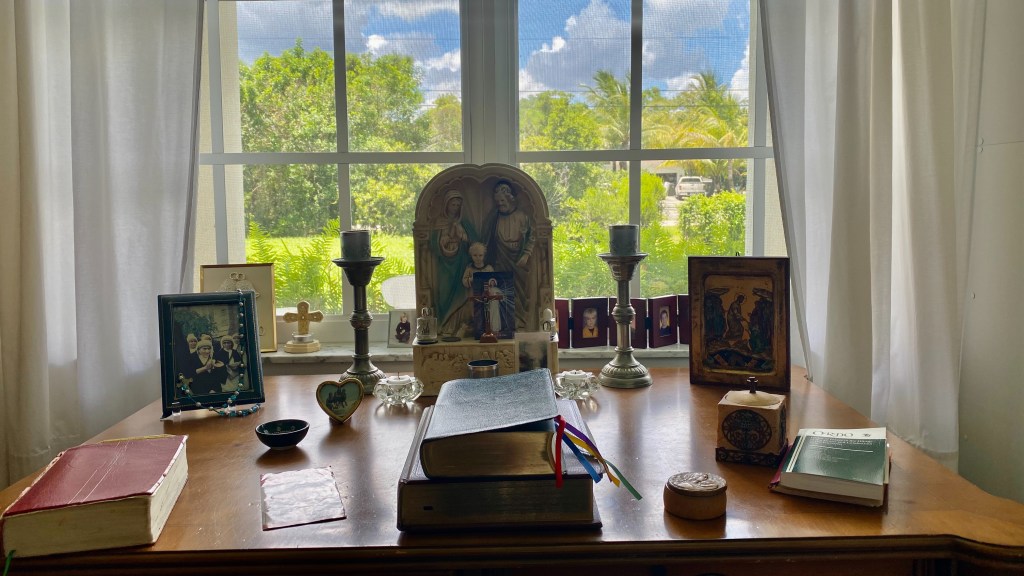
Photo: Where I show up to pray each day.
Link for the Mass Readings for today, Sunday, August 9, 2020
Bloom, Anthony. Beginning to Pray. New York: Paulist Press, 1970.

Faith grows as our relationship with Jesus grows.
Then the disciples approached Jesus in private and said, “Why could we not drive it out?” He said to them, “Because of your little faith.” (Mt 17:19-20).
How do the disciples get from this recurring theme of having little faith in the Gospel accounts to Peter healing a crippled beggar by saying with boldness, “I have neither silver nor gold, but what I do have I give you: in the name of Jesus Christ the Nazorean, [rise and] walk” (Acts 3:6)?
A helpful definition “is to say that faith always entails a relationship between persons which stands or falls with the credibility of the person who is believed” (Rahner and Vorgrimler 1965, 164). Faith is not just an intellectual exercise, it is a lived experience. Christian faith is the conviction, belief, and relationship experienced with Jesus the Christ. The disciples learned from Jesus but more importantly developed an intimate relationship with him, such that the love they received and shared became so strong that there was no more room for doubt, distraction and/or fear, such that they would align themselves with the will of God and do what Jesus did and by his power working through them they would do even greater deeds than he (cf. Jn 14:12-14)!
We are invited to do the same. If we only read the Gospels or hear them read we may know something about Jesus, but our life will for the most part remain unchanged. When we read, meditate, and pray with the Gospels and put into practice what we read, we will encounter Jesus as did his disciples and we will come to know and develop a relationship with Jesus and be conformed to him. In this way, we are not just reading a dead letter but encountering the living Word, the Son of God, who invites us to share in the infinite dance of Love that he participates in with God the Father and God the Holy Spirit.
As our relationship and intimacy with Jesus grows and matures we too will be able to say with conviction the words of Paul: “I live by faith in the Son of God who has loved me and given himself up for me” (Galatians 2:20). The best barometer of how we are doing with our relationship with Jesus, is how do we think, speak, and act toward each other?
———————————————————————–
Painting credit: CB Chambers, Sacred Heart of Jesus, a gift given to me by Jim and Christine Zoeller, now hangs in my classroom at CN!
Rahner, Karl and Vorgrimler, Herbert. Theological Dictionary. New York: Herder and Herder, 1965.
Link for the Mass readings for Saturday, August 8, 2020

Not I, me, mine but all together now.
Jesus said to his disciples, “Whoever wishes to come after me must deny himself, take up his cross, and follow me” (Mt 16:24).
Jesus invites us to deny our self-centered default position which places I, me, and mine (As George Harrison sang) at the center of each of our decisions. We can deny ourselves when we resist making excuses for our sins and come to a genuine place of sorrow for the pain we have caused God, ourselves, and others. By acknowledging our sins and confessing them, we die to our selfish ways, and then we rise again through the power of Christ. Empowered by our humility and the strength of Jesus we are better equipped to resist those temptations when they rise again.
We are also in a better position to then take up our cross, which is to follow the will of God. Jesus showed us the proper orientation of surrender when he said at Gethsemane: “Father, if you are willing, take this cup away from me; still, not my will but yours be done” (Lk 22:42). Jesus followed his Father’s will to the cross and endured horrific suffering, excruciating pain, humiliation, and abandonment, to death and into new life!
Many a mother I have talked with has shared the struggles of labor, but also expressed the joy of giving birth; many of my students have been exasperated by the time and effort expended for an examination, a sporting event, art show, musical or theatrical performance and yet experienced the joy from the feat they accomplished; and how many times have we faced a challenge, trial, or cleared some obstacle and felt the exhilaration of overcoming the hurdle?
Taking up our cross and following the will of God means accepting a disciplined approach to our lives. When we follow God’s will, as opposed to our own solely, the difference is that we are not alone in our persistent effort. Seeking God’s will in the midst of our decision-making process and trials for our everyday physical as well as spiritual pursuits is the key.
In my mid-twenties, I entered the Franciscan Friars of Holy Name Province to study for the priesthood. In the year and a half of discernment, from time to time I would imagine my ordination day. To my surprise, I did not feel intense joy. I enjoyed every aspect of my experience with the friars and the ministries but there was something or someone missing. I took a leave of absence and about a year and a half later, I realized what was missing was having a family.
About two years later I met JoAnn, and her three children, Mia, Jack, and Christy. Six months after that we were married and seventeen years later, I was ordained to the permanent diaconate. This is the short version of the story. There were bumpy moments as we learned to grow together by being willing to see each other’s point of view, some perspectives took a little longer than others, and we were at our best when we were willing to sacrifice for and serve one another.
The journey took its roughest lunge this time last year when JoAnn was experiencing her final weeks with us this side of heaven. From the beginning of JoAnn’s diagnosis of pancreatic cancer, we both prayed, not that our will but God’s will be done. This cross was the heaviest to bear, yet Jesus shouldered it with us and blessed us richly in our surrender. I am truly grateful for those final months that we had together.
The grief and sorrow that I did not allow during JoAnn’s sickness has risen up on and off since I returned home as it did today while I was organizing the garage, something we would often do together when I had time off. Yet, in embracing the sorrow and allowing the tears to flow, I was able to experience the joy and appreciation from our years together. In denying ourselves and carrying our cross – our willingness to resist curving in upon ourselves and face, instead of run away from our challenges, we can actually come to a place of healing, wholeness, and unity with others.
Photo: All of us together last July 4th weekend with Levi and Harley, Mia’s wee ones.
Link for the Mass Readings for, Friday, August 7, 2020
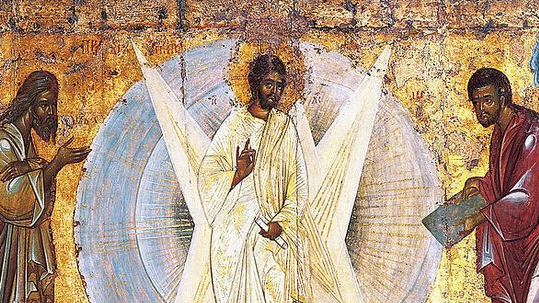
Jesus reveals that we can participate in his divinity.
Jesus took Peter, James, and his brother, John, and led them up a high mountain by themselves. And he was transfigured before them; his face shone like the sun and his clothes became white as light (Mt 17:1-2).
Peter, James, and John certainly experienced Jesus’ profound teachings, his powerful signs, and wonders. They also experienced his healing on the Sabbath, casting out demons, and forgiving of sins, which, alluded to the reality that he was the Son of God. I imagine Peter, James, and John, though acknowledging Jesus as the Messiah, still pretty much looked at Jesus as being solely a human being. In the encounter of Jesus transfigured, Jesus revealed to his inner circle of Apostles not only a foretaste of what was to come in heaven but a glimpse of his actual divinity.
Jesus is not 50% God and 50% human. He is fully God and fully man. This is the Mystery of the Incarnation; the reality that the second Person of the Trinity took on flesh and became human. This is an important reality, because in this very act of Infinite Grace, assuming humanity, God opened up heaven for us. The Son of God became one with us so that we can become one with him. Through participation in the life of Jesus Christ, we can restore our relationship with his Father.
“By revealing himself God wishes to make [us] capable of responding to him, and of knowing him, and of loving him far beyond [our] own natural capacity” (Catechism of the Catholic Church, 2nd ed., 52). As I have been sharing in prior posts, this reality of the invitation of communion with the Loving God and Father of all creation is for everyone. Our joy and fulfillment are achieved by developing a relationship with the God of Jesus Christ.
Many may say they are happy and living a good life without having a relationship with Jesus Christ or apart from God, and I would not disagree with them. I would only add that if we are honest with ourselves, there is more to life than the mere materiality before us. That if we slow down enough, we experience a yearning for more. Even with great achievement, mastery, and accumulation, there is still a lingering question, “Is this all there is?”
We experience consciously or unconsciously a restlessness, we continually search to fill this unease with material and finite things, feeling satisfied for the moment, but eventually, in short order, we are left feeling empty, time and time again. This unease is our soul’s yearning, our transcendent nature to long for more, and that longing is for the infinite that the finite cannot provide.
St Augustine of Hippo (354-430) articulates this desire and yearning so well in the opening chapter of his autobiography, Confessions: “You move us to delight in praising You; for You have made us for Yourself, and our hearts are restless until they find rest in You.”
The Feast of the Transfiguration is an invitation, not to reject our humanity, but to embrace the fullness of what it means to be human, as the Son of God did through the Mystery of his becoming one with us. We are invited to embrace the full range of our personhood; the reality that we are physical, emotional, intellectual, as well as spiritual human beings. Our fulfillment and joy come from the balancing and nurturing of each of these aspects of who we are. We are all called beyond mere existence, subsistence, and survival living to experience the fullness and meaning of life.
Peter, James, and John, as well as Augustine and the saints, embraced the invitation of Jesus and that has made all the difference in their lives. God invites us to do the same. He encourages us to be open to wonder, to explore the full breadth, depth, and width of all that our faith and reason can open for us such that we can draw ever deeper into the intimacy of a loving relationship with God, ourselves, and each other. We are called to experience the fullness of our interconnected humanity and through our participation in Christ, share collectively in his divinity!
Icon: Transfiguration of Jesus painted by Theophanes the Greek in 1408
The link for the Mass readings for Thursday, August 6, 2020
 Spiritual Stepping Stones
