
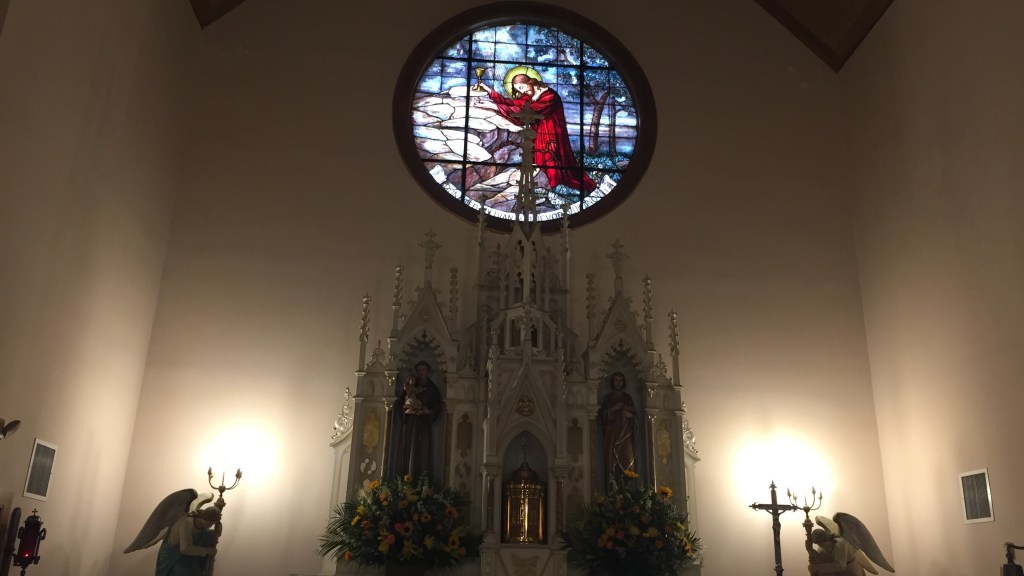
May Jesus’ prayer, “Not as I will, but you will.” Become our prayer.
Today, we celebrate the Passion of Jesus. The scene from the Passion account that I would like to reflect upon is Jesus in the Garden of Gethsemane (Mt 26:36-46). The disciples follow Jesus to the Mount of Olives and once arriving, Jesus withdraws about a stone’s throw from them, and kneeling, he prayed, saying, “Father, if it is possible, let this cup pass from me; yet, not as I will but as you will.” Jesus would pray this prayer again after finding his disciples asleep.
He probably reviewed his life, his simple beginnings with Mary and Joseph, his simple vocation as a carpenter, and the past three years of his ministry. Jesus had done all that the Father had asked of him, he preached, taught, healed, exorcised demons, built relationships, and each time his Father requested something of him, Jesus said yes. Now as he pondered one more request, he could probably sense Judas and the Temple guards drawing close. He would be turned over to those who had rejected the will of his Father.
Jesus would say yes again, “My Father, if it is not possible that this cup pass without my drinking it, your will be done!”
Jesus could have refused, but he was sent by his Father to become one with us in our humanity so that we could become one with him in his divinity, and that meant all that he assumed, all that he took upon himself in being fully human, he could redeem.
This meant Jesus would also take upon himself our sins, although he himself never sinned. Jesus was willing to follow the will of his Father all the way into utter godforsakenness, into death.
With these words of surrender Jesus echoed a verse from Psalms 42 and 43: “Hope in God, I will praise him still, my savior and my God.” Even faced with his death, he trusted that there would be a greater good from the sacrifice of giving his life. Jesus would surrender all.
The God-man, Jesus, arose, and as he approached his disciples he found them sleeping from grief. Jesus was ready to face the cross even if his apostles were not. As with the Apostles, Jesus commands us to watch and pray this Holy Week. How many times have we also been in a situation of facing something that is too heavy to bear? We, like the disciples, fall short, for our flesh is weak. Yet, Jesus has faith in us that we will actualize who his Father calls us to be, as he still had faith in his apostles who persisted despite their failures and fulfilled their role in God’s plan.
No matter what looms before us, let us place our trust in God, as Jesus did in the Garden of Gethsemane.
No matter what personal trials or tribulations or even the effects of the coronavirus that are preventing us from being together in communal worship, we choose to, like Jesus did, to put others before ourselves. That is why we quarantine ourselves in an act of solidarity and love for one another.
No matter what challenges we face, come what may, we are not alone. Let us not be afraid, but be brave. Let us hope in God, let us praise him still, our savior and our God.
Photo: Sanctuary of St Anthony Croatian Church in Chinatown, Los Angeles, CA
Link for the Mass readings for Sunday, April 5, 2020

With the setting of tonight’s sun, we enter the twilight of Lent.
A core group within the leadership of Israel has decided. They will not deny themselves, their power, prestige, their place. They will not take up their cross and follow Jesus, the way, the truth, and the life. They will not allow the teaching and momentum of the growing number of those following Jesus to continue unchecked. As Passover drew nearer, thousands of people were coming to Jerusalem to purify themselves for the great feast.
This meant the Romans would have many more centurions in place to keep the peace. The division and commotion that Jesus was causing could cause conflict and unrest and then swift and violent retribution from the Roman presence. The Sanhedrin, the Jewish High Council, followed the lead of the high priest, Caiaphas, who said, “You know nothing, nor do you consider that it is better for you that one man should die instead of the people, so that the whole nation may not perish” (Jn 11:49-50). With these words, they began to plan how to put to death the carpenter of Nazareth.
With the words of Caiaphas, the sun began to set on the life of Jesus. These words even affect us still today as they usher in the sunset of our Lenten observance. The gift of our liturgical readings allows us to relive the story of our faith. Lent has given us a time to reflect, to meditate on who Jesus is. Is he just a carpenter, another teacher, or a holy man from the past, or is he that, but someone so much more, the Son of God who became one with us in his humanity so that we can become one with him in his divinity?
Do we see his teachings and life as a threat as did the Sanhedrin? Do we like our life the way it is, such that we do not want Jesus to come into our home and start turning over the tables and disrupting our order and comfort? Or do the Gospels cut us to the heart and inspire us to shake off our complacency, our indifference, our cynicism, so to be inspired to acknowledge our sins, to repent, and to begin anew?
As Holy Week begins with the Vigil Mass for Passion Sunday may we meditate on the words of Caiaphas, “consider that it is better for you that one man should die instead of the people, so that the whole nation may not perish” (Jn 11:49-50). Caiaphas did not know that what he proclaimed would be so true, that the one, Jesus, would die, not only so the nation would not perish, but that all humanity would not perish.
Jesus died for you and for me that we might have life and have it to the full. As the sun sets this evening, may it not be just another rotation of the earth on its axis, but an opportunity to commit once again to die to our false selves, our egos, our self-centered postures, so to take up our cross and follow Jesus into Holy Week.
———
Photo: Sunset a few nights ago on my evening walk.
Link for the Mass readings for Saturday, April 4, 2020
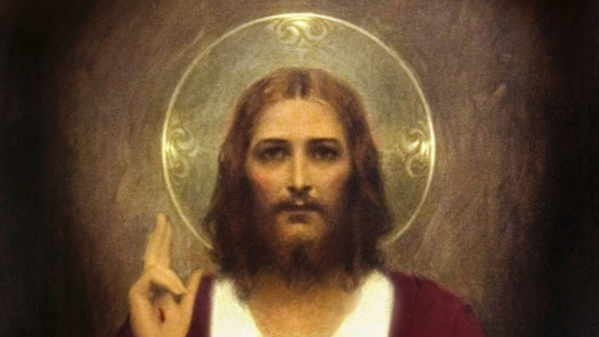
Is Jesus a blasphemer or truly the Son of God?
Two groups of Jews emerged in today’s Gospel account. There were those about to stone Jesus for blasphemy and those who began to believe. The first group did not recognize the good works that Jesus did as coming from God, nor his reasoning that “even if you do not believe me, believe the works, so that you may realize and understand that the Father is in me and I am in the Father” (Jn 10:38). They listened to the claim that Jesus was making but they refused to accept the fulfillment of the assertion: Jesus did the works of his Father because he was then and still is today the Son of God.
The more that Jesus sought to help them to understand that he was who he says he is, the more they dug in their heels. They left the stones on the ground but then moved to have him arrested. Jesus evaded their grasp and moved on to the region across the Jordan where John first baptized. John did not preach in the Temple precincts either, even though he was the son of a priest. John followed the lead of God to prepare the way for Jesus and his eternal priesthood. The Temple had not been the seat of God for some time. Jesus would become the new living Temple.
Jesus returned to the place of his baptism, where he joined in solidarity with sinful humanity. This visible image of consecration revealed what happened silently in his conception and birth: the Son of God took on flesh and became man to open up heaven for us in the humanity he assumed. As people came to John in the Jordanian wilderness, so too, people came to Jesus. Not all rejected his message. Many came to him and said, “John performed no sign, but everything John said about this man was true.” And many there began to believe in him (Jn 10:41-42).
The question that arises for us as our steps take us closer to Palm Sunday and Holy Week is to which group of Jews recorded in today’s Gospel account will we align ourselves with? Will we label Jesus as a blasphemer or accept that Jesus is the Son of God? The scriptural record does not reveal indifference as an option, the accounts do not leave any room for Jesus being only human; a good teacher, a wise man, or a revolutionary radical.
We either accept Jesus is fully human and fully divine or we don’t. If he isn’t who he claimed to be, God, then Christianity is a sham. If we accept that Jesus is the Christ, the Son of the Living God, then our lives ought to be aligned to his. Our thoughts, words, actions, and even our faces need to reflect that truth.
A good way to begin each day is affirming this fact by stating with an attitude of prayer, “Jesus I believe in you, I need you,” and asking him what works of the Father he would have us offer in his name this day? In what ways can we be of help and support even while limiting our social interactions during this pandemic. May we have the openness of mind and heart to hear his words and the courage to act upon his guidance, so to be living stones, radiating the light of the living Temple of Jesus the Christ, the Son of the Living God.
————————————————————————-
Painting credit: Sacred Heart of Jesus by CB Chambers
Link for the Mass readings for Friday, April 3, 2020
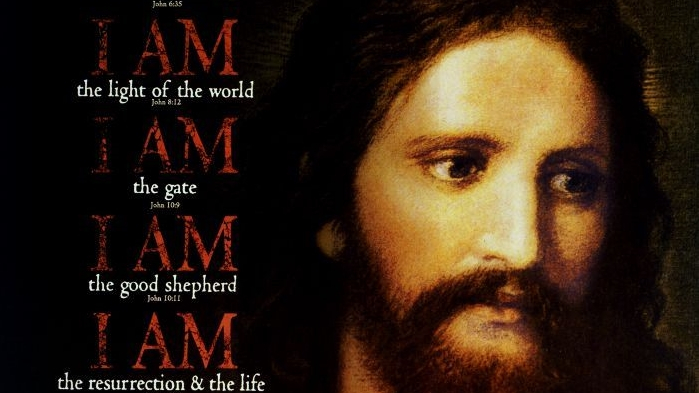
Do we believe that Jesus is who he said he is?
Jesus’ listeners “picked up stones to throw at him” (Jn 8:59). Though less violent, this interaction has some similarities found in Jesus’ Bread of Life discourse (cf. John chapter 6), where Jesus made the statement, that, “I am the bread of life” (Jn 6:48). In both cases, the people do not understand what Jesus is sharing and yet Jesus doubles down on his points.
In John 6, Jesus holds firm to the truth that his followers will consume him and in today’s Gospel Jesus does not equate himself as being just a representative of God, a prophet or a rabbi, but that he, in fact, is God when he states: “Amen, amen, I say to you, before Abraham came to be, I AM” (Jn 58). With these words, Jesus has just done the unthinkable, he not only has spoken God’s sacred name, which is not to be uttered because it is considered too holy to do so, he equates this sacred name, “I AM”, with himself. Jesus is making his point very clear, that he is God. During the Bread of Life discourse, people walked away from him because they were repulsed and most likely considered him mad, here they believe he is speaking blasphemy. The reactions would be appropriate in both cases, unless of course, Jesus is who he said he is.
As his listeners then, we too have a choice to believe or disbelieve in Jesus. One option that is off the table, if we give the Gospel accounts any rational reading, is that Jesus presented himself as just another teacher, philosopher, prophet, or guru. Jesus, during his public ministry, is consistently embroiled in conflict, which is evident in all four Gospels because Jesus presents himself as God incarnate. Jesus heals on the Sabbath because he is the Lord of the Sabbath, Jesus is the Bread of Life, Jesus is: “I AM.”
The Apostles struggle to make sense of the words and actions of Jesus and we may also struggle with our understanding of who God is and who Jesus is. We may have doubts, concerns, and unanswered prayers and/or questions. To walk the path of discipleship is not to walk with constant assurance, for we walk by faith and not by sight (cf. 2 Corinthians 5:7). Walking by faith does not mean we throw up our hands, toss out all reason, and believe blindly. Dr. Holly Ordway defined faith as “trust based on a reasoned knowledge of the evidence.” Faith means that we trust that Jesus is who he claimed himself to be based on the scriptural evidence, our own experiments with the truth based on these claims, and our experiences of him in our everyday actions.
Jesus calls and we follow. He does not give us the full picture, but as we step out trusting in his call, he will reveal to us each step of the way what we need to know. He will be present and work through us as we continue to turn our life over to him and one another more and more each day. When we begin to doubt, we can lean on Peter’s claim, “Master, to whom shall we go? You have the words of eternal life. We have come to believe and are convinced that you are the Holy One of God” (Jn 6:68-69). Peter made this claim based on his experience and trust in his relationship with Jesus. Our relationship and belief in Jesus will also grow to the same depth, moment by moment, with each yes to the invitation of Jesus, the Holy One of God.
———————————————————————————-
Photo: Accessed from Pinterest
Holly Ordway’s quote comes from Lesson 2: Bridging the Meaning Gap in her course: Imaginative Apologetics which can be accessed by registering for the Word on Fire Institute, the home page of which can be accessed: https://wordonfire.institute/
Link for the Mass readings for Thursday, April 2, 2020
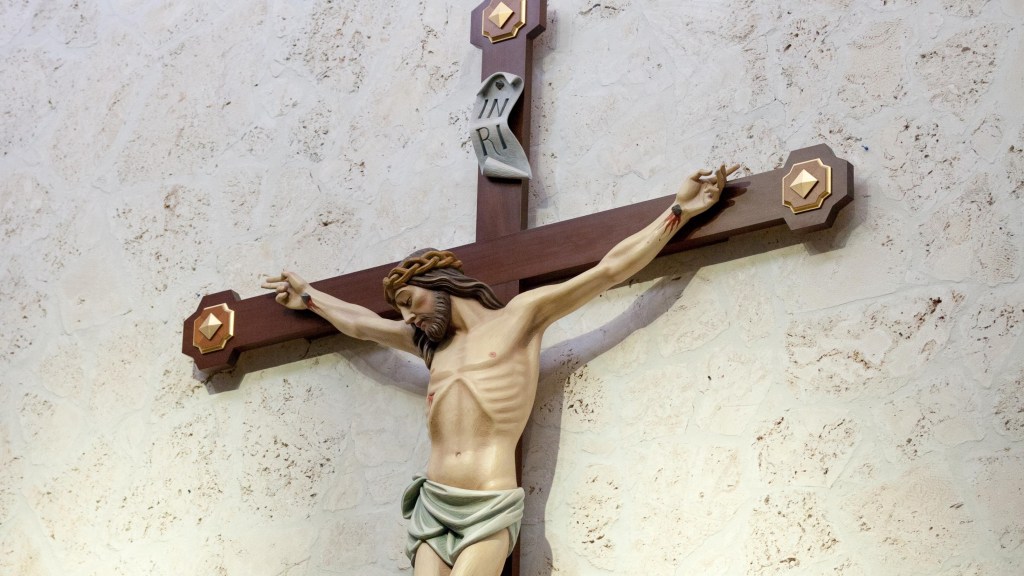
Jesus came to free us, to save us from our sins.
It is interesting to note that in today’s Gospel reading from John, Jesus spoke to those who “believed in him” (Jn 8:31). But the more he talked, the less they seemed to understand who he was: “If you remain in my word, you will truly be my disciples, and you will know the truth, and the truth will set you free.” His listeners balked at the word “free”, asserting that because they are ancestors of Abraham they have never been enslaved by anybody.
In the United States of America, freedom is also highly valued. Many of us would probably react very much in the same way. We may have different ways of expressing why we feel that we are free, but we would certainly assert that we are not enslaved to anybody or anything.
Jesus’ words ring just as true then and today: “Amen, amen, I say to you, everyone who commits sin is a slave of sin.” Jesus shined his light on the truth that many of us do not see, which is our enslavement to sin. If we truly seek to be free, then we need to acknowledge this point. What many of us claim to be freedom, doing whatever we want to do, when we want to and how we want to do it, is not true freedom. We cannot even hear the clanking of the chains or feel the weight of the shackles chaffing at our skin as we raise and shake our fists while asserting our freedom of indifference!
The response to Jesus’ statement of “who commits sin is a slave of sin” is not to hide, deny, rationalize, attack or flee, but to embrace the truth that Jesus is placing before us. In this way, we allow his light to expose the darkness in our heart where sin speaks and we say yes. In this way, the thoughts, words, and actions that we put before God are revealed.
When Pope Francis was asked, “Who is Jorge Mario Bergoglio?” he answered, “I am a sinner, but I trust in the infinite mercy and patience of our Lord Jesus Christ, and I accept in a spirit of penance.” We are all sinners because of the fact that we all in some form or fashion place idols before God. This is not a negative or defeatist attitude, quite the contrary. When we call out our sin in truth, we can be free from it. When we think our life is about us first and foremost, and ignore or rationalize our sin then we are enslaved by our sin, such that it chokes and threatens to undo us. Then we experience its debilitating effects and attempt to free ourselves, yet the process becomes likened to a Chinese finger trap. The more we pull to escape, the tighter the grasp.
We become free from our sins by acknowledging that we are sinners, that we cannot be freed by our efforts alone, and that we need the mercy of Jesus. We need a savior. Jesus accepts us as sinners, as we are. We do not have to be perfect or have our house in order for him to come to be present with us, for he is already waiting for us. We do not need to be worthy, we just need to be willing to open the door when he knocks, and invite him into the chaos of our lives so to heal us with his grace, love, and mercy. “So if the Son frees you, then you will truly be free.” Let Jesus in today, and each day so to be free for excellence!
——————————————————————
Link for the interview with Pope Francis from America Magazine, September 30, 2013:
https://www.americamagazine.org/faith/2013/09/30/big-heart-open-god-interview-pope-francis
Photo: Crucifix in the sanctuary of the cathedral, St Ignatius of Loyola, PBG, FL
Link for the Mass readings for Wednesday, April 1, 2020
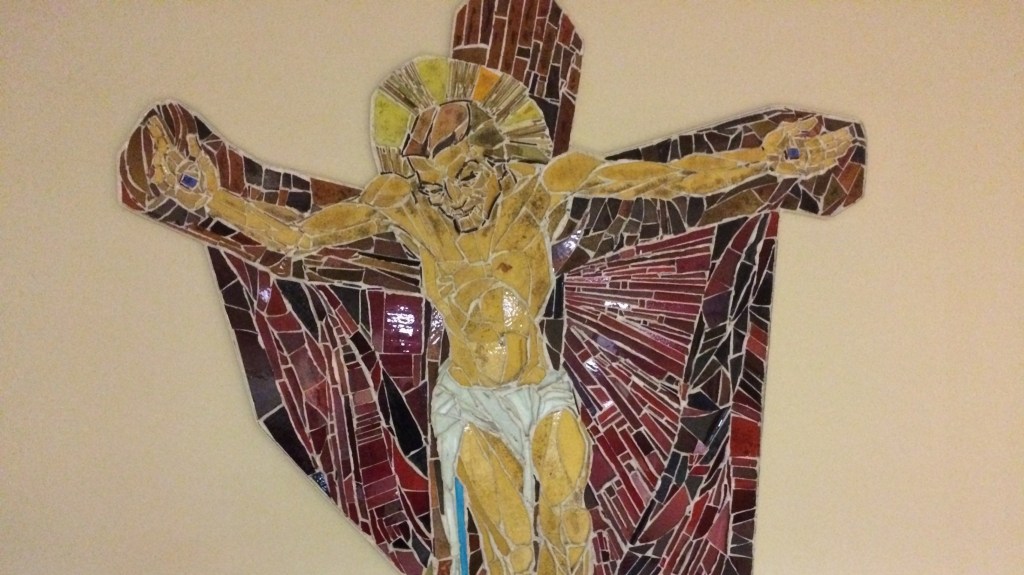
Jesus was lifted up on the cross to free us from our sins.
Jesus seeks again to help the Pharisees to understand who he is. In the preceding section of today’s Gospel of John, the Pharisees do not believe in his claim of being “the light of the world” because he testifies on his “own behalf, so [his] testimony cannot be verified” (Jn 8:13). The point being made here is that for verification there must be support given by two or three valid witnesses (cf. Deuteronomy 19:15). Jesus states that he testifies on his own behalf as does his Father who sent him (cf. Jn 8:19). His witness in this matter is God.
Jesus continues in today’s Gospel account to attempt to help the Pharisees and those gathered around them to understand who he is and what is about to transpire in his crucifixion. Jesus shared that God the Father sent him and continues to be with him. He has not left Jesus alone because Jesus maintains the intimacy of their relationship as he follows the will of his Father and will continue to do so all the way to being lifted up on the Cross.
Those listening to Jesus do not understand, they asked if he was talking about killing himself. Often throughout the ministry of Jesus many, even his Apostles, do not understand what Jesus taught, and that was because they were trying to make sense of what he said from this purely material and finite reality. Jesus invited them to seek a deeper understanding by sharing that he is from above and they were from below. They were needing to be born from above, to open their mind and hearts to him, as Simon Peter did when he came to realize that Jesus was the Christ, the Son of the living God. Jesus gave those he taught a choice. They could die in their own sin or repent and choose to live in participation with him.
Discipleship is a journey. We will not come to understand Jesus from one instance or encounter. Even Saul, who had an amazing experience and encounter with Jesus and changed his name to Paul, would take about three years to digest the significance of what happened to him that day on the road to Damascus. It will be so with us as well. We need to resist the world’s craving for instant gratification, especially regarding the growth of our discipleship and spiritual maturity.
We will develop on our faith journey as we acknowledge and repent from our sin, hear his call, believe in Jesus, remain committed to him, and walk with Jesus day by day and follow the will of his Father as he did. The gift of the liturgical seasons is that as we walk each year with Jesus and assess our growth, we will, like a finger making an upward spiral motion, come again and again to the same point each year, and hopefully, we are higher up that spiral each time.
Sometimes it is hard to see our changes in our day to day reality, but over time with the gift of hindsight, we can discover that we indeed have made a closer walk with Jesus a reality. When we can honestly assess that this is not so, it is not too late to begin again, to repent from that which keeps us bound to this world and turn our gaze to that which is above. Jesus made his choice to follow the will of his Father, to be lifted up, and to die on the cross for us. We too have been given a choice. We can hold tight to our sins or leave them at the cross and be free.
——————————————–
Picture: Mosaic of Crucifixion from Our Lady of Florida Spiritual Center, Palm Beach Gardens, FL
Link for the Mass readings for Tuesday, March 31, 2020

“Neither do I condemn you.”
“Let the one among you who is without sin be the first to throw a stone at her” (Jn 8:7).
As these words came forth from the mouth of Jesus, there must have been a deafening stillness. A mob had gathered that wanted blood around a woman seeking to stone her for being caught in the act of adultery. Had this woman actually been caught in the “very act”? Were there those that were scheming so scrupulously that they would spy on her at that moment, or like our first reading from the Book of Daniel was this a false accusation because the woman refused the advancement of someone who wanted to commit adultery with her and she refused? Either way, Jesus helped to restore the dignity of this woman by showing the common shortcoming of our fallen humanity.
Today’s Gospel account from John helps us to come to terms with the reality that we are all unified in the reality that we all fall short of the glory of God that we were originally created for. Fortunately, there was no one present who thought himself so self-righteous that he had not committed any sin. All left and only Jesus and the woman remained. It was only then that he spoke to her.
Jesus’ goal for each person he encounters is that we come to terms with our own sin, to repent and believe in the Gospel. Yet, he does so not by condemning us but by showing us how we are off the mark and bestowing his mercy and love upon us. In this way, he guides us to the path that will lead to what is truly good, not the false allures of apparent goods that may glitter at the moment, but then fade.
Jesus loves us more than we can ever mess up, but he does not want us to remain in our sin. By doing so, we are separating ourselves from a more real and intimate relationship with God and one another. Jesus is about healing those aspects of our choices, behaviors, habits, and vices that keep us separated. Lent is a more intense period where we make the time to become more aware of our vices so that through the love and mercy of God and in collaboration with him, we can transform them into virtues.
May we examine our conscience, call to mind those areas in which we have fallen short of the glory of God in our lives, where we have sinned, and with humility share them with Jesus and so with the woman caught in adultery hear too his words, “Neither do I condemn you. Go, and from now on do not sin any more” (Jn 8:11).
—————————————
Photo by Alexandro David from Pexels
Link for the Mass readings for Monday, March 30, 2020

Does the account of the raising of Lazarus have something to say to us as we deal with this pandemic?
John’s Gospel account of the raising of Lazarus from the dead is very poignant for our present time. Mary and Martha and Jesus’ disciples wonder why Jesus does not go to be with his friend as soon as he receives word that he is dying. Jesus has healed and restored so many people, why would he delay? With the present worldwide spread of Covid-19. Many of us may be asking the same thing. Why is Jesus allowing this to happen? Why do so many have to suffer? Why the delay?
Jesus responded to the disciples’ inquiry by saying, “This illness is not to end in death,
but is for the glory of God, that the Son of God may be glorified through it” (Jn 11:4). We know from the Gospel reading for today that Jesus raised Lazarus from the dead. We do not know the ending regarding our present plight. What many have experienced is the death of their family and friends, as did Martha and Mary. Many people are in fear and their daily lives have been uprooted on a massive scale. Many who are elderly or immunocompromised are facing the real prospects of death. There are those who want to help but they are being told to stay home. Many people want to worship in their faith communities, of all faith traditions and are not able to do so.
Does the Gospel speak to us today in our present moment, in our present global crisis? Yes. As I echoed yesterday from Pope Francis, Jesus, “more than anyone, cares about us.” Just as Jesus wept when he witnessed the anguish of Mary, the sister of Lazarus, so he weeps in this present situation. We were able to see God’s glory revealed in Jesus raising Lazarus, but we are in the midst of our own anxiety, pain, and anguish now as Martha and Mary were when Lazarus was sick, dying, then died. It would not be until four days later that Jesus came.
We may still be experiencing the first day of our crisis. Jesus had a plan for Lazarus and he has one for us. We need to have the same faith as Martha. Though she did not understand why Jesus had not come sooner, she trusted in him and who he was, the Messiah, the Son of God. Just as Jesus was present to Martha, he is present and among us as well.
I do not believe that God brought this pandemic upon us as a punishment, but I do believe he has allowed it to bring about a greater good, and that is different for each of us. What we need to do in times like these is to evaluate what is really important in our lives, who are really important to us. What are apparent goods and what is truly good?
Also, many of us who have been and continue to be so better off financially are experiencing some serious inconveniences, loss of work, livelihood, but we may have savings, we will be able to recover. There are many throughout our country and world that have been dealing with subsistence living and mere survival for maybe their whole lives. Maybe we can gain a little more empathy for those who have been suffering all along and are even more vulnerable now to the Corona Virus than many of us who have homes to isolate ourselves in.
Much of the anxiety we face may be having to deal with the reality of our own mortality. We are looking at the very real possibility of our death either from knowing those who have died or hearing about the vast numbers who have died from Covid-19. Being faced with the prospect of our death is a good thing. Those who I have known who have done so, have more often than not lived their lives more fully because they have not taken their lives for granted, they have lived their lives more richly, and they have been more present to others.
The key take away from the story of Lazarus is that no matter how wonderful the raising of Lazarus, a dead man four days in a tomb, was, it was just a foreshadowing of the truly incredible miracle of miracles we are about to celebrate in just a few weeks. The fact that Jesus rose again from the dead himself was no mere resuscitation as with Lazarus. Jesus experienced the fullness of death and conquered it becoming the firstborn of the new creation. Jesus would later ascend into heaven and from the right hand of his Father, he would send us the Holy Spirit.
We are not alone in our present suffering. Jesus cares and accompanies us in each of or present situations. I do not know how much worse this pandemic will get before it gets better, but I trust as did Martha and Mary in Jesus. As we draw closer to him and each other, we will see the glory of God at work and we will overcome and emerge stronger than before all this began.
Photo: sunset a few nights ago on my evening walk
Link for the Mass readings for Sunday, March 29, 2020
 Spiritual Stepping Stones