God has made his will known to us. Are we ready to receive it?
God heard the cry of his people who were suffering their enslavement in Egypt. God called and sent Moses to free them. Pharoah did not accept the request of Moses to let his people go and instead put more pressure on his slaves to fulfill their daily quota of bricks as before, though now without providing the straw that they needed to accomplish the task (cf. Exodus 5). The Hebrew slaves did not take out their frustrations on their oppressors but on Moses. This pattern of complaint continued time and again, even after their freedom was assured and they wandered in the desert. They complained regularly when things got tough, and stated that they were better off in their slavery and dependency on the Pharaoh instead of placing their trust and dependency on God.
God the Father sent his Son to free us from our slavery to sin, just as he sent Moses to free the Hebrews enslaved under Pharaoh. How many times do we, like our ancestors, also complain, preferring our life of sin, a life of mere existence, over embracing the gift of a life lived to the full because it is what we know. Even worse there are too often those in positions of spiritual leadership who abuse their power, look out for their own interests, instead of guiding and serving the people entrusted to their care.
Jesus is recorded in today’s Gospel addressing those who are missing, “how God has made his will known to the people, the Father who sent me has testified on my behalf. But you have never heard his voice nor seen his form, and you do not have his word remaining in you, because you do not believe in the one whom he has sent.” God the Father has sent his Son to reveal his will but too many do not have eyes to see or ears to hear.
Those who are learned “search the Scriptures, because [they] think [they] have eternal life through them; even they testify on my behalf. But [they] do not want to come to me to have life.” What is hidden in the Hebrew Scriptures is revealed in the New Testament: the New Covenant made with Jesus and all of creation. The prophecies of old testify that the Messiah will come as a suffering servant, he will unify the nations, cleanse the Temple, and the enemies of God will be placed at his feet. These affirmations are presented and known by those who study the sacred texts, yet they still do not recognize the signs that the Messiah is in the very midst of them.
Even Moses testified of Jesus when he said: “I will raise up for them a prophet like you from among their kindred, and will put my words into the mouth of the prophet; the prophet shall tell them all that I command” (Deuteronomy 18:18). Yet the successors of Moses would not even believe in his writings, so Jesus said how would they believe in his words?
Jesus shows us in our Gospel reading today how the people of his time could have known he was who he claimed to be. This is true for us today as well. If we are sincerely seeking God who has and continues to make his will known, we will find him in philosophy, mathematics, the sciences, literature, his creation, in our service to each other, in truths of other faith traditions, but the fullness of the Father is revealed in our encounter of him through his Son, “whom he has sent”. Do we have eyes to see or will we miss God’s invitation because we do not believe in “the one whom he has sent”?
Jesus is also revealed in Scripture, the Old and New Testaments. To understand the New Testament we must understand the Old, for Moses and the prophets testify to his coming and Jesus came not to abolish but to fulfill the Law and the Prophets. Do we leave the Bible on the shelf like any other book? If we do read it, do we do so as if it were a dead letter, or do we read and hear it as it is truly meant to be read and heard, as the living Word of God proclaimed?
The Father makes himself known to us through the presence of his Son and the love of the Holy Spirit. To experience the truth of this reality we need to do accept his invitation to relationship. As we reach out to God, we come to realize that he is already present and reaching out to us through his Son. We do not need to run to God, because he is already running to meet us, waiting to hold us in his arms, now and forevermore!
—————————————————
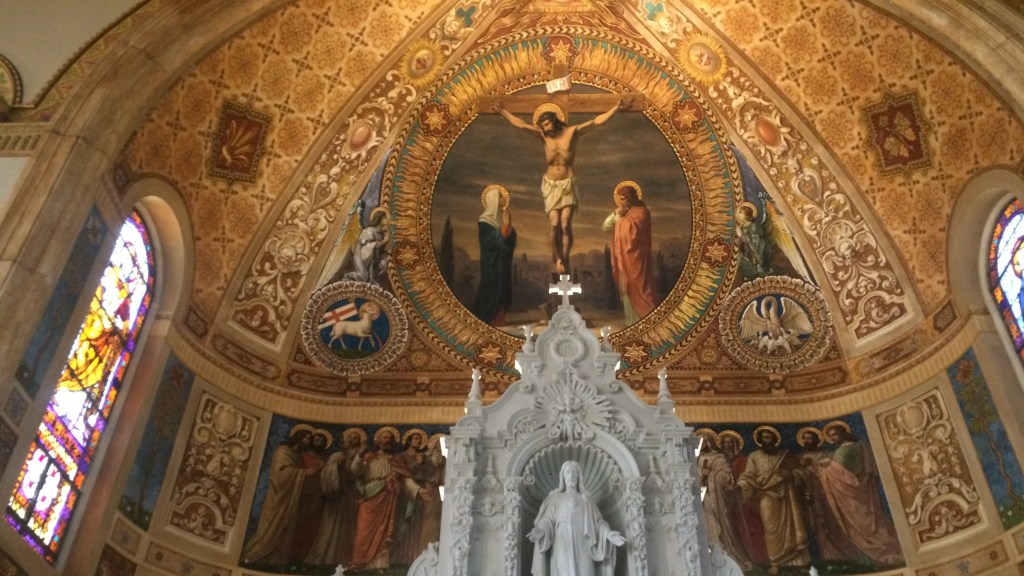
Photo of the apse, the semi-circular area behind the altar of St Edwards, Palm Beach, FL,
Link for the Mass readings for Thursday, March 26, 2020
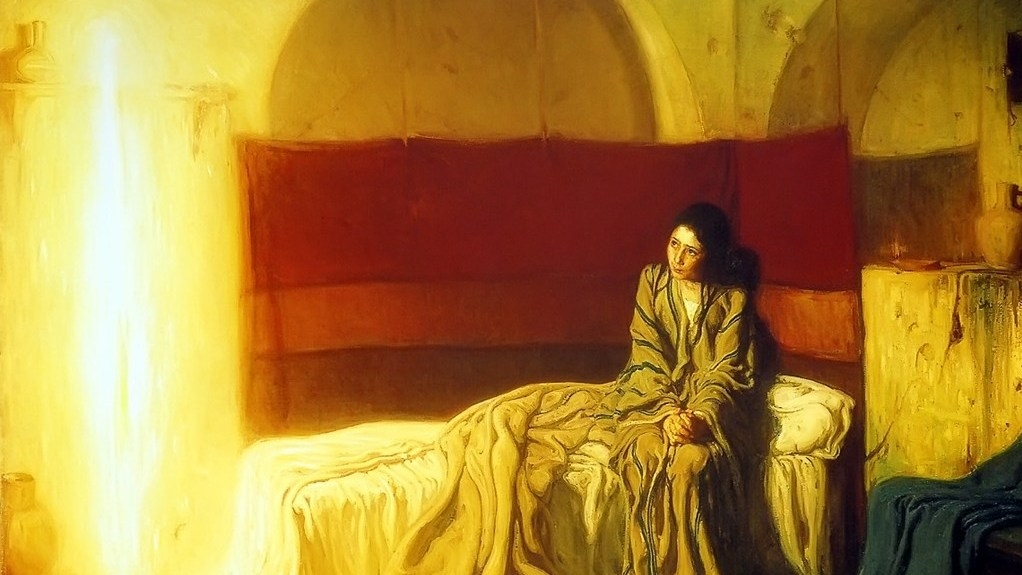
As with Mary, we too have a part to play in the drama of salvation history.
Why celebrate the Annunciation at the beginning of the third week of Lent? Simple math. If we celebrate the birth of Jesus on December 25, it is logical to celebrate his conception nine months earlier on March 25.
Gabriel, an angel, a messenger of God, a spiritual being, interacts with a human being; though Mary is not the first one to experience such an encounter. There are personal encounters with God and his messengers throughout the Bible. This is how the God of Israel, the God of Jesus Christ acts, person to person, through invitation, either directly himself or indirectly through one of his angels.
We can read such encounters going back to Genesis. God invited Abraham to be the father of a people that God would call to be his own. This reality would come to be with the birth of Isaac, while Sarah was well past child-bearing years. Jacob would wrestle all night with an angel and become the father of the twelve tribes of Israel, during the time of the Judges the mother of Sampson and Hannah, the mother of Samuel, both barren women would encounter angels bearing the message of men born unto them that would lead the people Israel in their time of need. Moses, the judges, David, and the prophets all would hear and answer God’s invitation. Zechariah had an encounter in the temple and his wife Elizabeth, also barren and older, would give birth to John the Baptist. God has communicated and reached out to his created beings in history, in time, and place.
With Mary, this announcement and encounter were different, for, at this appointed time, the Son of God himself would become, while remaining fully divine, a human being in the womb of Mary. The God who is. Period. Full stop. He is not a being, not a human, or even a supreme being. He is Infinite Act of Existence, the Sheer Act of to Be, who took on flesh and dwelt among his created beings. This is the message that Mary receives, and we can understand why she might be “troubled”. Yet Mary, the model of discipleship, pondered what this might mean as Gabriel said to her:
“Do not be afraid, Mary, for you have found favor with God” (Lk 1:30).
Mary, who knew the arch of salvation history as briefly sketched above, knew of the encounters God had with his people, her ancestors, knew of the promised coming of the Messiah, would now be the bridge between heaven and earth, the bridge between the old and the new covenant, the bridge between a people lost and a people found. Mary in her fiat, her yes, would become Theotokos, the God-bearer.
This is why we celebrate this feast each year: The Son of God has been born to us because Mary said yes. Yet, her yes is not in isolation. It is made possible by so many who had gone before her. Joachim and Anna, Mary’s parents who provided care and guidance, as well as the many named above and not named throughout the Biblical tradition who said yes to God and played a part in making this moment possible. Mary is not alone in the Annunciation, not alone in this definitive moment. This is the distinctive feature of Judaism and Christianity: We cannot save ourselves. We are not God. Our very life as created beings is a gift from God and we are in need of constant help and support from God and one another (cf. Lohfink, 254).
God invites us, not just today as we celebrate the feast day of the Annunciation, but every day. Each day is a day to ponder, to wonder, to be still, to be in awe. The Son of God, the Second Person of the Trinity, loved us so much more than we can ever imagine, more than we can ever even begin to conceive, that he became one with us so that we can become one with him. Us, you reading this, me writing this, and each unique person taking a breath on this earth.
No matter how much we have messed up, no matter how distant we feel we may be from him, no matter how confused, overwhelmed, disillusioned, he is present for and with us. The question is not whether we are worthy, for none of us are worthy, the question is, “Are we willing?”
We are invited to play our part in the ongoing drama of salvation history. Mary’s answer to this invitation was: “Behold, I am the handmaid of the Lord. May it be done to me according to your word” (Lk 1:38). This is her definitive yes. We too are called. What will our response be?
——————————————
Painting: Henry Oswana Tanner, The Annunciation, 1898
Lohfink, Gerhard. No Irrelevant Jesus: On Jesus and the Church Today. Collegeville, MN: Liturgical Press, 2014.
Link for today’s readings for Wednesday, March 25, 2020
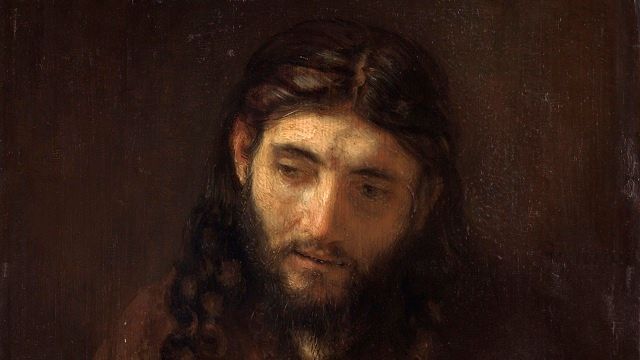
Jesus comes to us in our present situation.
Has there ever been a time when you were picked last for the team, whether on the playground, P.E., or gym class? I remember being on both sides, being picked last, and picking others to join and having to pick someone last. I much more preferred being chosen last than having to be in the situation to choose a classmate last because someone had to be in that position at some point, and it was often an agonizing situation. In our Gospel reading today, Jesus comes upon a man who has experienced an even worse situation.
This person has been in need of healing for thirty-eight years. Apparently, there was a limited time to get into the waters of the pool to experience the healing properties that it afforded, for each time the water stirred, while the man moved to get closer to and enter the water, “someone else gets down there before” him. This is worse than getting picked last, as he doesn’t in a sense even make the team!
But with Jesus, the last shall become first. Key ingredients are belief, faith, and a willingness to be healed. Jesus does not impose, even in the case of healing, Jesus invites. He asks the sick man, “Do you want to be well?” When the man in need of healing explains the limitations he has experienced in the past regarding getting to the pool, Jesus does not hesitate. Jesus commands him to rise, pick up his mat and walk. The man is no longer the one picked over, the one ignored, the one unseen. The sick man encounters Jesus and is healed by his word.
Jesus approaches us in the same way that he encountered the sick man by the pool of Bethesda in today’s Gospel. Jesus meets us in our need, where we are, no matter our station in life. He does not leave us on the outside looking in, he does not leave us wondering if we are loved, and he not only comes to encounter us but if we are willing, to empower us to be about the mission given to us by his Father. Jesus gives meaning and purpose to our lives. Each and every one of us is a gift from God and has been graced with something to contribute to others, something unique to help make the kingdom of God a reality.
I invite you to enter a place of silence and stillness, without and within. Settle into a place with no or little distractions, breathe in deep and exhale a few times, then close your eyes. See your self as you are in your present seated position, breathing, experiencing your shoulders relaxing, and just being still. Then notice Jesus walking toward you as he did with the man at the pool of Bethesda. Does Jesus remain standing, does he sit beside you, or kneel before you? As he assumes whatever posture, allow your thoughts to reflect on what you need from Jesus, or does Jesus ask you a question? What does he ask or what does he say?
Jesus is present, right here and right now, for you. There are no boundaries, no limitations, only those you impose on your self. Share with Jesus your need. You are no longer misunderstood, left out, or picked last. Jesus is present. Embrace the moment.
————————————————————————-
Painting: close up of Head of Christ by Rembrandt
Link for the Mass readings for Tuesday, March 24, 2020

“From the east comes the one whose name is Dayspring”. – Origen
We hear often in the Gospels how those who believed in Jesus received healings, exorcisms, and were forgiven of their sins. We have also read accounts such as from the Gospel of Matthew that he “did not work many mighty deeds” in Nazareth “because of their lack of faith” (Mt 13:58).
In today’s Gospel account from John, Jesus speaks to a royal official whose son is close to death. Jesus said to him, “You may go; your son will live.” The man believed what Jesus said to him and left (Jn 4:50). The man on his way home to his son is met by the slaves from his household and they told him that his son would live and when they compared notes, they realized the healing occurred at the moment Jesus spoke and the man believed.
What do faith and belief have to do with Jesus being active in our lives? The way of the Gospel, the good news, is all about invitation and acceptance. Jesus enters our world, our reality, gently and humbly. He came as a poor infant, completely dependent on Mary and Joseph for his very survival. He would live the majority of his life in the obscure village of Nazareth most likely working as a day laborer. When he begins his public ministry he does so by inviting people to be a part of his life, to enter into a relationship with him and his Father. People are free to say no or to say yes to that invitation.
Faith is trusting that what Jesus says is true, trusting that he is who he says he is. Belief is the act of our will that aligns with our faith, our trust in him. Jesus invited the man to believe that his son was healed and the man believed and walked away with full confidence that his son would be healed. Belief is followed by an affirmative act of the will. I can believe my car will run, but unless I get in it and turn the key, I am not going anywhere.
Just as the sun rose this morning, Jesus is present to each and every one of us. Just as Jesus invited Zacchaeus to come down out of the tree because he wanted to have dinner with him in his home, Jesus is offering his invitation to us to be a part of our lives. Just as Jesus invited Andrew and Peter, James and John to follow him, Jesus invites us to follow him as well.
If your schedule affords you the opportunity to wake up with the sun or early morning while the sun is still rising this week, I invite you to do so. Find a quiet place inside or outside, call to mind any struggles, confusion, sinful patterns, needs for healing, or forgiveness. As the light of the sun pierces the darkness, allow it to be an icon of Jesus’ invitation to enter into your life.
“From the east comes the one whose name is Dayspring, he who is mediator between God and men. You are invited then to look always to the east: it is there that the sun of righteousness rises for you, it is there that the light is always being born for you… So that you may always enjoy the light of knowledge, keep always in the daylight of faith, hold fast always to the light of love and peace” (Excerpt from a homily on Leviticus by Church father, Origen, 184-253).
Embrace the light of Christ who comes to you today to guide you through your struggles and confusion, to hear the deepest prayers of your heart, to offer confidence that you can believe in his power to heal you and those you love, to invite you to embrace the gift of repentance, and be forgiven. As the warmth of the sun touches your face, breath in deep the mercy and grace of Jesus, believe Jesus is the Son of the Living God and have faith, trusting that he will be with you today in all you do. When you are ready, arise to face the day and walk on with the confidence and assurance, with the faith and belief that you are loved more than you can ever imagine and more than you can ever mess up.
——————————————————————————–
Photo: Sun rising in our back yard.
Link for the Mass readings for Monday, March 23, 2020

COVID-19 – Choosing fear or an opportunity to grow in our faith?
As with last week, when the Samaritan women encounters Jesus, we again see this week an account of a transformation with the man born blind from birth. In both cases, neither are seeking the healing of Jesus, but they are open to Jesus as he encounters them in their present situations and are willing to be led by him. For the man born blind, Jesus, spat on the ground and made clay with the saliva, and smeared the clay on his eyes, and said to him, “Go wash in the Pool of Siloam” (Jn 9:6-7).
After the man followed the guidance of Jesus and washed in the pool of Siloam he was healed and his sight was restored. He then returned to his neighbors and they noticed that not only was he no longer begging but that he could see. They then asked him how this came to be and the man shared about his encounter with Jesus. Because of this miracle, they then brought him before the Pharisees.
Because this healing happened on the Sabbath and this was not the first time Jesus did so, they wanted to understand what had happened with this man and also some were hoping to gather information to make a case against Jesus. Unfortunately for them, this man would only share that Jesus healed him, confirm that he was born blind, and he would also ask if they would like to be his disciples!
This man had received the gift of sight from his encounter with Jesus and his conviction and faith in Jesus grew the more he was questioned and challenged. This is often the opposite response for many of us. Would that we could have the same healing of our spiritual blindness such that we could see the depth of our own hunger deep within for God and the needs of those around us.
With the present pandemic that we are experiencing on a world-wide scale, we can react with ever-growing anxiety and fear of the unknown or we can see with the eyes of faith and look at this as an opportunity to assess what is truly important in our lives.
We may be asked to remain in self-imposed quarantine, but that does not mean we are no longer in contact with one another. We have technological means through phone, different video applications, social media, and email, as well as time to take stock regarding opportunities we have taken for granted like going to Mass. A video Mass is not the same as being in person and receiving the Eucharist. Yet, being away from receiving the Eucharist could be just the opportunity for us to rekindle an appreciation that so many have lost. As many as 70% of Catholics do not believe in the Real Presence of the Eucharist.
Also, with a little more time for some of us and staring at death a little more closely than we usually do, we can regain a greater appreciation for each other. We can recognize how fragile our lives really are and better appreciate the gift of our humanity. This time can also be an opportunity to rekindle our relationship with God with some quiet and reflective prayer and meditation individually and with our families.
The man born blind was grateful for the gift of receiving his sight, so much so that he came to believe and worship the one who healed him. Maybe we too can come out of this present crisis more deeply committed to living as a disciple of Jesus and loving each other as he loves us through the many doctors and nurses who are putting their lives at risk to be present to those who are in need of healing from this virus.
Photo: This is a time to ask ourselves what brings us joy?
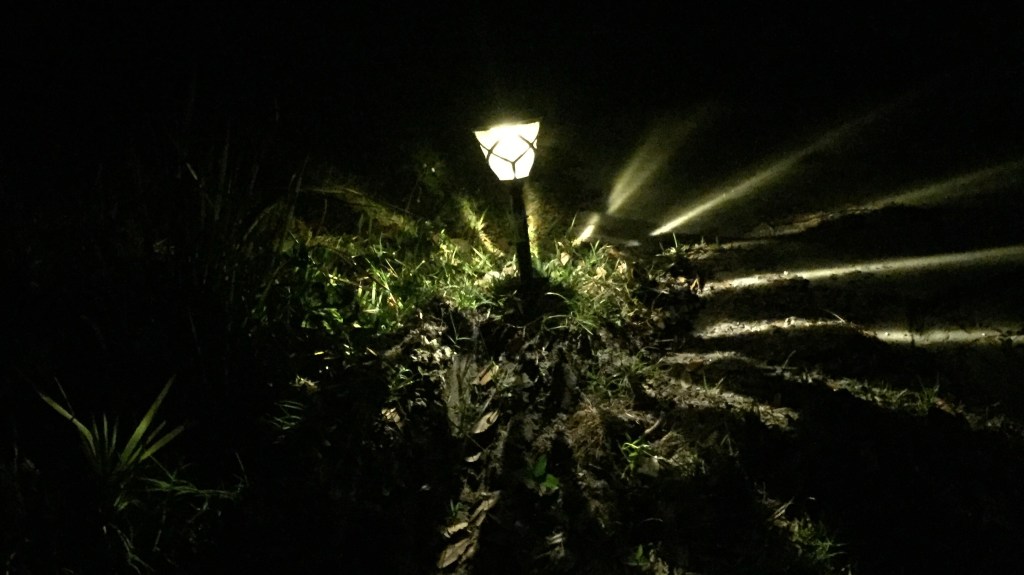
Jesus, please shine your light in our darkness.
It is much easier to find fault in others, and in some cases, the act of doing so has become entertainment in the private as well as the public sector. Gossip has a seductive allure and can be consuming. Judging others is also a way to justify and or project our own inappropriate behavior onto others. We may even place ourselves in a false sense of exalted pride. Have we ever, not just stated, but, thought or prayed something along the same lines as the Pharisee in today’s Gospel? “O God, I thank you that I am not like the rest of humanity — greedy, dishonest, adulterous — or even like this tax collector. I fast twice a week, and I pay tithes on my whole income” (Lk 18:11-12).
To pray any part of this prayer stunts the growth in our spiritual life because we are focused on ourselves instead of emptying ourselves before God. Anytime we rationalize, cover over, or deny our sinful behavior we create and support habits of selfishness. Left unchecked, we can become enslaved to them. Lent is a time for healing and transformation. To be able to heal from sinful attitudes and actions that have become habits, we first must be able to acknowledge and identify them.
Over time, reading more and more lives of the saints, I have come to understand that their recognition and their confession of their sinfulness was not just pious platitudes, but true presentations that they were growing closer in their relationship with Jesus. A simple example can help express where they are coming from.
When we drive our car while it is dark we don’t give much thought to the cleanliness of our windshield because we can see fine. Yet as the headlights from an oncoming car illuminate our windshield we can see how dirty in actuality it is. This can be evident in our spiritual life as well. The more we remain in our own darkness of denial, we feel we are fine, all is right with the world. The closer we grow in our relationship with Jesus, the more his light shines in our darkness, and he reveals to us our sin.
Jesus invites us to resist the prayer of the Pharisee who prays comparing himself to someone else, instead of acknowledging his own sinful actions and instead emphasizes that we are to follow the honest humility of the tax collector, who did “not even raise his eyes to heaven but beat his breast and prayed, ‘O God, be merciful to me a sinner’” (Lk 18:13). Now, Jesus is not saying this is the only way we pray. We have the opportunity to worship and praise the Lord joyfully, we can seek his help in praying for others through intercessory prayer or for ourselves in petitionary prayer, we can also sit in quiet meditation during adoration or out among God’s wonder of creation. Each prayer has its time and place and each type of experience of prayer helps us to grow and deepen our relationship with Jesus and each other.
True humility is brought about by being willing to see who we are from God’s eyes. If we are to set a standard to live up to and if we are to compare ourselves to anyone, let it be Jesus. A daily examination of conscience is a healthy practice and discipline. We just need to be willing to invite Jesus to shine his light of love into the darkness of our fear and anxiety. When we do so, we embrace our vulnerability by taking the risk to confess our sin and to experience the sorrow for the hurt we have caused. With a willingness to seek atonement for our sin, to seek God’s forgiveness, we will receive his love, mercy, and forgiveness that we have separated ourselves from when we justified and rationalized our sin.
One prayer I have found helpful over the last few years is the Jesus Prayer. It is very simple. Sit in a comfortable space, take a few deep breaths and exhalations, then as you take the next breath in recite, “Lord Jesus Christ, Son of the living God,” and then as you breathe out say, “Have mercy on me a sinner.” You are breathing in the light of Christ and you are breathing out the darkness of your sin. I use my rosary and pray an Our Father for each isolated bead and then the Jesus Prayer on each of the beads of each decade.
Traditional prayer ropes exist from the Eastern Orthodox tradition. They are made of wool, usually black, and have ten decades of ten beads. The bottom can also have a fringe representing the mercy of God wiping away our tears of sorrow. If you have neither a rosary or a prayer rope, you have your fingers. Start with a set of ten Jesus Prayer recitations each day so to embrace the light of Jesus that he may dispel the darkness of your sin, then confess it, and be forgiven.
—————————————————————————————
Photo: A light I came across while walking last night.
Link for the Mass readings for Saturday, March 21, 2020
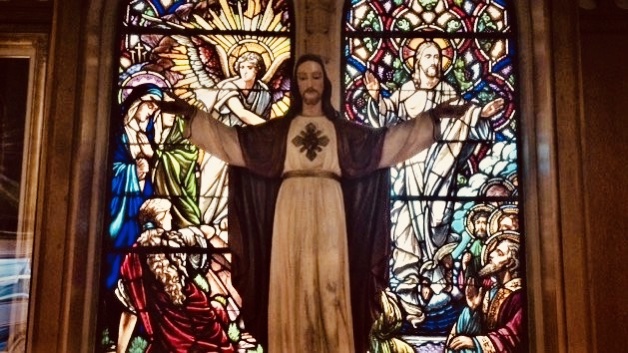
Jesus’ arms are wide open. How about ours?
Jesus recognized that the scribe, who asked him about which commandment was the greatest, “answered with understanding,” and then he said to him, “You are not far from the Kingdom of God” (Mk 12:34). What is it that the scribe understood?
The scribe understood that God “is One and that there is no other”. God is the true source of our being, our very existence. We have been created with an innate desire to be one with him. This is the longing we all feel in the depths of our soul, this is why nothing that is finite or material will ever fully satisfy us, why we are always wanting more. This is as true for the mystic as it is for the atheist and everyone in between.
God is “One and no other” also means that we are not God, we are his created beings. God is not just one being among many, not even the supreme being. This orientation is important for we can only see from our limited perspective. What we think or believe we might need, may in fact not be truly good or beneficial for us, the shimmer may be an apparent good, a distraction, a temptation, that will lead us away from the authentic fulfillment and meaning of life that we seek. God will guide us away from any unhealthy want, he will lead us away from temptation when we are willing to seek his guidance over and above our own. God will give us what we truly need, he will lead us to that which is, in reality, true, good, and beautiful.,
Once we come to believe that God is God and we are his created beings, then we can take the next step and surrender: “to love him with all [our] heart, with all [our] understanding, with all [our] strength”. In our surrender to God and his will, we become capable of receiving his love and so are able to love him in return. We all long to be loved and to love. Experiencing the love of God helps us to unconditionally love “our neighbor as our self” because through our surrender to his will we allow God to love others through us.
God invites us to open our minds and hearts to receive his love, to love him in return, and to love others as he has loved us. To love God then is like any other relationship, we need to spend quality time with God in stillness, be present One on one, as well as in our everyday activities. We are to resist compartmentalizing God and instead seek his presence in everything we do. The sacrifice he seeks is that we are willing to allow him to love others through us, especially those for whom we do not have a warm and fuzzy feeling, as this is not the unconditional love God loves with. We are to will the good of the other as they are.
Each of us is prone to sin, is wounded, and is broken. God loves us as we are, and when we are willing, he forgives our sins, he heals our wounds, and he transforms us. We need to stop running away from him and start running to him. The quickest way we can do this is to love our neighbor as our self. Going out of ourselves and giving to another, breaks down the walls of separation we build up around ourselves because of our fears.
Jesus’ arms are wide open before us in our neighbor. May we surrender all our heart, soul, mind, and strength into his loving embrace, to receive his love and love him in return, and to embrace loving our neighbor and our self in the same way. When we get this commandment, loving God, our neighbor and ourselves right, the other commandments will fall into their proper place. As we do so we too will hear Jesus say to us, “You are not far from the kingdom of God.”
—————————————————————————-
Photo: Side altar of St Augustine Parish, Culver City, CA, taken last week.
Link for the Mass readings for Friday, March 20, 2020
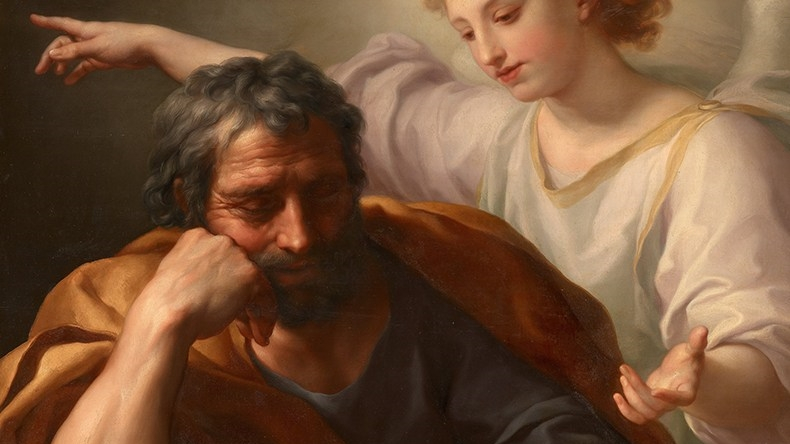
As with Joseph, God speaks to us in our dreams too.
Who do we want to be? It is so easy to get caught up in being busy, taking care of children, the home, school assignments, work, as well as a myriad of other activities that each of us, experiencing our unique vocation in life, can add to the list. These can all be good things, but we can lose ourselves in our busyness and responsibilities such that we slip into a state of survival mode or merely existing. We can fall into the trap of being defined by what we do instead of who we are and who God is calling us to be.
God has a plan for us with the end result being eternal communion with his Father in heaven. Living a life of holiness and becoming saints is our call. We need to remind ourselves of this from time to time, by assessing where we are now and listening to the guidance of God.
Our Gospel account from Matthew today gives us an opportunity to see this holiness in action. Joseph has become aware that Mary, his betrothed, is with child and he is not the Father. Joseph, “a righteous man” follows the law, but is “unwilling to expose her to shame, decided to divorce her quietly” (Mt 1:19). Joseph’s life of righteousness pulls him to follow the law, yet he shows that discernment in matters of the dignity of the person is just as important. Joseph not only was unwilling to make Mary into a public spectacle but was also unwilling to allow the possibility of her to be stoned to death.
Joseph pondered the idea of divorcing her quietly. Before he made his final decision, Joseph slept on the matter, which is often a good course of action when weighing such a heavy issue. How many times do we rush into decisions only to regret them later? Joseph receives God’s direction through the angel of the Lord in a dream.
When Joseph arises in the morning, he does not dig in his heels feeling he knows best and return to his original decision, he does not let fear or anxiety about the possible scenarios that could play out in his mind regarding what others may say or think sway him, nor do the possible and real difficulties he can envision deter him. Joseph trusts God. With confidence and assurance of who he is and what God calls him to do, Joseph acts on the guidance he has received.
St. Joseph is a model for us. When faced with decisions to make, we need to remember who we are, whose we are, and who we are called to be. We are children of God, and that means we belong to God, a God who loves and cares for us. He has a plan for each of our lives. Every decision and action is a step in fulfilling that plan.
When we are discerning, no matter how large or small the decision, we are invited to gather information, look at the reasonable options available to us, all the while, continuing to seek God’s guidance. God will guide us through many means and ways such as a thought, a family member or friend sharing an insight at an opportune time, as well as through our dreams. Joseph followed these steps and God granted him not only the guidance he sought but the support to fulfill the commission he received. We can be assured that God will do the same as we seek his direction too.
St. Joseph, pray for us!
——————————————————————–
Painting: “The Dream of St Joseph” by Anton Raphael Mengs about 1774
Link for the Mass readings for Thursday, March 19, 2020
 Spiritual Stepping Stones