Surrender all to the will of God.
Power and honor are attractive temptations. Power is alluring because we want to be in control. Many of us believe that control provides security and safety. Many of us believe that power provides access and control over our environment and situations as they arise. Honor has an attraction also because we want to belong, we want to be a part of. With honor and fame, we believe we will be accepted, liked, have access, without the risk of rejection.
Power and honor become a problem when they are grounded in our self and when we feel we attain them on our own initiative. They become an asset if we recognize them as gifts from God that help us to promote his kingdom. In and of themselves, power and honor are finite expressions. If they are only fueled by our insatiable desire to put our self first, front and center, we will not only constantly fall short, but we will constantly be seeking more because nothing finite can fulfill the transcendental hunger that we have to belong to someone so much greater than ourselves.
The disciples of Jesus fell for the temptations of power and honor in today’s Gospel from Mark. Jesus had just shared with them that he was to be handed over and killed and that he will rise again. The disciples do not understand what Jesus was saying to them and instead grasped at their idea of what the Messiah meant to them based on their experience and culture. He would be a powerful ruler, and so they began to jockey among themselves for seats of honor in his kingdom.
Jesus was aware that the disciples were squabbling about who among them would be the greatest, even though they were not willing to admit to that fact. He then sat down among them and said: “If anyone wishes to be first, he shall be the last of all and the servant of all” (Mk 9:35). Power and honor do not come by being served. True power and honor come from the source of all existence, God the Creator. Nor is the infinite power of God some impersonal force that we tap into.
True power is trusting not in the material and finite things of the world because they are unstable. True power comes from God, the one who is omnipotent, all-powerful, and worthy of all honor and praise. We receive the power of God by experiencing, developing, and sustaining our relationship with him, through participation in the life of his Son and the Love of the Holy Spirit. The path of discipleship is traveled not by those who are worthy but by those willing to follow the lead of Jesus, submitting to his will, embracing the gifts that the Holy Spirit grants us, and sharing what we have received with others.
Lent begins tomorrow. May we be willing to relinquish our perceived access of control in a fallen world that is ever unstable and changing and instead place our hope and trust in the one who is our destiny, who is our hope, our refuge, and our strength. Let us let go of the desire to be liked and adored by the fickleness of others and instead strive to be true to who we are called to be. May others see no longer us but Jesus shining through us in our acts of service, kindness, accompaniment, and love.
——————————————————————————————-
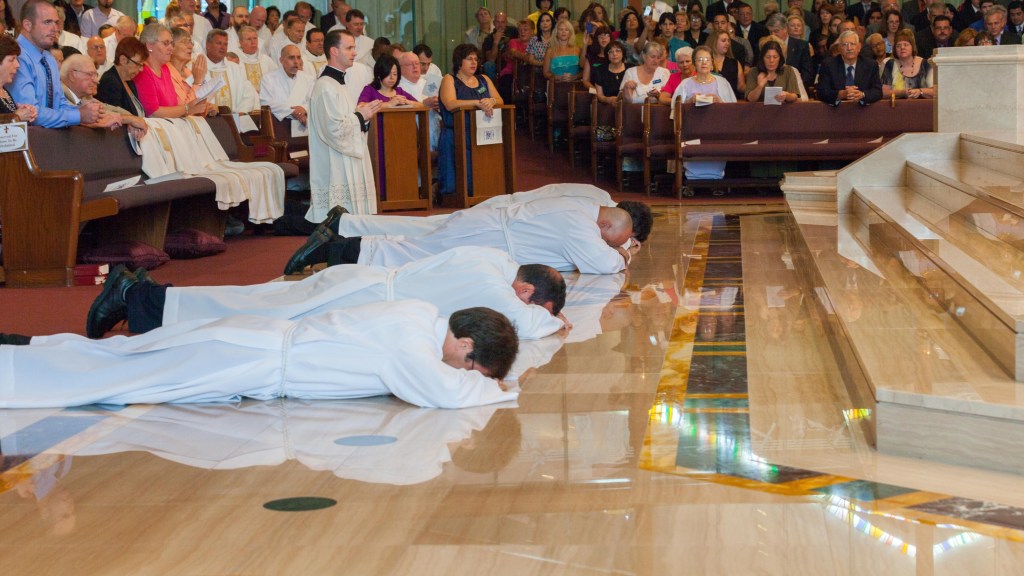
My classmates and I prostrating ourselves during our ordination, as a sign of our dying to self so to rise as servants of Christ. Photo credit Deacon Mike Miller
Link for the Mass readings for Tuesday, February 25, 2020

Jesus, I believe, help my unbelief.
In the opening of today’s Gospel, we witness Jesus, Peter, James, and John returning from the experience of the transfiguration. As they draw closer they witness a commotion, for while they were away, a man had brought his son to the other disciples to expel a demon from him but they could not. As they draw closer, the father appeals to Jesus: “But if you can do anything, have compassion on us and help us.” Jesus said to him, “‘If you can!’ Everything is possible to one who has faith.” Then the boy’s father cried out, “I do believe, help my unbelief” (Mk 9:22-24).
Jesus’ response to the man is clear and consistent with his teaching, miracles, exorcisms, and healings. We see that the key ingredient over and over again throughout the Gospels is an appeal to Jesus’ help and the person’s faith. What may be unclear is the man’s response, “I do believe, help my unbelief!” This statement not only addresses his experience but those of his disciples who were not able to heal the boy.
The man did have faith in Jesus to a point, for he brought his son to him believing that he could possibly heal him. His words reveal the maturity of his faith, “But if you can do anything…” This request shows some doubt. This is much different than the woman with the hemorrhage who believed if she but just touched the tassel on his cloak she would be healed or the Canaanite woman who sought to have her daughter exorcised even though Jesus initially dismissed her for being a Gentile.
The father’s statement, “I do believe, help my unbelief!”, is beneficial to us all. The father believes in Jesus to a point, but recognizes he needs help to go further in his faith. Jesus confirms that what is important in maturing in our faith life is being people of prayer. When his disciples talked to him in private, they asked him why they were not able to heal the boy and Jesus replied, “This kind can only come out through prayer.”
Prayer is not a magic formula. Prayer is about becoming aware of God’s invitation to develop and sustain a relationship with him. When we make time for God in our day and recognize his presence in every aspect of our life, we come to know him and know his will in each situation. The exorcism of the young boy happened because the father of the boy appealed to Jesus that he needed his help to believe. The disciples could not heal because they sought to do so through their own will power alone instead of drawing on the infinite source of Jesus.
The good news is that even though time and again they fell short, and we see plenty of examples of this, they persisted in their faith, in their belief in Jesus. They grew in their trust in him such that the disciples did mature in their relationship, and they recognized that apart from Jesus they could do nothing,
So much so, that we see Peter, who had denied Jesus, and reconciled with him after his resurrection, would come to encounter a man crippled from birth who was begging for alms. Peter said to the man: “I have neither silver nor gold, but what I do have I give to you: in the Name of Jesus Christ the Nazorean, [rise and] walk” (Acts 3:6).
Peter’s faith grew over time, through failure, sin, and unbelief, but he, like the father in today’s Gospel, gives us the model to follow each and every day. We can mature in our faith as well. Let us begin our day with this prayer and return to if often: Jesus “I do believe, help my unbelief.”
———————————-
Link for the Mass readings for Monday, February 24, 2020
Resist contempt, choose contrition, gratitude, and love!
The Word of God proclaimed is a living word. God has given his Word for all people and for all times with the purpose to shape and form us to be a people uniquely his own (cf. Deut 26:18). As we heard proclaimed in our first reading from Leviticus, we are to be holy as the Lord our God is holy (cf. Lv 19:1-2).
To be holy means we are to be set apart. There ought to be something different about us. As we read a few weeks ago, we are to be salt and light. The intent of our thoughts, words, and actions are not to be divisive but unitive, not to be a source of darkness but illumination, and not to be dehumanizing but empowering. Many times after someone speaks or acts in a negative way I hear someone make a comment along the lines of, he or she is just being human. Meaning we are fallible, that we are not perfect.
This is only partially true. We are finite, imperfect beings yes, but when we act in ways that are self-servicing and hurtful, we are not acting humanely. These words and actions are a reflection of our fallen and distorted humanity. The reality is that we are wounded by sin, but the good news is that we are not destroyed by it. We are more than our fallen nature, we do not have to stay stuck in it, and for God’s sake, may we resist the temptation to condone it as acceptable and normal!
All of us are in need of healing, and this begins when we diagnose our sickness. It is not normal to merely exist, to go through the motions, to accept a minimalist approach, to be anxious and stressed moment by moment, and to consistently assume a reactive and defensive posture.
God calls us to be so much more. As St Irenaeus has written, “The joy of God is the human being fully alive.” God didn’t create us just to survive, he created us to thrive!
How do we work to be fully alive, to thrive, to be holy? We love.
Love is not merely emotional, romantic, or a feeling, but an act of the will. As St Thomas Aquinas taught, “To love, is to will the good of the other as other.”
This is how Jesus can say, “offer no resistance to one who is evil” and to “love your enemies and pray for those who persecute you.” We make someone an enemy when we refuse to see them as human and fail to love them as brothers and sisters. We make a person other when we dehumanize them and when we have contempt for them.
These words, even the words of the Gospel, mean nothing if they have no relevance to us and if they do not change our hearts from hearts of stone to hearts of flesh.
This morning I would like to focus on the word contempt. Contempt is a form of dehumanization. It is expressed when we think or show impatience, disinterest, irrelevance, in what someone has said or at its worst, when we consider another person worthless and beneath us. A vivid manifestation of contempt is when someone rolls their eyes.
This subtle gesture is devastating to one who receives it. If you have any extended experience with children or teenagers, you have been on the receiving end of this. But we cannot help our children or anyone else to heal from this destructive habit of contempt until we acknowledge our practice of it and heal it from within ourselves.
I am only in the beginning stages of doing so. I had heard of the word before but really had not given it much thought, nor did I believe I engaged in it. But there were times over the years in which my wife, JoAnn, expressed her hurt because of having been on the receiving end of what I now understand was my contempt, for those times I had rolled my eyes when she was sharing something important.
The most recent example was when JoAnn was packing up to head to California last May. For those of you who do not know, after receiving her diagnosis of pancreatic cancer we spent our remaining time together closer to our three adult children. In planning to pack, JoAnn asked me on a couple of occasions what clothes of hers that I liked. I shared whatever she felt she was most comfortable in. She also asked me to bring along a few clothes I wore that she liked. At the time, I didn’t get the point of her request. I was thinking of a hundred other issues and didn’t find what clothes we would be wearing all that important.
JoAnn went to California two weeks ahead of me as I finished out the end of the school year. When I arrived and unpacked, she noticed that I did not bring my pair of black jeans that she liked. The look on her face cut me to the heart.
After JoAnn died in September and I was going through her clothes, I recalled our conversation about them and realized the relevance and importance of the clothes. Since her time was limited we could wear that which we liked best on each other. I was crushed that I did not make that connection sooner, and it was then that I began to understand the posture of contempt.
Fortunately, our final three months together, God granted me the grace of being present and free of contempt. I accompanied JoAnn 24/7 each step of the way. I asked God why I could not have come to this realization sooner in our marriage than JoAnn and my last three months together, and I realized that it was my own stubbornness, my hardness of heart.
In confession, a few weeks after her death, the sorrow in recognition for the pain I caused, the tears that poured down my face, and the words of the priest assuring me that JoAnn from her new perspective could now understand helped me to begin to realize I was forgiven by her and by God.
I have been blessed in that for twenty-three years God acted through JoAnn in her life, dying, and in her death to consistently teach me how to love and for that I am grateful. The antidotes to contempt are contrition, to be truly sorry for the hurt we have caused and if possible, share that we are sorry; gratitude, not taking for granted but feeling and expressing our thankfulness for those God has placed in our lives, and love. When we love one another, heaven and earth are united, because the Holy Spirit, is present in our midst.
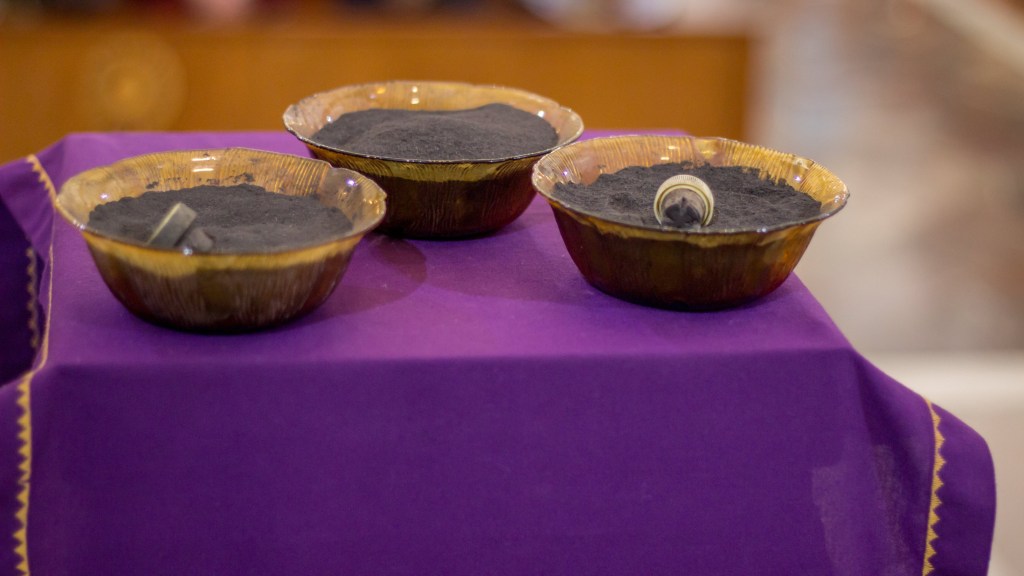
In three days, we will celebrate Ash Wednesday. May we use this time before receiving our ashes to examine our consciences and acknowledge where we have participated in the habit of contempt and for whom we have expressed contempt for in our thoughts, words, and actions.
Tolerance and civility will not change the polarization and division in our social, political, and spiritual spheres. During the forty days of Lent, if we can unlearn the habit of contempt and choose to be more contrite, thankful, and loving, we might begin to make a difference in our realm of influence.
We are to be holy as God is holy and that means we are to see each other as human again. We can, with the help of Jesus, become a part of the healing that is so needed in our communities, country, and world. Let us love one another as God has loved us.
God bless you.
————————
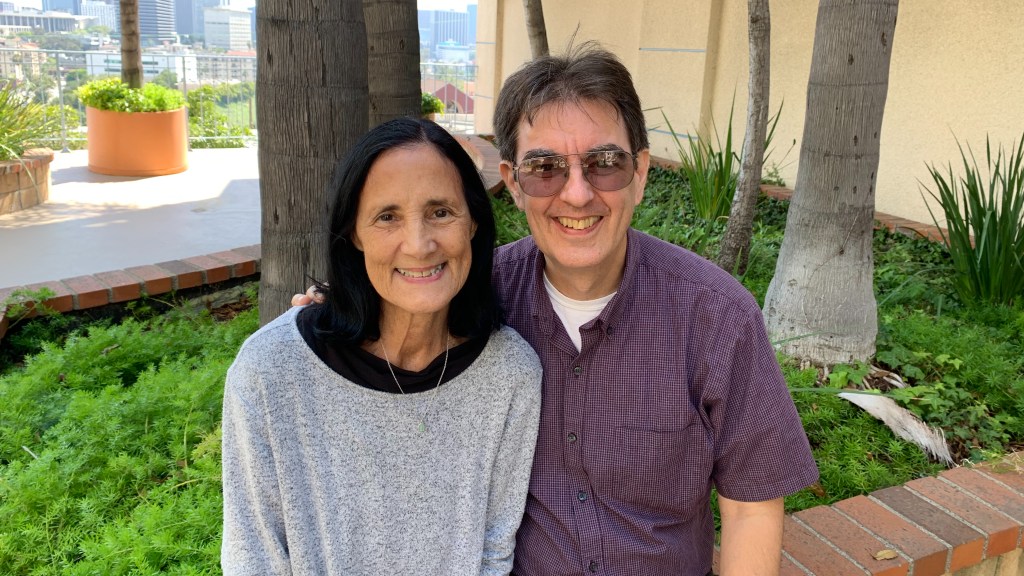
Picture: JoAnn and I together in the meditation garden outside our apartment in Los Angeles last June. Photo credit: Giovanna Christian
Link for the Mass readings for Sunday, February 23, 2020

Jesus, Son of God, help us to stop the madness.
Jesus asked, “Who do people say that the Son of Man is” (Mt. 16:13)?
Peter answers Jesus by saying that Jesus is: “The Messiah, the Son of the Living God” (Mt: 16:16). In other words, Jesus is Emmanuel, God with us.
When we dig a little deeper, another question that might overshadow the question of who Jesus is, especially since on the 14th of February we remembered the second anniversary of the deaths in Florida of the fourteen youth who died at Marjory Stoneman Douglas HS. Since that time a low estimate of about 2,641 and a high can be 4,500 to 5,000 more youth have died from gun violence. The presidents of all the worldwide bishops conferences gathered in Rome a year ago this month for a four-day summit with Pope Francis in Rome to address the abuse of children by clergy. Children continue to be separated from their families after the president signed his executive order in the summer of 2018, up to 1,100 that the government has admitted to. Governor Cuomo of New York about this time last year signed a law updating their 1970 law allowing a woman the right to carry her child to term or abort the life of her child at any stage of the pregnancy.
What does Peter’s response have to do with the above examples of the stripping of the dignity of the children of God? Jesus is the Christ the Son of the living God. This means Jesus is one with us. The infinite reality of God is present within each human being that exists because Jesus became one with us so that we can be one with him. We have been created in God’s image and likeness and this is true from the moment of our conception through each stage of life until natural death. The unfortunate effects of Orignal sin are that our image has been distorted and our likeness to God has been lost. The fact that intelligent people can justify and rationalize the death of children is the worst case in point.
This means that Jesus has experienced personally the death of the fourteen youth who died at Marjory Stoneman Douglas two years ago, and each of those counted and uncounted youths who have died since that day as a result of gun violence. Jesus experienced the untold number of children who have and continue to be abused and molested. Jesus has and continues to suffer with those children who have continued to flee from violence only to be separated from their parents and detained in inhumane conditions at our US border. Jesus experiences the death of each and every life in the hundreds of thousands that are aborted each year, in our country alone. How does Jesus the Christ, the Son of God, experience these horrific tragedies? For what you do to the least of these, my brothers and sisters, you did it to me (cf. Mt 25:31-46).
A culture of death will continue as long as we refuse to see the dignity present in each and every life we encounter. Human beings are not: illegal, to be objectified, property to be used, to be abused, or to be disposed of. As we pray and work to bring about a culture that supports life we also must remember that pain, injustice, suffering, and death do not have the last word. Jesus suffered and died and conquered death.
We need to place our trust in Jesus Christ, the Son of the living God, and turn to him in prayer, with our anger, our doubt, our pain, and our yearning for justice, mercy, and protection for the most vulnerable among us. Our prayer, if it is true, will lead us to act in the way God leads us to support a culture of life at every stage. We need to respect, be present to, and support those in our realm of influence and while we strive for change, may we find some comfort in the words of Fr. James Martin, S.J.: “Life is stronger than death. Love stronger than hatred. Hope is stronger than despair. Nothing is impossible with God.”
—————————————————————————–
Photo: photo of a Honduran girl accessed from advocatespost.org
The final quote came from a talk given by Fr. James Martin, S.J. given on April 22, 2014, titled On Pilgrimage with James Martin, SJ, Fordham University.
Link for Mass readings for Saturday, February 22, 2020

Are we willing to deny ourselves, take up our cross and follow Jesus?
Jesus summoned the crowd with his disciples and said to them, “Whoever wishes to come after me must deny himself, take up his cross, and follow me” (Mk 8:34).
Our life is not about us, about what we can accumulate. It is not about achieving power, fame, wealth, and pursuing pleasure. Nor are we here on this earth to merely exist, to just get by, and live in survival mode. We exist to be loved by God and to love others as we have been loved.
The challenge is are we willing to truly deny ourselves, take up the cross of Jesus, and follow him? Are we willing to change the question and process of discernment from asking what we want to do to ask, “God, what do you want me to do?” How and in what way does he want us to serve and participate in his plan?
As we draw closer to the season of Lent which is less than a week away, Jesus’ invitation and these questions are good to ponder.
Picture: Leaving Cardinal Newman Wednesday night, after staying late to pray for the Middle School finals basketball game we hosted in our gym.
Link for the Mass readings for Friday, February 21, 2020
St Peter helps us to see that we can learn from our mistakes and sins.
“Get behind me, Satan. You are thinking not as God does, but as human beings do” (Mk 8:33).
Peter received this rebuke from Jesus only moments after he recognized Jesus as the Christ. Acknowledging Jesus as the Anointed One was a significant insight inspired by God, but Peter still saw Jesus from his limited perspective, his preconceived notion of who the Messiah was to be. Peter was not alone in this presumption. For some five hundred years the chosen people were awaiting the promise and coming of the Messiah. The greater majority sought a Messiah in the mold of a new King David. One who politically and militarily would liberate the people from their Roman oppression.
The Messiah would set things right. The Messiah would restore proper order politically as well as spiritually. Many of the Jews were not happy with the alliance that the Sadducees, who held control over the Temple, had with Rome.
Peter got the first part right when he answered the question Jesus asked, “Who do people say that I am” (Mk 8:27), but he saw not the suffering servant of Isaiah 53 but most likely some other view of the Messianic hope of Israel. When Jesus began to build on Peter’s first insight by sharing how he would suffer, be rejected, and killed, Peter probably did not even hear anything about Jesus rising on the third day. He pulled Jesus aside and began to rebuke him!
We can learn from Peter’s boldness and misstep. In both instances, Peter confidently shared what he believed. In the first insight, that Jesus is the Christ, he was on target. In the second, he was off the mark by not understanding the reality of Jesus’ impending suffering and death and was corrected. Peter stated what he believed, sometimes insightful, sometimes shortsighted, yet through each experience, he learned. Sometimes they were hard lessons, such as when he rejected Jesus three times. Yet Peter kept coming back to Jesus. Peter was not lukewarm and/or indecisive.
Too many times I tend to be more cautious and often indecisive. Being reflective is good, but I could use more of Peter’s boldness. What doesn’t work is being afraid of making mistakes. Jesus shared a key lesson with Peter that we need to fully appreciate, and that is, we need to understand things from God’s perspective instead of our own. Our discernment in this area will only improve, as did Peter’s when we build our relationship with God.
Making mistakes, sinning, and being tripped by our temptations is not so much the problem as much as trying to rationalize or justify them, and staying in a state of self-justification when we become aware of them. We need to face them with contrition, seek forgiveness, and learn from them if we are to mature in our relationship with God and no longer be enslaved by our weaknesses. The good news is that we are not alone. Jesus walks with us each step of the way. Will he convict us and rebuke us as he did with Peter? Absolutely, because he loves us and seeks the best for us, but he will also provide the support and empowerment we need to get the most effective balance of boldness and humility.
——————————————————————-
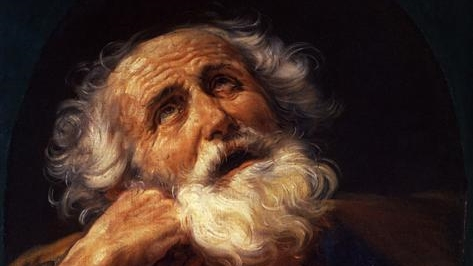
Painting: St Peter – Guido Reni, 1634
Link for the Mass readings for Thursday, February 20, 2020
Jesus heals us and guides us by meeting us on our level and urging us onward.
In today’s Gospel from Mark, Jesus healed a blind man. Like the healing of the deaf man (cf. Mk 7:31-37), Jesus again used his own saliva in the healing process showing the intimacy and closeness of each encounter. The difference this time is that this man does not receive a full and complete healing the first time. Jesus laid hands on the man’s eyes a second time and he saw clearly; his sight was restored and he could see everything distinctly (Mk 8:25).
Often with Jesus, there are instant healings, as well as healing without touch. What might be happening here? Maybe it is because Jesus meets each person where they are at. He invites us into the process of healing and each person has a different response, even to the point of saying no to the invitation to heal. Remember how Jesus was only able to heal a few people while in his own home town of Nazareth?
We need to read the two miraculous healings of the deaf and blind men deeper than the literal physical healings. Each of us suffers from both spiritual deafness and blindness to some degree. We come to hear and see God’s will for us gradually. As I shared a few days ago if we knew God’s intention for us early on, we might be crushed with the weight of our own doubt! If someone had told me when I was in high school that I would be a teacher or that I would preach to a whole church assembly in English and in Spanish, I would have quietly retreated to a stand of white birch across from the old oak tree in the field behind my parent’s house until that idea passed.
Yet, Jesus met me on my level. Sometime around my junior of high school, he invited me through an interim pastor to teach Sunday school to a class of three. About a year later I gave a children’s sermon to the youth and the small congregation. The summer after my freshman year of college, I began to work second shift as a certified nurse’s aide and during my sophomore year of college, after following the urge to take a search in education course, I switched my major from psychology to elementary education. After graduation, my first teaching position was not in the four walls of a classroom, but six hundred eighty acres at the Sharon Audubon Center as an environmental education specialist.
I began to interact with people, Jesus drew me out of my own self-centered posture, and I began to grow and mature. I would eventually enter the classroom when we moved to Florida in 1997 to teach, first in public school for five years and then through JoAnn’s guidance, I applied for a substitute position at Rosarian Academy in WPB, where I would spend the next eight years teaching middle school religion.
Each of these experiences of saying yes to Jesus was my willingness to be healed and lead gently. Certainly, with the loss of JoAnn, my foundation has been shaken, but I trust that Jesus will continue to lead me as he has consistently done. I trust that he will do the same for each of you. We just need to have our eyes and ears open for his healing touch. He is not done with either of us yet!
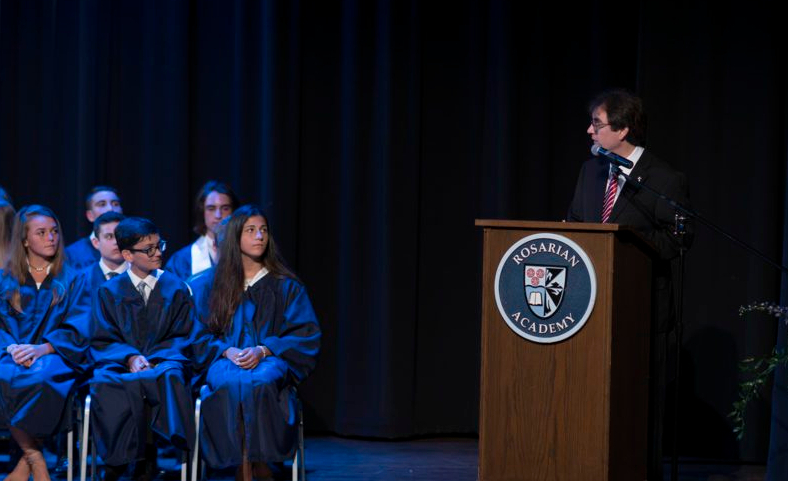
Photo: Returning to Rosarian Academy to share the commencement address a few years ago.
Link for the Mass readings for Wednesday, February 19, 2020

Jesus teaches us to be on guard for the leaven of the Pharisees.
Today’s account from the Gospel of Mark is a continuation of what we read Saturday when Jesus convicted the Pharisees for demanding a sign. He recognized their hardness of heart and hypocrisy and with the opportunity of being together in the boat, Jesus seized on this encounter as a teachable moment. He wanted to warn those of his inner circle to be aware not to follow the same path of corruption when he enjoined them: “Watch out, guard against the leaven of the Pharisees and the leaven of Herod” (Mk 8:15).
The disciples missed the point as they focused on the literal reality that they only had one loaf of bread among them. Jesus was warning his followers about the danger of pride, seeking honor, power, and fame which had lead the Pharisees and Herod astray. To be his followers, striving to place themselves first would be not only the undoing of each of them but also this posture would undermine those they would be charged to care for.
Unfortunately, too many have not heeded this lesson that Jesus offered in today’s Gospel to his disciples regarding being aware of the corrupting leaven of the Pharisees and Herod. Just as the effects of original sin has wounded humanity, so it has also affected those in the Church. Throughout the ages clergy as well as laity have succumbed to the temptations of placing our needs and focus on ourselves instead of God and who he calls us to serve.
Yet throughout the worst of corruption and abuse, the Church is still here. God continues to work through many who are faithful to his invitation and follow his will in simple ways, living lives of quiet service. It is unfortunate that there are those who leave because they see hypocrisy, injustice, abuse, and corruption. For it is those of us with eyes to see and ears to hear that need to stay and help to fight for the true expression of the Church. Even when cries for reform may be stifled and frustrations may arise time and again, we must remain persistent and lean on Jesus to give us the strength and clarity on how best to proceed to heal his wounded body.
At the same time, we need to be aware of the sinful leaven that would seek to undo each of us. It is easy to point fingers. We will be on surer footing when we choose God over our own self-serving pursuits, seek to live simple and holy lives, while seeking to be aware of the needs of others, and work to serve, protect, and empower the dignity of those in our midst each day.
——————————————————
Photo: Sunset at Our Lady of Florida Retreat Center, on retreat with our students last week.
Link for the Mass readings for Tuesday, February 18, 2020
 Spiritual Stepping Stones