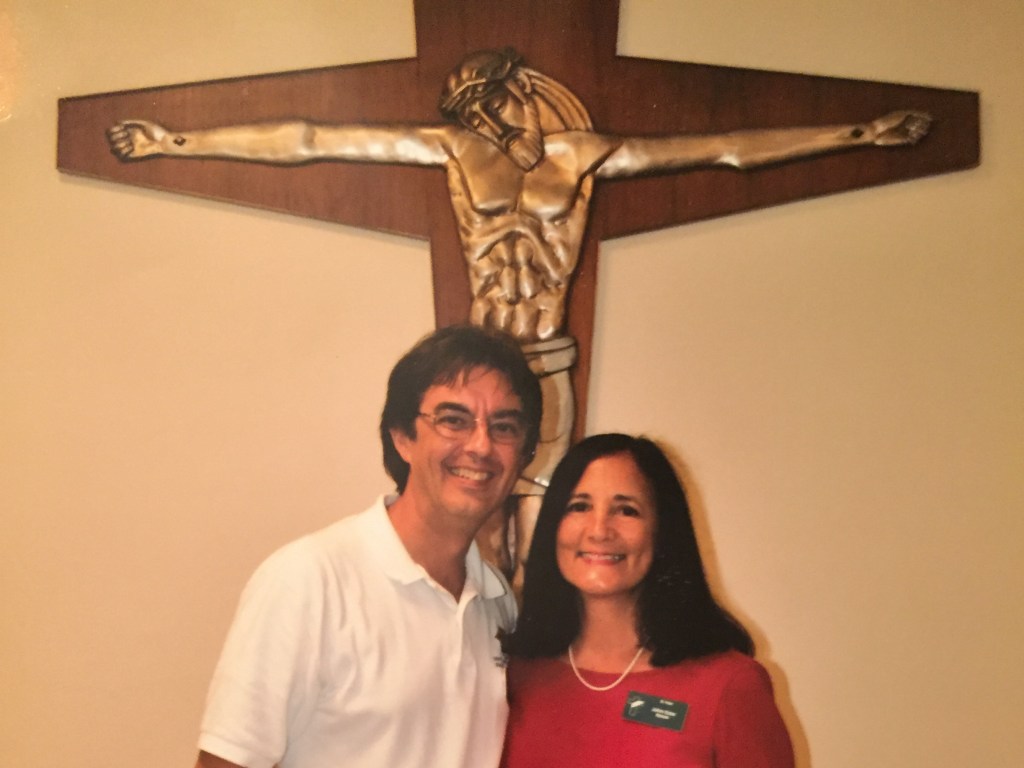
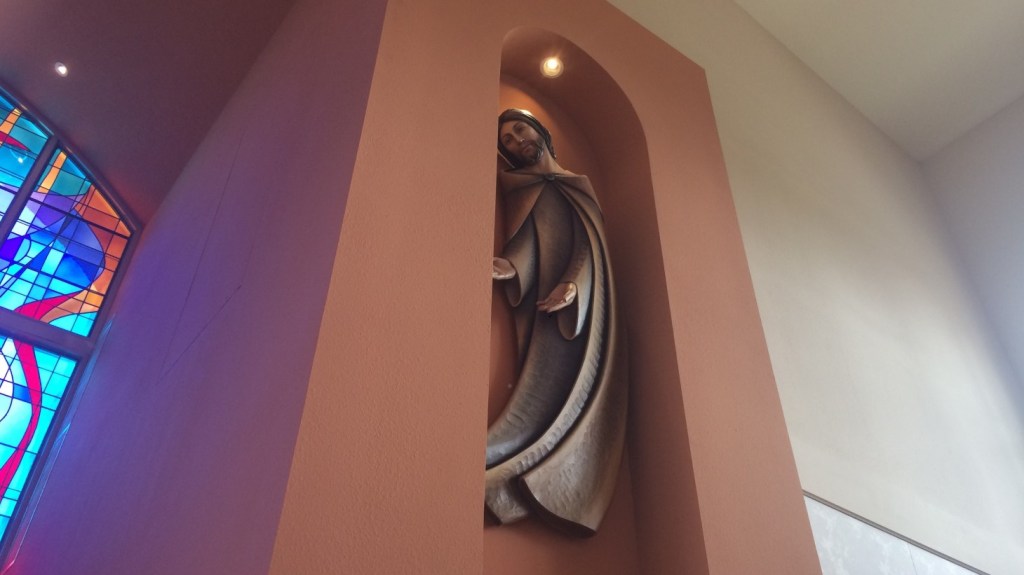
Jesus invites us to serve with him. Are we willing?
As Christians we are called to be disciples of Jesus, to learn his teachings, and follow his ways. We are also called to be apostles in that we are to go out, proclaim and share that he is who he said he is, and how he has affected our lives. Often when we are reminded of this message though, we may feel inadequate. We may question what it is that we can even possibly offer in an effort to help build the kingdom of God. We may feel we have nothing to share, nothing to give, nothing to say, or that what the Lord asks of us, we do not know how to accomplish.
The disciples express similar feelings today for the latter point. As the thousands who had just listened to him for three days are readying to depart, Jesus shows concern that they are hungry and some may collapse on their way home. The disciples look about bewildered as to how they could possibly feed the vast crowd. Then Jesus asked, “How many loaves do you have” (Mk 8:5)? They responded that they had seven loaves and two fish. Jesus would go on to feed, not only the whole multitude gathered, but when all ate their fill, seven baskets of bread fragments were left over.
We may not know how to take active steps to live our faith out in our daily lives, we may not even be aware of how to begin. On the other side, we may have actually been engaged in service, in our vocation, but start to coast, and need to continue to strive to mature as a disciple and apostle. Each day is a new opportunity to start, and a good way is to place ourselves in the presence of Jesus. If we have trouble visualizing him, we can look at a statue we may have, a picture, or an icon. Then take some deep breaths, meditate on our present life condition, and assess where there is a need in our own life as well as those of others. Once we are able to identify a concern, let us have ears to hear Jesus ask us, “What do you have, what can you offer?”
You may not have an immediate answer. Stay with the question for a period of time, take it with you throughout the day if need be. Resist looking for the big response, the grand plan. Ask yourself what you can offer no matter how small. What you give to Jesus in service and participation with him, he can multiply and bring about amazing results. The disciples only gave him seven loaves and two fish, what seemed insignificant to feed the thousands, and yet, Jesus multiplied the meager amount to feed all present with seven baskets left over. Jesus provides, Jesus works through us. The question we need to answer is not are we worthy because we are not. The question we need to answer is, “Are we willing?”
Photo: Statue of Jesus in the Chapel of St Anthony at St Thomas University, Miami Gardens, FL
Link for the Mass readings for Saturday, February 15, 2020
To be present, to listen, and to be heard is a gift.
Those who witnessed Jesus healing the man who was deaf with a speech impediment grasped something more than just the healing when they stated: “He has done all things well. He makes the deaf hear and the mute speak” (Mk 7:37). With these words, they were acknowledging the deliverance of Israel by the Lord, promised by the prophet Isaiah, when he mentioned how, “the eyes of the blind will be opened, the ears of the deaf will be cleared” (Isaiah 35:5).
The beauty of this healing may be missed by us in the modern age because of the graphic nature of the details used by Mark. Jesus places his fingers in the man’s ears, spits into his own hands, and then touches the man’s tongue. Jesus is mixing his own saliva with this man in need of healing. We don’t even share drinks from the same bottle anymore as we used to do when we were kids!
Jesus is showing the intimacy of communion that he offers us. He gave the very essence of his own being that it would be mingled with this man. This is a physical teaching, an image or icon, of how the Son of God, in no way diminishing the fullness of his divinity, entered into the very real corporality of our humanity. He became one with us so that we can become one with him. This was true then and it is still true for us today!
We all suffer physical, emotional, psychological, and spiritual trials. But we also suffer from not being able to hear God’s word, and so are mute in speaking his word. Jesus, even if he does not provide a healing or an immediate solution to a trial, is present in our lives. We are invited to consciously resist the temptation of avoiding our own suffering, pain, or challenges and instead are invited to deal with and enter into them. We are not expected to do this alone, but to bring our need for healing to Jesus. In this way, we are aligning our suffering with his on the Cross. While at the same time when we also choose to offer up our pain and suffering on behalf of another, we participate in redemptive suffering. Others can experience relief and healing from our sacrifice in participation with Jesus.
This act of the will gives meaning to our suffering such that we do not endure what we are going through in vain. May we embrace, head-on, that which is presented before us, actualizing the guidance of Jesus as well as the advances of modern medicine, science, and psychology, embracing a posture that engages both faith and reason. Our approach will be best if we are more mindful and balanced with our discernment. Just masking struggles without dealing with the root cause will only prolong and possibly worsen the condition.
Jesus seeks to heal us so that we too can hear his word, speak his word, so we can be more present to and love one another. Jesus also wants to heal others through us. With ears more open to the voice of God, we become more aware of the needs of others. What greater gift of healing on this Valentine’s Day can we give to another than to be present, to listen, such that they have experienced being heard and loved?
——————————————————————————————-
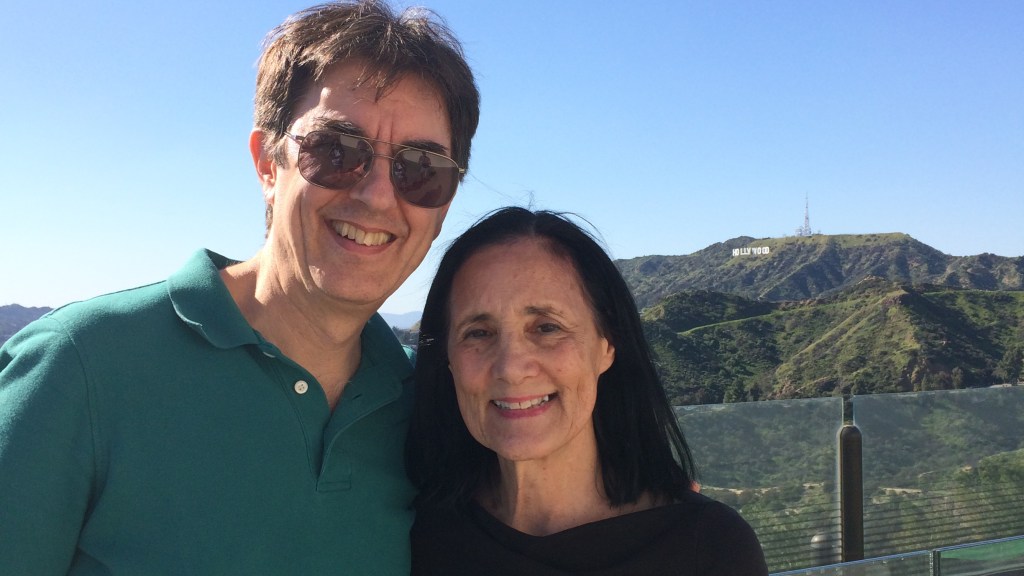
Picture: JoAnn and I together in CA last year during spring break. Happy Valentine’s Day!
Link for the Mass reading for Friday, February 14, 2020
Have faith that Jesus is still present and active in our lives.
In today’s encounter between Jesus and the Syrophoenician woman, we can observe again the crossing of societal norms by both the woman and Jesus. The woman, very much like the woman who had been hemorrhaging for twelve years, was desperate and approached Jesus. She was willing to risk breaking the social taboo of speaking with Jesus and just walking into the home where Jesus was staying for the sole purpose that her daughter would be healed.
Jesus meets her with the derogatory language of equating her with a dog, considered one of the most unclean of animals by Jews: “Let the children be fed first. For it is not right to take the food of the children and throw it to the dogs” (Mk 7:27). This woman would have none of Jesus’ rebuke, she wasn’t leaving without receiving healing for her daughter, even if that meant she was putting her life in danger. Her retort, “Lord, even the dogs under the table eat the children’s scraps”, emphasized this point. It was also the key that opened the door for the disciples and us to witness a consistent pattern with Jesus.
We saw the same situation with the woman who was experiencing the hemorrhage (cf. Mk 5:25-34) Both women had the faith and courage to approach Jesus. The outcome of this encounter was also similar to one Jesus had with another gentile, the Roman centurion, who said that he was not worthy for Jesus to enter under his roof. In both accounts, Jesus healed solely by his word from afar. What is important to Jesus is the person’s faith and belief that Jesus was who he said he was.
Do we have the courage, faith, and belief in Jesus as shown by the Syrophoenician woman in today’s Gospel? Are we willing to take the risk of crossing our own societal norms to draw closer to Jesus? When we let nothing hinder our stride closer to Jesus, including relinquishing the reigns of being our own masters, acknowledging that God is God and we are not, believing that Jesus is truly the Son of God and that he is still present and active in our lives, miracles do happen! Jesus said that if we have faith but the size of the mustard seed, we can move mountains (cf. Mt 17:20).
If you or someone close to you are dealing with some conflicts, challenges, trials, or tribulations. If something, someone, or your own fear or anxiety is keeping you from making a deeper commitment to surrendering your life to Jesus, if there are opposing forces that feel as big as mountains, be not afraid and trust in Jesus. Bring your anxiety, fear, trials, and/or tribulations to him, lay your burdens at his feet, and take his hand. With Jesus all things are possible, we just need the courage to believe that our Lord is present with us especially in the midst of our trials. Jesus has not left us as orphans. We need to have faith that Jesus is who he says he was then and continues to be today. Jesus the Christ, the Son of God our Savior and Redeemer, is present, is the kingdom of God at hand, and will see us through step by faithful step.
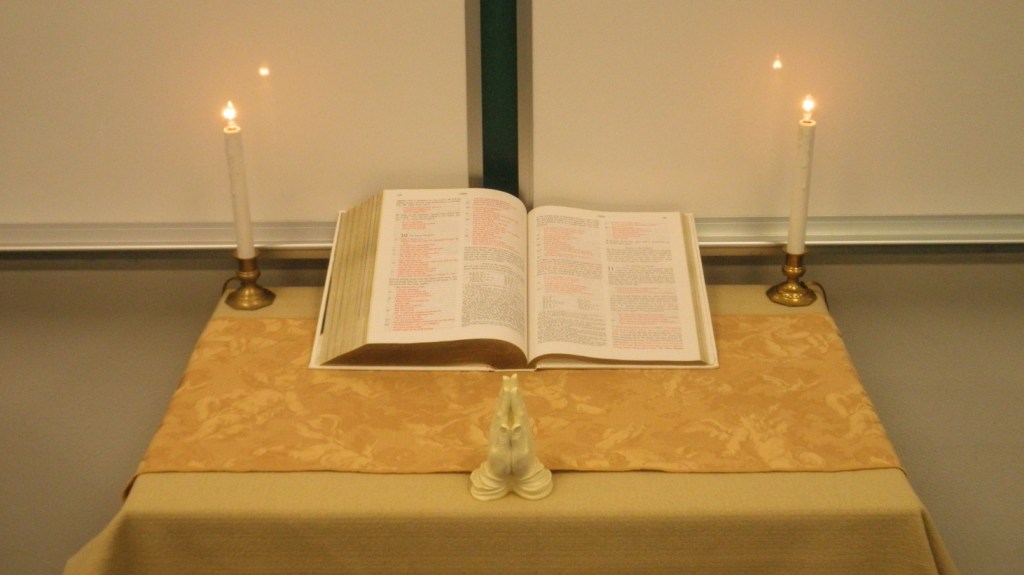
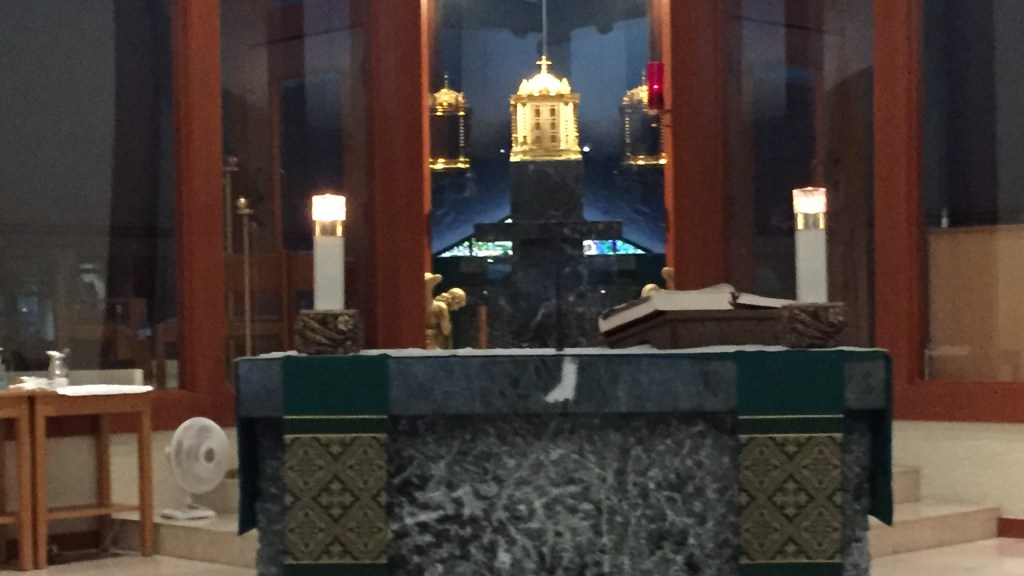
Photo: Small chapel at the front of my classroom at Cardinal Newman. May the light of the Gospel guide us each day!
Link for the Mass reading for Thursday, February 13, 2020
“You did it to me.”
“[W]hat comes out of the man, that is what defiles him” (Mk 7:20).
Jesus offers a list in today’s gospel of what can be unleashed from within and then directed out toward another. These are examples of what defiles us because, at some level, we make the decision to think about, speak, and put into action those thoughts, words, and actions.
To resist the temptation to defile ourselves and others, we can follow the lead of the writer from the letter to the Hebrews who offered a wonderful verse, which I pray each morning in my recitation of the Office: “Encourage each other daily while it is still today” (Hebrews 3:13). There are many that we will encounter or hear about each day that will do the exact opposite.
Our goal each moment is to resist spending any time or energy in supporting any thoughts, words, or actions that demean, belittle, or dehumanize. We can call those out who do so, stand up for those impoverished from these attacks who do not have a voice but we must not succumb, engage, or in any way be lowered to the negativity unleashed. Otherwise, we become an agent in perpetuating the same vileness and poison already unleashed.
Our thoughts, words, and actions matter because we are all interconnected, and even what we ruminate upon can be projected onto our faces and directed out toward another without saying one word. Thoughts entertained can lead to words and actions that wound. We need to approach each moment more mindfully such that we resist reacting, and instead take a slow breath, think and pray about our response. The only time our silence can be harmful is when we refuse to stand up for others when they disregard the dignity of a person.
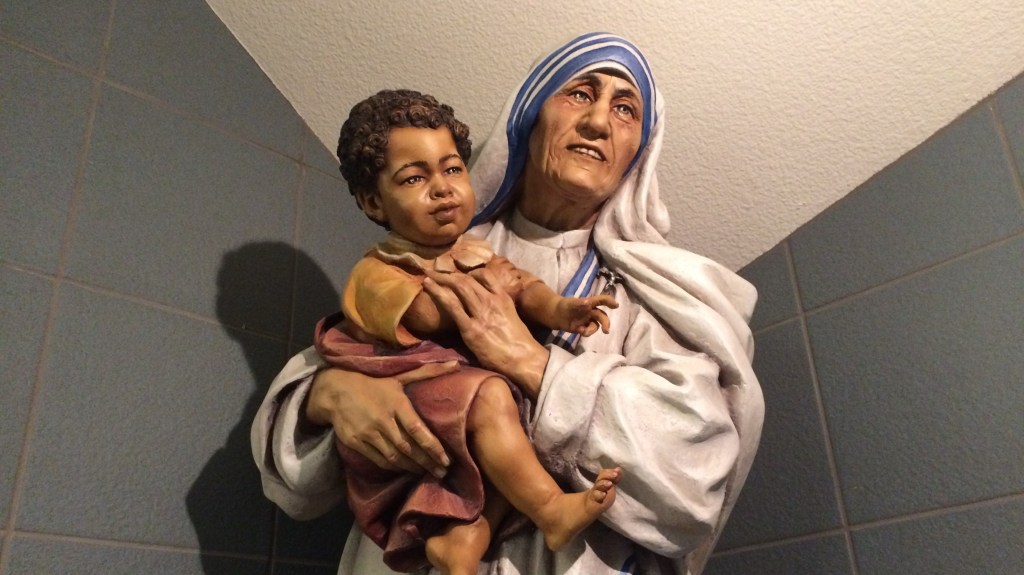
Let us choose this day to align our thoughts, words, and actions with those of Jesus. We can follow St Mother Teresa of Calcutta’s five-finger gospel as a reminder: “You did it to me.” What we say and do to the least of our brothers and sisters, we say and do to Jesus (cf. Mt 25:35-45). This begins when we resist defiling ourselves by never letting evil talk pass our lips and instead think, speak, and act in ways that empower, convict, and build up others. Our effort is strengthened when we choose to forgive any negativity hurled at us, and meet it with a posture of compassion that seeks to understand the perspective of the hurler. In our efforts, we are not alone when we call upon the help and strength of Jesus as we strive to become ambassadors of his transforming love.
————————————————————————————————-
Photo: St Mother Teresa of Calcutta, in the sanctuary at St Peter Catholic Church
Link for the Mass readings for Wednesday, February 12, 2020

Boundaries, rules, and discipline provide the foundation for us to experience freedom for excellence.
Jesus reacted to the criticism of not observing ritual washing prior to eating that was leveled at him from the Pharisees and scribes by recalling the tradition of the Prophets through the words of Isaiah: “This people honors me with their lips, but their hearts are far from me” (Mk 7:6). For Jesus, following the law for the law’s sake is an empty act. What is important is encountering God, experiencing his love and forgiveness, developing a relationship with him, being transformed by him and returning to his image and likeness, so as to be able to glorify him by serving others and inviting others into communion with him. Jesus challenged the hyper scrupulosity and exactitude of the rules that had nothing to do with being humble servants of God.
Just laws and practices are those that are enacted to build up and empower ourselves and others through discipline and clear boundaries. They help keep us away from our enslavement to sin and instead lead us to freedom for excellence, for fulfillment, and to experience a heart on fire with an ever-growing love that yearns for a relationship with God and each other, like a deer for running streams.
As with any game we play, there are rules and regulations, there are referees and officials to keep order. When the rules enforced encroach on the flow of the game, such that they inhibit the freedom of play, the game is stunted. When there is no enforcement, the game quickly devolves into chaos. When the rules are consistent, they provide the structure and boundaries that limit abuse, allow for the game to flourish, and the players to experience the freedom to actualize their potential, and as such, there is the experience of the true, the good, and the beautiful.
The first time I saw people skate, I was enraptured. I think I was seven. My father was working on a project at our local ice rink and even though we were not there to skate, I refused to leave until he took me on the ice. It didn’t matter that the only skates to rent that fit my feet were figure skates. It didn’t matter that my first attempt was a dismal failure. What mattered was I made it to the ice and the joy of that experience carried me as I learned the rules of balance, how to stop and what a toe kick was and was not for. Soon I had the freedom not only to skate but to join a hockey team. The freedom and joy I felt any time I skated or played hockey, I still carry with me to this day.
The Church, when we are at our best, is the same. We don’t lead with the rules and moralizing, but instead, we share our time, presence, and the joy of our faith. We empower and support one another as we enter into the play between our finite freedom and God’s infinite freedom. We are built for a relationship with God and one another and as our relationship matures, we start to learn and share the finer points of our life of faith. We experience the meaning of why we do what we do and why certain thought patterns and actions lead us either away from or closer to God.
Loving someone does not mean we allow them to do whatever they want, but in willing their good, we offer invitations, options, and establish boundaries that will provide opportunities for growth, maturity, and authentic freedom. We are going to make mistakes, I have made plenty. The key is recognizing that we are on a journey together. As we walk together, we support and learn from one another. In this way, the boundaries and rules we follow are meant to set a foundation for healthy relationships and actualizing who God invites us to be, joyful, human beings that are fully alive!
———————————————————————————
Photo: About eight or nine, living the dream on the ice!
Link for the Mass readings for Tuesday, February 11, 2020

Jesus calls us to “heal the wounds and warm the hearts of the faithful.”
“Whatever villages or towns or countryside he entered, they laid the sick in the marketplaces and begged him that they might touch only the tassel on his cloak; and as many as touched it were healed” (Mk 6:56).
The people of Jesus’ time were in need of healing, hungry to draw closer to God, often searching, wandering, and wounded. This is just as true today. Though Jesus is not as visible to us as he was to those in the land of Gennesaret, he is just as present if not closer. We who receive Jesus in his Word proclaimed and we who receive his Body and Blood, we who receive his healing, mercy, and grace are sent forth to bring Jesus to others.
We are not to go home as if nothing of any significance just happened in our gathering as the Mystical Body of Christ at Mass. Jesus does not send us to walk around with an air of superiority over others, to judge and condemn people, to refuse to help people because we feel they deserve the condition they are in, that they are illegal, that they chose their lifestyle, that they are lazy and just need to pull themselves up by their own bootstraps. Jesus was and is not indifferent to the plight of others.
Pope Francis was asked in an interview by Fr. Antonio Spadaro, S.J., in 2013, “What does the church need most at this historic moment?” And Pope Francis answered, “that the thing the church needs most today is the ability to heal wounds and to warm the hearts of the faithful; it needs nearness, proximity. I see the church as a field hospital after battle.” We need to be “near”, in the same “proximity”, to bear Christ to one another: “The church sometimes has locked itself up in small things, in small-minded rules. The most important thing is the first proclamation: Jesus Christ has saved you. And the ministers of the church must be ministers of mercy above all.”
Jesus, please help us to be present, to come near, and bring your love, mercy, forgiveness, and be willing to enter into the chaos of one another. Help us to resist the temptation to keep others at a distance and refuse to be indifferent to the needs of those you bring to us in their time of need. May we too, in the words of Pope Francis, go out to “heal the wounds and to warm the hearts of the faithful” by being willing to accompany others in their sorrows, anxiety, trials, and tribulations.
People are really hurting all around us. Help us to let go of the need to fix them or fix their problems. Jesus, help us to be present, to listen, to hear, and be open to allow the Holy Spirit to speak through us at the appropriate time, so that, in the end, we do not prevent people from encountering Jesus, but provide a means for them to encounter the divine physician.
—————————————————————————————————————
Photo: Class of 2017 expressing nearness and proximity!
Spadaro, S.J., Antonio. “A Big Heart Open to God: An interview with Pope Francis”. America Magazine. September 30, 2013 Issue: https://www.americamagazine.org/faith/2013/09/30/big-heart-open-god-interview-pope-francis
Link for Mass readings for Monday, February 10, 2020
We will be the light that shines in the darkness when we allow Jesus to set us on fire with his love.
Our readings today embody the core of the Gospel message, in fact, the core of the written record of the Bible and our Tradition as Catholics and Christians. The Son of God became one with us in our humanity so that we can become one with him in his divinity. Jesus is the incarnation of the Son of God, he is God made man so that through our participation in his life we can become like God, we can be restored to the likeness of God that we were originally created to be and that has been lost to us through our sin.
Ultimately, what is Jesus saying to his disciples then and to us his disciples today when he said, “You are the salt of the earth” and “You are the light of the world”? Jesus is saying that we are called by him to be holy, we are to be deified or divinized. Our image is to become transformed, perfected in and by Christ and through the Holy Spirit our likeness, the glory of God will be returned.
We are a living, craving, hunger, and desire to be one with God and each other. This is true for the atheist as well as the mystic. God did not create us just to survive and merely exist, to take up space and then die. He created us to be fully alive, to be loved and to love, and to collaborate with him to bring about his reign on earth as it is in heaven. Yet, we all fall short of the glory of God when we sin.
Jesus came to save us and opened up heaven for us in the humanity he assumed. God loved us into existence and loves us so much he is willing to risk that we will reject him. He wants us to choose him freely. Jesus shines the light in our darkness to reveal to us those ways in which we have said no to God and invites us to repent, to turn away from our sin and to restore our relationship with our loving God and Father.
Our yes to God is not a one time yes for all time. We need to make a daily, moment by moment yes to God in every aspect of our life. God loves us more than our worst mistakes, our greatest sin, more than we can ever mess up. He is just waiting for us to turn to him, so he can forgive us and release us from our bondage. God loves us so that we can receive his love, return to communion with him, and love others as he has loved us.
Jesus calls us to be salt, to preserve that which is good and holy in God’s creation. That means we need to be growing in holiness. Jesus calls us to be the light that shines in the darkness leading people to experience that which is good, true, and beautiful about being a human being fully alive. That means we need to be cleansed of our sin so that the light of Christ can shine through us to others.
On our own merits and efforts, this is impossible, but in union with Jesus all things are possible. We become holy by following the guidance of the psalmist. Our hearts are to be firm and steadfast as we trust in the Lord (cf Psalm 112: 8-9) and along with St. Paul we need to believe that we “rest not on human wisdom but on the power of God” (I Cor. 2:5). As we are more and more conformed to the life of Jesus, people no longer see us, but Jesus working through us. As we mature in our walk with Jesus we too will be able to say with Saint Paul that I have been crucified with Christ, yet it is no longer I who live, but Christ who lives in me (cf. Galatian 2:19-20).
We become salt to the earth and a light to the world, we become holy, when we accept the reality that God is God and we are not. When we willingly and with firm intent say yes to the grace, the free gift, of the invitation of Jesus. When we pray, meditate, and are willing to be led into contemplation by the Holy Spirit. When we slow down on a daily basis to hear the Word of God who speaks to us in the silence of our hearts and allow the love of the Holy Spirit to transform us, to purge from us all within us that is not of God.
Yet, our prayer is not for us alone. Prayer, meditation, and contemplation are where we become aware of the invitation to experience God vertically, where he calls us through the love of the Holy Spirit and sends us out on mission. This outward action directed toward others is our relationship with God horizontally. The two directions, vertical and horizontal, intersect as the trinitarian love of the Cross.
When we become people of prayer, allow our eyes to see the needs of our neighbor, and allow our hearts to feel again, we will hear with the prophet Isaiah: “Share your bread with the hungry, shelter the oppressed and the homeless; clothe the naked when you see them, and do not turn your back on your own” (Isaiah 58:7). We will also hear Jesus say, “I was hungry and you gave me food, I was thirsty and you gave me drink, a stranger and you welcomed me, naked and you clothed me, ill and you cared for me, in prison and you visited me” (Mt 25:35-36).
These words are not easy to hear nor to put into practice, but the Word of God is the kindling we need to ignite the embers of our soul. Our “light will shine before others” (Mt 5:16) when we ponder these words and are willing to allow the Fire of the Holy Spirit to burn the dross of our sin, pride, and selfishness from within, and allow ourselves to be ablaze by the Love of God. When we allow Jesus to live in and through us we will no longer be shaped by the world, but we will set the world on fire with his love.
We become “the light of the world” (Mt 5:14) when we have the moral courage as a Democrat to stand up for the dignity of the unborn and as a Republican to grant safe and humane passage to our neighbors outside our borders seeking refuge. We are the light of the world when we no longer allow our politics to shape the Gospel but when we allow the Gospel to shape our politics. We are the light of the world when we recognize that what we do to the least of our brothers and sisters in each and every encounter, we are doing to Jesus.
Be not afraid of this present age. Be the light of Christ that shines in the darkness.
Photo: Praying in the St Peter chapel yesterday before 8 am Saturday Mass.
Link for the Mass readings for Sunday, February 9, 2020
Enjoy a five-minute retreat today.
After hearing the accounts of the missionary trip of the apostles, Jesus invites them to step away from the crowds “to a deserted place [to] rest awhile” (Mk 6:31). Jesus is showing the apostles the importance of balance. There are times to serve and times to recharge, to reconnect, and spend some quiet, and reflective time with him. Jesus is our model, our guide and teacher, but he is at the same time more than that. Jesus is the source and sustenance of who we are as a living craving, hunger, and desire to be one with God and one another. As the deer longs to refresh itself from the waters of a running stream, we long to be nourished by the living water, Jesus, and this is true for the atheist as well as the mystic, for each and every one of us, whether we are aware of this reality or not.
Our thirst for communion can be stifled because it is so easy to be busy, there is so much that needs to be done, and at the same time, there are so many distractions and diversions that vie for our energy and attention. In today’s Gospel, the intent of Jesus is to escape with his apostles for some rest and renewal. They get in a boat to do just that, yet the crowd that they thought they had left behind has arrived on the other side before they did! “When Jesus disembarked and saw the vast crowd, his heart was moved with pity for them, for they were like sheep without a shepherd; and he began to teach them many things” (Mk 6:34). So much for being able to “rest away for awhile”! Or maybe the boat ride across was that moment of rest.
Choosing five to ten minutes to be still, to rest in the Lord, may not seem like much but can make a huge difference. Our challenge is to be able to discern and develop a healthy balance that becomes fruitful through aligning our will with Jesus. When we intentionally put God first and make the time each day to spend with him, often there is a serendipitous alignment that we experience in our day, that we did not think possible at the outset. This often happens when we consciously make time for stillness, for prayer, even and especially, during the moment when we may feel we just don’t have the time.
Give yourself a five-minute retreat today. Step into the boat with Jesus and his disciples. Breathe in deep, let your head fall back to feel the breeze of the Sea of Galilee, feel the warmth of the sun on your face, and experience the rhythm of the boat on the water. Does Jesus remain silent and rest with you? Does he begin to teach, what does he share? In your time of quiet, do you have questions for him, what do you ask, and what is his answer? Enter into the experience, and when the boat comes to shore, go forth into the day renewed and blessed by Jesus so to go forward with a heart and mind able to be moved with compassion to serve others. Such that we embrace interruptions instead as encounters and opportunities of service.
—————————————————————-
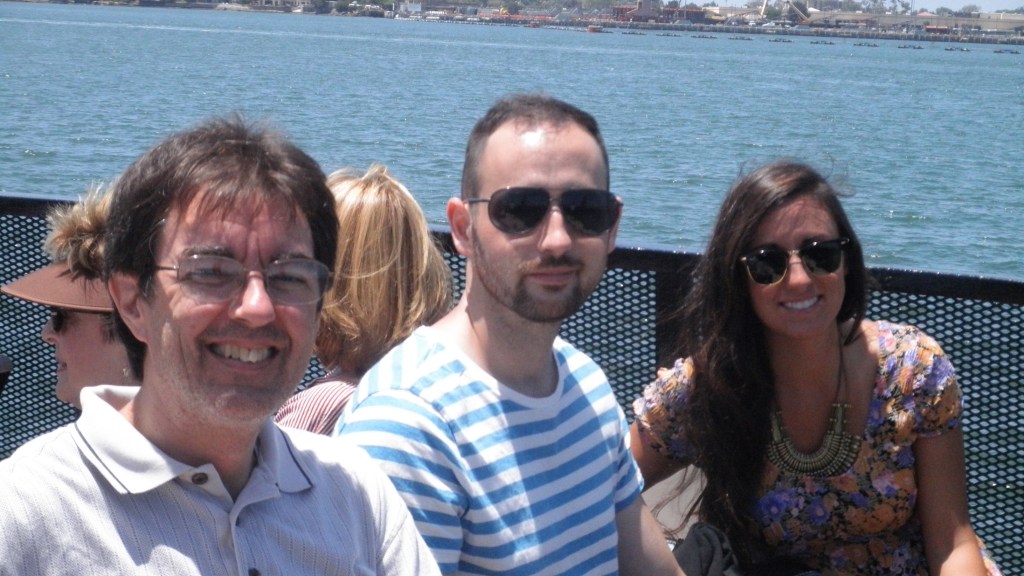
Photo: On the ferry to Coronado Island, CA, June 2014. Enjoying a little downtime.
Link for the Mass readings for Saturday, February 8, 2020
 Spiritual Stepping Stones