Tradition is not to become cast aside or made a cult, but continually clarified, renewed and deepened in the love of Jesus.
“At that time Jesus exclaimed: ‘I give praise to you, Father, Lord of heaven and earth, for although you have hidden these things from the wise and the learned you have revealed them to the childlike’” (Mt 11:25).
Why did the wise and the learned, referring to the Sadducees, Pharisees and scribes, reject Jesus? One possibility is that Jesus challenged their idol of tradition. Even though Jesus did not come to abolish the law but to fulfill it (cf. Mt 5:17), the invitation to go deeper was and continues to be challenging. This is certainly highlighted in the six antitheses, Jesus shared during his Sermon on the Mount. Here is one such example: “You have heard that it was said, ‘An eye for an eye and a tooth for a tooth.’ But I say to you, offer no resistance to one who is evil” (Mt 5: 28). Offer no resistance to one who is evil? Not only hard to swallow for people of Jesus’ time, but for us today as well.
Jesus offered then and continues to offer us today the intimacy of the Trinitarian Love of God shared between Father, Son and Holy Spirit. To be fully alive, to share in his Love, we need to resist being governed by our fear and holding blindly on to tradition for its own sake. Instead we need to be open to growth, change, and renewal. Gerhard Lohfink, in his book, No Irrelevant Jesus, quotes the Polish philosopher Leszak Kolakowski: “A society in which tradition becomes a cult is condemned to stagnation; a society that tries to live entirely through revolt against tradition condemns itself to destruction” (Lohfink 2014, 2).
Many have left the Church because they feel we are too steeped in tradition, rules, and laws, but in their throwing the baby out with the bathwater, they have no secure ground or foundation, no anchor in their life. Others remain hunkered down entrenched in a bunker of tradition fearing the secular tide, holding on to tradition, not to Jesus. Both tendencies weaken us because we are choosing our self over accepting Jesus’ invitation to let go and enter into the living stream of the communal Love of the Trinity we can then share with one another.
Jesus sees the potential we have as well as our brokenness and fear. He meets us where we are, as we are, in our present condition, and from that starting point he invites us to crawl, then to walk, to run, and eventually to fly – to experience and share the experience of his unconditional Love. We need to resist the extremes of rejecting tradition altogether or idolizing tradition alone, but instead build on the foundation we have been given; Jesus Christ: “The Way, the Truth and the Life” (cf Jn 14:6). Within the life of the Church, “we must not do away with its traditions, but at the same time it must continually clarify, renew, and deepen them” (Lohfink 2014, 2).
May we entrust ourselves to the Holy Spirit and ask him to burn away those small “t” traditions that keep us from God, so to reveal to us those capital “T” Traditions, that which remains from his purifying fire of Love. In this way, we may come to know that which in reality is the foundation of our identity that leads us to being people of integrity. May we be open to receiving that which Jesus wants to teach and reveal to us, learn it, and live it in our everyday lives!
—————————————
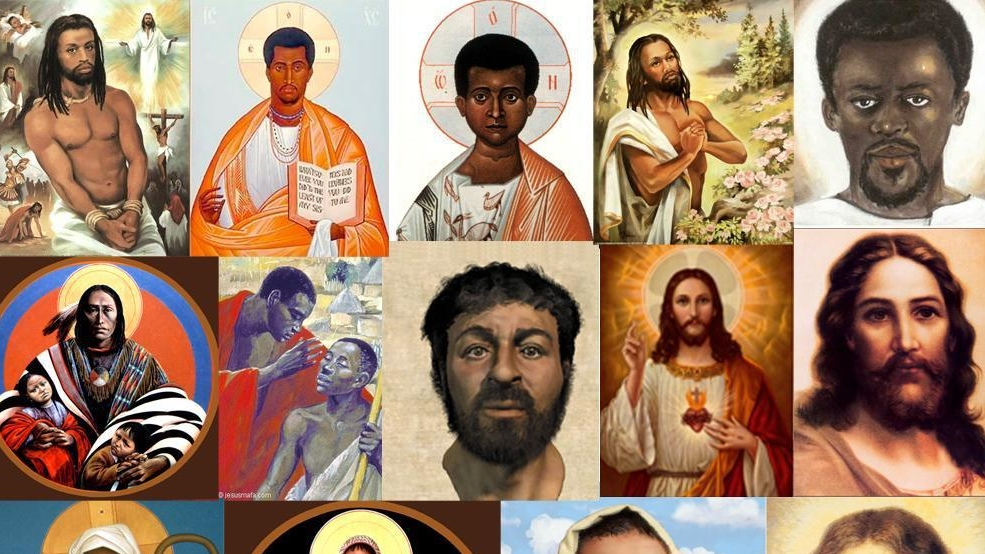
Photo: Collection of just a few artistic representations of Jesus. Historically, Jesus was a Palestinian Jew, yet there have been wonderful, diverse depictions from many parts of the world. Which picture of Jesus do you most identify with?
Lohfink, Gehrhard. No Irrelevant Jesus: On Jesus and the Church Today. Minnesota: Liturgical Press, 2014.
Link for the Mass readings for, Wednesday, July 17, 2019

Repent and believe in the Gospel.
“Jesus began to reproach the towns where most of his mighty deeds had been done, since they had not repented.” (Mt 11:20).
To encounter Jesus is to be invited to change. Jesus shines the light of his love and mercy into the darkness of our own fallen nature, where we are wounded, sinful, and broken. He invites us to repentance, healing, and reconciliation. A wonderful invitation, but why would we turn away? The light is too bright.
Facing our own darkness and brokenness is not easy and can be frightening as well as intimidating. That is why we are so vulnerable to temptations, distractions, and diversions. We are not able to sit still because we want to keep moving so as not to face our fear and pain, nor let go of our false senses of security, control, and the glitter of apparent goods.
Jesus invites us today to enter into his stillness and silence where we can hear the word of his Father and experience the love of the Holy Spirit. In the silence, we come to encounter the choice to change our hearts and minds, to repent: to turn away from our sin and back to God.
God loves us more than we can ever mess up, more than we can ever imagine, and he does not define us by our worst mistakes. Jesus’ arms are wide open to receive us in the midst of our brokenness, pain, and sin, but we must be willing to stop running and be still long enough to experience and feel his forgiving, loving and healing embrace. Once doing so, we are then to offer the same to others.
“This is the time of fulfillment. The kingdom of God is at hand. Repent, and believe in the Gospel” (Mark 1:15).
Photo: Morning sunrise, a good day for repentance, forgiveness and to begin again.
Link for the Mass readings for Tuesday, July 16, 2019

Living the teachings of Jesus may not always bring peace but it will bring the light of truth.
“Do not think that I have come to bring peace upon the earth. I have come to bring not peace but the sword” (Mt 10:34).
Words to live by from the King of Peace. The reality of this statement is the reality of his mission. Jesus entered the lives of individuals. Some said yes to following him and some said no; some saying yes and no within the same family. The image of the sword represents how sharp and stark this choice could cut. If you do not think that is true, just look at the polarization in our country right now. The cut between democrat and republican bleeds quite deep.
During the time of Jesus and for most within the first generation of believers, there was not a luke-warm choice. You were either for Jesus or against Jesus. Unfortunately, today, for too many, the Gospel is being shaped more by politics than the Gospel shaping politics. To live as disciples of Jesus and to actively engage in living out the teachings of the Gospel, it is more important that we follow Jesus, putting him first before any politician or political party. The platforms of democrats, independents, libertarians, and republicans are all deficient in fully following the teachings of Jesus.
We, who have chosen to follow Jesus, need to speak truth to the issues and hold leaders accountable on all sides. Our starting point for any issue needs to be respecting, first and foremost, the dignity of the person from the moment of conception and everywhere in between until natural death as well as promoting a healthy stewardship of God’s creation. In that dialogue, dialogue not monologue, we need to respect those to whom we share our views with and be willing to also listen in turn. In actuality, listening first and more often, is a good posture to assume. We can and will disagree, but we need to resist devolving into demonizing one another.
There are those who promote a right to choose taking the life of their own unborn, there are those who support taking children away from their parents for seeking asylum and weeks and months later still not returning them, and those refusing to welcome the refugee and the migrant fleeing from dire situations to discourage people coming into this country. There are those who say we can’t pray in our schools, while others say we can’t take a knee to protest the disproportionate unjust killings of people of color by our law enforcement agencies. Mass murders, including the death of students in our schools as well as the daily violence in our cities abound. The addiction rate of our youth in many rural and urban areas has reached epidemic proportions with little concrete help and support, while equal access to education, jobs, and health care is woefully unbalanced.
These issues are complex and there is no silver bullet that will solve them. When Jesus said, “I have come to bring not peace but the sword” (Mt 10:34), he meant that we are not to settle for a false peace of appeasement to get along and water down the Gospel message. We must wield his sword, which is the Word of God, that speaks truth to power. When seeking to counteract a culture of death to build a culture of life, we must resist making political party affiliations and leaders into our idols, we must resist the urge to give in to our fears and prejudices.
We must refuse to contribute to the dehumanization and demonization of others in our country, nor fall into hopelessness, indifference and despair, but instead be a people of hope, mercy, and love in each and every encounter such that we promote a consistent ethic of life. May we make the Word of God a reality in our time and generation by immersing ourselves in the teachings of Jesus, applying them to our lives, speaking the truth of the Gospel, praying for all of our leaders, for one another, and inviting the Holy Spirit to give us the the ears to hear, the words to speak, and the actions to engage in.
In following Jesus in these ways, and putting into practice the words of the Prophet Isaiah by ceasing to do evil, learning to do good, and making justice our aim (cf. Isaiah 1:15-17), we will cause disruption and face conflict but if we remain in the word of Jesus, we will truly be his disciples, and we will know the truth and the truth will set us free (cf Jn 8:31-32).
Photo: Sunrise at St Peter Catholic Church. As the sun rises each day, may Jesus, the Son of God rise in our hearts.
Link for the Mass readings for Monday, July 15, 2019

Are we willing to act as the Good Samaritan and “go and do likewise”?
In today’s Gospel of Luke 10:25-37, Jesus is challenged by “a scholar of the law”, most likely one of the scribes. Scribes were among the two percent or so who were literate and used their skill as interpreters of the law. This scholar was seeking to embarrass and shame Jesus in front of those who had gathered around them so to discredit this upstart peasant.
Instead of being shamed, Jesus used the encounter as a powerful teaching moment for the scribe and those who gathered to listen then and today. Jesus answered the scribe’s question with another: “What is written in the law? How do you read it?” The scribe masterfully quoted the Torah from Deuteronomy 6:4-5 and Leviticus 19:18 regarding how we are to love God and neighbor. Jesus showed agreement with the scribe’s interpretation when he said, “You have answered correctly” showing again that he has not come to abolish the Law but fulfill it. The fulfillment here is not just knowing about the Law, not just knowing the Law, but putting the Law into practice, “do this and you will live.”
Not comfortable having the tables turned on him, the scribe sought to save face or “justify himself” by asking Jesus, “And who is my neighbor?” The scribe again knew full well the answer was his “own people” a fellow Israelite, as found in Leviticus 19:13-18. Jesus will raise the bar higher again with his presentation of the parable of the Good Samaritan.
A man is completely stripped and beaten such that he is unrecognizable. The listeners do not know if this man is a Jew or a Gentile. The only ones identified in the parable are the priest, the Levite, and the Samaritan. For the priest and the Levite, they both chose the same course of action, they “passed by on the opposite side.” Each of them, the reasons are not shared by Jesus, refused to come close. They chose not to encounter the wounded man. The Samaritan was willing to risk because “he was moved with compassion.”
The Samaritan, most likely a trader and traveled these roads before, had mercy on this man left for dead. He, unlike the priest and the Levite who kept the man at a distance, was willing to come close to encounter and enter into the chaos of this stranger. He did not allow his fear, bias, prejudice, and/or indifference to dictate his actions, but instead was moved without hesitation to provide assistance.
The scribe, at the end of the parable, again answered correctly when he was asked, “Which of these three, in your opinion, was neighbor to the robbers’ victim?” He answered, “The one who treated him with mercy.” Jesus said to him, “Go and do likewise.”
The scribe in today’s Gospel account from Luke began his encounter with Jesus with the sole intent of making Jesus look foolish, to diminish him. Jesus, instead of retaliating, taught him with his own words. We are to love God with all our heart, soul, and strength. We are to embrace our God who is willing to come close to us, who has compassion for us and is willing to show us his mercy because he is willing to enter into the chaos of our lives. He comes close to us to fill us with his love to overflowing such that we will move beyond our own selfish limitations, to allow ourselves to be moved with compassion, to love our neighbor, who is everyone.
The travesty of what is happening on our southern border regarding our brothers and sisters seeking asylum or a better life is our failure, our refusal, and/or our unwillingness to come close, to encounter, to hear the parable of the Good Samaritan. We refuse to see those seeking refuge and so many “others” as neighbors, as human beings, as brothers and sisters, and children of God. Too many of us have grown callous and as Pope Francis has said, have forgotten how to weep.
Jesus calls us to open ourselves up to love, to risk, to show compassion, and mercy to others, for the Gospel is not just for a select few. We do not know if the scribe curved in upon himself, refused to repent, or accepted the teaching of Jesus to “Go and do likewise”, to go and live his life like the Good Samaritan, who without hesitation was willing to provide aid for his brother in dire need. Will we repent from our fears, biases, prejudices, and indifference and go and do likewise, go without hesitation, to serve anyone who is need? If we do so, we will live and have eternal life.
Photo credit: Stuart Palley/Washington Post 10/13/18 picture of Magale Nieto Romero and her son, Jose Torentino Nieto, at the Nogales Port seeking asylum.
Link for the Mass readings for Sunday, July 14, 2019
In becoming like the teacher, we are becoming God through our participation in the life of Jesus.
Jesus said to his Apostles: “No disciple is above his teacher, no slave above his master. It is enough for the disciple that he become like his teacher, for the slave that he become like his master (Mt 10:24-25).
Following the teachings and guidance of Jesus was hard for his apostles and disciples then and it is for us now. To live as authentic disciples, we need to learn and put his teachings into practice. That means more than reading some of his teachings: love God with your whole heart, mind and soul and your neighbor as yourself, turn the other cheek, and what you do to the least of my brothers, you did it to me, and acknowledging, that, “That is some good stuff!” Then just moving on to the next thing on the to do list.
Living as a disciple also happens in a public way, which means public scrutiny. One thing we all have in common as human beings is that we want to belong, to fit in, and to be a part of. We risk rejection and ridicule by following Jesus and living as his disciple because we run up against our own fallen nature and the fallen nature of others. As with yesterday’s reading, Jesus said he would be sending us as sheep among wolves and in today’s reading he announces that we are not to be afraid of those who kill the body. Not exactly the kind of encouragement many of us look for.
Yet, Jesus affirms more than once in today’s Gospel that we are not to be afraid. He is the most important relationship we will develop. He cares for us, just as he cares for the sparrows, but even more. He knows us by name and we are his, we belong to him. God, our loving Father, has known us not only before we were born, but before all creation began. We are not alone. As we risk, grow in confidence, and begin to live our life in alignment, in relationship with Jesus, we begin to become unified with him so to feel a joy and a fulfillment that is unmatched.
One of the keys to living the Christian life is understanding that it is more than a philosophy, a set of teachings, or a theology. Being a Christian means building our relationship with a person such that we become unified, one with him. Jesus is that person, and turning to him, through our ups and downs, and in risking to share our stories of faith with others, we invite others to join us, because as we develop our relationship with him, we also are to build relationships with others. Some will decline, some will sneer, some will be outright hostile, and yet some will say yes.
What is important is that we stay true to Jesus and follow his lead, then we will be truer to ourselves and who we have been created to be. In being willing to share our faith journey with others, in bringing Jesus to others that he may minister and be present through us, we come to experience the fulfillment and joy of the relationship with him that we have been created for.
As we become more unified with Jesus, we will experience deeper and fuller relationships because we are less turned in on ourselves and we will begin to be more present, patient with, and open to giving of ourselves to others. We will also experience the wonder and connectedness to God’s creation in a deeper way because we begin to not only see the footprints of God in the beauty of his creation, but we will see the natural world and each other through his eyes.
In “becoming like the teacher” we are not just modeling his teachings, we are becoming deified, we are becoming one with God, we are becoming God through our participation in the life of Jesus through the love of the Holy Spirit. No matter the risk, this is some Good News to get up out of bed and be joyful about and want to share with others!
————————
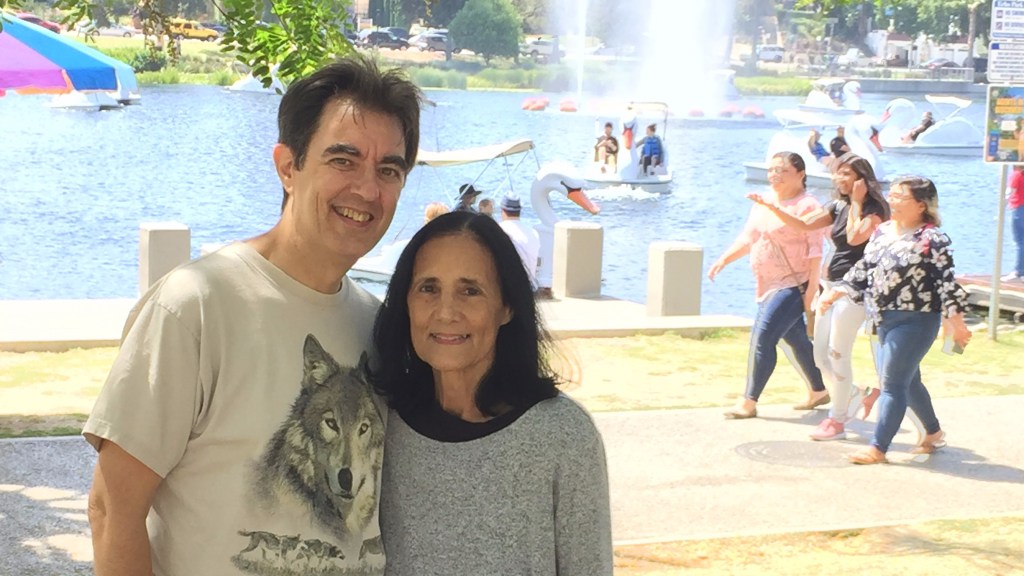
Photo: Enjoying each other and some of God’s creation last Saturday at Echo Park in Los Angeles.
Link for the Mass readings for Saturday, July 13, 2019
“Each one of you has to be God’s microphone.” – Saint Oscar Romero
“… you will be led before governors and kings for my sake as a witness before them and the pagans. When they hand you over, do not worry about how you are to speak or what you are to say” (Mt 10:18-19).
Can you feel the anxiety building within his followers? I can! Presented with the possibility of being dragged before family, peers, and local governance can be daunting. The stomach acid begins to swirl and butterflies take flight often before I preach before fellow believers!
When speaking about and/or defending our faith, anxiety arises because we are risking that the message, and more so, we, will not be received. This is because we are focusing more on our self. When Jesus invites us to speak of our faith he is asking us to express and not to impress. Jesus seeks to expand us beyond our limitations and draw us into the Love of his Trinitarian communion. The Holy Spirit, the Love shared between the Father and the Son, who casts out all fear, accompanies us and will provide what we need to accomplish the task before us, to give us the words to speak, even in the midst of anxiety or fear. We need to learn to trust in him. As Mark Twain wrote: “Courage is not the absence of fear. It is acting in spite of it.”
One of the most powerful prayers during the Mass is during the Communion Rite at the end of the Lord’s Prayer: “Deliver us, Lord, we pray from every evil, graciously grant peace in our days, that, by the help of your mercy, we may be always free from sin and SAFE FROM ALL DISTRESS, as we await the blessed hope and the coming of our Savior, Jesus Christ” (Bold letters mine).
Our anxieties and fears often present us with the temptation to be indifferent, indecisive, and/or to look the other way when the dignity of others are infringed upon. The feeling can be suffocating and choking, yet St. Oscar A. Romero (1917-1980), of San Salvador, who was assassinated for publicly confronting the oppressive military in his diocese reminds us in his book, The Violence of Love, that, “There is no dichotomy between man and God’s image. Whoever tortures a human being, whoever abuses a human being, whoever outrages a human being abuses God’s image, and the church takes as its own that cross, that martyrdom.”
When the dignity of any person or people is infringed upon, in any way, we are called to speak up and act on behalf of those that are belittled, demeaned, or dehumanized. At the first moment that the smallest anxiety, worry or fear sends out its tendrils to grasp at and choke us, we are to seek the strength of the Holy Spirit, and trust that he will give us the words and the courage to speak what he would have us to say. In this way, we are to “be God’s microphone” so as to shine a light on the darkness of dehumanization, oppression and fear.
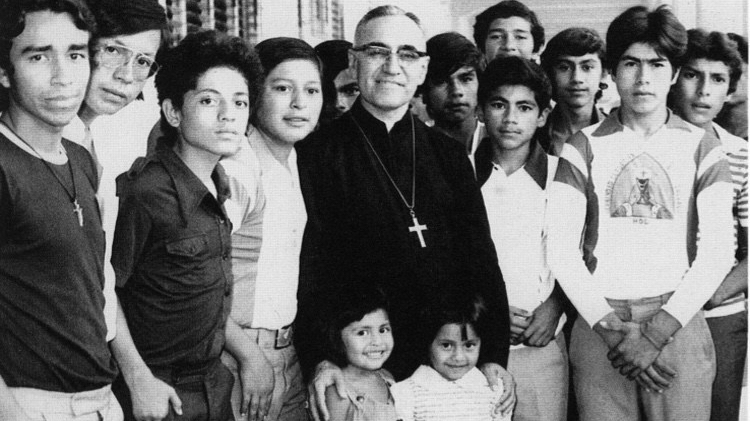
Photo: Archbishop Saint Oscar A. Romero with the youth of San Salvador.
Link for the Mass readings for Friday, July 12, 2019
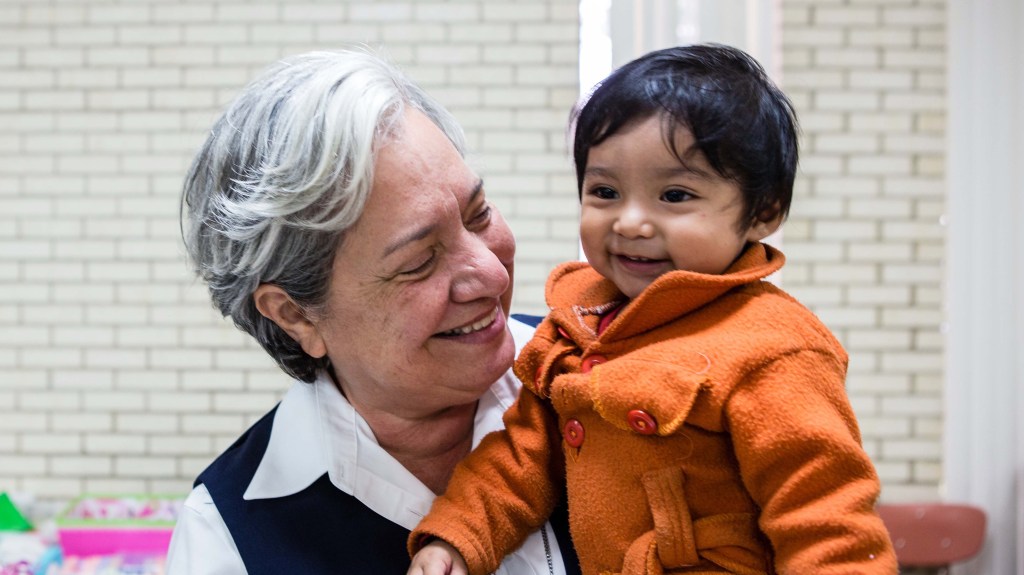
Sr. Norma gives without cost. We are called to do so also.
“Without cost you have received; without cost you are to give” (Mt 10:8).
We cannot buy the grace of God, we do not earn our way into the kingdom of heaven. God’s grace and presence is freely given, without cost. As with any gift, the joy and fulfillment comes from the willingness to receive and open the gift.
God has given us the gift of his Son. We have the choice to say yes or no to receiving him in our life, each and every moment, each and every day. When we say yes to receiving Jesus into our life, he does not come to dwell with us for our sake alone, we are invited to freely share him with others. The Second Vatican Council renewed this call for evangelization. We are to, as did the Apostles, his disciples, and each following generation, say what he said, do what he did, and live how he lived.
We say what Jesus said when we use our words to empower, affirm, heal, and to convict but not condemn. We do what Jesus did: when we build relationships and foster an encounter with one another, when through our acts of hospitality, mercy, forgiveness, healing, and being present, we attend to the needs of others, especially the most vulnerable in our midst.
We are to live as Jesus did. We are to be holy ourselves in every aspect of our conduct, as St. Peter wrote, “for it is written, ‘Be holy because I [am] holy’” (cf. 1 Peter 1:15-16). We begin to grow in holiness when we recognize, repent, choose no longer to be governed by, and seek healing from our own fears, pride, selfish and ego centered ways of living. We grow in holiness when we say yes to receiving the gift of the purifying fire of the Holy Spirit to come into our life to purge us from our indifference and fear so to be aflame with love. In this way, we will shift our posture from the stiff arm of keeping others at arm’s length and instead open our arms wide to embrace each other, to love one another by giving of ourselves without cost.
Sr. Norma Pimentel, M.J., executive director of Catholic Charities of the Rio Grande Valley, provides an example for us today of how we can live a life dedicated to “giving without cost”. She has allowed Jesus to minister through her as an advocate for the voiceless along the Texas/Mexico border. Sister Norma has been working with asylum seekers, immigrants, and refugees since the 1970’s, providing welcome, hospitality, and shelter, showing those seeking aid, that hope is still possible and that Jesus does care for their plight. Sr. Norma reflected recently on the beginning of her vocation by stating that, “During those first years of my religious formation, I quickly learned the importance of living out our faith by how we welcome and protect those that need us, especially the vulnerable stranger in our midst.”
Jesus may or may not be calling us to the border, but what he is inviting all of us to do, is to be open to receive the gift of the touch of his embrace, to be loved by him. In receiving the gift of his love, we will begin to see each other with his eyes, to see each other as human beings, created in the image and likeness of his Father. Jesus is calling us to love each other, to be willing to touch and accompany one another in our need.
We cannot be indifferent to the cries of the poor. We need to pray and work for an end to the abhorrent and inhumane treatment of our brothers and sisters on our southern border. “Without cost you have received; without cost you are to give” (Mt 10:8).
Photo: Sr. Norma Pimentel with young child by Heather Eidson
Link for the Mass readings for Thursday, July 11, 2019

The kingdom of heaven is at hand, not for a select few, but for everyone.
“As you go, make this proclamation: ‘The Kingdom of heaven is at hand” (Mt 10:7).
Empowered by Jesus, the Apostles were sent to proclaim that the Kingdom of heaven is at hand, that the God of all creation is present in our midst and seeks to restore a relationship with his fallen creatures. The Apostles are to continue Jesus’ saving act of restoring and healing humanity’s relationship with God, through word but more so through deed.
Salvation was to be experienced through encounter and interaction with individuals. The Apostles, followed Jesus who devoted himself to people, “accepting them, receiving them into fellowship with him and granting them forgiveness of sins. The power of his affirmation is to be found in his attention to the concrete individual, in particular to the despised, the abused, the sinner, but also involving himself with people in a very personal way… in giving himself away to them” (Gnilka 1997, 111).
We are called to do the same. Empowered by Jesus, we are sent to enter into the chaos of the lives of concrete individuals in our midst and on the margins in a very personal way. The Gospel is not just for a select few but for everyone. Let us no longer feed our fears, prejudices, and pride, but instead come to a place of contrition, sorrow for the hurt we have caused others, for our actions and omissions, for failing to reach out in love.
Jesus, help us to be more present, accepting, understanding, kind and forgiving and send us to bring your light, love, mercy, and fellowship, so to spread your proclamation: “The Kingdom of heaven is at hand!”
Photo: Lifting one another up!
Gnilka, Joachim. Jesus of Nazareth: Message and History. Massachusetts: Hendrickson Publishers, 1997.
Link for the Mass reading for Wednesday, July 10, 2019

 Spiritual Stepping Stones