“I have come to bring not peace but the sword.”

“Do not think that I have come to bring peace upon the earth. I have come to bring not peace but the sword” (Mt 10:34).

Words to live by from the King of Peace. The reality of this statement is the reality of his mission. Jesus entered the lives of individuals. Some said yes to following him and some said no; some saying yes and no within the same family. The image of the sword represents how sharp and stark this choice could cut. If you do not think that is true, just look at the polarization in our country right now. The cut between democrat and republican bleeds quite deep.

During the time of Jesus and for most within the first generation of believers, there was not a luke-warm choice. You were either for Jesus or against Jesus. Unfortunately, today, the Gospel is being shaped more by politics than the Gospel shaping politics. To live as disciples of Jesus and to actively engage in living out the teachings of the Gospel it is more important that we follow Jesus, putting him first before any politician or political party. The platforms of democrats, independents, libertarians, and republicans are all deficient in following the teachings of Jesus.

We, who have chosen to follow Jesus, need to speak truth to the issues and hold leaders accountable on all sides. Our starting point for any issue needs to be respecting, first and foremost, the dignity of the person from the moment of conception and everywhere in between until natural death as well as promoting a healthy stewardship of God’s creation. In that dialogue, dialogue, not monologue, we need to respect those we share our views with and be willing to also listen. We can and will disagree, but we need to resist demonizing one another.

In the first reading from Isaiah today (Isaiah 1:15-17), I felt God was speaking to us directly as a country: “Though you pray the more, I will not listen. Your hands are full of blood! Wash yourselves clean! Put away your misdeeds from before my eyes; cease doing evil; learn to do good. Make justice your aim: redress the wronged, hear the orphan’s plea, defend the widow.” 

There are those who promote a right to choose taking the life of their own unborn, there are those who support taking children away from parents because they are seeking asylum and weeks and months later still not returning them, and those refusing to welcome the refugee and the migrant fleeing from dire situations. There are those who say we can’t pray in our schools, while others say we can’t take a knee to protest the disproportionate unjust killings of people of color by our law enforcement agencies. Mass murders, including the death of students in our schools as well as the daily violence in our cities abound. The addiction rate of our youth has reached epidemic proportions with little concrete help and support, while equal access to education, jobs, and health care is woefully unbalanced.

These issues are complex and there is no silver bullet that will solve them. When Jesus said, “I have come to bring not peace but the sword” (Mt 10:34), he meant that we are not to settle for a false peace of appeasement to get along and water down the Gospel message. We must wield his sword, which is the Word of God, that speaks truth to power. When seeking to counteract a culture of death to build a culture of life, we must resist making political party affiliations and leaders into our idols, we must resist the urge to give in to our fears and prejudices such that we demonize each other. Instead may we recognize that there is a need to promote a consistent ethic of life, and in any policy dialogue or discussion prioritize the dignity of each person involved.

Let us not contribute to division and polarization nor despair but be people of hope, mercy, and love. May we take up the sword of the Word of God by immersing ourselves in the teachings of Jesus, apply them to our lives, pray for all of our leaders, for one another, and invite the Holy Spirit to give us the words to speak, the ears to hear and the actions to engage in, regarding how we can recognize that the kingdom of heaven is at hand and strive to make it a reality in our world today. Jesus, may your love make us what you have called us to be.


Photo: Sunrise at St Peter Catholic Church. As the sun rises may the Son of God rise in our hearts.

Link for the Mass readings for Monday, July 16, 2018:

http://www.usccb.org/bible/readings/071618.cfm

Instead of gathering a cloud of negativity, let us shake off the dust from our sandals.

Getting back at someone, seeking revenge, and/or being unforgiving has taken a firm root in our fallen nature and our interaction with one another. Living from this perspective also skews our perspective of reality. If someone aligns them self with a particular political party affiliation, holds certain views, is of a particular religious belief, race, ethnicity, gender, or sexual orientation, more often than not, the dynamic and depth of the person is no longer seen, but a two dimensional caricature of them is assumed.

This posture says more about our own weakness and brokenness than it does about another. As human beings we are much more dynamic, have greater depth and wide ranges of beliefs and interpretations than the caricatures that our prejudices and biases cast on each other.

Certainly, throughout the Gospel Jesus models and shows us that this is not the way we are to behave toward one another, and Mark records a good way for us to begin in our interactions in today’s Gospel account when he writes: “Wherever you enter a house, stay there until you leave. Whatever place does not welcome you or listen to you, leave there and shake the dust off your feet in testimony against them” (Mk 6:10-11).

First and foremost, what Jesus shares with the Twelve, as he sends them off to preach, is that they are to trust in the divine providence of God. God will provide for them on their journey and their itinerant ministry. When they come to a village they are to seek those who are hospitable to them, providing a place of lodging. Once settled they are not to leave if a better, richer, or more prestigious accommodation opens up.

For those who do not welcome or reject their message, the Apostles are not to bear a grudge, they are not to take offense, and/or seek revenge, they are to simply leave “and shake the dust” from their feet. Now this was a common symbol of passing on judgment for Jesus’ time, but the main principle is that they are not to carry the weight of their negative reactions with them. They are to invite and offer, those who accept and are hospitable will receive the blessing they have bestowed, and those who do not, separate themselves from the gift that has been offered.

We can learn a lot from the simple phrase of “shaking off the dust” from our Gospel today, because we so often do the opposite. We carry a cloud of negativity that weighs us down because of our unwillingness to forgive, let go of grudges, or our active ruminations of seeking revenge that feeds our prejudice and biases. When unwilling to let go of our negative reactions, we often walk around in a dust cloud of gloom, looking somewhat like a negative Pigpen from the Peanuts cartoon. In actuality, Pigpen, “Despite his outward appearance, he always carries himself with dignity, knowing full well that he has affixed to him the ‘dust of countless ages.’”

Jesus encourages us to let go of that which is negative and destructive, because it poisons and darkens our soul. God is the ultimate arbiter and judge. We can let go of our grudges and unforgiveness, trusting in God’s judgment and believe that there will be an accounting for all of us, including ourselves. When we do so, we can feel a wonderful weight that has been lifted and see clearer to witness to others.

May we seek to deepen our relationship with Jesus, learn from him, learn our faith, live our faith, and share what we believe to be true, leading not with judgment and condemnation, but with joy and love. With those that we encounter, may we answer what we are able, clarify where we can, seek answers to that which we do not know, and above all allow God to happen. This means being open to learning from others. If we do receive rejection or ridicule, may we just shake off the dust and move on.


Photo: Pig Pen, character created by Charles Schulz for his comic strip “Peanuts”, quote from: https://www.peanuts.com/characters/pigpen/

Link for the Mass readings for Sunday, July 15, 2018:

http://www.usccb.org/bible/readings/071518.cfm

Becoming like the teacher, becoming one with Jesus!

Jesus said to his Apostles: “No disciple is above his teacher, no slave above his master. It is enough for the disciple that he become like his teacher, for the slave that he become like his master (Mt 10:24-25).

Following the teachings and guidance of Jesus was hard for his apostles and disciples then and it is for us now. To live as authentic disciples, we need to learn and put his teachings into practice. That means more than reading some of his teachings: love God with your whole heart, mind and soul and your neighbor as yourself, turn the other cheek, and what you do to the least of my brothers, you did it to me, and acknowledging, that, “That is some good stuff!” Then just moving on to the next thing on the to do list.

Living as a disciple also happens in a public way, which means public scrutiny. One thing we all have in common as human beings is that we want to belong, to fit in, and to be a part of. We risk rejection and ridicule by following Jesus and living as his disciple because we run up against our own fallen nature and the fallen nature of others. As with yesterday’s reading, Jesus said he would be sending us as sheep among wolves and in today’s reading he announces that we are not to be afraid of those who kill the body. Those two invitations just make you want to hop out of bed and get to proclaiming the Gospel don’t they?

Jesus affirms more than once in today’s reading that we are not to be afraid. He is the most important relationship we will develop. He cares for us, just as he cares for the sparrows, but even more. He knows us by name and we are his, we belong to him. God, our loving Father, has known us not only before we were born, but before all creation began. We are not alone. As we risk, grow in confidence, and begin to live our life in alignment, in relationship with Jesus, we begin to become unified with him so to feel a joy and a fulfillment that is unmatched.

The key to living the Christian life is understanding that it is more than a philosophy, a set of teachings, or a theology. Being a Christian means building our relationship with a person such that we become unified, one with him. Jesus is that person, and turning to him, through our ups and downs, and in risking to share our stories of faith with others, we invite others to join us, because as we develop our relationship with him, we also are to build relationships with others. Some will decline, some will sneer, some will be outright hostile, and yet some will say yes.

What is important is that we stay true to Jesus and follow his lead, then we will be truer to our self and who we have been created to be. In being willing to share our faith journey with others, in bringing Jesus to others that he may minister and be present through us, we come to experience the fulfillment and fullness a joy of the relationship with him that we have been created for and that expression of experienced joy that rises from within is beyond words.

Becoming unified with Jesus, we will experience deeper and fuller relationships because we are less turned in on ourselves, from our selfish postures and we are more open to giving of ourselves to others. We will also experience the wonder and connectedness to God’s creation in a deeper way because we begin to not only see the footprints of God in the beauty of his creation, but we see the natural world and each other through his eyes, because he is more deeply present within us. In “becoming like the teacher” we are not just modeling his teachings, we are becoming deified, we are becoming one with God, we are becoming God through our participation in the life of Jesus through the love of the Holy Spirit. This is some Good News to get up out of bed and be joyful about and want to share with others!
————————

Photo: Leaves of green from my visit back home this past June.

Link for the Mass readings for Saturday, July 14, 2018:

http://www.usccb.org/bible/readings/071418.cfm

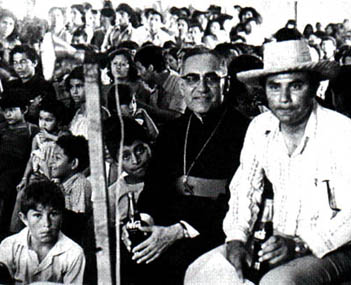
“Each one of you has to be God’s microphone.” – Blessed Oscar Romero

“… you will be led before governors and kings for my sake as a witness before them and the pagans. When they hand you over, do not worry about how you are to speak or what you are to say” (Mt 10:18-19).

Can you feel the anxiety building within his followers? I can! Presented with the possibility of being dragged before family, peers, and local governance can be daunting. The stomach acid begins to swirl and butterflies take flight often before I preach before fellow believers!

When speaking about and/or defending our faith, anxiety arises because we are risking that the message, and more so, we, will not be received. This is because we are focusing more on our self. When Jesus invites us to speak of our faith he is asking us to express and not to impress. Jesus brings us into the Love of his Trinitarian communion. The Holy Spirit, the Love shared between the Father and the Son, who casts out all fear, is present to us to provide what we need to accomplish the task before us, to give us the words to speak, even in the midst of anxiety or fear. We need to learn to trust in him. As Mark Twain wrote: “Courage is not the absence of fear. It is acting in spite of it.”

One of the most powerful prayers during the Mass is during the Communion Rite at the end of the Lord’s Prayer: “Deliver us, Lord, we pray from every evil, graciously grant peace in our days, that, by the help of your mercy, we may be always free from sin and SAFE FROM ALL DISTRESS, as we await the blessed hope and the coming of our Savior, Jesus Christ” (Bold letters mine).

Our anxieties and fears often present the temptation to be indifferent, indecisive, or to look the other way when the dignity of others are infringed upon. The feeling can be suffocating and choking, yet Archbishop Oscar A. Romero (1917-1980), of San Salvador, who was assassinated for publicly confronting the oppressive military in his diocese reminds us in his book, The Violence of Love, that, “There is no dichotomy between man and God’s image. Whoever tortures a human being, whoever abuses a human being, whoever outrages a human being abuses God’s image, and the church takes as its own that cross, that martyrdom.”

When the dignity of any person or people is infringed upon, in any way, may we speak up and act on behalf of those that are belittled, demeaned, or dehumanized. At the first moment that the smallest anxiety, worry or fear sends out its tendrils to grasp at and choke us, may we seek the strength of the Holy Spirit, trust that he will give us the words and the courage to speak what he would have us to say. In this way, may we “be God’s microphone” so as to shine a light in the darkness of oppression and fear.


Photo: Blessed Archbishop Oscar A. Romero with the people of San Salvador. Blessed Romero will be canonized a saint with Blessed Pope Paul VI this October 14, 2018.

Link for the Mass readings for Friday, July 13, 2018:

http://www.usccb.org/bible/readings/071318.cfm

May we “welcome and protect those that need us, especially the vulnerable stranger in our midst.”

“Without cost you have received; without cost you are to give” (Mt 10:8).

We cannot buy the grace of God, we do not earn our way into the kingdom of heaven. God’s grace and presence is freely given, without cost. As with any gift, the joy and fulfillment comes from the willingness to receive and open the gift.

God has given us the gift of his Son. We have the choice to say yes or no to receiving him in our life, each and every moment, each and every day. When we say yes to receiving Jesus into our life, he does not come to dwell with us for our sake alone, we are invited to freely share him with others. The Second Vatican Council renewed this call for evangelization. We are to, as did the Apostles, his disciples, and each following generation, say what he said, do what he did, and live how he lived.

We say what Jesus said when we use our words to empower, affirm, heal, and to convict but not condemn. We do what Jesus did: when we build relationships and foster an encounter with one another, when through our acts of hospitality, mercy, forgiveness, healing, and being present, we attend to the needs of others, especially the most vulnerable in our midst.

We are to live as Jesus did. We are to be holy ourselves in every aspect of our conduct, as St. Peter wrote, “for it is written, ‘Be holy because I [am] holy’” (cf. 1 Peter 1:15-16). We begin to grow in holiness when we recognize, repent, choose no longer to be governed by, and seek healing from our own fears, pride, selfish and ego centered ways of living. We grow in holiness when we say yes to receiving the gift of the purifying fire of the Holy Spirit to come into our life to purge us from our indifference and fear so to be aflame with love. In this way, we will shift our posture from the stiff arm of keeping others at arm’s length and instead open our arms wide to embrace each other, to love one another by giving of ourselves without cost.

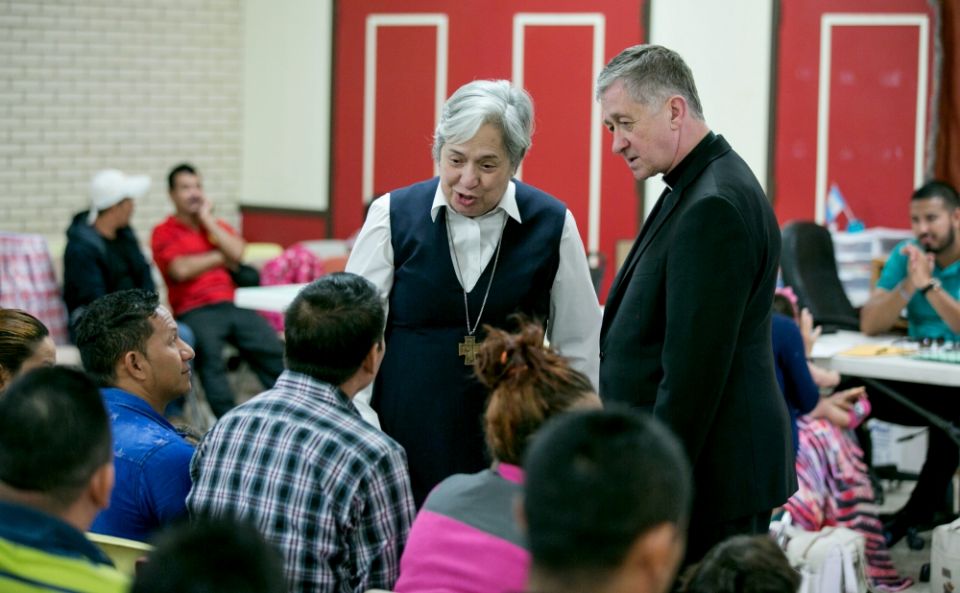
Sr. Norma Pimentel, M.J., executive director of Catholic Charities of the Rio Grande Valley, provides an example for us today of how we can live a life dedicated to “giving without cost”. She has allowed Jesus to minister through her as an advocate for the voiceless along the Texas/Mexico border. Sister Norma has been working with asylum seekers, immigrants, and refugees since the 1970’s, providing welcome, hospitality, and shelter, showing those seeking aid, that hope is still possible and that Jesus does care for their plight. Sr. Norma reflected recently on the beginning of her vocation by stating that, “During those first years of my religious formation, I quickly learned the importance of living out our faith by how we welcome and protect those that need us, especially the vulnerable stranger in our midst.”

Jesus may or may not be calling us to the border, but what he is inviting all of us to do, is to be open to receive the gift of the touch of his embrace, to be loved by him. In receiving the gift of his love, we will begin to see each other with his eyes, to see each other as human beings, created in the image and likeness of his Father. Jesus is calling us to love each other, to be willing to touch and accompany one another in our need. May we reach out and touch someone today.

We pray in thanksgiving for the boys who were rescued in Thailand. May we also pray for the rescue, the speedy, safe unification and healing from the trauma for those children and parents still separated from each other along our border.


Photo: Sr. Norma Pimentel, and Chicago Cardinal Blase Cupich greet asylum seekers at the Humanitarian Respite Center at Sacred Heart Church in McAllen, Texas, Aug. 15. (CNS/Courtesy of Catholic Extension)

Link for the Mass readings for Thursday, July 12, 2018:

http://www.usccb.org/bible/readings/071218.cfm

Let us proclaim, “The Kingdom of heaven is at hand” by having the courage to will each other’s good.

“As you go, make this proclamation: ‘The Kingdom of heaven is at hand” (Mt 10:7).

Empowered by Jesus, the Apostles were sent to proclaim that the Kingdom of heaven is at hand, that the God of all creation is present in our midst and seeks to restore a relationship with his fallen creatures. The Apostles are to continue Jesus’ saving act of restoring and healing humanity’s relationship with God, through word but more so through deed.

Salvation was to be experienced through encounter and interaction with individuals. The Apostles, followed Jesus who devoted himself to people, “accepting them, receiving them into fellowship with him and granting them forgiveness of sins. The power of his affirmation is to be found in his attention to the concrete individual, in particular to the despised, the abused, the sinner, but also involving himself with people in a very personal way… in giving himself away to them” (Gnilka 1997, 111).

We are called to do the same. Empowered by Jesus, we are sent to enter into the chaos of the concrete individuals in our midst and on the margins in a very personal way. Let us spend some time in prayer today asking Jesus to help us to identify our fear, prejudices, pride, and biases, so we may come to a place of contrition, sorrow for the hurt we have caused others from our actions and omissions of reaching out to love. May we ask Jesus to help us to be more present, accepting, understanding, kind and forgiving and ask him to whom does he wish to send us to bring his light, love, mercy, and fellowship, so to spread his proclamation: “The Kingdom of heaven is at hand!”


Photo: Lifting one another up!

Gnilka, Joachim. Jesus of Nazareth: Message and History. Massachusetts: Hendrickson Publishers, 1997.

Link for the Mass reading for Wednesday, July 11, 2018:

http://www.usccb.org/bible/readings/071118.cfm

Troubled and feeling abandoned? Follow the Shepherd.

“At the sight of the crowds, his heart was moved with pity for them because they were troubled and abandoned, like sheep without a shepherd” (Mt 9:36).

There is much that pulls at us for our time and attention. Jesus witnessed the anxieties, struggles, pain, and lost nature of those in his midst. Are we so different today? Jesus knows the Father, he knows the joy and fulfillment of what being in a full relationship with him entails. Jesus saw then and sees in us now how lost we are, how easily distracted we are, how much we put before our relationship with God, and he “is moved with pity.”

Jesus’ heart goes out to us, he yearns to be one with us, he loves us, but in that very act of love, he risks. He loves us so much, that he is willing to let us choose ourselves, others, or a myriad of pursuits over him. Jesus invites us to enjoy developing a relationship with his Father, while at the same time he does not impose himself on us. We are given the whole world to choose from or we can choose him. Who do we put first? Is God a priority in our life? If we find that God is at best an after-thought, or at worst a no thought, what is it that we may be choosing over him? Instead of our getting to know God better, what are we putting before him?

Jesus invites us, but too often, we choose other pleasures, distractions, temptations, and apparent goods. With time and experience we may come to see the emptiness of the lure of these worldly promises, as well as see that our attachments to these often lead to many of our troubles, struggles, trials, and annoyances. We may also get in touch with our feeling unfulfilled, abandoned, and alone, because there is only one answer to our innermost longing, God himself.

Fr. Thomas Dubay writes that the “one who seeks delight in God alone finds peace and joy no matter what happens” (Dubay 1989, 154). Jesus offers to lead us, just as Jesus has led his disciples through the ages. He sees our potential, our promise, the fullness of who we can become. What made the difference for them, was that they said yes to the call of the Shepherd. How will we answer the Shepherd’s invitation today?


Photo: by Kat Jayne from Pexels

Dubay, S.M., Thomas. Fire Within: St. Teresa of Avila, St. John of the Cross, and the Gospel on Prayer. San Francisco: Ignatius Press, 1989.

Link for the Mass readings for Tuesday, July 10, 2018:

http://www.usccb.org/bible/readings/071018.cfm

“If only I can touch his cloak.” If only we can reach out to each other.

“If only I can touch his cloak, I shall be cured.” Jesus turned around and saw her, and said, “Courage, daughter! Your faith has saved you.” And from that hour the woman was cured (Mt 9:21-22).

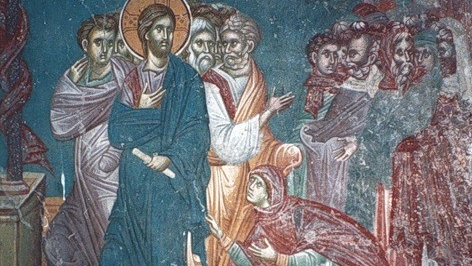
Just to touch his cloak may seem a small and insignificant act, but by doing so, this woman showed tremendous courage. Suffering from hemorrhaging for twelve years, broke from spending all her resources to be healed, she risked. She could have been severely punished, beaten or stoned for this small act. Under the Levitical code her condition deemed her unclean, in the same category as a leper, a pariah. Touching someone else in that condition would then make them unclean. Yet, in that small touch, that great act of courage, “power had gone forth from him” (Mk 5:30), and she was completely healed. Not only did the woman have courage to touch Jesus, but to admit she had done so when Jesus questioned who had touched him.

In calling the woman who touched him out, Jesus was not condemning her, Jesus was acknowledging her faith and restoring her to the community from which she had been ostracized. Jesus restored her dignity. How many women today still feel and experience the pain of exclusion, not having access to the full and equal benefits of society and the Church? How many people are still considered outcasts and pariahs in our communities?

Pope Francis in his general audience from August 31, 2016 stated: “Once again Jesus, with his merciful behavior, shows the church the path it must take to reach out to every person so that each one can be healed in body and spirit and recover his or her dignity as a child of God”. May we treat each person we encounter, in person and online, with dignity, mercy, and respect. May we respect the dignity of the women in our realm of influence. May we have the courage and persistence of this woman, to risk and reach out to Jesus even when it may cost us to do so: Jesus who is present in the marginalized, those on the peripheries among us, those we may consider unclean. In so doing, in risking to reach out and touch one another, we will be healed and our lives transformed!


Icon of woman touching the cloak of Jesus

I invite you to read and meditate today on the story in full from each of the synoptic records: Mark 5:21-43, Matthew 9:18-26 and Luke 8:40-56. These are powerful accounts!

Link for the Mass readings for Monday, July 9, 2018:
http://www.usccb.org/bible/readings/071017.cfm


Let us work with the Carpenter to build the Kingdom of God.

“Is he not the carpenter” (Mk 6:3)?
This is a fascinating phrase because it addresses a common question that many have. What was Jesus doing from the last time we read about him in the Gospel of Luke, when Mary and Jesus find him in the Temple, to the beginning of his public ministry? The years from twelve to thirty are often called the hidden years of Jesus because there is no written record describing Jesus or what he was doing during this time. There have been many speculations, but I believe that Mark encapsulates concisely what Jesus was doing in this verse: nothing unusual or out of the ordinary.
Jesus grew up in Nazareth, a small town of about two to four hundred residents. Most of the people lived a simple, agrarian lifestyle. Joseph was a tektōn, carpenter, as translated above, meaning he was most likely a common woodworker, and day laborer. He would have belonged to the artisan class. For us today, not so bad, but during this time period, it would have meant that Joseph and his family would have been considered on the lower rungs of the social ladder, lower than even the peasants “because they did not have the benefit of a stable plot of land” (Martin 2014, 78). The only people that would have been considered any lower in society would have been those considered outcasts and unclean.
What was Jesus doing during his life during these hidden years? Most likely, he started as an apprentice of Joseph. Together they lived a hard life on the margins, relied on God and each another. Jesus grew up as a faithful and devout Jewish man, and all else was pretty much uneventful. In today’s Gospel from Mark we see that Jesus has returned home after his ministry and outreach had already begun. Word of Jesus had gotten back to his hometown crowd that he had been casting out demons, healing the blind, the lame and the sick, and as witnessed in his home synagogue, taught with authority, his own. Jesus did not preface his teaching by sharing which Rabbi or scribe he was citing.
Other than learning his faith from Mary, Joseph, and his extended family and local synagogue, most likely, nothing even theologically eventful happened while he grew up, because as is evidenced in today’s reading the crowd questioned, “Where did this man get all this?  What kind of wisdom has been given him? What mighty deeds are wrought by his hands! Is he not the carpenter” (Mk 6:2-3)? How could this simpleton woodworker, who we have known all his life do or speak as he does?
The derogatory way in which tektōn was viewed may also be indirectly present in the four Gospel accounts as well. Mark is the only one who cites that Jesus is a tektōn directly. Matthew uses the phrase “carpenter’s son” (Mt 13:55), Luke and John do not even mention tektōn at all, writing, “Joseph’s son” (Lk 4:22) and “the son of Joseph” (Jn 6:42). The further away in time, the record cleans up Jesus a bit more.
What is the relevance of Mark’s simple phrase, “Is he not the carpenter?” (Mk 6:3), mean for us today? It means that the Son of God became human, lived a mundane and harsh life on the margins like many in our world today. It means that God began in small measured ways, even with his Son, regarding his plan of salvation that unfolds over time, in his time. We can be assured that God is continuing his work in us and through us as well today and that we can participate in that very plan.
Even if we believe in God, we may not feel that God is working in or through us. We may feel ineffectual, out of touch, overwhelmed, with little or no sense of direction. We may or those close to us, may have just been dealt with something unexpected and dire, or have been struggling chronically for a long time with health conditions. We may also feel life is going pretty well, that we are on top of the world, yet something is still missing, still alluding our grasp.
We need to slow down, if we want to catch up to God’s plan and follow his blueprint. No matter where we find ourselves in our present condition in life, Jesus has not left us to deal with our situation alone. Jesus understands what we are going through from his own experiences of humanity and because of his divinity, Jesus is in our midst, present and accompanying us today. We need to trust, be patient with him, and invite the carpenter into our situation. May we surrender our control to Jesus the tektōn, and work along side of him to build a firmer foundation for our life and for others. Knowing full well that as we align our faith more and more visibly to the teachings of Jesus, let us be prepared to receive some of the same rejection that Jesus did.

Photo: Summer projects, working with the Carpenter, physically and spiritually!
Martin, S.J., James. Jesus: A Pilgrimage. New York: Harper Collins, 2014.
Link for the Mass reading for Sunday, July 8, 2018:
http://www.usccb.org/bible/readings/070818.cfm

Becoming new wine skins.

“Rather, they pour new wine into fresh wineskins, and both are preserved” (Mt 9:17).

Mark, Matthew and Luke all record the reference of pouring new wine into fresh wineskins. What Matthew adds is, “and both are preserved.” Luke adds: “[And] no one who has been drinking old wine desires new, for he says, ‘The old is good.’”

The Gospel authors are reflecting the tensions of those who would follow Jesus and his new way and those who would not. To accept the Gospel, the Good News of the kingdom of God in their midst, one needs to change their mind and heart. “The tension, and often incompatibility, between the old and the new is part of every religious tradition and attends every change within that tradition. Matthew and Luke wrestled with it and adapted it to their community situation. Contemporary Christians have no less a challenge” (The Gospel of Mark, Donahue, SJ, p. 109). Matthew shared with his community that Jesus is the new Temple, the old has been destroyed. Following him in fact meant that both the old and new covenants would be preserved. Jesus is the fulfillment of the law and prophets, he is the natural progression of what went before him.

We are invited to wrestle as well. The Church is called to change, to be transformed by the Living God. Many say the Church needs to change this and that, not realizing that we are the Church, the People of God, the Body of Christ. If the Church is to mature and grow each of us are to embrace transformation, being made anew through the guiding presence of the Holy Spirit. This invitation is a call to let go of those habits, lifestyles, behaviors, mindsets, attachments, and addictions that are weighing us down or worse holding us in bondage and slavery to our sin, keeping us separated from God. Much of the material and finite things we hold onto prevents us from receiving the new life God wants to pour into us.

Jesus has come to set us free from our enslavement to sin, he invites us to try some new wine, the message of his actions and teachings as recorded in the Gospels. We do not have to be afraid of the change and transformation Jesus is calling us to. As St Irenaeus, the second century bishop of Lyons is attributed to have written: “The Glory of God is Man fully alive!” Jesus is inviting us to live our life and live it to the full! To become new wineskins then, may we begin to identify and let go of those selfish and sinful inclinations that keep us from being filled by the new wine Jesus wants to pour in us. Each day may we create a place of stillness for God alone, for it is in the stillness of our hearts that we can hear God speak to us.

Let us spend some time in prayer today, to contemplate, and ask Jesus to reveal one attachment that is keeping us from actualizing our potential and who he calls us to be, one way in which we have been turning within ourselves instead of willing the good of another. Each time we come to God in stillness he will reveal to us that which distracts us from going deeper. You may be thinking the old wine is good, but I have had some of the new. The new wine is much better! As we are more and more conformed to Jesus, who we are remains intact, in fact, what falls away is the false self as we become more of our authentic and true self.


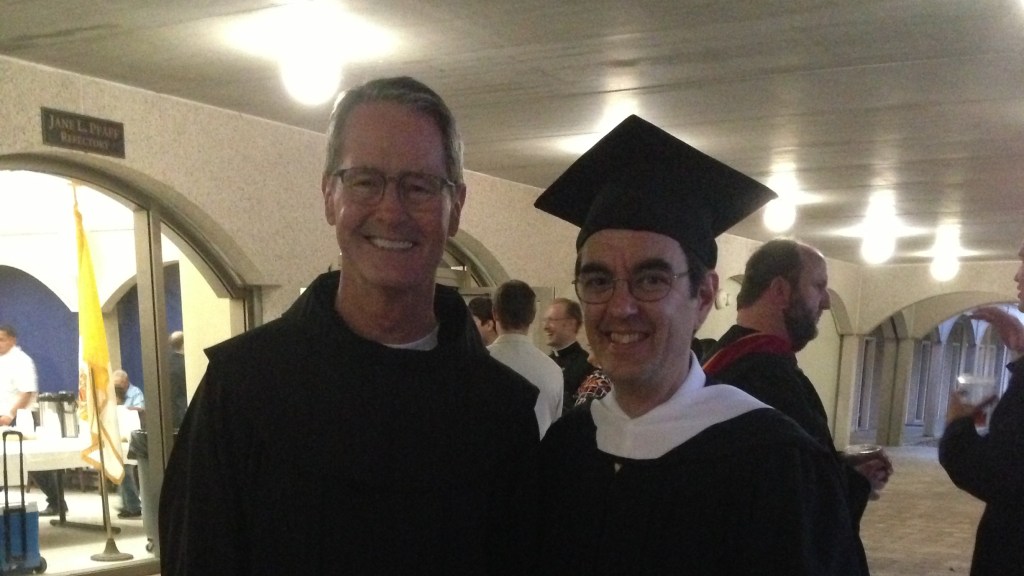
Photo: With Fr. Bill Burton, ofm. 2013 graduation from St Vincent de Paul Seminary. Fr. Bill definitely helped me to shed my old wine skin and put on the new so to better receive the new wine of the Gospel!

Donahue, John R. S.J., and Daniel J. Harrington, S.J. The Gospel of Mark. Vol. 2 of Sacra Pagina, edited by Daniel J. Harrington, S.J. Collegeville, MN: Liturgical Press, 2002.

Parallel Scriptural accounts:

See Mark 2:22, Matthew 9:16-17 and Luke 5:37-39

Link for the Mass readings for Saturday, July 7, 2018:

http://www.usccb.org/bible/readings/070718.cfm