We Live by Faith

Then the disciples approached Jesus in private and said, “Why could we not drive it out?” He said to them, “Because of your little faith.” (Mt 17:19-20).

How do the disciples get from this recurring theme of having little faith in the Gospel accounts to Peter healing a crippled beggar when he said, “I have neither silver nor gold, but what I do have I give you: in the name of Jesus Christ the Nazorean, [rise and] walk” (Acts 3:6)?

A helpful definition “is to say that faith always entails a relationship between persons which stands or falls with the credibility of the person who is believed” (Rahner and Vorgrimler, 164). Faith is not just an intellectual exercise, it is a lived experience. Christian faith is the absolute conviction, belief, and relationship experienced with Jesus Christ. The disciples learned from Jesus but more importantly developed an intimate relationship with him, such that the love they received and shared became so strong that there was no more room for doubt, distraction and fear, such that they would align themselves with the will of God and do what Jesus did and through him do even greater deeds than he (cf. Jn 14:12-14)!

We are invited to do the same. If we only read the Gospels or hear them read at Church we may know something about Jesus, but our life will for the most part remain unchanged. But when we read, meditate and pray with the Gospels, and put into practice what we read, like the disciples we will come to know and develop a relationship with Jesus and be conformed to him. In this way, we are not just reading a dead letter but encountering the living Word, the Son of God who invites us to share in the infinite dance of Love that he participates in with God the Father and God the Holy Spirit.

As our relationship and intimacy with Jesus grows and matures we too will be able to say with conviction the words of Paul: “I live by faith in the Son of God who has loved me and given himself up for me” (Galatians 2:20).

———————————————————————–

Mass Readings for today, Saturday, August 12, 2017:

http://www.usccb.org/bible/readings/081217.cfm

Rahner, Karl and Vorgrimler, Herbert. Theological Dictionary. New York: Herder and Herder, 1965.

Painting credit: CB Chambers
Take Up Your Cross

Jesus said to his disciples, “Whoever wishes to come after me must deny himself, take up his cross, and follow me. (Mt 16:24).

Jesus invites us to deny our self-centered default position which places I, me, and mine, at the center of each our decisions. We also deny our self when we resist making excuses for our sins and come to a genuine place of sorrow for the pain we have caused God, our self and others. By acknowledging our sins and confessing them, we die to our selfish ways, and then we rise again through the power of Christ. Empowered by our humility and the strength of Jesus we are better equipped to resist those temptations when they rise again.

We are also in a better position to then take up our cross, which is to follow the will of God. Jesus showed us the proper orientation of surrender when he said at Gethsemane: “Father, if you are willing, take this cup away from me; still, not my will but yours be done” (Lk 22:42). Jesus was willing to follow his Father’s will to the cross of horrific suffering, excruciating pain, humiliation and abandonment, to death and into new life!

Many a mother I have talked to has shared the struggles of labor, but the joy of the birth; many of my students have shared the time and effort expended for an examination, a sporting event, art show, musical or theatrical performance and the joy they experienced from the feat they accomplished; and how many times have you faced a challenge, trial, or cleared some obstacle and felt the exhilaration of success?

Taking up our cross, following the will of God is the same. In actuality, each of the examples above can certainly be expressions of following God’s will. Seeking God’s will in the midst of our decision-making process and trials is the key.

In my mid-twenties, I entered the Franciscan Friars of Holy Name Province to study for the priesthood. In the year and a half of discernment with them, I contemplated from time to time about my ordination day. I often did not feel any joy. I enjoyed every aspect of my experience with the friars and the ministries I was involved in, but there was something or someone missing. I took a leave of absence and in that time, I realized what was missing was having a family. About two years later I met JoAnn, and her three children, Mia, Jack and Christy, and six months after that we were married. Seventeen years after our marriage I was ordained to the permanent diaconate. This is the short version of the story. There were many crosses along the way, but in seeking God’s will throughout, the circle was complete! The journey continues.

Self-denial, carrying our cross, and following Jesus is the path that leads to freedom for excellence, fulfillment and joy!

———————————————————————–

Mass Readings for today, Friday, August 11, 2017:

http://www.usccb.org/bible/readings/081117.cfm

May We Die to Ourself

Jesus said to his disciples: “Amen, amen, I say to you, unless a grain of wheat falls to the ground and dies, it remains just a grain of wheat; but if it dies, it produces much fruit. (Jn:12:26).

In reading this verse, I was transported back to Middle School. Our sixth-grade class was dismissed to head to the cafeteria for the Science Fair. As I drew closer I could hear some unintelligible chanting going on. Of course, I was curious and craned my neck to see over the other students filing in as we entered our destination. I drew closer to see a circle of kids chanting and circling. I stopped as I heard muffled groans and then saw one of my friends standing in the center of the circle, his forearms pulled up to cover his face. No one was laying a hand on him, but that heckling and chanting was inflicting its damage. I froze not knowing what to do or how to act.

I don’t remember how the situation was resolved, but I remember how bad I felt that day, and still do for not doing anything. I also withdrew from my friend when I saw him later because I felt so bad, I couldn’t even be there for him to provide any comfort as I was still only thinking of myself and not his feelings.

That day, I remained just a grain of wheat. I was unwilling, unable to die to myself to stand up for my friend or provide any comfort.

When we find ourselves in such situations, when another’s human dignity is being diminished, even now as adults, Jesus reminds us that we are not to love our life, assess our own self-interest first, or we will lose it. Instead we are to love, to will the good of the other, to hate our life in this world so as to preserve it for eternal life (cf. Jn 12:25) By building a foundation of thinking of the other first instead of ourselves we will be in a better position to serve as Jesus did.

May we pray for each other today, that we may draw strength from Jesus, to be that grain of wheat that dies to self, so that our actions directed toward others may be empowering, caring, and supportive; and may we bear the fruit of his courage to stand up, to speak up and out, for the dignity of those in our midst who are treated in any way that belittles or demeans their dignity as a person.

———————————————————————–

Mass Readings for today, Thursday, August 10, 2017:

http://www.usccb.org/bible/readings/081017.cfm

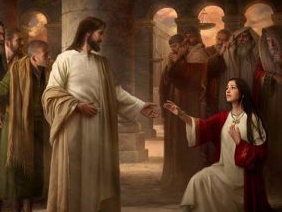
“O Woman, great is your faith!”

He said in reply, “I was sent only to the lost sheep of the house of Israel.” But the woman came and did him homage, saying, “Lord, help me.” He said in reply, “It is not right to take the food of the children and throw it to the dogs.” (Mt 15:23-24).

I would encourage you to read the full account (Mt 15:21-28), it is only eight verses. See the link below.

Jesus’ reaction in this scene does not appear to be consistent with how he has acted toward others who have approached him in the past. Is he just having a bad day and taking it out on this woman? Is his reaction because she is a woman and a Gentile at that? I don’t think so in either case.

Jesus has seen his disciples time and again attempting to turn people away, just as recently when the five thousand were hungry and they were ready to send them to the nearby villages, knowing the hour was late to get their food. I am sure Jesus was tired that day too, all but spent, and I am sure he did not check who were the card-carrying Jews among those gathered, but he fed all present.

I wonder if Jesus was not so much testing the woman’s faith, as much as testing the faith and the response of his disciples. The woman was calling for help. Would the disciples offer to provide her support, following the lead of Jesus who they have observed so many times before? Jesus remained silent to her initial plea, what would the disciples do? They asked Jesus to send her away. Jesus appeared to support their indifference when he justified his non-response by stating that he was sent to the lost sheep of Israel, clearly she was of another fold. Again, the disciples did not step up to defend the woman in need. The woman persisted. She came forward and knelt before Jesus imploring him to help her and Jesus met her with a degrading slur, referring to the woman as a dog. The disciples would now certainly appeal to Jesus for mercy, right? Nothing. Nada. His apostles stayed silent, or worse they may have even started to have a good laugh ay=t her expense.

The woman does not back down, she remains resilient. She is here because her daughter needs help and she will not be turned away. She does not react or get defensive, but comes back with her own retort that even the dogs will eat the scraps that fall from the table. Jesus then upends the whole scene and shares that the woman is the one with great faith! A woman, a Gentile, not his disciples.

Those who have great faith are the ones who believe and act on that belief. Coming up with excuses to turn people in need away is not faith. Those who are aware of the need of another and are willing to take a risk to reach out and help, that is great faith. How would we have acted in this same scenario? I invite you to read this segment in full a few times, then imagine yourself in the scene. Who are you? And honestly, how would you react? If we are going through a trial as did the woman, do we have her persistence, determination, and resilience not to give up? How can we align ourselves with Jesus and his ministry of service today? If you get a bit stuck, ask Jesus who knows for help!

———————————————————————–

Mass Readings for today, Wednesday, August 9, 2017:

http://www.usccb.org/bible/readings/080917.cfm


Peter Walked on Water!

“It is a ghost,” they said, and they cried out in fear. At once Jesus spoke to them, “Take courage, it is I; do not be afraid.” Peter said to him in reply, “Lord, if it is you, command me to come to you on the water.”
He said, “Come.” Peter got out of the boat and began to walk on the water toward Jesus. (Mt 14:26-29).

No matter how many times I read this Gospel, I get goosebumps because, Peter was walking on the water! Yes, he quickly started to sink, but for that brief moment…

Life is a struggle, challenges, fears, trials, and conflicts pound at us. Do we allow ourselves to be paralyzed by our fears; or do we look for Jesus who is already present in the midst of our storms?

In many a top ten, list of fears, I would guarantee speaking in public will consistently make the top three. I have struggled with this myself for as long as I can remember. I still remember the first reflection I gave during my formation for the deaconate. I must have prepared for three to five hours, writing and rewriting well into the wee hours of the morning the night before. Just before the morning liturgy, our director of formation, Deacon Dennis Demes, informed me that there had been a last-minute change of plans and we were going to have different readings. He offered to give the reflection or gave me the option to continue and incorporate what I had planned into the new readings.

As we processed in, the winds and waves of anxiety started to kick up a storm and continued to build when it was my time to come up and read the Gospel. As I began the reading, a quiet peace settled over me. I then began to preach extemporaneously, ignoring my notes. There was a feeling of joy that welled up in me that I can’t explain, other than, I was walking on water! Half way through the reflection though, I looked away from my brothers and back to my notes. I sputtered from there, but finished free of any major catastrophe.

After the service was over, I remained in my seat quietly for a second to catch my breath. My classmates Dennis, Hank, and Pete swarmed around me like I had just touched home plate after a walk off homerun. I can still feel Pete’s bear hug, and have drawn on my brother’s support and strength from that morning on more than one occasion, as I have faced similar storms.

There will be times when Jesus will invite us to come out of the boat. We need to trust him and step out in faith. This will be a risk, and yes, there will be times that we will sink, just as Peter had done. But even though he sank, he immediately remembered to call out to Jesus to save him and Jesus immediately reached out his hand and pulled him up. Jesus was there for Peter, he has been there for me, and he will be there for you. “Be not afraid!” Come out of the boat, and walk on the water!

———————————————————————–

Mass Readings for today, Tuesday, August 8, 2017:

http://www.usccb.org/bible/readings/080817.cfm

Are We Aware?

When he disembarked and saw the vast crowd, his heart was moved with pity for them, and he cured their sick. (Mt 14:14).

The feast of the feeding of the five thousand was quite different from the birthday feast of Herod Antipas (Mt 14:1-12). Herod’s focus was on himself, not the welfare of the guests attending his banquet. Herod’s pride was on full display, and it culminated in his ordering the head of John the Baptist to be served up on a platter.

Jesus was focused instead on those who gathered around him; “his heart was moved with pity for them”. Jesus was aware of their need, their hunger, not only for something to eat, but a deeper spiritual hunger. He made himself available to them. Jesus taught, healed, and when that time ended instead of sending them off to fend for themselves, in the multiplication of the bread and fish, he met their most basic need of nourishment.

There is a stark contrast between the attitude of Herod and Jesus. We can certainly see these two scenes playing out clearly in our country and world today. The question for us is do we close ourselves off, embrace an indifference to those who are in need, and let others fend for themselves, or do we make an effort to be aware of the needs of those around us. Mother Teresa said: “People are hungry for God. People are hungry for love. Are we aware of that? … Do we have eyes to see? Quite often we look but don’t see. We are all just passing through this world. We need to open our eyes and see” (Mother Teresa, 56).

We do not have to feed five thousand. The effort of putting our love into action for one person today is a good way to begin. Let us ask Jesus for the eyes to see that we may be aware, for a heart that is open that we may feel, and for a soul on fire with the Holy Spirit to reach out and be present to those in need in our midst. “We are collaborators with Christ, fertile branches on the vine” (56).

———————————————————————–

Mass Readings for today, Monday, August 7, 2017:

http://www.usccb.org/bible/readings/080717.cfm

Mother Teresa. No Greater Love. Edited by Becky Benenate, Joseph Durepos. Novato, CA: New World Library, 2001

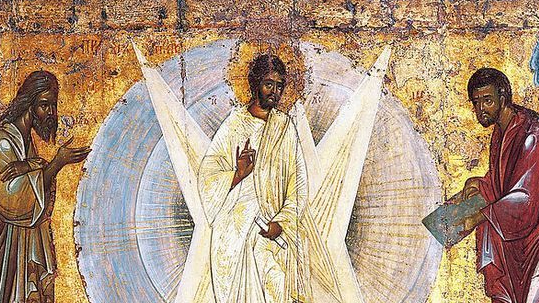
The Feast of the Transfiguration

Jesus took Peter, James, and his brother, John, and led them up a high mountain by themselves. And he was transfigured before them; his face shone like the sun and his clothes became white as light. (Mt 17:1-2).

Peter, James and John certainly experienced Jesus’ profound teachings, his powerful signs and wonders, they also experienced his healing on the Sabbath, casting out demons, and forgiving of sins, which, alluded to the reality that he was the Son of God. I imagine Peter, James, and John, though acknowledging Jesus as the Messiah, still pretty much looked at Jesus as a human being. In the encounter of Jesus transfigured, Jesus revealed to his inner circle of Apostles not only a foretaste of what was to come in heaven, but a glimpse of his actual divinity.

Jesus is not 50% God and 50% human. He is fully God and fully man. This is the Mystery of the Incarnation; the reality that the second Person of the Trinity took on flesh and became human. This is an important reality, because in this very act of Infinite Grace, assuming humanity, God opened up heaven for us. The Son of God became one with us so that we can become one with him. Through participation in the life of Jesus Christ we can restore our relationship with his Father.

“By revealing himself God wishes to make [us] capable of responding to him, and of knowing him, and of loving him far beyond [our] own natural capacity” (Catechism of the Catholic Church, 2nd ed., 52). As I have been sharing in prior posts, this reality of the invitation of communion with the Loving God and Father of all creation is for all. Our joy and fulfillment is achieved through developing a relationship with the God of Jesus Christ.

Many may say they are happy and living a good life without having a relationship with Jesus Christ or apart from God, and I would not disagree with them. I would only add that if we are honest with ourselves, there is more to life than the mere materiality before us. That if we slow down enough, we experience a yearning for more. Even with great achievement, mastery, and accumulation, there is still a lingering question, “Is this all there is?” We experience consciously or unconsciously a restlessness, we continually search to fill this unease with material and finite things, feeling satisfied for the moment, but eventually in short order, we are left feeling empty, time and time again. This unease is our soul’s yearning, our transcendent nature to long for more, and that longing is for the infinite that the finite cannot provide.

St Augustine of Hippo (354-430) articulates this desire and yearning so well in the opening chapter of his autobiography, Confessions: “You move us to delight in praising You; for You have made us for Yourself, and our hearts are restless until they find rest in You.”

The Feast of the Transfiguration is an invitation, not to reject our humanity, but to embrace the fullness of what it means to be human, as the Son of God did through the Mystery of his becoming one with us. We are invited to embrace the fullness of our humanity; the reality that we are physical, emotional, intellectual, as well as spiritual human beings.  Our fulfillment and joy comes from a balance of nurturing each aspect of who we are in participation with Jesus.

Peter, James and John, as well as Augustine and the saints, embraced the invitation of Jesus and that has made all the difference. God invites us to do the same. To experience the wonder, to explore the full breadth, depth, and width of all that our reason and faith can open for us that we may draw ever deeper into the intimacy of a loving relationship with God, ourselves, and each other. I invite you to say yes to that same invitation today, tomorrow, and each day going forward, to experience the fullness of our humanity and through participation in Christ, our divinity!

———————————————————————–

Mass Readings for today, Sunday, August 6, 2017:

http://www.usccb.org/bible/readings/080617.cfm


Who Do We Serve?

Herod the tetrarch heard of the reputation of Jesus and said to his servants, “This man is John the Baptist. He has been raised from the dead; that is why mighty powers are at work in him.” (Mt 14:1-2).

After the death of Herod the Great (4 BC), one of his sons, Herod Antipas, was given a portion of his father’s kingdom by the Roman Emperor Augustus. Thus, Herod Antipas was the tetrarch, or prince, of Galilee and Perea from 4 BC to 39 AD. Herod, like, Pontius Pilate, held power as long as he was a faithful servant to Rome.

News of the ministry of Jesus gets back to Herod and he believes Jesus to be John the Baptist raised from the dead. What follows is the backstory of how Herod arrested and unjustly beheaded John the Baptist. John is killed for speaking truth to power, as happened often in the long line of prophets before him. Jesus would continue John’s ministry calling for repentance. He too would also suffer capital punishment at the hands of Herod Antipas and Pontius Pilate. The Apostles and martyrs of the early Church also lived courageously and were bold witnesses of their faith even to point of giving their lives.

How are we living our faith  today? Are we faithful to the Gospel values that Jesus and the Apostles taught and were willing to die for?  Do we serve Herod Antipas and Pontius Pilate or Jesus the Christ? Do we serve fear or love?

It is important to stop and reflect on questions such as these from time to time, to examine our conscience and determine who it is that we are truly serving. God loves us more than we can ever mess up. We can only experience the fullness of his light, love, mercy, and forgiveness if we are willing to repent, to let him into the darkness of our failure of not putting into practice his will. In experiencing his forgiving embrace of love and mercy, we are more open to knowing his will, to knowing how he wants us to serve him. Empowered by his love, we can then begin again to take a step forward along the narrow path, recommitting ourselves to living as his disciple.

———————————————————————–

Mass Readings for today, Saturday, August 5, 2017:

http://www.usccb.org/bible/readings/080517.cfm


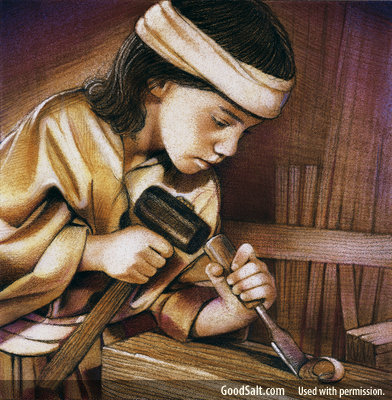
The Carpenter

“Where did this man get such wisdom and mighty deeds? Is he not the carpenter’s son?” (Mt 13:54-55).

Many people wonder what Jesus did from the age of twelve until he began his ministry around the age of thirty. Today’s reading gives us some insight into that question. Most likely, Jesus did nothing out of the ordinary realm of any other first century Palestinian Jew living in the small town of Nazareth, with a population of about 250 to 500 people.

Jesus most likely worked as a carpenter. This was rough, menial work, and a position that was looked down upon. We can even see evidence of this in the Gospel accounts. Mark describes Jesus as the carpenter, the son of Mary, Matthew portrays Jesus as the carpenter’s son, and Luke and John just refer to Jesus as Joseph’s son, leaving out all reference to carpenter altogether. Most scripture scholars believe Mark was written first, so we can see a progression in the biblical tradition moving quickly away from identifying Jesus as a carpenter.

Jesus’ return to his hometown and his teaching was first met with wonder, where did he get such wisdom and how did he work such mighty deeds? But wonder soon turned to judgment. Who is he? He is just the carpenter of Nazareth, no better than any of us. In effect, “Who does he think he is?” Not only does this show that Jesus probably lived a very simple peasant life, but that Jesus’ social status was set in stone.

The people’s hearts and minds were closed to Jesus, THEY KNEW who he was and there was no way someone like him could do what they had heard, so they “took offense at him… And he did not work many mighty deeds there because of their lack of faith” (Mt 13:57-58).

How many times have we judged someone, saying to ourselves, I know who he or she is. We box them in, not as they are, but as WE see them. We look at another individual not as a person with dignity, but as a two-dimensional cut out character to satisfy our own prejudices. We also do this to ourselves, chaining ourselves, limiting our potential by saying I can’t do this or that.

Jesus rebukes these limiting perspectives. Instead he seeks to do mighty deeds in our lives and so invites us to open our minds and hearts to rest in the depths of our soul where we can touch the love and power of the Holy Spirit, repent from our judgmental and prejudicial dispositions, so to be healed from the finite limitations of our brokenness and sin. Let us resist the temptation to limit Jesus, others, and ourselves.

May we instead accept the invitation of our loving God and Father to embrace the infinite possibilities that will arise when we participate in his Life and Love. This invitation is for each and every one of us, no matter our race, gender, ethnicity, nationality, religious, political, economic, social, immigrant, or migrant status. Let us accept the invitation of the Holy Spirit who seeks to free us from the shackles that bind us, the limitations imposed upon us, and those we impose on ourselves and others. May we follow Jesus the carpenter who calls us to conform our life to his, so that we will actualize who he encourages us to be, and better be able to empower others in our realm of influence to do the same.

———————————————————————–

Picture credit: Darrel Tank/GoodSalt.com used with permission

Mass Readings for today, Friday, August 4, 2017:

http://www.usccb.org/bible/readings/080417.cfm

Parallel Gospel accounts: Mark 6:3, Matthew 13:55, Luke 4:22, and John 6:42

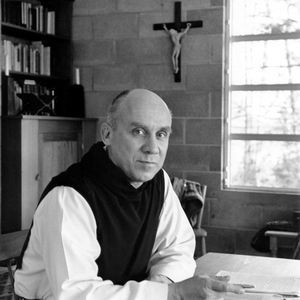
The Road Ahead – Thomas Merton

My Lord God,

I have no idea where I am going.

I do not see the road ahead of me.

I cannot know for certain where it will end.

Nor do I really know myself,

and the fact that I think that I am following

your will does not mean that I am doing so.

But I believe that the desire to please you

     does in fact please you.

And I hope I have that desire in all that

     I am doing.

I hope that I will never do anything apart

     from that desire.

And I know that if I do this, you will lead

     me by the right road

     though I may know nothing about it.

Therefore, will I trust you always though

     I may seem to be lost.

and in the shadow of death. I will not fear,

     for you are ever with me,

and you will never leave me to face my perils

      alone.

     Amen.