Listen up!

“The mother of the sons of Zebedee approached Jesus with her sons and did him homage, wishing to ask him for something. He said to her, ‘What do you wish?’ She answered him, ‘Command that these two sons of mine sit, one at your right and the other at your left, in your Kingdom’” (Mt 20:21-22).
The context of this request from the mother of the sons of Zebedee, James and John, comes from reading a few verses before the quote above. Start reading at Matthew 20:17 and you will see that Jesus and his twelve apostles are heading toward Jerusalem. Jesus stops to share with them, for the third time, that he will be condemned and crucified.
Jesus’ statement of his imminent suffering and death appears to be ignored by the mother of James and John. The other ten are indignant, not regarding the lack of acknowledging Jesus’ statement, but about who is the greatest among them! It is easy to imagine how the chaotic scene ensues! “See how imperfect they all are: the two who tried to get ahead of the other ten, and the ten who were jealous of the two” (Chrysostom, 1551)!
This event is recorded in Matthew, Mark and Luke. Mark has James and John speaking for themselves, not their mother, as in Matthew. Luke does not even record the initial request of James and John at all, but comes in at the point of the apostle’s dispute. What all record, including the Gospel of John, is that Jesus made it clear to his apostles that he came to serve not to be served. To follow Jesus meant, not that they would be in positions of power, the sitting to his right or his left, but that they were to serve as he served, to love as he loved.
One of the most powerful ways we can serve, can love, is to be truly present with others and this is done most effectively when we actively listen. We need to resist the temptation that the apostles fell for, thinking about their own needs instead of listening to what Jesus was sharing with them; the coming of his own death! We need to put the book down, set the work aside, turn off the tv, put away the cell phone, disengage our thoughts, and instead look at and listen to what the person in our midst has to say.
Today, may we make time to stop and listen to Jesus, to our family, our children, and friends, and those, who we may have in the past not given the time of day. Jesus came to serve, to love, by willing the good of the other as St Thomas Aquinas said. Let us too serve and love one another by giving of ourselves with our time and attention.
—————————————
Mass readings for today, Tuesday, July 25, 2017:
Parallel Gospel passages to review:
Mark 10:35-45; Matthew 20:20-28; Luke 22:24-27 and John 13:12-17
Chrysostom, St John. Homily. Catholic Church. The Liturgy of the Hours: According to the Roman Rite. 1975.

The Sign of Jonah

“An evil and unfaithful generation seeks a sign, but no sign will be given it except the sign of Jonah the prophet” (Mt 12:39).
Jonah is the prophet best known as the one who spent 3 days and nights in the belly of a whale, great fish or sea monster, depending on your scriptural translation. Jonah ended up in that predicament because he refused to follow God’s direction to speak his message of forgiveness to the sworn enemies of Israel, the Ninevites. It would be like God asking one of us to fly out to the Middle East to meet with members of ISIS or Al-Qaeda and invite them to repent. Not only would we not believe they would want to repent, would we want them to if they would? Also, whether they did or didn’t, would we be able to return from such a meeting with our heads intact?
These were probably some of the issues running through Jonah’s mind when he refused to follow God’s will. Jonah overcame his resistance and followed the command of the Lord, kept his head on his shoulders, and the people of Nineveh repented. Happy, happy, joy, joy! Not exactly. At the repentance of his enemies and God’s expression of mercy and forgiveness, Jonah said to God, “This is why I fled at first to Tarshish. I knew that you were a gracious and merciful God, slow to anger, rich in clemency, loathe to punish” (Jonah 4:2)”. Jonah did not want his enemies to receive God’s forgiveness!
Some of the scribes and Pharisees asked for a sign. Jesus gave them the sign of Jonah: The Ninevites, who were Gentiles, non-Jews, were willing to repent at the word of Jonah, and those scribes and Pharisees before questioning him, God’s chosen, were not willing to repent at the urging of one greater than Jonah, the Son of God, who was in their midst.
Jesus announced his ministry, as recorded Mark 1:15, with the words: “The kingdom of heaven is at hand. Repent and believe in the Gospel.” That is again our invitation today. Let us examine our conscience by asking God to help us to recognize his presence among us, then reflect on what good God has done in our lives and give him thanks. Review the last day or two to see where God has called us to act. Where did we answer his call, where did we, like Jonah resist? For those actions in which we did resist the will of God, especially in turning away from an opportunity to bestow God’s grace upon someone, or committing some other sinful action, we need to ask God for forgiveness. Finally, close by spending some quiet time asking God for his grace to be with us as we go through the day. This examination of conscience is an excellent exercise to practice at the end of each day. (This process I just described is called the Examen, a Jesuit practice I learned from Fr. James Martin, SJ).
Someone greater than Jonah is in our midst, he is Jesus the Christ. May we be willing to bestow his Love and Mercy on all we meet today, even and especially those who may have just popped into our mind that we would rather not share his grace with: those who get under our skin, grate on our nerves, or who we even consider an enemy. Let us repent and call others to do so by the way we live our life.
—————————————
Mass readings for today, Monday, July 24, 2017:

Maples Do Grow in Florida!

“’Master, did you not sow good seed in your field? Where have the weeds come from?’ He answered, ‘An enemy has done this.’ His slaves said to him, ‘Do you want us to go and pull them up?’ He replied, ‘No, if you pull up the weeds you might uproot the wheat along with them. Let them grow together until harvest” (Mt 13:27-30).

One of my favorite trees is a Maple. When JoAnn, the kids, and I moved to Florida twenty years ago, I did not believe that Maples grew in Southern Florida. A few years after we moved into our home, I was walking in our backyard and thought I saw a maple leaf. I squatted down for a closer look and found that not only was it a maple leaf but a sapling with three leaves! I carefully cleared some of the grass around it, but otherwise let it be because it was so small. As it grew I cleared more around it. Today it is a fully mature Swamp Maple!

A few weeks ago, I saw a new Maple sapling emerging, though this time poison ivy was growing in the brush and weeds around it. I sprayed poison ivy killer, thinking I was carefully avoiding the Maple. Unfortunately, I must have gotten some of the poison on the Maple leaves because it shriveled up and died.

You can understand why I related well to Jesus’ first parable in today’s reading. The master warned his servants to let the wheat and weeds grow together until they were more mature at the time of the harvest, so as not to pull up the wheat with the weeds. Weeds in this verse is translated from the original “Greek [as] zizanion [which] refers to a noxious weed that in its early stages closely resembles wheat and cannot be readily distinguished from it” (Harrington, 204). Both, in their immature state, were indistinguishable.

The practical application for us is to recognize the importance of resisting the temptation of judgment. We may be quick to judge or even condemn someone who is not living what we believe our faith tradition dictates, or maybe the person is of another faith or no faith. Even those who commit heinous acts of evil, we may feel justified in our judgment to condemn. Jesus says no. The Father is the ultimate arbiter and judge.

All of humanity has been created in the image and likeness of God, we are a unique gift to this world, we have been created good, yet we all fall short of the glory and grace of God. God the Father will judge at the end of time and only he knows the time or the hour. We are rather to be about following the teachings of Jesus, repenting, and encouraging others in the maturation process which can include, convicting others at times, yes, but condemning, no. As St Paul wrote: “We who are strong ought to put up with the failings of the weak and not please ourselves” (Romans 15:1).

May we resist the temptation to spread the poison of judgment, gossip and condemnation, otherwise we are promoting death, as I did with our second gift of a Maple that withered and died. Let us instead welcome, nurture and care for one another, promoting life, as I did with our first little gift of a Maple. We need to pray for patience, understanding, and the ability to forgive and seek forgiveness in our interactions with each other. Life, even when going well, is hard. We need each other if we are to mature and actualize the fullness of who God calls us to be. “Encourage each other while it is still today” (Hebrews 3:13).

—————————————
Mass readings for today, Sunday, July 23, 2017:
http://www.usccb.org/bible/readings/072317.cfm

Harrington SJ, Daniel J. 2007. “The Gospel of Matthew”. In vol. 1,
Sacra Pagina Series, edited by Daniel J. Harrington, 204.
Minnesota, Liturgical Press.

Mary Magdalene: Hope in the Midst of Sorrow

Mary Magdalene went and announced to the disciples, “I have seen the Lord,” and then reported what he told her (John 20:18).
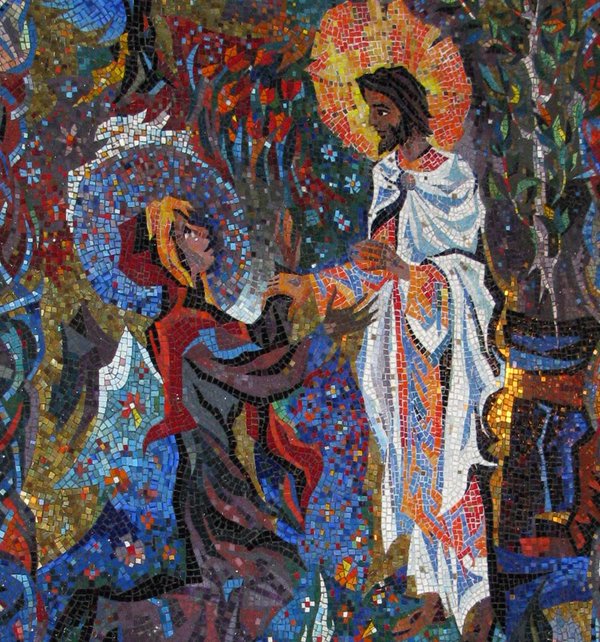
Mary is the Apostle to the Apostles! Though before she announces this proclamation, the foundation of our faith that Jesus is risen, we find Mary weeping outside the tomb. She is crushed by the death of her Lord and his body has apparently been taken away. Peter and John, following Mary’s initial lead, ran to the tomb, saw it empty, and “then the disciples returned home” (Jn 20:10).
Mary stayed, she remained still, experiencing her doubt and growing despair.
How many times have our hopes been obliterated, what pain have we or do we endure, what horrors do we continue to witness throughout our communities, country and world? When Jesus first speaks to Mary, she does not recognize his voice, thinking him to be the gardener. Are we like Mary, that we are so weighed down by our sorrow that we are unable to recognize Jesus in our midst?
Mary was willing to weep, to experience and not run from her sorrow, and deep down held on to hope. Even after seeing the tomb empty, even after Peter and John had left, she still looked in the tomb again. Despite a growing doubt and despair, even after encountering two angels, she did not leave the empty tomb. In the midst of her disillusion, Mary recognizes the risen Jesus when he calls her by name!
May we not lose the ability to weep but also hold on to hope. Both are part of our humanity. To lose our capacity to weep, is to reject our humanity, and then risk the slide into the temptation of indifference to our own hurt and the agony of others. Hope is a cornerstone of our faith. Jesus is present in the midst of our brokenness. When we are willing to be still and experience our emotions, resist the temptation to run away, while at the same time embracing hope, we too will encounter Jesus.
I pray you may experience Jesus in the midst of your trials or sorrow, as well as your joys, for Jesus is present to us through the full range our human condition. And when we encounter Jesus, like Mary, may we go boldly forth with joy, to proclaim what he tells us! May we share our stories of Jesus active in our lives, so to be a living Bible to others. Our stories shared may be the only Bible someone else ever reads.
Mary of Magdalene, Apostle to the Apostles, pray for us!!!

—————————————
Mass readings for today, Saturday, July 22, 2017:
http://www.usccb.org/bible/readings/072217.cfm

Something Greater Here…Mercy!

I say to you, something greater than the temple is here. If you knew what this meant, I desire mercy, not sacrifice, you would not have condemned these innocent men. For the Son of Man is Lord of the sabbath.” (Mt 12:6-8).
 
Jesus continues to rock established regulations and practice. Here he is challenging the understanding of the Sabbath itself when justifying the accusations leveled toward his disciples who were picking and eating grain on the Sabbath, and he does so in a profound way by saying that “something greater than the temple is here.” Present in the heart of the temple, the area called the Holy of Holies, was the ark of the covenant. Atop the ark was the lid called the mercy seat of God. Jews believed that this was where God sat and when the blood of atonement was offered from sacrifices, God’s mercy was offered to the people. In the temple then, was the very presence of God.
 
Jesus’ claim that he is greater than the temple is putting him on the same level as God. A blasphemous statement to say the least, unless of course, he is God. Not only does he make this claim, but he doubles down by claiming that he is the Lord of the sabbath; Jesus is God!
 
In quoting Hosea 6:6: “I desire mercy, not sacrifice”, Jesus is not only saying that he is the something greater, but also that his disciples are, his way is something greater. One of the foundational points of the Way of Jesus is mercy. Through the incarnation, the Son of God dwelt among us, became one with us in our humanity. He restored our dignity in the midst of our brokenness. What Jesus is saying in his defense of his disciples, and what he is saying to us today is: “What is owed to every human being on the basis of his or her human dignity is personal respect, personal acceptance, and personal care” (Kasper, 2014, 202).
 
We as the Church are also greater than the temple as we are the Body of Christ and are to follow Jesus in his bestowing acts of mercy on our neighbor. “The works of mercy are charitable actions by which we come to the aid of our neighbor in his [or her] spiritual and bodily necessities. Instructing, advising, consoling, comforting are spiritual works of mercy, as are forgiving and bearing wrongs patiently. The corporal works of mercy consist especially in feeding the hungry, sheltering the homeless, clothing the naked, visiting the sick and imprisoned, and burying the dead. Among all these, giving alms to the poor is one of the chief witnesses to fraternal charity: it is also a work of justice pleasing to God” (Catechism of the Catholic Church, 2nd ed. 2447).
 
Let us review the spiritual and corporal works of mercy above and choose one to practice this week. May we desire and seek the mercy of God, be open to receiving it, and be open to share his mercy. Let us draw strength and courage from Jesus, so to be willing to face our own brokenness and come to healing, while at the same time bestowing mercy; which is “the willingness to enter the chaos of another” (Keenan, 2015).
 
—————————————
Mass readings for today, Friday, July 21, 2017:
 
Kasper, Walter. 2014. Mercy: The Essence of the Gospel and the Key to Christian Life. NY: Paulist Press.
 
Catholic Church. Catechism of the Catholic Church: Revised in Accordance with the Official Latin Text Promulgated by Pope John Paul II. Vatican City: Libreria Editrice Vaticana, 1997.
 
Keenan SJ, James. “The Scandal of Mercy Excludes No One.” Thinking Faith. December 4, 2015.

With Jesus Our Burdens Are Lighter

Jesus said: “Come to me, all you who labor and are burdened, and I will give you rest” (Mt 11:28).
Scripture scholar, Fr. Daniel J. Harrington, SJ, states that in this passage Jesus’ invitation was given to those who are not yet his disciples, those Jews who do not yet believe in him and his way. He also intuits that Jesus is calling them from the heavy burdens laid upon them by the scribes and Pharisees and inviting them to accept his burden that is lighter (cf. The Gospel of Matthew, 167). We can read this in Matthew 4:3: “They tie up heavy burdens [hard to carry] and lay them on people’s shoulders, but they will not lift a finger to move them.”
The key to the conviction that Jesus levels against the Pharisees is that they impose the law, but do nothing to assist those they are teaching. I would say the demands of Jesus are even more challenging than those of the Pharisees, Sadducees, or the scribes! I shared yesterday one of the six antitheses, here is another: “You have heard that it was said… whoever kills will be liable to judgment. But I say to you, whoever is angry with his brother will be liable to the judgment, and whoever says to his brother, ‘Raqa,’ will be answerable to the Sanhedrin, and whoever says, ‘You fool,’ will be liable to fiery Gehenna” (Mt5:21-22). Jesus is equating calling someone Raqa – an air-head, or calling someone a fool akin to murder. Our words can destroy or empower! We need to choose our words wisely.
The difference between Jesus and the religious leadership is that Jesus, the Son of God in the fullness of his divinity, has entered the chaos of our humanity, as a fully human being and walks among us and suffers along with us. He offers to yoke himself to us and so carry the burden with us, making it lighter. Many impose burdens on us, we impose burdens on others, as did the Pharisees. We also impose them on ourselves and turn away from the invitation of Jesus’ help.
A handful of injuries I have suffered through the years were because I attempted to lift or carry something beyond my strength, instead of seeking assistance from another. I can do it, I don’t need any help! That is just the physical; there are also the mental and emotional burdens of anxiety, doubt, pride, fear, worry. This is not Jesus’ way. He offers a path for us to follow that leads us to joy and peace in this life and fulfillment in the next. No matter what pain, suffering, trial or challenge you are facing right now, you do not have to go through it alone. You just need to remember to reach out your hand to Jesus. You will find his hand already waiting there to grasp yours.
Let us take our first step together today, hand in hand with Jesus, and so find rest in knowing we are not alone! Also, may we be kind to those in our midst with our words, actions and faces. We are not aware of the burdens they carry. A simple smile can make a heavy load just a little lighter.
—————————————
Mass readings for today, Thursday, July 20, 2017:
http://www.usccb.org/bible/readings/072017.cfm

Welcome to Spiritual Stepping Stones!

This is my first attempt at creating a blog. You are invited to share the journey! Please be patient with me as I learn how to develop and maintain this page. My hope is to offer a site to share ideas and enter into dialogue. The beginning category will be reflections from the Gospel from the Mass readings of the day.
Please feel free to share insights, ask questions, write what you believe, in a spirit of charity, recognizing and being understanding of others that post who may have different views. Resist ad hominem remarks and degrading the person. A vibrant discussion helps for growth as long as ideas are tossed about and not insults.
Let us journey together, one stepping stone at a time!

Be open to Trinitarian Love

Wednesday, July 19, 2017
“At that time Jesus exclaimed: ‘I give praise to you, Father, Lord of heaven and earth, for although you have hidden these things from the wise and the learned you have revealed them to the childlike’” (Mt 11:25).
Why did the wise and the learned, referring to the Sadducees, Pharisees and scribes, reject Jesus? Jesus challenged their idol of tradition. Even though Jesus did not come to abolish the law but to fulfill it (cf. Mt 5:17), the invitation to go deeper was challenging. This is certainly highlighted in the six antitheses, Jesus shared during his Sermon on the Mount. Here is one such example: “You have heard that it was said, ‘An eye for an eye and a tooth for a tooth.’ But I say to you, offer no resistance to one who is evil” (Mt 5: 28). Offer no resistance to one who is evil? Hard to swallow for people of Jesus’ time. For us today? Insert that verse into our present dialogue regarding refugee and immigration policies, or Church entrenchment in reaction to atheism, secularism and scientism.
Jesus offered then and continues to offer today the intimacy of the Trinitarian Love shared between Father, Son and Holy Spirit. To be fully alive, to share in his Love, we need to resist fear and holding blindly to tradition for its own sake. Instead we need to be open to growth, change, and renewal. Gerhard Lohfink, in his book, No Irrelevant Jesus, quotes the Polish philosopher Leszak Kolakowski: “A society in which tradition becomes a cult is condemned to stagnation; a society that tries to live entirely through revolt against tradition condemns itself to destruction” (2014, 2).
Many have left the Church because they feel we are too steeped in tradition, but in their throwing the baby out with the bathwater, they have no secure ground or foundation. Others remain hunkered in the Church entrenched in a bunker of tradition fearing the secular tide. Both are postures keeping us from Jesus’ invitation of a communal Love with God and one another.
Jesus sees the potential we have as well as our brokenness and fear. He meets us where we are, as we are, in our present condition, and from that starting point he invites us to crawl, then to walk, then to run, and eventually to fly – to experience and share his unconditional Love. Let us resist the temptation of rejecting tradition altogether or idolizing tradition alone, but instead build on the foundation we have been given; Jesus Christ: “The Way, the Truth and the Life” (cf Jn 14:6). Within the life of the Church, “we must not do away with its traditions, but at the same time it must continually clarify, renew, and deepen them” (Lohfink 2014, 2).
Spend some quiet time with God. Ask him to reveal something you have been holding onto that is keeping you bound in fear. Then offer it to him and let the Holy Spirit burn it, so as to purify you with his eternal flame of Love. Trust in Jesus each step of the way!
—————————————
Mass readings for today, Wednesday, July 19, 2017:
http://www.usccb.org/bible/readings/071917.cfm
Lohfink, Gehrhard. 2014. No Irrelevant Jesus: On Jesus and the Church Today. Minnesota: Liturgical Press.

A Light Shines in the Darkness

Tuesday, July 18, 2017
“Jesus began to reproach the towns where most of his mighty deeds had been done, since they had not repented.” (Mt 11:20).
To encounter Jesus is to be invited to change. Jesus shines the light of his love and mercy into the darkness of our fallen nature, where we are wounded, sinful, and broken. He invites us to repentance, healing, and reconciliation. A wonderful invitation, but why would we turn away? The light is too bright.
Facing our own darkness and brokenness is not easy and can be frightening and intimidating. That is why we are so vulnerable to temptation and distraction. We are not able to sit still because we want to keep moving so as not to face the fear and pain, nor let go of false senses of security and apparent goods.
May we pray for one another and be present to one another, that we can embrace the light of Christ, be willing to change, to repent: to turn back to God. God loves us more than we can ever mess up. Jesus’ arms are wide open to receive us in the midst of our pain and brokenness. But we must be willing to stop running from the pain and experience it to feel his loving embrace. The God of Jesus Christ, Father, Son and Holy Spirit, is our source, our security, our refuge, our hope, and our fulfillment.
“This is the time of fulfillment. The kingdom of God is at hand. Repent, and believe in the Gospel” (Mark 1:15).
—————————————
Mass readings for today, Tuesday, July 18, 2017: http://www.usccb.org/bible/readings/071817.cfm

To Live in Peace, God first

Monday, July 17, 2017
“Do not think that I have come to bring peace upon the earth. I have come to bring not peace but the sword” (Mt 10:34).
Words to live by from the King of Peace. The reality of this statement is the reality of his mission. Jesus entered the lives of individuals. Some said yes to following him and some said no; some saying yes and no within the same family. The image of the sword represents how sharp and stark this choice could cut. If you do not think that is true, just look at the polarization in our country right now. The cut between democrat and republican is quite deep.
During the time of Jesus and for most within the first generation of believers, there was not a luke-warm choice. You were either for Jesus or against Jesus. Unfortunately, today, the Gospel is being shaped more by politics than the Gospel shaping politics. It is more important that we follow Jesus, putting him first before any politician or political party. All parties are deficient in following the teachings of Jesus.
We, who have chosen to follow Jesus, need to speak truth to the issues and hold leaders accountable on all sides. Our starting point for any issue needs to be respecting, first and foremost, the dignity of the person from the moment of conception and everywhere in between until natural death and the stewardship of God’s creation. In that dialogue, dialogue, not monologue, we need to respect those we share our views with and be willing to also listen. We can and will disagree, but we need to resist demonizing one another.
Let us begin by learning the teachings of Jesus, applying them to our lives, praying for our leaders, praying for one another, and seeking to enter dialogue – inviting the Holy Spirit to give us the words to speak and ears to hear.
—————————————
Mass readings for Monday, July 17, 2017:
http://www.usccb.org/bible/readings/071717.cfm