Reflections on the Gospel Reading for the Day

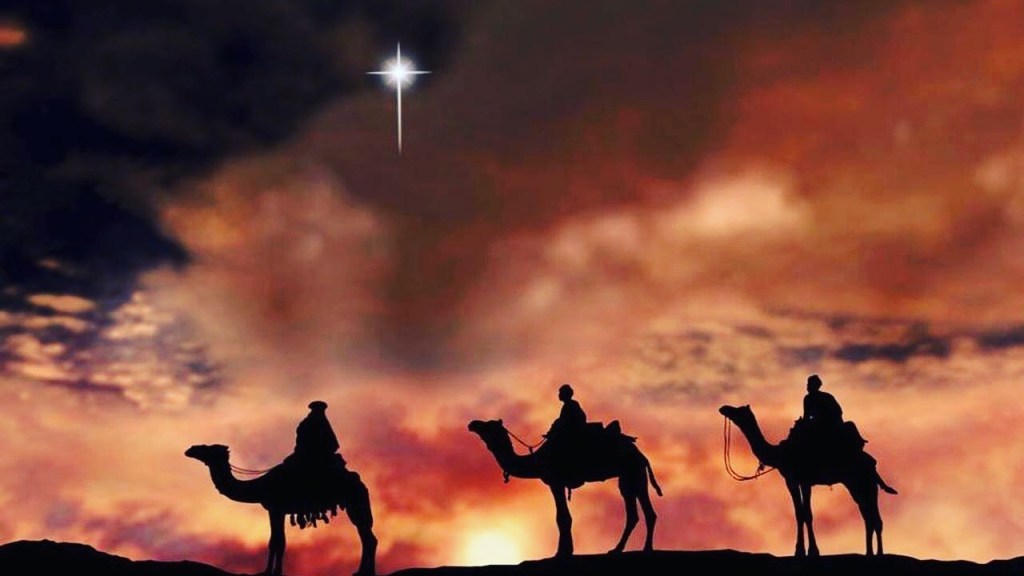
In Encountering Jesus, we will not be the same.
When Jesus was born in Bethlehem of Judea, in the days of King Herod, behold, magi from the east arrived in Jerusalem, saying, “Where is the newborn king of the Jews? We saw his star at its rising and have come to do him homage” (Mt 2:1-2).
At some point as they approached Jerusalem, the magi lost track of the star, did it become cloudy, did they close in on the city during the day, or did they believe it was the proper protocol that in entering the city they ought to check in with Herod first before proceeding? We do not know. Somehow, these magi were led by a star with the belief that they were to pay homage to the king of the Jews in a distant land.
What drew them from their home miles away? What inspired them to leave the comfort of their everyday routine? This was no easy journey, and it was a risky adventure. Yet something or someone inspired them, invited them to come. They said yes. And though they were misdirected for a time, when they left the audience of King Herod and resumed their pilgrimage, they again saw the star and were “overjoyed” (Mt 2:10).
That joy must have multiplied when they prostrated themselves before the baby king, the one for whom they risked all and sought for. In reality, their journey had only begun. Their lives would be forever changed and they would go back a different way than they came. The magi would not return to Herod, nor would they return to their home quite the same. They would not return from this journey and just go back to business as usual. The magi carried within them their encounter with the Christ; the light that drew them, they now carried inside of them.
They would proclaim him in the East. The magi did what they were called to do, to encounter Jesus and bring his light to the world. They and those who followed the same invitation are why we are still able to hear this same message today.
Today is the feast of Epiphany, and it is on this day that we celebrate that the King of the Jews, Jesus the Christ, has brought the invitation of salvation to the whole world. The manifestation of God’s glory came to the Jews first as the chosen people of God and then to all the Nations. The Son of God has become one of us and one with us so that all people are given the offer to be saved and deified in our participation in the life of Jesus.
We too are invited. We like the magi are called to put the light of Christ first in our life. Let us seek each day to encounter him and his plan. Distractions, diversions, and temptations, anxieties and anticipations as well as many appealing and apparent goods will attempt to lead us astray, yet to put Jesus first will help all other priorities to fall into their proper order and place.
Bishop Robert Barron in his book, To Light a Fire on Earth, writes about becoming part of God’s “Theodrama”, using the Swiss theologian, Hans Urs von Balthasar’s term. God is directing all of creation, all of the cosmos, and each of us to play our part. “The key”, Bishop Barron writes, “is to find the role that God has designed for us, even if it looks like a bit part… When, through faith, we see every moment and every creature as an ingredient in the divine plan, when we know that there is a gracious providence at work in the universe, we live in joyful surrender and with a great sense of wonder.”
This is what the Epiphany is about. Jesus manifesting his light to us so that we can finally come to see that we are not the center of the universe, but he is. “When we decenter the ego, and live in exciting and unpredictable relationship to God, we realize very clearly that our lives are not about us. And that’s a liberating discovery” (Barron 2017, 164-165).
May we follow the lead of the magi, and prostrate ourselves before our Lord and Savior. Let us lay face down and surrender to him our ego and self-centered ways of life. Let us acknowledge and let go of those things that prevent us from deepening our relationship with God and one another. When ready, we will rise again forever changed, heading forth in a different way to proclaim the Gospel of the Lord!
—————————————————————–
Photo: The Magi following the star accessed from http://www.free-hdwallpapers.com/wallpapers.com
Barron, Robert and John L. Allen Jr. To Light a Fire on the Earth. New York: Image, 2017.
Link for today’s reading of the Mass for Sunday, January 2, 2022
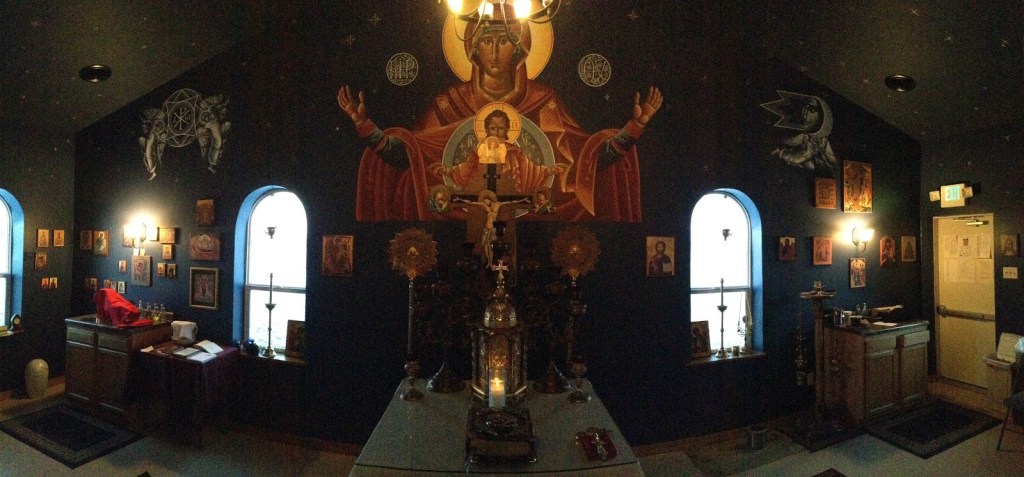
May we ponder more in 2022.
Mary offers us a wonderful gift today as we begin the new year together. “Mary kept all these things, reflecting on them in her heart” (Lk 2:19). Gabriel shares with Mary that she will conceive a child through the power of the Holy Spirit. Her relative Elizabeth, who is past childbearing years, is six months pregnant when Mary and Elizabeth meet. In their encounter, John leaps in the womb of Elizabeth. The shepherds convey the message they received from the angels that Mary’s baby is the long-awaited Messiah. Simeon and Anna offer prophetic confirmation that Jesus is the Messiah.
These are events to ponder, not to just take at face value and move on. The Church at her best has followed the model of Mary’s reflection, pondering, and meditating on what these words mean and has come to call this day the Solemnity of the Blessed Virgin Mary, the Mother of God. This title says more about Jesus than it does about Mary. This is the teaching that the Church Fathers confirmed during the council of Ephesus in 431 AD:
Mary is the Mother of God, in Greek – Theotokos – the God-bearer.
The fullness of divinity, the Son of God, was present at the conception of Jesus. Jesus remained fully divine as the second Person of the Trinity and was not diminished in any way as he developed as a human being in the womb and was born of Mary. This is the Mystery of the hypostatic union: Jesus is one divine person subsisting in two natures the human and divine.
Theological insights such as Mary being the Mother of God, the hypostatic union of Jesus, are easily missed or worse dismissed if we conform ourselves to the present age of instant gratification, instant access, surfing, swiping, taking in sound bytes from Facebook, Twitter, Instagram, as well as others, and amassing information overload. All of these technological avenues can be wonderful if we stop, slow down, and as Mary did, ponder what they offer.
If we still read books, do we do so with pencil and highlighter in hand, take notes and go back to those points underlined, highlighted, and or annotated and ponder the insights we have received, and then put them into practice? Or do we just have a moment of pause and say hmm, interesting, and then move on to the next factoid?
May today, the first day of the new year, be a day to take a few deep breaths, slow down, and commit to a practice of daily pondering. We can reflect on a word, a phrase, or a short statement that we write down and return to it often. The phrase could be as simple as a paraphrase from today’s reading: Mary pondered on these things in her heart. Let us reflect on where God has been calling us to stop and take a deeper look at our lives. It could be one word: Theotokos, expressing that Mary is the God-bearer, the Mother of God, and what that means to us in our lives. We can meditate on a picture like the one I posted with this reflection.
If we seek to live a life of joy and fulfillment in 2022, we would do well to follow the model of Mary. That would entail assuming a posture of pondering and a willingness to slow down and reflect on life, on what is important, what has value, where we are putting our time and effort, and recognizing where we do not welcome God and where we do welcome God in our life. Otherwise, we may just float along through another year indecisively or stagnantly with indifference or cynicism, merely reacting to situations that arise, or just plodding along in survival mode or merely bored and listless. Being still can be scary because as we do so, our fears, our past hurts, our losses, and our loneliness can arise.
When we are willing to slow down and even come to a complete stop, the Holy Spirit can lead us with his love to experience the emotions that are just under the surface, so we can begin to heal and transform beyond merely existing, so as to set a course of fully living. Hand in hand with Jesus and Mary, we can face and embrace our anxieties, fears, heal from our wounds, grieve and mourn.
As we do so we will be better engaged in our lives which will lead to more meaning and purpose. Conformed to the life and love of Jesus, we will realize that we are not alone and build more authentic and intimate relationships. We can face our challenges head on, act more decisively and with greater clarity, and experience more fully what we are here for, to bring a little more tenderness, mercy, understanding, forgiveness, and love to the many others around us who are also wounded.
May 2022 be a wonderful new year of meaning, joy, and fulfillment, as we, like Mary, come to experience God’s presence in the silence of our hearts, so to be a people of faith, hope, and love in contemplation and action. Mary Mother of God, pray for us.
Happy New Year! Peace and all God’s good. Take good care of yourselves and those around you.
Icon painted by Brian Matthew Whirledge in St. Mary’s Orthodox Church, Goshen, IN
Link for the Mass readings for Saturday, January 1, 2022
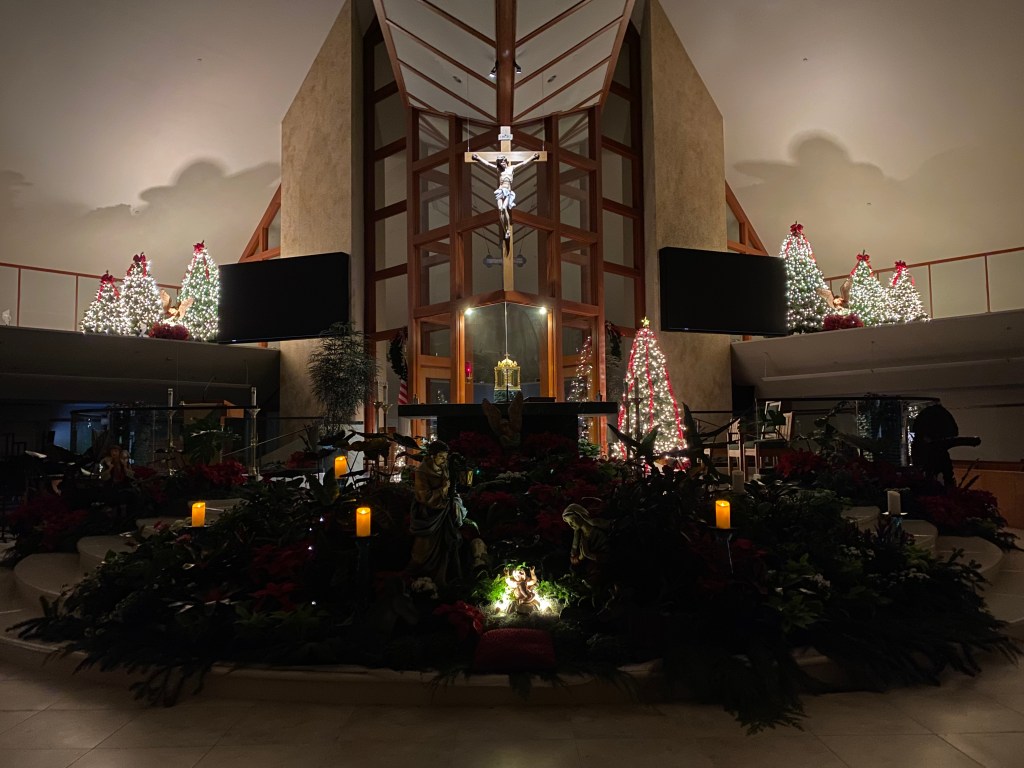
The true light has come into the world to enlighten everyone.
“And the Word became flesh and made his dwelling among us” (John 1:14). The Logos, the Word, the second person of the Holy Trinity, dwelt or another translation, “tabernacled” among us. The Son of God pitched his tent in our midst. This is a reference to the tabernacle or tent of meeting which was erected whenever Moses and those who had escaped slavery in Egypt camped. Within the tent of meeting was placed the Ark of the Covenant. This was done to follow the will of God who wanted to be present with his people. “They shall make a sanctuary for me, that I may dwell in their midst” (Exodus 25:8).
The Ark of the Covenant and the tabernacle housing it was portable and would move with the people, such that God was always present in their midst. The basic structure would later become the foundation for Solomon’s temple, then Herod’s Temple. The Holy of Holies was believed to be the very seat of God in Jerusalem. In the fullness of time, Jesus was born to us, and he became the living temple, Emmanuel, God with us. As he predicted,“Destroy this temple and in three days I will raise it up” (Jn 2:19).
And why did Jesus come? So that the glory of God could be revealed not just to the temple priest, but to all of us, “and we saw his glory, the glory as of the Father’s only-begotten Son, full of grace and truth” (Jn 1:14). Jesus came to be one with us in our humanity while remaining fully divine to reveal the glory of his Father to us, the same glory that filled the tabernacle. Jesus came to be present, to accompany us, in our very midst as God did in the tabernacle and then the Temple.
The Son of God became human to restore the ancient covenant that God has been making with his people throughout the ages. Jesus invites us to share in the infinite, faithful love that he shares and has shared and always will share with his Father. This free, generous act of love is a pure gift. Jesus, in becoming human, in living among us, in teaching, healing, and casting out demons, built a bridge leading to a relationship with God. He shines his light, a light that is not overcome by the darkness of pride, hatred, prejudice, and violence so that we can see the truth: God is our Father and we are all brothers and sisters.
The Incarnation, the reality that the Son of God became fully human while remaining fully divine, reveals to us that none of us are worthless. In becoming one with us so that we can become one with him, Jesus reminds each of us that by our very existence God granted us human dignity because we are created in his image and likeness.
Each and every human being is a part of God’s family. This includes all people no matter race, ethnicity, political party, or creed, male or female, the unborn, the hungry, the homeless, the stranger, the sick, those without access to water or adequate health care, widows, orphans, refugees, migrants, the LGBT person, the person in jail or on death row, or at the end of life, and as Fr. James Martin, SJ wrote, “so many others who feel forgotten, excluded or marginalized. All are members of God’s family.”
The significance of this wonderful gift of the love of God poured out for each and every one of us is not only to be pondered upon and embraced but also shared with all we encounter each day of the new year we are about to begin. Even in the darkness of division and polarization, Jesus calls us to be advocates of understanding, reconciliation, hope, and bearers of his light and love.
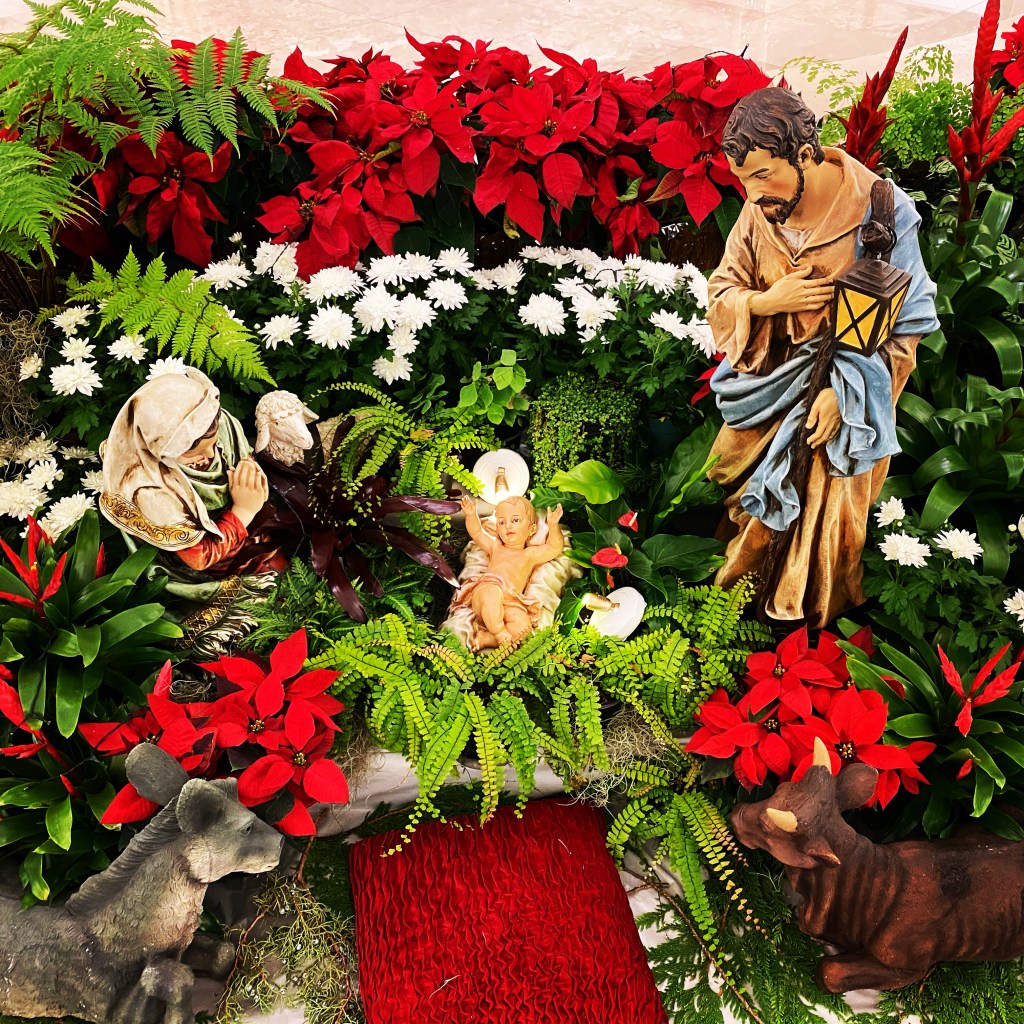
Photo: Christmas Eve 2021 getting ready to set up before midnight Mass.
Link for the Mass readings for Friday, December 31, 2021
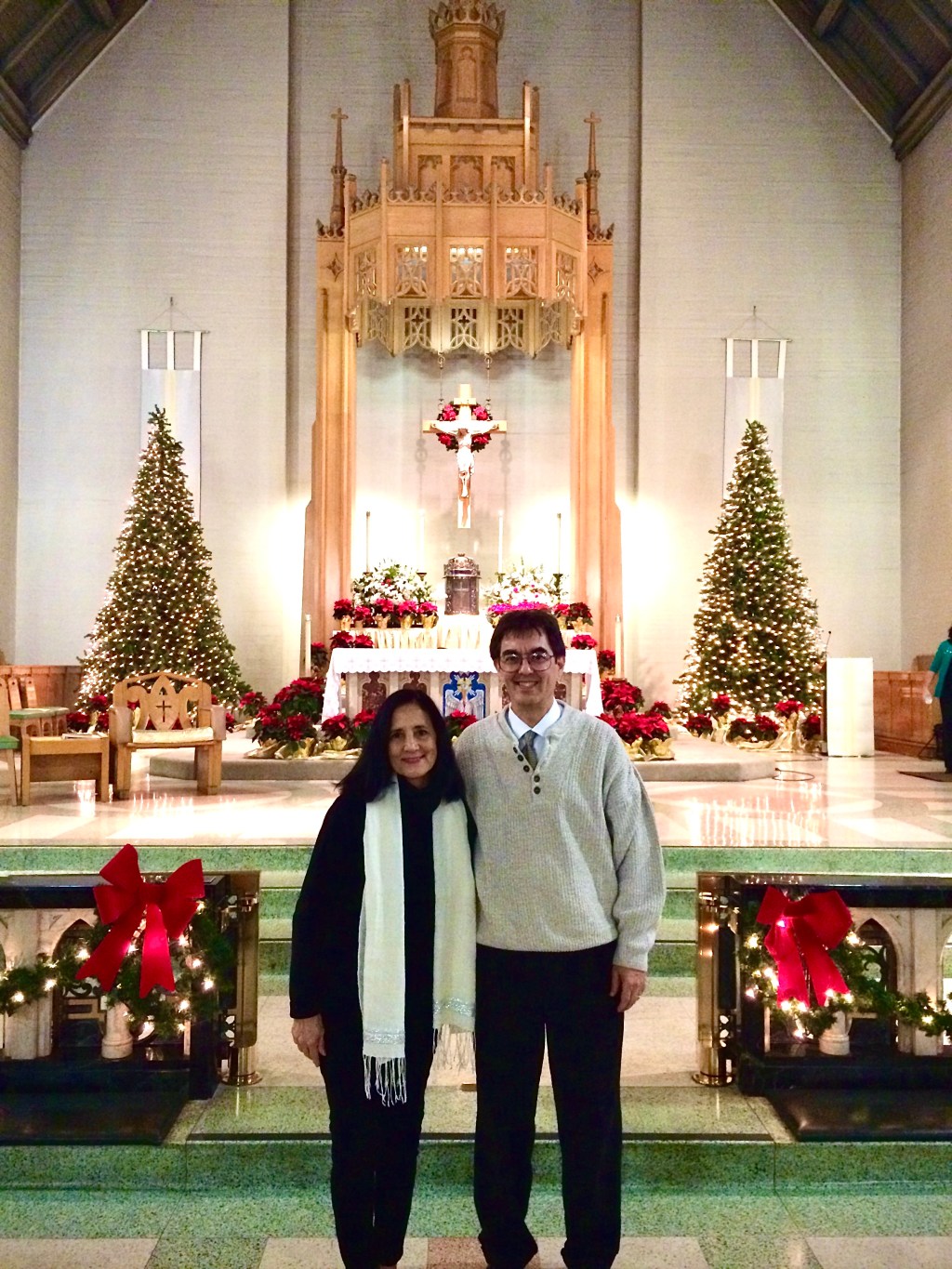
Appreciate each moment we have together for it is gift in which God is quietly working among us.
We have no evidence of what Anna, Simeon, the Magi, or the shepherds did after their encounter with the baby Jesus. We can surmise though that one thing that happened as with Luke’s account of Anna today is that they told the story of their encounter. They, like Anna, shared what they experienced with anyone who would listen.
At the end of today’s account from Luke, Joseph, Mary, and Jesus “returned to Galilee, to their own town of Nazareth. The child grew and became strong, filled with wisdom; and the favor of God was upon him” (Lk 2:39-40). No ticker-tape parade, no giving the key to the city, and no gala ball awaited the Holy Family when they entered Nazareth. They went on to live very simple lives.
The pattern of how God works, how his kingdom begins is like a mustard seed, like the seed that is sown, or like yeast. It starts small, quietly, simply, and unnoticed by the majority. God works through the everyday events of our lives, often unseen. We so often look for the mighty, majestic, and grandiose. We often believe we need to do great things, and often do nothing. St Mother Teresa directs us to follow what she learned from the Little Flower, St Therese of Lisieux, to do little things with great love.
As the Christmas Season continues, we are experiencing that life has already or has begun to shift; families and friends have come and gone or are readying to go, vacation days are coming to an end. We can choose not to allow the celebration and remembrance of Jesus’ birth, as well as our coming together with family and friends to just fade away, to be absorbed by the busyness of life again. Instead, we can appreciate the gift we have been given in the Incarnation. We can spend time each day in stillness with Jesus. Life can be hard because it is so fragile. It can change in an instant or the blink of an eye. We would do well not to take any moment for granted.
As the Holy Family begins their journey to Nazareth, and we begin to return to our regular course of daily living, may we be a little more open this year to paying some more attention to the quiet and gentle ways that God is working in our lives. God has yet again planted his seeds in us this Christmas Season. They have been sown such that we might see his creation as a gift of wonder to protect and to be good stewards of. As we ponder and gaze in wonder upon the gift of the Incarnation, we might experience the gift of seeing each other as brothers and sisters again and be more willing to support and care for one another, to be aware and reach out to those in need, as well as to be open to expressing our need for help and allowing others to assist us.
When we do so, we will start to recognize the simplicity of divinity operating within the midst of our humanity. We will see that the Holy Spirit is offering us nourishment in revealing to us our interconnectedness with God, each other, and all of creation. Tilling our soil through watchfulness, meditation, prayer, worship, fellowship, and cooperating with him in loving service will allow for our growth and transformation and to bear the fruit of his love in this new year.
Photo: Christmas Eve 2015, St Augustine Parish, Los Angeles.
Link for the Mass readings for Thursday, December 30, 2021
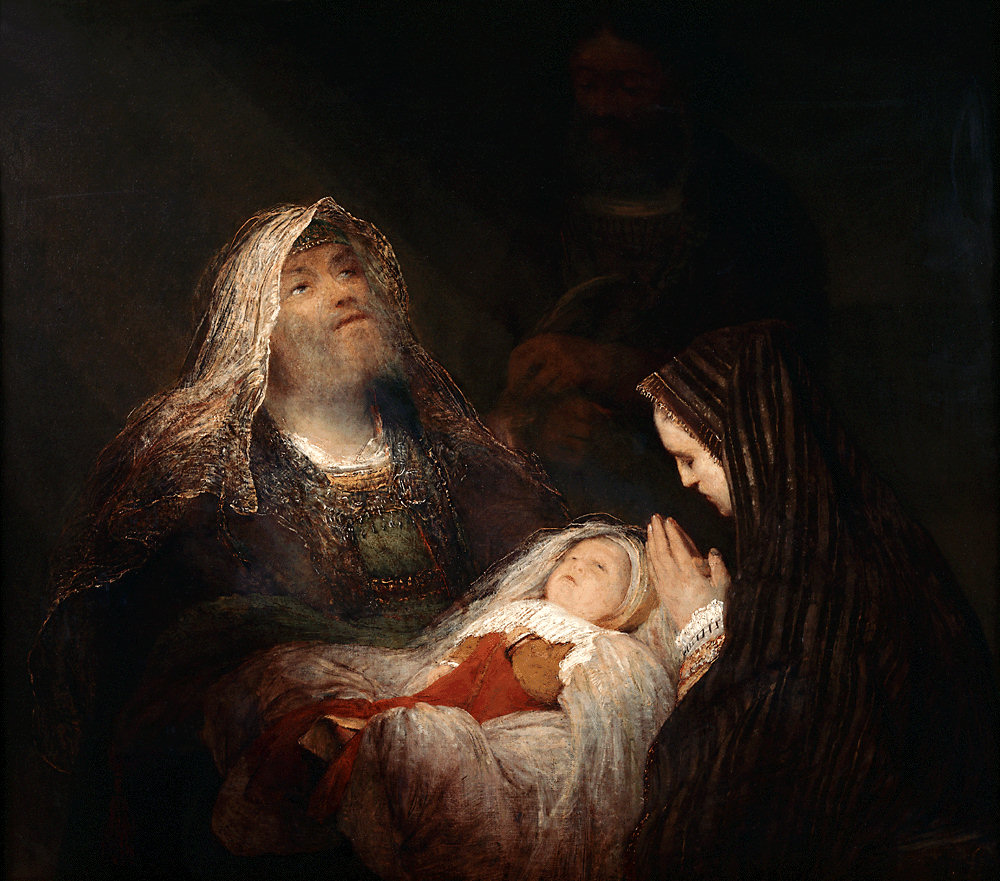
Let us see the same gift of salvation in the eyes of the Christ child and share his love today.
“Lord, now let your servant go in peace; your word has been fulfilled: my own eyes have seen the salvation which you prepared in the sight of every people, a light to reveal you to the nations and the glory of your people Israel” (Lk 2:29-32).
As Simeon receives Jesus to be consecrated to the Lord, he recognizes through the gift of the Holy Spirit that this child, is the one he and Israel had been waiting for. Jesus is the Messiah, the Christ. He has come to fulfill the Law and the Prophets as well as be a light to the Gentiles and to all the Nations.
These verses, called the Canticle of Simeon, recorded by Luke are recited each night by those of us who pray the Divine Office or the Liturgy of the Hours. They are prayed during Compline or Night Prayer, the last prayers before going to sleep. The gift of reading a Gospel passage again and again is that when we are open God can speak to us in deeper ways or help us to see something we have not seen before. We too can celebrate the birth of Jesus who is our savior, our fulfillment and our light also.
We are all invited to meditate with this same passage. We can enter the scene and, like Simeon, receive this child in our arms from Mary and Joseph. We too are invited to see the salvation that is offered us, the invitation given to us. May we not run from the light of his truth, but may we embrace it so as to be transformed. Let us glory in the joy of knowing that Jesus came to share his forgiveness, love, mercy, and grace, with us. He is the promise of healing that we all need to realize and actualize in our lives.
Jesus invites but does not impose. This Christmas can be just another few days in a cycle of days that pass with no change, or we can immerse ourselves in this Octave of Christmas so as to take seriously the fact that Jesus is who he said he is, who the Apostles claimed that he is, who the Church still announces that he is today. Jesus is the Christ the Son of the Living God. Do we also believe this truth?
I invite you to return to the meditation we started above and to hold the baby Jesus, our savior, in your arms as Simeon did. As you hold him look into his face, see his smile, the glint in his eye, and allow that exchange to melt away any sin of pride, lust, greed, envy, sloth, gluttony, prejudice, and/or wrath. Experience the warmth of his love radiate up from the depths of your soul to be filled with his joy to overflowing.
As we go forth and our gaze falls upon others we meet, may we share that same smile we have received and so radiate the love of Christ with those we encounter today and each day going forward.
Painting: Het loflied van Simeon – the Song of praise from Simeon, by Arent de Gelder, ca. 1700-1710
Link for the Mass readings for Wednesday, December 29, 2021
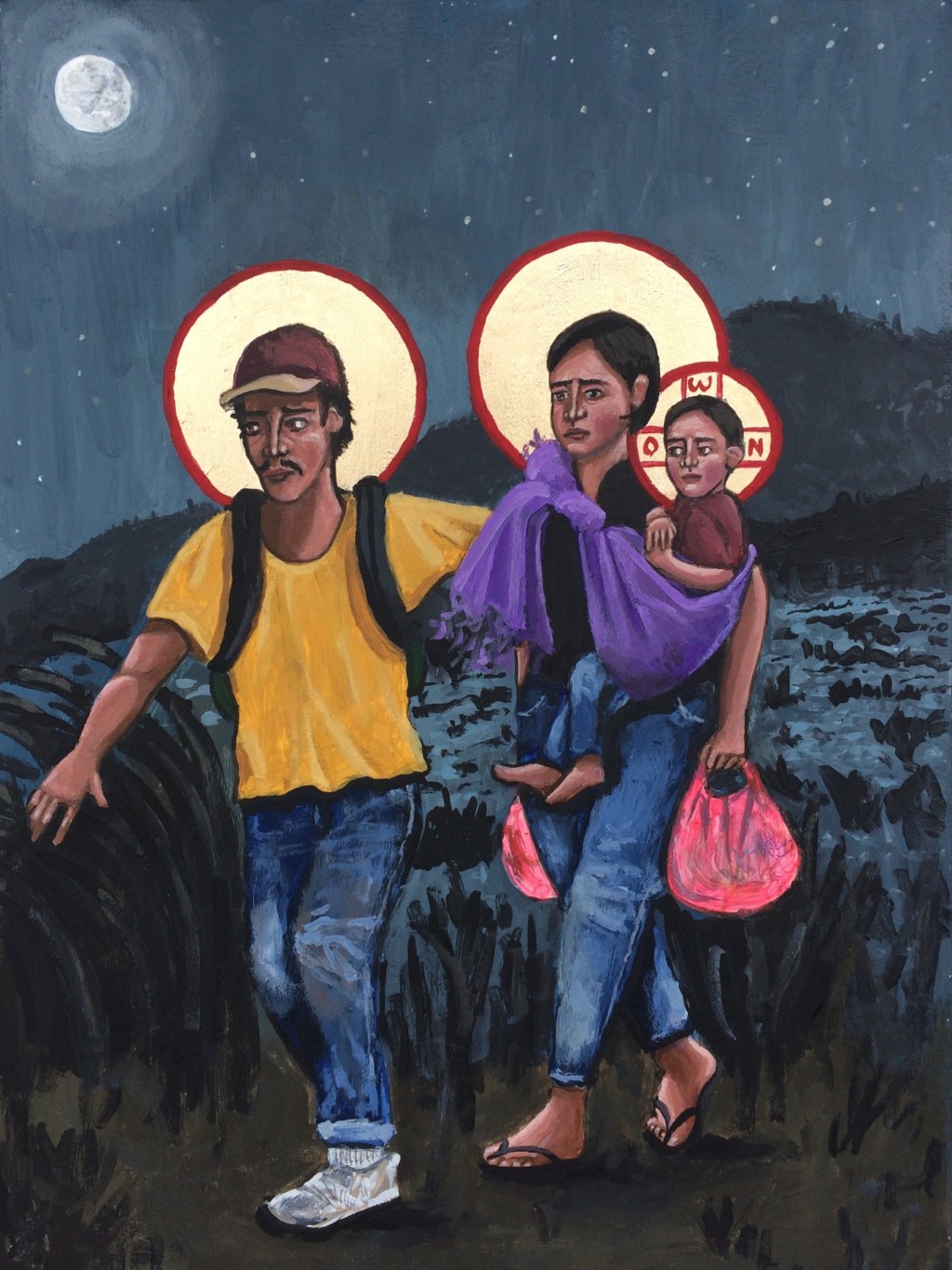
“God is present where man is in danger.” – Pope Francis
When the magi had departed, behold, the angel of the Lord appeared to Joseph in a dream and said, “Rise, take the child and his mother, flee to Egypt, and stay there until I tell you” (Mt 2:13).
If we resist glossing over the scene of the nativity because we have heard it many times before, we will realize anew that it is not a romantic one. Mary gave birth to Jesus in a stable or a cave. This setting was not the most hygienic of situations as this is where animals were kept. After the shepherds and kings come to pay the baby homage the situation does not get much better. For as we read in today’s Gospel from Matthew, Joseph is urged by an angel to flee because Herod had ordered the death of all male children under two years of age.
With the words of the angel and their forced relocation to Egypt, Jesus, Mary, and Joseph became refugees fleeing persecution. So many families today are unfortunately in a similar situation, fleeing to save their lives because their countries are torn by war, violence, terrorism, and/or the threat of persecution.
So many are escaping the horrors of the Syrian civil war, the instability, and violence in other areas of the Middle East and northern Africa, as well as in our hemisphere, especially in the Central American countries of Honduras, Guatemala, and Nicaragua. These countries, as well as too many others, are part of the tragic reality that has resulted in the largest number of families fleeing their countries since World War II.
The Son of God could have easily been born in a palace, among a family with power and stability, yet he chose to be born among the poor and displaced. His earliest days were ones marked by instability and danger.
“Jesus wanted to belong to a family who experienced these hardships so that no one would feel excluded from the loving closeness of God. The flight into Egypt caused by Herod’s threat shows us that God is present where man is in danger, where man is suffering, where he is fleeing, where he experiences rejection and abandonment; but God is also present where man dreams, where he hopes to return in freedom to his homeland and plans and chooses life for his family and dignity for himself and his loved ones” (Pope Francis homily, 12-29-13).
It is no wonder that Jesus teaches clearly later in the Gospel of Matthew 25:31-46 that we will be judged on how we treat the least of his brothers and sisters. For how we treat those in need is how we treat him. Not only does Jesus invite us to open our hearts and minds to those exiled from their homes and seeking refuge, but we are also to reach out to those individuals and families in need in our own communities.
To do so, we need to be aware and willing to be of help, to provide welcome, hospitality, hope, promise, and what support we can give. Jesus entered our human condition so he understands our trials, he is present to be of support for those of us in need as well as those in positions to help. May we pray for those families in need as well as be open to how God may be moving us to be more aware and seek concrete ways to help or provide support to those ministries and organizations that do so.
Photo: “La Sagrada Familia” by Kelly Latimore.
Link for the Mass readings for Tuesday, December 28, 2021
A cure for anyone experiencing the post-Christmas blues.
Jesus Christ is born for us. Jesus Christ dies for us. Jesus Christ conquers death and rises again for us. Because of our place in time, December 27, 2021 AD – Anno Domini, In the year of our Lord, we are capable of experiencing the Paschal Mystery of Jesus: his life, suffering, death, Resurrection, and Ascension into Heaven. The important question we need to answer is, “Does this new fact, this new reality in human history make a real difference in our lives today?”
Christmas did not end two days ago. We are still in the Octave of Christmas. The Church celebrates two octaves in the Church liturgical calendars, Christmas and Easter. These eight days are celebrated as such to impress on us the solemnity of the event of remembrance. From the vigil celebration of Christmas Eve on December 24 to January 1, the Solemnity of Mary the Mother of God, we celebrate the significant event of the Incarnation, the Son of God becoming one with us in human history. The Masses celebrated within the Octave of Christmas, as well as the readings of Evening Prayer in the Liturgy of the Hours, reflect the celebration of Christmas Day each day for the eight days. It is like having a week-long birthday party.
If we are solely focused on gifts, the returning of gifts, and celebration apart from the celebration of Jesus’ birth, if we are removed from the liturgical cycle and rhythm of the Church, it is easy to fall into the post-Christmas blues because it does feel like everything is done but the returning of gifts and getting a good after Christmas deal. We hear Christmas music coming through many radio channels for weeks before Christmas, but at some point on Christmas Day and definitely the following day, they stop. This is when the music of Christmas ought to begin!
A cure for the post-Christmas blues is to be thankful and rejoice in the Gospel, the Good News, that Jesus changed human history and we are a part of that human history of transformation. In today’s Gospel reading from John, Mary Magdalene shared that Jesus was no longer in the tomb. Peter and John ran to see, John arrived first, and then Peter. Peter went in and saw an empty tomb except for the burial clothes. When John entered after Peter, “he saw and believed” (Jn 20:8).
Do we see? Do we believe? The Apostle John came to realize and embrace the gift of the Paschal Mystery: Jesus has been born for us, he suffered, died, rose again and conquered death for us. His, Mary, and Peter’s lives were transformed and ours can be too. This is something to celebrate, not just two days ago, or just today, but for eight days, each and every day! “O Come let us adore him, O come let us adore him, O Come let us adore him, Christ, the Lord!”
————————————————————–
Photo: Christmas Eve Mass at St Peter 2018.
Link for today’s reading for Wednesday, December 27, 2019
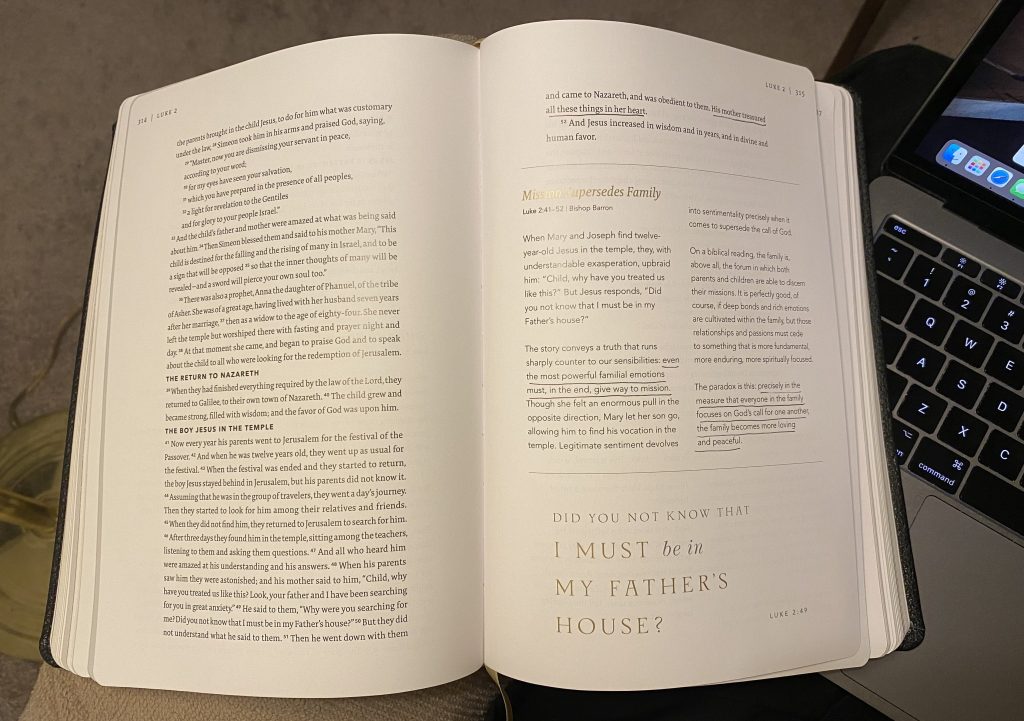
Ponder the Gospels and we will come to know Jesus and better be guided by him.
When his parents saw him, they were astonished, and his mother said to him, “Son, why have you done this to us? Your father and I have been looking for you with great anxiety.” And he said to them, “Why were you looking for me? Did you not know that I must be in my Father’s house?” But they did not understand what he said to them (Lk 2:48-50).
We are now in the Octave of Christmas. The Church has decided that the Solemnity of Christmas is to be celebrated over an eight day period because we need time to ponder the great mystery of the Incarnation to better understand its implications for us in our daily lives.
Each time we hear the accounts that there was no room for them at the inn, Jesus was born in a stable, shepherds and magi come to see the new born king, today’s account of Jesus being found in the Temple, our response is not to be, “Oh, we have heard that story so many times before, I am going to check out now.” Instead, each time we are invited into the story, to allow the retelling of these accounts to draw us deeper into the Mystery they convey.
One of the reasons that we may resist this practice of pondering, may be because we do not understand what the Gospel accounts are talking about. We are modern people living in our own time, experiencing our own culture, language and perspectives. In fact, in today’s account from Luke, Mary, who lived the day to day nuances of ancient Palestine, knew Jesus for twelve years, still does not understand what he says to her, that he stayed behind instead of traveling with them because he had to be in his Father’s house. If Mary has some trouble understanding, we need to have patience with ourselves when we struggle to understand as well.
Often our immediate response to our lack of understanding is one of frustration, aggravation, impatience, or worse indifference or seeing no relevance from the readings to our time and daily living. May we resist this knee-jerk reaction and instead follow the lead of Mary. Let us ponder, let us keep all these things in our heart. Luke only mentions that she and Joseph did not understand, there is no mention of a Joseph head slap to the back of the head, no Mary mentioning how long Jesus would be grounded when they got back to Nazareth. Just that Jesus was obedient and followed Mary and Joseph home. I am sure during their journey home, as with many of their experiences with Jesus, there was some serious pondering.
Often we find in the Gospels, that Jesus’ words and actions, pull us up short, they stop us in our tracks. When this happens we are receiving the invitation from Jesus to reevaluate our life, how we have been thinking, living, and how we can be better human beings. We can certainly understand the Bible a bit better through researching the historical, psychological, and sociological background, as well as scholarly commentaries to gain context, just as we can in studying any form of literature. Yet, along with our intellectual pursuit, we must also be willing to engage our soul, because our mind can only take us so far. We are created as human beings, which means we are physical as well as spiritual beings, people of reason and faith.
Pope St John Paul II said that living a life of faith without reason is superstition, and Albert Einstein said that living a life of reason without faith is boring.
To understand the teachings and leading of Jesus in our life, we need to let go of the absolute security we place in our own autonomy. We need to acknowledge that we are not the center of the universe, we need to let go of our false sense of freedom that states, “I can do what I want, when I want, and how I want and I want to understand right now.” God has created us as transcendent beings, and to be fulfilled in our lives, and to experience the reality of both, we need to be willing to open ourselves to the divine.
Part of understanding Sacred Scripture and not only understanding but knowing Jesus, is learning his language. Not literally Aramaic, but the language of his very being as fully human and fully divine. Pope St. Paul VI wrote that we need to learn from the school of the Holy Family. “The silence of Nazareth should teach us how to meditate in peace and quiet, to reflect on the deeply spiritual, and to be open to the voice of God’s inner wisdom and the counsel of his true teachers.”
We don’t just read the Gospels to finish, close the cover, and walk away. We need to allow ourselves to be still, to rest for awhile in the presence of God’s word and allow ourselves to experience being loved and guided by him. By doing so, we come to learn the language that Jesus spoke to us. Jesus’ language of love was not just an emotion, but a willing the good of the other, as other. An invitation to participate in his life. To learn and understand the language that Jesus speaks we must slow down.
When we experience the love of God we are for that moment, no longer governed by our fears and wounds. We are able to let go of our defensiveness and begin to trust. When we are willing to surrender daily to the will of God, we become less and Jesus becomes more the center of our lives. In this way, we will come to develop eyes that see, ears that hear, minds and souls that begin to understand the word and will of God. When we, like Mary, learn to ponder, we too will hear God who speaks in the silence of our hearts, we too will then come to know him and better understand what he has to teach us so as to become contemplatives in action.
Photo: Making some time to study in the School of Nazareth, by pondering the Gospel of Luke in the Word On Fire Bible: The Gospels.
Quote from Pope St Paul VI from an address, “Nazareth”, that he gave January 5, 1964.
Link for the Mass readings for Sunday, December 26, 2021
 Spiritual Stepping Stones