Reflections on the Gospel Reading for the Day

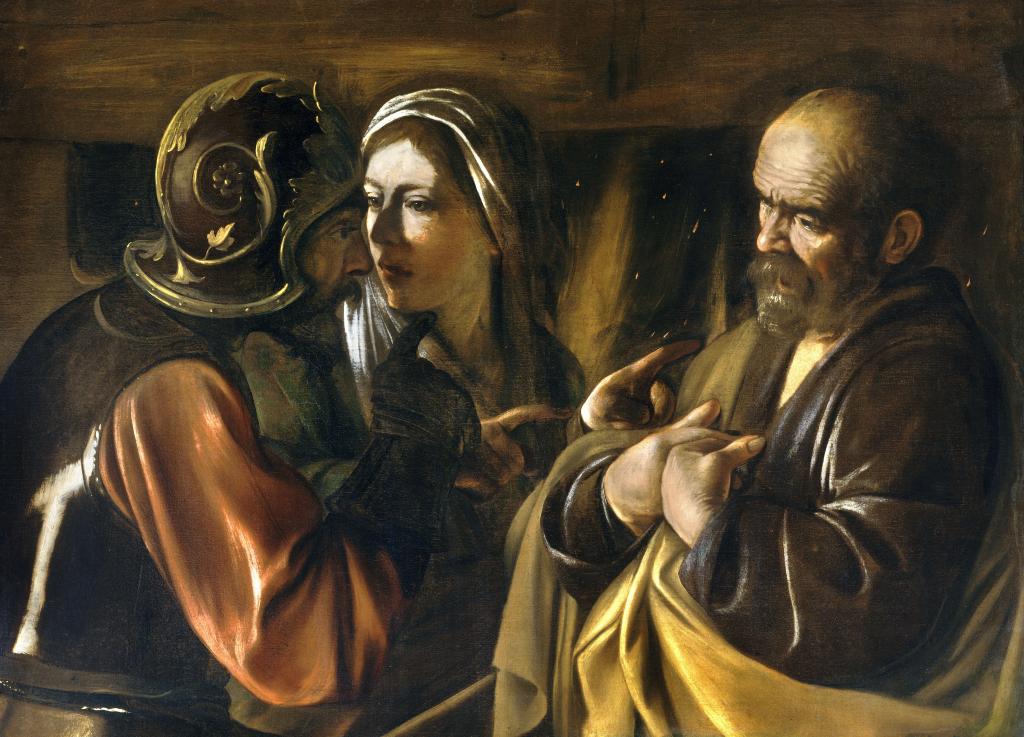
Peter denied Jesus, Jesus forgave Peter.
The Gospel reading for today from John is painful on two fronts. First, Jesus said to Judas, “What you are going to do, do quickly” (Jn 13:27). Did their eyes meet at that moment, was there an unspoken appeal from Jesus to Judas, or had that already been settled in Jesus’ full surrender in the Garden of Gethsemane? Judas aligned himself with Satan and set his course, and removed himself from Jesus and his companions and it was night.
The second front appears at the end of today’s reading. Despite Peter’s apparent full endorsement of Jesus and promise to even lay his life down for him, Jesus predicted that “the cock will not crow until” Peter will deny him “three times” (Jn 13:38). The momentum of utter betrayal builds. Judas will agree to turn Jesus over for thirty pieces of silver. He will betray the Son of God, yet in so doing, Judas will play his part in salvation history.
Judas will set in motion Jesus’ arrest that will culminate in his crucifixion. Peter will come to deny Jesus three times as Jesus predicted. I cannot think of any experience worse than the pain of betrayal. Yet, how is it that we betray Jesus each day? Remember what he taught us, “What you did not do for one of these least ones, you did not do for me” (Mt 25:45). Who and how have we betrayed Jesus in our lives? This is an important question to ask, and what is even more important is that we not only answer it honestly but seek forgiveness and resist the temptation of isolating ourselves in our sin and pride.
Judas separated himself, cut himself off from Jesus and his companions. He came to realize his sin, though he did not seek forgiveness, but isolated himself further and in his despair took his life. Peter, also regretted his sin, his cowardice, he wept when he heard the cock crow, and met eye to eye with Jesus but he also trusted, and later affirmed his love for Jesus three times, atoning for his three denials and was forgiven.
This Holy Week we can choose to walk the path of Judas or Peter. With each humble step may we come to see how our spirits are often willing but our bodies are weak, that we have been wounded by others and acted in kind, so falling short of who God has called us to be in what we have done and what we have failed to do.
Through our awareness of our unworthiness though, we must resist isolating and beating ourselves up, but instead recognize that Jesus has not come for those who are worthy, but for those who are willing to be forgiven and to be healed. In this way, we can learn from Peter, that we have betrayed Jesus also, but Jesus still loves us and is willing to forgive us as well. We will heal, mature, and grow as long as we continue to turn back to Jesus. We will then, like Peter, become wounded healers as well!
——————————————————————-
Painting: Denial of St Peter by Caravaggio, 1610
Link for the Mass readings for Tuesday, April 12, 2022
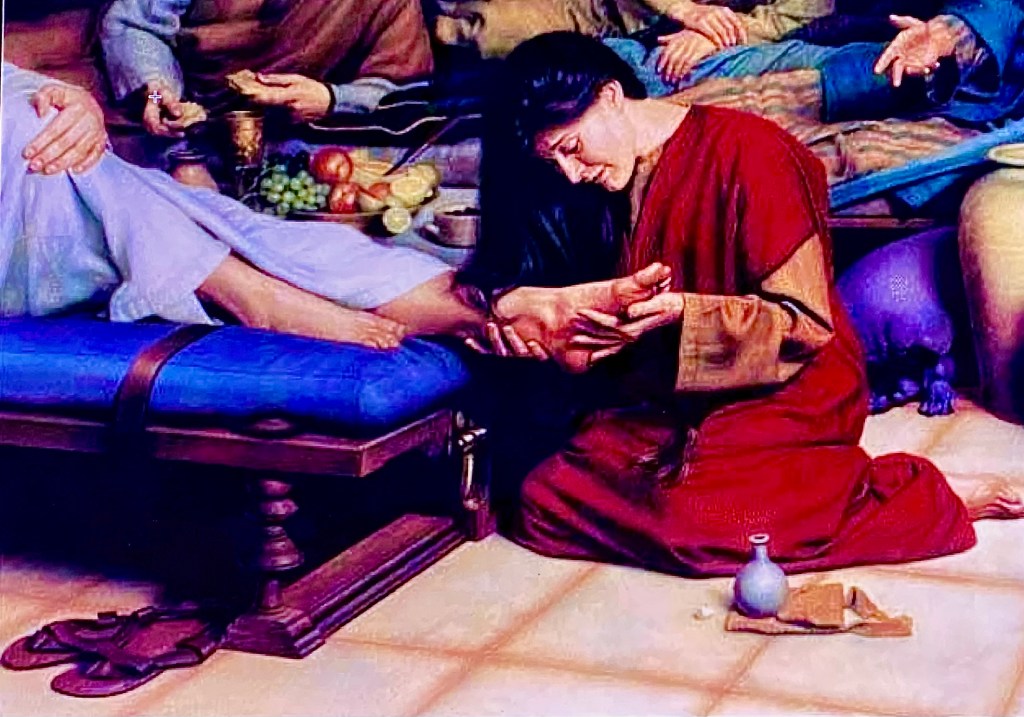
What are we willing to give without counting the cost?
“Mary took a liter of costly perfumed oil made from genuine aromatic nard and anointed the feet of Jesus and dried them with her hair; the house was filled with the fragrance of the oil” (Jn 12:3). This is indeed some gift that Mary shares with Jesus, though Judas’ critical response showed that he missed the point of her offering, which went well beyond the material cost of the perfume. Mary even exceeded the gesture of hospitality by going beyond washing Jesus’ feet in anointing them as well. This act of caring could have been a bestowal of appreciation and gratefulness toward Jesus who brought Lazarus, her brother, back to life, but it was even more than that.
In Jesus’ correction of Judas, “Leave her alone. Let her keep this for the day of my burial” (Jn 12:7), we may intuit the best source for interpreting Mary’s act. Mary comprehended better than any of the Apostles that Jesus’ death was imminent. Mary’s washing the feet of Jesus, anointing them, and drying them with her hair was a gift of love, of giving herself in service to the Son of God. This exchange mirrors the communion between God the Father, God the Son, and the love shared between them, God the Holy Spirit. Mary follows the will of the Father and plays her part in salvation history.
We do not know how Mary came to possess this precious oil, but what we do know is much more important. She did not grasp or cling to the oil, she did not count the cost and just pour out a little bit. When she felt moved to pour the costly nard and anoint the feet of Jesus she freely poured all the perfume out in an act of love to serve the need of Jesus by anointing him for his death and burial. Even Peter, James, and John would not be able to stay awake in the garden with Jesus in his time of need.
As we continue our steps into Holy Week, may we contemplate what we may hold as precious that God may be calling us to give up, to let go of, not just for the sake of doing so, but in service to Jesus? The path to holiness and sanctity, is coming to a place in our lives in which we can let go of that which we are attached to, so to hear clearly the will of God, know what is required of us, and give freely in love and service without counting the cost, to be as St. Mother Teresa has said, just a pencil in God’s hand.
————————————————————————————–
Painting: Mary anointing the feet of Jesus, artist unknown
Link for the Mass reading for Monday, April 11, 2022
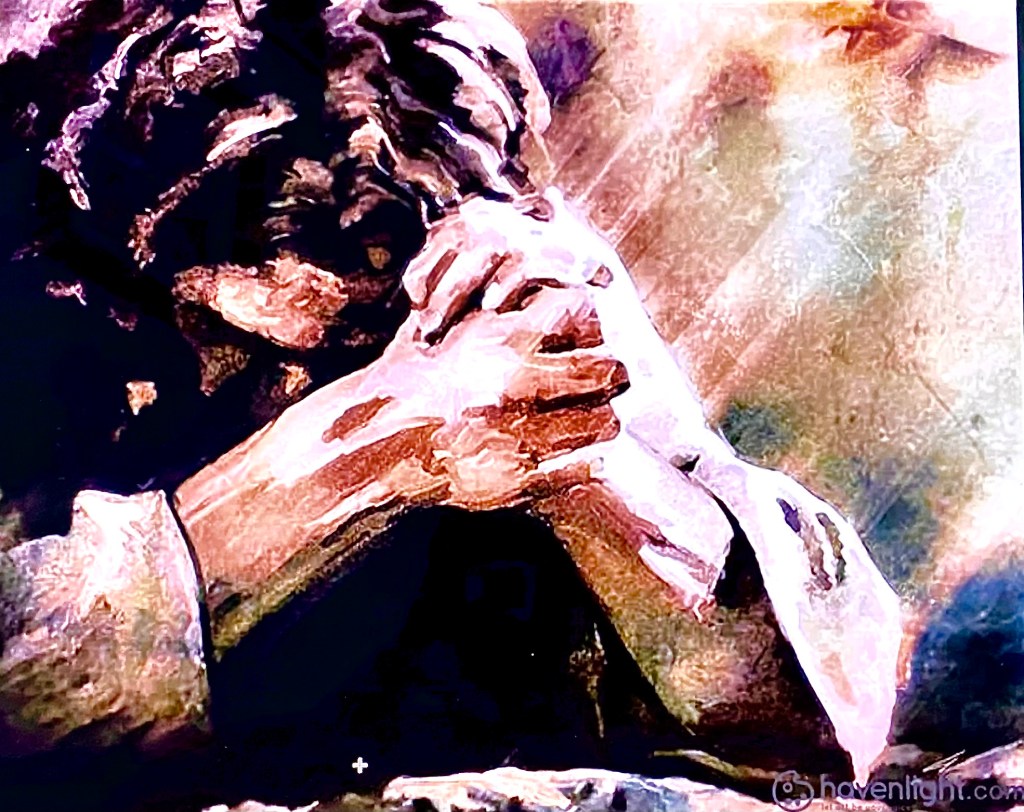
Surrendering all, Jesus knows his death on the cross will bring about a greater good.
In yesterday’s Gospel reading, Caiaphas and the Sanhedrin plot to bring about the death of Jesus. The results of their planning will be on full display today in the Gospel account of Luke 22:14-23:46.
The scene from the Passion account that I would like to reflect upon is Jesus in the Garden of Gethsemane (Lk 22:39-46). The disciples follow Jesus to the Mount of Olives and once arriving, Jesus withdraws about a stone’s throw from them, and kneeling, he prayed, saying, “Father, if you are willing, take this cup away from me; still, not my will but yours be done.” As Jesus accepted the cup he would take from his Father, He was in such agony and he prayed so fervently that his sweat became like drops of blood falling on the ground. Jesus is willing to follow the will of his Father even unto death and willingly giving his life.
Jesus has done all that the Father asked of him, he has preached, taught, healed, exorcised demons, and each time his Father requested something of him, Jesus said yes, and now finds himself on death’s door. He sensed Judas and the Temple guards drawing close and knew he would be turned over to those who have rejected the will of his Father. Jesus would say yes yet again, “Father, if you are willing, take this cup away from me; still, not my will but yours be done.”
With these words of surrender, Jesus echoed the verse from Psalms 42 and 43: “Hope in God, I will praise him still, my savior and my God.” Even faced with his death, Jesus accepted the will of his Father, his Abba. He trusted and hoped that there would be a greater good from the sacrifice of giving his life. Jesus would surrender all and what is on full display for us in the garden is the mystery of his hypostatic union: Jesus is one divine person, the Son of God, subsisting in two natures and two wills, the human and divine.
The God man, Jesus, arose from his intense time of prayer with his Father, and as he approached his disciples he found them sleeping from grief. Jesus was ready to face the cross even if his apostles were not. Jesus commands us to watch and pray as well this Holy Week. How many times have we too been in a situation of facing something that is too heavy to bear, and our response is to sleep, sometimes literally, because we are overwhelmed and it is too much to bear. Jesus understands.
We, like the disciples fall short, for our flesh is weak. Yet, Jesus continues to have faith in us that we will actualize who his Father is calling us to be, just as he did with his apostles despite their failures and they went on to fulfill their appointed role in God’s plan. No matter our shortcomings, our weaknesses, whatever trial or tribulation looms before us, we are not alone. Let us now, as did the apostles, rise with Jesus and move forward, placing our hope and trust in God, as Jesus did in the Garden of Gethsemane.
Let us follow the lead of Jesus, the Son, this Holy Week, and surrender our will to the Father so as to experience the Love of the Holy Spirit. No matter what we experience today or what may come tomorrow, we are accompanied and supported. Let us hope in God, let us praise him still, our savior and our God.
——————————————————————————-
Painting: In Agony He Prayed, Chad Winks
Link for the Mass reading for Sunday, April 11, 2022

“The setting sun now dies away.”
A core group within the leadership of Israel has decided. They will not deny themselves, their power, prestige, their place. They will not take up their cross and follow Jesus, the way, the truth, and the life. They will not allow the teaching and momentum of the growing number of those following Jesus to continue unchecked. As Passover drew nearer, thousands of people were coming to Jerusalem to purify themselves for the great feast.
This meant the Romans would have many more centurions in place to keep the peace. The division and commotion that Jesus was causing could cause conflict, unrest, and then swift and violent retribution from the Roman presence. The Sanhedrin, the Jewish High Council, followed the lead of the high priest, Caiaphas, who said, “You know nothing, nor do you consider that it is better for you that one man should die instead of the people, so that the whole nation may not perish” (Jn 11:49-50). With these words, they began to plan how to put to death the carpenter of Nazareth.
With the words of Caiaphas, the sun began to set on the life of Jesus. These words even affect us still today as they usher in the sunset of our Lenten observance. The gift of our liturgical readings allows us to relive the story of our faith. Lent has given us a time to reflect, to meditate on who Jesus is. Is he just a carpenter, another teacher, or a holy man from the past, or is he each of these, but someone so much more, the Son of God who became one with us in our humanity so that we can become one with him in his divinity?
Do we see the teachings and life of Jesus as a threat as did the Sanhedrin? Do we like our life the way it is, such that we do not want Jesus to come into our home and start turning over the tables and disrupting our order and comfort? Or do the Gospels cut us to the heart and inspire us to shake off our complacency, our indifference, our cynicism, so to be inspired to acknowledge our sins, to repent, and to begin anew? Are we willing to have our hearts opened such that we see the needs of our brothers and sisters in need and so be moved with compassion to help?
As Holy Week begins with the Vigil Mass for Passion Sunday may we meditate on the words of Caiaphas, “consider that it is better for you that one man should die instead of the people, so that the whole nation may not perish” (Jn 11:49-50). Caiaphas did not know that what he proclaimed would be so true. That the one, Jesus, would die, not only so the nation would not perish, but that all humanity would not perish.
Jesus died for each and everyone of us that we might have life and have it to the full. As the sun sets this Saturday evening, may it not be just another rotation of the earth on its axis, but an opportunity to commit once again to die to our false selves, our egos, our self-centered postures, so as to take up our cross and follow Jesus into Holy Week.
———
Photo: A beautiful time for a walk
Link for the Mass readings for Saturday, April 9, 2022
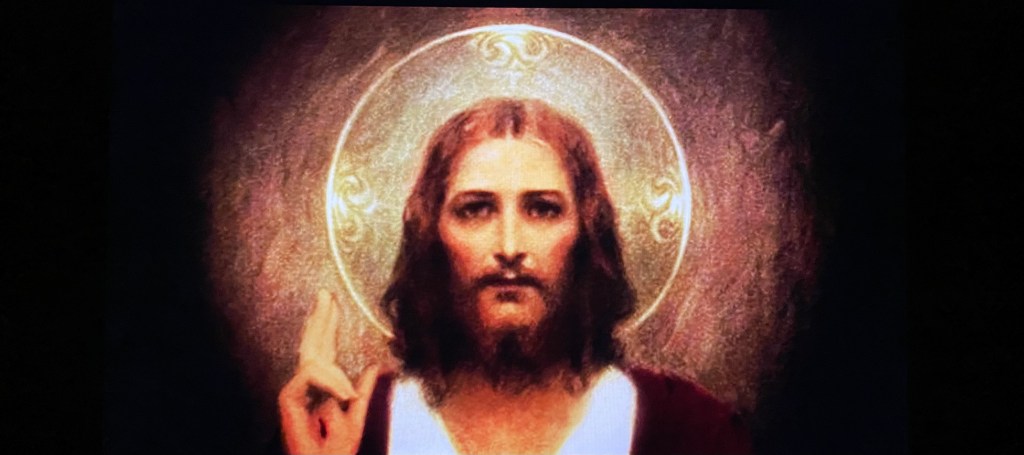
Blasphemer or Son of God?
Two groups of Jews emerged in today’s Gospel account. There were those about to stone Jesus for what they believed was blasphemy and those who began to believe. The first group did not recognize the good works that Jesus did as coming from God, nor his reasoning that “even if you do not believe me, believe the works, so that you may realize and understand that the Father is in me and I am in the Father” (Jn 10:38). They listened to the claim that Jesus was making but they refused to accept the fulfillment of the assertion: Jesus did the works of his Father because he was then and still is today the Son of God, sent by his Father to redeem all of humanity.
The more that Jesus sought to help them to understand that he was who he says he is, the more they dug in their heels. They left the stones on the ground but then moved to have him arrested. Jesus evaded their grasp and moved on to the region across the Jordan where John first baptized. John did not preach in the Temple precincts either, even though he was the son of a priest. John followed the lead of God to prepare the way for Jesus and his eternal priesthood. The Temple had not been the seat of God for some time. Jesus would become the new living Temple.
Jesus returned to the place of his baptism, where he joined in solidarity with sinful humanity. This visible image of consecration revealed what happened silently in his conception and birth: the Son of God took on flesh and became man to open up heaven for us in the humanity he assumed. As people came to John in the Jordanian wilderness, so too, people came to Jesus. Not all rejected his message. Many came to him and said, “John performed no sign, but everything John said about this man was true.” And many there began to believe in him (Jn 10:41-42).
The question that arises for us as our steps take us closer to Palm Sunday and Holy Week is to which group of Jews recorded in today’s Gospel account will we align ourselves with? Will we label Jesus as a blasphemer or accept that Jesus is the Son of God? The scriptural record does not reveal indifference as an option, the accounts do not leave any room for Jesus being only human; a good teacher, a wise man, or a revolutionary radical.
We either accept Jesus is fully human and fully divine or we don’t. If he isn’t who he claimed to be, God, then Christianity is just another philosophical, theological pursuit. If we accept that Jesus is the Christ, the Son of the Living God, then our lives ought to be aligned to his. Our thoughts, words, actions, and even our faces are to reflect that truth, so that when others look at us they see no longer our faces but the face of Jesus.
A good way to begin each day is affirming this fact by stating with an attitude of prayer, “Jesus I believe in you, I need you,” and asking him what works of the Father he would have us offer in his name this day? In what ways can we be of help and support? May we have the openness of mind and heart to hear his words and the courage to act upon his guidance, so to be the precious, living stones we are, radiating the light from our source, Jesus the Christ, the Son of the Living God.
————————————————————————-
Painting credit: Sacred Heart of Jesus by CB Chambers
Link for the Mass readings for Friday, April 8, 2022
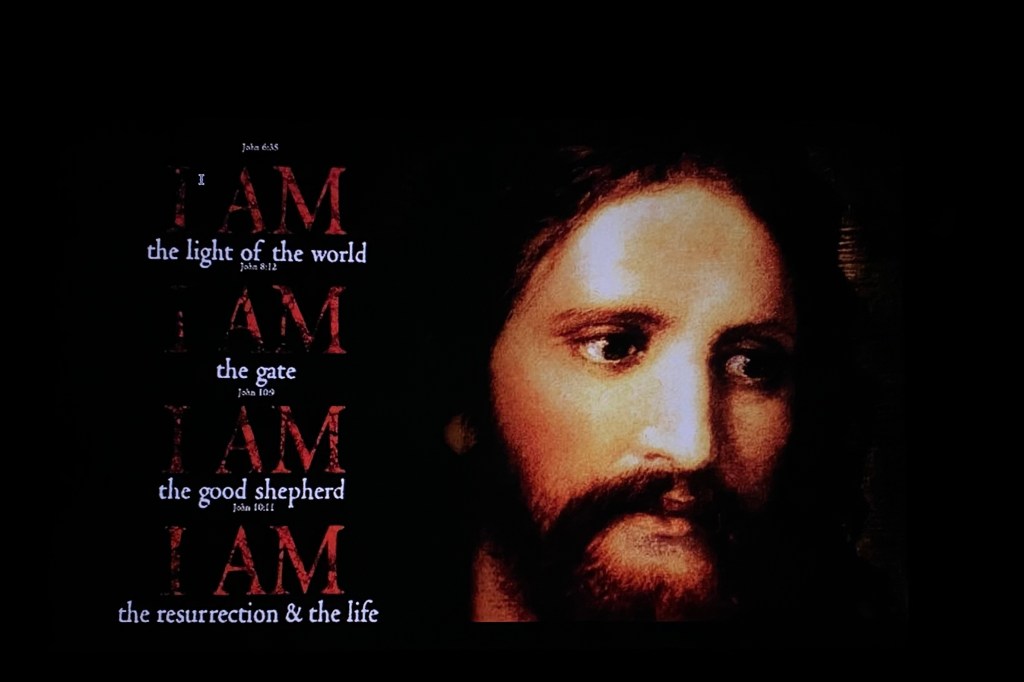
Do we believe that Jesus truly is the Son of God?
Jesus’ listeners “picked up stones to throw at him” (Jn 8:59). Though less violent, this interaction has some similarities found in Jesus’ Bread of Life discourse (cf. John chapter 6), where Jesus made the statement, that, “I am the bread of life” (Jn 6:48). In both cases, the people do not understand what Jesus is sharing and yet Jesus doubles down on his points.
In John 6, Jesus holds firm to the truth that his followers will consume him and in today’s Gospel Jesus does not equate himself as being just a representative of God, a prophet or a rabbi, but that he is, in fact, God when he states: “Amen, amen, I say to you, before Abraham came to be, I AM” (Jn 58). With these words, Jesus has just done the unthinkable, he not only has spoken God’s sacred name, which is not to be uttered because it is considered too holy to do so, he equates this sacred name, “I AM”, with himself. Jesus is making his point very clear, that he is God. During the Bread of Life discourse, people walked away from him because they were repulsed and most likely considered him mad, here they believe he is speaking blasphemy. The reactions would be appropriate in both cases, unless of course, Jesus is who he said he is.
As his listeners then, we too have a choice to believe or disbelieve in Jesus. One option that is off the table, if we give the Gospel accounts any rational reading, is that Jesus presented himself as just another teacher, philosopher, prophet, or guru. Jesus, during his public ministry, is consistently embroiled in conflict, which is evident in all four Gospels because Jesus presents himself as God incarnate. Jesus heals on the Sabbath because he is the Lord of the Sabbath, Jesus is the Bread of Life, Jesus is: “I AM.”
The Apostles struggle to make sense of the words and actions of Jesus and we may also struggle with our understanding of who God is and who Jesus is. We may have doubts, concerns, and unanswered prayers and/or questions. To walk the path of discipleship is not to walk with constant assurance, for we walk by faith and not by sight (cf. 2 Corinthians 5:7). Walking by faith does not mean we throw up our hands, toss out all reason, and believe blindly. Dr. Holly Ordway defined faith as “trust based on a reasoned knowledge of the evidence.” Faith means that we trust that Jesus is who he claimed himself to be based on the scriptural evidence, our own experiments with the truth based on these claims, and our experiences of him in our everyday actions.
Jesus calls and we follow. He does not give us the full picture, but as we step out trusting in his call, he will reveal to us each step of the way what we need to know. He will be present and work through us as we continue to turn our life over to him and one another more and more each day. When we begin to doubt, we can lean on Peter’s claim, “Master, to whom shall we go? You have the words of eternal life. We have come to believe and are convinced that you are the Holy One of God” (Jn 6:68-69). Peter made this claim based on his experience and trust in his relationship with Jesus. Our relationship and belief in Jesus will also grow to the same depth, moment by moment, with each yes to the invitation of Jesus, the Holy One of God.
———————————————————————————-
Photo: Accessed from Pinterest
Holly Ordway’s quote comes from Lesson 2: Bridging the Meaning Gap in her course: Imaginative Apologetics which can be accessed by registering for the Word on Fire Institute, the home page of which can be accessed: https://wordonfire.institute/
Link for the Mass readings for Thursday, April 7, 2022
Jesus crucified is the way to our freedom from sin.
It is interesting to note that in today’s Gospel reading from John, Jesus spoke to those who “believed in him” (Jn 8:31). But the more he talked, the less they seemed to understand who he was: “If you remain in my word, you will truly be my disciples, and you will know the truth, and the truth will set you free.” His listeners balked at the word “free”, asserting that because they were ancestors of Abraham they have never been enslaved by anybody.
In the United States of America, freedom is also highly valued. Many of us would probably react very much in the same way. We may have different ways of expressing why we feel that we are free, but we would certainly assert that we are not enslaved to anybody or anything.
Jesus’ words ring just as true then as they do today: “Amen, amen, I say to you, everyone who commits sin is a slave of sin.” Jesus shined his light on the truth that many of us do not see, which is our enslavement to sin. If we truly seek to be free, then we need to acknowledge this point. What many of us claim to be freedom, doing whatever we want to do, when we want to and how we want to do it, is not true freedom. We cannot even hear the clanking of the chains or feel the weight of the shackles chaffing at our skin as we raise and shake our fists to assert our freedom of indifference!
Our response to Jesus’ statement: “who commits sin is a slave of sin” ought not to be one of hiding, denying, rationalizing, attacking or fleeing. It is better to embrace the truth that Jesus is placing before us. In this way, we allow his light to expose the darkness in our heart where sin speaks and where we have said yes to engaging in those sins. Becoming aware of our fault for those things we have done and have failed to do is the first step in healing and moving toward true freedom.
When Pope Francis was asked in an interview, “Who is Jorge Mario Bergoglio?” he answered, “I am a sinner, but I trust in the infinite mercy and patience of our Lord Jesus Christ, and I accept in a spirit of penance.” We are all sinners because of the fact that we all in some form or fashion place idols before God. This is not a negative, pessimistic, or defeatist attitude, quite the contrary. When we call out our sin in truth, we can be free from it. When we think our life is about us first and foremost, and ignore or rationalize our sin then we are enslaved, such that it chokes and threatens to undo us. Then we experience its debilitating effects and succumb or attempt to free ourselves because the process becomes likened to a Chinese finger trap. The more we pull to escape, the tighter the grasp.
We become free from our sins by acknowledging that we are sinners. This does mean we are awful people. It just means that we have fallen for an apparent good instead of the true Good that God wants for us. We also cannot ultimately be freed by our efforts alone. We need to work in collaboration with the mercy of Jesus. We need a savior.
Jesus accepts us as sinners, as we are. We do not have to be perfect or have our house in order for him to come to be present with us, for he is already waiting for us. We do not need to be worthy, we just need to be willing to open the door when he knocks, and invite him into the chaos of our lives so he can heal us with his grace, love, and mercy. “So if the Son frees you, then you will truly be free.” Let Jesus in today, and each day thereafter, so the slow and steady process of healing can begin.
——————————————————————
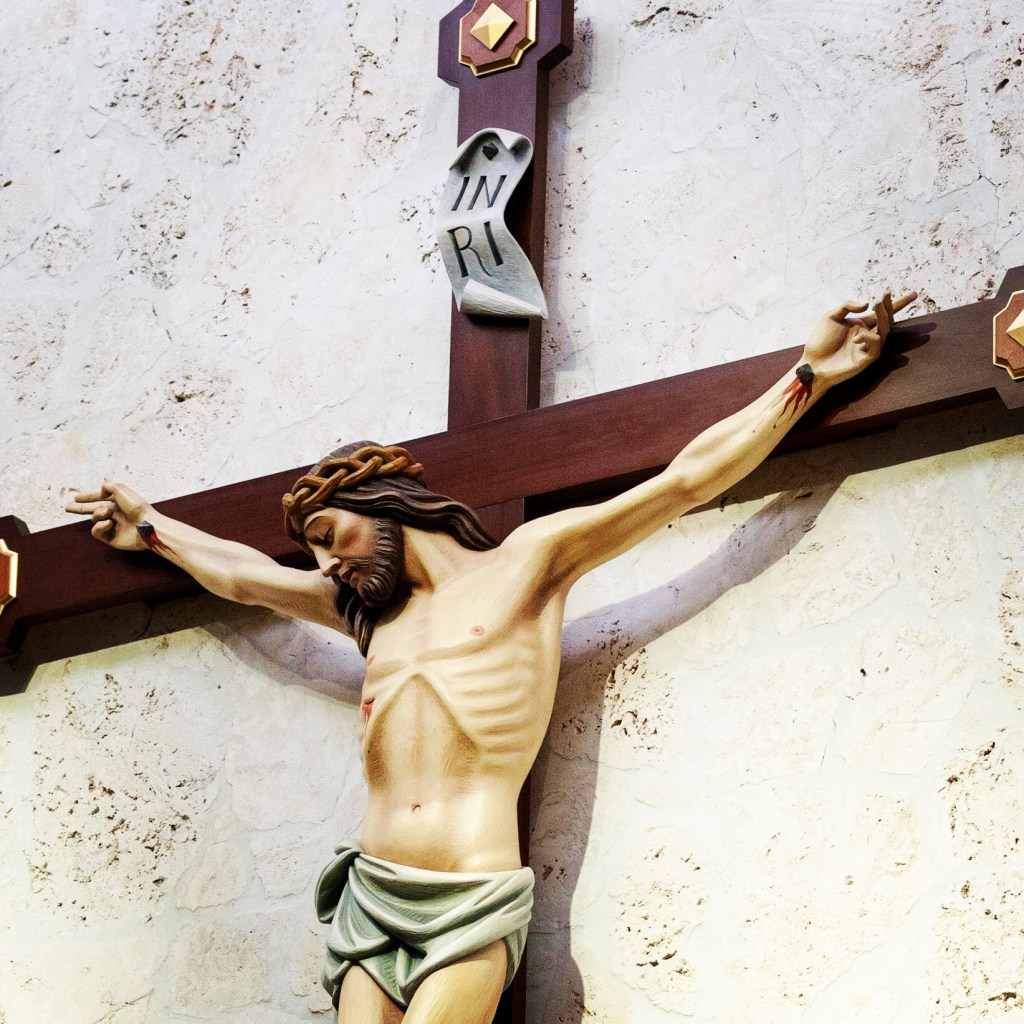
Photo: Crucifix in the sanctuary of the cathedral, St Ignatius of Loyola, PBG, FL
Link for the interview with Pope Francis from America Magazine, September 30, 2013
Link for the Mass readings for Wednesday, March 24, 2021
We can support a world devoid of God or participate in “what is above.”
“You belong to what is below, I belong to what is above. You belong to this world, but I do not belong to this world” (Jn 8:23).
Jesus is not making a judgment on humanity or creation. All that God has created is good, including us. If that were not so, the Son of God would not have become one of us in our humanity. Jesus is the incarnate Son of God. He is one divine person, the Son, with a human and a divine nature, as well as a human and divine will. Jesus came to restore that which was lost in the fall. Jesus came to heal and restore us to the fullness of our likeness and image, the full reality of who his Father created us to be.
The “world” is the finite reality of the fallen human condition apart from our participation in the will of God. It is the apparent good of claiming that we know best and that we do not need God. The world is a distortion of what God intended, humanity as well as creation. This continues because of our turning away from the spiritual reality of God’s kingdom, the refusal to care for each other and the earth that God has given us by using and abusing humanity and the vast natural resources for our own selfish gain. God’s grace builds on nature when we willingly accept God’s invitation to participate and collaborate with his will.
We are only passing through this fallen and weary world. We are pilgrims on a journey. Each day we can choose to contribute to the false narrative of a world devoid of the reality of God, that fuels countless acts of inhumanity, violence, wars, and environmental degradation in which we merely exist for a time and are gone. Or we can choose to align ourselves with the One who came to restore and transform us.
Each day we can choose to follow the will of God to support the dignity of each human being, be advocates of access, healing, and reconciliation as well as be peacemakers and faithful stewards of the earth. Each day we can make a difference by choosing to belong to what is above, so that God’s will can be done on earth as it is in heaven.
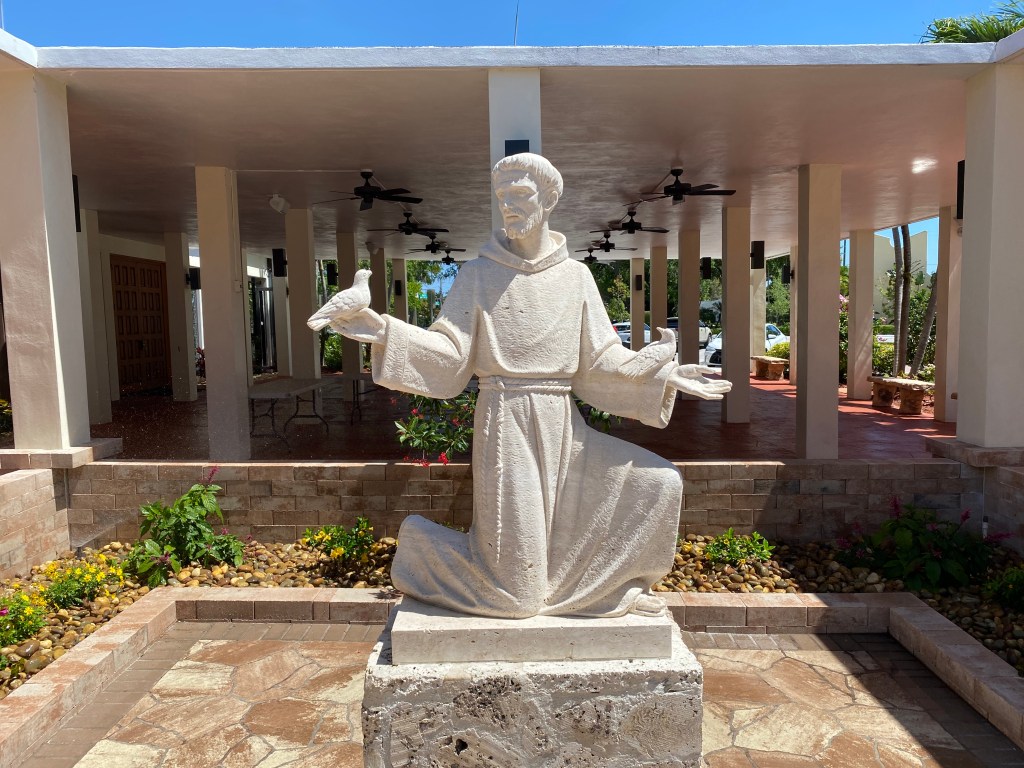
Photo: A good model for us in this matter, St. Francis of Assisi – taken at the cathedral of St. Ignatius of Loyola in Paim Beach Gardens, FL.
Link for the Mass readings for Tuesday, April 5, 2022
 Spiritual Stepping Stones