Reflections on the Gospel Reading for the Day
The feast is ready, drumstick?
“The Kingdom of heaven may be likened to a king who gave a wedding feast for his son” (Mt 22:2).
Throughout the Gospels, Jesus not only talked about feasts but he is recorded as often celebrating table fellowship with others. Those he ate with ranged from people who were considered sinners to the religious elite among the Pharisees.
In the parable from today’s Gospel, Jesus presented a wide range of reactions to the invitation offered by the king through his servants. Some are so caught up in their own lives, that they are not able or willing to break away and others reject the invitation outright and do so violently, by mistreating and even killing the servants of the king. Then others, the good and bad alike, welcome and say yes to the invitation.
God invites, but we must be willing to change our hearts and minds to see the invitation for what it is, an eternal gift. Those who refused were unwilling to change their plans, as well as others who, with hearts of stone, were outright hostile, willing to abuse and even kill the servants.
Near the end of the parable, Jesus presents a curious fellow that the king found present at the banquet without the proper attire. This is not a literal indictment of not having the proper clothes, but the wedding garment imagery may be a recognition of a willingness to receive the benefits of the invitation without a yes to the responsibility involved with the invitation of transformation.
We are invited to participate in the banquet of eternal life with God. The invitation is freely given, yet it requires that we dress for the occasion of participating in the banquet of a king. This dress is no material garment of fine linen and gold embroidery, but our willingness to repent, to turn away from those idols, that which we have placed or put before God, to have our heart and spirit renewed. We are invited to be a part of God’s new creation by participating in the life of his Son, the firstborn of the new creation.
God the Father offered an invitation to an eternal banquet to the judges, the prophets, the people of Israel, to be one with him that they might shine brightly before all so to make his will and glory known to the world. In God’s timing, he sent his Son to fulfill that mission of invitation and to be with us in our present moment and in our present condition in life. Jesus meets us where we are right now in our everyday experiences and tells us that “the feast is ready.”
This is an invitation to begin again, to turn away from our selfish ways, to receive a new heart and a renewed spirit. God invites us too but we need to be willing to let go, to change our hearts and minds, to be transformed and perfected through our participation in the life of Jesus and through the purifying fire of the Holy Spirit.
Our yes demands accountability, we can’t just show up dressed for the part and take up space. Our ultimate attire is the transformation from within in which our posture changes from a curving in upon ourselves to an opening and willingness to devote our time, discipline, talent, and treasure to serving at the banquet and inviting others to attend.
“Many are invited, but few are chosen” (Mt 22:14). The first step is saying yes to the invitation. The second step is being willing to move beyond our comfort zones so to embrace the change we are invited to. We need to be willing to allow God to renew our hearts and minds, to take up our cross, be willing to serve and sacrifice by the giving up of ourselves in love, which is not easy, but we can also take comfort that we are not alone. Jesus invites, as well as guides, and empowers us all the while as he accompanies us.
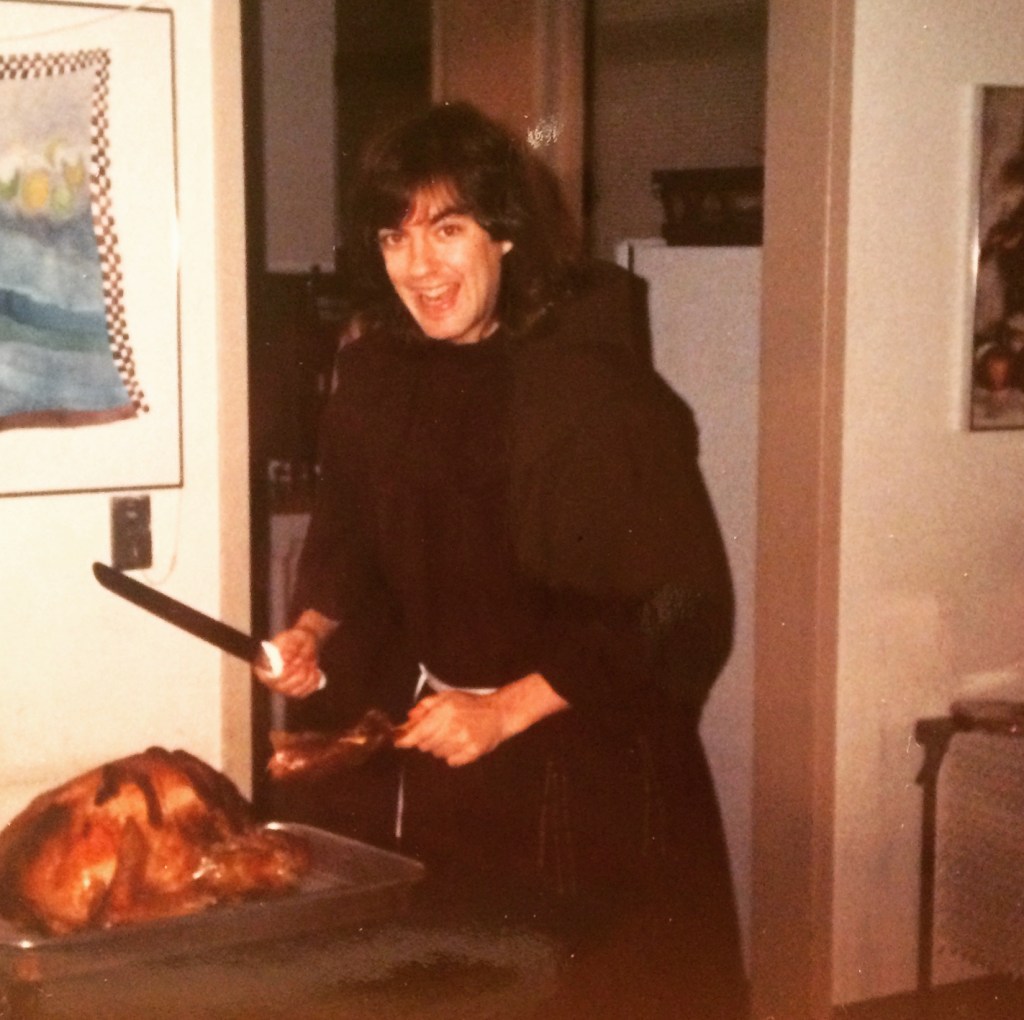
Photo: Serving Thanksgiving dinner at Seton Manor, my novitiate year (about 1992) with the Franciscans. Seton Manor was one of the ministries in which I was blessed to serve people living with HIV.
Link for the Mass readings for Thursday, August 19, 2021

How do we act when God shares his mercy and grace with others?
Jesus told his disciples this parable: “The Kingdom of heaven is like a landowner who went out at dawn to hire laborers for his vineyard…” (Mt 20:1).
At dawn, nine, noon, three, and five o’clock the landowner hired day laborers to go into the field to bring in the harvest. Many, familiar with this parable, find themselves a bit bemused, bewildered, or even angry at the ending when they read or hear that the landowner had his foreman pay everyone the same pay. The immediate cry is, “That is not fair!” Those, more often than not, who respond this way are focused on the hired hands who started at dawn, worked all day, and were paid the same as the laborers who started at five o’clock.
The workers who started at dawn agreed to a certain wage and the owner paid that agreed amount. The landowner explained, “to one of them in reply, ‘My friend, I am not cheating you. Did you not agree with me for the usual daily wage” (Mt 20:13)? What is missed, if someone is feeling as perplexed as were some of the dawn laborers, is the generosity of the landowner.
We see this similar scene of generosity given and played out in some of Jesus’ other parables. The older son who refused to listen to his father’s invitation to come in to share in the celebration of the feast when his wayward brother had been lost but now was found (Lk 15:11-32); the man who was forgiven his entire debt from the king and then when he had the same opportunity to forgive one who owed him, did not (Mt. 23-35), and in the parable of the Good Samaritan the priest and Pharisee left the man on the side of the road yet the Samaritan, the despised one, was the one to provide aid (Lk 10:25-37). Each of these parables represents the generosity and mercy of God.
There is a reason Jesus shared the parable of the workers in the vineyard after warning about the dangers of riches. Jesus is inviting the disciples and us to be generous with our time, talent, and treasure. He is also calling us out of our group think or tribal mentality. He is showing us that God’s invitation is for all and he is free to bestow his mercy, grace, and forgiveness on those for whom he chooses, whether we approve or not. Ideally, he seeks to bestow his mercy on others through us.
Are we aware of how generous and merciful God has been with us? If not, may we give some thought to the blessings we do have in our life, instead of focusing on what we do not have, otherwise, we will envy the generosity he shows others. Do we fall into the camp of the laborers who worked all day for their fair share but were begrudging those who received the same pay for an hour’s work, the older brother unwilling to be grateful for the return of his brother, the servant unwilling to show mercy to a debtor, and/or the priest and Pharisee that took the long way around the wounded man on the Jericho Road? Or will we rejoice today in the glory our Father shines upon us, seek opportunities to share our joy, fruit, and gifts with others, and be thankful when God bestows his generosity and grace upon others, even at the eleventh hour?
———————-
Photo: from pexels.com
The link for the Mass reading for Wednesday, August 18, 2021

Are we thankful for all that God has given?
“Who then can be saved?” Jesus looked at them and said, “For men this is impossible, but for God all things are possible” (Mt 19:25-26).
The disciples are “greatly astonished” about Jesus’ comments about how difficult it would be for the rich to enter heaven. Their astonishment came from the belief system that those who had wealth did so because they had been blessed by God for following his commandments. Just remember the rich young man’s attitude from yesterday. He had followed God’s commands and was blessed with riches, but Jesus turned his world upside down when he asked the man to give up all he had to follow him.
Jesus attempted to help the man and his disciples to understand that what we have, all that we have, is a gift from God, starting with our very existence. He is the ground, the source, and sustenance of our life as well as our ultimate fulfillment. A problem arises when we place our security in material things instead of God who provides them for us. If our security is dependent on that which is finite, we are always going to be left unfulfilled, attached, and/or at worst addicted, and so like the rich man, unwilling to give of ourselves to those in need, because we are afraid, we won’t have enough. Also, when we look to our own effort and work ethic, we can build a reliance on our self alone. We can place ourselves as the supplier of our security instead of God. Pride then becomes a dangerous idol. We think and start to believe that we don’t need God because we can do well enough on our own thank you very much.
“Who then can be saved?” The disciple’s question can then very easily be our own. If we can’t buy, earn, or achieve our way into heaven, how will we get there? Jesus is clear. For men, this is impossible because there is no means for us to get there on our own merit. But for God, all things are possible because our salvation is a gift freely given by him.
As with any gift though, we need to be willing to receive it and accept it. One way is to be grateful for what we have and recognize that the source of this gift is God. In this way, we can share freely from what we have, because God, who is our source, is unlimited. As we give from what God has given, God will continue to supply. What is primary then is deepening our relationship with him and collaborating with him. As we do so, we will have the proper orientation to encounter one another in love.
What is essential in our life is not what we have, but that we recognize that God is the source of what we have, that he will provide for us and be present with us. Time goes fast. This life that we have been given is good, but it is also finite, and fragile. Let us not take each other for granted, let us take the time to love God and each other as he loves us. “Let us encourage one another while it is still today” (Hebrews 3:13).
—————————————————————
Photo: I am thankful for the walks JoAnn and I used to take together, and look forward to evening walks again soon to see friends such as this red shouldered hawk drying out after a rain. What are you thankful to God for?
Link to the Mass Readings for Tuesday, August 17, 2021
“If you wish to be perfect…”
A young man approached Jesus seeking to know what he must do to attain eternal life. Jesus shared that the key was to keep the commandments. The man asked which ones he was to follow, a reasonable request as there were 613 commandments to choose from! Jesus gave him six: do not kill, commit adultery, steal or bear false witness; do honor his father and mother, and love his neighbor as himself (cf. Mt19:18-19). The man affirmed that he had followed them all. Then he asked that next question, “What do I still lack” (Mt 19:20)? I can feel the disciples wince, see the mouth of Jesus curl into a smile while his left eyebrow raises. Mark is more eloquent than me: “Jesus looked at him, and loved him…” (Mk 10:17). Matthew, in his Gospel account, does not engage in such subtleties.
Jesus said to him, “If you wish to be perfect, go, sell what you have and give to the poor, and you will have treasure in heaven. Then come, follow me.” When the young man heard this statement, he went away sad, for he had many possessions (Mt 19:21-22). The young man was so close!
Jesus saw that which was keeping this man from following him. Jesus gave him the opportunity to renounce what he had, give to the poor, and have eternal life, which was his original request. It is what we have all been created for, “You have made us for yourself, O Lord, and our hearts are restless until they rest in you” (St Augustine, Confessions). The young man knew what he needed to do but was too attached to his wealth to let go, so he walked away sad.
We do not know if the young man reconsidered Jesus’ offer and returned. I invite you to find a quiet space today, enter the stillness, and return to this scene in your imagination. Play it out again in your mind and come to the same ending, with the disciples and Jesus watching the rich man walk away sad. Continue your observation of them as they ever so slowly turn their heads and gaze at you. You then ask Jesus, “What do I still lack that is keeping me from walking a more intimate walk with you?”
What are you holding onto that is keeping you from giving yourself to the One who is truly Good? Jesus looks at you and loves you, and says, “If you wish to be perfect…” How does he fill in the blank for you?
———————————————–
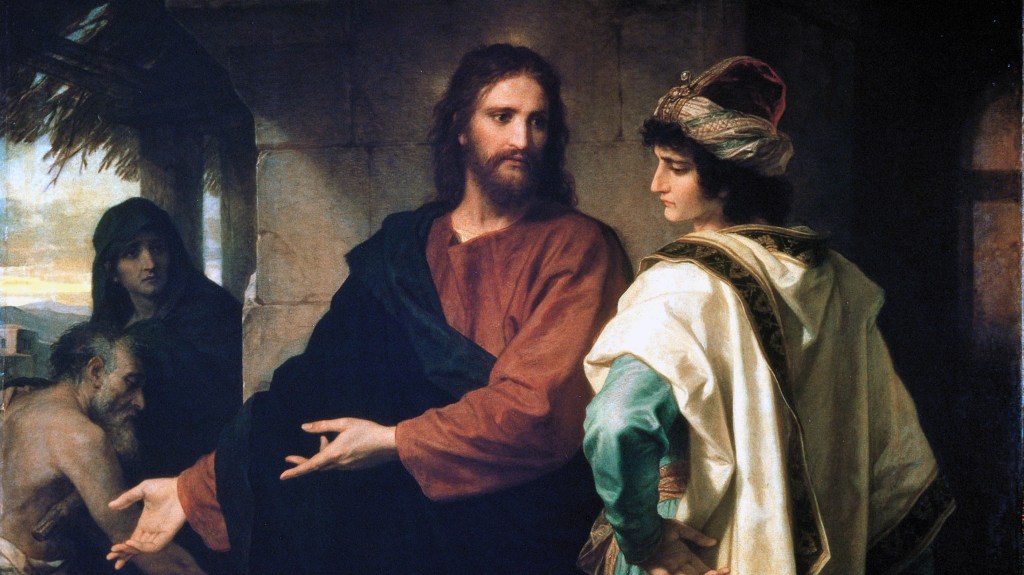
Painting: “Christ and the Rich Young Ruler” Heinrich Hoffman, 1889
Mass readings for Monday, August 16, 2021
May we follow the practice of Mary, the model of discipleship.
There was no one on this earth closer to Jesus than Mary. She bore him, nursed him, raised him, initiated his public ministry, held him in her arms as he was taken down from the cross, and she was with the Apostles in the upper room when the Holy Spirit descended upon them. Mary, like Jesus, also experiencied an Immaculate Conception. When her time came to leave this life, who better than Mary to have experienced the “singular participation in her Son’s resurrection and an anticipation of the resurrection of other Christians” (Catechism of the Catholic Church 1997, 966)?
Today we celebrate the official dogmatic constitution issued by Pope Pius XII in 1950, the Assumption of Mary, acknowledging what the Church has recognized from the beginning, the special grace she received from her Son. Jesus is the promise and Mary is the hope that we will live eternally with our heavenly Father, for Mary is now where we will one day be, body and soul.
Jesus and Mary have undone the sin of Adam and Eve. They, in their continual faithful life of saying yes to the will of God, opened up heaven for us. In our darkest trials, when the storm clouds of pandemic, injustice, racism, violence, division and polarization gather, when a situation or conflict does not appear to be getting any better, when death may be imminent, and/or when a loved one has died, even then, death does not have the last word becasue we are not alone.
As St. Paul wrote to the Church in Corinth, Jesus “has been raised from the dead”. He is the first born of the new creation. We are invited to join Jesus in participating in his new Kingdom on earth as it is in heaven, preparing ourselves in this life for eternity in the next. How? By doing what Jesus and Mary did. We are to open our heart and mind to God, hear and observe his word, and put into practice what we receive.
Mary was not blessed so much because she gave birth to the Son of God but because she heard the Word of God, pondered it in her heart, acted upon, and put it into practice. This is why the Church calls Mary the model of discipleship. Just as the moon does not radiate because of its own light but reflects the light from the Sun, so Mary reflects the light of her Son.
Mary encourages us, as she did the servants at the wedding feast of Cana, to do what he tells us to do. She radiates the light of Jesus in her thoughts, words, and actions and we are to do the same such that when people look at us they no longer see us but the love of Jesus radiating from us. How do we radiate Christ to others? We become deified, meaning becoming like God through our participation in the life of Jesus. This happens when we make a daily commitment to praying and meditating so as to allow the Holy Spirit to transform us by the holy fire of his love.
A simple way to accomplish this is to commit to a time and place every day to meditate and pray and then show up. When we arrive, we begin by taking some deep, slow breaths, and open our minds and hearts to God who is already present and waiting for us. As we continue to be mindful of our breath, we read from the Bible or a spiritual writing. We can also focus upon a sacramental object like a crucifix, statue, picture, or a setting in God’s creation. We then choose a word, phrase, or account to meditate upon. Allow God to lead and speak to us. As our time comes to an end we then commit to putting into action what we have received.
This practice will take some time to develop. We need to be patient with God and ourselves. God begins small and slowly with us. If you have never spent any time sitting still or quiet, your first few times, even for five or ten minutes might feel like agony. Continue to show up each day and spend some time with God and you will, like Mary, come to know him more deeply and intimately and experience the joy of encountering Jesus in deeper and more profound ways. Meditation and prayer may begin with conversation but it is ordered to our transformation.
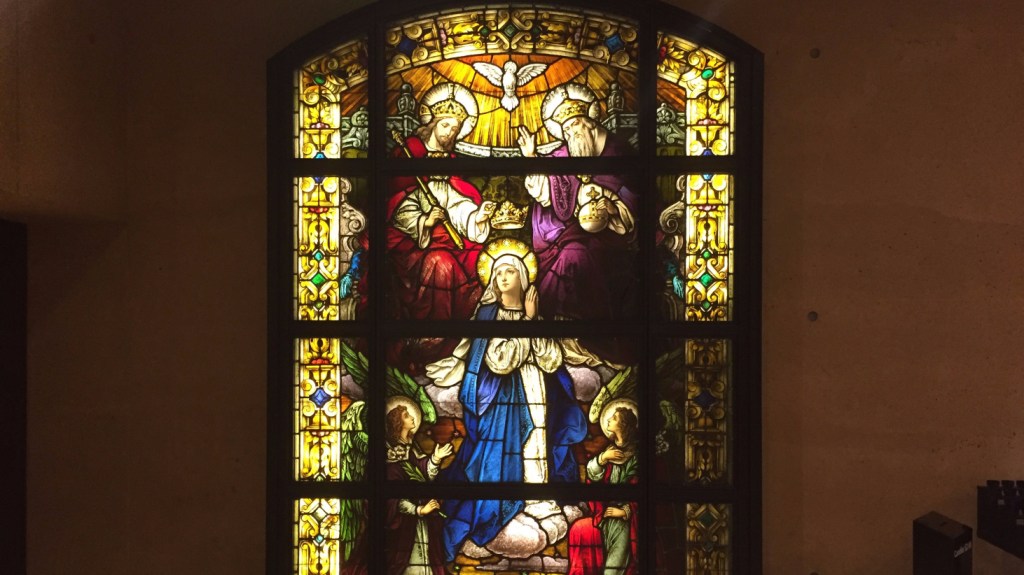
Stain glass of the Assumption of Mary at the Cathedral of Our Lady of the Angels, Los Angeles, CA
Link for the Mass readings for Sunday, August 15, 2021
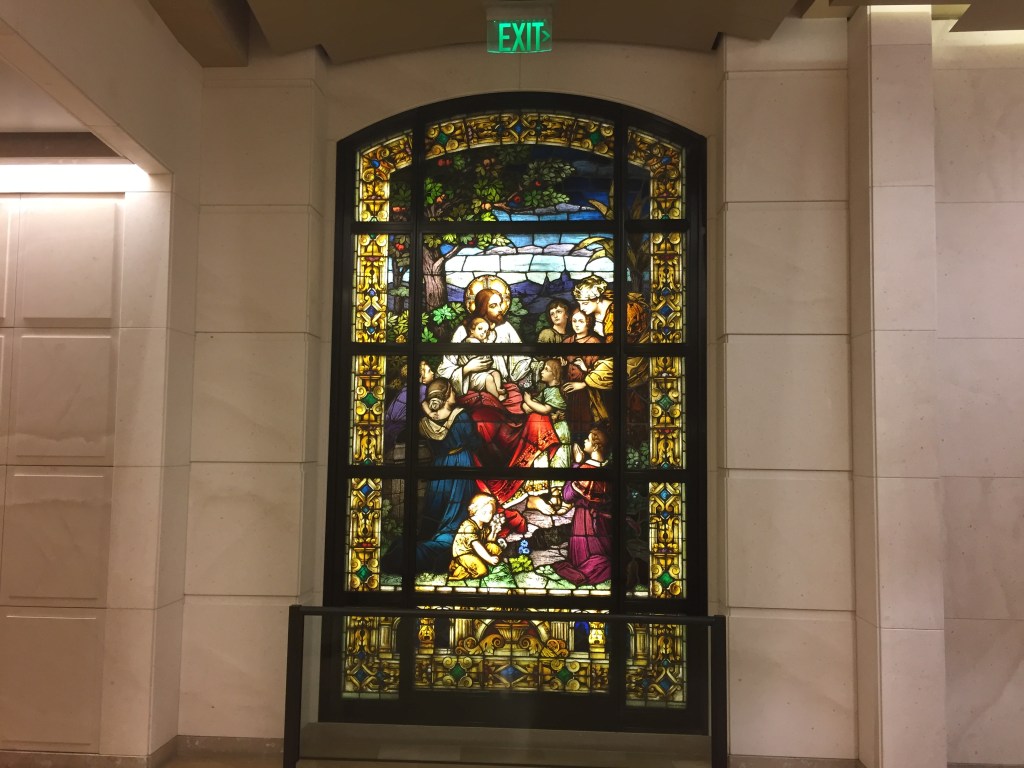
Are we willing to be as dependent and vulnerable on God as an infant is with his/her parents?
“Let the children come to me, and do not prevent them; for the Kingdom of heaven belongs to such as these” (Mt 19:14).
Again we see the disciples refusing access to Jesus. The scriptures are not clear why they consistently act this way. We see them doing so with the blind man Bartimaeus, the tax collector Zacchaeus, and the Canaanite woman. In today’s reading, they are refusing access to children. The characteristic of each of those being refused is that they are considered to be on the periphery of Jewish society.
Children, paidia in Greek, especially so. Paidia could represent a child from infancy to twelve years of age. In ancient Palestine, children were particularly vulnerable, had no status and were completely dependent on their families for survival. Luke goes even further than Mark and Matthew by using, brephē, meaning infant, to describe the children. It is to these children and infants that Jesus states the Kingdom of heaven belongs.
Just as consistent as the disciples are in turning away those in need, Jesus is just as consistent in his ministry of paying particular interest to the individual person in their particular need. He welcomes the children and blesses each one of them. Jesus continually acknowledges and affirms the dignity of each person he meets, especially those neglected and ignored. Those who have been on the other side of the glass looking in, Jesus gives admittance to. Jesus bridges the divide of separation through his presence and healing touch.
To enter the Kingdom of heaven, we must be willing to trust and place, as children, even more so, as infants, our total dependence on God alone, instead of relying on our own initiative or effort. There is nothing we can do to earn our way into heaven. The entrance into the Kingdom of heaven is a free gift of God’s grace. This gift is not about our worthiness, for all of us fall short. It is about our willingness to acknowledge our utter dependence on our loving God and Father and accept the invitation he offers all of us to be in relationship with him. As we do so, we are to resist the temptation to prevent others from having access to this wonderful gift, but instead we are to share the same invitation we have received with others.
Photo: A stained glass image of Jesus with children at Our Lady of the Angels Cathedral, Los Angeles, CA.
Link for the Mass readings for Saturday, August 15, 2021
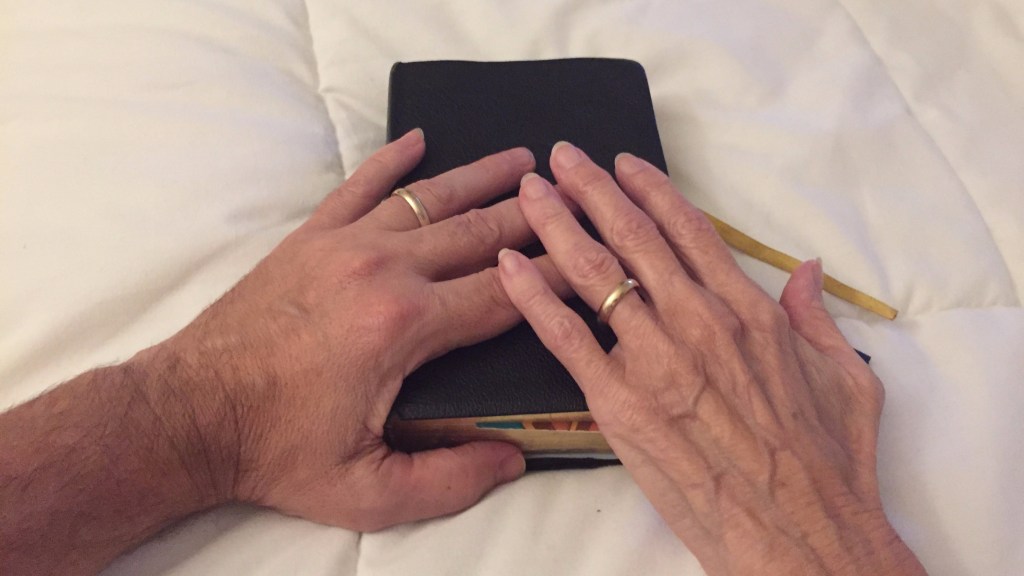
With this ring, I thee wed.
Some Pharisees approached Jesus, and tested him, saying, “Is it lawful for a man to divorce his wife for any cause whatever” (Mt 19:3)?
The question about divorce came from an already existing debate within Jewish circles of interpretation and schools of thought. Testing Jesus arose from time to time to better understand who he would side with. Regarding the issue of divorce, there was a range of interpretations. On one end of the spectrum, there was the School of Shammai, which permitted divorce only in the event of some sexual misconduct. At the other end, was the School of Hillel, which would allow a man to divorce his wife if she cooked a bad meal (cf. Harrington 2007, 275).
The Pharisees sought to understand the perspective of Jesus in this debate. Jesus responded: “Have you not read that from the beginning the Creator made them male and female and said, ‘For this reason a man shall leave his father and mother and be joined to his wife, and the two shall become one flesh'” (Mt 19:4-5)? This response negated both schools as well as rejected the precept that Moses set for allowing divorce, explaining that, “from the beginning it was not so” (Mt 19:8). Jesus’ defense went back to God’s original intent recorded in the Book of Genesis, which allowed no provision for divorce.
In God’s plan, marriage is a covenantal relationship, as is the relationship between God and his people. A covenant is a sacred bond that is not to be broken. In the Sacrament of Matrimony, a man and a woman who give themselves freely to one another and are open to children as the fruit of their union mirror the Trinitarian communion of Father and Son and the eternal love between them the Holy Spirit.
The ideal of marriage then is to be a lifelong commitment; for God does not break his covenant with us, nor should we. The goal is clear, yet we live in a fallen world and we do not often live up to what God has planned for us. For many reasons, there are times where a marriage does not work as intended but that does not mean we are to give up on marriage. Even though Jesus holds the standard high, he remains with us when we are wounded and in our fallibility. He reminds us: “Those who are well do not need a physician, but the sick do. I did not come to call the righteous but sinners” (Mk 2:17).
We are to resist the temptation to settle for anything less than what God has in store for us, which is a covenant relationship with himself and each other. Relationships are not easy and we don’t naturally know what we are supposed to do. We need to learn how to develop healthy friendships. As we do so, we might be able to better help those not only preparing for marriage but also continue to mentor and guide them during their marriage. And when a relationship breaks down, we need to be present to and walk with those who suffer through the pain of such a rupture. We are not to abandon one another for Jesus does not abandon us and instead bestows his mercy upon us, which is his willingness to enter into the chaos of our lives.
Photo: JoAnn and my hand on my breviary. We dedicated our lives to God and each other, and on the inside of each of our rings is etched the word eternally.
Harrington, S.J., Daniel J. The Gospel of Matthew in Sacra Pagina, vol. 1. Edited by Daniel J. Harrington, S.J. Collegeville, MN: Liturgical Press, 2007.
Link for the Mass readings for Friday, August 13, 2021

Forgiving seventy-seven times – mission impossible or possible?
Peter approached Jesus and asked him, “Lord, if my brother sins against me, how often must I forgive him? As many as seven times” (Mt 18:21)?
Peter’s initial question of asking to forgive seven times may sound pretty generous to us, because the usual question most of us ask is, “Do I have to forgive at all?” Many of us do not do forgiveness well, even if we recognize that it is a virtue. If someone says to us they are sorry, do we reply, “I forgive you?” Often our automatic response is, “That’s alright”, “It’s ok”, or “No problem”. When we are convicted of a mistake, error or offense, do we ask for forgiveness or operate from a defensive posture to explain why we did what we did, or defend what we did as right, not willing to admit any inappropriate action?
We are very habitual creatures, and much of what I shared above is learned behavior. We are conditioned and shaped since the time of our youth and even from our time in the womb. That is why when we hear Jesus’ answer to Peter, “I say to you, not seven times but seventy-seven times”, we may dismiss Jesus’ statement as mission impossible. Another thought that may come to our minds is those cases or positions in which we feel justified in our stance of unforgiveness. Jesus is yet again raising the bar for us.
We are to strive to forgive as our heavenly Father forgives. Forgive the same person seventy-seven times? Yes. If someone is seeking forgiveness, we are called to forgive. Jesus does not mean that we don’t hold people accountable, remain in a dangerous or life-threatening situation, or enable people in their self-destructive behavior. Forgiveness has to do with not holding on to the hurt, not allowing the offense to fester as a grudge that builds to hate and negative or violent behavior. Forgiveness is also not a curse but a blessing. For when we forgive, it is an antidote to the poison someone has injected us with. If we refuse to forgive, we allow the person who has injured us to do so over and over again. In our unwillingness to forgive we allow that poison to continue to fester.
If you are struggling with holding onto a grudge and/or past hurts. One approach that may be helpful is to visualize yourself approaching the person you have the issue with and saying to them, “I forgive you”. You may also find it helpful to visualize Jesus standing beside you while you do this exercise. Repeat the process each day in your time of prayer until you start to feel yourself coming to a place of forgiveness, and can imagine that reconciliation is indeed possible.
If you find visualizing difficult, sit down and talk to Jesus. Be honest with him, tell him the situation and share with him that you do not want to forgive the person. Then ask for Jesus to help you. Embrace the sacrament of Reconciliation and confess your unwillingness to forgive. When ready, determine how best to reach out to the person to say that you forgive them; a phone call, email, text message, or in person.
A third idea that may work is to write the person a letter, whether you send it or not. Each of these practical ways provides an opportunity to approach the great gift that Jesus offers us, to forgive seventy-seven times, or to forgive each and every time we are given the opportunity to do so.
We don’t do forgiveness well. But with Jesus, we can begin again. Let us practice saying each morning, “Please forgive me, (Name)” and think of a few thoughts, words, or actions you need to be forgiven for. Then say, “I forgive you (Name), for…” and think of a few words, actions, or inactions to insert. Also, Jesus gave us a pretty good prayer: “Forgive us our trespasses as we forgive those who trespass against us.” We are not alone. Remember, Jesus asked God to forgive those who crucified him. We can ask God to forgive those who have offended, hurt, or abused us. Then we can actually move to the point where we begin to develop the freedom to say to others, “I forgive you”, and “Please forgive me.”
Photo was taken by JoAnn. When we are open to receiving, God’s forgiveness cleanses us like an ocean breeze.
Link for the Mass reading for Thursday, August 12, 2021
 Spiritual Stepping Stones