Reflections on the Gospel Reading for the Day
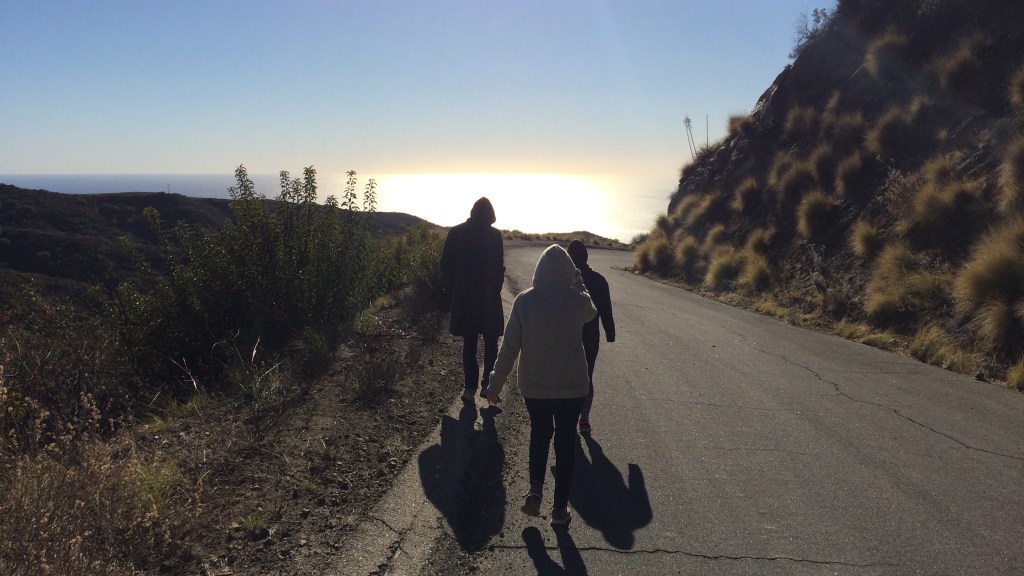
We are called to embrace both our faith and reason.
Asked by the Pharisees when the Kingdom of God would come, Jesus said in reply, “The coming of the Kingdom of God cannot be observed, and no one will announce, ‘Look, here it is,’ or, ‘There it is.’ For behold, the Kingdom of God is among you” (Lk 17:20-21).
Many of the Pharisees were scrutinizing Jesus’ every word and action, unfortunately, with a hard heart. They were closed to the reality present before them because they were looking for ways to accuse him, to catch him, to have cause to show him to be a fraud. They were closed to the actual events happening around Jesus that the blind saw, the deaf heard, the lame walked, lepers, were healed, the dead had arisen, and the poor had the good news proclaimed to them (cf. Matthew 11:5).
They missed the very reality that the Kingdom of God was in their midst. We see this very much today through the mental posturing of “scientism”, the belief that the only reality is that which can be measured empirically, through the five senses. Scientists have brought about many advances and innovations that we enjoy today, yet there is a reality beyond the physical. This is the spiritual, which transcends the three-dimensional reality that we experience and are aware of through our senses. We understand the world around us better when we embrace both science and theology, the physical and the spiritual, as well as embrace the gifts our reason and our faith.
If our mind is closed to an idea, a reality, and/or a belief we will not only resist believing, we will also seek rationalizations to explain it away as did some of the Pharisees. From a hypersensitivity to accept only the physical, we can brush off acts of synchronicity as mere coincidence. Yet, if we are open to the spiritual reality of interconnectedness beyond that which we can measure finitely, these incidences can be termed, God-incidences.
We cannot solve or prove God like a problem because God is not in the genus of being, he is not an animal, a human, an angelic, spiritual, or even a supreme being. There are no words to adequately describe him. We can say more about what he is not than what or who he is! The best attempts we have are that God is an Infinite Act of Existence or to use the phrasing of St Thomas Aquinas, Ipsum Esse Subsistens – The sheer act of ‘to be’ itself, or as God said to Moses, “I am, who am” (Exodus 3:14). God is completely transcendent, beyond categories, beyond the genus, beyond the grasp of our finite minds, yet we can experience him because God is closer to us than we are to ourselves.
We will not encounter God by forcing him to come to us on our own terms, by attempting to force-fit him into our finite conceptions. God meets us where we are and as we are, on his terms. As we open ourselves to his presence, accept his invitation, he then helps us to expand, to experience more broadly, who we, others, and our world are. We experience this best when we truly love, when we go out from our own self-centered stance to will the good of another, to love. We become more when we follow what truly brings us joy and fulfills us. We encounter God through embracing the wonders of his creation!
As Jesus said to Philip, “Whoever has seen me, has seen the Father” (Jn 14:9). The Kingdom of God is among us because Jesus is who he said he is. Jesus is fully God and fully man in our midst. By his very presence, he shows us that there is no opposition or competition but a union between heaven and earth. We will never fully comprehend God, but we can come to know and understand him, ourselves, and the world around us better when we breathe with both lungs of faith and reason, embrace our intellect as well as our spirit. As St. John Paul II stated, “Faith without reason is superstition” and as attributed to Albert Einstein, “Reason without faith is boring.”
———————————————————-
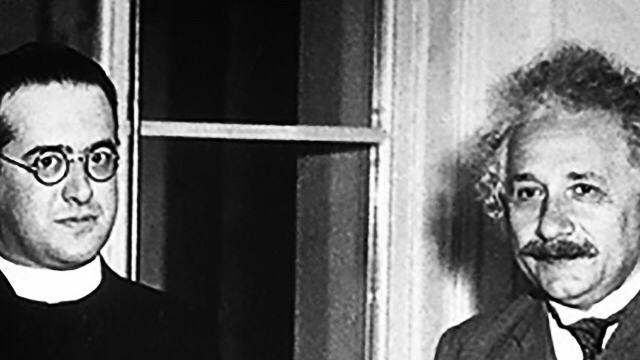
Photo: Georges Lemaître, priest and astrophysicist, father of the Big Bang theory with Albert Einstein in 1933.
Link for the Mass readings for Thursday, November 12, 2020
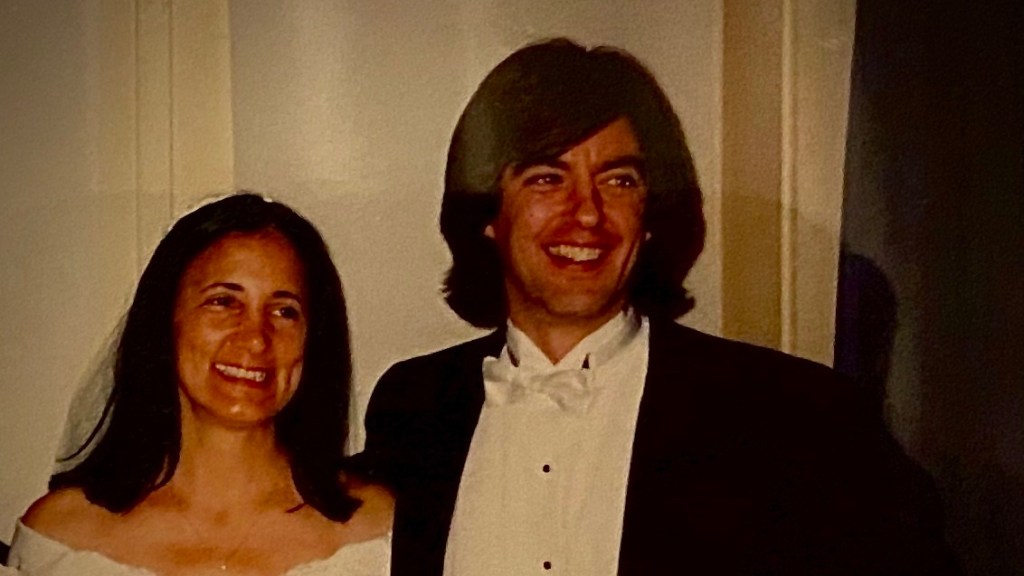
For whom or what are you thankful?
Jesus said in reply, “Ten were cleansed, were they not? Where are the other nine? Has none but this foreigner returned to give thanks to God?” Then he said to him, “Stand up and go; your faith has saved you” (Lk 17:17-19).
Bloodline doesn’t matter, gender doesn’t matter, nation doesn’t matter, ethnicity or race doesn’t matter. Ask Mary the mother of Jesus, ask Mary Magdalene, ask the woman who suffered from hemorrhages for twelve years, ask the Roman centurion whose slave was dying, ask the Samaritan leper what matters. Each of them will share with us that what matters is our faith in Jesus the Christ.
The lifeblood of Christianity is our belief, faith in, and developing our relationship with Jesus, the Son of God, who made his dwelling among us. St Irenaeus of Lyons (born in Smyrna about 135-140 AD and died about 202-203 AD) in his work Against the Heresies wrote: “The Word of God, our Lord Jesus Christ, who did through His transcendent love, become what we are, that he might bring us to be even what He is himself.”
That Jesus became one with us in our humanity so that we could be one with him in his divinity is something to be thankful for! Many times when we are feeling down, maybe it is because we are focusing on what we do not have or who is not in our life instead of being thankful for who or what we do have. A way to turn our frown upside down is to think about three things we are grateful for.
The leper from today’s Gospel helps us to take the next step. Once we become aware of what we are thankful for, we are to reach out and thank the one who made what we have possible. Our time on earth is too short to allow the temptations of indifference and complacency to take hold. May we be more aware and take action to reach out to those who are important in our lives and tell them how thankful we are that they are in it, how much they mean to us, and how much we love them. Make some time to thank God today for his constant presence, the wonderful gift of the invitation of Jesus to share in his divinity, and the Holy Spirit who leads us to love one another as he loves us.
———————————————————————
Photo: I am thankful for the best day of my life, our wedding day. I am also grateful for the twenty-three years we had together!
Link for the Mass readings for Wednesday, November 11, 2020
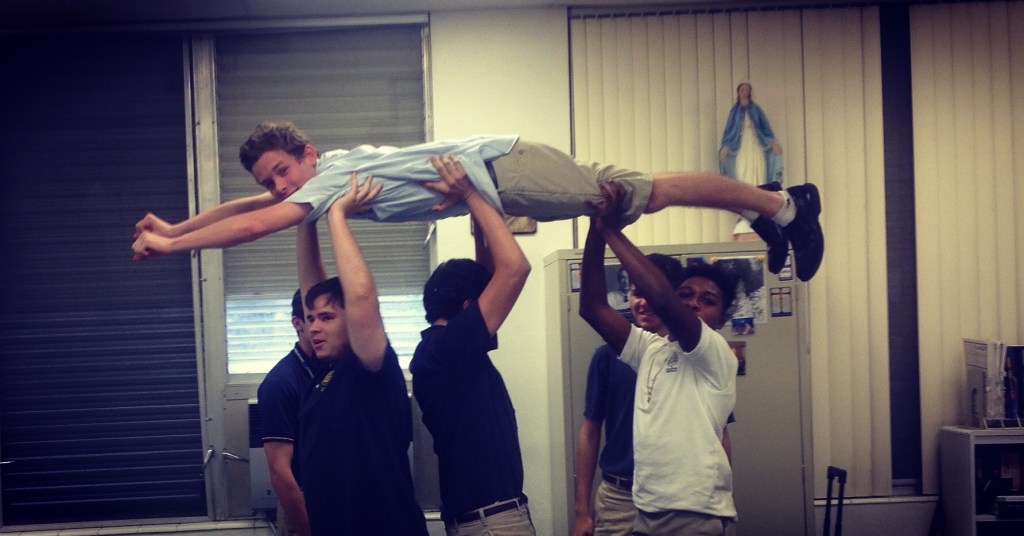
To follow God, we are to serve and lift each other up.
“When you have done all you have been commanded, say, ‘We are unprofitable servants; we have done what we were obliged to do'” (Lk 17:10).
This closing line from our Gospel reading today can be a hard verse to digest at first glance, especially with our track record of slavery in the U.S. We need to remember and recognize that this was a teaching that Jesus shared in a different time period, in a different culture, and in a place far removed from any clear modern context. The master/slave relationship is also a theme that Luke returns to often.
Another important point to touch upon when reading the Gospels is that when Jesus made the statement that, “we are unprofitable servants; we have done what we are obliged to do”, we are not to read this verse in isolation from the full context of Scripture. Jesus himself modeled service at the last supper when he washed his disciples’ feet (cf. Jn 13:1-17). This was the lowest of menial tasks. St Paul wrote to the Galatians informing them that in the Body of Christ there is no Jew or Gentile, slave or free, male nor female (cf. Galatians 3:28). The ultimate point is that God is God and we are not. We all have a part to play in participating in promoting the kingdom of God by following his lead.
As a disciple of Jesus, we are not to seek adulation and glory. We are to serve God and one another without hesitation. We are not to ask in the words of James and John, “Grant that in your glory we may sit one at your right and the other at your left” (Mk 10:37). We serve God because he is the director and we are the directed. He is the master and we are the servant. In aligning ourselves in this way, we also experience the intrinsic joy of following his will.
When I oversee students in our cafeteria, during retreats, and other opportunities, as they finish eating, instead of telling them to pick up after themselves, I begin to pick up some of their plates and trash. I serve them. Some are quite happy to receive the service, some will say thank you, while others will join in to assist. It is my hope to model for them acts of service that they may respond in kind as well and experience the joy of serving.
May we be open to serve God and one another today. No task is too menial or beneath us, nor do we need to be concerned about doing big and grandiose things. We just need to be obedient and act as God leads us. Each chance we have, to smile, to hold a door, to acknowledge prejudice and be willing to interact with someone who we have considered as “other”, to be patient and present instead of losing our temper, and/or to listen with understanding, are all opportunities to say to someone that they have dignity and worth and that they matter.
Pope Francis said in a homily last year on June 11, that we are to: “Serve and give freely that which you have received freely. May our life of holiness be permeated by this openness of heart, so that the gratuitousness of God – the graces that He wishes to give us without cost – may enter our hearts.” As our hearts expand through small acts of kindness we are moved to serve and to love even more. As St Mother Teresa said, we are to be a pencil in God’s hand. In our willingness to be moved by God to serve, we and those in our realm of influence will be better for the effort. Our country and our world are in desperate need of some unconditional acts of kindness and service.
———————————————————
Photo credit: Each playing their part!
Link for the Mass readings for Tuesday, November 11, 2020
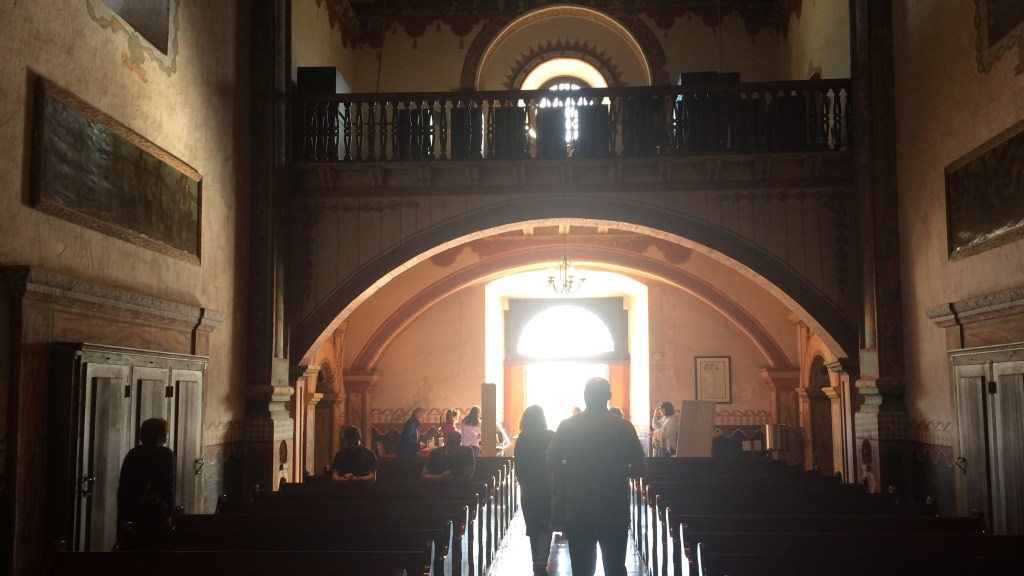
We may be the only Bible someone reads.
When I ask my students if Jesus ever sinned, inevitably, some reference the account from today’s Gospel. In these verses, we read how Jesus, “made a whip out of cords and drove them all out of the temple area” (Jn 2:15). Jesus is not sinning here, rather, he is acting in line with the prophetic tradition. Jesus is making a bold spectacle to drive home the point that the temple is not a marketplace but is to be a place of worship and right praise to his Father.
Greater still than the temple, is the people of God. Further down in the text, when those present ask for a sign to justify this act, Jesus said: “Destroy this temple and in three days I will raise it up” (Jn 2:19). Clearly, he was pointing to his body as the temple of God and referring to his Resurrection that would come.
The temple, the house of God, believed to be the very corporal presence, the very seat of God among his people, Israel, was destroyed in 70 AD by the Romans. This left a tremendous spiritual vacuum. Two groups that were intimately tied to the sacrificial cult of the temple, the Sadducees and the Essenes, very soon after the destruction, ceased to exist as a sect within Judaism. The Pharisees, who already were moving to a practice of home worship that mirrored the worship in the temple, would survive and be the ancestral root of Judaism today. Another sect would also arise as the followers of the new way of Jesus which became the Church, the Body of Christ.
Each of us has a unique part to play in the Church. We are called to bear witness and practice, in our own unique way, our faith in our everyday experiences. We may be the only Bible someone ever reads. This call to put our faith into action is not an invitation to be overwhelmed by nor an excuse to assume a posture of elitism. We are no better than anyone else.
Pope Francis wrote: “Believers should not be presumptuous; rather, truth leads to humility. We know it is not ourselves possessing truth, it is truth that embraces and possesses us” (Costello 2013, 14). We are to seek and follow Jesus, the Truth, and allow his truth to shape our lives. We need to resist being defensive and rigid. Instead, we are called to be flexible and open to dialogue, sharing our stories and experiences, and inviting others to do the same. When we are willing to encounter and walk together, we learn and grow from one another. In this way, we become less other and more human to one another.
We need to resist all that contributes in any way to the dehumanization, hate, and violence that is rampant in our country and the world by rooting ourselves in Jesus, the living Temple. We need to recognize that we all fall short of the glory of God and on our own, we are limited in how far we can go. We need to be willing to be conformed to the will of God through spending consistent time in silence, prayer, meditation, study, worship, and service to be empowered by the love of Christ to be instruments of peace, contemplatives in action, and advocates for healing and reconciliation in a wounded and weary church, politics, country, and world.
——————————————————–
Photo: Exiting Mass from Mission del Rey, Oceanside, CA. One of the ways we are dismissed after Mass is to “Go in peace, glorifying the Lord by our life.”
Costello, Gwen. Walking With Pope Francis: Thirty Days with the Encyclical The Light of Faith. New London, CT: Twenty Third Publications, 2013.
Link to the Mass readings for Monday, November 9, 2020
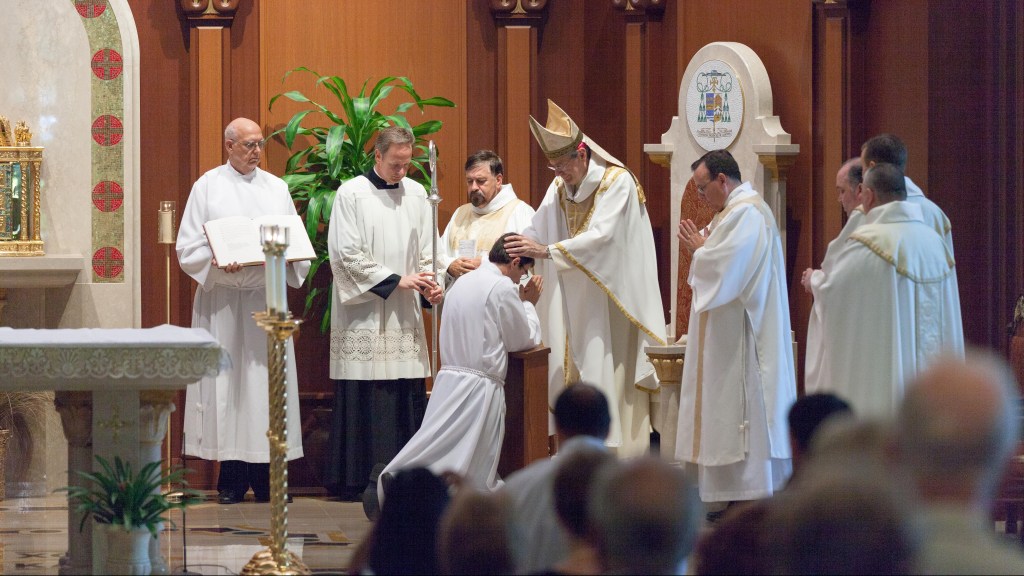
May our purpose each day be to serve one another.
Our teen years can be the best of times, but they can also be the scariest of times. It is during our early development that we begin experiencing the awakening of the fullness of our humanity, psychologically, emotionally, socially, sexually, and spiritually. We start to ask ourselves what it means to be open to experiencing life, to accepting the gift of our humanity, answering questions like why do we exist, what is our purpose in life?
When I was in high school, I asked myself these questions. But I did so, mostly, within the confines of my own mind. I didn’t reach out too much. I kept my questions, emotions, joys, and struggles pretty much bottled up inside. This is not a healthy practice, because, at that age, I hadn’t developed the discipline of discernment, I hadn’t lived enough to have the benefit of the gift of lived experience.
During my last two years of high school, I experienced some intimate interactions with God that I have shared in past reflections as well as even just for the briefest of seconds, his absence. I remember one evening while in bed I tried to imagine life without God, an eternity without God. I then tried to imagine absolute nothingness. I don’t remember for how long, but I do remember the instant and split second that I experienced that sense of nothingness and feeling an absence of God. It was not pleasant, it was unnerving, and it was a wake-up call.
No matter our age, we have a lot on our plate, there is a lot that we are dealing with. There are a lot of temptations that pull at us, that if we give in to can destroy our relationships, that can take our very lives. The most dangerous one to buy into is the lie that we walk this journey of life alone. We need one another, we need to risk reaching out to share our fear, our pain, our questions, with somebody, even better a core group of those we can trust. Yes, there will be those who we reach out to that will not be there for us, there will be those who do not nor want to understand, there will be those that we encounter that will be cruel. But this we can be clear about, please let these words soak into the very core and fiber of your being:
Always remember that you are unique, you are one of a kind, you are special, you are loved, and you are a gift to your family, friends, your parish, church, or place of worship, community, and the world. Read this section again, aloud if you have to.
As we age, we hope to progress in wisdom, as wisdom is considered the “perfection of prudence,” as is shared in the first reading from Wisdom. Prudence is the virtue that we develop which allows us to make the right decision, at the proper time, and even while facing temptations and stress. “Resplendent and unfading is wisdom, and she is readily perceived by those who love her, and found by those who seek her” (Wisdom 6:12). Seeking wisdom leads us to seek a life worth living, which is to live outside of one’s self for the purpose of willing the good of others. This is to be true even despite the forces that will work against us. Living our faith means taking a risk: a risk, that we will not be understood, a risk that we will be hurt, a risk that we will be rejected.
Do we allow our fears, anxieties, doubts, and a minimalist approach to just settle to rob us? If you thought yes, then you are not alone. We all do! But we don’t have to stay in that state.
St. Mother Teresa said, “A life not lived for others is not a life.” How can she say that? Because she knew Jesus intimately, she experienced him in the depth of her soul, answered his call to serve the poorest of the poor, even, when for the last fifty years of her life she experienced an absence from him who called her.
How do we live our life for someone else?
Like St Mother Teresa. We look for Jesus in each person we interact with and we do so when we treat each person we meet with dignity and respect. We resist judging another and accepting them as they are and where they are. We welcome them as our brothers and sisters. This stance ought to be our foundational approach. From that point, each of us also has a unique vocation of service. Some way that we can contribute to the Body of Christ that God uniquely calls us to.
We need to be careful though that our day to day demands as students, workers, family providers and caregivers, material and social pursuits, don’t consume all our time and distract us from our purpose in life.
This is the point of The Parable of the Ten Virgins. We can only develop a relationship with Jesus, only develop our faith for ourselves. We can’t do it for others. I can share stories from my experiences to show you the possibilities, the reality from my perspective as life in relationship with Jesus but you have to experience Jesus for yourself. You must see the relevance of Jesus in your life. You must be willing to receive his forgiveness and his love and answer his call to begin your vocational path.
Like I imagined nothingness for that briefest of moments, can you imagine living 20, 30, 50, or 60 years, or your whole life, never knowing your purpose? Unaware and without hope, like St. Paul wrote about in the second reading today (cf 1 Thessalonians 4:13)? Do we want to just go through the motions, to fiddle our life away, and to miss out on a life of joy and fulfillment that God has in store for us? The good news is that it is never too late to begin. And even if we have already said yes, each day is a new beginning, each day we are called to deepen our relationship, to rededicate our willingness to go out to love God, love others, and make disciples.
May we ask God each day: “What is our purpose in life?” No matter who we are or what our status in life, we are loved. Please receive the reality of that Gift from the God of all creation. Then from a place of thankfulness, may we seek to pursue the freedom for excellence that embraces life with a singular purpose that guides us every day. What is it that God would have us do? What brings us fulfillment and joy? If we do not know how, or where to begin, Jesus knows, let us turn to him to seek his wisdom and guidance.
May we embrace the gift God has given us, his life for us, the dignity of our own humanity, and that of one another. In today’s gospel reading, the problem with the five virgins who had not filled up their oil lamps was that they did not bother to do so. Fr. James Martin, S.J. shared in a talk that, “Sin for Jesus was a failure to bother to love.”
Being a Christian, embracing our humanity, is to bother. We are made to care. We are to go out from our comfort zones empowered by the Holy Spirit to live life fully with joy, to seek our unique purpose, to treat each other with love, mercy, caring, and kindness. We don’t have to have all the answers, we don’t have to fix ourselves and those we meet. We just need to be willing to walk with one another, to care for each other, and let God happen.
As the election process now comes to a close, may we commit daily to work for healing and reconciliation. We will do this when we respect each other as human beings. That does not mean that we all have to agree but that we are willing to listen to and respect the dignity of one another.
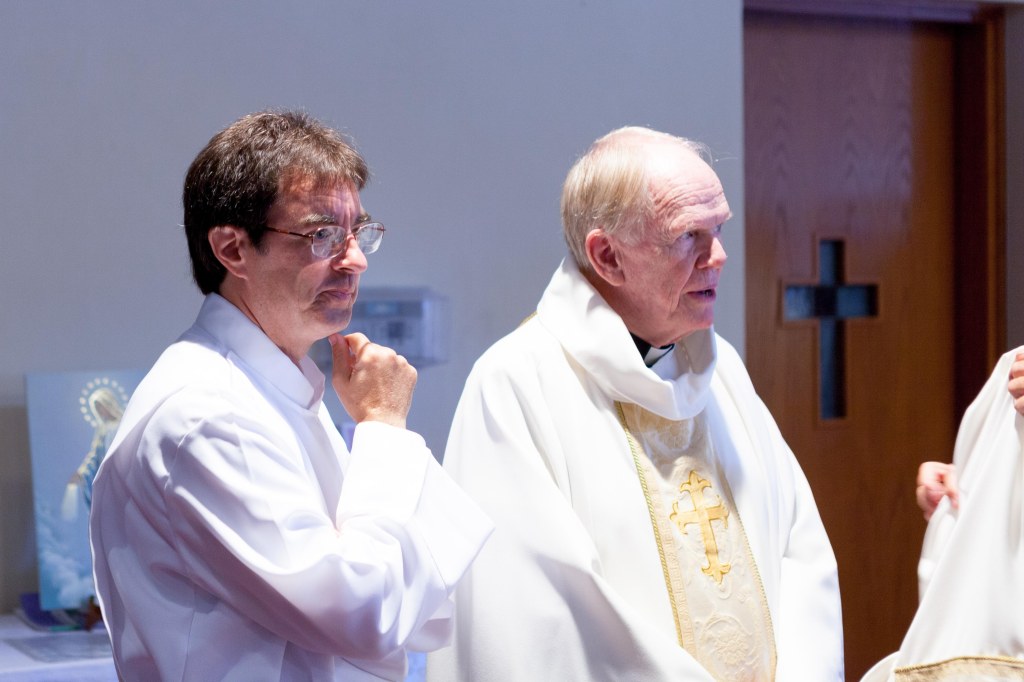
Photo from my ordination from 2013, photo credit – Deacon Michael Miller

Not in Gold but in God are we to place our trust.
“No servant can serve two masters. He will either hate one and love the other, or be devoted to one and despise the other. You cannot serve God and mammon” (Lk 16:13).
Jesus consistently emphasizes the priority of making God primary in our lives. Anything that moves into the slot of preeminence before God is idolatrous. Anything, even family, as we heard a few days ago. We cannot have two firsts, because either we will “hate the one and love the other, or be devoted to one and despise the other.” This balancing act is not an easy discipline.
It becomes especially challenging when we look at mammon, money, or material wealth. Many of us seek our security in having a home, insurance policies, savings, retirement plans, market investments. Setting up this security is often considered prudent. The problem is when material security becomes the foundation of our life, our fulfillment, our god.
This has certainly influenced the Church at times with movements governed by a prosperity gospel. The approach to a faith life that is not so much building up a relationship with our loving God and Father, but one of seeking God as a holy investor. There is a perspective offered on verses such as the Parable of the Sower (cf. Mark 4, Matthew 13, and Luke 8) in which the primary intent in giving is to reap a financial return of ten, twenty, or a hundredfold. God certainly wants us to be good stewards, and he will indeed bless us and wants us to be generous and cheerful with our giving, but again, if in our giving the primary intent is to receive more of our treasure, we are serving Mammon and not God.
Following are two scriptural verses and two Church Father quotes that may help us to see that in giving away and not accumulating the material, thus trusting in God for our security is the prudent path:
“If one of your kinsmen in any community is in need in the land which the Lord, your God, is giving you, you shall not harden your heart nor close your hand to him in his need. Instead, you shall open your hand to him and freely lend him enough to meet his need” (Deuteronomy 15:7-8).
“For I was hungry and you gave me food, I was thirsty and you gave me drink, a stranger and you welcomed me, naked and you clothed me, ill and you cared for me, in prison and you visited me” (Matthew 25:35).
“When giving to the poor, you are not giving him what is yours; rather, you are paying him back what is his” (St Ambrose of Milan, 340-339).
“If each one of us took only what is necessary for his sustenance, leaving what is superfluous for the indigent, there would be no distinction of rich and poor” (St Basil of Caesarea, 330-379).
Our reactions to the above can be a barometer as to whether we are putting gold first or God first. God is to be our source and our fundamental option. The blessing we receive, the hundredfold we seek, is to be measured in love, mercy, and generosity received and given. Pope Francis, in a 2013 address, expressed his concern “that some homeless people die of cold on the streets [and this] is not news. In contrast, a ten-point drop in the stock markets of some cities is a tragedy. A person dying is not news, but if the stock markets drop ten points it is a tragedy! Thus people are disposed of as if they were trash. Consumerism has led us to become used to an excess and daily waste of food, to which, at times, we are no longer able to give a just value, which goes well beyond mere economic parameters” (Vatican Insider).
Do we place our trust, faith, and security in Mammon, or God? Do we build up treasure for ourselves at the expense of or indifference toward others or build up our treasure in heaven, aware of and reaching out to those who are in need? Were someone to observe us objectively, and closely would they say about us, “There goes someone that lives their life believing: In Gold we Trust.” Or would they say, “There goes someone that lives their life believing: In God we Trust?”
———————————————————————————-
Photo: pexels.com
Link for a quote from Pope Francis found in Vatican Insider
Link for the Mass readings for Saturday, November 7, 2020
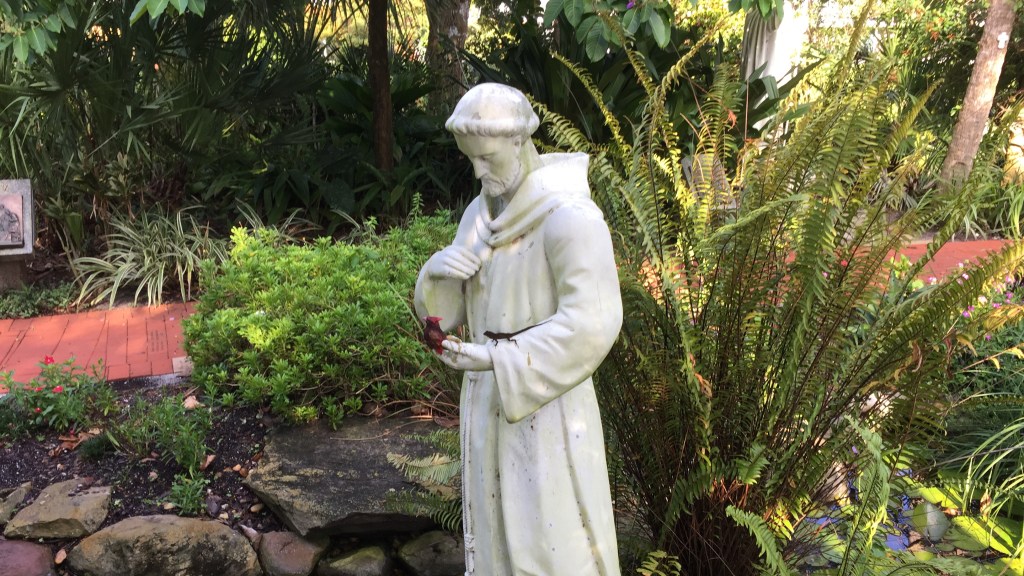
May we be conformed to Jesus as the saints were.
In the Parable of the Dishonest Steward, the steward who is on the block to lose his job for squandering his lord’s property comes up with a plan to settle his lord’s accounts. He lessened the amount owed with the intent to gain some support from those indebted to his master. Most likely he was giving up his own profits in settling these debts, much like a real estate agent or car salesman today would forego their commission to make a sale.
The prudence or cleverness of the steward is commended by the lord because the dishonest steward had utilized foresight, which was a better quality to develop than the original squandering that landed him in this predicament in the first place.
Jesus commenting on this parable also acknowledged those who were clever in worldly ways, thinking and acting with prudence. Being shrewd and having the foresight to navigate potential conflicts to acquire the desired goal is admirable. Jesus then shared the insight that we as “children of the light” ought to act with prudence as well. The difference being, the application is not for personal gain but applying cleverness in evangelization. As we spread the Gospel, we do so, not in a one size fits all approach. We are to be present and adjust to each person’s uniqueness.
Many in the Church have gone before us aware of the needs of those people in their midst and coming up with creative ways to minister to them. Often they too, utilized the model of the steward’s prudence in today’s Gospel, giving up their opportunity for immediate gain to provide for the needs of others.
St. Francis of Assisi, lived his youth, not as a faithful steward, but as a pampered troubadour, part of the social elite. Then as his transformation began to take hold, he began to sell off his father’s cloth and gave it to the poor. He would ultimately renounce his family name as well as all material possessions, and give all to follow Jesus.
St. Mother Teresa, left her home at eighteen, never to see her family again to become a missionary in India with the Loretto Sisters. She became a school teacher in Calcutta, by no means squandering what the Lord gave her, but she too was called to go deeper. She left the convent to serve the poorest of the poor in the streets, those in the most deplorable of conditions.
Jesus has a unique call for each of us. We too are called to be faithful stewards, to be holy, and to be saints. What needs do we see in our midst? In what ways can we be more prudent? Each of us is invited into a deeper embrace of the Gospel. “We experience faith and encounter God in our own particular time in history, and faith lights up our journey through time. Faith must be passed on in every age” (Pope Francis, 20). Jesus, please deepen our faith and help us to put it into practice in the unique way you call us to.
Photo: Statue of St. Francis in our rosary garden at St Peter Catholic Church in Jupiter, FL.
Walking With Pope Francis: Thirty Days with the Encyclical The Light of Faith. New London, CT., Twenty Third Publications, 2013.
Link for the Mass readings for Friday, November 6, 2020
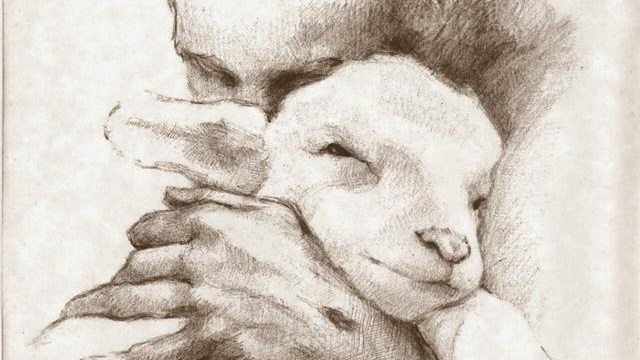
Each of us matters to God.
In our Gospel account today, Luke records that Jesus is critiqued for eating with tax collectors and sinners. Jesus responds to the criticism of the Pharisees and the scribes by sharing three parables, two of which we read today, and the third, the Prodigal Son, is often reserved for reading on Sunday during this liturgical cycle of readings.
The two parables we are given today display the love of God the Father for his children. Though we may not find being compared to a sheep or a coin endearing, the imagery of the shepherd going to find the one lost sheep and the woman searching all over her house for the one lost coin is a message well worth meditating on.
Someone hearing this parable might say, “Why bother looking for the one sheep when you have ninety-nine other sheep or why bother looking for one insignificant coin when you have nine other ones?” But if we reflect upon this parable for a bit we might recall a time or feel right now that we may be lost or insignificant. What Jesus is telling us is that we matter, that God loves us more than we can ever imagine, and he is constantly seeking us out. God is the creator of the vast expanse of the cosmos yet he cares for each and every one of us individually. He cares for you as if you were the only person in the world.
We do not need to look for God so much as we need to just stop, be still, and notice he is already waiting for us. If we feel a bit worn, misunderstood, lost, lonely or underappreciated, rest assured that we are not alone. God cares and he is present, yes, even in the midst of any conflicts, trials and/or tribulations that we may be going through. Even if we have separated ourselves from him through our sin, God loves us more than we can ever mess up and he is the shepherd that watches over us and seeks us out even when we walk away from him. Return to him and feel the healing balm of his forgiveness.
I have experienced his forgiveness, mercy, and love when I participate in the Sacrament of Reconciliation and I invite you to do the same when you can. In the meantime, allow yourself to let go in the loving embrace of Jesus today. Breathe slowly, rest, cry, or vent. Receive the gift of his love so as to share it with someone today who also needs to know they matter, that they have dignity, that they are not alone, and that they are loved.
Photo: One of my favorite pencil drawings by Kathryn J. Brown, 1982
Link for the Mass readings for Thursday, November 5, 2020
 Spiritual Stepping Stones