Reflections on the Gospel Reading for the Day
Do we have great faith?
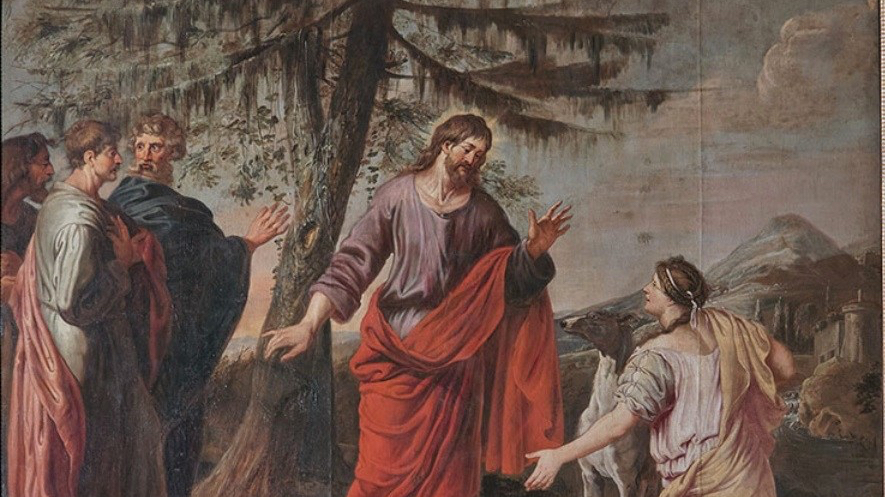
He said in reply, “I was sent only to the lost sheep of the house of Israel.” But the woman came and did him homage, saying, “Lord, help me.” He said in reply, “It is not right to take the food of the children and throw it to the dogs.” (Mt 15:23-24).
I would encourage you to read in full Matthew 15:21-28 to get the full feel of this Gospel account. (If needed, see the link below).
Jesus’ reaction in this scene does not appear to be consistent with how he has acted toward others who have approached him in the past. Is he just having a bad day and taking it out on this woman? Is his reaction because she is a woman and a Gentile at that? I don’t believe either case to be true.
Jesus has seen his disciples time and again attempting to turn people away, just as recently when the five thousand were hungry and they were ready to send them to the nearby villages, knowing the hour was late to get their food. Jesus was also tired that day too, all but spent, yet, even so, I am sure that he did not check to see who were the card-carrying Jews among those gathered, but instead fed all that were present.
In today’s recording of Matthew, I wonder if Jesus was not so much testing the woman’s faith, as much as he was testing the faith and the response of his disciples. The woman was calling for help. Would the disciples offer to provide her support, following the lead of Jesus who they have observed so many times before? Jesus remained silent to her initial plea for help. What did the disciples do? They asked Jesus to send her away. Jesus appeared to support their indifference when he justified his non-response by stating that he was sent to the lost sheep of Israel, clearly, she was of another fold.
Again, the disciples did not step up to defend the woman in need. Maybe they even egged Jesus on. The woman persisted. She came forward and knelt before Jesus imploring him to help her and Jesus met her with a degrading slur, referring to the woman as a dog. The disciples would now certainly appeal to Jesus for mercy, right? Nothing. Nada. His apostles stayed silent, or worse they may have even started to have a good laugh at her expense.
The woman did not back down, she remained resilient in her effort because her daughter needed her help and she would not be turned away. She did not react or get defensive, but returned with her own retort, by stating, “Please, Lord, for even the dogs eat the scraps that fall from the table of their masters” (Mt 15:27). Jesus then upended the whole scene and shared that the woman was the one who had great faith! A woman, a Gentile, not his disciples.
Those who have great faith are the ones who believe and act on that belief. Coming up with excuses to support our own indifference or rationalizing turning away people in need is not faith. Those who are aware of the need of another, even and especially when the task seems beyond them and is willing to take the risk, to make the effort to reach out and help, are those who show great faith. How would we have acted in this same scenario? I invite you to read Matthew’s account again in full a few times and imagine yourself in the scene.
With honesty, let us assess where we find ourselves in the scene? Are we aghast at Jesus’ initial responses, do we stay silent or speak up for the woman? Do we add our own insults? If we are going through a trial as did the woman, do we have her persistence, determination, and resilience, resisting to be turned away or lose our cool? Would we have this woman’s laser-focused unwillingness to give up?
Can we recall times when we did not recognize the need of others or respect the dignity of others because we perceived them as different or other than us? Were there times when we have or supported others who have loosed derogatory or dehumanizing speech or actions behind people’s backs or directly? Have we defended, justified, or rationalized our gossip, prejudices, or hurtful behavior?
If so, may we seek God’s forgiveness, and if possible reach out to apologize to those we have directly or indirectly hurt. May we commit today to follow the guidance that St. Paul offered to the members of his Church at Ephesus: “No foul language should come out of your mouths, but only such as is good for needed edification, that it may impart grace to those who hear. And do not grieve the holy Spirit of God, with which you were sealed for the day of redemption. All bitterness, fury, anger, shouting, and reviling must be removed from you, along with all malice. [And] be kind to one another, compassionate, forgiving one another as God has forgiven you in Christ” (Ephesians 4:29-32).
Jesus, please fill us with your love and grace. Guide us and give us the courage to resist hurting others with our thoughts, faces, words, actions, or inactions. Help us to be your light in the midst of the darkness of prejudice, hate, and racism by being more aware, understanding, patient, present, kind, encouraging, empowering, and loving today and each day. Help us to respect the dignity of all we encounter, especially, those we have considered different or have in the past kept at a distance, so that one day we too may hear the words you spoke to the Canaanite woman, “Great is your faith!”
———————————————————————–
Picture: Jesus and the Woman of Canaan by Micahel Angelo Immenraet, 1673-1678
Mass readings for today, Wednesday, August 5, 2020

Seeking to know God and his will? Spend time in prayer as Jesus did.
[H]e went up on the mountain by himself to pray (Mt 14:23).
Jesus sent his disciples ahead of him and went further up the mountain to pray by himself. There is a consistent record of Jesus praying in the Gospels and beyond this written record I am sure that Jesus practiced this one on one time with God often.
The goal of Jesus spending time in prayer was not to amass enough spiritual energy so that he could do miraculous things like walking on the water. Spending silent time in prayer was an example of Jesus answering the invitation of his Father to spend time with him. Jesus knew the will of his Father because of this consistent time they spent together.
If we are to come to not just know about God but truly know him and his will for our lives we need to do the same. We need to make consistent time to be still and open our minds and hearts to be present with God. True, God doesn’t only speak to us in our quiet and still moments. God engages with us in our everyday activities, but if we are not aware and attuned to his presence, which improves when we are still and quiet, we can often miss or dismiss daily happenings with God.
Setting consistent, daily time, ideally the same time each day, will help us to slow down our pace. The first thing in the morning is best. We can slow down before we even get started. Start with five or ten minutes. If this is new, even those few minutes can be a challenge. Just continue to show up!
As we begin to slow down more consistently, turn off the automatic pilot, and step away from our harried pace, we will begin to discern and come to know God’s voice which speaks in the silence of our hearts.
God invites us to move beyond our mere survival instinct and reactions or settling into a comfortable and protected cocoon. God encourages us to be fully alive and to be engaged in the lives of others. How this takes shape will be different for each of us. We each have a particular and unique role to play in our collaboration with God, which we will come to know when we set aside and show up for some consistent time to pray just as Jesus did.
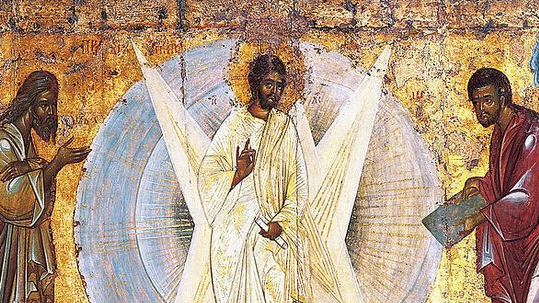
Painting: “Not By Bread Alone” by Michael Dudash
Link for the Mass readings for Tuesday, August 4, 2020
“Take courage, it is I; do not be afraid.”
“It is a ghost,” they said, and they cried out in fear. At once Jesus spoke to them, “Take courage, it is I; do not be afraid.” Peter said to him in reply, “Lord, if it is you, command me to come to you on the water.” He said, “Come.” Peter got out of the boat and began to walk on the water toward Jesus. (Mt 14:26-29).
This is one of my favorite Gospel stories. Yes, Peter quickly started to sink, but for that brief moment…
Life is a struggle. Challenges, fears, trials, and conflicts pound at us like turbulent waves. We may be tempted to be paralyzed by our fears and begin to sink because of the weight of the pounding. Yet, when we trust and keep our eyes on Jesus we keep who is present in the midst of our storms, we will overcome.
In many a top ten list of fears, I would guarantee that speaking in public consistently makes the top three. This is an area I have struggled with on and off again over the years. One incident happened about six years ago as I had the opportunity to share my first reflection during my acolyte year of formation for the permanent diaconate. I must have prepared for three to five hours, writing and rewriting well into the wee hours of the morning the night before. Just before the morning liturgy, our director of formation informed me that there had been a last-minute change of plans and we were going to have different readings than I had planned. He offered to give the reflection in my place, as well as gave me the option to continue and incorporate what I had planned into the new readings.
I chose to remain on course to offer the reflection, and as we processed in, I immediately regretted my choice. The winds and waves of anxiety started to batter me and continued their assault as I came up to read the Gospel. As I came to the end of the reading, a quiet peace settled over me. I then began to preach extemporaneously, ignoring my notes. There was an unexplainable feeling of joy that welled up in me, and like Peter, for that brief moment, it was as if, I too was walking on water! Halfway through the reflection though, my mind directed me back to my prepared notes, and I lost the connection that I had just experienced. I sputtered a bit to the end but finished free of any major catastrophe.
After the service ended, I remained in my seat quietly for a second to catch my breath. My classmates Dennis, Hank, and Pete, who all knew how nervous I was going into this, swarmed around me like I had just touched home plate after a walk-off home run. I can still feel Pete’s bear hug.
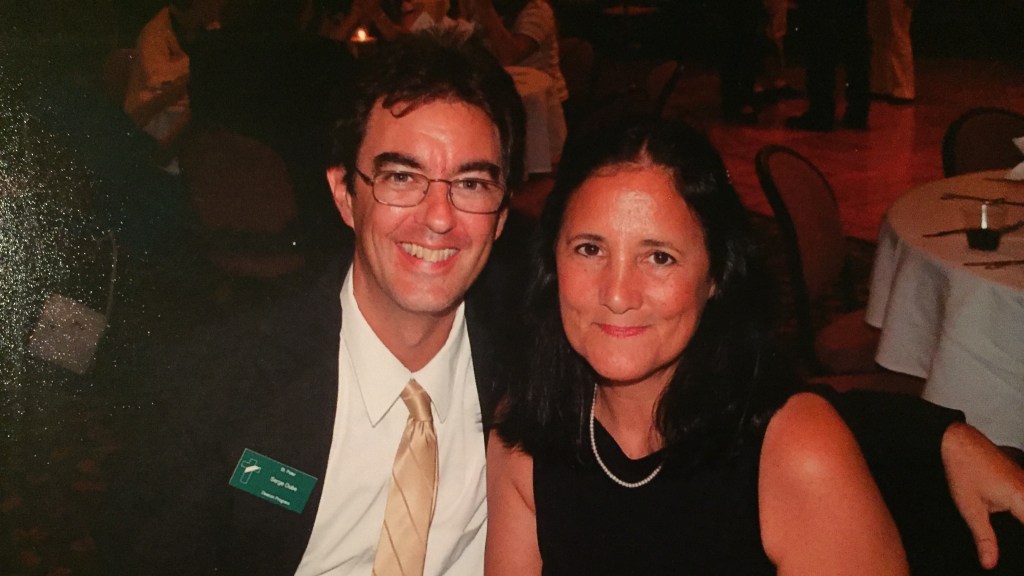
JoAnn had appendicitis during her first-grade year of school. She missed a lot of her reading lessons but worse became very self-conscious from that time forward about reading aloud. During our husband/wife retreats each year, wives were given the opportunity to read during the Liturgy of the Hours or Mass. JoAnn did not feel comfortable nor did she want to do so but accepted the offer. We prepared, she practiced ahead of time, and then she prayed to the Holy Spirit just as she approached the ambo. JoAnn felt very nervous but as she began to read, she felt this overwhelming sense of peace fill her whole body. She was no longer fighting back nerves but tears of joy at God’s presence.
There will be times when Jesus invites us to come out of the boat and step onto the water, he will call us to move out of our comfort zone. May we, as did Peter, trust him and step out in faith. This will be a risk, and yes, there will be times that we will sink, just as Peter had done. But even though he sank, he immediately remembered to call out to Jesus to save him and Jesus immediately reached out his hand and pulled him up. Jesus was there for Peter, he has been there for JoAnn and me, and he will be there for you.
There may be something that you have been feeling led or encouraged to attempt, to start, to do, yet the waves of doubt, anxiety, and fear have been rocking the stability of your boat. “Be not afraid! Come.” Step out of the boat, take the risk, keep your eyes on Jesus, and walk on the water!
———————————————————————–
Photo: JoAnn and I during our formation period in the permanent diaconate program.
Link for the Mass Readings for Monday, August 3, 2020

When we allow our hearts to be moved by compassion, we serve with love.
When he disembarked and saw the vast crowd, his heart was moved with pity for them, and he cured their sick. (Mt 14:14).
The feast of the feeding of the five thousand was quite different from the birthday feast of Herod Antipas (Mt 14:1-12) that we read yesterday. Herod’s focus was on himself, not the welfare of the guests attending his banquet. Herod’s pride was on full display, and it culminated in his ordering the head of John the Baptist to be served up on a platter.
Jesus was focused instead on those who gathered around him; “his heart was moved with pity for them”. Jesus was aware of their need, their hunger, not only for something to eat but a deeper spiritual hunger. He made himself available to them. Jesus taught, healed, and when that time ended instead of sending them off to fend for themselves, in the multiplication of the bread and fish, he met their most basic need for nourishment.
There is a stark contrast between the attitude of Herod and Jesus (cf. Mt 14:13-21). We can certainly see these two scenes playing out clearly in our country and the world today. The question for us is do we close ourselves off, embrace an indifference to those who are in need, and let others fend for themselves, or do we make an effort to be aware of the needs of those around us and attempt to be of help. Mother Teresa said: “People are hungry for God. People are hungry for love. Are we aware of that? … Do we have eyes to see? Quite often we look but don’t see. We are all just passing through this world. We need to open our eyes and see” (Mother Teresa, 56).
We do not have to feed five thousand. The effort of putting our love into action for one person is a good way to begin. Jesus, please grant us the eyes to see, help us to be more aware. Please help us to have hearts that are more open that we may experience compassion for those around us, and please set our soul on fire with the Holy Spirit to put into practice acts of love, to reach out and be present to those in need in our midst. May we recognize with St. Mother Teresa that: “We are collaborators with Christ, fertile branches on the vine” (56).
———————————————————————–
Photo of St Mother Teresa, putting her love into action. Getty Images.
Mother Teresa. No Greater Love. Edited by Becky Benenate, Joseph Durepos. Novato, CA: New World Library, 2001
Link for the Mass readings for Sunday, August 2, 2020

Who is it that we truly serve?
Herod the tetrarch heard of the reputation of Jesus and said to his servants, “This man is John the Baptist. He has been raised from the dead; that is why mighty powers are at work in him.” (Mt 14:1-2).
After the death of Herod the Great (4 BC), one of his sons, Herod Antipas, was given a portion of his father’s kingdom by the Roman Emperor Augustus. Thus, Herod Antipas was the tetrarch, or prince, of Galilee and Perea from 4 BC to 39 AD. Herod, like, Pontius Pilate, held power as long as he was a faithful servant to Rome.
News of the ministry of Jesus got back to Herod and he believed Jesus to be John the Baptist raised from the dead. What followed in today’s Gospel were some reasons why Herod arrested and unjustly beheaded John the Baptist. John was killed for speaking truth to power, as happened often in the long line of prophets before him. Jesus would continue John’s ministry of calling for repentance, for a return to follow the will of God. He would also suffer capital punishment, at the hands of Herod Antipas and Pontius Pilate. The Apostles and martyrs of the early Church followed John and Jesus, lived the truth publicly and courageously, and were bold witnesses of their faith.
How are we living our faith today? Are we faithful to the Gospel values that Jesus and the Apostles taught and were willing to die for? Do we serve Herod Antipas and Pontius Pilate or Jesus the Christ? Do we serve fear or love? Are we putting our identity first or our integrity of living and holding others accountable for living the Gospel? If we are honest with ourselves, we are not so much all the way one or the other, but a mixture. The hope is that we are moving over time closer to serving God, being people of prayer, and being present to each other with more love.
It is important to stop and reflect on questions such as these, to examine our conscience and determine who it is that we are truly serving. It is not easy living the teachings of Jesus. We will fall short, but we must remember that God loves us more than we can ever mess up. We experience the fullness of his forgiveness, light, love, and mercy when we are continually willing to follow the call of John the Baptist and Jesus, which is to acknowledge when we have put something or someone else first before God. When we repent, turn back to God, we are strengthening the union of relationship we were created for.
When we are willing to allow the Holy Spirit to shine upon the darkness of our mistakes, failures, and sins, we will experience his forgiveness and mercy, we will become more open to truly knowing his will and how best to serve him and each other. Embraced by and participating in the Trinitarian Communion of love, let us recommit ourselves today to living as Jesus’ disciples, to growing in courage to better follow his path, so to better live and speak his truth with love, mercy, and justice in and out of season.
———————————————————————–
Photo: Have missed my evening walks. Returned last Wednesday to see this beautiful white flower. A random occurrence or a God incident? I believe God was saying hello and welcoming me back to the beauty of his creation 😉
Link for the Mass readings for, Saturday, August 1, 2020

“There are no limits. There are plateaus, but you must not stay there, you must go beyond them.” – Bruce Lee
“Where did this man get such wisdom and mighty deeds? Is he not the carpenter’s son?” (Mt 13:54-55).
Many people wonder what Jesus did from the age of twelve until he began his ministry around the age of thirty. Today’s reading gives us some insight into that question. Most likely, Jesus did nothing extraordinary, he was just as ordinary as any other first-century Palestinian Jew living in the small town of Nazareth, with a population of about 250 to 500 people.
Jesus most likely worked as a carpenter. This was rough, menial work, and as a day laborer, a position that was looked down upon. We can even see evidence of this in the Gospel accounts. Mark describes Jesus as the carpenter, the son of Mary, Matthew in today’s account portrays Jesus as the carpenter’s son, and Luke and John just refer to Jesus as Joseph’s son, leaving out any reference to carpenter altogether. Most scripture scholars believe Mark was written first, so we can see a progression in the biblical tradition moving quickly away from identifying Jesus as a carpenter.
Jesus’ return to his hometown and his teaching was first met with wonder. The question arose, “Where did he get such wisdom and how did he work such mighty deeds?” But wonder soon turned to judgment. Who is he? Isn’t he just the carpenter of Nazareth, no better than any of us. In effect, “Who does he think he is?” Not only does this show that Jesus probably lived a very simple peasant life, but that Jesus’ social status was set in stone.
The people’s hearts and minds were closed to Jesus. THEY KNEW who he was and there was no way someone like him could do what they had heard, so they “took offense at him… And he did not work many mighty deeds there because of their lack of faith” (Mt 13:57-58).
How many times have we judged someone? Have we said to ourselves, “I know who he or she is.” We box them in, not as they are, but as WE see them, as we define them. We look at another individual not as a person with dignity, but as a two-dimensional caricature to satisfy our own prejudgments. We also do this to ourselves by limiting our potential when we say we can’t do this or that.
Maybe we have had a similar experience as Jesus did in returning to his hometown, in that we have sought or are seeking to move beyond our particular social status, or follow a dream or career out of the norm of familial or community expectations. No matter our age, through no fault of our own, by pursuing this path some or many may feel threatened. Thus, not willing to accept our vision, those who are not willing to grow beyond what they have always known.
This week I read an account from Stirling Silliphant and how one day Bruce Lee challenged him to run five instead of his usual three miles. Into their fourth mile, Stirling said, “if I run any more I’m liable to have a heart attack and die.” [Bruce] said, “Then die.” He was so mad he finished the five miles. Afterward, Stirling approached Bruce and asked him why he said that.
Bruce replied, “Because you might as well be dead. Seriously, if you always put limits on what you can do, physical or anything else, it’ll spread over into the rest of your life. It’ll spread into your work, your morality, into your entire being. There are no limits. There are plateaus, but you must not stay there, you must go beyond them. If it kills you, it kills you. A man must constantly exceed his level” (p. 23).
Jesus rebukes limiting attitudes and perspectives. His Father has a plan for our lives and so he invites us to open our minds and hearts, to see the potential he sees in us. Jesus, the carpenter, invites us to embrace the infinite possibilities that will arise when we participate in his life and love. This invitation is for each and every one of us, no matter our race, ethnicity, nationality, gender identification, religious, political, economic, social, immigrant, or migrant status.
I read the above account of Bruce Lee a few nights ago not realizing that I was putting limits on myself. After reading it, I set my alarm for the morning and recommitted myself to the path I am on. The Holy Spirit seeks to free us from the shackles that bind us, the limitations imposed upon us without, as well as those we impose on ourselves, and others. Cooperating with the Spirit, we will actualize who God calls us to be as well as encourage and empower others in our realm of influence to do the same.
———————————————————————–
Photo accessed from Bruce Lee Podcast Episode #77
Stirling Silliphant story accessed from Bruce Lee: The Art of Expressing the Human Body, compiled and edited by John Little.
Parallel Gospel accounts: Mark 6:3, Matthew 13:55, Luke 4:22, and John 6:42
Link for the Mass readings for Friday, July 31, 2020

Caught in the net of God’s love.
Jesus said to the disciples: “The Kingdom of heaven is like a net thrown into the sea, which collects fish of every kind.” (Mt 13:47).
The invitation of God is universal and we are all lured by his invitation of love and intimacy. We long to belong, our very substance and essence as human beings is the reality that our ultimate fulfillment can only be reached in communion with the God who created us. Yet, though drawn, we resist being caught.
St Augustine (354-430), bishop of Hippo, came to a point in his life where he realized that the flame of his desire for wealth, fame, and pleasure was dimming. He clearly felt moved toward “one reality that cannot decay, from which all other realities are derived.” Though he was caught in God’s net and being pulled in, Augustine still sought to wriggle free, for: “Though drawn to the Path, who is my savior, I shied from its hard traveling” (Augustine 2008, 161).
How many of us could echo Augustine’s dilemma? We have experienced God in our lives and feel the invitation to go deeper, yet, we still seek to wriggle free. We are attracted to God but our attraction to fame, pleasure, power, or wealth still has a stronger hold. At a baser level, we may believe that the minimalist approach is easier. God’s path is too hard.
Hard yes, but if we look at anything that has been worthwhile in our life, haven’t we received it through discipline, effort, and hard work?
Often it is more effort to work against God’s will, just read the Book of Jonah! May we instead surrender to the current of the Father’s Love and allow ourselves to be caught in the net of his Grace. At first, anxiety and fear will arise, because the pull may appear too strong, his love too pure. Yet, when we align our discipline and effort with his will, the anxiety will wane, and we will indeed be free to swim again. This time with more exhilaration and joy than we had ever experienced before.
———————————————————————–
Photo by Orest Sv from Pexels
St Augustine. Confessions. Translated by Gary Wills. NY: Penguin Books, 2008.
Link for the Mass readings for Thursday, July 30, 2020

Death does not have the final answer.
The Gospel account from Luke may be more infamous because of the encounter of Martha and Jesus. Martha approached Jesus in the midst of his teaching looking for support in rebuking her sister Mary for sitting at his feet with the male disciples gathered around him. Jesus not only did not do so but said that Mary had chosen the better part. Martha’s boldness is on display again in today’s Gospel reading from John read. Martha again approaches Jesus when she becomes aware that he has come close to their home. She does not wait but “went to meet him” (Jn 11:20). Martha’s brother, Lazarus had now been dead for four days and Jesus, who had the time to arrive before his death, was not present to help his friend Lazarus in his time of need.
How many times have we been in Martha’s position? We felt that Jesus was not there when we needed him most. Why does God allow suffering? Especially the suffering of the innocent, which is an age-old question. Part of the answer is that we live in a fallen world of sin and self-centeredness. God does not bring about suffering but he does allow it because he loves us so much he is willing to give us the free will to reject him and each other. The cost of our freedom means that there are consequences to our choices which can be detrimental or beneficial. We are all interconnected so when we choose to act on our own apart from God’s guidance and the welfare of others, the damage that ensues affects not only those around us but everyone. On the other side of the coin, there is the presence of grace when we draw close to God and each other.
We are not alone in our suffering, especially, when we do as Martha had done. She went out to meet Jesus. Martha most likely did so not holding back any of the full range of her hurt and pain. The only evidence we have is her words that express her anguish. “Lord, if you had been here, my brother would not have died” (Jn 11:21). We can only see from our limited point of view, especially when we are in the midst of grief. Yet God sees far beyond our limited, finite perspectives. In the midst of our suffering, Jesus helps to not only bring about a greater good, though it may take time to come to understand and experience, he accompanies us in our suffering. This is true even in our experiences with death.
Jesus did not come to comfort his friends Martha and Mary when he heard of the death of Lazarus, Jesus came to restore him to life, which would also be a foreshadowing of his own Resurrection. The difference being that Jesus would not merely be resuscitated as Lazarus was and die again. Jesus conquered death and became the firstborn of the new creation. We need not fear even death, our own, or our loved ones. Jesus has conquered death for all of humanity.
I still entertain thoughts that JoAnn will walk through the door one day such that the last ten months has been my worst nightmare or a bizarre conspiracy in which she didn’t really die. I know that will not happen. I know that Jesus did not heal her from pancreatic cancer. I also know despite that fact we were not alone in our suffering. Many people drew close from near and far in many unique ways and Jesus was present with us each step of the way during those agonizing months. My heart is still heavy and still aches and it doesn’t take much for tears to flow, yet, I believe that JoAnn has risen to experience the greatest healing beyond anything we can ever imagine in this lifetime. I believe that God will bring about a greater good for me and our adult children because I believe with Martha that Jesus is the Christ, the Son of God (cf. Jn 11:25-27).
Photo: “True love stories never have endings.” – Richard Bach
Link for the Mass readings for Wednesday, July 29, 2020

 Spiritual Stepping Stones
