Reflections on the Gospel Reading for the Day

Are we willing to bring the light into our present darkness?
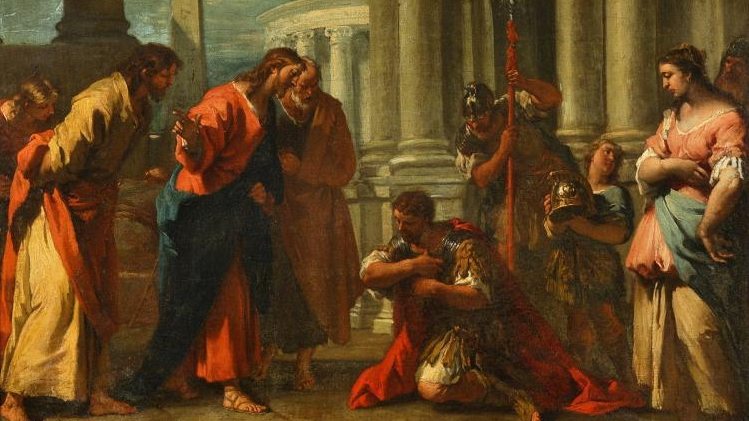
“Lord, if you wish, you can make me clean.” He stretched out his hand, touched him, and said, “I will do it. Be made clean” (Mt 8:2-3).
Jesus in reaching out and touching the leper would be considered ritually unclean for having touched the leper. Unless in that coming close and touching the leper he was healed.
There are many ways in which we consider others to be unclean and so deemed to keep at arm’s length. Doing so cuts us off from entering into a relationship with one another. We then begin to believe the stirring of thoughts swirling in our minds about the other person instead of getting to know another human being with their imperfections yes, but also their gifts.
Jesus was and continues to be willing to come close, to touch us and be a part of our lives intimately, to hear our stories, our fears, our struggles, and our pain. He also celebrates with us when we overcome, when we repent, when we love. When we are willing to do the same with each other, willing to close the gap and come close, to be a conduit of accompaniment and healing, we will begin to see healing in our families, communities, and beyond. Will we do it?
Photo: Evening walk a few nights ago
Link for the Mass readings for Friday, June 26, 2020

Receive the love of Jesus and pass it on.
“Everyone who listens to these words of mine and acts on them will be like a wise man who built his house on rock” (Mt 7:24).
Jesus speaks to us, in the Gospels, in the silence of our hearts, through our conscience, through the words of others, in our daily activities, and through creation which has been loved into existence through collaboration with his Father and the Holy Spirit.
We can be unaware of the words he speaks among us, we can hear his words but not listen, hear his words but ignore them, listen but not act upon them, or we can do with his words as Jesus encourages us to do. We can listen to the words of Jesus and put them into action. We can hear and let them come in through our minds and enter our hearts, where we can then be transformed.
Jesus became one with us so that we can become one with him. Not one with us, so that we can know about Jesus. Not one with us, so that we can say that we prophesy, cast out demons, do mighty works, cite Bible chapter and verse to show our knowledge or justify our behavior in his name. One with us so that we can become one with him.
Jesus meets us on our level and leads us up to his. Jesus has been doing just that in his Sermon on the Mount which we have been reflecting upon these past few weeks. If you are just coming in today or need a refresher, this gathering of teachings began in chapter five of Matthew and takes us up to today with chapter seven. Jesus presented us with the Beatitudes, that we are called to be salt and light, he built on the law and the prophets by giving us the six antitheses (You have heard it said, but I say to you…), he taught us to pray the Our Father, that we are to depend and place our trust in God and not the things of this world, we are to refrain from judging others, we are not to cast our pearls before swine, we are to do to others as we would have them do to us, we are to seek to enter through the narrow gate, and to be aware of false prophets.
These are but just some of the teachings of Jesus that we are to put into action if our house is to be built on solid rock. May we go back through chapters five, six, and seven of Matthew and see which teaching Jesus is leading us to ponder, meditate upon, and put into action.
If this list is a bit overwhelming, let us start with St Irenaeus who learned from St Polycarp, who learned from the beloved Apostle John who learned from Jesus. St Irenaeus taught that Jesus became one with us so that we can become one with him. Jesus entered our humanity so that we can participate in his divinity. Jesus invites us to be in relationship with him, to know him, so that we can know his Father, so that we can be one as Jesus and the Father is one. Jesus loves us as we are, and for who we are, right now at this very moment. Jesus loves us more than we can ever imagine. May we receive his love as we would receive a loving embrace, stay with it, savor it, so to return his love, by loving each other as he has loved us.
Photo: Building a firm foundation on the rock of Jesus!
Link for the Mass reading for Thursday, June 25, 2020
Identity helps us to belong, integrity gives our identity authenticity.
“No. He will be called John” (Lk 1:60).
With these simple words, three inter-related points arise. First, Elizabeth is beginning to shift the momentum of original sin. Eve was tempted by the serpent to eat of the fruit that God had told her and Adam not to eat of, yet she did. Adam did not support her step in during her dialogue but remained silent in the face of the pressure placed upon Eve. Both of them slipped into sin, by not following the will of God.
At the time of the birth of Elizabeth’s son, there was even more cause for celebration, for Elizabeth was past child-bearing years. The day had come to have the boy circumcised and named, her relatives and neighbors had gathered around with great excitement and there appeared to be a unanimous decision to name the boy after his father. Elizabeth did not, like Eve, cave to the pressure and temptation. Unlike Adam who lost his voice at the time he needed to speak up, Zechariah found his voice, had Elizabeth’s back and followed the will of God. Both Elizabeth and Zechariah knew what God wanted them to do and were faithful to follow through.
The second point is already alluded to in the first, and that is how Elizabeth and Zechariah were faithful to God amidst the familial and social pressure placed on them. Some may be removed by such familial pressure when naming a child, but for this time, Elizabeth despite the pressure held her ground and stood firm that the boy would be named John. Ignoring her, the people deferred to Zechariah, the boy’s father, thinking he would have more sense, but he, ignoring the paternal cultural pressure, supported Elizabeth. The point here is not so much the name, but the following of the will of God in the face of pressure to do the opposite.
This brings us to the third point and that is the maturation in moving from identity to integrity. Culture and traditions are not sacred, but God is. Elizabeth and Zechariah faced a lot of familial and social pressure to conform, yet they chose to be true to God, to be true to themselves, and they chose integrity over their identity.
The very simple account of Elizabeth and Zechariah naming their child John in opposition to the pressure offers for us a way to counteract the rising tide of polarization and conflicts that we face in our own country today. Identity provides safety, support, and security. It fuels one of our deepest pangs of hunger and that is to belong, to be a part of something bigger than ourselves. We can find our identity in family, friendships, our religious traditions, culture, political affiliations, common interests, clubs, activities, and hobbies. But our identity, which provides us with security, can also be a trap.
We want to belong so much, the drive is so strong, that we may have made decisions, acted in ways, and supported others, that go against who we are just so we can belong. We may have known what God wants from us, heard the whispers of his voice in our conscience, yet were pulled by the louder voices of our group. We are sometimes so ingrained by our identity that we are being strangled and suffocated by it.
In today’s Gospel account, Elizabeth and Zechariah were true to the will of God and won over those placing pressure on them by their family and neighbors. More often though, being a person of integrity does not go so well. Their own son, who would grow up to be John the Baptist, would lose his life by speaking truth to power.
John would also show his integrity when he said, “I must decrease and he must increase” (cf. John 3:30). John was talking about Jesus who embodies the moral courage that we all need today. Though more than just a model of a life well-lived, more than just a word on the page, Jesus is the Word of God. Jesus is present to us now, to guide and lead us, to empower us with the same love that he embodies, such that when we invite him into our lives, we too can be transformed to live a life of truth, moral courage, and integrity.
Becoming less, like John the Baptist, and allowing Jesus to work through us, we can act and speak up when there are those that are being belittled, demeaned, and/or dehumanized, no matter who it is that is doing so. We are called to transcend the ranks of identity and rise to the heights of integrity, even and especially when it means standing up to those in our “group.” Protecting police officers, priests, and/or political leaders who have abused their power at the expense of others for the sake of protecting the identity of the institution not only adds further abuse but weakens the institution.
Being people of integrity, we are to speak truth to power and seek to protect those who might be at risk and/or those who have been or are being abused, oppressed, and or prevented access. This provides the first necessary step in providing support for those needing healing, allows for the planning and enacting of the necessary reforms to reduce the risk of further abuse and create more equitable access. All of which will also strengthen the integrity of the institutions that are in place to empower the very people they serve.
————————————————————————–
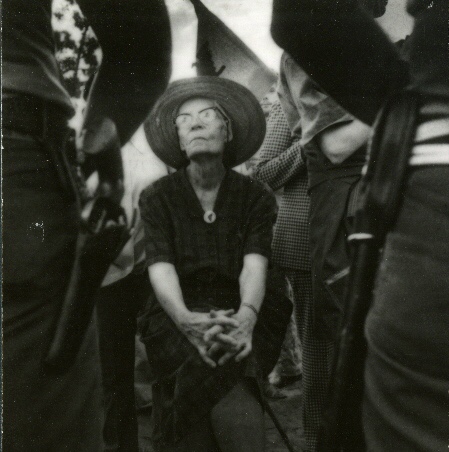
Photo: Dorothy Day speaking with police officers during her time picketing for rights of farmworkers in California in 1973. Credit – Bob Fitch.
Link for the Mass readings for Monday, June 24, 2020

“How narrow the gate and constricted the road that leads to life. And those who find it are true”
“Enter through the narrow gate; for the gate is wide and the road broad that leads to destruction, and those who enter through it are many. How narrow the gate and constricted the road that leads to life. And those who find it are true” (Mt 7:13-14).
Jesus meets us where we are in our present state of life. He accepts us as we are at this very moment. At the same time, Jesus does not want us to just settle, to be minimalists, and to merely get by, surviving day by day. Instead, he guides us to be fully actualized. He calls us to perfection, to holiness, to be saints! He sees in us, as he did in his disciples and apostles, the promise of our potential and who his Father calls us to be. We each have a unique gift or gifts to offer to the world, each and every one of us.
Entering the narrow gate means that we need to say no to those apparent goods that can burden us, weigh us down, and worse lead us to be addicted and enslaved. To pass through the narrow gate, we need to say yes to that which will truly bring us happiness, fulfillment, and freedom and this means we need to say no to supporting our false ego and our slavery to sin; to fear, anxiety, and worry such that we turn in upon ourselves. We need to instead be willing to expand and go out of ourselves and will the good of and accompany others.
Today is a good day to pray and spend some time with Jesus, seeking and discerning his will and listening for his guidance. During your time together allow those burdens of worry, anxiety, or fear; pride, judgment, or prejudice; sinful actions, habits, or addictions to surface, so we can acknowlege and begin letting go of them. This will not be a one time, done now for all activity, but a daily, disciplined commitment. We also will not be able to enter the narrow gate and stay on the path alone.
We need to continually open our hearts to the Holy Spirit such that he will give us the courage to do so. In our time of prayer, imagine placing our hand in Jesus’ hand as if we were a small child and allowing him to lead us to experience the love, mercy, and grace of our ever-present God and Father. What Jesus leads us to do, he will also give us the strength and resources to bring to completion, which ultimately will be a life of communion with God and one another.
———————————————————————-
Photo credit: Photo by Rene Asmussen from Pexels
The Mass readings for Tuesday, June 23, 2020
Instead of judging, may we empower one another.
For many of us, judging one another is almost as automatic as breathing. As we encounter someone we have instant internal judgments. We judge looks, clothes, actions, inactions, homes, cars, and material items. We judge our family, spouses, friends, colleagues, classmates, leaders, enemies, celebrities, as well as those different from us and those on the peripheries. Much of what gets our attention when we take the time to think about it is what Jesus is addressing in today’s Gospel, negative judgments.
Jesus said to his disciples: How can you say to your brother, ‘Let me remove that splinter from your eye,’ while the wooden beam is in your eye? You hypocrite, remove the wooden beam from your eye first; then you will see clearly to remove the splinter from your brother’s eye” (Mt 7:4-5).
There are positive judgments that bring about effective change for the good. In a court case, our hope is that the judge is learned in the law and guides the lawyers and jury in ways of sound judgment such that justice with mercy is served. For us to do likewise in our everyday interactions with one another, Jesus shares that we need to remove the wooden beam from our eye first before we are able to remove the splinter in another’s.
Jesus is leading us to be transformed. We need to have a change of heart, one that is not hardened by negative judgments of others based on our biases and prejudices, but a heart softened, one that is lead by the mercy and love of Jesus. This does not mean that we accept any and all behaviors, actions, and inactions from ourselves and others. Jesus does not do this. Jesus accepts ALL people as we are and where we are, with mercy. He is willing to enter our chaos, to embrace any and ALL of us who will receive the invitation of his healing embrace, and through his love Jesus accompanies and walks with us, leading us from our slavery of sin to that which is True, Good, and Beautiful.
We participate in the life of Jesus when we allow him to heal us from our own limitations of self-centered perceptions, from our anxieties, fears, and prejudices. Then we will begin to see others as God sees them, as human beings endowed with dignity because ALL people have been created in the image and likeness of God.
We participate in making our realm of influence a better place when we allow God to love and to bestow his mercy upon others through us. We participate in Jesus’ work of redemption when our judgments toward ourselves and others are not condemnations but convictions that help to empower, build, and lift up our brothers and sisters.
We participate in taking the log out of our own eye and assisting to remove the splinter in another’s eye when we are willing to admit to our shortcomings, weaknesses, and failures, and then learning and growing from those experiences. We are then in a better position to be able to accompany others in their own chaos, to journey side by side, willing to help each other to be transformed into who God is calling us to be.
These steps will begin when we first are willing to lay down our gavels of judgment, bias, and prejudice and instead, with open hearts on fire with the love and mercy of the Holy Spirit, offer our hands to one another with an invitation to walk hand in hand, arm in arm, so to be about building each other up.
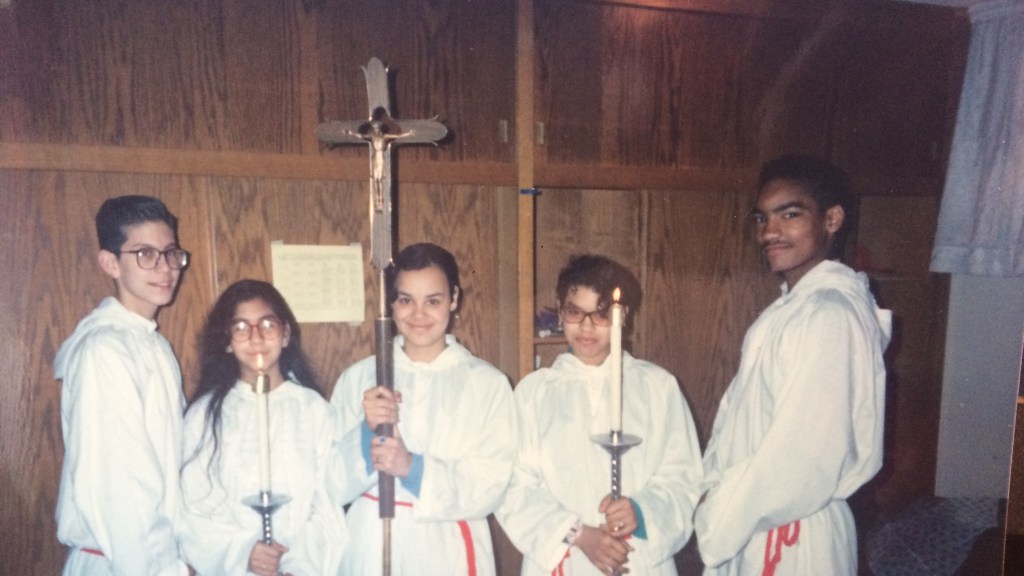
Photo: One of the altar server teams of over one hundred altar servers that I was blessed to train and serve with at Holy Cross Parish in the Bronx, NY, around 1991.
Link for the Mass readings for Monday, June 22, 2020

God the Father is closer to us than we are to ourselves.
“Are not two sparrows sold for a small coin? Yet not one of them falls to the ground without your Father’s knowledge. Even all the hairs of your head are counted. So do not be afraid; you are worth more than many sparrows” (Mt 10:29-31).
Jesus is encouraging his followers in today’s Gospel account as he does so with us today. What may seem insignificant to his hearers, two small sparrows, Jesus is saying has great significance to God. What has greater significance still is us as human beings because we are created in God’s image and likeness.
It was in the parallel verses to today’s Gospel from Matthew found in Luke 12:2-9, that I first remember God speaking to me in my late teens. I had returned home from a high school party. I vaguely remember feeling bored and not quite fitting in and wondering what direction my life would lead as graduation loomed on the horizon. I opened my Bible for some guidance and read the verses above.
Then I heard in the quiet of my mind God encouraging me not to worry. He then followed by telling me that I would not win the lottery, but that he would provide work for me. God has remained true to his word over these past thirty-five plus years. Life hasn’t been perfect, and there have been some rough moments, especially over the past year, but through it all, God has not only consistently provided a means for me to make a living, but more importantly, I have felt his comfort, his guidance, but above all his quiet, rock-solid presence, especially during times when I did not feel I had the strength to go on.
No matter what you may be struggling with or what may be troubling you now, no matter what may be tempting you to buy into worry, anxiety, or even fear, don’t give in to the mind storm, because we are never alone. When Jesus says that even all “the hairs of your head are counted”, he is assuring us that God knows each and every one of us that intimately, that closely. He knows us better than we know ourselves and ultimately, that he is with us for the long haul. God our Father will guide and provide the means we need to not only survive but thrive.
Photo: Some quiet time with God, early evening walk last night.
Link for the Mass readings for Sunday, June 21, 2020
Immaculate Heart of Mary, pray for us!
There are two points that struck me in today’s Gospel from Luke. The first is what Jesus was doing when Mary and Joseph found him. After three days they found him in the temple, sitting in the midst of the teachers, listening to them and asking them questions, and all who heard him were astounded at his understanding and his answers (Lk 2:46-47). Other than his infancy, this is the only other account we have of Jesus in his youth. Jesus was listening to his teachers and asking them questions.
One of the greatest joys that I experience is when I am teaching. There are times when I actually feel like I step out of my body and I am watching the exchange along with the students. These are times when the students are asking questions, they are listening and engaged, and I believe that in that exchange the Holy Spirit is present.
The second point was Mary’s response to the whole affair. After three days of anxiety trying to find Jesus, Jesus’ response that they ought to have known where he was, that he was about his Father’s business, and their lack of understanding of what Jesus said, Mary did not meet Jesus with a head slap to the back of the head, instead she “kept all these things in her heart” (Lk 2:51). As Mary did with the news of the shepherds at the birth of Jesus, Mary’s response was to ponder.
We learn best when we enter into an exchange of dialogue where we listen to each other and ask each other questions. We commit an egregious sin when we stifle questions, inquiry, critical thought, and dialogue and slip into monologue and demagoguery. We are encouraged not to talk about faith, politics, and the social hot button issues, but if we don’t talk about these issues, which are the core and foundation of a healthy society, we will never be able to improve or make effective and healthy change.
We are wired for the practice of wondering from a very young age. If you have been around a three or four-year-old for any length of time, the question of, “Why?” will come up more than once. Unfortunately, this natural curiosity is often tamped down, because answering questions takes time. Questions can challenge our own beliefs, they also help us to recognize what we know and do not know. It is one thing to think we understand something, and it is another to articulate it.
Especially now in our present moment, when we come to realize that we do not understand certain issues or perspectives, when we are challenged, when we are uncomfortable, and when we are presented with a response that we do not expect or agree with, the better course of action would be to resist the temptation to react and lash out. Instead, may we assume the posture of Mary and ponder. Actually, to open our hearts and minds and listen to the question, the statement, seek a posture of empathy and a willingness to seek to understand the other’s point of view instead of being so quick to impose our view. Take a few deep, slow breaths and pray for discernment.
In taking these initial steps, we can then honestly engage in the discussion from what we know and feel, as well as what we don’t know, and what we are struggling to understand. Our part to play is to educate ourselves, to be open to wonder, to meditate and ponder about what we believe, and engage in respectful dialogue allowing others to do the same and then be willing to journey together to seek that which is true, good, and beautiful. Then we will be in a better position to begin to work to bring about change and reform that will be more lasting and fruitful in our realm of influence.
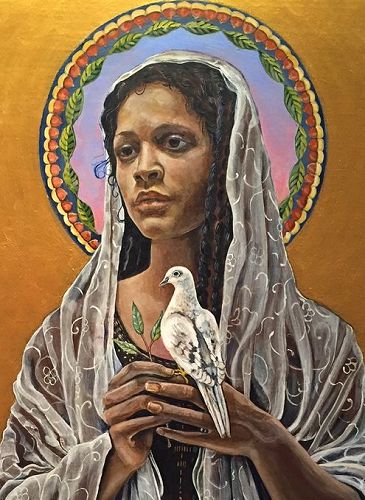
Painting: “The Black Madonna with Dove”, by Sue Ellen Parkinson
Readings for the Mass for June 20, 2020
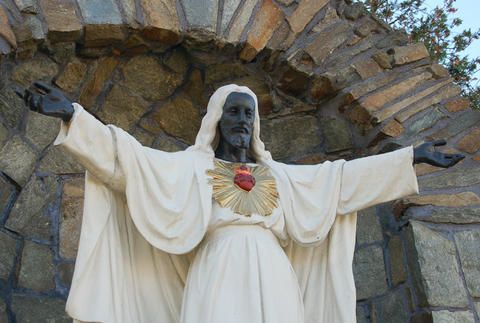
We can find rest for our soul in the Sacred Heart of Jesus.
“Come to me, all you who labor and are burdened, and I will give you rest” (Mt 11:28).
Many of our minds are distracted, diverted, and anxious and our hearts are restless. Many times what we seek does not fulfill and what we gather does not satisfy. Jesus, who is more than a wise teacher, for he is also the Son of God, invites us to enter into his rest. This rest is not determined by our external circumstances, but in finding fulfillment for that which we seek. St Augustine came to realize some sixteen hundred years ago that, “You made us for yourself, O Lord, and our hearts are restless until they rest in you.”
In 1672, St. Mary Alacoque experienced this feeling as well when she received a series of visions of Jesus. Jesus shared with St Mary that not only was his heart wounded on the cross but continues to be wounded by the ingratitude of his sacrifice especially through humanity’s inhumanity toward each other. The devotion to the Sacred Heart of Jesus was to be a practice to experience his Divine love and mercy. This devotion and practice became recognized by the Church as a Solemnity in the liturgical calendar in 1856. It has been celebrated each year nineteen days after the Solemnity of Pentecost.
The practices of devotion to his Sacred Heart that St Mary received were to participate in the Sacrament of Reconciliation once a month, receive the Eucharist often, and as a special devotion to the Sacred Heart of Jesus to do so on each first Friday. Putting these practices into place, one was promised that they would come to experience Jesus’ love and mercy. This special grace once received is a gift to be shared. We are to go out and bring the life, love, and mercy we have received to effect change in our world.
The practices of the devotion to the Sacred Heart of Jesus are disciplines to help us to find our meaning and rest in him. We are invited to dwell in his presence to receive his acceptance and love and so once loved we are to love others as he loves us. In that grace, we can find our rest, meaning, and peace that surpasses all understanding no matter the external challenges.
Dr. Martin Luther King Jr. expressed the rest that can be experienced in a close walk with Jesus even during turbulent times when in 1965 he gave a speech looking back at the bus boycott of 1955-56: “But today as I stand before you and think back over that great march, I can say, as Sister Pollard said—a seventy-year-old Negro woman who lived in this community during the bus boycott—and one day, she was asked while walking if she didn’t want to ride. And when she answered, “No,” the person said, “Well, aren’t you tired?” And with her ungrammatical profundity, she said, “My feets is tired, but my soul is rested.”
Amid our disunity and polarization, amidst the call for much-needed change and reform, we can see hope from the past in the fact that today is also Juneteenth day. This is the date commemorating the announcement by General Gordon Granger in Texas on June 19, 1865, two years after the Emancipation Proclamation was signed by Abraham Lincoln, that, “The people of Texas are informed that, in accordance with a proclamation from the Executive of the United States, all slaves are free.”
Two hundred forty-six years it would take for slavery to be abolished in all 35 states by 1865. It would take eighty-seven years for the Jim Crow laws to be turned over by the signing of the Civil Rights Act of 1964. We are still not where we need to be today in this country regarding equity and justice for all. The Solemnity of Jesus’ Sacred Heart falls on Juneteenth this year. His heart was pierced that all might be freed from the scourge of our slavery to sin and unfortunately continues to bleed for those who continue to be unjustly demeaned, dehumanized, and continue to lose their lives.
As Christians, we are to draw close to his Sacred Heart, to draw close to those who suffer to hear their voices, their stories, to lean into the difficult conversations to actually listen to one another. The issues before us are complex, multilayered, and nuanced, yet the arc of change that we have seen in our dark history will continue to move toward equity for all the more we are willing to see each other as human beings with dignity and value and the more we are willing to encounter, spend time with, and accompany one another.
Photo: Black Jesus at the Sacred Heart Seminary in Detriot
Link for the Mass readings for Friday, June 19, 2020
 Spiritual Stepping Stones