Reflections on the Gospel Reading for the Day
Behold the Lamb of God who reaches out his hand to save us.
John the Baptist saw Jesus coming toward him and said, “Behold, the Lamb of God, who takes away the sin of the world” (Jn 1:29).
The unblemished lamb is the animal that is sacrificed at the Passover meal, commemorating when the angel of death passed over the Hebrews whose doorposts were marked with the blood of the lamb. The next day they were freed from their slavery under the pharaoh and the exodus event began culminating in their passing through the Red Sea to freedom.
The Son of God became the Lamb of God as he became human. He experienced laughter, pain, suffering, love, tears, and temptation, but he did not sin. The only one who can take away sins is God. The second person of the Trinity, the Son of God, while remaining fully divine, became human so that what he took upon himself in his human condition, he redeemed. As the Lamb of God, Jesus approached John for baptism. He took upon the sin of the world and submitted his divinity to his humanity and was willing to be baptized as a foreshadowing of his crucifixion on the Cross, the Lamb slain in atonement for our sins.
The act of the Incarnation, becoming fully human while remaining fully divine, was the premiere act of mercy, in that Jesus entered the chaos and woundedness of our lives. He did so for each and every one of us, to be one with us, to understand and experience our struggles, our temptations, and to lead us to freedom from our sin, from our turning away from his Father who only wants the best for us, who loves us so much he is willing to let us reject him.
Alone we cannot be redeemed, we cannot be fully healed or restored to who we have been created to be. We need a savior. Jesus is more than a model to follow or a teacher to guide us, he became one with us in our humanity to lift us up out of our brokenness. In saying yes to his invitation, we can say with Paul, “yet I live, no longer I, but Christ lives in me; insofar as I now live in the flesh, I live by faith in the Son of God who has loved me and given himself up for me” (Galatians 2:20). This is the gift we have received again this Christmas, access to the divine power of the Love between God the Father, God the Son, and God the Holy Spirit.
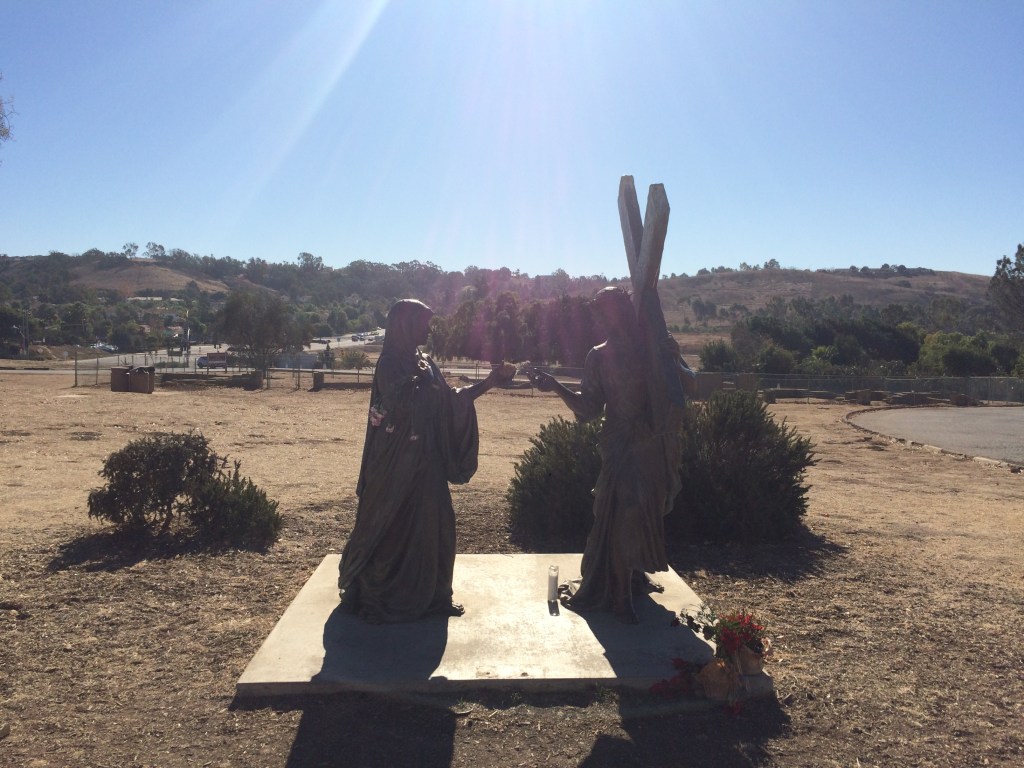
Jesus holds his hand out to each one of us today. May we receive his hand in our own, and as our fingers touch his palm may we feel the wound there, embrace the remembrance of the nail that pierced his flesh, the pain that he endured, so we could have this very moment with him. Even in our brokenness, anxiety, confusion, fear, and sin, may we resist pulling away. May we feel the warmth of his hand grip ours, let his wound heal ours. Let your gaze be drawn up to see his face, his smile, his forgiveness, his love.
“Behold, the Lamb of God, who takes away the sins of the world.” Behold the Lamb of God who takes away our sin and restores us to life.
———————————————————-
Photo: Statue of Mary and Jesus on the front grounds of Mission San Luis Rey de Francia, Oceanside, CA
Link for the Mass readings for Friday, January 3, 2020

Make some time to be still and ponder who Jesus is, who we are and who God calls us to be!
“Who are you” (Jn 1:19)? John did not claim or pretend to be something that he was not. He was clear who he was, he was clear of his place in serving God, and he was clear about the mission God gave him. He was preparing the way of the Lord. John shared that “there is one among you whom you do not recognize, the one who is coming after me, whose sandal strap I am not worthy to untie” (Jn 1:26-27).
The question also arose about who Jesus was. It was a question that was addressed during the early development of the Church’s Christology and still arises today. The readings of the Christmas Season, that we are still celebrating liturgically, in fact, all four Gospels, address the question of who Jesus is.
The various heresies in the Church surrounded this question. From the Annunciation, we recognize that at his conception in the womb of Mary Jesus remained fully God and became fully human. He did not become the Christ at his baptism as the heresy of Adoptionism would propose. Nor was Jesus a powerful created being as the priest Arius would propose in the third century. We counter the heresy of Arianism every Sunday when we recite in the Nicene Creed: “God from God, Light from Light, true God from true God, begotten not made, consubstantial with the Father; through him, all things were made.”
Arianism taught that Jesus was a created being, the highest of beings made by God, but created none the less. The Church teaches that Jesus is begotten not made. He was, is, and always will be God, the Second Person of the Trinity. He is God the Son consubstantial, homoousios, which means of one and the same substance as God the Father. The Father and the Son are one in substance, yet distinct in their operation. The Father begets, the Son is begotten.
Adoptionism and Arianism are but two of the early heresies that arose, of which Arianism gained more of a following. Arianism still rears its head today in practice as it did then because of the unwillingness of those who will not acknowledge that the divine could become human. This goes back to our starting question that was asked about John. “Who are you?”
We are human beings created in the image and likeness of God. We are physical beings with a rational soul, we are invited to embrace the reality that we are human and through our participation in the life of Jesus, we also become divine. Do we reject our humanity, our created status, trying to determine our own destiny on our own terms, to put ourselves in the place of God, or are we like John the Baptist, and acknowledge the gift of who we are and the mission God invites us to participate in?
As we continue to celebrate this Christmas Season and the new year that has just begun, may we embrace who we have been created to be, a unique person, never created before nor will we ever be again, with a particular vocation and part to play in building up of the reign of God. We will come to know our purpose and find meaning in our life as we follow the lead of Mary and John the Baptist, which is to make time to ponder and align our human will with the divine will of God. As we collaborate with Jesus in all the decisions we are to make, the smallest to the biggest, let us pray for a heart, mind, and soul that is open to following the love of the Holy Spirit so we can know the mission that the Father has given us and begin to live it each day.
——————————————————————————————-
Photo: I believe this was my senior year of high school or just after graduation, on a CT beach, ’82 or ’83, pondering God’s direction. More pondering to do this year 😉
Link for today’s Mass readings for Thursday, January 2, 2020
May we ponder more in the new year.
Reflection for Wednesday, the Solemnity of Mary the Mother of God.
Mary offers us a wonderful gift today as we begin the new year together. “Mary kept all these things, reflecting on them in her heart” (Lk 2:19). Gabriel shares with Mary that she will conceive a child through the power of the Holy Spirit, her relative Elizabeth, who is past childbearing years, is six months pregnant when Mary and Elizabeth meet John leaps in the womb of Elizabeth, the shepherds convey the message they received from the angels that Mary’s baby is the long-awaited Messiah, Simeon and Anna offer prophetic confirmation that Jesus is the Messiah.
These are events to ponder, not to just take at face value and move on. The Church at her best has followed the model of Mary’s reflection, pondering, and meditating on what these words mean and has come to call this day the Solemnity of the Blessed Virgin Mary, the Mother of God. This title says more about Jesus than it does about Mary. This is the teaching that the Church Fathers confirmed during the council of Ephesus in 431 AD:
Mary is the Mother of God, in Greek – Theotokos – the God-bearer.
The full divinity of the Son of God was present at the conception of Jesus. He remained fully divine as the second Person of the Trinity and the Holy Trinity was not diminished in any way as he developed as a human being in the womb and was born of Mary. This is the Mystery of the hypostatic union: Jesus is one divine person subsisting in two natures the human and divine.
Theological insights such as Mary being the Mother of God, the hypostatic union of Jesus, are easily missed or worse dismissed if we conform ourselves to the present age of instant gratification, instant access, surfing, swiping, taking in sound bytes from Facebook, Twitter, and Instagram and amassing information overload. All of these technological avenues can be wonderful if we stop, slow down, and as Mary did, ponder what they offer.
If we still read books, do we do so with pencil and highlighter in hand, take notes and go back to those points underlined, highlighted, and or annotated and ponder the insights we have received? Or do we just have a moment of pause and say hmm, interesting, and then move on to the next factoid?
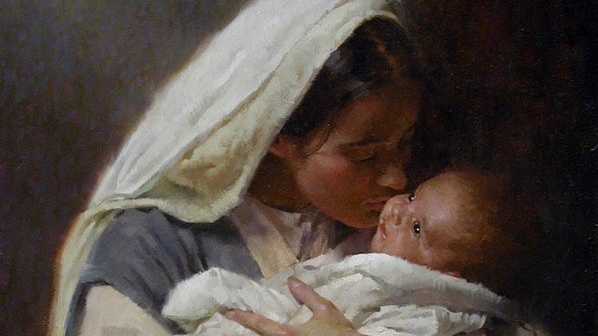
May today, the first day of the new year, be a day to take a few deep breaths, slow down, and commit to a practice of daily pondering. We can reflect on a word, a phrase, or a short statement that we write down and return to it often. The phrase could be as simple as a paraphrase from today’s reading: Mary pondered on these things in her heart. Let us reflect on where God has been calling us to stop and take a deeper look at our lives. It could be one word: Theotokos, expressing that Mary is the God-bearer, the Mother of God and what that means to us in our lives. We can meditate on a picture like the one I posted with this reflection.
If we seek to live a life of joy and fulfillment in 2020, we would do well to follow the model of Mary. May we also assume a posture of pondering and a willingness to slow down and reflect on life, on what is important, what has value, where we are putting our time and effort, and recognizing where God is and is not welcome in our life. Otherwise, we may just float along through another year indecisively or stagnantly with indifference or cynicism, merely reacting to situations that arise, or just plodding along in survival mode or merely bored and listless. Being still can be a scary moment because as we do so, our fears, our past hurts, and our loneliness can arise.
Yet in that willful act of stopping, the Holy Spirit can embrace us with his love, so we can begin to heal and transform beyond merely existing, so to set a course of being fully alive and in love with life. Hand in hand with Jesus, we can face our fears, and heal from our wounds, so to be better engaged in our lives by experiencing more meaning and purpose. Conformed to the life and love of Jesus, we will realize that we are not alone, and so can build more authentic and intimate relationships, we can act more decisively and with greater clarity, and experience more fully what we are here for, to bring a little more tenderness, mercy, understanding, forgiveness, and love to the many others around us who are wounded.
May 2020 be a wonderful new year of meaning, joy, and fulfillment, as we, like Mary, come to experience God’s presence in the silence of our hearts, so to be a people of faith, hope, and love in contemplation and action. Mary the Mother of God, pray for us.
Happy New Year! Peace and all God’s good. Deacon Serge
————————————————————————————
Painting: “Kissing the Face of God” by Morgan Weistling, 2011, accessed from cathopic.com
Link for today’s reading for January 1, 2020

The Incarnation: the Son of God became one with us in our humanity revealing that each of us has dignity and worth.
“And the Word became flesh and made his dwelling among us” (John 1:14). The Logos, the Word, the second person of the Holy Trinity, dwelt or another translation, “tabernacled” among us. The Son of God pitched his tent in our midst. This is a reference to the tabernacle or tent of meeting which was erected whenever Moses and those who had escaped slavery in Egypt camped. Within the tent of meeting was placed the Ark of the Covenant. This was done to follow the will of God who wanted to be present with his people. “They shall make a sanctuary for me, that I may dwell in their midst” (Exodus 25:8).
The Ark of the Covenant and the tabernacle housing it was portable and would move with the people, such that God was always present in their midst. The basic structure would later become the foundation for Solomon’s temple, then Herod’s Temple. The Holy of Holies was believed to be the very seat of God in Jerusalem. In the fullness of time, Jesus was born to us, and he became the living temple, Emmanuel, God with us. “Destroy this temple and in three days I will raise it up” (Jn 2:19).
And why did Jesus come? So that the glory of God could be revealed not just to the temple priest, but to all of us, “and we saw his glory, the glory as of the Father’s only-begotten Son, full of grace and truth” (Jn 1:14). Jesus came to be one with us in our humanity while remaining fully divine to reveal the glory of his Father to us, the same glory that filled the tabernacle. Jesus came to be present, to accompany us, in our very midst as God did in the tabernacle and then the Temple.
Jesus was born to share the fullness of God’s grace and his truth with us. He came to restore the ancient covenant that God has been making with his people throughout the ages. Jesus invites us to share in the infinite, faithful love that he shares and has shared and always will share with his Father. This free, generous act of love is a pure gift to us. Jesus, in becoming human, in living among us, in teaching, healing, and so building a bridge of relationship with God, shines his light. A light that is not overcome by the darkness of pride, hatred, prejudice, and violence, so that we can see the truth, that God is our Father and we are all brothers and sisters.
The Incarnation, the reality that the Son of God became human while remaining fully divine, reveals to us that none of us are junk, because God created us and became one with us. Each of us by our very existence has human dignity because we are created in his image and likeness and he dwells among us.
Each and every human being is a part of God’s family. This includes all people no matter race, ethnicity, or creed, male or female, the unborn, the hungry, the homeless, the stranger, the sick, those without access to water or adequate health care, widows, orphans, refugees, migrants, the LGBT person, the person in jail or on death row, the person at the end of life, and as Fr. James Martin, SJ wrote, “so many others who feel forgotten, excluded or marginalized. All are members of God’s family.”
Jesus has made his dwelling among us such that we may be healed and reconciled with God and one another, and we do so as we open ourselves with all our mind and heart, strength and soul, to receive the gift of the grace and truth that Jesus offers to us 24/7, his very life and love. The receiving of this unmeritorious gift of grace, that Jesus became one with us in our humanity so that we can become one with him in his divinity, is what we are celebrating this Christmas Season. Let us not only experience, receive, and ponder the significance of this wonderful gift of the love of God, but share it with all we encounter each day in this new year.
Photo by Jonas Ferlin from Pexels
Link for the Mass readings for Monday, December 31, 2019
Let us commit to accompanying and supporting one another as did the Holy Family.
We have no evidence that the vocation of Anna, Simeon, the Magi, or the shepherds changed in any way after their encounter with the baby Jesus. What did happen in each of their lives was the same as what happened with Luke’s account of Anna today; they told the story of their encounter. They, like Anna, shared what they experienced with anyone who would listen.
At the end of today’s account from Luke, Joseph, Mary, and Jesus “returned to Galilee, to their own town of Nazareth. The child grew and became strong, filled with wisdom; and the favor of God was upon him” (Lk 2:39-40). No ticker-tape parade, no giving the key to the city, and no gala ball awaited the Holy Family when they entered Nazareth. They went on to live very simple lives.
The pattern of how God works, how his kingdom begins is like a mustard seed, like the seed that is sown, or like yeast. It starts small, quietly, and simply. God works through the everyday events of our lives, often unseen. We so often look for the mighty, majestic, and grandiose. We often believe we need to do great things, and often do nothing. St Mother Teresa directs us to do, what she learned from the Little Flower, St Therese of Lisieux, little things with great love.
As the Christmas Season continues, we are experiencing that life has already or has begun to shift; families and friends have come and gone or are readying to go, vacation days are coming to an end. May we not allow the encounter that we have experienced with Jesus in celebrating his birth, as well as our coming together, just fade into the busyness of life again. Let us appreciate the gift we have been given in our relationships of family and friends, and renew our commitment to keeping in touch and supporting one another. Life can be hard and can change in an instant because it is fragile.
As the Holy Family begins their journey to Nazareth, and we begin to return to our normal course of daily living, may we be open to the quiet and gentle ways of how God is working in our lives. As seeds are planted so to germinate and sprout, as the yeast begins to cause the dough to rise, may we commit to support and care for one another, to be aware and reach out to those in need, to be open to expressing our need for help and allowing others to assist us. When we do so we will start to see God working in our lives and begin to recognize the simplicity of divinity operating within the midst of our humanity. The Holy Spirit is inviting us to be transformed in this new year, to kindle in us the fire of his love so it may spread to others. We are to watch, pray, and cooperate with his will if he is to renew the face of the earth through us.
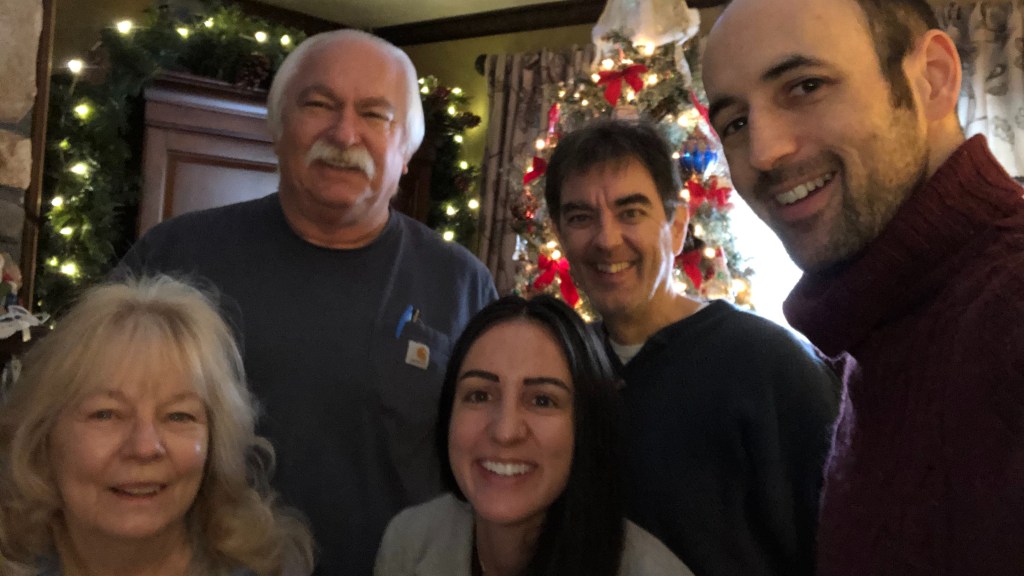
Photo: First Christmas back home in Connecticut in about 20 years
Link for today’s Mass readings for Monday, December 30, 2019
Do we see the Holy Family in today’s refugees?
When the magi had departed, behold, the angel of the Lord appeared to Joseph in a dream and said, “Rise, take the child and his mother, flee to Egypt, and stay there until I tell you” (Mt 2:13).
The scene of the nativity is not a romantic one. Mary gave birth to Jesus in a stable or a cave, which was not the most hygienic of situations as this is where animals were kept. After the shepherds and kings come to pay the baby homage the situation does not get much better, for as we read in today’s Gospel from Matthew, Joseph is urged by an angel to flee. The reason for the urgency of their departure we read about yesterday. Herod had ordered the death of all male children under two years of age.
With the words of the angel and their forced relocation to Egypt, Jesus, Mary, and Joseph became what we would call today refugees. They were fleeing persecution. So many families today are unfortunately in a similar situation in which they are fleeing to save their lives because their countries are torn by war, violence, and/or they do so because of the threat of persecution.
So many are fleeing the horrors of the Syrian civil war, the instability, and violence in other areas of the Middle East and northern Africa, as well as in our hemisphere, especially in the Central American countries of Honduras, Guatemala, and Nicaragua. These countries, as well as too many others, are part of the tragic reality that has resulted in the largest number of families fleeing their countries since World War II.
The Son of God could have easily been born in a palace, among a family with power and stability, yet he chose to be born among the poor and displaced. His earliest days were ones marked by instability and danger.
“Jesus wanted to belong to a family who experienced these hardships so that no one would feel excluded from the loving closeness of God. The flight into Egypt caused by Herod’s threat shows us that God is present where man is in danger, where man is suffering, where he is fleeing, where he experiences rejection and abandonment; but God is also present where man dreams, where he hopes to return in freedom to his homeland and plans and chooses life for his family and dignity for himself and his loved ones” (Pope Francis homily, 12-29-13).
It is no wonder that Jesus teaches clearly later in the Gospel of Matthew 25:31-46 that we will be judged on how we treat the least of his brothers and sisters. For how we treat those in need is how we treat him. Not only does Jesus invite us to open our hearts and minds to those exiled from their homes and seeking refuge, but we are to also reach out to those families in need in our own communities.
To do so, we need to be aware and willing to be of help, to provide welcome, hospitality, hope, promise, and what support we can give. Jesus entered our human condition so he understands our trials, he is present to be of support for those of us in need as well as those in positions to help. As we celebrate the Feast of the Holy Family, may we pray for those families in need, as well as how we can be more aware and seek concrete ways we can play our part to be of help.
——————————————-
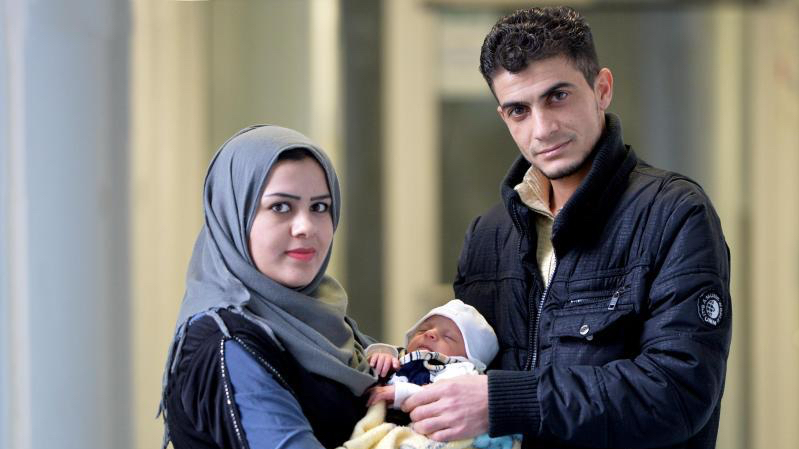
Photo: Syrian refugees, Mamon and Tema Al-Hamza with their baby Angela who was born shortly after entering Germany in December 2015 (Credit: WEB.DE).
Link for the Mass readings for Sunday, December 29, 2019
This Christmas, reject fear and instead “embrace and protect human life.”
The magi come from the East seeking the newborn king. They follow the natural sign of the star, and they are led into Jerusalem. They lose or turn away from the star and seek instead the ruler, Herod, to help them find the child. But after meeting with Herod they again see the star and come to Jesus, do him homage, and share their gifts. Warned in a dream not to return to Herod with the location of the newborn infant, they instead depart for their home another way. The magi had encountered the infant king and would share the news of his birth with joy. A sign that the good news of Jesus is for all nations, for all peoples.
King Herod, as in the time of Moses with the Pharaoh, has a different reaction: Fear. Herod fears to lose his title, power, and prestige. “When Herod realized that he had been deceived by the magi, he became furious. He ordered the massacre of all the boys in Bethlehem and its vicinity two years old and under, in accordance with the time he had ascertained from the magi” (Mt 2:16). Often when we are led by our fears, we react with violence.
We see in today’s Gospel two very different reactions to the birth of Jesus. In coming before him, the magi become more open in their posture, leaving a different way, and moving on to share their experience with others. King Herod closes in upon himself in a defensive posture of protecting his false self and disregarding the dignity of others even to the point of ordering the death of infants.
This Christmas Season how do we respond to the birth of Christ? Do we grasp at and cling to fear or do we accept the invitation to let go of the fear and prejudice?
May we choose with the magi and Joseph to follow God’s lead that respects the dignity and value of others. Pope Francis pointed out on this feast day of the Holy Innocents in 2016 that “Christian joy does not arise on the fringes of reality, by ignoring it or acting as if it did not exist. Christian joy is born from a call – the same call that Saint Joseph received – to embrace and protect human life, especially that of the holy innocents of our own day. Christmas is a time that challenges us to protect life, to help it be born and grow.”
Life is a precious gift yet it is fragile and vulnerable. This Christmas Season as we continue to enjoy our family and friends, tell those we care for that we love them, may we also be willing to be more open to the cry of the innocent, the cry of the poor in our midst. Jesus, please touch our hearts that we may be willing to reach out to the need of the holy innocents of our own day, for they are family. Help us to resist assuming a posture of fear, and instead to be more open to will the good of others by allowing you to love others through us.
———————————————————————
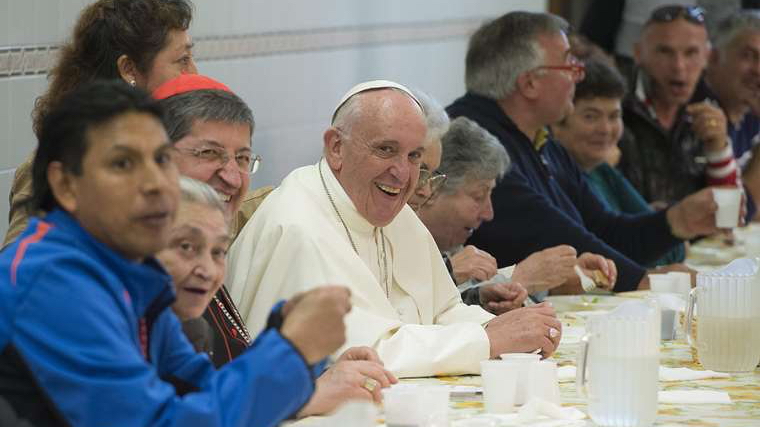
Photo: Pope Francis in 2015 eating lunch with the poor – L’Osservatore Romano
LETTER OF HIS HOLINESS POPE FRANCIS TO BISHOPS ON THE FEAST OF THE HOLY INNOCENTS
Link for today’s Mass readings for Saturday, December 28, 2019
There is good news and it is not that we have a gift return receipt!
Jesus Christ is born for us. Jesus Christ dies for us. Jesus Christ conquers death and rises again for us. Because of our place in time, December 27, 2019 AD – Anno Domini, In the year of our Lord, we are capable of experiencing the Paschal Mystery of Jesus: his life, suffering, death, Resurrection, and Ascension into Heaven. The important question we need to answer is, “Does this new fact, this new reality in human history make a real difference in our lives?”
Christmas did not end two days ago. We are still in the Octave of Christmas. The Church celebrates two octaves in the Church liturgical calendars, Christmas and Easter. These eight days are celebrated as such to impress on us the solemnity of the event of remembrance. From the vigil celebration of Christmas Eve on December 24 to January 1, the Solemnity of Mary the Mother of God, we celebrate the significant event of the Incarnation, the Son of God becoming one with us in human history. The Masses celebrated within the Octave of Christmas, as well as the readings of Evening Prayer in the Liturgy of the Hours, reflect the celebration of Christmas Day each day for the eight days. It is like having a week-long birthday party.
If we are solely focused on gifts, the returning of gifts, and celebration apart from the celebration of Jesus’ birth, if we are removed from the liturgical cycle and rhythm of the Church, it is easy to fall into the post-Christmas blues because it does feel like everything is done but the returning of gifts and getting a good after Christmas deal. We hear Christmas music coming through many radio channels for weeks before Christmas, but at some point on Christmas Day and definitely the following day, they stop. This is when the music of Christmas ought to begin!
A cure for the post-Christmas blues is to be thankful and rejoice in the Gospel, the Good News, that Jesus changed human history and we are a part of that human history of transformation. In today’s Gospel reading from John, Mary Magdalene shared that Jesus was no longer in the tomb. Peter and James ran to see, John arrived first, and then Peter. Peter went in and saw an empty tomb except for the burial clothes. When John entered after Peter, “he saw and believed” (Jn 20:8).
Do we see? Do we believe? The Apostle John came to realize and embrace the gift of the Paschal Mystery: Jesus has been born for us, he suffered, died, rose again and conquered death for us. His, Mary and Peter’s lives were transformed and ours can be too. This is something to celebrate, not just two days ago, or just today, but for eight days, each and every day! “O Come let us adore him, O come let us adore him, O Come let us adore him, Christ, the Lord!”
————————————————————–
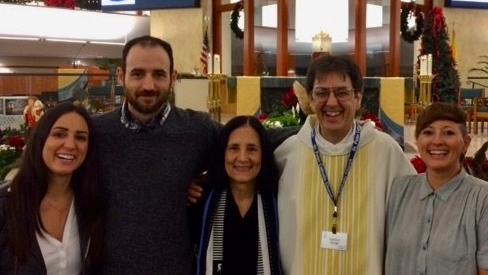
Photo: Christmas Eve Mass at St Peter last year.
Link for today’s reading for Wednesday, December 27, 2019