Reflections on the Gospel Reading for the Day
We are all brothers and sisters
“You have heard that it was said, You shall love your neighbor and hate your enemy. But I say to you, love your enemies, and pray for those who persecute you, that you may be children of your heavenly Father” (Mt 5:43-45). With these words, Jesus continues to raise the bar of discipleship and outlines what the pursuit of love truly is.
For many people, as Bob Dylan wrote and Joan Baez has sung, “love is just a four-letter word.” But the love that Jesus calls us to is not romantic, emotional, or mere sentiment, though this may be healthy in that when we have feelings of infatuation we are drawn out from ourselves to another, but this kind of love has no depth and is based on physical or emotional attraction, and if it is to be real it must mature to the level of friendship.
The bond of friendship and family goes beyond mere attraction and is built through shared interests and experiences. Through sharing our lives with others, working through conflicts, trust is built, and relationships will hopefully grow and deepen. Jesus, though, is calling us to mature in our growth of loving even beyond friendship or familial ties. If we love those who willingly love us in return, greet only our brothers and sisters, only those in our clique, group, tribe, or political party, what is the recompense or satisfaction in that? Agape, in Greek, loving without conditions, with little or no chance of mutual exchange, is what Jesus is calling us to strive for.
Many of us could not conceive of loving our enemy or someone who is persecuting us, because we have, at best only experienced doing no overt harm to others and loved our friends and family. But do we risk going outside of our group, our like-minded safety net? Life is hard enough and it is often safer, we believe, not to take the risk. We continue to operate from a concept of love as an emotion or feeling, because it feels good, even though without something deeper this love does not last.
How can Jesus ask us to love an enemy or pray for someone who persecutes us? St. Thomas Aquinas can be of help. He defines the love that Jesus describes as willing the good of the other as other. We make an act of the will, a free choice to accept the person as they are, to see them, not from our limited finite perspective but as God sees them, as a person with dignity. Can we pray for, embrace thoughts of support for, assume a posture of understanding, visualize positive interactions with, actively offer kind words, and resist reacting toward those who we consider as different than us? Can we resist judging and labeling others?
On our own, we may not even conceive of the possibility, but we can be assured that if Jesus has asked us to strive for this height and depth of love, he will provide the means and support. We love others unconditionally by allowing Jesus to love others through us, one person at a time as we strive to reach the summit of loving our enemy. Even if we fall short, how much better would our country and the world be if we sought this as our goal? To counter divisiveness, fear, and hatred, we need to choose to engage in an act of the will to love one another as Jesus loves us.
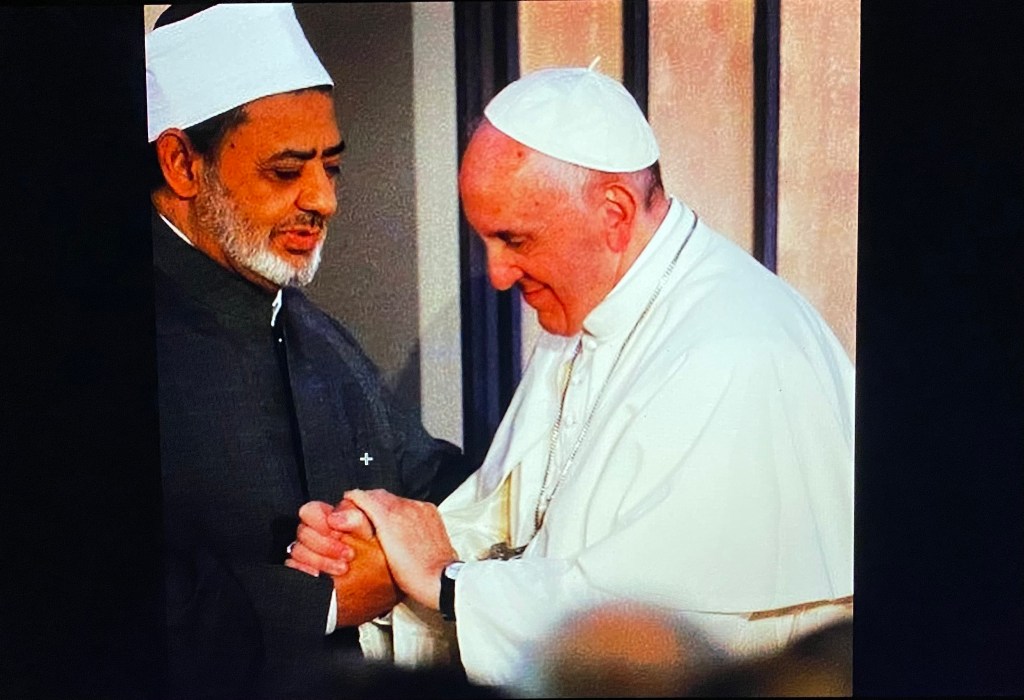
Pope Francis and Grand Imam, Sheikh Ahmad Al-Tayyeb have brought forth the fruit of dialogue and a willingness to engage in mutual brotherhood when they first met at the Vatican in 2016. Since that time they have collaborated to draft the document, “A Document on Human Fraternity for World Peace and Living Together” which they both presented and signed while meeting together in Abu Dhabi on February 4, 2019.
Pope Francis summed up the importance of their collaboration when he said, “Fraternity is the new frontier for humanity. It is the challenge of our century, the challenge of our times. There is no time for indifference. Either we are brothers and sisters or we will destroy each other…. A world without fraternity is a world of enemies.” This ongoing dialogue also helped to inspire the writing of Pope Francis’ encyclical, Fratelli Tutti – on fraternity and social friendship, released in 2020.
We unfortunately are witnessing yet again the opposite of this call for fraternity with the present aggression and atrocities against the people of Ukraine by President Putin’s military forces. May we pray and fast for an end to this and violence in all its forms. May we also embody in our thoughts, words, and actions these words from line 95 of Fratelli Tutti: “Love also impels us towards universal communion. No one can mature or find fulfilment by withdrawing from others. By its very nature, love calls for growth in openness and the ability to accept others as part of a continuing adventure that makes every periphery converge in a greater sense of mutual belonging. As Jesus told us: ‘You are all brothers'” (Mt 23:8).
——————–
Pope Francis and Grand Imam of Al-Ahzar Sheikh Ahmed El-Tayeb sign human fraternity document in Adu Dhabi, February 4, 2019. Photo credit: AFP (L’Agence France-Presse)
Link for the Mass readings for Saturday, March 12, 2022
Instead of death, may our words bring life.
Jesus calls us to be holy, each and every one of us. Our life is to be lived with the end goal which is heaven, to be in union with our Loving God and Father for all eternity, and to assist others to do the same. Jesus provides for us a concrete example of the heights to which we are called to reach: “You have heard that it was said to your ancestors, You shall not kill; and whoever kills will be liable to judgment. But I say to you, whoever is angry with his brother will be liable to judgment, and whoever says to his brother, Raqa, will be answerable to the Sanhedrin, and whoever says, ‘You fool,’ will be liable to fiery Gehenna” (5:21-22). Jesus is building on the Torah, the Law or the Teachings, by helping us to realize that we can not only kill with weapons but also inflict dehumanizing damage with our words. Pope Francis has echoed these sentiments by stating that gossip is akin to terrorism.
To resist this temptation of inflicting mortal wounds, we need to start participating in a deeper examination of conscience which gets to the roots of our own thoughts, words, and actions. If we are not able to discipline our thoughts, what will follow is undisciplined words, and then undisciplined actions, which can lead to entertaining and embracing the deadly sin of wrath. Wrath is unbridled anger that leads someone away from the capacity to think or behave in a rational manner, such that this individual would no longer acknowledge the dignity of the person they would inflict their wrath upon.
Jesus is helping us to see that we can be free of the temptation of wrath if we recognize the danger and destruction of unleashing words as weapons. He offers us the examples of calling someone, Raqa, meaning something along the lines of an air-head or an idiot, and calling someone a fool. These words directed at another have no other cause than to demean, degrade, and belittle. This language, and worse, has no business coming out of the mouths of a disciple of Christ if we are serious about being one of his followers.
I remember a moment in sixth or seventh grade unleashing a derogatory word or two directed at a classmate. Even though they were loosed in jest, I felt a sinking feeling in my gut after hearing myself say them. God gave me a graced moment to feel, contrition, actual sorrow for the negativity and poison I had unleashed with my words. I remember making a commitment to myself not to speak that way toward another person going forward.
We need to be aware that words have the power to wound or to heal. If we are serious about following Jesus, then a wonderful practice this Lent can be to commit to fasting from gossip and from words that belittle, divide, diminish, or dehumanize and replace them with words that empower, unite, uplift and acknowledge the dignity of others. Even when we disagree with another’s point of view, we can do so by still respecting the person and fostering dialogue.
May we also commit to going deeper and resisting negative or dehumanizing thoughts. Even when we have defensive musings, resulting from another’s disparaging tone, words, or actions, we need to resist entertaining them. Instead, we can choose to pray for the strength from the Holy Spirit to develop a more mindful disposition that seeks to understand instead of react, to hold each other accountable with respect, and ultimately to love: to will the good of each other.
—————————————————————
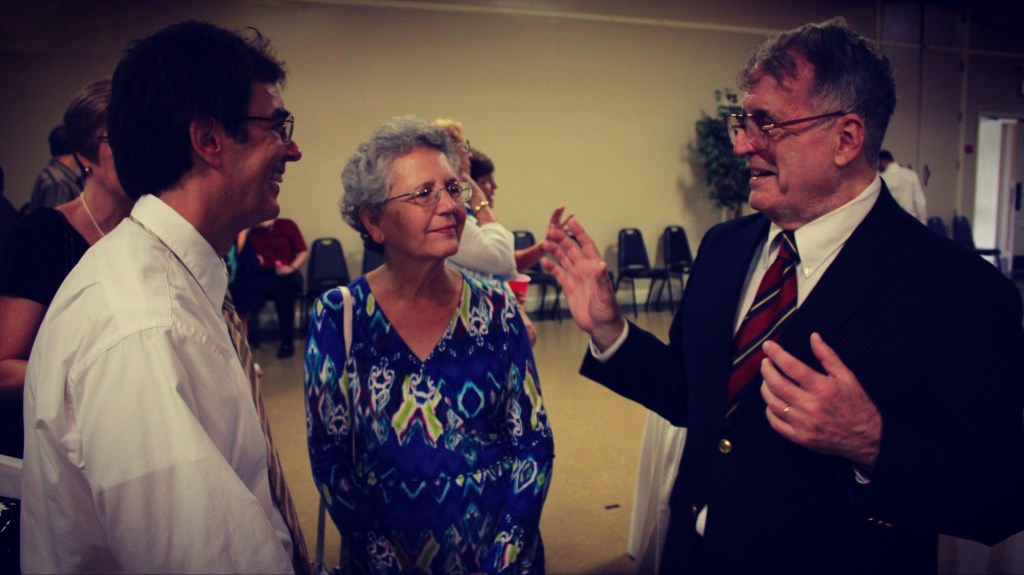
One of many uplifting conversations with Dr. Sixto and Elena Garcia, September 2013 – photo credit – Jack McKee
Link for the Mass readings for Friday, March 11, 2021
Prayer will be more meaningful when we seek to understand it from God’s point of view.
Jesus said to his disciples: “Ask and it will be given to you; seek and you will find; knock and the door will be opened to you” (Mt 7:7). If taken in a purely secular, non-religious, or non-biblical sense, this teaching of Jesus from his Sermon on the Mount may not ring true. Some people have also left their faith behind because they have asked something of God and from their perspective, they did not receive what they asked for.
To understand this verse we need to understand a few key points. One is that God is God and we are not. That means that we do not have the full scope and sequence of God’s infinite viewpoint. We can only see from our limited finite perspective. Our God, who is Good, will only give us that which is good for us and that which serves his ultimate purpose. What we are asking for may appear to be good, but may not, in fact, be truly good, and/or in our best interest beyond the moment. If someone wants to say, well, I ought to be able to decide that! That means they have missed the first point, God is God and we are not.
Another point that I have learned from Bishop Robert Barron is that “Your life is not about you.” We are created by God for a reason and a specific purpose. Our life is about fulfilling our role in God’s theodrama. We are not the director in the great play of life, God is, but we do have a unique and significant part to play! God does not need us but desires us to share in his work of salvation history. What God requires of us, he will give us the means and support necessary to fulfill it. We also need to remember that when we experience the forgiveness, love, and mercy of God, that experience is not for ourselves alone, but we are to receive these precious gifts and give them away!
A third point that can be helpful comes from C.S. Lewis: “I pray because I can’t help myself. I pray because I’m helpless. I pray because the need flows out of me all the time, waking and sleeping. It doesn’t change God. It changes me.” If we pray to God to bend his will toward ours then we are going to come away from prayer frustrated time and again. Our time of prayer with God has to do with answering his invitation to spend time with him, being willing to participate with his plan, and then being willing to share what he has given us in his love to share with others. In this way, we become transformed by his love and his grace builds on our nature.
As we make time to pray this Lent, let us approach our time with the proper orientation of recognizing that God is God and we are not, that our life is not about us but about coming to understand and how to follow the will of God, and acknowledging that our prayer does not change God, but instead does change and conform us to his will. When we approach prayer from these three points of reference, we can be confident that we will grow in our relationship with him and what we ask of God will be given to us, what we seek we will find, and when we knock, the door will be open.
—————————————————————–
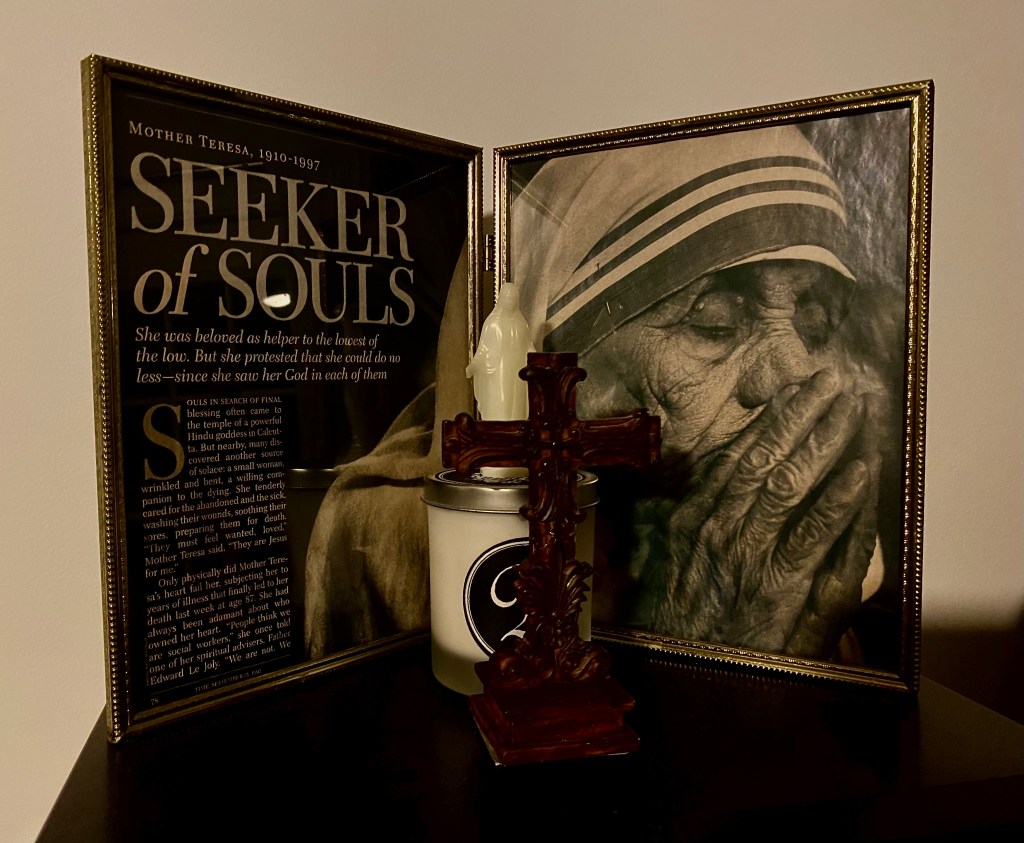
Photo: One of my favorite pictures of St. Mother Teresa at prayer which I framed shortly after her death.
Link for the Mass readings for Thursday, March 10, 2022

We do not need to be afraid of the quiet.
There is something greater here. Something greater than the wisdom of Solomon and something greater than the preaching of Jonah. Following the way of Jesus is a faith we are called to live daily. This is not a part-time vocation. We all have a unique gift in the dignity we have been conceived and born with. We have a unique way to express and live out our dignity as well. Unfortunately, what happens with most of us is that we are tempted, misdirected, distracted, and diverted as to what God would have us do and as a result we are often unplugged from the very source of our existence.
As Jesus taught, often in his parables, the kingdom of Heaven on earth starts small, like a mustard seed, like yeast, and develops slowly when nurtured. Lent is a good time to slow down, step back, take a retreat even while in the midst of our everyday activities. We just need to insert some dedicated time to God each day so as to better be able to acknowledge his presence in our activities.
If you are feeling a bit restless, on edge, or out of sync, I invite you to make some time to be still and breathe, this can be while in the shower, when you have some breakfast, a morning walk, or taking a sip of coffee or tea. During this time ask God for some guidance. We can ask him to help us see those areas that we need to repent from and let go of, those thoughts, words, and actions that keep us distracted, redirected, and off-kilter as to who God is calling us to be. We can then confess to him and receive his forgiveness and reconciliation.
God invites us to come to the silence to also be able to sit with our wounds and traumas. Many times we do not want to be still or quiet because there may be unresolved issues, hurts, and/or pain that we would rather not face. We may even believe in the lie that if we feel that we will become completely undone. God is present and waiting, inviting us to come to experience acceptance and love as we are, to feel safe to be vulnerable and honest and from this place of truth, begin with simple steps being to walk the path to our freedom.
Jesus said in today’s Gospel that, “There is something greater here.” Christianity is not a secret sect. We are called to share the joy, the forgiveness, healing, and reconciliation we experience from God with others, even with, as Jonah found out, our enemies. We are to look for opportunities to offer a smile, even from our eyes while wearing our masks, an encouraging word, to reach out to someone we have been meaning to connect with for a while, in person or far away, and/or someone that we may sense just needs a listening ear. We can also react less by asking for God’s patience to be more understanding. Just as we are hurting, so are so many others.
Lent can be a joyful time when we enter into the season with the intent to deepen our walk with the One who is wiser than Solomon and preached repentance and reconciliation. With our hearts and minds turned back and open to God, Lent will not so much be a drudgery to endure, but a joyful embrace of the opportunity for experiencing a change of mind such that we are more open to dialogue, forgiveness, healing, sharing the joy, reconciliation, and contributing to building up the kingdom of God one healing at a time!
———————————————————-
Photo: Afternoon stillness, never know what the quiet will reveal in our depths.
Link for the Mass readings for Wednesday, March 9, 2022
A prayer to rest in.
Jesus begins his teaching on prayer by stating that prayer is not babbling. When we pray we are to resist just saying empty words that have no meaning or just praying in words that we think God wants us to hear. We are to pray from our heart.
Prayer, first and foremost, is a response to the Holy Spirit moving within us, urging us to pray, “for we do not know how to pray as we ought” (cf. Romans 8:26). We are to speak honestly to God in our prayers. One of the most honest prayers I prayed was when I was around eight years old and overheard my parents discussing the idea of getting a divorce. I said to God that if I woke up in the morning and he allowed this to happen we were through. When we pray we bring our struggles and petitions, as well as our joys and prayers of Thanksgiving, and let us not forget, we are to be still and silent as well to listen for his word or his silence.
Though I walked away from God that night, he did not walk away from me. He provided a release and a place to sleep and he accompanied as I bumbled about for a time. He continued to place small bread crumbs along the way back to him. A story for another time.
We can get a real taste of speaking from the heart in reading the psalms which covers the full range of our human emotions as well as expressions of prayers of blessing, petition, intercession, thanksgiving, and praise. We will even come across a reading like Psalm 88, which may not appeal to us at the moment, as it is such a psalm of despair, yet someone, somewhere, might be feeling that prayer and we can read and pray it for others if we are not feeling the same way.
In our Gospel today, we read Matthew’s familiar version of the Lord’s Prayer or the Our Father. It presents two ways to pray. First, it is a rote prayer that we memorize word for word. The blessing of a rote prayer is we can pray it in communion with others, as we all know the same words. Another important gift of rote prayers is that we can pray them when we are physically in pain or emotionally distraught when we feel we can’t pray. Having prayed the Our Father daily, it is a prayer we can lean on to give us strength through the storms of our life. Praying the Our Father gives us the words to speak when we have none, and by loosening our tongues, we can come to a place where we can speak more freely with God and experience the peace of his presence.
The Lord’s Prayer is also a model of prayer such that each word or phrase can be a starting point to enter into a deeper and loving dialogue. As an example, we begin with the words, “Our Father.” This is a reminder that God is the Father of us all and the beginning of all prayer. His sun shines on the good and the bad alike. Our prayer begins by putting our self in his presence and recognizing that we are all interconnected.
God, our Father, is with us even when we experience fear, feel forgotten, misunderstood, or alone. God loves us more than we can ever imagine, and our every desire to pray is already a prayer because we are responding to his invitation to spend time with him. Calling on his name is a reminder that he is always present and he hasn’t forsaken us. He provides our daily bread and forgives us as we forgive others. The flip side is that God also rejoices with us, for the joy of God is the human being fully alive!
I invite your to carve out some time today to pray the Our Father s-l-o-w-l-y. Allow whatever is going on in our life to enter into the recitation and remember that the best dialogue allows each party involved to spend some time listening to the other. As St Mother Teresa taught, “God speaks in the silence of our hearts.” By making some time to pause, to be still, and not rush through the prayer, to listen silently to God, we might just be able to come into the rest of our day better able to listen to each other a little better as well.
—————————————————————
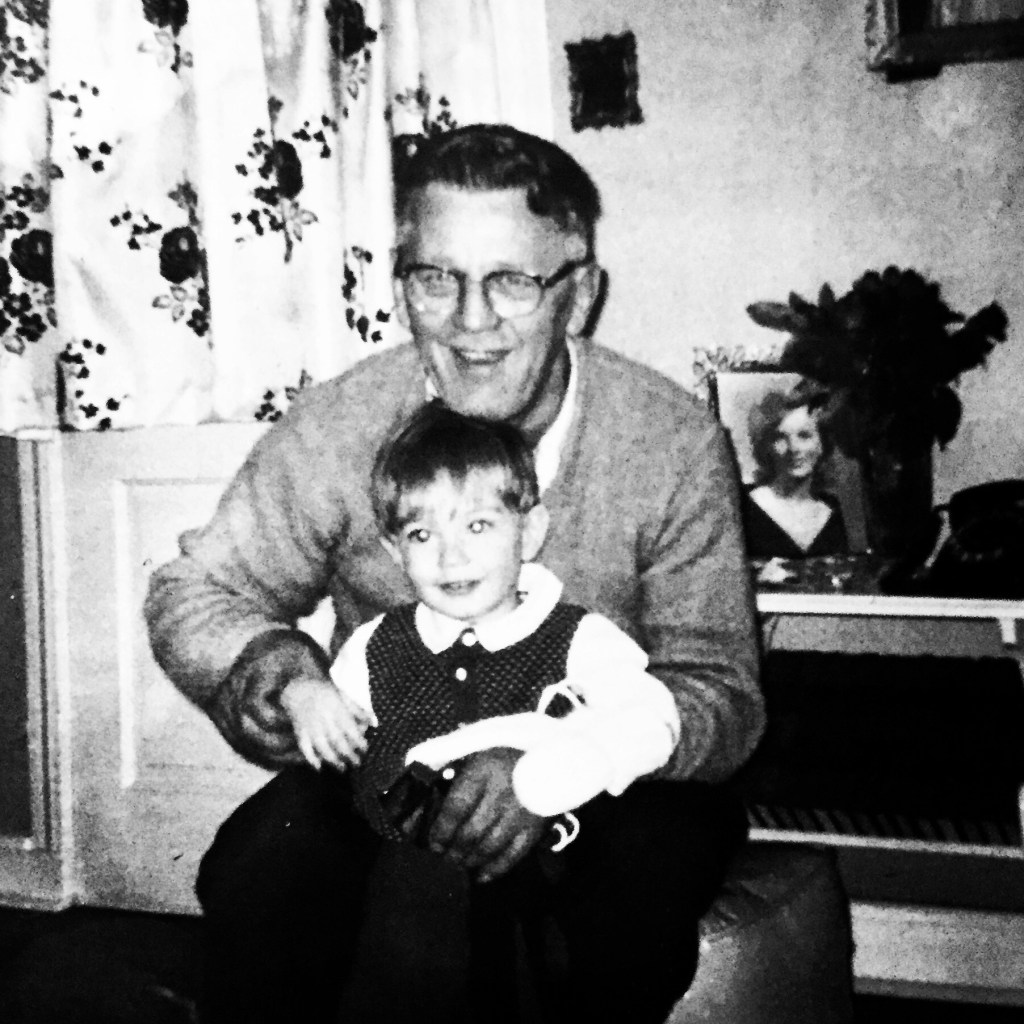
Photo: As far back as I can remember, my grandfather prayed the Our Father before meals during holiday dinners. Who taught you to pray?
Link for the Mass readings for Tuesday, March 8, 2022
What we think, say, and do as well as what we don’t toward each other matters.
How we treat each other matters. How we speak to each other or about each other matters. Even how we think about each other matters because our actions come from our thoughts. If we are able to be mindful of how we think we can be more aware of our actions. We do not have to immediately react, we can think before we act. We can discern how what we are about to do will affect the person before us.
One way to put this into practice is to follow the psychologist, Dr. John Gottman’s 5:1 principle. When you think a negative thought about someone and before you share that thought, think and write down five affirming thoughts about that person. Many times we will find that by the time that we get to the fifth compliment we will have forgotten the negative quip.
Jesus is very clear in today’s Gospel from Matthew, “Amen, I say to you, whatever you did for one of these least brothers of mine, you did for me” (Mt 25:45). All of us are interconnected. What we do to one another affects everyone. When we throw a stone into the middle of a pond, the ripples of the water circle out to touch the bank and go even beyond the bank. This same ripple effect happens with our thoughts, words, and actions. Our inaction also matters.
When we are moved by the Holy Spirit to reach out to help someone in need, to be more understanding, kind, and to be willing to move beyond our prejudices and biases, and we don’t, we are cutting ourselves off from Jesus. Yet, when we do listen, risk, and move out toward another in love, we put Jesus’ teaching into practice, we begin the healing of our relationship with God, ourselves, and each other.
St. Mother Teresa called this verse her five finger gospel. She taught each person in her order and each person she had the opportunity to pass it on to that each finger on her hand represented the words: you – did – it – to – me. When we entertain a thought today, are about to form a word, and are about to follow through on an action, may we first look at the five fingers of our hand before following through. Would we continue to think the thought, say the word, or follow through on the action if Jesus was in front of us? Because he is. For what we do to each other we do to Jesus.
Give somebody a Gospel five today!
———————————————————————————–
Photo: A CN high five moment!
Dr. John Gottman’s 5:1 principle I learned from Dr. Arthur Brooks’s discussion with Bishop Robert Barron through the Word on Fire Institute. To watch Dr. Brooks talk on loving our enemies and to consider becoming a member of the Institute: wordonfire.institute/bishop-barron-presents-nov-2019/
Link for St Mother Teresa sharing her five finger gospel starts about 30 seconds in:
https://www.youtube.com/watch?v=oL2aQWeWAmE
Link for the Mass readings for Monday, March 6, 2022

Jesus resisted the temptation of Satan and unified with him, we can resist and triumph as well.
Filled with the Holy Spirit, Jesus returned from the Jordan and was led by the Spirit into the desert for forty days, to be tempted by the devil. (Luke 4:1-2). Jesus experiences the temptations of Satan, the one who tempted Adam and Eve, the father of lies, the accuser, the slanderer. Satan is one who seeks division, disunity, and we dismiss the reality of his presence at great risk. On the other hand we often give him more power than he deserves. Jesus is tempted, but unlike Adam and Eve, he does not give in. Jesus remains grounded in the will of his Father and so Satan has no power over him.
Jesus could have dismissed Satan, yet he endured his temptation to teach us “how to triumph over temptation” (St Augustine 1976, 87). Jesus not only teaches us how, but empowers us to overcome Satan. The weakest Christian is more powerful than Satan himself, because we can call on the name of Jesus. This is not some magical incantation, but when we call on the name of Jesus, he, in the fullness of his humanity and his divinity, is present with us. God has given Jesus the name above every other name, so that as his word is spoken, every knee shall bow in heaven and on earth (cf. Philippians 2:9-10). Just as a floodlight shines in the darkness, the darkness gives way to the light. This is even more true with Jesus. Where Jesus is present there is love, such that no fear or evil can remain.
Jesus came to deify us. As St. Irenaeus wrote, and I am paraphrasing, Jesus became one with us in our humanity so that we can become one with him in his divinity. When we give our life to Jesus, we become more like God and our image and likeness is restored as God created his in his image and likeness. We do so by committing daily to reading and meditating upon, praying with, and contemplating the Word of God shared in Sacred Scripture and Sacred Tradition, practicing acts of love through the corporal and spiritual works of mercy, participating in the Mass and the sacraments as often as possible, and reading the lives of the saints and other enriching and empowering writings.
The more we are engaged in these practices, the more we are healed, transformed, and conformed from within to the love of God. As we continue to turn to God through the love of the Holy Spirit and the presence of his Son, there is no room for the devil in our lives, we will be better able to recognize and resist his temptations, and come to trust in Jesus all the more. Jesus was willing to suffer and die for us so that we may find a pathway that leads us away from sin, so that we don’t need to merely survive, and to be free to live life and live it to the full, now and into the fullness of the glory to God for eternity to come.
I had a dream some time ago, I am not sure how long now, but it is still just as vivid. I was sitting on a couch in the first floor of a house. The scene shifted so that I was seeing myself sitting on the couch from above and then my view was redirected to the attic. I witnessed a misshapen, dark figure rummaging through old boxes and newspapers. He embodied pure evil. I was then back in my body, and knew this creature was moving out of the attic and coming down the stairs to the room I was sitting in. My heart was pounding and I felt petrified as I heard his steps drawing closer. I was frozen in fear. In a few more moments, he came into view. What I saw was not the figure in the attic, but a handsome man, but I knew it was him. As he continued closer my fear increased, fearing that he would touch me. I felt frozen in place as I sat on the couch and he continued to walk closer. Then a hymn came to mind. He stopped the moment I began to sing, my fear began to dissipate and I woke up.
Evil tends to present itself at first as an apparent good, as attractive, as normal, otherwise we would reject it outright. Satan and his demons are active through whispers and nudges, they look for our weaknesses and through the same tactics as peer pressure, seek to inject their poison and manipulate our actions. I am not talking about possession here, I am just talking about their divisive influence. The most dangerous evil is the one masked in faith. Someone who can speak the verses of a Bible and quote chapter and verse does not a Christian make. The devil can do the same thing as we saw in today’s Gospel from Luke.
Each day we need to examine our conscience and assess honestly who we are serving. As with the Parable of the Talents, we cannot sit on our hands and do nothing like the wicked servant. That is the most effective tool Satan has, that he can influence us to do nothing, to be indifferent in the face of the dehumanization of the person in all of its forms. Another horror is when we rationalize what we know is unacceptable in ourselves as well as others, such as giving into the temptations of gossip, prejudicial, racist, and/or divisive talk, that lead to actions, such as the centurions who placed a robe and crown of thorns on the bloody, scourged body of Jesus and mocked him.
May we see in this icon of Jesus, scourged, bloody, wearing a crown of thorns, and mocked in our minds eye whenever we are tempted to or justify anyone who would, even in the smallest of ways, belittle, demean or degrade the dignity of another person, through thoughts, words, and/or actions, because what we do to the least among us, we do it to Jesus (cf. Mt 25:35-45). We also need to also resist the temptation of beating ourselves up when we have sinned, that is another trap, another lie, because we are still focused on ourselves, still caved in within ourselves, instead of opening up ourselves to the love of God and one another. When we are tempted, we can also remember and visualize whenJesus was tempted by Satan and resisted. We can experience the presence of Jesus, experience his love and his courage so to also recognize, resist, and triumph over the wiles of the devil.
It is helpful to assess our day, our thoughts, actions, and words with honesty and humility, thank God where we have said yes to his will and followed through on acting where he has led us, where we have loved, and ask for forgiveness for the part we have played in spreading the darkness of the father of lies. We leave less room for the allurements of Satan when we keep ourselves grounded not in ourselves, but in the will and love of God, just as Jesus did in the desert. When tempted, we can call on his name, “Jesus, I trust in you”, or sing his name! As St Augustine wrote, the one who sings prays twice.
“Trust in Jesus, my great Deliverer, my strong Defender, the Son of God. I trust in Jesus
Blessed Redeemer, my Lord forever, the Holy One, the Holy One” (Chorus from Third Day’s song, “I Trust in Jesus”).
———————————————————————-
Photo:”Temptation of Christ” (1872) by Vasily Surikov
Quote from St. Augustine in The Liturgy of the Hours. New York: The Catholic Publishing Co., 1976.
Link for the Mass readings for Sunday, March 5, 2022
Jesus loves us as we are. We repent so we can experience his love more fully.
Think about how good we feel after coming to be on the other side of healing from a bad cold or the flu, recovering from a twisted ankle, a broken collar bone, or other health conditions. We experience a feeling of wholeness that was missing during the midst of our suffering where we may have pondered a time or two whether or not we would ever get better.
The same can be said for estranged relationships. There is a distance of separation that can be agonizing, an inner gut-wrenching experience that gnaws away at us. We wonder if there can ever be a coming back together. When there is reconciliation, forgiveness, and amending of the brokenness of relationships, we can experience such a relief, lightness and joy, that we never imagined possible while in the midst of the gut wrenching angst, conflict and separation.
Sin separates us from one another, and unchecked sin can build and multiply like cancerous cells. The Pharisees and the scribes questioned why Jesus was eating with tax collectors and sinners, and Jesus replied: “Those who are healthy do not need a physician, but the sick do. I have not come to call the righteous to repentance but sinners” (Lk 5:32).
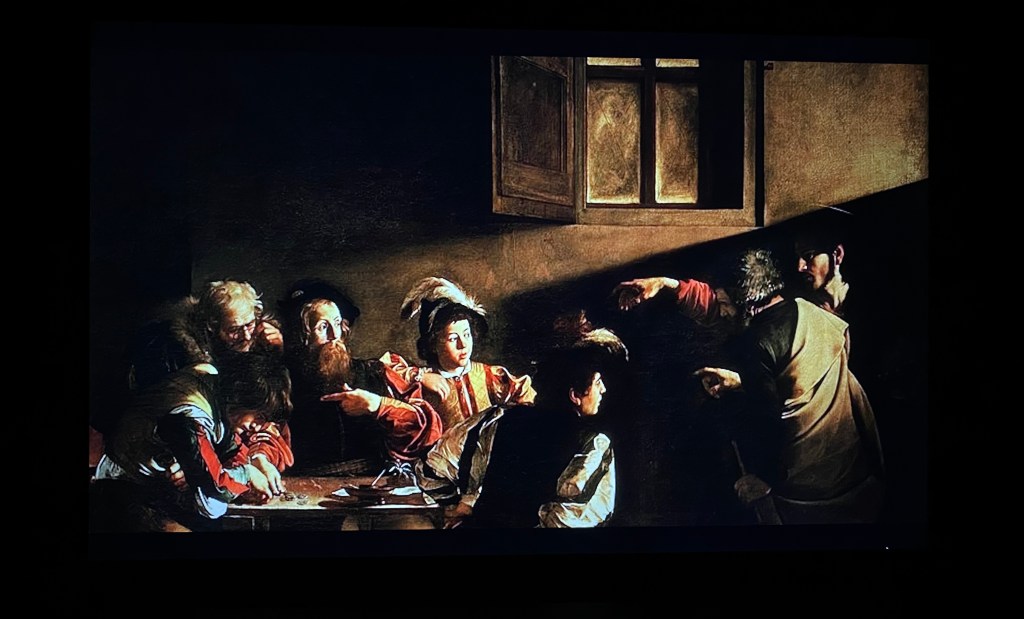
Jesus is truly a light in the darkness. For Levi and his friends, who just settled for the path they were on, thinking and feeling, this is the best it was going to get, were given a choice, an invitation, a new way. A great celebration of fellowship ensued in Levi’s home because these men and women, who had been outcasts, who were separated from the greater community were forgiven, welcomed, and embraced. They were loved by Jesus as they were. They did not have to change first for Jesus to call Levi and gather with them.
They were welcomed into the kingdom and reign of God. Their ticket to reconciliation and healing was accepting the invitation of Jesus, to receive and experience his love and welcome. Levi and the other sinners did not run from the light of Jesus, but were willing to recognize their need for healing, were willing to repent, to turn away from their prior ways of life and so were reborn!
They were divinized because of their willingness to participate in the life of Jesus. Levi would continue to follow Jesus such that it was no longer he who lived, but Christ who lived in him (cf. Galatians 2:20)!
Jesus invites us each day, as he invited Levi in today’s Gospel, to follow him. We are given the same invitation and opportunity for healing and for discipleship. Will we resist rationalizing and justifying our sinful thoughts, actions, and habits, welcome the light of Jesus that reveals our venial and mortal sins, admit our need of healing, and repent so to be forgiven and released from all the energy we have expended in protecting and hiding from ourselves and our God who loves us more than we can ever mess up?
Quietly spending time daily, especially in the evening and recalling our day, by asking Jesus to reveal to us those ways in which we have not lived according to his will is a wonderful practice. Those venial sins we call to mind we can confess on the spot and Jesus will forgive us. As we recognize recurring actions or more grave sins, we will need a more direct human encounter by embracing the Sacrament of Reconciliation. Reconciliation is a gift of mercy and healing where we can experience firsthand the healing grace of Jesus.
Jesus loves us as we are. Yet holding on to our sin, keeps us at a distance from experiencing the greater breadth, depth, and width of his love. When we are willing to be contrite, to embrace sorrow for the harm we have inflicted with our personal sins, and go to the Divine Physician we receive his forgiveness, healing, and reconciliation. Once absolved, the heavy weight is lifted. We are then better able to engage in penance to atone for our sins committed, better able to forgive others as we have been forgiven, and better able to love as we have been loved!
——————————————————————–
Photo: The Calling of St. Matthew (also known as Levi) by Carravagio, 1599-1600. Wonderful work to meditate upon for Lent!
Link for the Mass readings for Saturday, March 5, 2022
 Spiritual Stepping Stones