“At that time Jesus exclaimed: ‘I give praise to you, Father, Lord of heaven and earth, for although you have hidden these things from the wise and the learned you have revealed them to the childlike’” (Mt 11:25).
Why did many of the wise and the learned, referring to the Sadducees, Pharisees and scribes, reject Jesus? One possibility is that Jesus challenged their idol of tradition. Even though Jesus did not come to abolish the law but to fulfill it (cf. Mt 5:17), the invitation to go deeper was and continues to be challenging. This is certainly highlighted in the six antitheses that Jesus shared during his Sermon on the Mount. Here is one such example: “You have heard that it was said, ‘An eye for an eye and a tooth for a tooth.’ But I say to you, offer no resistance to one who is evil” (Mt 5: 28). Offer no resistance to one who is evil? Not only hard to swallow for people of Jesus’ time, but for us today as well.
Jesus offered then and continues to offer us today an invitation to experience the intimacy of the Trinitarian Love of God shared between Father, Son, and Holy Spirit. To be fully alive, to share in his Love, we need to resist being governed by our fears, insecurities, and holding blindly on to tradition for its own sake. Instead, we need to be open to growth, change, and renewal. Gerhard Lohfink, in his book, No Irrelevant Jesus, quotes the Polish philosopher Leszak Kolakowski: “A society in which tradition becomes a cult is condemned to stagnation; a society that tries to live entirely through revolt against tradition condemns itself to destruction” (Lohfink 2014, 2).
We are called to live in the tension of both/and. Many have left the Church because they feel we are too steeped in tradition, rules, and laws, but in their throwing the baby out with the bathwater, they have no secure ground or foundation, no anchor in their life. Others remain hunkered down entrenched in a bunker of tradition fearing the secular tide, holding on to tradition. Both tendencies weaken us because we are choosing our self over accepting Jesus’ invitation to let go and enter into the living stream of the communal Love of the Trinity which we can then share.
Jesus sees our potential as well as our wounds, insecurities, and fears. He meets us where we are, in our present condition, and from that starting point, he invites us to crawl, then to take some baby steps, to walk, run, and eventually to fly – to experience and share his unconditional love. We need to resist the extremes of rejecting tradition altogether or idolizing tradition alone, but instead build on the foundation we have been given; Jesus Christ: “The Way, the Truth and the Life” (cf Jn 14:6). Within the life of the Church, “we must not do away with its traditions, but at the same time it must continually clarify, renew, and deepen them” (Lohfink 2014, 2).
Hans Urs von Balthasar offers a wonderful balance. He proposed archetypes of the church that when each are properly ordered to God and work in collaboration enrich the Church. These archetypes are “Mary (Christ’s mother), Peter, James, John, and Paul. St. Peter is associated with paternal care and governance; St. John with love, typical of those with contemplative vocations; St. James with knowledge and defense of the tradition, typical of scholars; and St. Paul with the universal mission of the Church and her adaptation to changing social conditions, typical of the new ecclesial movements” (Rowland, 91).
The balancing of each one of these archetypes helps to perpetuate the deposit of faith Jesus that shared. Those who are faithful in each successive generation to the true, the good, and beautiful that Jesus has handed on may continue to participate in his love, forgiveness, healing, and wholeness. As we trust in Jesus, he reveals to and offers us an intimate participation in the love shared between the Father and the Son and the Holy Spirit.
—————————————
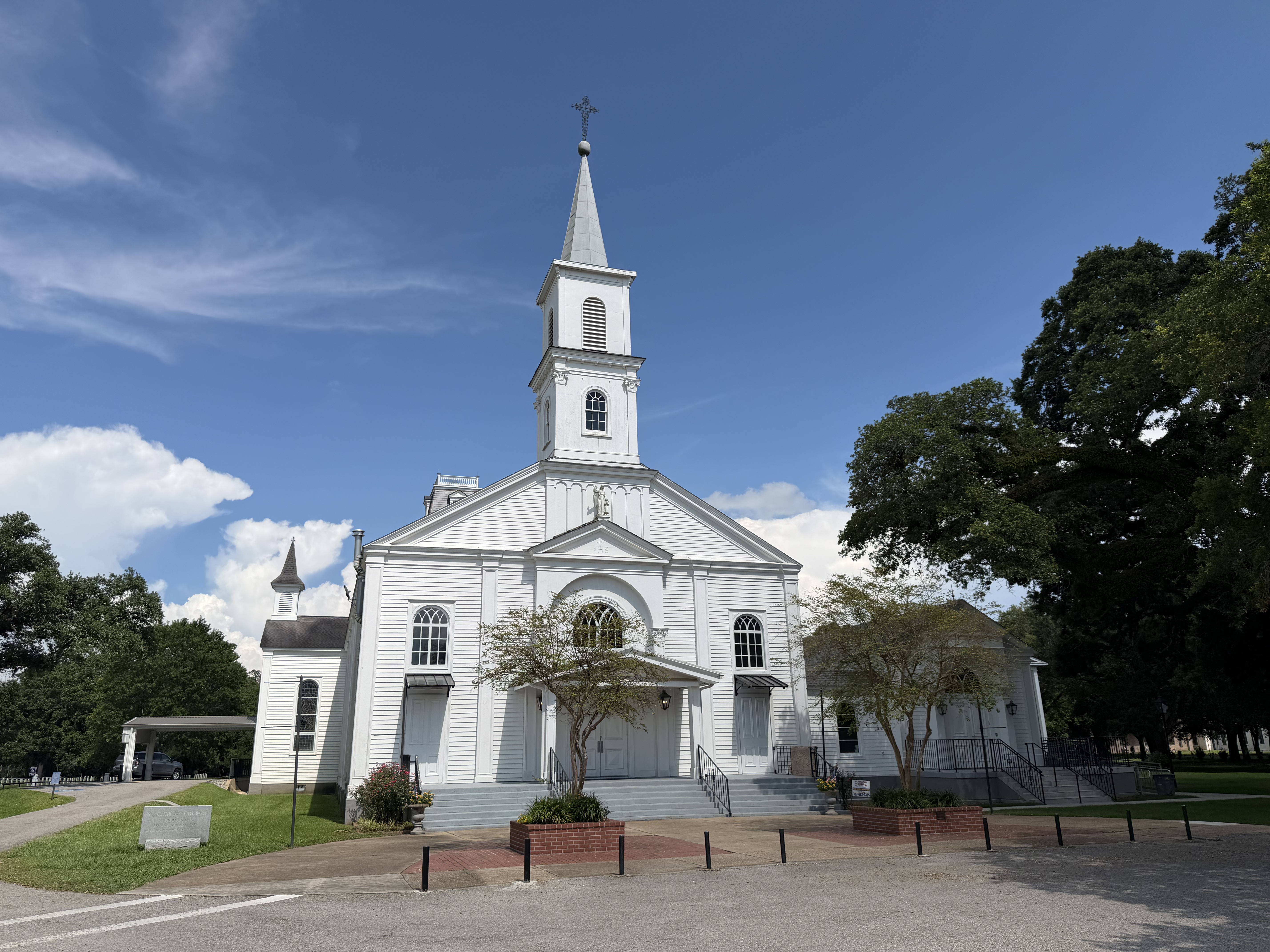
Photo: St. Charles Church, Grand Coteau, Louisiana founded in 1819, present church built in 1879.
Lohfink, Gehrhard. No Irrelevant Jesus: On Jesus and the Church Today. Minnesota: Liturgical Press, 2014.
Rowland, Tracey. Introducing Communio Theology. Elk Grove Village, IL: Word on Fire Academic, 2025.

