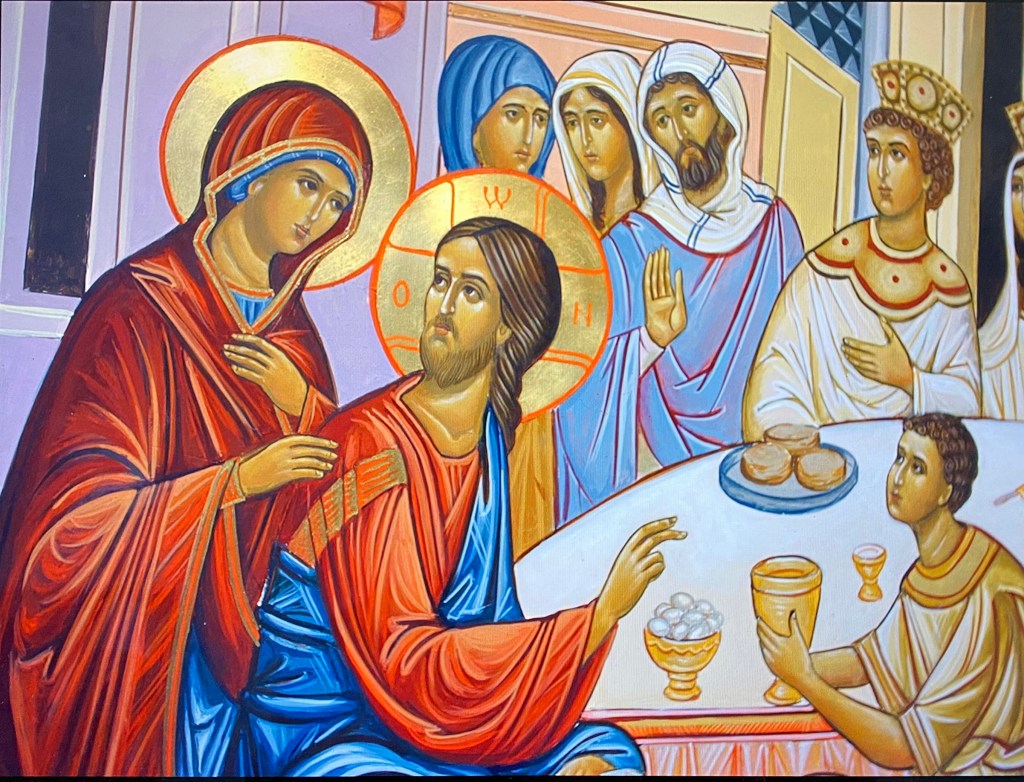
Our life will be more fulfilled when we do whatever Jesus tells us.
God takes the initiative to reach out to us and then we have the choice to respond. Our very desire to encounter God in prayer is already a prayer in itself, because we are acknowledging the relationship with God that already exists. Awareness that God exists is not the end goal but only the beginning. A deist believes God exists. Our God, though transcendent and beyond our realm of understanding, is at the same time a God who draws close, who initiates an encounter and invites us, each and every one of us, to have a relationship with him.
Our relationship with God begins with our awareness of his presence in our lives and a recognition that he invites us to experience him more and more. Our relationship develops in intimacy and authentically when we are willing to reveal ourselves to God and be still and open as he reveals himself to us.
Many times our relationship with God and others flattens out or plateaus for many reasons. The core of which is that we close in on ourselves. We focus too much on work or projects, seek false truths, deny our own emotional and spiritual hurts and wounds and instead of seeking help or reaching out, and we keep others at arm’s length. We begin to live a half life or merely exist day to day because we are only going through the motions or are in survival mode.
God seeks for us to be fully engaged in life. We can see this in the account of John’s Gospel for today. The wine has run out at the wedding feast of Cana.
Our discernment for our vocation and path in life becomes clearer when our relationship with God is truer. God sent his Son to invite us and help us to deepen our relationship with his Father. If you need to stop but do not know how, if you are aware of past hurts and wounds that are in need of healing, if you are indecisive, anxious, angry, or losing hope, follow the words of Mary: “Do whatever he tells you” (Jn 2:5).
When we are willing to listen to and follow Jesus’ guidance, he will lead us to the source of our being, God his Father and our Father, and to the truth of who we are and are called to be. As our relationship with him grows we are transformed just as Jesus transformed the water to wine. Each of us have been given gifts to utilize for mission, and Jesus will give us what we need to accomplish that which God has given us to do. The Holy Spirit will also guide us through any barrier or obstacle that opposes our mission. We will find joy and strength, we will find healing and renewal, we will find access and means, as well as fulfillment and joy in living our life to the full, when we do whatever Jesus tells us and allow him to transform us in his love.
———————————————————-
Photo: Icon accessed from Rorarte-Caeliblogspot.com
Link for the Mass readings for Sunday, January 16, 2022
Jesus has come to lead us to reconciliation, for time is too precious to waste.
Tax collectors were disliked, even despised by many in ancient Palestine because they were considered unclean, as were lepers and sinners. They were cast in this net because of those who abused their position. A tax collector had a responsibility to pay a fixed amount to the occupying power of Rome but then could keep as a commission anything he collected over and above that fixed amount. The majority of the population, already just getting by, paying a temple tax, and the Roman tax, then finding out their local tax collector was taking more than their fair share, did not make for feelings of endearment.
Jesus surprises all who had come to hear him teach when he not only invites Levi, also known as Matthew, to follow him but then they have dinner together. We are witnessing yet again another healing miracle. Jesus provides an opportunity of bridging divides by inviting someone to his inner circle, to turn away from one way of life to begin anew, to: “Repent and believe in the gospel” (cf. Mk 1:15). The Pharisees question his choice of table fellowship companions. It is not clear if the Pharisees are eating with them or are on the outside looking in. The other curious point is that the Pharisees are conversing with Jesus’ disciples. So both groups are together witnessing the communal exchange.
Whichever is the case, that they were engaged in the meal together or observing from afar, not quite sure if they were wanting to participate, they could not have been at too great a distance because Jesus could hear their concerns and responded to them: “Those who are well do not need a physician, but the sick do. I did not come to call the righteous but sinners” (Mk 2:17). The Pharisees, and possibly some of his disciples, were not a part of the intimacy of this communion because of their own unwillingness to accept those that Jesus invited to share a meal, to accept that they too were sinners also in need of healing.
Jesus forgives and offers mercy to all who are willing to be aware of his invitation to fellowship. In surrendering our finite freedom over to his divine freedom, we receive healing and transformation, then develop a relationship of intimacy and communion with the one who is ushering in the kingdom of God. Our relationship continues to grow and deepen as we accept the love and light of Jesus in our life, which helps us to be more aware of our fear, pride, and sinfulness. In our turning away and letting go of our self-absorbed posture, we are further healed, experience his joy, and come into the fullness of who God calls us to be, so as to share the invitation of blessing, healing, and joy.
As with many Gospel passages, this one offers a wonderful opportunity to place ourselves in the scene. Mark presents Jesus teaching the people though he does not tell us anything about what Jesus shared. Knowing what follows, we might ask ourselves, “What might Jesus have taught about before going directly to Levi at the custom’s post?” Could he have been talking, as Matthew adds in his parallel account, about how Amos preached that God desires mercy and not sacrifice (Mt 9:12)?
Let us sit with the opening line for a time and see what Jesus shares. Then as Jesus moves to the custom post, follow him and the others. What is our reaction to Jesus calling the tax collector Levi to follow him as one of his Apostles? Are there sins that others commit that we find easy to forgive, others that we find hard to forgive? Do we accept the invitation to table fellowship with this motley crew, stay at a distance, or walk away? With the gift of these readings that we have been given, it is important that we take the time to ponder them, to invite Jesus into our reading, and to encounter him as did those we read about.
This is a wonderful spiritual practice that can bring us much joy and help us to experience the divine physician who seeks us out to bring healing and reconciliation. Jesus reminds us that we have been created to be in communion with God and one another. No RSVP needed, just come, open up your Bible, and join the feast!
————————————————————————-
Photo: Resist taking any moment for granted, life goes too fast.
Link for today’s Mass reading for Saturday, January 15, 2022
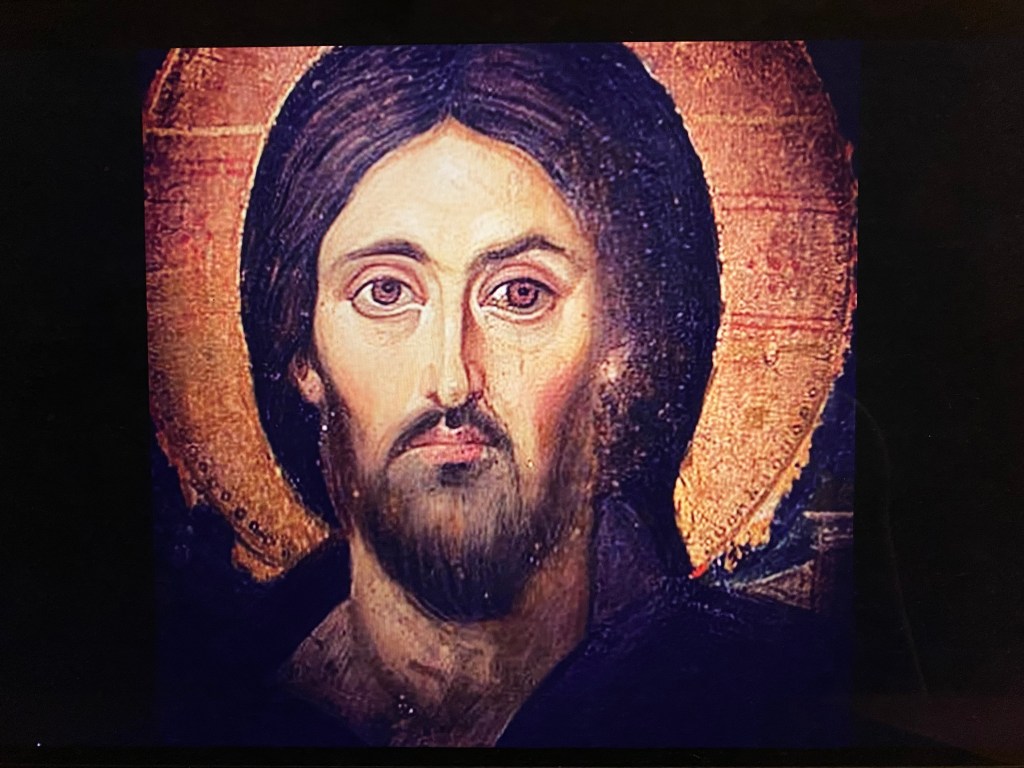
Iesous Kyroios, Jesus is to be Lord of our lives.
When it was known that Jesus was in the vicinity, people came. They came to hear him teach because he taught with authority, he taught in ways that were practical as well as demanding, he confirmed the foundational principles of Judaism, while at the same time, Jesus called out abuses in leadership. Jesus came not to abolish the law but to fulfill it. That meant that he did not water down the message of God, but raised the standards even higher than they had been before under the leadership and legacy of Moses. Unlike some of the Pharisees though, Jesus did not just add heavy burdens to leave the people to carry on their own, Jesus accompanied those he challenged, he carried the weight of their sin, all the way to Calvary. Jesus also healed and cast out demons.
If Jesus had a business card to hand out as people gathered around him, written on it would probably be his first words recorded by Mark in his Gospel: “This is the time of fulfillment. The kingdom of God is at hand. Repent, and believe in the gospel” (Mk 1:15). The time of fulfillment is indeed at hand in the presence of the Son of God made flesh. The entrance to that kingdom is measured by a willingness to turn away from self and turn back to God. Those who are open to the love of God, willing to be shaped and transformed by his love, who are in touch with their hunger and yearning to be one with the Father, recognizing that there is more to life than what they experience in the here and now are drawn to Jesus. This is why his house in Capernaum was full to overflowing.
When Jesus returned to Capernaum after some days, it became known that he was at home. Many gathered together so that there was no longer room for them, not even around the door, and he preached the word to them (Mk 2:1-2).
It is clear that there is a movement afoot in just these first two chapters of Mark. Another key verse from Mark is the very first line of his Gospel: “The beginning of the gospel of Jesus Christ [the Son of God]” (Mk 1:1). This is an amazing line, unless we read the words only and miss its proper contextual background. Those reading or hearing these words in the first and early second century would have grasped Mark’s intent immediately. There are two words in that verse that would have leaped off the pages or the lips of the reader; gospel and Christ.
The geopolitical powerhouse lording over Israel at the time of the life of Jesus was Rome. The house of Caesar was its head. Augustus Caesar was emperor at the time of the birth of Jesus. Tiberius Caesar reigned during most of the adolescence and adult life of Jesus. The term gospel, euangelion in Greek, meant good news. This gospel was spread throughout the Roman empire by messengers especially on two occasions, at the behest of the emperor; on his birthday and after great military victories. Christ, or Christos in Greek, meant the anointed one. The only ones who were anointed were emperors, kings, and priests.
Mark was making a very clear point with this opening verse, the proclamation of the good news: Jesus is the Christ, the anointed one, not Caesar. It is not Kaiser Kyrios, Casaer is Lord, but Iēsous Kyrios, Jesus is Lord! This verse is treasonous in the face of Caesar and a subversive rallying cry for the followers of Jesus then and today. Yet Mark was not calling for a military coup, or a power play.
Jesus the Christ is our Lord. He is the one to whom we bow when we hear his name, not an emperor, president, prime minister, or political party. We are not called to take up arms but to repent, to turn back to God, to resist the path of self-centeredness, and instead, we are called to love – to will the good of others. We are to surrender our ego to the Son of God, so as to be transformed from the darkness of revenge, hatred, pride, and division, and instead be conformed to the Body of Jesus, with the purpose of upholding the dignity of our brothers and sisters through our acts of understanding, mercy, love, caring, and unity.
Iēsous Kyrios! This is good news!
________________________________________
Photo: a 6th-century icon of Jesus
Link for the Mass reading for Friday, January 14, 2022

Are we willing to build bridges of solidarity and compassion?
A leper came to him and kneeling down begged him and said, “If you wish, you can make me clean” (Mk 1:40).
The term leprosy, used during the time of Jesus, was a more general way to describe various issues pertaining to the skin such as open wounds, sores, skin flaking, as well as much more severe and chronic conditions. Today we use it more specifically to refer to Hansen’s disease, a chronic infectious disease caused by a rod-like bacterium named Mycobacterium leprae (PubMed Health).
During the time of Jesus, those dealing with such skin conditions were deemed unclean. They were to live outside of their village, town, or city; wear ragged clothes, their hair needed to be unkempt. If anyone came close to them, they were to yell out that they were unclean, so there would be no chance of human contact. Lepers were exempt from any communal religious practice and the common opinion held was that those in this situation deserved it because of some sin that they committed. Those with chronic or recurring conditions could be in a state of exile for the entirety of their life. The experience was like a living death because they were isolated from all societal interaction.
When Jesus comes near to the leper, both were well aware of the cultural and societal requirements dictating that each one was to keep their distance. The leper does not follow the societal norms. Instead of warding off Jesus and urging him to stay away, he approaches Jesus and kneels before him. Jesus does not reprimand him, and he, like the leper, does not follow social protocol: “Moved with pity, he stretched out his hand, touched the leper, and said to him, ‘I do will it. Be made clean'” (Mk 1:41).
The leper is healed at the moment of Jesus’ contact, his death sentence is commuted, his opportunity for worship and communal life is restored. This simple act of healing the leper in today’s Gospel is, in fact, a microcosm of Jesus’ ministry and mission. The Son of God, in embracing our human condition, provides the opportunity for restoring us also from our exile, our separation from God and one another.
Jesus the carpenter in the humanity he assumed, became a bridge, a stairway to heaven, that provides us a way to cross the wide chasm separating us from his Father. In his willingness to touch the leper, Jesus became a living icon showing how he as the Son of God was willing to draw close to us as well. He was willing to walk among us, accompany us, experience our pain, suffering, and separation, becoming one with us in our humanity so that he could offer us forgiveness, reconciliation, and communion so that we can become one with him in his divinity and become instruments of healing for one another.
We are to not shun those on the peripheries, nor, God forbid, are we to support social prejudices, injustices, and structures that isolate and exile others. We are called by Jesus to be open to walking in solidarity with our brothers and sisters. We need to be aware of the ones that are socially kept at arm’s length, those we force into positions of shouting, “Unclean!” when we come near. What bridges can we build in our families, schools, work, and communities? Jesus is inviting us to risk, to go out to the margins, and in the words of Pope Francis to go with “a spirit of profound solidarity and compassion.”
—————————————————————
Photo: That’s one way to build a bridge…
PubMed Health. “Hansen’s Disease (Leprosy).” https://www.ncbi.nlm.nih.gov/pubmedhealth/PMHT0027942/
Link for Mass readings for Thursday, January 13, 2022
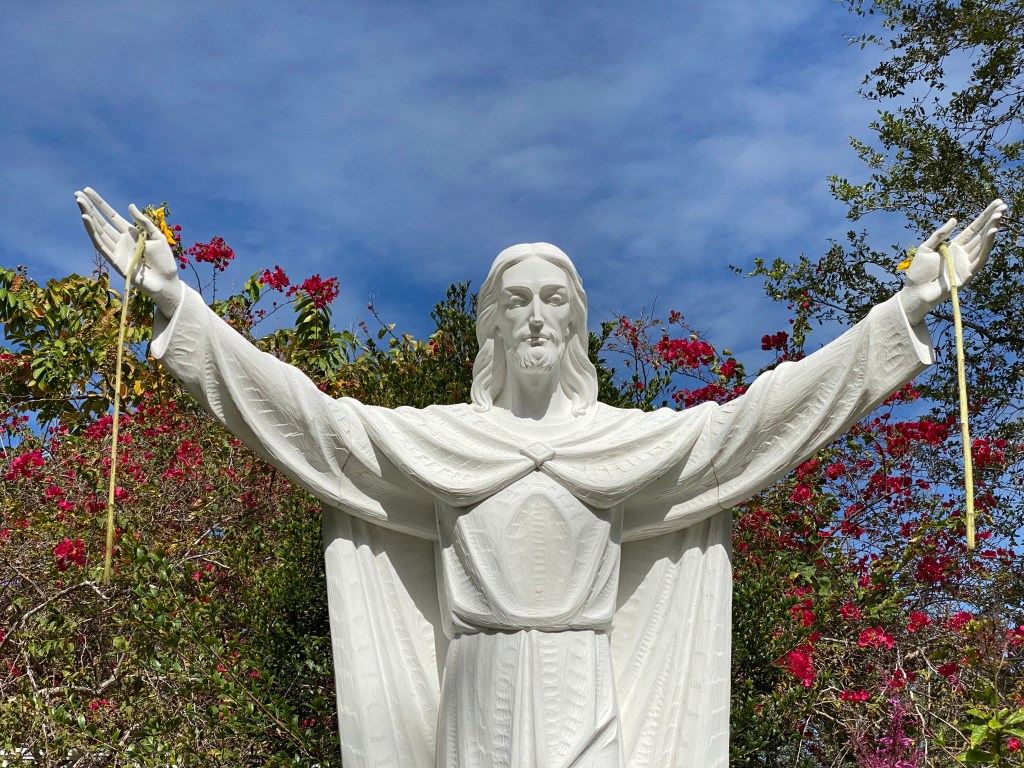
Jesus can still heal us and others through us.
There is a danger when we read a comment from Scripture such as when Jesus, “cured many who were sick with various diseases, and he drove out many demons” (Mk 1:34), that we may not believe we are capable of healing as Jesus did, so we don’t do anything active with our faith. We also might think that Jesus is divine, so of course, there is no way we can measure up to what he has done. An even less helpful line of thought would be to disbelieve that the healings of Jesus happened at all, they were all made up, and that they never really happened.
Another challenge can be pride. We may want to heal like Jesus, for the purpose of our own aggrandizement, so people look at us, not God. That was the sin of Simon the magician, who saw the Apostles healing, just as Jesus had, and offered payment to them for the power to accomplish the same (cf. Acts 8:9-25). Along the same line is wanting to do something grandiose, something beyond our own unique gift and charism, again so the focus is placed on us.
What we need to keep in perspective is that Jesus had a specific mission to accomplish, and yes he is divine, but as I have shared often, Jesus is also fully human. He had a specific mission from his Father, he gave a specific mission to his Apostles, and his Father has a specific mission for each and every one of us as well. Jesus himself proclaimed: “Amen, amen, I say to you, whoever believes in me will do the works that I do, and will do greater ones than these, because I am going to the Father” (Jn 14:12). Not only does Jesus say we can do works such as these but even greater ones! Jesus knows the plan God has for our life, the part we are to play, and he will share it with us and empower us with that which we need to accomplish it.
We all have the capacity to provide God’s healing presence to others. God works through us when we embrace the love of the Holy Spirit. There are simple ways for all of us to contribute. Throughout the Bible there are accounts of how God invites others to service, each in small and humble ways – Jesus himself began his days on this earth wrapped in swaddling clothes in a feeding trough, as vulnerable and humble a beginning as there can be. He then lived the next thirty years in obscurity until his public ministry began.
We need to resist the temptation to limit and define Jesus, but instead embrace the gift of a “sitting theology” in which we allow ourselves to look at Jesus, take him in, for he is “infinite Love incarnate” (Barron). We just need to place ourselves before Jesus and allow him to expand us so that we can receive his revelation and guidance so as to know the mission our loving God and Father has planned for us. We also need to be willing to allow his Spirit to work through us.
Then as we go about our lives each day, we can become contemplatives in action, open to the experiences that come before us, the opportunities and interruptions that arise in which we can be present to another with a smile, an active, listening ear, and a helping hand. In each small act, we say yes to God’s invitation to be present to others and accompany them by our willingness to love as he has loved us, by willing the good of each other. Through each of these actions, no matter how small, healing happens.
—————————————————————————–
Photo: Another photo from our Rosary Garden from St. Peter Catholic Church.
The thought of a sitting theology comes from Bishop Robert Barron Lesson 5 lecture that he gave on Hans Urs von Balthasar from his Word on Fire Institute. To learn more about the WOFI and what it offers, type the following link into your web browser: https://wordonfire.institute
Link to Mass readings for Wednesday, January 12, 2022
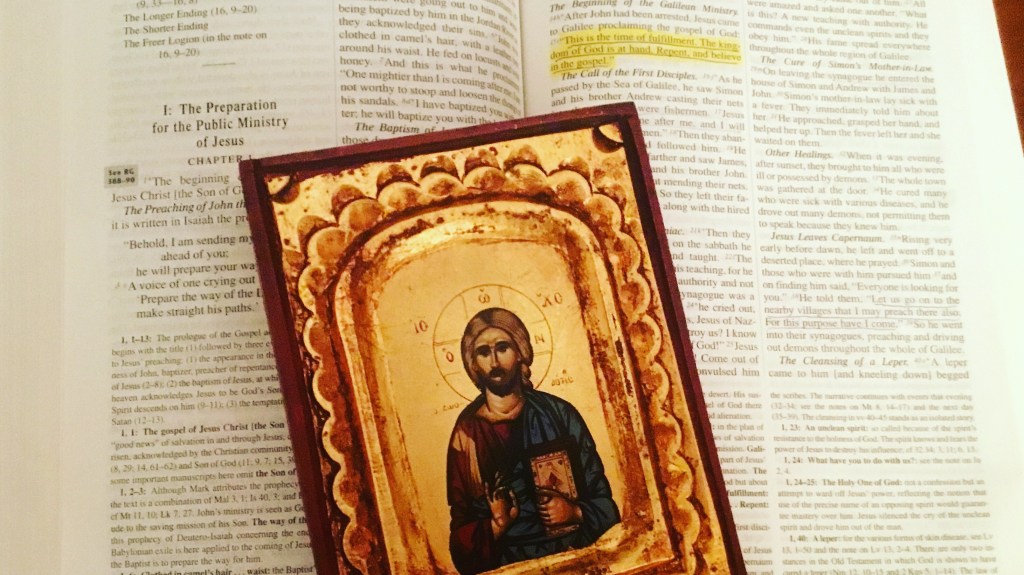
Jesus is the living Word of God.
Jesus quoted no one. He spoke from his own authority.
The Gospel of John picks up the source of Jesus’ authority from the beginning line of his Gospel. “In the beginning was the Word, and the Word was with God, and the Word was God” (Jn 1:1). Jesus Christ is the Word, the Logos in Greek. Who would have more authority to speak about the word of God, than the Logos, the Word, himself?
The authority of Jesus was not only limited to teaching but restoration. As he was teaching in the synagogue he expelled the unclean spirit of a man when he said, “Quiet! Come out of him” (Mk 1:25)! Time and again we read accounts of Jesus healing and exorcising demons with his word.
If you haven’t read the Bible ever, have not for a long time, or have been away for a while, I invite you to read the Gospel of Mark. Along with prayer, reading the Gospels is a way to come to know Jesus and experience his authority in our lives. You may do so along with the Church as we are reading the Gospel daily or at your own pace, say five to ten minutes a day. What may be even better is to read a short section at a time and meditate on the passage read.
Mark is the shortest of the four Gospels, it is quick moving, and action-packed. The Gospels lend themselves particularly well to visualizing the text, and placing yourself in the reading as if you were watching a movie. See what Jesus wants to reveal or communicate to you in the silence of your heart.
We can also receive a word or phrase and carry it with us throughout the day, such as from today’s account. We may not be dealing with being possessed, but if we are experiencing pressure, temptation, feeling indecisive or divided we can call on Jesus’ words and speak in his name, “Quiet!” or “Peace be still!” and receive through the authority of his word his healing presence within us.
We do not have to journey alone this day. We have the gift of prayer and the Gospels to help us to remember that Jesus is present with us, helping us to continue his mission which is to help us and others to be aware that the kingdom of God is at hand!
——————————————————————————–
Photo: Jesus makes himself known to us in his Word proclaimed and lived in our lives!
Link for today’s Mass reading for Tuesday, January 11, 2022
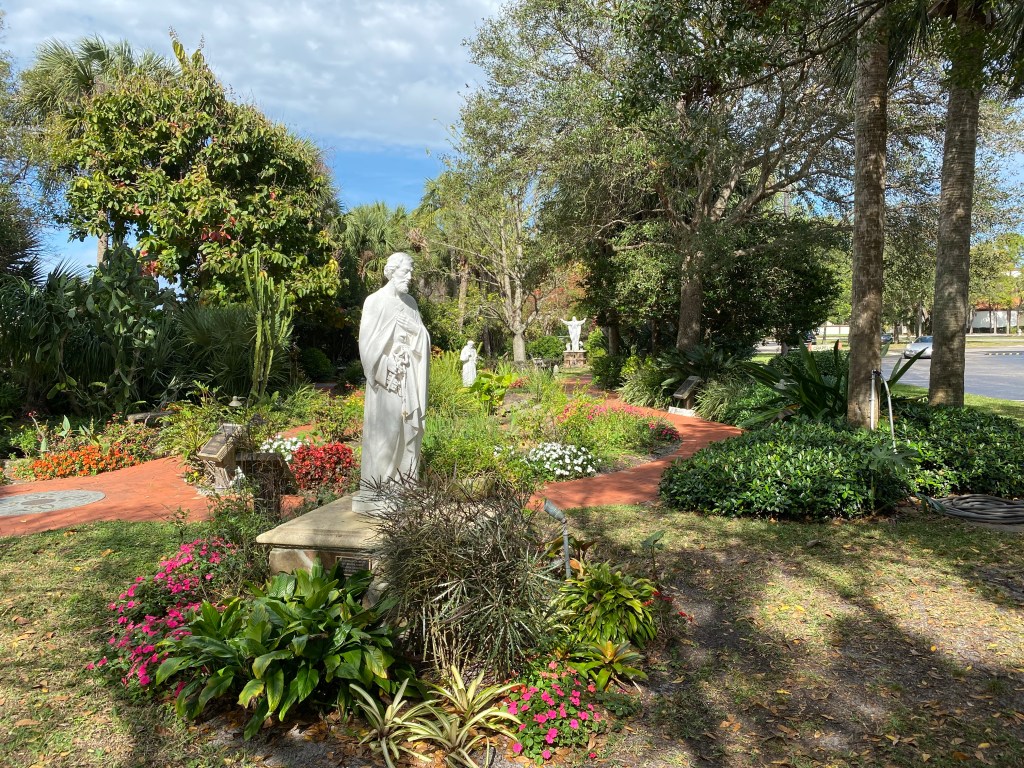
Now is a good time to turn back to Jesus, for: “The Kingdom of God is at hand.”
“This is the time of fulfillment. The Kingdom of God is at hand. Repent, and believe in the Gospel” (Mk 1:15).
With these words as recorded by Mark, Jesus begins his public ministry in time and space and we in 2022 begin the first week of Ordinary Time together. Whether we are in the season of Christmas, Easter, or Ordinary Time, each day is an opportunity to be thankful and celebrate our life for this continues to be “the time of fulfillment”. The Kingdom of God is still at hand because Jesus is still present with each and every one of us.
We are not alone on our journey. The Son of God became human, as we just celebrated this Christmas season, and as we will celebrate in Easter, he died and rose again. This was no mere resuscitation like with Lazarus who rose and died again. Jesus conquered death and became the firstborn of the new creation. Ordinary Time is the season in which we not only study the life and teachings of Jesus but hopefully continue to be willing to be conformed to his Body and the will of his Father through the love of the Holy Spirit.
One of the things that may hold us back from embracing the gift of the Kingdom of God in our midst is that we have often chosen to place our focus on ourselves first. Jesus calls us to reorient our lives in urging us to repent, to turn away from the false reality that we are the center and author of our own lives, such that we come to realize the truth that God is our true author and director. To repent also means to open ourselves to his love, to place our trust in him, and to be assured that God accepts us as we are, right now at this very moment.
We do not repent so that God will love us. We do not have to do anything or act perfectly or say the right prayer for God to love us. We just need to “move the Lord out of the category of ‘polite company’ and into that of intimate friend to whom one can tell everything” (Barry 1987, 55). To repent means to turn back to the God whose arms are wide open ready to embrace us. It is we who have turned away from him. Let us turn back at this moment to our loving God and Father so that we can receive the forgiveness, mercy, and love that he offers us.
As we begin our journey into Ordinary Time together, let us recommit our lives to God by receiving his invitation to walk together side by side. Jesus encourages us to resist limiting the movement and work of the Father and the possibilities the Holy Spirit places before us. Instead of attempting to bend his will to ours, may we allow the love of the Holy Spirit to expand our hearts and minds such that we will trust God more and be like a pencil in his hand.
———————————————————————–
Photo: Spending some time meditating, praying, and walking in our Rosary garden at St. Peter after Sunday Mass.
Barry, S.J, William A. God and You: Prayer as a Personal Relationship. NY: Paulist Press, 1987.
Link for the Mass readings for Monday, January 10, 2022
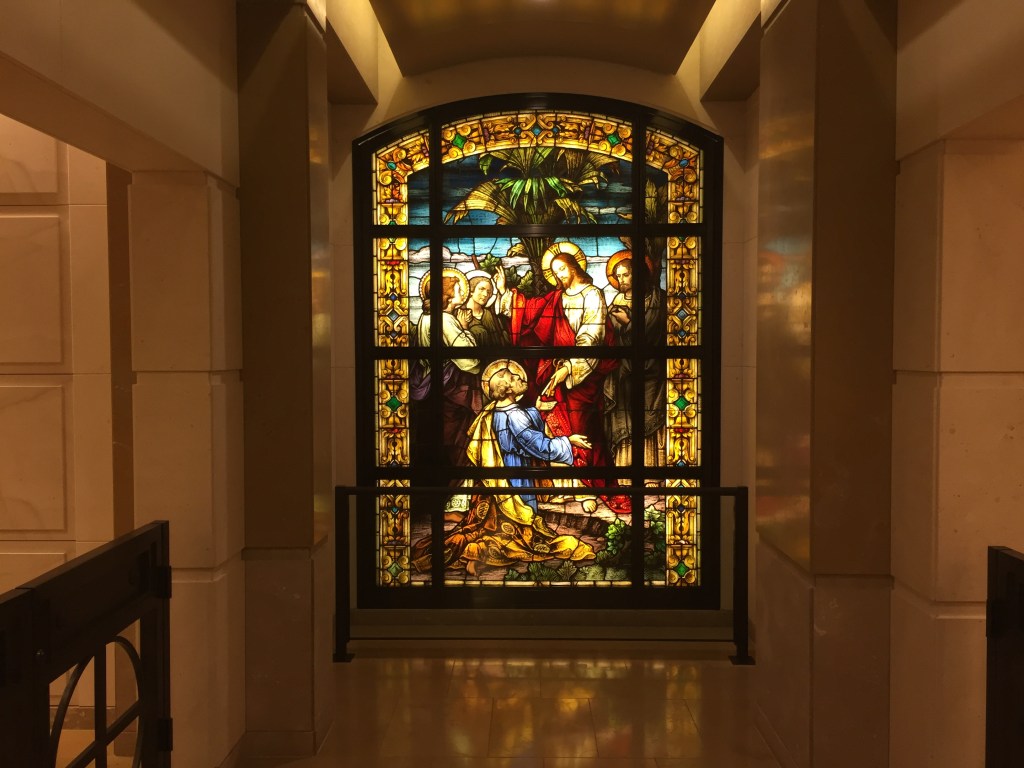
Jesus’ baptism paved the way for our baptism and to answer the call to be saints.
Today we celebrate the feast of the Baptism of the Lord and the ending of the Christmas Season. From the timeline of the synoptic Gospels, Mark, Matthew, and Luke, this is a significant step in the life of Jesus. After his baptism, he immediately goes into the desert for forty days and following that period, he will begin his public ministry.
It is good to occasionally reflect on our baptismal vows. Especially now that we can dip our fingers into the Holy Water again. When we bless ourselves with the signing of the Cross, we participate in this action to affirm that we choose again to live by the baptismal vows made on our behalf by our parents and Godparents.
In reflecting in this way, we may see this feast as important to us as well. Jesus was not participating in baptism as an act of repentance, he was joining in solidarity with us in our fallen and sinful nature, while at the same time affirming that we are not destroyed by sin but only wounded. Jesus came to redeem us, to save us, to help to reconcile our fractured relationship with his Father.
We recall and celebrate this reality that the Son of God, non-being, Infinite Act of Existence, became a finite, human being and then even assumed our sinfulness, while remaining sinless himself. The pure, unblemished, Lamb of God began the process that would end in his death on the cross. He was willing to participate in John’s baptism and in his crucifixion because he loved his Father and was willing to follow his Father’s will all the way. He was willing to show unconditional love for us, by giving his life for us, not because we are perfect, but in our imperfection.
We have choices each and every day, each and every moment to make. We can turn our away from our God our Father and listen to false promises, apparent goods, and give in to temptations and diversions that may satisfy for the moment but leave us empty over time. We can live a life for our self alone working toward an eternity of eternal separation from the one who loves us more than we can ever know. Or, we can choose to participate in the plan that God has for us and to follow Jesus in the way he has and continues to reveal. We can actualize our potential and experience the joy and meaning of a life of fulfillment that is working toward a life of eternity with God while at the same time helping others to do the same.
How come Jesus never sinned? Because he never said no to his Father. He always said yes. Jesus’ baptism made a difference for us not for him. He took upon our sin as he would do again on the Cross. Our baptism, in which we were indelibly marked, eternally conformed to Jesus, made a difference. But our baptism, our being born again, born from above, is just the beginning. God the Father has a part for us to play in bringing about his kingdom. It does not matter how small. We are called to be holy, we are called to be saints. Each and every one of us, each and every day, are invited to say yes to God’s will and commit to playing our part in salvation history.
We are not alone in this endeavor. The saints in a stained glassed window, with the light shining through, are not just there for adornment. They are examples and reminders of those, though sinners and imperfect like us, made a decision that their baptism mattered, that they were going to say yes to God, that day, and each day that followed. They allowed the light of Christ to shine through them to others.
We can do the same, as the saints cheer us on. The Father and the Son have also sent the Comforter, the Holy Spirit to empower us through his love, to give us the guidance, the ears to hear, and the courage to act. All that needs to happen for us to begin and continue to live out our baptismal call is to say yes, today, tomorrow, and the next day, and in each moment to the will of our Loving God and Father.
Photo: Stained glass window of Jesus and the Apostles, taken at the Cathedral of Our Lady of the Angels, Los Angeles.
Link to today’s Mass reading for Sunday, January 9, 2022

 Spiritual Stepping Stones