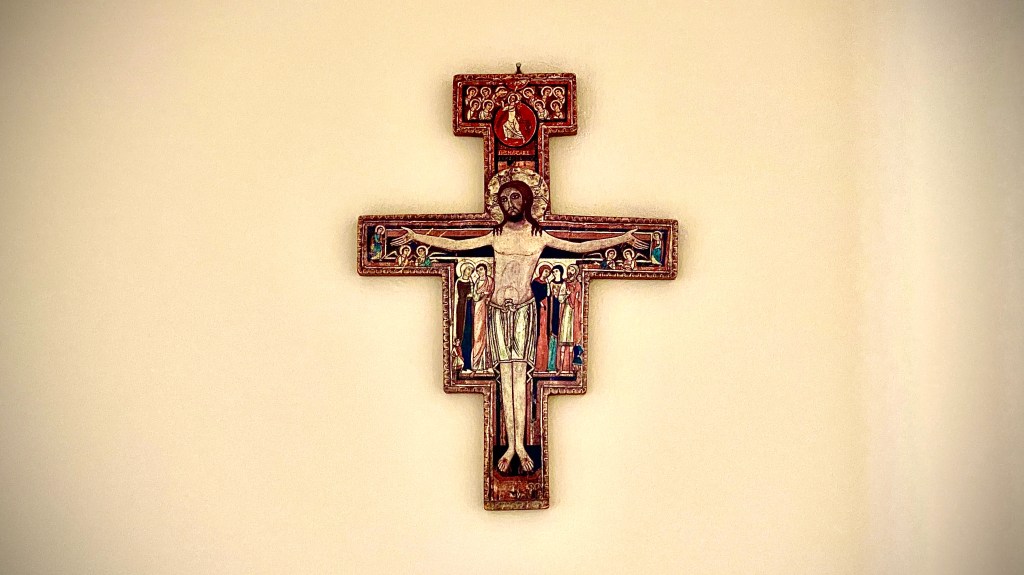
Jesus, you loved God and neighbor. Please help us to do the same.

“You shall love the Lord, your God, with all your heart, with all your soul, and with all your mind. This is the greatest and the first commandment. The second is like it: You shall love your neighbor as yourself. The whole law and the prophets depend on these two commandments.” (Mt 22:37-40).

The scholar of the law who asked Jesus to share with him which commandment of the law is the greatest was a common question among Jews for they had 613 laws! Following these laws was how one showed faithfulness to God. Discussing which were the most important and which were those of lesser rank as well as the practicality of learning and practicing all 613 presented quite a challenge. How do we do with just following the Ten Commandments today? Could we even recite the Ten?

The scholar brought Jesus into this debate. Jesus’ response, that we call today the Great Commandment, was a masterful synthesis of the Torah, the Law, or the Teachings. He drew from Deuteronomy 6:4-5 which was the beginning of the Shema, the prayer that Jews offered each morning and each evening while facing the Temple that stated: “Hear, O Israel! The Lord is our God, the Lord alone! Therefore, you shall love the Lord, your God, with all your heart, and with all your soul, and with all your strength.” Jesus then added to it Leviticus 19:18: “Take no revenge and cherish no grudge against your fellow countrymen. You shall love your neighbor as yourself. I am the Lord.”

As we witness time and again with Jesus, he did not come to abolish the law but to fulfill it (cf. Mt 5:17). Jesus sought to help people to come to know his Father who he knew so intimately, who he loved so fully. Though the Great Commandment sounds simple enough, and it is, it demands our whole self, our full commitment to be contemplatives in action. We are called to love God with our whole heart, soul, and mind. That means all of us, physically, socially, emotionally, and spiritually. We are to recognize that God is actively engaged in all of what we do and who we are in every aspect of our self-identity and integrity.

Our lives will be richer and more fulfilled once we embrace, once we open ourselves up to this reality, and resist the temptation to compartmentalize our time with God. Saying we are only with God on Sunday while in the sanctuary of the Church but leaving him there in the tabernacle is not loving God with our whole heart, soul, and mind.  Stepping into the parking lot becomes like a time warp in which we go back into secular apparent reality, where in the first instant of encounter with our neighbor cutting us off with their car, our hand gesture is most likely not a blessing in the form of the sign of the cross.

If we can turn on a dime so quickly, have we really worshipped at all? Are we living our lives more as Pope Francis calls, “defeated Christians”? Are we just going through the motions of our faith, showing up but our heart, soul, and mind aren’t fully engaged? Pope Francis shares that “the one who confesses the faith well, the whole faith, has the ability to worship, to worship God” (Francis, 292).

We become Christians, contemplatives in action when we give our all as did St. Francis of Assisi who would often pray this simple prayer “My God and my all”. He gave himself in love, all of who he was to God. He encountered the God of Jesus Christ who is Love, received his loving embrace, and went forth to share that love with others. This is called the Greatest Commandment not one of the Greatest Commandments, because loving God and neighbor is one and the same act.

May we embrace the gift of who God is for us, not just as the one who created us and went away to do whatever God does, that is deism. The God of Jesus Christ is a God of relationship grounded in unconditional love, the one who is present with us always, in all the practical and mundane we do, and in everyone we meet. Through this embrace of God and his love and going out from ourselves to will the good of the other, the better we will be able to heal from our wounds of prejudice, bigotry, selfishness, pride, greed, lust, fear, and anxiety.

Our very life is a blessing, a gift, to be thankful to God for and to share and bless others with. May each thought we entertain, each word we speak, each action we take, each facial gesture we express, be one of encouragement, of support, of empowerment, and of love. Dedicating ourselves to following the Great Commandment means that we are to approach our life one day at a time renewing our commitment to love God and neighbor a little bit better today than yesterday. To aid us in our trust and conviction, let us pray often the prayer of St. Francis, “My God and my all”.


Photo: Replica of the San Damiano Cross that I have had since my novitiate year while with the Franciscans. When St. Francis was praying before the original he felt the call by God to rebuild his Church.

Pope Francis. Encountering Truth: Meeting God in the Everyday. NY: Image, 2015
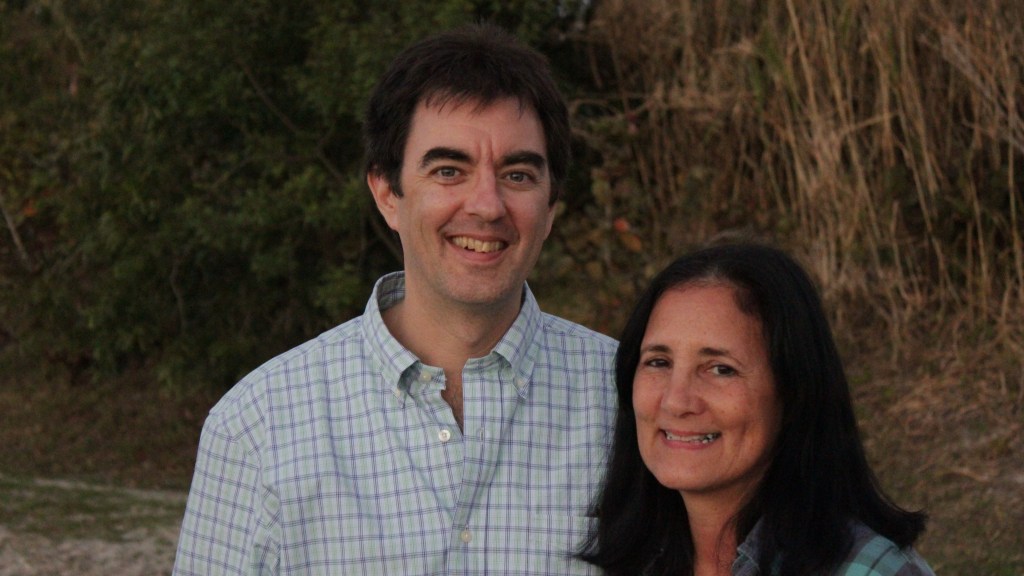
Link for the Mass readings for Sunday, October 25, 2020

Repentance is the key for a healthy relationship with God and each other.

In today’s Gospel, we read about two accounts of horrific deaths. The first is at the hands of Pontius Pilate, who has not only ordered the execution of Jesus’ fellow Galileans but had their blood mixed with “the blood of their sacrifices.” In the second incident, Jesus brought up the tragic accident in which eighteen people died “when the tower of Siloam fell on them.” 
In both cases, Jesus rejected the common notion of the time that these incidents were caused by God’s punishment and focused instead on the importance of repentance. Jesus stated quite emphatically, that, “Do you think that because these Galileans suffered in this way they were greater sinners than all other Galileans? By no means! But I tell you, if you do not repent, you will all perish as they did” (cf. Lk 13:1-5)!
Jesus was emphatic about helping his followers understand the purpose of his coming. Jesus provided meaning and fulfillment in this life as well as being the way to the truth of eternal life in the next. Yet, to receive the gift of his invitation, people needed to repent from their focus on self, misunderstandings of God, and the false substitutions that the world offered. Instead, they were to repent, have a change of mind, and turn back to God, the very source of their being. This is just as true for us today.
Jesus accompanies us through our trials, pain, and desolation, just as he is present in the midst of our achievements, joys, and consolations. To repent and surrender to him is not some submissive posture to a tyrant but an acceptance of the aid offered by the divine gardener. Our repentance gives permission to Jesus to cultivate our ground to rid us of that which sickens us and fertilize us in such a way that we are renewed by his care. Jesus tends to our growth such that we can be more aligned with the will of his Father and the love of the Holy Spirit. In these ways, we are healed and mature so that we will bear fruit that will last. We will become more patient, kind, loving, understanding, forgiving, present, and joyful in our encounters with one another.
We live in uncertain times as did those of the first century. We still live in a fallen world. We do not know the time or the hour, and sometimes we do not understand the rhyme or the reason why someone’s life here ends. The death of my wife, JoAnn, still makes no sense. She was proactive and took good care of herself and I remember her doctors saying that except for the pancreatic cancer she was in perfect health. What made our last months together in this world more bearable was our daily turning over our lives to God’s will and the many people who were praying for us. The months together then seemed like forever and today looking back it seems like the blink of the eye.
We often do not want to think about our death, yet, we need to ponder it from time to time. By doing so we just might live the one life we have been given a little bit better. Each day we wake up is a gift from God. Please don’t take it for granted. Repent, turn back to the God who loves us more than we can ever imagine or mess up. The time to appreciate our life and the lives of those that we hold close to our hearts is now.

Photo: Each day with JoAnn was a gift.
Link for the Mass readings for Saturday, October 24, 2020

Take the time each day to read the signs.

“You know how to interpret the appearance of the earth and the sky; why do you not know how to interpret the present time” (Lk 12:56).
Reading this verse brought two memories from my childhood. The first one is from when my friend Steve and I as kids were interested in reading the natural signs and weather patterns, and we enjoyed watching our local weatherman, Hilton Kaderli forecasting the weather each night. Another memory was with my cousin Danny. We were at my Uncle Pierre and Aunt Claudette’s house one afternoon and we saw a storm rising. We headed to the road and started running as fast as we could in the opposite direction to see how far we could get before the storm caught us, and when it did we walked home, sucking in air, being pelted by the rain, and enjoyed a good soaking. Steve, Danny, and I read the signs of the earth and the sky, but we didn’t pay all that much attention to the things of the spirit at that time.
Not only through his teachings, but also through his public actions, Jesus revealed some powerful signs that God was in their midst. Jesus taught and preached on his own authority, he cast out demons, forgave sins, healed people, met and ate with sinners and women. These were amazing signs that the Messiah came to dwell among them, yet some did not or would not see, rationalized away that he could not be who he showed himself to be.
Some did see and believe and some two thousand years later because of their faithfulness, Jesus speaks to us again today. The stories and encounters of Jesus have been preserved, passed on generation after generation. They are not just a dead letter, nor is the sacred deposit of our faith some inanimate object passed on blindly generation after generation. We are invited time and again to be aware, to look for how Jesus still works in our lives today.
Do we see coincidences or God-incidents? Do we see his presence working in our lives? If not, could it be because our lives are so busy and fast-paced? If so, we need to schedule some time each day to stop and reflect, to take some deep breaths, and ask God to help us review the past twenty-four hours with the express purpose of noticing how he has been involved and engaged in our lives.
It is often by reflecting and looking back over the course of a day, a week, or a month, that we will recall some God-incidents no matter how small. Being thankful for this growing awareness and asking God for greater insight each day will help us to grow in our awareness of how much he has been accompanying us all along in our daily experiences.
For those times that we have refused or failed to recognize this closeness to Jesus, especially in his presence coming to us through others seeking our help, we can ask for forgiveness and for him to assist us in being more aware and more intentional in following the stirring of the Holy Spirit going forward. Opening our hearts and minds to God will help us to better read the signs that the kingdom of heaven is indeed at hand, in our very midst.
————————————————————————-
A moment of rest, enjoying family time and God’s creation, Christmas 2010 – Photo credit: Jack McKee
Link for the Mass readings for Friday, October 23, 2020

May we be willing to be set on fire by God.

Jesus said to his disciples: “I have come to set the earth on fire, and how I wish it were already blazing” (Lk 12:49)!
What has been burned does not remain the same. What fire touches, it transforms. Jesus wants us to be consumed so as to be transformed by the fire of the Holy Spirit. Encountering Jesus effects a change in us. When we are open to allow the Holy Spirit to breathe on the embers in the depths of our souls they are fanned like tinder and ignite. We continue to fuel the fire by getting in touch with what God has called us to do in our place and in our time.
We are not to be a Christian in name alone but in thought, word, and deed. Pope Francis, in his exhortation The Joy of the Gospel, wrote: “THE JOY OF THE GOSPEL fills the hearts and lives of all who encounter Jesus. Those who accept this offer of salvation are set free from sin, sorrow, inner emptiness, and loneliness” (Francis 2013, 9). Joy is a gift, a holy flame, that is given to us by the Holy Spirit and it wells up within. It is different than pleasure which arises when the stimulation of the senses is aroused but fades once the external stimulus has ended.
Happiness is also external and fleeting. It lasts longer than passion in that the memory of the experience will linger on but it too will also dissipate. Joy wells up from within, as it is imparted to us by God and can be present even when the external experiences are stressful or chaotic. I experienced this when I was still teaching 5th and 6th Grade Religion and acting as the dean of students at Rosarian Academy. At the same time, I was also immersed in family and parish life, as well as my studies and formation activities for the permanent diaconate.
One particular morning I woke up exhausted. When the alarm went off my first response was to skip my morning prayer and hit the snooze button to get an extra twenty minutes before getting up to go to school. Instead, I literally crawled to my small chapel area, lit the candles, and opened my breviary. When I read the words in Psalm 42: “Hope in God; I will praise him still, my savior and my God”, something ignited within the depths of my being. I felt an energy well up within me that I cannot to this day describe. I felt an inexpressible joy. Not only did the experience carry me into the day but lasted throughout the whole week.
God comes to us and seeks to transform us with the fire of his Love, and even when we are at our lowest as if we were just cooling embers, we need to resist the temptations of indifference and complacency and remember to turn to Jesus. Instead of brooding over what we don’t have, we will encounter him in being thankful for that which he has given. We will experience him in his Word, in prayer and worship, and in serving one another. We just need to keep showing up, even if sometimes we have to crawl to get there, and allow God to set us on fire.
————————————————————–
Photo by moein moradi from Pexels
Pope Francis. Evangelii Gaudium: The Joy of the Gospel. Frederick, MD: The Word Among Us Press, 2013.
Link for the Mass readings for Thursday, October 22, 2020

In our present darkness, we are to reflect the light and love of Jesus to others.

“That servant who knew his master’s will but did not make preparations nor act in accord with his will shall be beaten severely” (Lk 12:47).
Jesus, as did the prophets, spoke in ways that can be jarring. The purpose was to shake his listeners out of a dull stupor and to make clear his point. In today’s Gospel passage, Jesus addressed Peter’s question: “Lord, is this parable meant for us or for everyone” (Lk 12:41)? Jesus was most likely speaking to Peter and the Twelve. They are the ones he entrusted with continuing his mission. And just as he had been clear to point out those Pharisees who had abused their positions, he was being clear with Peter and the apostles. Jesus wanted to make sure that his successors were not to continue on with business as usual. What Jesus required of them was not just for themselves, but those whose care they had been entrusted with and beyond them to all the nations. His parable was for both the Twelve first and foremost and then to everyone.
Unfortunately, we have witnessed those in Church leadership who have in effect, “beat the menservants and the maidservants, to eat and drink and get drunk” (Lk 12:45) on their own power. Those who have: abused children, covered abuse, skimmed off the top of the donations of the blood, sweat, and tears of their parishioners’ donations, limited access to positions within the leadership of the Church to only male or clergy, been unmerciful confessors, held up the sin of one group or groups while turning a blind eye to others. These and other forms of hypocrisy do irreparable damage.
The world has been darkened by sin and so has the Church. Even though all of us have been wounded we have not destroyed by sin. The Son of God entered into the condition of our fallen nature, became one of us, one with us, and overcame the darkness of sin. Even when those in his name have participated in and perpetuated in that which Jesus warned his Apostles against, we are not to lose heart nor hope. I agree with Bishop Robert Barron that we are called out of “the realm of hatred, racism, sexism, violence, oppression, imperialism, what Augustine termed the libido dominandi (the lust to dominate).”
We are called out of this darkness to be children of the light. There have been many throughout the ages as well as up to and including our own present time who have done just that. They have embraced the light of Christ allowing it to reveal to them their sins. With humility and contrition, they confessed their weaknesses and failures and from this place of surrender, they were healed and transformed. They have become an empty cup able to be filled to overflowing with the love of Jesus. We too are to be open to opportunities to share the purifying light, the healing salve of the Father’s Love that we have received so also to spill over into the lives of those in our realm of influence.
———————————————————-
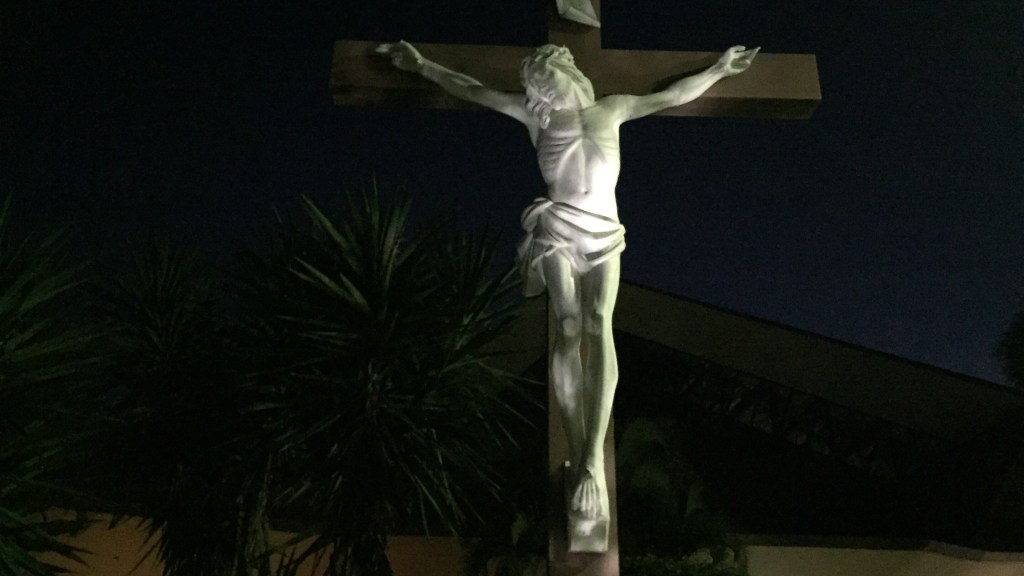
Photo: Crucifix front entrance of St Peter Catholic Church, Jupiter, FL
Barron, Robert. Catholicism: A Journey to the Heart of the Faith. NY: Image, 2011.
Link for the Mass readings for Wednesday, October 21, 2020

Do we plan or prepare?

Jesus said to his disciples: “Gird your loins and light your lamps and be like servants who await their master’s return from a wedding, ready to open immediately when he comes and knocks” (Lk 12: 35-36).
As disciples, we need to be ready for the coming of Jesus. Yes for when he comes again at the end of time, but more importantly, to be prepared for his coming each day in the midst of our lives. If we do not prepare to encounter him daily, the likelihood of us being prepared for his coming again will be slimmer, and only the Father knows the time or the hour.
To plan something means that we outline all that needs to be done down to the last detail. This can be an advantage especially when we are dealing with blueprints for a home or building. By having detailed plans we can be sure we have the proper materials and tools, an estimated budget, and hire the help needed to accomplish the goal. There are many areas in our life where planning has its advantages. Planning our spiritual life is important, deciding when and how we are to pray, meditate, study, engage in Bible and spiritual reading and/or which service we are going to attend, establishing a routine of spiritual direction, time for fellowship and small groups, and how, when and where we can serve others. These are all plusses for planning.
The challenge with planning pops up when we become too attached to the plan and we leave no room for the Holy Spirit, no awareness for the knock at the door because we are so focused on finishing the plan. Thanksgiving and Christmas dinners are on the horizon. How many times have we experienced planning a dinner with guests, gotten stressed when things did not go exactly as planned and spent more time adhering to the plan and its execution such that we missed engaging with those we are working so hard to provide hospitality for?
Preparing is akin to planning, in that we get ready but are more flexible to other options not governed by our mind and control alone. Jesus calls us to be prepared to receive him at any moment. Are we prepared to encounter and be present to a classmate, colleague, family member, or neighbor who asks for help at an inopportune time, the homeless person in need, the undocumented immigrant, migrant, or refugee looking for safety and security, the unborn striving to actualize his or her potential, the coworker that has not been the most pleasant, the person that we perceive as somehow different from us – who we keep at arm’s length?
How about planning and preparing for those traumatic events in life that appear all of a sudden? When we heard of JoAnn’s diagnosis we went into planning mode, and anyone who has spent any time with JoAnn knows that she is in her element when there is something to plan for. There were many items we could plan out and for the most part, they came together as JoAnn planned. There were other experiences where we needed to be flexible and adjust the plans sometimes on minimal notice. Since we were open to the guidance and leading of God, as well as his help, support, and prayers coming through family and friends, we were blessed during a tremendously challenging time.
JoAnn often said that life is hard, even before her diagnosis. She saw many people suffering and couldn’t understand why people couldn’t be kinder to one another. St. Oscar Romero wrote, “It would be beautiful if people saw that their flourishing and the attainment of their highest ideals are based on their ability to give themselves to others.”
Can we better prepare ourselves to be more open to those closest to us, even in the most challenging of times, as well as being present to whomever we meet today as human beings, as brothers and sisters, created in the image and likeness of God? Yes, even in our current political climate. Are we willing to see and serve Jesus, who is present in each person we encounter, for: “whatever you did for one of these least brothers [or sisters] of mine, you did for me” (Mt 25:40).
———————————————————————-
Photo: JoAnn and me two spring breaks ago in CA.
Rothrock, Brad. 30 Days with Oscar Romero. New London, CT: Twenty-Third Publications, 2016
Link for the Mass readings for Tuesday, October 20, 2020

Our joy will increase in the measure we give.

“Take care to guard against all greed, for though one may be rich, one’s life does not consist of possessions” (LK 12:15).
Jesus wisely warns us to be careful to resist the temptation of greed, which can be defined as an intense, selfish desire for something. Here Jesus addresses the greed of material wealth, but we can also have unhealthy selfish desires for anything. Jesus also stated that “one’s life does not consist of possessions.” Material goods are finite and will not ultimately fulfill us but they can be good when used for the purpose they were intended for and in moderation.
God provides for our needs. Fostering an attitude of thanksgiving for that which we have received and then being good stewards helps us to resist the temptation of greed. St Clement of Alexandria (150-215 AD) wrote: “How could we do good to our neighbor if none of us possessed anything.” God does bless us, and from what we have been given we are to assist those in need. The problem comes when we interfere with the flow of receiving by hoarding what we have received and rationalizing our unwillingness to share. Also, when we look to our wealth as our safety net, instead of God’s providence, we begin to cling to what we have and develop an unhealthy attachment. We need to remember that the material and finite of below will not satisfy and will not last, we need to set our heart and mind to God above.
Acts of charity, willing the good of and support for one another in need will help us to resist the temptation of greed and help us to be open conduits of God’s mercy. Pope Leo XIII (1810-1903 AD) wrote that “Once the demands of necessity and propriety have been met, the rest of your money belongs to the poor.” How many of us are willing to put that quote on our bathroom mirror? More so, put it into practice? How about posting this quote from John Chrysostom (349-407 AD) over our closet and reading it before we enter: “The man who has two shirts in his closet, one belongs to him; the other belongs to the man who has no shirt.”
God has given us the gift of his Son, Jesus. In so doing he has given us the free gift of our salvation which is a reason to rejoice! He loved us and creation into being and is loving us into eternity. We are invited to participate in the love experienced by the Father and the Son and the Holy Spirit. We do this best when we resist clinging to the material and finite and instead be thankful for the gift of life and invitation to be in relationship with his Son. May we share that which we have received from God, our infinite source and spring of eternal Love. We will be fulfilled and joyful, not by how much we have saved up in our bank account, but by how much love we invest in serving each other.
—————————————————————
Photo from pexels.com
Link for the Mass readings for Monday, October 19, 2020

We make our society better when we live and put into practice our faith.

The Pharisees and Herodians had hatched a clever plot to trap Jesus. The Pharisees pretty much went along with paying the Roman taxes, which is equivalent to approximately a laborer’s wage for the day, to keep the peace with Rome. The Herodians showed public support for the paying of the tax because they supported the house of Herod and his dynasty. Herod Antipas, the tetrarch or prince of Judea and son of the deceased Herod the Great, would only stay in power as long as he abided by the authority of Rome. Which meant making sure his subjects paid the tax and he kept the peace. The Jews that identified themselves as nationalists or zealots were more openly opposed to the Roman tax, to the oppression by Rome, the presence of Roman leadership, and the military in their land.

If Jesus sided with paying the tax to Rome he would upset the nationalist zealots, and if he sided with not paying the taxes he would upset the Herodians. The disciples of the Pharisees were sent with Herodian representatives to ensnare Jesus and so begin to divide and conquer his support base. The only problem was that they were used to playing two-dimensional chess and they were on their way to meet a master at three-dimensional chess. Jesus immediately saw through their flattery and called them out for what they were – hypocrites! Jesus then deftly answered their challenge with, “repay to Caesar what belongs to Caesar and to God what belongs to God” (Mt 22:21).

The coin used to pay the tax was a denarius, and it bore the inscription of the Roman emperor, Tiberius, on it. In point of fact, the coin did belong to Tiberius. Jesus not only evaded their verbal trap but also utilized the situation as a teaching moment for those present with him and for us today. We are citizens of states and countries, while at the same time citizens of heaven. We are to give to the government that which is for the greater good of the society to provide for appropriate services and the protection of our fellow citizens, especially in being sure to take care of the poorest and most vulnerable among us. We are also to pay to God that which belongs to God, our very life.

Jesus presented a consistent message that God the Father is to be first in all things, that he is to be the priority over everything. Also, that God wants all of us, not just that we worship one day a week. We are to align ourselves with his will and have the courage to follow him. Jesus was no hypocrite. What he required from his followers, he did himself. Jesus showed this in his encounter with Pontius Pilate. Jesus did not call down the angelic host to wipe out the soldiers that came to apprehend him at Gethsemane, nor did he do so with Pilate and his army in the Praetorium.

Instead Jesus said: “You would have no power over me if it had not been given to you from above” (Jn 19:11). God allowed the judgment of Pilate to stand, the death of an innocent man, and Jesus followed his Father’s will to his death, and death on a cross, to bring about a greater good, the salvation of the world. Jesus rendered to Caesar what belonged to Caesar and to God what belonged to God.

May we pray daily for the discernment to know and the courage to follow the will of God as did Jesus and the saints, such that we too can be engaged citizens in our society while remaining faithful to our God. We are to be shaped and formed not by the society, culture, and political climate. We are to be shaped by the Gospel of Jesus the Christ.

———-——————————————

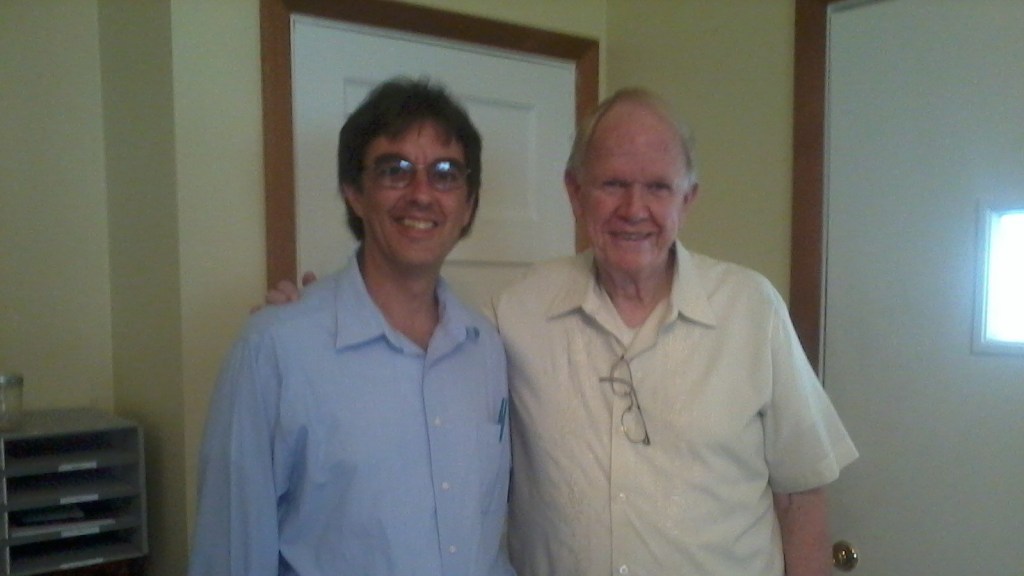
Photo: Friend of 30 years, Fr. Ed O’Brien, who taught me to carry the NY Times in one hand and the Bible in the other.

Link for the Mass readings for Sunday, October 18, 2020

Denying the Holy Spirit cuts us off from the love of God.

“Everyone who speaks a word against the Son of Man will be forgiven, but the one who blasphemes against the Holy Spirit will not be forgiven” (Luke 12:10).
This verse is often referred to as the “unforgivable sin” and it can be difficult to understand. Also, if you have been reading this blog regularly you may have read more than once my writing that God forgives us more than we can ever mess up, so, how is it that we can’t we be forgiven for blaspheming the Holy Spirit?
A story that I shared in yesterday’s reflection may help. When I was a junior or senior in high school, one of my teachers commented that if we thought Stephen King wrote amazing tales, then we might find reading the book of Revelation from the Bible interesting. This was a public school mind you. As a big fan of Stephen King, that phrase stayed with me, and a few weeks later, I purchased a King James Bible from our local bookstore, Waldens, which I am not sure exists anymore. I don’t remember if I read it at all, I must have thumbed through it a time or two, but then placed in on a shelf, presumably with my a copy of The Stand.
A month or two passed and I remember being at a party and not having much fun, so I left. When I arrived home I had the urge to open my newly purchased Bible and when I did my eyes found not the words from the author of Revelation but Luke. He shared: “Do not be afraid. You are worth more than many sparrows” (Lk 12:7). After reading the section leading up to this verse, I felt God saying to me that I would not ever win the lottery, but like the sparrows, he would take care of me providing me the opportunity and the ability to work. He has continued to be true to his word through all the ups and downs of my fifty-five years so far. These beginning stepping stones have led to others that would ultimately pave the way to me typing these words to you today. Because of each successive yes to the invitation and guidance of the Holy Spirit, and confessing those times that I did not, I placed myself in a better position each time to recognize and hear the word of God.
Now, that experience could have taken a different turn. I could have resisted the initial curiosity that welled up within me from my teacher’s discussion and instead of going out to purchase a Bible, I could have stayed home that day and opened up my copy of The Stand and given it a second read. Thus denying that invitation of the Holy Spirit, I would not have had a Bible when I went to that party. I could have followed through on the first urging to purchase a Bible but then resisted the second urge to leave the party. Choosing to ignore either or both promptings would have led to a higher probability of my not hearing God’s voice that night. Say each step did happen up to and including hearing God’s voice but then I denied that I heard God, instead attributing the experience to some bad pepperoni pizza from the party. Each one is an example of how I could have closed myself off to God’s communications.
God invites us to share in his life in a myriad of ways. With each invitation, no matter how small, we can say yes, or we can dismiss these “encounters” as mere “coincidences.” With each denial, we further limit ourselves to the possibility of acknowledging an encounter with God, even begin to doubt and/or come to a place of denying that he even exists. We could then develop “a mentality which obstinately sets the mind against the Spirit of God, and as long as that obstinate mindset perdures, God’s forgiveness cannot be accorded to such a person” (Fitzmeyer 1985, 964).
God loves us more than we can ever mess up, so much so, that he gives us the freedom to reject him. He does not impose his will upon us. John the Baptist and Jesus got this, and this is why their emphasis on repentance was so preeminent in their preaching. If we turn to God with humility and contrition, true sorrow for our sins, God will forgive us and we will receive his healing touch.
The danger of a consistent and obstinate disposition is that like a muscle that is not used, it will atrophy, and so will our ability to see God working in our lives. We will become less and less able to notice his gentle stirrings and invitations. We will become spiritually blind and our hearts will become hardened. Now that does not mean God stops communicating. He continues to reach out to us in an infinite number of ways, but we are less and less able to receive the forgiveness he so thirsts to give us when we close off ourselves to even the mere possibility of him doing so.
Jesus, in becoming one with us so that we can become one with him, opened up the opportunity for us to experience the Holy Spirit, who is the Love that is shared between himself and God. The more we say yes to his guidance and leading, the more we will experience him, the more we will begin to recognize his voice, and the more we will participate in his forgiveness and love. I don’t believe in coincidences, but God-incidences!
_________________________
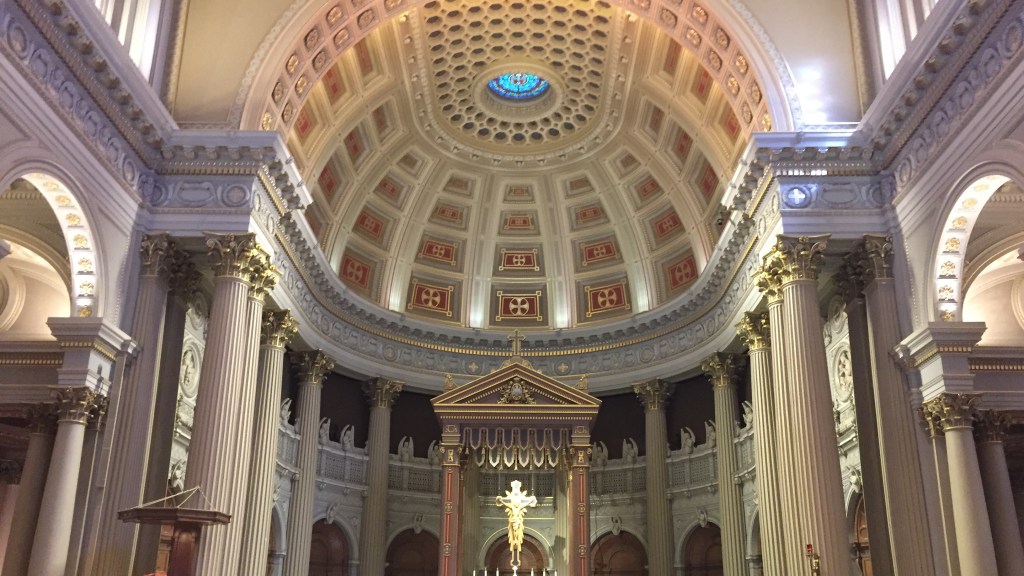
Photo: The dome in the apse of St Ignatius Church in San Francisco. “Come Holy Spirit, fill the hearts of the faithful and kindle in them the fire of your love. Send forth your Spirit and they shall be created. And you shall renew the face of the earth.”
Fitzmeyer, Joseph A. The Gospel According to Luke X-XXIV in the Anchor Bible. NY: Double Day, 1985.
Link for the Mass readings for Saturday, October 17, 2020

Not even the sparrows escape the notice of God.

“Are not five sparrows sold for two small coins? Yet not one of them has escaped the notice of God. Even the hairs of your head have all been counted. Do not be afraid. You are worth more than many sparrows” (Lk 12:6-7).
Some thirty-five plus years ago I was in high school and either in my junior or senior sociology or psychology class, my teacher mentioned that if we thought Stephen King told amazing tales, we should definitely read the Bible. He keyed in especially on the imagery expressed in the Book of Revelation. My teacher’s comment piqued my interest because at the time I enjoyed reading Stephen King, though I had not spent any time reading the Bible. My teacher’s words stayed with me beyond that class period.
A few weeks or months later I remember going to Waldens, a bookstore, at the Enfield Mall in the next town over from where I grew up in East Windsor, Connecticut. I purchased a King James Bible. I don’t remember reading it right away, but shortly sometime after, I do remember leaving a party. I don’t remember anything about the party or why I left, but when I arrived home, I remember going up to my room and for some reason grasping my new Bible. I then just opened it at random and began reading. The verse above was what I read, and it was the first time I can remember experiencing God speaking to me.
It was not a booming voice emanating from the burning bush that was directed to Moses, the room didn’t shake, nor did the lights flicker. Yet, in that quiet and still moment, I heard in my mind, “You will not ever win the lottery, but like the sparrows, I will take care of you. I will always give you the ability and means to work.” God has proven true to his word. I have not won the mega millions, but God has provided me with the opportunity to have regular, gainful employment and even though experiencing some tight financial times through the years, God has provided beyond work through the kindness of friends, families, as well as some amazing assistance outside of the norm at times.
Does God still speak to us as he spoke to the people in the Bible? Absolutely! God does speak to us directly, he also speaks to us through his Word in our personal reading, in our time of communal worship, and through preaching. He also speaks to us through music, art, movies, through others, through our serving each other, through his creation, and a myriad of other infinite possibilities.
The question is not so much, does God still speak to us? The question is how do we open ourselves up to the reality that we can hear his words or his silence? One way is to ask God to help us to recognize his voice, just as the sheep that come to learn the shepherd’s voice. Another way is to stop and be still. Doing so gives us the opportunity for reflection, to ask God to reveal times in the past where he has spoken and we were not aware. When we examine and reflect on our day, with God’s help we can see where God has been with us and reaching out to us.
Not only do we need to make a consistent time each day to pray but we need to stay long enough to listen! One of the biggest reasons many of us do not hear God is because we are not listening or we don’t make the time to stop. God’s silence is also a profound answer. There are many people that may want to give us advice, to offer solutions to fix our problems, when sometimes, we just need to stop, slow down, and be still. Are we willing to be open and believe that God speaks to us, and guides us? Fr. Jim Martin, S.J. has expressed the search for finding God in this way: “God is always inviting us to encounter the transcendent in the everyday, the key is noticing” (Martin 2010, 86).
God knows us better than we know ourselves, he loves us more than we can ever imagine. Let us be a little more aware today than we were yesterday, and may we have eyes, ears, and minds open to notice God working in our lives. Our Loving God and Father cares for and provides for us as he does the sparrows. Are we willing to answer his invitation to spend time with him and to listen for his word or his silence?
————————————————————
Photo by Tejas Prajapati from Pexels
Martin, S.J., James. The Jesuit Guide to Almost Everything: A Spirituality for Real Life. NY: Harper Collins, 2010.
Link for the Mass readings for Friday, October 16, 2020