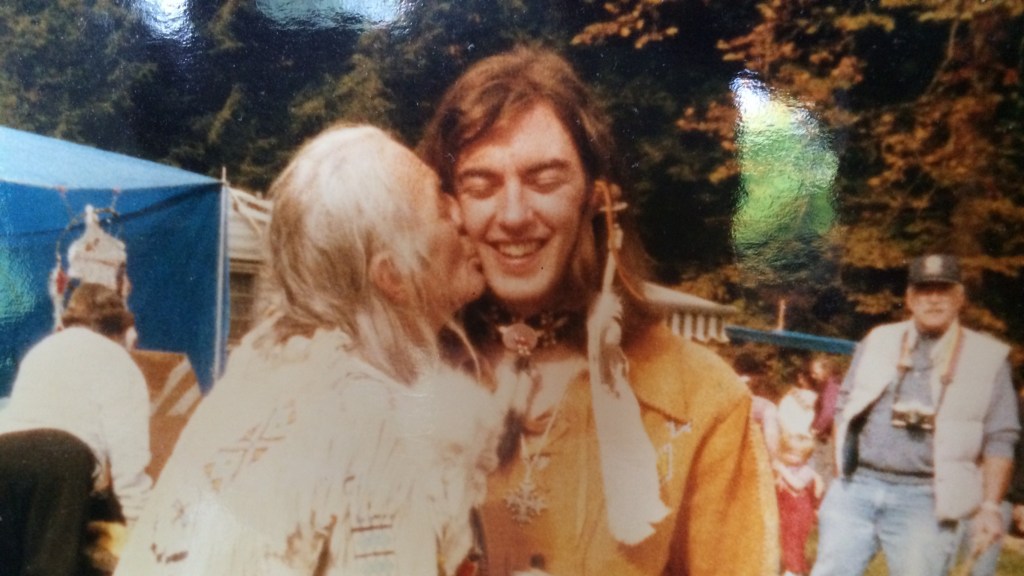
Attached to the vine, we will mature and bear the fruits of compassion, kindness, and love.
In today’s Gospel reading, we experience the imagery of the vine and the branches. As the branch of the vine matures, it begins to look more like the vine itself. As it remains connected, is sustained by the nourishment provided, and protected by the vine grower, the branches become more and more conformed to the vine. This is also true in the event that a branch not originally attached to the vine is grafted to it. Over time, the branches are almost indistinguishable from the vine itself.
Our hope, as disciples of Jesus, no matter what our background, culture, gender, ethnicity, or race will be the same. We are to be one as the Son and the Father are one. As St Paul has written to the Churches in Galatia and Collosse: In Christ there is neither Jew or Greek, circumcision or uncircumcision, male or female, barbarian, Scythian, slave or free because we are all one in Christ (cf. Galatians 3:28, Colossians 3:11).
We are not to be automatons, cyborg, ants, all following mindlessly. Being a Christian means the opposite, the more we are conformed to Jesus, the more we come to know him and also to really come to know our self. We begin to let go of the pressures to conform to that which stunts our growth and begin to embrace who we are, the truth of our reality and dignity. That sense of being fully who we are that sometimes just wants to burst out is allowed to be free when we die to our false self and live in Christ.
We must resist turning in upon ourselves, for when we do so, we disconnect ourselves from the vine, from the very source of our life. Just as the body will suffer without water regularly, so our soul will suffer if we are separated from the living spring of our sustenance. Remaining attached to Jesus, the vine, means that we will mature and live our life to the full, with joy that reaches out beyond ourselves to serving the needs of others, thus bearing fruit to share.
We can bear fruit that will last today and all days by putting the words of St Paul into action: “Put on then, as God’s chosen ones, holy and beloved, heartfelt compassion, kindness, humility, gentleness, and patience, bearing with one another and forgiving one another, if one has a grievance against another; as the Lord has forgiven you, so must you also do. And over all these put on love, that is, the bond of perfection. And let the peace of Christ control your hearts, the peace into which you were also called in one body. And be thankful” (Colossians 3:12-15).
————————————————————-
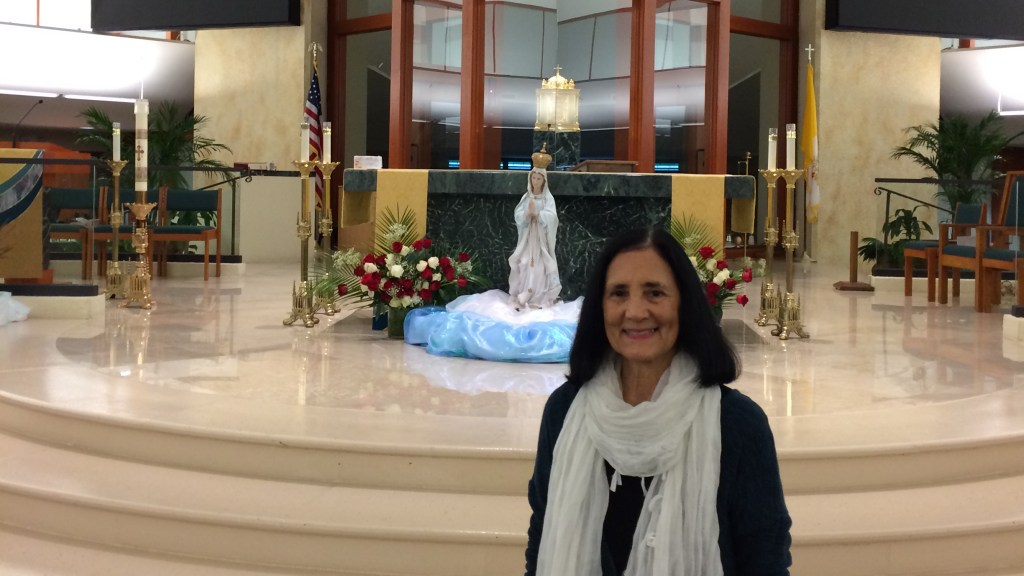
Photo: Two models of compassion, kindness, and love – Mary and JoAnn – Memorial of Our Lady of Fatima, May 13, 2018. Our Lady of Fatima on your feast day, pray for us!
Link for the Mass readings for Wednesday, May 13, 2020
Receive the gift of Jesus’ peace and share it, person, to person.
Have you ever wondered why there is so much violence? How many countries, including our own, were founded on taking of lands by force and oppression of aboriginal peoples? Has there ever been a time without war? How many of our youth and citizens die from gun violence and mass murders? So many examples of road rage, domestic abuse, human trafficking, terrorism – foreign and domestic, and the myriad of random acts of violence that are occurring daily?
We often hear goodwill speeches, petitions, and intercessions ringing from our pulpits and prayer groups, participate and see people march, and vote for change. There are those working in the trenches, putting their own lives at risk, matching their words and their deeds, yet do any of these efforts make a difference? And now for the past few months, we are overshadowed by a pandemic.
Amidst our own experiences, directly and indirectly, and with the constant temptation of cynicism and despair biting at our heels, the words of Jesus are proclaimed in today’s Gospel from John: “Peace I leave with you; my peace I give to you” (Jn 14:27).
The peace that surpasses all understanding, the peace that is not of this world, has been and continues to be offered to us as a gift. Many have indeed said, “If there is a God, well then, why doesn’t he do anything?” He has. The reality is, the peace that God shares through his Son, is one person at a time. This is why when he resurrected he only appeared to those he chose and not the whole world. Even if he had, these experiences, in time, would have been attributed to mere myth and legend. Jesus must be encountered and his relationship is built with each person in each generation. What we pass on as disciples, as we encounter and build a relationship with him for ourselves, are the ways for others to open their hearts and minds to receive him and enter into their own relationship with Jesus, to accept the gift of his grace that he offers.
The peace that Jesus offers is not some abstract formula, the command to love is not some pie in the sky universal love for all. The acts of peace and love Jesus shares throughout the Gospel are very concrete, individual, and personal. Jesus interacts with people as people, not as numbers. He interacts and directs us to do the same, by encountering, accompanying, and loving a person. The real question is not why isn’t God doing anything? The real question is why have we left the gift of his peace that he has given us unwrapped?
If we want peace, our heart and mind must be open to receive it, to embrace, and to live it in the most minute of details. We also need to have the room to receive it so we must be willing to let go of our weapons of hate, prejudice, cynicism, racism, paternalism, and the like. God created us as beings who are interconnected, which means that what one does affects all, for the sun rises and sets on the good and the bad alike.
If we want peace, we need to be more aware and mindful of our thoughts, words, actions, and even the expressions of our faces. The thoughts that we feed are the ones that bear fruit in our words and deeds. Figuratively and literally, we need to be willing to “beat our swords into plowshares and our spears into pruning hooks” (cf. Isaiah 2:4).
This verse becomes real in our lives when we disagree with someone, we resist being disagreeable and respect the person. When we make a mistake, we resist beating ourselves up over the process and instead look to learn from our misstep, and begin again. We also need to be willing to offer the same understanding and patience to someone who speaks or acts in a way that gets under our skin.
What we need to decide today, is do we really want to receive the peace that Jesus gives and put it into practice now, with each person we encounter? Can we really bring about world peace? In some abstract form, for all people, for all time, no. What we can do, is choose to respect the dignity of each person we encounter. We can offer a smile, a random act of kindness, an understanding and encouraging ear or word, even to someone who we consider unapproachable, one person at a time.
—————————————————————
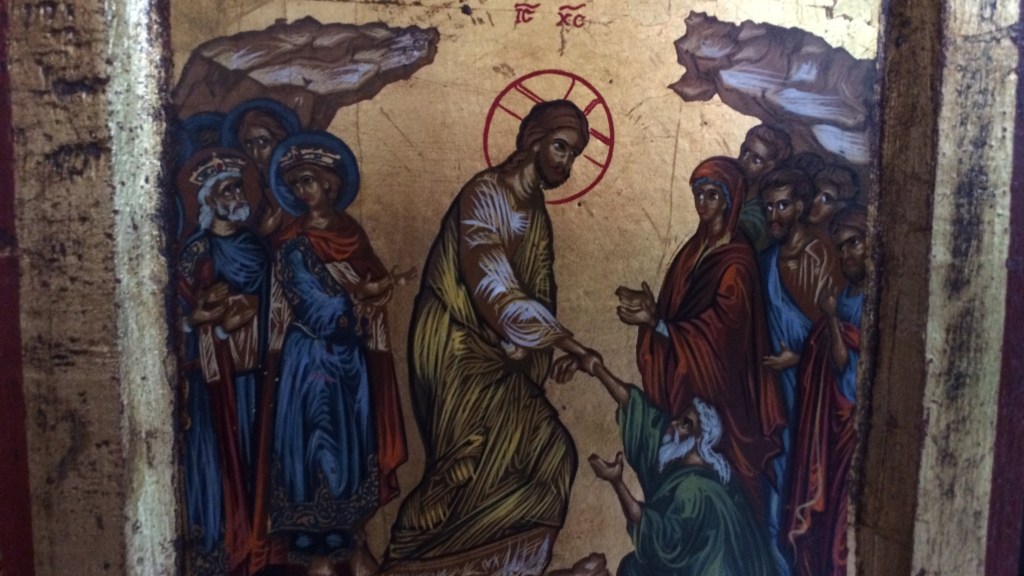
Photo: Of my Eastern Orthodox icon of the Resurrection of Jesus destroying the gates of Hell, and saving our ancestral parents, Adam and Eve, and so us! Do we want to be saved? Do we want his peace? Grasp the hand of Jesus that he extends out to us today, receive his peace that surpasses all understanding, and share it with another!
Link for the Mass reading for Tuesday, May 12, 2020

The balance of commandments and love will give us freedom for excellence.
Two points jump out of the Gospel of John today: commandments and love. How is each one of these related to living life as a disciple? Often, many who hear the word commandments, often react and are immediately put off. There goes the Church again telling me what I can and cannot do. Yet what Jesus is doing is connecting the following of his commandments to being a true expression of loving him.
Love is another word that evokes reactions. One reason is that, even though the English language has a plethora of words to utilize and choose from, there is only one word for love and it is interpreted in many ways. In Ancient Greek, there are four words that are used to connote love. There is eros, which has to do with attraction. It is the beginning stage of love because we are drawn out of ourselves as we are attracted to another. The next word for love is philios, which has to do with friendship. This is the love between friends. If our love matures it moves from attraction or infatuation to friendship. The third word is storge or the deeper love shared with family members. The fourth word is agape, which is unconditional love.
When Jesus shares that we are to follow the commandments, he is not demanding that we do so as a tyrant would. He is providing the boundaries and parameters for us to grow and mature as people who love, who, in the words of St Thomas Aquinas, will the good of the other as other. As humans, we are social beings. We want to belong, to be accepted, and to be a part of. We seek meaning, purpose, and fulfillment in our lives. This is best done through cooperation and collaboration with God and with one another, striving to love unconditionally, agape.
If we operate from a self-centered posture in which we are only turned in upon our self, and we only seek to manipulate and get from others, instead of working for consensus and sharing a common vision with others, we will ultimately be empty with the exchange on any level, because we will be left wanting more. This is true because once the immediacy of the stimulation, whether material or sensual, ends, so does the experience of the feeling. Some happiness may linger from the effect, but we will never be filled or satisfied with finite things. We will continue to seek more and more until the pursuit of instant and constant gratification ensnares us and we are entangled in a web of addiction.
The commandments, grounded in love, are meant to provide boundaries for us, training wheels, and to keep us free from enslavement to sin, while at the same time help us to be persons who move away from being self-centered to maturing to become other-centered instead. Discipline in this way is meant to be a means of freedom for excellence such that we can become who God calls us to be and who we truly desire to be. God is not in competition with us. He is our biggest fan. As St Irenaeus wrote, the glory of God is the human being fully alive!
Commandments and morality imposed without reason or an end goal is a bludgeon. Love and mercy without accountability and justice can be enabling. Jesus provides the blueprint for a balanced both/and approach. May we seek this day for opportunities to be loving guides, to align ourselves with the Holy Spirit, who is the Love expressed and shared between the Father and the Son. May we seek where we can improve our lives so we can be more mindful and whole, to be more honest with our weaknesses, and to seek God when we are tempted and seek forgiveness when we have fallen.
As we journey in this life, we do not do so alone. As we seek to follow Jesus’ lead, as we grow and mature, we do so while in the midst of encountering and forming relationships with others. Conformed by following the commandments, we reach out in love to each other as Jesus has done for us. As we form and deepen relationships, new and old, may we encourage, support, and love one another while at the same time, challenge and hold each other accountable as we strive to be who Jesus invites us to be.
———————————————————–
Photo: Last year’s CN graduates: After three years of religious studies with me, how have they been putting into practice what they have learned in their freshman year at the university level? Anyone want to weigh in?
Link for the Mass readings for Monday, May 11, 2020

“I am in the Father and the Father is in me.”
Philip said to him, “Master, show us the Father, and that will be enough for us.” Jesus said to him, “Have I been with you for so long a time and you still do not know me, Philip” (Jn 14:8-9)?
Again we see the Apostles struggling to understand that Jesus and the Father are one, that Jesus is the Son of God. Jesus attempts to explain again to Philip that whoever sees him sees the Father.
The challenge here is that Philip and Jesus are using the same language but talking from different points of view. When Philip is asking Jesus to show him the Father through physical eyes, he is asking to see God along the lines of Michaelangelo’s Sistine Chapel painting of God. Jesus has been revealing the Father through the spiritual eyes of his works.
God is not finite, he is not a being like we are. He is neither male nor female. We use the term Father because Jesus used it often to speak of him, and thus why we use the pronoun him. But he was using analogous language to create a bridge of understanding for us who are finite, human beings to help us understand better our relationship with our God who is Infinite Act, having no limitation, for his essence and his existence is one and the same. Even though God is beyond any genus, beyond any way for us to classify him, we can still know and experience God.
Jesus shared with Philip that “The Father who dwells in me is doing his works. Believe me that I am in the Father and the Father is in me, or else, believe because of the works themselves” (Jn 14:11).
When Jesus heals, exorcises demons, speaks on his own authority, associates with those on the peripheries, these are just some of the ways he is revealing the Father who dwells within him. In these very acts, he is loving those in his midst, he is willing their good. When Philip and the Apostles believed in Jesus and when we do, we will do the same works that Jesus did, because when we love one another as Jesus loves us, God is present because God is the infinite act of Love.
Speaking of love, sending some love out today to my mother, step-mother, sister, and all mothers today. Happy Mother’s Day!
Photo: Evening walk a few nights ago
Link for the Mass readings for Sunday, May 10, 2020
We are invited to participate in the love of God and share what we receive.
In our reading from the Gospel of John today, Jesus explains to Philip how he and God the Father are one. When Philip asks Jesus to show him the Father, Jesus responds: “Have I been with you for so long a time and you still do not know me, Philip? Whoever has seen me has seen the Father” (Jn 14:9). Even though Philip had lived with Jesus, experienced the authority of his teachings, witnessed his works of healing and exorcism, witnessed to the inclusiveness of his ministry, he, as we, struggle with comprehending what Jesus was talking about regarding the unity between God and Jesus.
One of the reasons is that God is God and we are not. God is not one being among many, he is not even the Supreme Being, nor is God even in the genus of being. God so transcends our reality and sphere of understanding that any words we say about him are going to be limited. God is Infinite Act, God simply is. We are finite. At the same time, this does not mean that God is an impersonal force. God transcends all of his creation and is the source and foundation of all that exists, yet he is closer to us than we are to ourselves, each and every one of us.
God came closer still when, in the Person of his Son, he came to dwell among us. This is what Jesus meant when he said to Philip that when he saw him he saw God. Each person, God the Father and God the Son are distinct but because of their infinite essence they are also, as we say in the Nicene Creed each Sunday, consubstantial, they are of one and the same substance.
The Son came to be one with us while remaining fully divine and in full communion with his Father, so we can be one with him and experience the intimate relationship that they share. We participate in the life of Jesus because he became human, and as human beings, God created each of us as being interconnected with one another. So what happens to one of us, happens to all of us.
Through our Baptism and participation in the Sacraments, we participate and become conformed to the Body of Christ so to encounter Jesus in ever deeper intimacy and share in the divine Communion between God the Father and God the Son, the Love that is shared between them who is God the Holy Spirit.
The wonderful gift of relational communion with the Holy Trinity, is not just for us alone as some treasure to sit on, as some secret knowledge to be shared with only a few chosen ones. This is a universal message to be shared with all. As we grow in our relationship and participation with God, we are to make him known to others. We are able to do so through our participation in the life of Jesus. As Jesus said to Philip, “[W]hoever believes in me will do the works that I do, and will do greater ones than these, because I am going to the Father” (Jn 14:12). Jesus seeks to work, love, and serve through us as the Father did through him.
That may sound intimidating, but each of us is given a particular charism, a ministry of service to build up the kingdom of God. The key is to believe in Jesus and seek his guidance so that he can help us to discern how best we can serve him and build up his Body. Those we call saints were those who came to know that one thing that God called them to do. They then surrendered all to their vocation. This is not just for clergy or religious, this is for each and every person on this planet. The only requirement is that we are willing to follow Jesus, say yes to the invitation to experience the love of the Holy Spirit he freely offers, and be willing to be sent to allow God to happen in our interactions with one another. In so doing, we find meaning and fulfillment in our lives.
Embrace today the reality that the God of all creation loves each and every one of us more than we can ever imagine. Embrace the unique relationship he calls us to participate in, which is a share in his Trinitarian Communion. Embrace this unique blessing so we can open our hearts and minds to the service and ministry he calls us to through our participation in the life of Jesus the Christ, the Son of the Living God, through the Love of the Holy Spirit.
———————————————————-
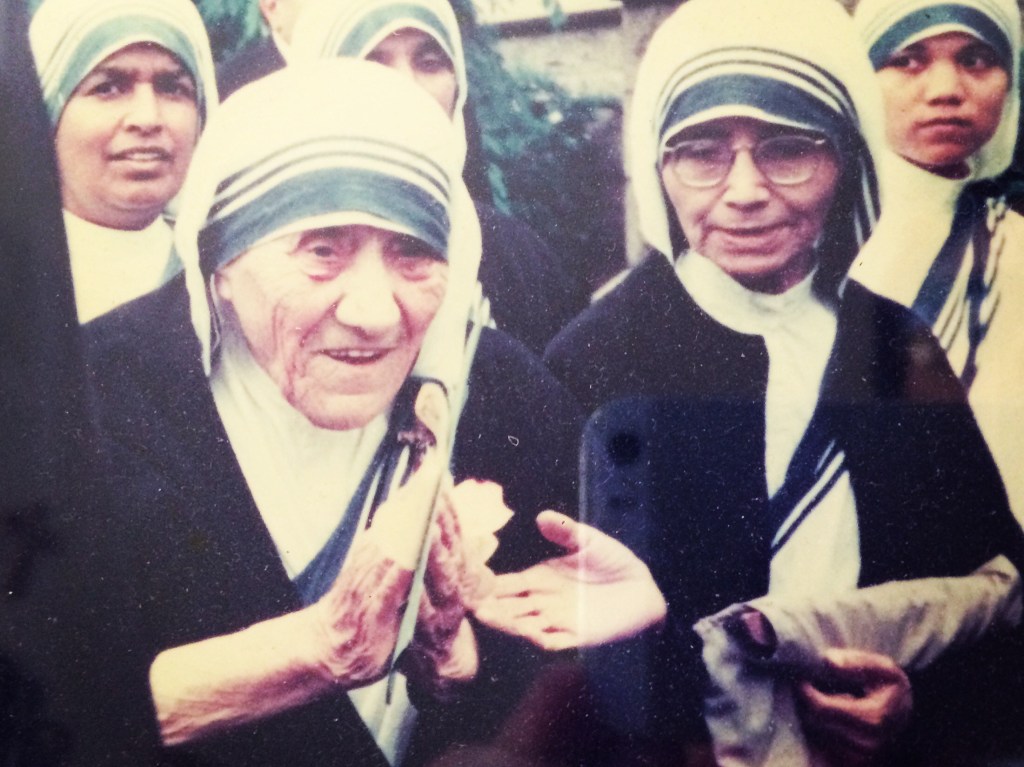
Photo Credit: Photo I took of St Mother Teresa in Massachusetts early 90’s
Link for the Mass reading for Saturday, May 9, 2020.
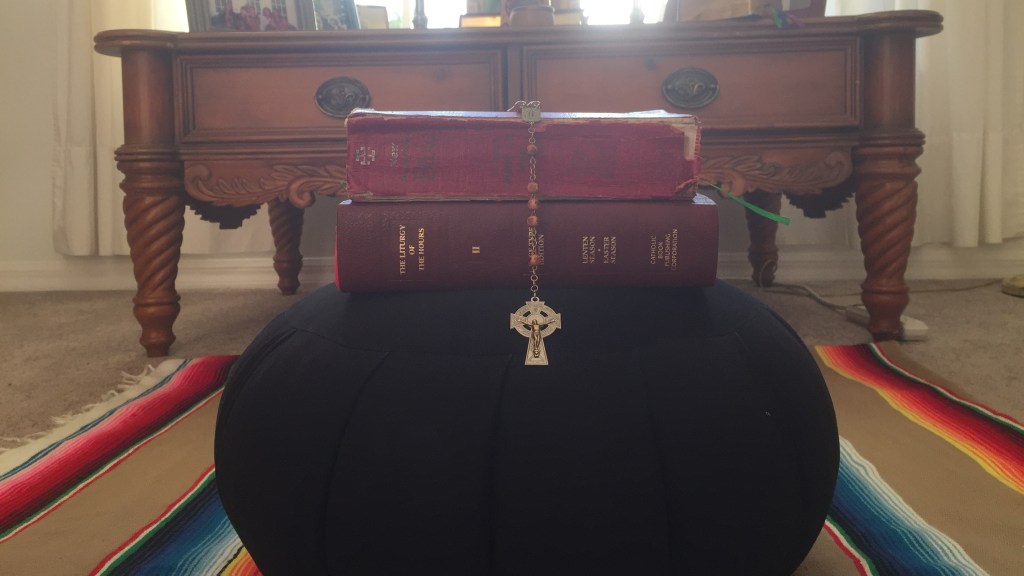
Adrift in troubles or anxiety? Here are some ways to anchor yourself in God.
Our days are so full of activities, conflicts, health issues, technological stimulation, 24/7 news cycles, social media interaction, and mix into all of this, our present pandemic and you have a mix that can lead to our emotional, physical, and spiritual undoing. If we do not have the proper foundation and orientation, we can feel stretched, hollow, and/or fatigued at best. One day can seem to blend into another, and another, and another. The image of being on a hamster wheel or an unending treadmill can fall afresh in our mind’s eye when we actually do take a minute to breathe. Anxiety, worry, stress, fear, prescriptions, and addictions all appear to be on the rise and swirling out of control.
Is there an answer to this hyper pace or are we doomed to just keep going until the wheels fall off? The opening verse in today’s reading provides an antidote when we are feeling any or all of the above.
Jesus said to his disciples: “Do not let your hearts be troubled. You have faith in God; have faith also in me” (Jn 14:1).
We are invited to place our trust in God through his Son, Jesus. By putting them first does not mean that the externals to our life will take an abrupt turn for the better, but what it does mean is that we will have support and divine assistance. It means that we are not alone in our suffering. The disciples found this out when in the midst of a sudden sea squall, taking on water as the waves grew higher they were terrified and so, called to a sleeping Jesus. Jesus awoke and with a word, he calmed the sea (cf. Mk 4:35-41).
Jesus may or may not calm the sea of our trials and tribulations, but what he will do is be present with us through our storms in life and we can trust in him that he will guide us through. As we grow more confident in our trust in Jesus, knowing that no matter who or what comes at us, he will be there to assist us. There will be more peace and calm within – no Prozac or Zoloft required. The ultimate assurance that Jesus provides is that when we surrender our life to him we belong to him, we are not alone or orphaned. He gave his life for us, to redeem and save us so that we can be assured of our home for eternity.
If we are struggling at any level and are seeking to build our trust and faith in Jesus, we do need to realize that this takes time. We need to daily ask Jesus for help, seek his discernment about where we can make changes in our life, and make periodic efforts to stop in our day to be still. This time does not need to be lengthy, three to five minutes to start can do wonders. On the surface level, by stopping for five minutes to pray and breathe more deeply and consciously, we get off the wheel, we step out of survival and reaction mode, so we can then make more mindful decisions, and we can come to see that we truly have options, but more importantly, we begin to develop a relationship and intimacy with Jesus so to begin to recognize his voice that is calling out to guide us.
For me, the Liturgy of the Hours has been my anchor, and since my time in California, I have also included meditation in the morning and evening as well. I stop to pray throughout the day, some days are better than others, some days are less rushed than others, but each day I make the time. There have been days, especially since we have begun distance learning, that I have had so much to do that I have wondered if taking the time to pray and meditate was really the most sensible choice, and time and again it has been.
The Rosary is also a great way to get into God’s word by meditating on the mysteries of the life of Jesus. If you are not able to pray the whole Rosary in one sitting, periodically pray a decade at key points throughout the day, first thing in the morning, mid-morning, mid-day, afternoon, and evening. You may start with just one decade a day.
Read for a few minutes from the Bible once in the morning and then return to meditate on the same verse or verses that touch or challenge you throughout the day. You can also read the daily Mass readings each day and place your self in the scene as if you were actually there.
Each of these practices helps to bring the Word of God alive. They are just a few of the many ways to stop the madness and to connect with the power, the love, and the grace that Jesus yearns to share with us so we may be healed, whole, and more alive. May we trust in him today and each day going forward, for he is “the way and the truth and the life” (Jn 14:6).
—————————————————–
Photo: My prayer anchors for helping me to trust Jesus and put God first in my life each day
Link for the Mass readings for Friday, May 8, 2020

Are we ready and willing to serve no matter the task?
Today’s Gospel from John begins as Jesus had just finished washing the feet of his disciples. Jesus then said, “Amen, amen, I say to you, no slave is greater than his master nor any messenger greater than the one who sent him” (Jn 13:16). Jesus not only taught the truth that God the Father sent his Son to serve and not be served, he modeled this practice consistently.
From his conception, gestation, and birth, the Son of God developed as a human being in the very simplest of conditions and endured the hardships of those on the margins. Joseph, Mary, and Jesus were political refugees very soon after his birth. The young family was forced to flee from Bethlehem to Egypt. When Herod the Great died they returned to Nazareth, and other than the incident in the Temple, we hear nothing about the life of Jesus until he begins his public ministry. The most likely reason for this was that there was nothing to tell. Jesus most likely apprenticed with Joseph, in the trade of a simple tektōn, a woodworker, which was pretty low on the rung of the social ladder.
Through the short time of his ministry, Jesus modeled for his disciples what a follower of his entailed and what it meant to be one of his successors. To follow in his footsteps they would need to participate in servant leadership. He not only taught them but lived and modeled that there is no task too menial that we can’t roll up our sleeves and dive in to help. There is no person too other that we can’t assist when they are in a need.
A good prayer and meditation for us today is to ask Jesus to reveal for us how we have resisted his urgings in the past regarding serving others as well as when we have refused to interact or treat someone with anything less than the basic human dignity which they deserved. Have we ever thought that what he was asking of us was beneath us? Have there been people we have kept at arm’s length or refused to reach out to? For those ways in which we have withdrawn within ourselves and refused to be of help may we ask for his forgiveness.
Being willing to allow Jesus to shed some light on our lack of embracing opportunities to serve is a good place to begin. Renewed with his forgiveness and healing touch, may we be more willing to be bearers of his understanding, grace and mercy which we have received. May we be more open to each of the people and/or tasks that God will place before us, the discernment to know his will, and the clarity and courage to act as his servant with humility and without hesitation.
—————————————————————————-
Photo: Grounds work during my novitiate year with the Franciscans in Brookline, MA around 1992.
Link for the Mass reading for Thursday, May 7, 2020
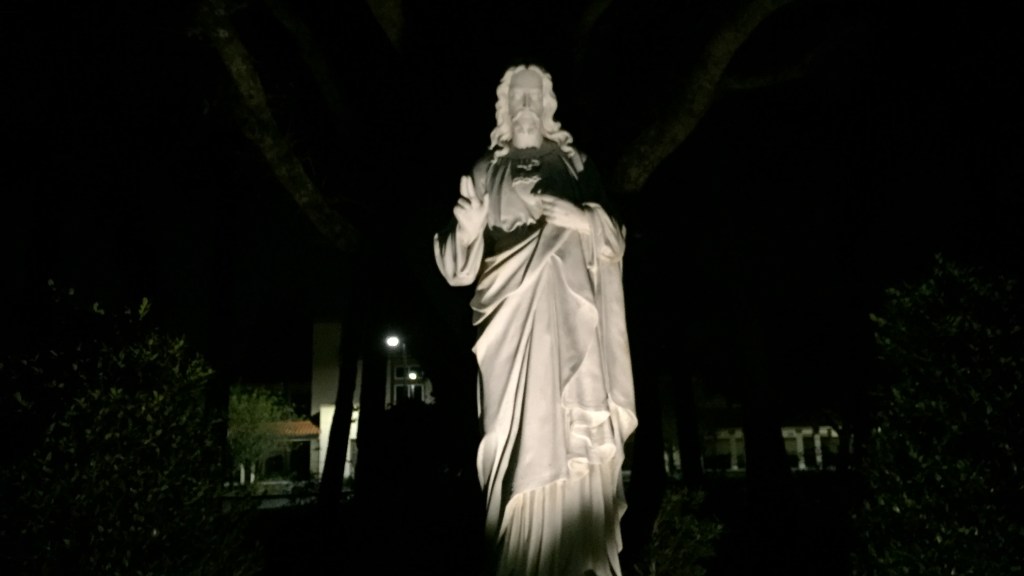
Jesus, our light, exposes our darkness.
“I came into the world as light, so that everyone who believes in me might not remain in darkness” (Jn 12:46).
What might be the darkness that Jesus refers to? It could be anything that turns us within ourselves, away from that which is True, Good, and Beautiful. This can be prejudice, ignorance, cynicism, sin, violence, hatred, war, division, dehumanization, and the list can go on.
A major root that keeps us in this darkness is fear. Jesus offers us the light of his Father. He encourages us to leave our self imposed imprisonment by loving us as we are, more than we can imagine, and more than we can ever mess up. Christianity is not just a set of moral principles, a set of doctrines, a philosophy, or a theology. Christianity is about an encounter with a person, the Son of God, Jesus the Christ.
The light of Jesus leads us and invites us to experience that which we have been created and are restless for – an intimate relationship with God the Father and each other. Through the light of his love, Jesus reveals to us those apparent goods, false substitutes, and idols that distract us and keep us separated from deepening our relationship with God. We come to know God when we are willing to receive the love of the Holy Spirit and are moved to share that love with each other.
Jesus, today, help us to resist any selfish impulse or reaction based on fear and guide us instead to love as you have loved us. Even in quarantine or from a distance, we can still smile, be aware and offer to be of help, reach out to someone and be present and willing to listen, and/or choosing to be more understanding, supportive, and encouraging. In these small ways, we allow the light of Jesus to shine in and through our lives outward toward others and the darkness will not overcome it!
Photo: Sacred Heart of Jesus statue on the grounds of St Peter Catholic Church, Jupiter FL
Link for the Mass readings for Wednesday, May 6, 2020
 Spiritual Stepping Stones