

When we say, “Lord, Lord!” Will Jesus know who we are?
Jesus said to his disciples: “Not everyone who says to me, ‘Lord, Lord,’ will enter the Kingdom of heaven, but only the one who does the will of my Father in heaven” (Mt 7:21).
I have written quite often, paraphrasing one of my favorite quotes from St. Irenaeus, that Jesus came to be one with us so that we can be one with him and that his invitation is for everyone, no one is excluded. You may be thinking, readying to write a response, or muttering under your breath that, “If everyone is invited, how can Jesus say that not everyone will enter the Kingdom of heaven?”
The answer to that question is in the line that follows. The one who will enter heaven is, “the one who does the will of my Father in heaven.” If this verse does not help, then it might be helpful to understand a little about heaven, as best as we can as, the mere mortal, finite beings that we are.
Heaven is not so much a place but a state of being in relation to God. Heaven is the state of being in which we are privileged to share communion, a deeper intimacy with God for all eternity. We will still not know everything about God because God is infinite and we will still be finite in heaven. God is without limit, we are limited. We will never exhaust our relationship, never get bored with God.
Maybe a more three dimensional, earthly example may be of help. If we were invited to play a sport, an instrument, or to act in a play, with the end goal being that we would play in the upcoming game, concert, or performance, we might feel pretty excited about the offer. We tell the coach, conductor, or director “That’s great news!” Yet, in the days that follow, we do not attend any of the practices, we do not practice the skills required to play the position, instrument, or role and we don’t return any of the follow up invitations by phone, email, or text. The day of the big game, concert, or performance comes, we gather our self together and head on over to the arena or hall. We arrive to see the coach, conductor, or director but are denied entrance. You might say, “I don’t understand, you invited me to play!” The reply is, “Not everyone who says to me coach, coach (conductor, conductor, or director, director) is ready and prepared.”
Jesus indeed invites us to be in relationship with him, yes everyone. Some say yes and some say no. Some say yes, and then don’t do anything, some say yes and do some things, some say yes and dive in. Most of us take a few steps forward and a step or two back. Just like preparing to play in the big game or perform in the big concert, or play, we need to be committed, disciplined, and persistent with our faith life. Unlike a missed opportunity to participate in a game or performance, that we can correct and make another attempt down the road, we don’t want to miss the opportunity to spend eternity with Jesus in heaven.
The above analogy does not imply in any way that we earn our way to heaven, or we can do so on our own effort and will power. The bottom line is that Jesus gave his life for all of us and through his grace we have been saved. This is a free gift. Yet, we have to be willing to receive and open the gift. Our time here on earth is time we are given to work out our salvation and be about building a relationship with Jesus, being conformed to him, so that we can come to know his Father as he does.
If we want to know God’s will, we need to come to know God. Advent is a time of preparation, to place ourselves in a position before God so we can come to know him and his will. Jesus helps us to recognize that we are off the target when we attempt to conform God’s will to our small reality. Instead we need to reorient ourselves such that we allow our minds and hearts to be opened by his love.
This happens when we are quiet and still, through prayer, spending time in his word, spending time in worship and fellowship, and in doing so we will be more open to be led by the Holy Spirit to step out of our comfort zone and reach out to others in an act of service for another’s sake and not just our own. For we are here not only to actualize the grace we have been given for our salvation, we are to help others to do the same.
——————————————————————————
Photo: Icon, “Lakota Jesus and children”, by Fr. John Giuliani
Link for the Mass reading for Thursday, December 6, 2018: http://www.usccb.org/bible/readings/120618.cfm

Let us experience the unlimited supply of God’s love, grace, and mercy
“Jesus walked by the Sea of Galilee, went up on the mountain, and sat down there. Great crowds came to him, having with them the lame, the blind, the deformed, the mute, and many others. They placed them at his feet, and he cured them” (Mt 15:29-30).
There is a key yet subtle point before Jesus began to heal that might be missed. Before great crowds came to him, Jesus “went up on the mountain, and sat down there.” This is no insignificant sentence. The posture of sitting on the mountain would have been recognized right away by the people of Jesus’ time. This was the posture of the teacher and sitting on the mountain a reference to Moses. Prior to the healing in this setting, as he did throughout the Gospels, Jesus most likely taught about the reign of God. In fact time and again, Jesus’ “works of healing took place in this context of his preaching of the kingdom of God” (Lohfink 2014, 58).
A great multitude of people came to Jesus to hear his message and also with a full range of needs. Jesus made himself available, restored, and healed those who were brought to him. He encountered them as they were in their present condition of need. There is no record in this Gospel account that Jesus asked for any identification, that he discussed their belief system before healing them, nor did he ask if they were Jewish or Gentile, and nowhere in this account did Jesus deny anyone who came to him. The response of those to being healed and restored was that “they glorified the God of Israel“. This is because, “where God is master, there is salvation and healing” (Lohfink 2014, 62).
These recorded accounts of mass healings, are but a foretaste of the heavenly realm of eternal communion with the Father. Jesus is the kingdom of heaven at hand, for as St Irenaeus wrote, “Jesus opened up heaven for us in the humanity he assumed.” Jesus though was not done. The whole process took some time, which is probably an understatement, and as people were getting ready to leave, Jesus showed compassion yet again. He sought the assistance of the disciples because he did not want to send the people away hungry.
The disciples of course are taken aback because of the reality of the undertaking Jesus proposed. Jesus asked what they had with them and they shared just some bread and fish. Jesus took “the seven loaves and the fish, gave thanks, broke the loaves, and gave them to the disciples, who in turn gave them to the crowds. They all ate and were satisfied. They picked up the fragments left over–seven baskets full” (Mt 15:36-37).
This Advent let us surrender our will to God. May we pray with and meditate on the Gospels such that they become relevant in our lives, so we can serve God as Jesus did. Not stopping to ask for identification, religion, race, gender, creed, or political affiliation, but to see each person before us as a human being with dignity and worth.
Let us also not be dismayed with how little we might have, but let us give what we do have to Jesus in solidarity for his purpose, as did the disciples with the seven loaves and fish, so to experience with those we serve, the abundance, love, and grace of our loving God and Father.
—————————————————————————
Photo by David Bartus from Pexels
Lohfink, Gerhard. No Irrelevant Jesus: On Jesus and the Church Today. Collegeville, MN: Liturgical Press, 2014.
Link for the Mass readings for Wednesday, December 5, 2018: http://www.usccb.org/bible/readings/120518.cfm

Advent, a time to again embrace the wonder of God.
“All things have been handed over to me by my Father. No one knows who the Son is except the Father, and who the Father is except the Son and anyone to whom the Son wishes to reveal him” (Lk 10:22).
God the Father knows God the Son and God the Son knows God the Father. They do not just know about each other, they know each other with a deep intimacy that is far beyond our human comprehension. Contemplating this reality can fill us with hope especially when we come to realize that Jesus is the Son of God who has come into our lives so that we can participate in the trinitarian communion of the Father and the Son and the love shared between them, the Holy Spirit!
Jesus has come as an agent of reconciliation, to restore our relationship with God, to undo the effects of the sin of separation that has so ruptured and wounded our relationship with God our Father. This is our hope this Advent, that we can come not just to a better understanding about God, but to intimately know and restore our relationship with God through our participation in the life of his Son.
Advent provides us this wonderful opportunity of a season to remember that Jesus, the Son of God came to be with us in time, and in history, as well as a time to prepare for his coming again. While at the same time, Advent is a time to prepare each day to open our heart and mind to Jesus who wants to rekindle our relationship with God the Father, who knit us together in our mother’s womb, who knows us better than we know ourselves!
May the Advent season not get away from us before it even starts because of the material, commercial, and busyness that threatens to take over. A good practice is to embrace the wonder of God’s creation, to enter into its natural rhythm, the wonder and vast expanse of it all.
This morning before dawn I saw the crescent moon rising near Venus in the eastern sky. Last night, JoAnn and I enjoyed a walk together at sunset. All of creation echoes the wonder and adoration of the gift that the season of Advent offers: the wonder of wonders is that Jesus comes to us each day to invite us to participate in a deeper walk with his Father, the creator of heaven and earth.
———————————————————————————–
Photo of buffalo I took while driving in South Dakota in between Pine Ridge and Rosebud reservations around 1990 – a moment of quiet wonder, God’s creation on full display as the buffalo appeared to be walking right out of the sun.
Link for the Mass readings for Tuesday, December 4, 2018: http://www.usccb.org/bible/readings/120418.cfm
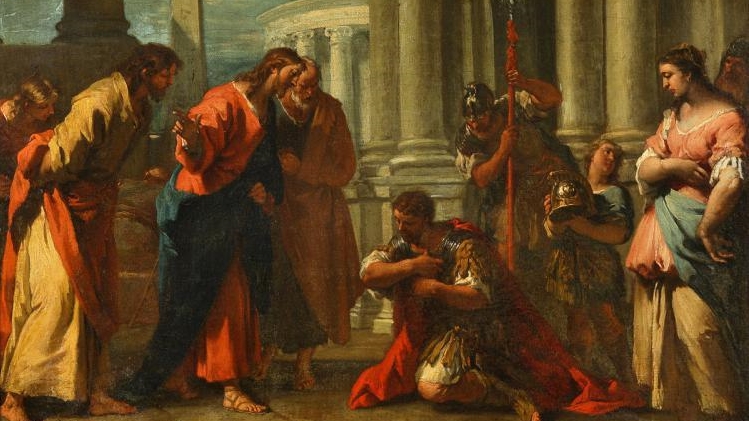
What can a centurion teach us today?
“Amen, I say to you, in no one in Israel have I found such faith. I say to you, many will come from the east and the west, and will recline with Abraham, Isaac, and Jacob at the banquet in the Kingdom of heaven” (Mt 8:10-13).
The one to whom Jesus is referring to is a Roman centurion who approached Jesus seeking healing for his servant. I imagine that Jesus was not only amazed with the man’s humility, recognizing his sinfulness, not only that he believed that Jesus could heal from a distance with simply his word, but also that he was aware of the need and suffering of his slave and willingness to do something about it. This Roman centurion, an occupying presence in Israel, clearly embodied the teachings of Jesus! It is from the centurion’s words that we speak before receiving Jesus in the Eucharist during each Mass: “Lord, I am not worthy that you should enter under my roof, but only say the word and I shall be healed.”
The chosen people of Israel, were called not to be saved in and of themselves alone, but to be a light to the nations. As Isaiah said, all nations shall stream toward mount Zion and “from Zion shall go forth instruction, and the word of the LORD from Jerusalem” (see Isaiah 2:1-5). Jesus echoes Isaiah’s prophetic words as is recorded in today’s Gospel: “Amen, I say to you, in no one in Israel have I found such faith. I say to you, many will come from the east and the west, and will recline with Abraham, Isaac, and Jacob at the banquet in the Kingdom of heaven” (Mt 8:11). The centurion’s act of faith is the beginning movement, like a drop of water that is the beginning of a waterfall.
The first point we can learn from the centurion is that he was aware of the need of his slave. The slave, in the present culture of Jesus and the centurion held no dignity, yet, he was not invisible to the centurion. The centurion was not indifferent to his suffering and pain. We also need to be aware of those who are in need among us. We need to resist the temptation to walk around, over, or by others that are different in any way. We need to embrace the gift of our diversity, not stiff arm and keep those who are different at arm’s length.
Second, like the centurion, we need to embrace humility and acknowledge our own sinfulness, and when we do so, we are better able to see other’s needs. None of us are perfect. No one person is above any other. We all have gifts as well as shortcomings. We need each other because we complement one another. When we engage in dialogue and cooperation we are stronger.
Third we cannot stand on our own. The centurion recognized his limitations. He acknowledged that he needed help. He needed Jesus. As do we. We cannot accomplish our salvation on our own merit or will power. We need a savior, for apart from Jesus, who we prepare to encounter this Advent season, we can do nothing, but with Jesus all things are possible.
Jesus is the Truth and the Fulfillment that we seek. He has sent out a universal invitation of communion for all, to Israel first and then to all from east and west, north and south. Our yes comes in the form of the Roman Centurion who recognized his own sinfulness, acknowledged it before Jesus, was aware of his need for help for the healing of his slave and moved to seek aid when he knew he was helpless. The centurion had faith and hope in the one who would provide healing.
This Advent may we take time to examine our conscience, have the humility to confess our sins, to acknowledge that we need help from Jesus and others. May we be willing to seek forgiveness and be willing to forgive. May we be willing to resist the temptation to embrace fear and close ourselves off and be indifferent to the plight and needs of others, but instead assume a posture of openness to the gift of the rich diversity of our humanity.
We have so much to offer one another when we are willing to work together instead of apart from or against one another. May we who have received the forgiveness and grace of Jesus and felt the embrace of his love, reach out to provide hope and to empower those who have been dehumanized, kept apart, or labeled as other.
——————————————————————-
Painting: Sebastiano Ricci – Christ Heals the Centurion’s Servant, 1726-1729
Link for the Mass readings for Monday, December 3, 2018: http://www.usccb.org/bible/readings/120318.cfm

Just as night gives way to day, may we be vigilant, watch and pray.
As the earth turned again one more time on its axis last night, and the shadows began to fall, night slowly crept over each part of our planet. Our sacred text, our sacred word, is not only written in the Bible, but the finger of God has traced his word across all of the earth, the galaxy, the universe, the whole of the created order, for God continues to write his love song. The ground, foundation, and source of creation and our very being is the outpouring of the Trinitarian Love expressed between God the Father, God the Son, and God the Holy Spirit.
As the sun appeared to us to set, and night gently made its way across our minuscule earth in this part of the Milky Way last night, the vigil began and so also the beginning of the new liturgical year and the season of Advent. We heard or will hear again today the words of Jesus to his disciples in today’s Gospel for the first Sunday of Advent: “Be vigilant at all times and pray that you have the strength to escape the tribulations that are imminent and to stand before the Son of Man” (Lk 21:36).
Traditionally, the readings of the first two weeks of Advent focus on our watching for the second coming of Jesus. We are to watch and pray, two words that may challenge many of us who instead are too busy and in a tense posture ready to react. But as the daily cycle of day to night and night to day repeats itself, so are we called to enter into a daily rhythm of watching and praying so that we can be more aware and more alert for the signs of his coming, like a watchman standing guard over the city.
During Advent, we also prepare in the final two weeks to remember again the first humble coming of Jesus, the Incarnation, in which the infinite Son of God took on flesh at his miraculous conception in the womb of Mary and became man. Fully God and fully man, Jesus experienced our human condition in the most vulnerable of settings. We are a people of memory, though we often forget, that is why we hear the story again of the simple birth of our savior, who many rejected even then, saying there was no room for him in the inn.
The third way we prepare for the coming of Jesus during Advent is in our everyday experiences. We who have much in the way of material comfort need to remember, how God heard the cry of the poor and saved his people by sending Moses to free them from their bondage in Egypt, he sent them judges and kings to guide them, and he sent his Son to free us from our bondage to the sin of our pride, seeking of fame and celebrity, greed, lust, sloth or acedia, gluttony, despair, and wrath.
May we remember this Advent who we are, whose we are, and who we are called to be: Pope Francis teaches that the Church of Jesus Christ, “is the people of God, and the people of God welcome, love, forgive, and encourage others by how they live” (McCann, 5). As we prepare for Jesus’ second coming and to remember his birth, may we also remember to watch for him in our encounters with those we meet each day, and to spend time in the rhythm of his creation.
We have been created by Love to love. As gently as the night gave way to the morning rays of the sun this morning, may we live and move more gently upon this earth. May our thoughts, actions, and words be filled to overflowing with kindness, compassion, understanding, thanksgiving, and mercy toward those we encounter. May we remember the forgotten, the invisible, the lonely, and dehumanized, may we see Jesus as St. Mother Teresa saw him in the distressing disguise of the poor: the materially poor as well as the spiritually poor, the one hundred percent, who require a savior this Christmas.
————————————————————–
Photo accessed from pexels.com
McCann, Deborah. 30 Days of Reflections and Prayers: What Pope Francis Says About Mercy. New London, CT: Twenty-Third Publications, 2015.
Link to the Mass readings for Sunday, December 2, 2018: http://www.usccb.org/bible/readings/120218.cfm
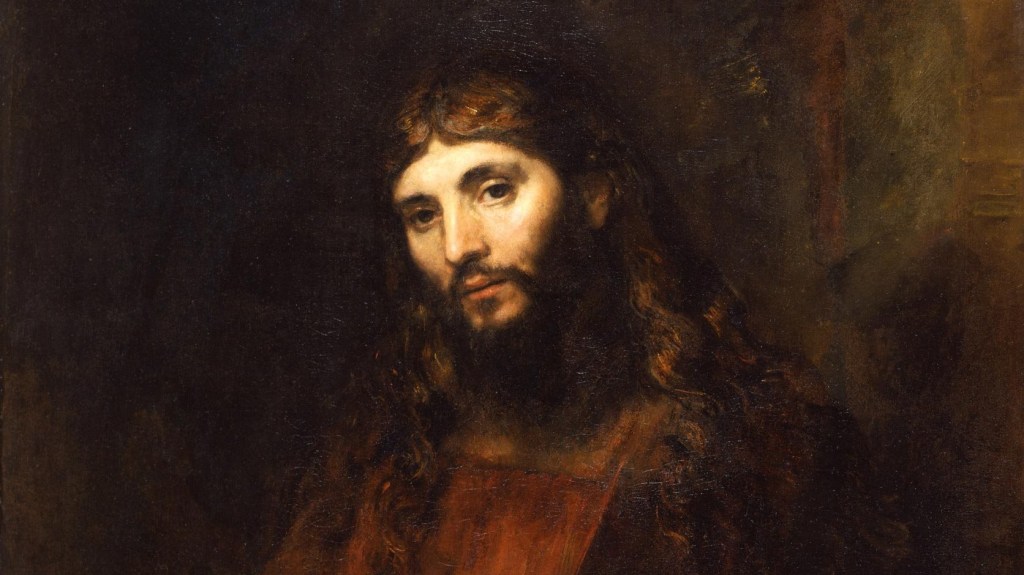
Be vigilant, watch and pray.
“Be vigilant at all times and pray that you have the strength to escape the tribulations that are imminent and to stand before the Son of Man” (21:36).
These are the last words we will hear or read this year from the readings of the Mass. The season of Advent and the new liturgical year begins tonight at the vigil Mass. As I read these words, I thought they are not only good words to end the year with but that they would also be good words to read at the beginning of each day.
“Be vigilant at all times” are certainly words to abide by. This is not a call to be paranoid or to live in fear. This is a call to be aware, to watch and pray. Being vigilant is also a reminder that we need to resist the temptation of speeding through life with blinders on and not taking time to listen to that quiet voice of God that guides us day in and day out. The more we hear the subtle, quiet leading of the Holy Spirit and ignore it, the less we grow in our awareness of his presence in our lives or the presence of those who need his mercy, grace, and love.
Worse yet, the less we take the time to hear and know God’s word, the more we will be tempted and persuaded by the myriad of other voices that are not of God, that might lead us astray. That is why prayer is so important, so we can develop an ear for our loving God and Father’s guiding voice heard when we are still. Once we begin to recognize his voice spoken in the silence of our hearts, we will begin to hear him speak in our daily activities.
Being vigilant also requires us to surrender our self-serving ego, for if we want what we want when we want, if we just keep up our pace at a fever pitch, if we are feeding ourselves with apparent goods, we can open ourselves up to some unsatisfying and pretty horrible scenarios.
God will provide us with the strength and awareness to escape the imminent tribulations. Some predators seek to do us harm in so many ways and forms that are unconscionable, yet pretending that they aren’t there, doesn’t work, and being paralyzed with fear makes us more vulnerable. We need to be aware of, and establish clear boundaries for ourselves and communicate them with others. Each time we listen to our intuition, our conscience, the whisperings of the Holy Spirit, we increase our confidence in who we are and who God leads us to be. We can also sidestep scenarios that can lead us down some very dark pathways.
Even while being vigilant, people of prayer, darkness can still fall upon us and those we care for. We still live in a fallen world of sin. There is darkness within the Church as well. But in each and every case, we are to maintain hope in the one who we will be preparing for this Advent, the Son of Man, who we stand before. He is the Light that shines in the darkness who has not and will not be overcome by it (cf. John 1:5).
Though others may let us down, Jesus is the one we can trust. Jesus is the one who will accompany us through the trials and tribulations we face. As St Augustine said in one of his homilies, “while we are still in the midst of this evil, let us sing alleluia to the good God who delivers us from evil.” For, in the end, Jesus the Christ will be the one to lead us home to the Father’s embrace for all eternity. Watch and pray today and all days!
———————————————————–
Painting: Rembrandt’s Christ with Arms Folded.
Link for the Mass readings for Saturday, December 1, 2018: http://www.usccb.org/bible/readings/120118.cfm
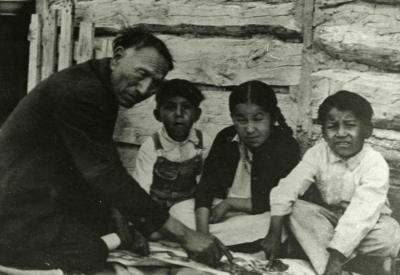
Jesus invites us to follow him and to invite others to do the same.
He said to them, “Come after me, and I will make you fishers of men” (Mt 4:19).
Today’s Gospel account recalls Jesus calling of Simon Peter, Andrew, James, and John. An interesting contextual point about this recollection is that Jesus was the one doing the calling. Spiritual teachers were common during the time of Jesus within and without of Judaism. What was common in those accounts were that the disciples came to the master. It was rarer that the master would search out and call his followers.
Another point to observe is that Jesus met the brothers in the midst of their everyday activities of fishing. Jesus came to them as they were working. The encounter with Jesus was not on some isolated mountain top, it was not at a gathering revival, nor at the temple or synagogue. Jesus met them in the midst of Simon and Andrew casting their nets and James and John mending theirs.
A third point from this short account is that Jesus immediately followed up his invitation to Simon and Andrew to come after him with the insistence that they will be fishers of people. They are not entering their new apprenticeship with Jesus having any false notion that they will wait for others to come to them. They will travel out of their comfort zones, literally, leaving their fishing businesses, their security, and trusting in Jesus as they learn about and share the Good News that the kingdom of God is at hand.
The three points above apply directly to us as well. Jesus invites us. We just need to be open to receiving the invitation and saying yes as Simon, Andrew, James, and John had done. Jesus meets us in our everyday moments. He encounters us in our workplace, among our interactions with family and friends, in our class and dorm rooms, as well as in our activities and leisure, and in our conflicts, struggles, and suffering. Jesus often meets us in those unprepared for interruptions we experience. Jesus certainly meets us in our prayer, but if we have the desire to pray it is because he has already placed it there. Also, our time of prayer helps us slow down and become aware of his presence in our life, so that when we leave our times of prayer and worship, we will be more able to see him in the midst of our daily activities.
Finally, Jesus calls us to share what we have experienced and learned from our encounter. No matter how small. When we reach out in faith the Holy Spirit will provide the means. We will make mistakes, we will not be perfect, but if we are humble, we will learn and grow as his disciples. Remember who he called? Peter, Andrew, James, and John. There are four Gospels full of accounts of their false starts, gaffes, and “Oops”. We grow and learn by doing. As we crawl, we will soon learn to walk, as we walk we will soon learn to run, and as we run, we will soon learn to fly!
Jesus invites us to participate in his life. May we be thankful for the gift of his life that he gives us and may we live our life and be open for opportunities to share our faith by accompanying those in our realm of influence through the normal means of interaction we have. Again, remembering first and foremost to do so in a way that respects the dignity of each person we encounter. We are to resist imposing and be open to inviting.
One of the reasons that this time last year, the cause for the canonization was promoted for Nicholas Black Elk (ca. 1866-1950), an Oglala Lakota, holy man, best known from John Neihardt’s work, Black Elk Speaks, was that he, like St Andrew whose feast we celebrate today, said yes to the invitation to follow Jesus. Black Elk was baptized in 1904, on the feast day of St. Nicholas, taking his name. He continued to practice his Lakota ways as well as becoming a catechist, and under his invitation and guidance, over 400 people came to believe in Jesus.
Let us say yes to Jesus’ invitation to come and follow him, and become fishers of people! St Andrew pray for us, Servant of God Nicholas Black Elk pray for us.
———————————————————————————————
Photo: Source Marquette University Catholic Mission Archives. Nicholas Black Elk catechizing with the “Two Roads Map” the children of Broken Nose.
Link for the Mass readings for Friday, November 30, 2018: http://www.usccb.org/bible/readings/113018.cfm

Jesus, especially in our trials, reveals to us our dignity so we can see the dignity in each other.
In today’s Gospel of Luke, Jesus paints a picture of Jerusalem under siege. The imagery is stark, dire, and horrific such that the only option is to flee. Even the natural elements are affected as there will be “signs in the sun, the moon, and the stars,” as well as “the roaring of the sea and the waves” (Lk 21:25). Yet, even in the midst of the appearance that all is lost, today’s reading ends: “And then they will see the Son of Man coming in a cloud with power and great glory. But when these signs begin to happen, stand erect and raise your heads because your redemption is at hand” (Lk 21:27-28).
There are certain things that are within our control to influence and to effect in such a way to bring about change, but in much of our life much is out of our control. No matter how much we seek safety and security in this world, it is never guaranteed. The Bible from Genesis to Revelation offers those experiences of the ones who have encountered the ultimate security even in the midst of the most tragic of circumstances. Our solid foundation and source of being is God.
We can be more assured of God’s presence and reality in our life if we do not wait until calamities come before we turn to him for help. Answering his invitation to develop a relationship with him now is not a benefit for God, for he is self sufficient in and of himself, and does not need us. Saying yes to the invitation of the Holy Spirit helps us to experience that we are not alone in our life, through the ups and down, the good times and the bad. As we build our relationship with God over time and experience, this relationship becomes more real and tangible to us.
I remember an experience about half way through my first year of teaching. I was being observed by my mentor as I taught a math lesson to the first graders under my care and guidance, yet nothing seemed to be working, the attention of the students was gone. I remember turning to look at the clock, and having this sinking feeling that I could not do this. For that brief moment, I wanted to turn over my keys, ask my observer to take over, and head out the door never to return and look for a new career.
Yet, from the moment I turned back from looking at the clock to the students before me a peace settled in my soul. I continued the lesson, finished out the day, and continue to teach eighteen years later. I know many of you reading this have and/or are going through much worse trials and struggles. Yet I invite you to arise with confidence today.
We have an advocate, Jesus the Christ, who understands our plight and is present with us, providing guidance, support, and strength so that we can endure, even when we may feel alone, lost, or besieged on every side. Our security comes from our faith and hope in our relationship with Jesus, such that we will not only endure, not only survive, but we will thrive, so to be empowered to recognize our dignity as well as respect the dignity of others.
Photo of card with the painting of Lisette de Winne titled, “Our Greatest Contribution” – commissioned by Selection Research, Inc. – which also states: “Our greatest contribution is to be sure there is a teacher in every classroom who cares that every student, every day, learns and grows and feels like a real human being.” The goal I aspire to each day.
Link for the Mass readings for Thursday, November 29, 2018: http://www.usccb.org/bible/readings/112918.cfm

 Spiritual Stepping Stones