
May we too, “Give until it hurts with a smile.”
“I tell you truly, this poor widow put in more than all the rest; for those others have all made offerings from their surplus wealth, but she, from her poverty, has offered her whole livelihood” (Lk 21:3-4).
The biblical recommendation for giving is a tithe of our income, meaning ten per cent. We can see an example of this in the book of Genesis when Abraham offers a tithe of his possessions to the priest Melchizedek in thanksgiving to God for a successful battle through which he rescued his nephew Lot (cf. Genesis 28:20-22). Tithing was practiced consistently and this, or the giving of alms, was most likely what Jesus was observing at the temple.
The widow went further though than giving a simple tithe. Widows in Jesus’ time were often destitute and needed care and support from others. They were often recipients of alms. There was a long tradition in Judaism of the mandate to care for the widow and orphan. This widow, though giving a significantly smaller amount than the heftier donations before her, proportionally gave much more, indeed, “her whole livelihood.”
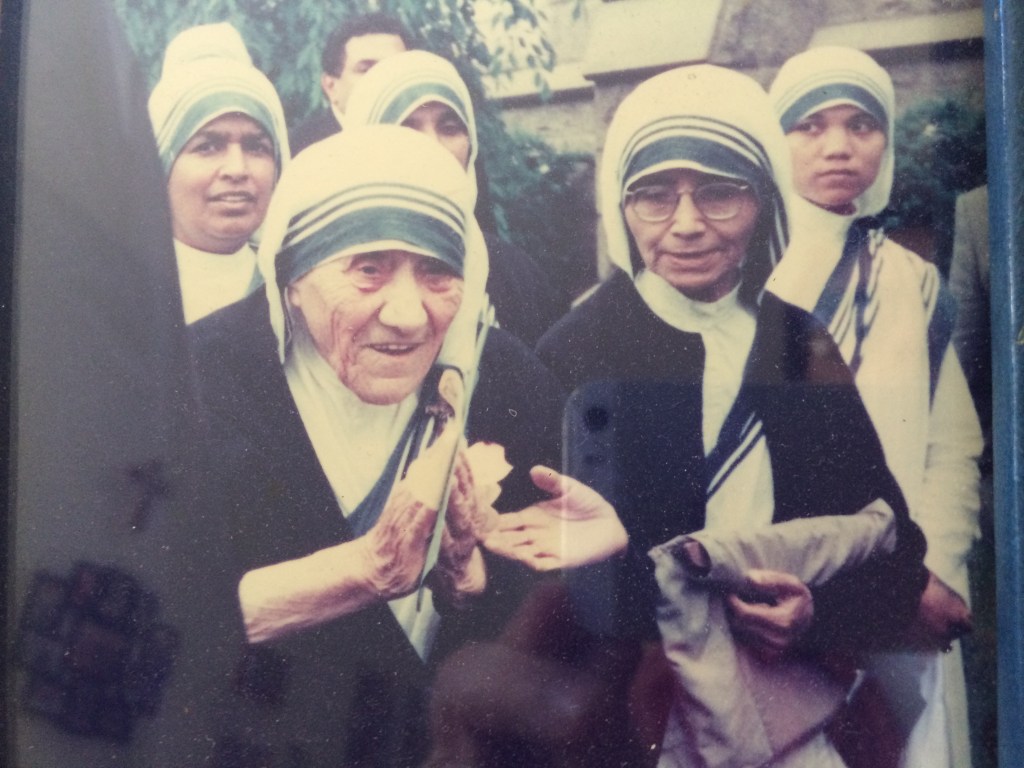
St. Mother Teresa understood these verses very well, especially after receiving her “second call” in which she left her Loretto Convent and went to serve among the poorest of the poor in Calcutta. Often in her talks she mentioned giving until it hurts, not from our surplus, but more like the widow. To her this was true giving.
One of the many examples Mother Teresa witnessed of this was when she gave a cup of rice to a poor Hindu family. The mother was very grateful for the gift and as soon as she received the rice, she went to her Muslim neighbors and gave them half of what she had received. Upon her return, the woman told Mother Teresa, “They are hungry too.”
What impressed Mother Teresa was not that the woman shared the meager amount that she received, she had observed the generosity of the poor often. She was touched by the fact that this woman was aware of the need. Mother’s charge to us is, “Are we aware?”
Are we willing to see the needs within our own family as well as beyond to the needs of others? Are we then willing to share? We do not need to share just monetarily. We can and ought to discern how we can share of our time, talent, and treasure.
Jesus’ observation and pointing out how the widow “gave more than all the rest” shows us how to participate in the kingdom of God. We are to recognize all that we have is a gift from God and all truly belongs to him. We are simply stewards of what he has given us. Remember the recent parables of the talents, the gold coins, and Matthew 25 – what you do to the least of my brothers, you do it to me?
Jesus, help us to be better stewards of our time, talent, and treasure so that all of our life is a participation in the building up of the kingdom of God. Let us, as St Mother Teresa shared, “give until it hurts with a smile” so we can experience the joy of sharing God’s love.
——————————————————
Photo of St. Mother Teresa that I took when I saw her in Massachusetts in the early 90’s.
Link of video of St Mother Teresa talk at National Prayer Breakfast 1994. Her talk begins at 48:58: https://www.c-span.org/video/?54274-1/national-prayer-breakfast
Link for the Mass readings for Monday, November, 26, 2018: http://www.usccb.org/bible/readings/112618.cfm
Collaborating with Christ the King, one person at a time
Today is the last Sunday in Ordinary Time. Next Sunday will begin the new liturgical year in the Church calendar as we begin Advent. In today’s Gospel from John, Jesus faces the Roman procurator, Pontius Pilate:
“So Pilate said to him, “Then you are a king?”
Jesus answered, “You say I am a king. For this I was born and for this I came into the world, to testify to the truth. Everyone who belongs to the truth listens to my voice” (Jn 18:37).
Clearly, Jesus is a king, yet not in the way of other kings who have gone before him or followed after. As Jesus said before his above statement, “My kingdom does not belong to this world” (Jn 18:36). The Son of God came among us to re-orient, to re-align the worldly order. Leadership is to no longer to be about the aggrandizement of self nor at the expense of others. God was very aware of the suffering of his people. He sent Moses to free his people from slavery from Egypt and he sent his Son to free all humanity from our slavery to sin.
Yet this freedom has a cost. Today we are reminded that we have a choice to make. Who are we to serve? Are we to serve Pharaoh or Moses, Pilate or Jesus, our self or God. If we seek to be free from the shackles of our slavery to sin, the choice is clear that we are to listen to the voice of the king of the universe, the truth of Jesus the Christ.
We can see in our own actions who we serve and whose voice we listen to in the action or inaction we direct toward one another. Are we indifferent, blind to another’s suffering or are we aware and willing to get involved, to be, as Fr. James Keenan, S.J. wrote, “willing to enter the chaos of another.”
The reign of Jesus is about personal encounter. We serve Christ the King in being aware of and accompanying one another. We are not to be about bringing world peace, ending hunger, providing homes for all in some abstract utopian pursuit. We are instead to be about treating each person we meet with dignity, we are to see Jesus in our midst: “For I was hungry and you gave me food, I was thirsty and you gave me drink, a stranger and you welcomed me, naked and you clothed me, ill and you cared for me, in prison and you visited me” (Mt 25:35-37). Jesus our king, commands us to act as he lived, to be aware, to accompany, and to make a difference, one life at a time.
We may feel overwhelmed with our own struggles, let alone the present state of our country or weight of the world, but we do not have to bear the weight alone, nor are we expected to change the world. We begin each day with ourselves. We resist the temptation to turn within and instead adjust our attitude and focus outward, while at the same time making a commitment to serve Jesus in one another. God is guiding us already through the love of the Holy Spirit he shares with us, we just need to receive his love, and have eyes to see, ears to hear, and a willingness to participate in his will.
What we need today, on this feast day of Christ the King, is to allow Jesus to re-orient, to re-align the order of our life. We need to be willing to allow Jesus to lead us such that we are willing to enter the chaos of another. May we, in this final week of Ordinary Time, choose who we will serve, and then spend some time reading and meditating on the Beatitudes (Mt 5:1-12) and chapter 25 of Matthew. Jesus gives us not only this blueprint on how to be collaborators with him, he empowers us to accomplish that which he guides us to do.
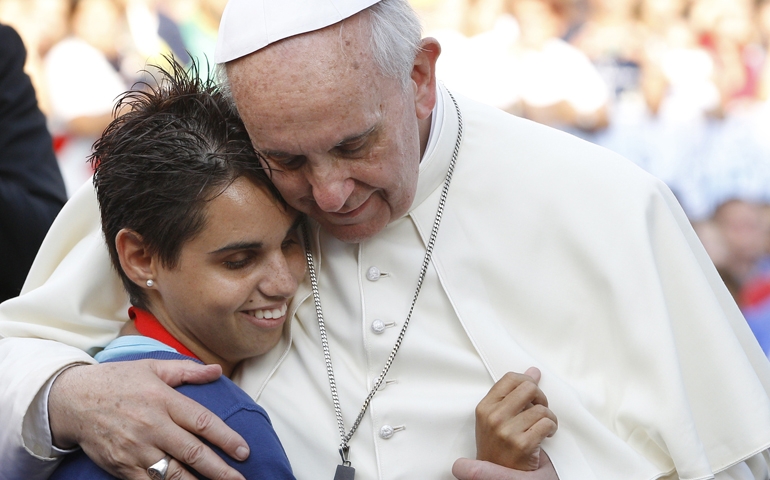
As Pope Francis said in a 2014 homily these are: “Few words, simple words, but practical for all. Because Christianity is a practical religion: it is not just to be imagined, it is to be practiced. If you have some time at home today, take the Gospel, Matthew’s Gospel, chapter five. At the beginning there are the Beatitudes; in chapter 25 the rest. And it will do you good to read them once, twice, three times. Read this programme for holiness. May the Lord give us the grace to understand his message.”
——————————————————————-
Pope Francis photo credit: Paul Haring, CNS
Fr James Keenan article on Mercy:
http://www.thinkingfaith.org/articles/scandal-mercy-excludes-no-one
Pope Francis homily, 6 September 2014: http://en.radiovaticana.va/news/2014/06/09/pope_the_beatitudes,_a_practical_programme_for_holiness/1101553
The Mass readings for Sunday, November 25, 2018: http://www.usccb.org/bible/readings/112518.cfm

Experience the God of the living and a foretaste of heaven today.
The Sadducees present an absurd scenario for Jesus to respond to: a woman’s spouse died leaving her childless and then successively married her husband’s six brothers who all died, also leaving her childless. The question from the Sadducees was, “Now at the resurrection whose wife will that woman be? For all seven had been married to her.” (Lk 20:33)? What the Sadducees were really getting at was to have Jesus weigh in on his views about whether there was or was not a resurrection of the dead.
The Sadducees did not believe in a resurrection of the dead because they only believed in the Torah, the law or the teachings, what we as Christians today recognize as the first five books of the Old Testament. In the Torah, there is no overt reference to the resurrection. The Pharisees, recognized the written Torah, but also acknowledged an oral tradition beyond the written text, and thus did recognize the resurrection of the dead. Jesus deftly answered the question by keying in on the verse from Exodus, found in the written Torah: “That the dead will rise even Moses made known in the passage about the bush, when he called ‘Lord’ the God of Abraham, the God of Isaac, and the God of Jacob; and he is not God of the dead, but of the living, for to him all are alive” (Lk 20:37-38).
Jesus clearly pointed out that God was not a God of the dead but of the living.
The deeper reason for the question was ultimately, and is the question that also arises today, “What goes on in heaven? What do we do all day?” Jesus’ response to the Sadducees then and us today is: “The children of this age marry and remarry; but those who are deemed worthy to attain to the coming age and to the resurrection of the dead neither marry nor are given in marriage. They can no longer die, for they are like angels; and they are the children of God because they are the ones who will rise” (Lk 20:34-36).
What Jesus means is that heaven is a different reality than we experience now. Heaven is a different dimension of existence. We will no longer marry because we will be living eternally, there will be no death, no more need to procreate.
Also, heaven is not so much a geographical place as it is a relationship and experience of a deeper communion with God. We want to know what we are going to do there, because we are attached to what we have and what we do here. In heaven, we will experience the fulfillment of that which we have been created for, that which we truly crave and hunger for, that which will fulfill our deepest longing, which is to look upon God face to face, what theologians call the beatific vision. Many would scoff and say, “That’s it?” I am sure there is more, but if that was all, there would be more joy, more acceptance, more totality of being, than we could ever imagine or embrace in just a second of that eternal gaze. As the psalmist wrote: “Better one day in your courts than a thousand elsewhere” (Psalm 84:11).
Definitively speaking, heaven is a mystery to us. Again, the Mystery of God is not a problem to be solved but a relationship to experience and develop. This is why prayer, worship, encounter, relationships, and experiencing God’s creation are so important because each are encounters with the living God, each are a foretaste of heaven. If we are only tied to the material, the finite, our self apart from others, we will succumb to attachments and addictions that will create walls of division and separation such that we cannot even begin to conceive of the eternal or spiritual ground and foundation of our existence.
May we be more mindful today to make some time for prayer, reread today’s Gospel and pondering it, wondering about the gift of an eternal communion with God, the God of the living, and what it would be like to see God face to face. Head to worship with a community of faith this weekend, and actually sing during the service. God does not implore that we sing well, but only that we make a joyful noise unto the Lord (cf Psalms 98, 100). During the Mass, heaven and earth become one through the presence of Jesus in his people gathered, his word proclaimed, and his real presence in the Eucharist.
In our homes and in our everyday experiences, may we really experience, accompany, and be with the people around us, talking and listening to one another. May we seek a ministry of service that we can participate in regularly or invite someone to join us if we are already active. May we spend some time immersed in God’s creation, whether taking a walk, taking long deep breathes while looking at the starry night, or just sitting and watching all the gifts of life pass by, birds, otters, bobcats, or whatever may cross our path. Each of these are opportunities to encounter the God of all creation and to experience a foretaste of heaven!
Photo: Family of bobcats that were playing in our backyard about this time last year.
Link for the Mass readings for Saturday, November 24, 2018: http://www.usccb.org/bible/readings/112418.cfm
Jesus, ekballō – drive or cast out all that defiles us.
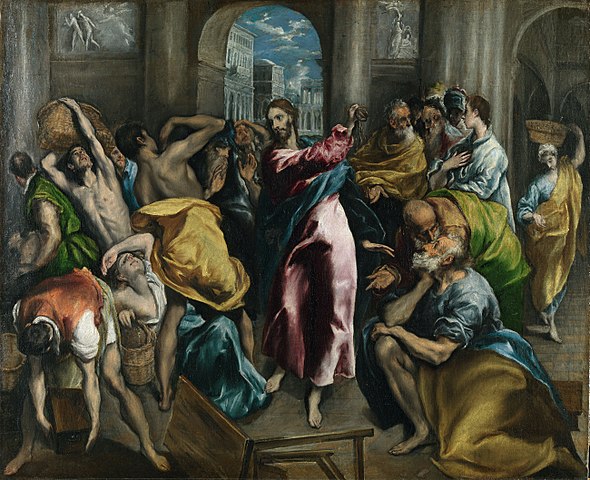
Jesus entered the temple area and proceeded to drive out those who were selling things, saying to them, “It is written, My house shall be a house of prayer, but you have made it a den of thieves” (Lk 19:45-46).
Luke’s account of Jesus casting out the money changers is the most succinct of all four Gospels. Luke uses the Greek term for “drive or cast out” – ekballō, eight other times. Each time he used it, Luke was making reference to exorcising demons and unclean spirits. The profanation of the body through possession of evil is equivalent to the desecration of the Temple precincts.
Jesus justified his actions by saying: “Destroy this temple, and in three days I will raise it up” (Jn 2:19). Jesus showed the dignity of our humanity, in that as the Son of God he entered our humanity. He entered into the chaos of our lives, our faults and foibles, or sin, while remaining sinless himself, and showed that even though we have turned away from God, we are not destroyed. He reminds us that what God has created is good and that includes us. Though we constantly turn away, he infinitely reaches out to us in love, and calls us home.
One of the wonderful features of holidays, is that families that are apart seek to come together. They return home. Some are not able to and reconnect by phone, email, or the other avenues of social media available to us now. But there are those, we may even experience this ourselves, whose family members are estranged, or who no longer have family. There are those suffering today that are homeless, displaced, refugees and immigrants, or living in fear of deportation. May we pray for them and be avenues of reconciliation where we can.
No matter who or where we are, Jesus is present. He became one with us to restore our communion with God and one another. He provides the living water that quenches the thirst of our deepest longings. That which will not be satisfied by even the greatest of deals available today on Black Friday.
Our temple today is not the Malls, even though the masses may be flocking there. Jesus, our temple, our new covenant, the dwelling place of God, is alive and present to each of us in every condition, situation, and place we find ourselves. And through his resurrection and ascension, and our participation in his life, he has made us temples of the indwelling of God the Holy Spirit. Through our baptism, we are incorporated into his mystical Body. All we need to do is say yes to his invitation.
May we allow Jesus to cast out, as he did in the temple precincts, all from our being that would defile us and keep us bound in sin. May the Holy Spirit reign in our hearts that we may embody and bear his love to all we meet so to be reconciled with God and one another. If you are braving the masses of those going to the stores today, or if you are already there, I invite you to periodically draw some deep breaths and invite Jesus to be present with you, so that you may be a bearer of his light. Be patient, kind, and loving with those you are rubbing elbows with. You are braver than I. I will be digging in to correct my student’s essays, do some pruning outside, and making some quiet time for prayer.
————————————————————————-
Painting: By El Greco, 1600 – https://commons.wikimedia.org/w/index.php?curid=152167
Link for the Mass readings for Friday, November, 23 2018: http://www.usccb.org/bible/readings/112318.cfm
Thankful to you for sharing the journey!
I am thankful and grateful for all of you who have made the time to read, post likes, and/or share comments, whether it be directly through the long version from my blog site accessed through subscription, via twitter or LinkedIn links, or the short versions posted on Instagram and Facebook.
Life is busy and I appreciate those of you who have been walking with me along these spiritual stepping stones as we journey through the Gospel readings each day. God is with us in his Word, through the gift of his Son, the Love of the Holy Spirit, and through each of us being there for one another!
If you ever have questions, specific prayer requests or intentions, or care to make comments of agreement or disagreement, don’t hesitate to do so. Be assured of my daily prayers for your intentions. May we continue to pray for one another. May God bless and keep you and all you hold in your heart in his loving care and embrace.
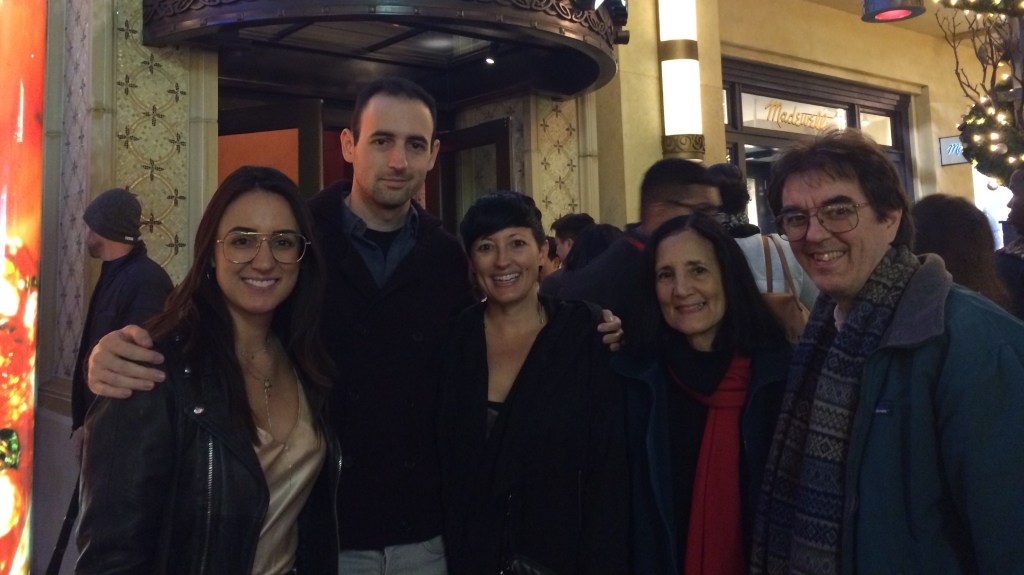
Happy Thanksgiving from our family to yours (photo from our visit to CA last year)!
Deacon Serge and JoAnn
A time to give thanks
As they were going they were cleansed. And one of them, realizing he had been healed,
returned, glorifying God in a loud voice; and he fell at the feet of Jesus and thanked him (Lk 17:14-15). Ten were healed from their leprosy and only one, a Samaritan, after realizing he was healed, returned to thank Jesus.
It is a good practice to spend some time each day to reflect on what we are thankful for. To see where God has entered our lives and provided assistance. At times when we feel a bit down and out, or in a bit of a funk, often the reason may be that we are focusing, on what we do not have instead of on what we do have. There is a quote, I am not sure of the source, that goes: “I cried because I had no shoes, and then I came upon a man with no feet.” We can be so bombarded by the mass appeal to the material, that we forget the truly important realities of this life that we have been given.
Times of family coming together can get a bit messy. There is all the cleaning, setting up and the prep for the big dinner, the travel, the unresolved issues of life, and there are the wonderful gifts of diverse personalities and points of view. If we can periodically stop, take a breath and be thankful for the fact that we have families and friends to be messy and grumble with, we might appreciate each other a bit more this day.
As Jesus reminds us, we do not know the time or the hour. Life is fragile in the best case scenarios, life is also finite. We will not be here forever. November is a time in the Church when we remember those who have joined the communion of saints. I know too many that have lost family members unexpectedly. May they be home with God and may we remember them through pictures and stories shared.
My thoughts and prayers are with you this Thanksgiving Day. May we feel the warm embracing arms of our loving God and Father reminding us that we are never alone and that he cares for our loved ones who have gone before us. Jesus, help us to remember that life is a gift, to appreciate and be thankful for our life and the lives of those near and far we are blessed to call family and friends. May we also remember and pray for those who may be alone, struggling, or without food and home this day.
———————————————————————————————-
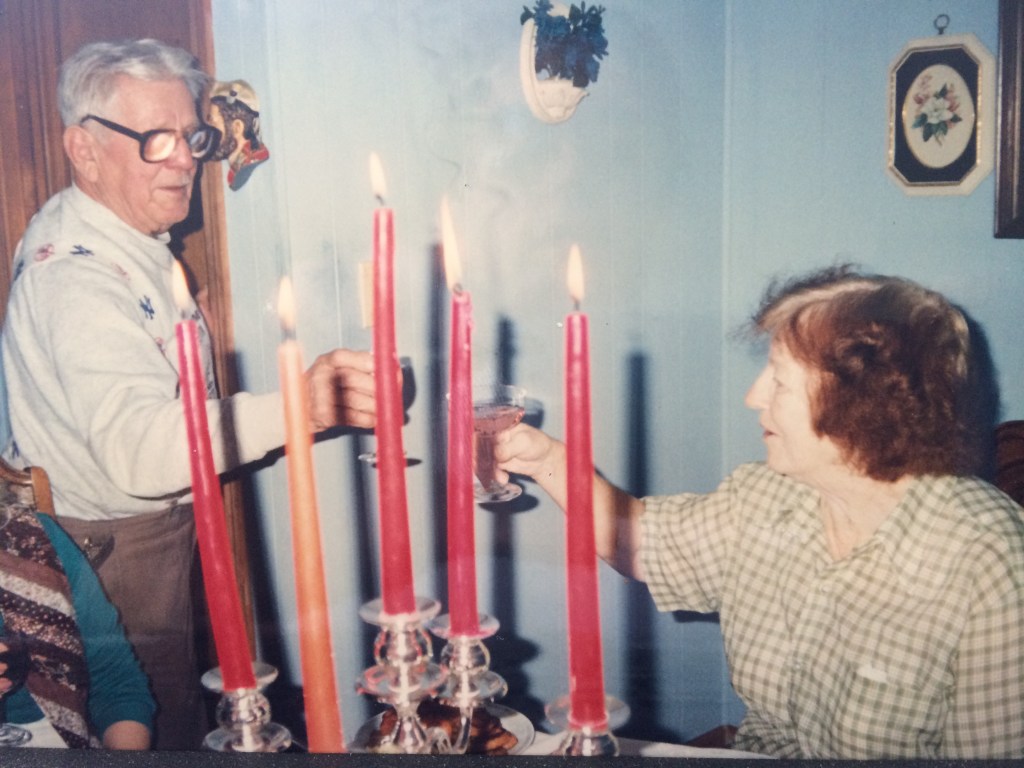
Photo: Thanksgiving toast with my maternal grandparents Bernard and Helen Morcus. Today they are toasting now, where we will one day be!
Link for the Mass readings for Thursday, November 22, 2018: http://www.usccb.org/bible/readings/112218-thanksgivingday.cfm
Let us pray for the discernment to know and act upon the gift God has given us!
In today’s Gospel we have available to us the same parable as The Parable of the Talents from Matthew 25:14-30, though the Parable of the Ten Gold Coins from Luke 19:11-28 has some differences. A key opening point is that in Matthew’s account, we do not know why or where the master goes after entrusting three of his servants with talents; five, two, and one respectively. In Luke’s account the man is a noble and he “went off to a distant country to obtain the kingship for himself and then to return” (Lk 19:12). He called ten servants to invest a gold coin he gave each of them. The theme is the similar in both accounts in that when the man returns, two of the servants have invested well and brought about a greater return on their investment for their master, and one hid what he was given out of fear.
Another added feature in Luke’s account was that there were fellow citizens of the nobleman that did not want the man to be king and openly opposed him. The nobleman after attaining his kingship and returning successfully, dealt harshly, to say the least with those who opposed him, having them slain. Those listening to the parable would understand this outcome, as it was not uncommon in the ancient Near East for a ruler to slay those who would oppose his rise.
The readings over this week continue in this vein of eschatological talk, references to the second coming of Jesus because we are in the final two weeks of the liturgical year. Each of the readings present us with the reality that there will be a judgment by God, but what Jesus makes clear is that we are not the judge and jury, though many appropriate this role for themselves. We are only accountable to the talent or gold coin we have been entrusted with.
We’ve got talent. But we can’t just sit on it.
There is a unique gift that God has given each of us, and we are called by the Lord to put this gift into action so to be a part of building up the kingdom of God. We need to resist burying this gift or rapping it in a handkerchief and hiding it away. Doubts, fears, and anxieties will arise in our hearts and minds. We may say to ourselves, “I don’t even know where to begin.” One place to begin is in prayer with the one who calls us to this work of encounter, solidarity, and accompaniment.
How we respond will be different for each one of us. May we ask God for his guidance regarding how best we can serve him, and may we seek the love of the Holy Spirit this day, that in the words of Pope Francis we may: “Have the courage to go against the tide of this culture of efficiency, this culture of waste. Encountering and welcoming everyone, [building] solidarity – a word that is being hidden by this culture, as if it were a bad word – solidarity and fraternity: these are what make our society truly human” (Pope Francis 2014, 61).
——————————————————————–
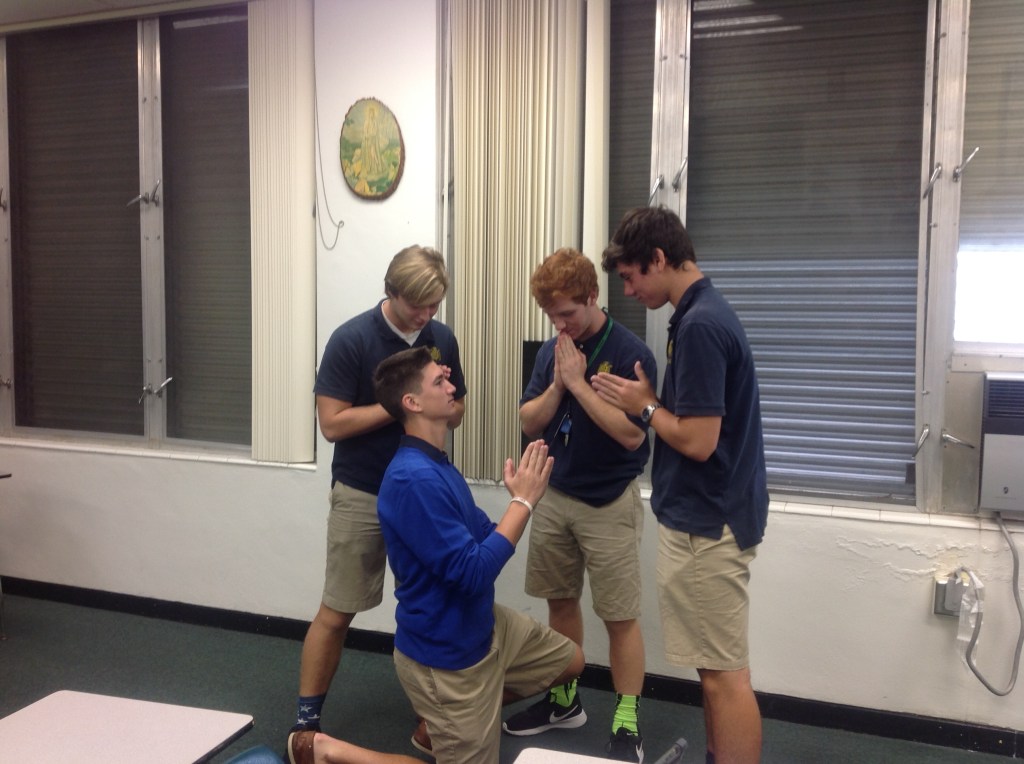
Photo: An icon of prayer for discernment in solidarity and fraternity
Francis, Pope. The Church of Mercy: A Vision For the Church. Chicago: Loyola Press, 2014.
Link for the Mass readings for Wednesday, November 21, 2018: http://www.usccb.org/bible/readings/112118.cfm

May we let go of grumbling and open our arms wide to healing.
Again, the crowd gets in the way of someone seeking access to Jesus. The wall of people does not appear to be overtly keeping Zacchaeus from seeing Jesus, as they may be so focused on seeing him themselves that they are not aware another cannot see. There is also the possibility that the people were aware, they knew Zacchaeus, and many judged him to be the sinner of sinners, as he was the chief tax collector of the area. Each time Zacchaeus nudged by to get through a gap to get a better look, the individuals may have time and again closed the gap such that Zacchaeus could not get through.
Zacchaeus though would not be thwarted in his effort to see Jesus. He climbed a sycamore tree. From his perch he was not only able to see Jesus, Jesus saw him and said, “Zacchaeus, come down quickly, for today I must stay at your house” (Lk 19:5). Jesus did not see a tax collector or a sinner, he saw a seeker. As with yesterday’s reading, the crowd only saw a blind beggar, and today they tried not to see the tax collector. Jesus saw Bartimaeus yesterday and today he saw Zacchaeus. He saw his brothers.
Jesus did not see the 99% and he did not see the 1%, Jesus saw people who were in need of compassion and mercy. Jesus did not meet Zacchaeus with judgment, but with love and acceptance as he was, and that made all the difference for conversion to happen. Zacchaeus responded to Jesus’ invitation with the words: “Behold, half of my possessions, Lord, I shall give to the poor, and if I have extorted anything from anyone I shall repay it four times over” (LK 19:8). Jesus did not judge Zacchaeus, he saw his open heart of faith. Zacchaeus is moved by Jesus’ acceptance of him as he is, as a person with dignity, and he repents as a response to the love he has received.
We need to follow the lead of Jesus and start seeing each other as human beings. One way to do so is to resist the temptation to “grumble”, to gossip, to pre-judge, to dehumanize one another, and to see beyond the exterior and to be willing to go deeper to the heart and character of the person. To do that, we need to be willing to encounter one another, to walk with one another, to accompany and spend time with one another.
May we move from a people who seek to define and limit ourselves by our identity, and instead seek to open ourselves up to being people of integrity. This means resisting the temptation of building walls that protect ourselves from others and instead building bridges of dialogue and embracing the gift of diversity. Integrity means that we will be aware, we will stand with and stand up for someone who is ignored, belittled, dehumanized, harassed, discriminated against, ridiculed, abused, objectified, persecuted, segregated, and prevented access no matter their gender, sexual orientation, race, ethnicity, income level, class, political party, religion or none.
Life is hard enough, so let’s stop grumbling and start healing, let’s stop preventing access and start opening opportunities, and let’s stop closing ourselves off and begin to open our arms wide to embrace and accompany one another as we journey with Jesus.
——————————————————————————
Photo by Tri Nguyen Trong from Pexels
Link for the Mass readings for Tuesday, November 20, 2018: http://www.usccb.org/bible/readings/112018.cfm
 Spiritual Stepping Stones