Jesus is the one God sent!

The people who had been miraculously fed by Jesus sought to make him their king. He slipped away from them, and withdrew to pray on the mountain alone. In the evening the disciples went to Capernaum and Jesus caught up to them as he walked on the sea. The following day the people tracked down Jesus and the disciples at Capernaum and asked Jesus what they were to do to accomplish the work of God.

Jesus answered and said to them, “This is the work of God, that you believe in the one he sent” (cf: Jn 6:27-29).

The response of Jesus may not appear to fit the request. But to believe is not just a passive activity. Belief is to be followed by action. If we say that we believe in Jesus, the one God sent, do we pray with him, do we worship him independently and in communion with fellow believers, do we sing songs of praise, do we serve him through giving of ourselves to one another by practicing the corporal and spiritual works of mercy? When we experience set backs, interruptions, conflict, or outright trials and tribulations, do we turn to cursing and yelling or to Jesus for guidance and direction? Do we turn within ourselves and cut ourselves off from others? Do we surround ourselves only with those of like mind, color, political and religious views? Do we embrace ourselves and engage in the richness of the uniqueness and diversity of God’s people? Where are we spending our time, talent, and treasure?

By engaging in an honest assessment of the questions above, we can better answer the most important question of our faith, “Do we really believe in Jesus the Christ, the one God sent?” Admitting to ourselves where we really are in our relationship with Jesus is good to do. If you are spending time reading these reflections, then most likely you are doing at least some of the above. May we thank God for helping us to develop healthy habits of holiness in those areas. For those areas we fall short, may we ask for forgiveness and help to do better today.

If we believe that Jesus is the one who God sent, then we must believe that Jesus is who he said he is, the Son of the living God. Jesus invites us each day to deepen our relationship with him and each other, because Christianity is not a solo endeavor. May we say yes to his invitation, commit to and schedule worship with his community of believers once a week; set up a daily place and time to pray each day to be still with God; spend time each day reading the Bible; and make an effort to give of ourselves to another in small ways with great love each day. These simple practices can have a profound, transformative affect in our lives, for they will help us to grow deeper in our relationship with Jesus and one another. This is what we have been created for!

———————————————————

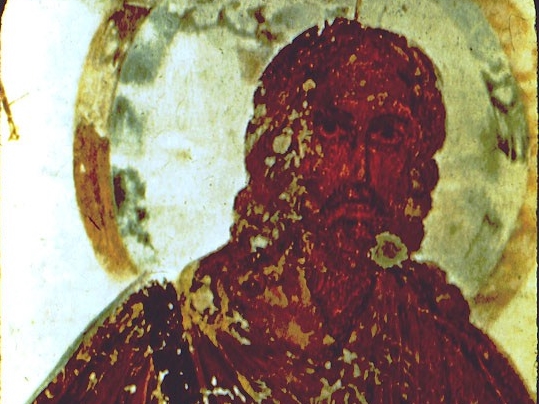
Painting from a cemetery in an imperial villa that belonged to Constantine and is dated to the 4th century. Accessed: https://churchpop.com/2015/03/09/6-of-the-oldest-images-of-jesus/

Link for the Mass readings for Sunday, August 5, 2018:

http://www.usccb.org/bible/readings/080518.cfm

Who do we follow? Who do we serve?

Herod the tetrarch heard of the reputation of Jesus and said to his servants, “This man is John the Baptist. He has been raised from the dead; that is why mighty powers are at work in him.” (Mt 14:1-2).

After the death of Herod the Great (4 BC), one of his sons, Herod Antipas, was given a portion of his father’s kingdom by the Roman Emperor Augustus. Thus, Herod Antipas was the tetrarch, or prince, of Galilee and Perea from 4 BC to 39 AD. Herod, like, Pontius Pilate, held power as long as he was a faithful servant to Rome.

News of the ministry of Jesus got back to Herod and he believed Jesus to be John the Baptist raised from the dead. What followed was some of the backstory of why Herod arrested and unjustly beheaded John the Baptist. John was killed for speaking truth to power, as happened often in the long line of prophets before him. Jesus would continue John’s ministry of calling for repentance, of returning to following the will of God. He too would also suffer capital punishment at the hands of Herod Antipas and Pontius Pilate. The Apostles and martyrs of the early Church followed John and Jesus, lived the truth publicly and courageously, and were bold witnesses of their faith even to point of many also giving their lives.

How are we living our faith today? Are we faithful to the Gospel values that Jesus and the Apostles taught and were willing to die for? Do we serve Herod Antipas and Pontius Pilate or Jesus the Christ? Do we serve fear or love? Are we putting our identity first or our integrity of living and holding others accountable to living the Gospel?

It is important to stop and reflect on questions such as these, to examine our conscience and determine who it is that we are truly serving. It is not easy living the teachings of Jesus. We will fall short, but we must remember that God loves us more than we can ever mess up. We experience the fullness of his forgiveness, light, love, and mercy when we are continually willing to follow the call of John the Baptist and Jesus, which is to acknowledge that we have put something or someone else first before God. To repent, to turn back to God, we are strengthening the union of relationship we were created for.

When we are willing to allow the Holy Spirit to shine in the darkness of our failure of not putting into practice his will, we will experience his forgiveness and mercy, we will become more open to truly knowing his will and how best to serve our loving God and Father. Embraced by and participating in the Trinitarian Communion of his love, may we recommit ourselves today to living as Jesus’ disciples, may we grow in courage to better follow his path, may we live and speak his truth in and out of season.
———————————————————————–

Photo: Morning at Cardinal Newman High School, I will be returning Monday to begin another school year! May we pray for each other as we seek to live out our vocational call!

Link for the Mass readings for, Saturday, August 4, 2018:
http://www.usccb.org/bible/readings/080418.cfm

The son of a carpenter

“Where did this man get such wisdom and mighty deeds? Is he not the carpenter’s son?” (Mt 13:54-55).

Many people wonder what Jesus did from the age of twelve until he began his ministry around the age of thirty. Today’s reading gives us some insight into that question. Most likely, Jesus did nothing extraordinary, he was just as ordinary as any other first century Palestinian Jew living in the small town of Nazareth, with a population of about 250 to 500 people.

Jesus most likely worked as a carpenter. This was rough, menial work, and a position that was looked down upon. We can even see evidence of this in the Gospel accounts. Mark describes Jesus as the carpenter, the son of Mary, Matthew in today’s account portrays Jesus as the carpenter’s son, and Luke and John just refer to Jesus as Joseph’s son, leaving out any reference to carpenter altogether. Most scripture scholars believe Mark was written first, so we can see a progression in the biblical tradition moving quickly away from identifying Jesus as a carpenter.

Jesus’ return to his hometown and his teaching was first met with wonder. The question arose, “Where did he get such wisdom and how did he work such mighty deeds?” But wonder soon turned to judgment. Who is he? Isn’t he just the carpenter of Nazareth, no better than any of us. In effect, “Who does he think he is?” Not only does this show that Jesus probably lived a very simple peasant life, but that Jesus’ social status was set in stone.

The people’s hearts and minds were closed to Jesus. THEY KNEW who he was and there was no way someone like him could do what they had heard, so they “took offense at him… And he did not work many mighty deeds there because of their lack of faith” (Mt 13:57-58).

How many times have we judged someone? Have we said to ourselves, “I know who he or she is.” We box them in, not as they are, but as WE see them, as we define them. We look at another individual not as a person with dignity, but as a two-dimensional cut out character to satisfy our own prejudices. We also do this to ourselves by limiting our potential when we say we can’t do this or that. Maybe we have had a similar experience to Jesus, in that we have sought or are seeking to move beyond our particular social status, or follow a dream or career out of the norm of familial or community expectations. Through no fault of our own, by pursuing this path we threaten those who are not willing to accept this lateral movement or vision, those who are not willing to grow beyond what they have always known.

Jesus rebukes these limiting perspectives. Instead he seeks to do mighty works in our lives and so invites us to open our minds and hearts, to rest in the depths of our soul where we can touch the love and power of the Holy Spirit, repent from limiting ourselves and others through our judgmental and prejudicial dispositions, so to be healed from the finite limitations of our brokenness and sin. Let us resist the temptation to limit Jesus, others, and ourselves.

May we instead accept the invitation of our loving God and Father to embrace the infinite possibilities that will arise when we participate in his Life and Love. This invitation is for each and every one of us, no matter our race, gender, ethnicity, nationality, religious, political, economic, social, immigrant, or migrant status. Let us accept the invitation of the Holy Spirit who seeks to free us from the shackles that bind us, the limitations imposed upon us, and those we impose on ourselves and others. May we follow Jesus the carpenter who sees our potential, and seeks to impart his love and encouragement, so that we will actualize who he encourages us to be, and better be able to empower others in our realm of influence to do the same.
———————————————————————–
Picture credit: Darrel Tank/GoodSalt.com used with permission

Parallel Gospel accounts: Mark 6:3, Matthew 13:55, Luke 4:22, and John 6:42

Link for the Mass readings for Thursday, August 3, 2018: http://www.usccb.org/bible/readings/080318.cfm


May we be willing to be caught in the net of God’s love.

Jesus said to the disciples: “The Kingdom of heaven is like a net thrown into the sea, which collects fish of every kind.” (Mt 13:47).
The invitation of God is universal and we are all lured by his invitation of love and intimacy. We long to belong, our very substance and essence as human beings is the reality that our ultimate fulfillment can only be reached in communion with the God who created us. Yet, though drawn, we resist being caught.
St Augustine (354-430), bishop of Hippo, came to a point in his life where he realized that the flame of his desire for wealth, fame and pleasure was dimming. He clearly felt moved toward “one reality that cannot decay, from which all other realities are derived.” Though he was caught in God’s net and being pulled in, Augustine still sought to wriggle free, for: “Though drawn to the Path, who is my savior, I shied from its hard traveling” (Augustine 2008, 161).
How many of us could echo Augustine’s dilemma? We have experienced God in our lives and feel the invitation to go deeper, yet, we want to wriggle free. We are attracted to God but our attraction to fame, pleasure, power, or wealth still has a stronger hold. At a baser level, we may believe that the minimalist approach is easier. God’s path is too hard.
Hard yes, but if we look at anything that has been worthwhile in our life, haven’t we received it through discipline, effort, and hard work?
Often it is more effort to work against God’s will, just read the Book of Jonah! May we instead surrender to the current and draw of the Father’s Love and allow ourselves to be drawn into his net of Grace. At first, anxiety and fear will arise, because the pull, we may feel, may appear too strong, his love too pure. Yet, when we align our discipline and effort with his will, the anxiety will wane, and we will indeed be free to swim again. This time with more exhilaration and joy than we had experienced before.
Lord bless us and draw us close to you!
———————————————————————–
Photo by Josh Sorenson from Pexels
Link for the Mass readings for Thursday, August 2, 2018: http://www.usccb.org/bible/readings/080218.cfm
St Augustine. Confessions. Translated by Gary Wills. NY: Penguin Books, 2008.

What treasure lies beneath if we are willing to look?

Jesus said to his disciples: “The Kingdom of heaven is like a treasure buried in a field, which a person finds and hides again, and out of joy goes and sells all that he has and buys that field” (Mt 13:44).

God is hiding in plain sight. He is in our midst, present to all of us, a wonderful treasure just waiting to be found. God’s eternal love and grace is ever reaching out to us. Our soul hungers, yearns, and seeks for that love, whether we know it or not. It is when we seek satisfaction, filling this deepest of our desires in material and finite pursuits alone, that we miss the mark. When we sin, create idols, seek the allure of apparent goods, we block our access to the very union we seek. Our desire increases. God acts in the everyday events of our lives, but we limit those experiences by waving them off as just coincidences. In doing so, we have missed the opportunity to find a great treasure.

The saints and the mystics are those who have found the treasure of God’s will in their lives, they have experienced his love and mercy. They have encountered the living God in the midst of their everyday and given all to be immersed in his communion. They “are amplifiers of every person’s more hidden life of faith, hope, and love. Their lives help us to hear the interior whispers and see the faint flickers of divine truth and love in ourselves and others. The Christian mystics point the way to fully authentic human life by illustrating what it means to be a human being, what life means: eternal union (which begins here) with the God of love” (Egan 1996, ix-xx).

Today, may we set aside some time to be still so to hear God’s whisperings. May we open our hearts and minds to recognize his presence, the faint flickers, the God-incidents present in daily our experiences and those we encounter today. May we seek Christ by reading and meditating on his Word. May we also read the lives of the mystics and the saints who are our mentors, who have found the treasure of Jesus’ presence and want to share it with us: St Francis of Assisi, St Teresa of Avila, St John of the Cross, St Ignatius of Loyola, or St Therese of Lisieux; so many leading us and urging us on to experience the rich encounter of the loving God of Jesus Christ.

One who found this great treasure, St. Alphonsus Liguouri (1696-1787), whose memorial we celebrate today, shared: “All holiness and perfection of soul lies in our love for Jesus Christ our God, who is our Redeemer and our supreme good” (The Liturgy of the Hours, vol III, 1975, 1568).  May we experience the love of God in the depths of our soul, and love as Jesus loves us. St. Alphonsus, Pray for us!
———————————————————————–

Photo: Hiking in California a few years back.

Egan, Harvey D. An Anthology of Christian Mysticism, Second Edition. Collegeville, MN: Liturgical Press, 1996.

Link for the Mass Readings for, Wednesday, August 1, 2017:
http://www.usccb.org/bible/readings/080118.cfm

Why does God allow suffering and pain?

“Explain to us the parable of the weeds in the field.” He said in reply, “He who sows good seed is the Son of Man, the field is the world, the good seed the children of the Kingdom. The weeds are the children of the Evil One, and the enemy who sows them is the Devil.” (Mt 13:36-39).

In this parable of the wheat and the weeds, Jesus is addressing the ancient question of why does God allow evil and how are we to deal with it? Why do bad things happen to good people? As a starting point, we need to recognize that God is God and we are not; meaning we are not capable of reading the mind of God. Any answer to justify how and why God allows suffering then will be insufficient. A second reality is that the Devil exists, though he is a created being. An angelic being, yes, but not equal in a genus with God.

Ultimately, there is no genus of God, because God is not a being. At best we can say he is Infinite Act of Existence, he is, or as God told Moses, “I am who am” (Exodus 3:14). God did not create evil, he only created good. “God looked at everything he had made, and found it very good” (Genesis 1:31). The Devil, Satan, the one who opposes, was created good also, as a high arch angel, Lucifer, yet he chose to turn away from the will of God, those angels who followed him are demons. God is greater than the Devil and his demons, and his good is greater than evil they sow.

Evil is not so much a created thing, but a deprivation, or distortion of the good. God does not create evil, but he allows it, and even though we cannot understand the reasons why God allows or permits evil or suffering, it is not a sufficient reason to say that God does not exist. This is especially true if we are seeking to grasp spiritual realities and truths from purely physical and rational means alone. We are indeed rational beings, who seek to know and understand, but we are so much more. As human beings, we are physical AND spiritual, so need not limit ourselves to the merely sensate and empirical realm.

To better be guided by God, to hear his voice in the silence of our soul, to be fulfilled, our hearts and minds need to be open to the will of the Holy Spirit in our lives. We are called to be people of prayer. As we mature spiritually and deepen our relationship with God we will come to experience God as did Job: “I know that you can do all things, and that no purpose of yours can be hindered. I have dealt with great things that I do not understand; things too wonderful to me, which I cannot know” (Job 42: 2-3). In essence, Job acknowledged and accepted that God was in control and he was not, and though he could not grasp everything, he trusted in the will of God for his ultimate good.

How do we deal with evil then? We need to surrender our pride and control over to God and acknowledge that he is in control and knows what is best for us. We need to choose to put God first above ourselves and everything. Our fundamental option, our telos, our end goal, is to be above all an embrace of the reality that we are striving to be in relationship with him. From the moment of our conception, we are a living, craving, hunger, and desire to be one with God and one another. This is true of the atheist and the mystic alike, whether we believe it or not. As we embrace this reality, put God first and focus on him, no matter what arises, we will begin to experience his presence in not only our everyday lives, but begin to feel his presence with us in the midst of our suffering. We will come to know that he is stronger than any pain or evil, and he will guide us through and give us what we need to endure.

Our loving God and Father has given us the means to understand suffering and evil especially in sending his Son to enter into our humanity, to suffer with us, even unto his unjust death on the cross. Our deepest prayer is when we willingly offer up our suffering, and enter into the Mystery of the Passion of Jesus. Jesus, the pure and innocent one, beaten and crucified, understands our pain and agony, our cry for the horrors of injustice, and he understands the presence of evil. Jesus himself, asked not to be crucified, though he relinquished in saying, “Not my will but yours be done” (Lk 22:42).

In that acknowledgement, Jesus faced the utter evil, horror, betrayal, and injustice of humanity his crucifixion. In taking on the whole sin of the world on the Cross, he even felt his separation from the Father. Through his complete surrender into God forsakenness, into his death, and descent into hell, his willingness to die for us, Jesus made the Resurrection possible. He conquered suffering, evil, and death forever, he brought about a greater good, through the evil. No matter what trials we face, the Father has the last word over sin, suffering and even our death.

We can deal with suffering and evil in our lives with our hope intact because we can trust that God hears our prayers and is present in our trials and tribulations. For our part, may we be willing to be honest with him, even if we are angry, afraid, or doubtful. We will not find Jesus when we deny or run from our challenges, but we will find him with his arms wide open waiting for us when we are willing to enter into and face of our suffering and pain.  “Suffering is never the last word. Life is stronger than death, love is stronger that hatred, hope is stronger than despair, nothing is impossible with God” (Fr. James Martin, S.J.).

When we struggle or suffer, we are not alone. Let us resist running from our pain and instead bring our challenges to Jesus on the Cross. The strength of our faith is that we can trust in the knowledge that Jesus is present in the midst of our suffering. Jesus understands our pain because he experienced it on the Cross and experiences it with us now. Our hope is assured in that Jesus has already won the battle and he will give us the strength to endure.

May we call on the Love of the Holy Spirit who will be a light for us that shines in the darkness. No darkness can or will overcome his Love. God the Father has the last word on the matter and aligned with him, and willing to call on the name of his Son Jesus, we will be victorious even in the face of the purest evil. Let us face whatever rises before us today with confidence and courage, as did Jesus, when he set his face toward Jerusalem. Hand in hand with Jesus, we shall overcome.
———————————————————————–

Photo by Johannes Plenio from Pexels

Mass Readings for today, Tuesday, July 31, 2018: http://www.usccb.org/bible/readings/073118.cfm

The quote above, inspiration, and key points I shared regarding dealing with suffering come from Fr. James Martin, S.J. who answered a question on how we deal with suffering. You may access his answer on the You Tube video On Pilgrimage With James Martin SJ Fordham University. https://www.youtube.com/watch?v=xVtA_d7NwKE&t=5s His response on dealing with suffering begins around the 1:30:00 mark. The whole video is well worth watching as well!

A Mustardseed of Grace

“The Kingdom of heaven is like a mustard seed that a person took and sowed in a field. It is the smallest of all the seeds, yet when full-grown it is the largest of plants.” (Mt 13:31-32).
God can do so much with so little. This is so because even the smallest detail is important to God. Just think of the immensity, not only of our solar system and galaxy, but the whole universe. Despite the grandiosity and massive expanse of all creation, not even a sparrow can fall to the ground without the notice of God. Even all the hairs of our head can be counted (cf Mt 10:29-30). Our life, who we are, and who we are becoming matters to God.
God sows his seeds of divine grace, a movement of his love, reaching out to us in a joyful way. He watches us, his children, and shares his life with us. We can accept or reject this Love that falls afresh upon us. Our first step is to accept the reality that God loves us as we are. Then we are in a position to receive his love and share his love.
Our smallest thought, word or deed makes a difference, because they reflect our yes or no to the invitation of God. May we think, speak and act today as children of our loving God and Father. May we share a smile, a word of encouragement, a hug, or attentive presence with someone today, for no matter how small a sharing of God’s love with another we offer, it can do more than we can ever imagine.

Photo accessed from pexels.com: https://www.pexels.com/photo/sky-space-dark-galaxy-2162/
Link for the Mass reading for Monday, July 30, 2018: http://www.usccb.org/bible/readings/073018.cfm

Looking at Jesus, as he looks at me.

The Gospel passage from John today recounts the multiplication of the loaves. Instead of reflecting today on the miracle of Jesus feeding the five thousand with just “five barley loaves and two fish”, I wanted to focus on one verse that illumined the page as I read it.
Jesus went up on the mountain, and there he sat down with his disciples. The Jewish feast of Passover was near. When Jesus raised his eyes and saw that a large crowd was coming to him (Jn 6 3-5).
People were approaching Jesus because of the signs they saw him perform. Jesus raised his eyes and saw the large crowd coming, but he also saw their need. He could see that they were tired, they were wounded, they were hungry. Jesus would provide for the vast multitude from the meager five barley loaves and one fish that a young boy had with him. The people sought Jesus, he recognized their need, came down from the mountain and met them on their level, and provided for their need.
The same is true today. Though Jesus has ascended from our day to day existence of our three dimensional world, he has not left us orphaned. Just as Jesus went up on the mountain in today’s reading, Jesus ascended to a greater height, a higher plane or pitch of existence in his ascendance, so to better see us and to see our need.
How often do we find ourselves hungry for we know not what, how often may we feel adrift, confused, not quite sure of the direction we ought to take? How often are we hurting or ill, know of someone else who is in pain, suffering, or dealing with a chronic physical or mental situation? How often do we feel alone, not understood, anxious, or afraid? If you are feeling any of the above or something else not listed, may we, like the people in today’s Gospel come to Jesus.
How do we do that? How do we come to him? Because of the fact that Jesus has ascended, he has greater accessibility to us now than he did the day he fed the multitude. One way Jesus is present to us is in the sacraments. For just as he received the loaves and fish and multiplied them for those reclining on the grass, in the Mass through the priest he receives the matter, bread and wine, and he offers the prayer to his Father, the form, or words of institution. In each sacrament, there is a particular matter and form, such that Jesus is present. He raises his eyes to see us when we come to participate in the sacraments of the Eucharist, Baptism, Confirmation, Reconciliation, Anointing of the Sick, Matrimony, and Holy Orders.
We can also come to Jesus when we read the Scripture prayerfully and place ourselves in his word through our imagination, meditation, and contemplation; we can come to Jesus in our service and acts of love and generosity offered; any time we open our hearts and mind to Jesus in prayer individually, in a small group, or during our worship as a community of faith, Jesus is in our midst. We can come to Jesus in the wonders of creation, on a mountaintop, at the ocean, sitting in a tree, or watching a sunrise or sunset.
There are so many ways to experience Jesus in our lives, we just need to come to Jesus and as we draw near to him, he will raise his eyes and see us approaching. We can rest assured that he will welcome us, be present, and accompany us in our need. One of the simplest of encounters that best exemplifies how we can experience Jesus was told by St. John Vianney (1786-1859), also known as the Curé de Ars, French for the Pastor of Ars, a small village in France.
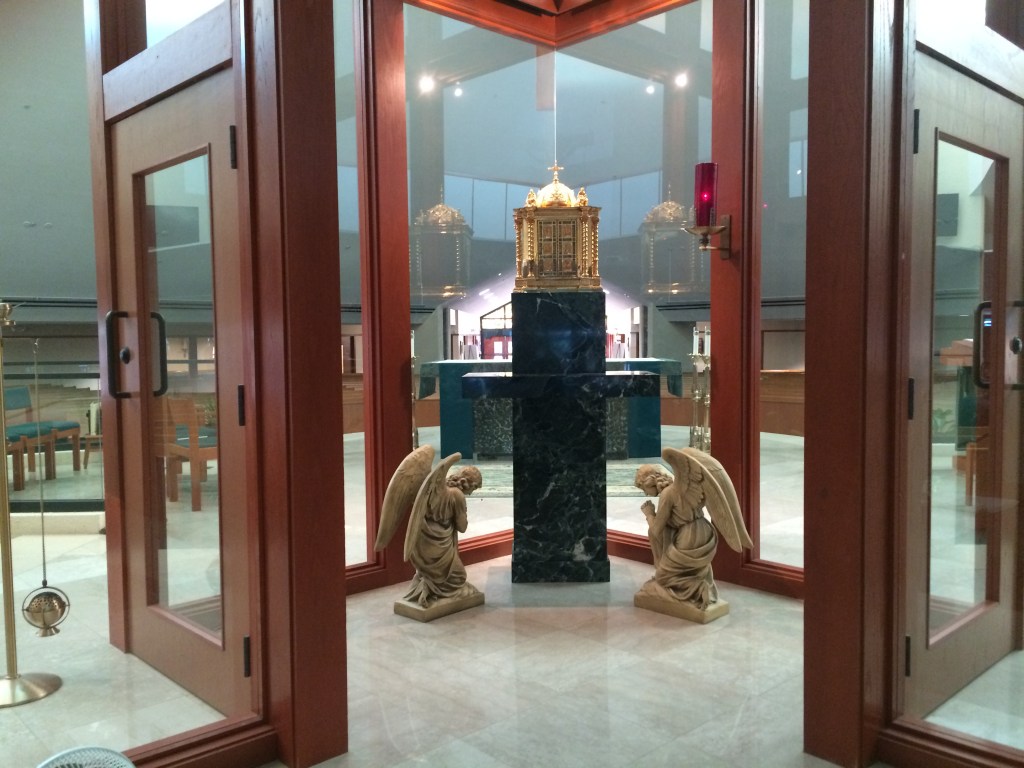
St. John would come into the church sanctuary early each day to prepare for Mass, and each day he witnessed a man sitting in the front pew gazing at the tabernacle. After some days of observing this daily practice, the Curé de Ars approached the man and asked him what he was doing so early in the church each day. The man replied that he was sitting, looking at Jesus, while Jesus was looking at him.
Let us do likewise, approach Jesus today in the way that suits us best, thank him for the gift of his presence in our lives, share with him our needs, and allow him to help us to make our burdens a little lighter. As we go through our day, may we carry Jesus within us and be open for opportunities to share him with others.

Photo: Tabernacle in the sanctuary at St Peter Catholic Church, view from the chapel side. Come and spend some time with Jesus!
Link for the Mass readings for Sunday, July 29, 2018: http://www.usccb.org/bible/readings/072918.cfm

Maples do grow in Florida!

“’Master, did you not sow good seed in your field? Where have the weeds come from?’ He answered, ‘An enemy has done this.’ His slaves said to him, ‘Do you want us to go and pull them up?’ He replied, ‘No, if you pull up the weeds you might uproot the wheat along with them. Let them grow together until harvest” (Mt 13:27-30).

One of my favorite trees is the Maple. When JoAnn, the kids, and I moved to Florida twenty years ago, the thought did not cross my mind that Maples grew in Southern Florida. A few years after we moved into our home, I was walking in our backyard and thought I saw a maple leaf. I squatted down for a closer look and found that not only was it a maple leaf but a sapling with three leaves! I carefully cleared some of the weeds and grass growing among and around it, but otherwise let it be because it was so fragile. As it grew I cleared more around it. Today it is a fully mature Swamp Maple!

About a year ago, I saw a new Maple sapling emerging, though this time, some poison ivy was growing around it. I sprayed poison ivy killer, thinking I was carefully avoiding the Maple. Unfortunately, I must have gotten some of the poison on the Maple leaves because the sapling also shriveled up and died.

I related well to Jesus’ parable in today’s Gospel. The master warned his servants to let the wheat and weeds grow together until they were more mature at the time of the harvest, so as not to pull up the wheat with the weeds. Weeds in this verse is translated from the original “Greek [as] zizanion [which] refers to a noxious weed that in its early stages closely resembles wheat and cannot be readily distinguished from it” (Harrington 2007, 204). Both, in their immature state, were indistinguishable.

We may resist the temptation to be quick to judge another. Even when there are those who commit heinous acts of evil, we may feel justified in our judgment and condemnation. Jesus says no. We may convict the person of their action and we are certainly to hold each other accountable, but judge and condemn, no. The Father is the ultimate arbiter and judge.

All of humanity has been created in the image and likeness of God, each of us are a unique gift to this world, we have been created good, yet all of us fall short of the glory and grace of God. God the Father will judge at the end of time and only he knows the time or the hour. Let us leave the judgment to God, and let us rather to be about following the teachings of Jesus, repenting, and encouraging each other in the maturation process which can include, convicting others when needed, but condemning, no. As St Paul wrote: “We who are strong ought to put up with the failings of the weak and not please ourselves” (Romans 15:1).

May we resist the temptation to spread the poison of judgment, gossip and condemnation, otherwise we are promoting division and a culture of death. Let us instead welcome, nurture and care for one another, promoting unity and a culture of life. May we pray for patience, understanding, and the ability to seek forgiveness in our interactions, as well as be willing to forgive each other. Life, even when going well, is hard. We need the encouragement and support of each other if we are to mature and actualize the fullness of who God calls us to be. “Encourage each other while it is still today” (Hebrews 3:13).
—————————————

Photo: Our Maple tree enjoying the sunrise this morning, much more mature than the little sapling I discovered about twenty years ago (As to why I picked this picture, you may read the full reflection by clicking the link to my blog below).

Mass readings for today, Sunday, July 28, 2017: http://www.usccb.org/bible/readings/072818.cfm

Harrington SJ, Daniel J. “The Gospel of Matthew”. In vol. 1, Sacra Pagina Series, edited by Daniel J. Harrington. Minnesota, Liturgical Press, 2007.

Not choked by vines, and thorns, but maturing in Jesus!

In the Gospel today, Jesus shares with us his Parable of the Sower. Their are four settings in which seeds are sown. Some fall on the path, some on rocky ground, some among thorns, and some on rich soil. I would like to primarily focus on the seed sown among thorns today.
From this perspective, our hearts, minds and souls are open to know him more. We have some understanding of our faith, it has not been stolen away because our hearts are not completely hardened like those on the well trod path. Nor have we allowed a hyper sense of cynicism, scientism, secularism, or relativism to steal our joy away completely. We have endured some times of stress and trial and our faith has not diminished but endured. Jesus has taken root in our heart, unlike those suffering from rocky soil.
Most of us would fall into the third category: “The seed sown among thorns is the one who hears the word, but then worldly anxiety and the lure of riches choke the word and it bears no fruit” (Mt 13:22). Jesus is a part of our life, we are growing in our faith, but our maturation, and bearing of mature fruit is diminished. We are limited because Jesus is only a part of our life, not the core foundation. This is because we look to the world and its false promises to be our security and support.
Pope Francis questioned in his apostolic exhortation, The Joy of the Gospel: “How can it be that it is not a news item when an elderly homeless person dies of exposure, but it is news when the stock market loses two points? This is a case of exclusion. Can we continue to stand by when food is thrown away while people are starving? This is a case of inequality” (Francis 2013, 53). How often is it that the top voting issue in our national elections has to do with concern about the economy?
If we are placing our hope and focus, if our primary source of building for ourselves a  secure foundation is in the political and economic realm, we are going to be consistently anxious and stressed. Our faith is going to be choked, and worse our politics will be shaping the Gospel instead of the Gospel shaping our politics. We will justify and rationalize behaviors from our leaders that are contrary to living our life aligned with the teachings of Jesus as long as the economy is going well.
These subtle vines of false security also promote a privatization of our faith. If we seek to counter and challenge injustice, if we call for an awareness of those who are vulnerable and suffering, if we call out actions that are immoral, we can face the backlash of being accused of stamping on an individual’s personal rights, regarding speaking out for the rights of the unborn; being unpatriotic, when protesting by taking a knee for the inconceivable number of unjust killing for people of color by police;  a socialist or a leftist, by seeking to keep migrant families together, to provide safe haven for asylum seekers or refugees. We become anxious and stressed because we want to belong, to be liked, to be a part of. Taking the risk to be “God’s microphone”, to speak the Gospel publicly, is challenging today because: “The process of secularization tends to reduce the faith and the Church to the sphere of the private and personal” (Francis 2013, 64).
To live our faith means more than just doing so in our own home. This is certainly a good start. But if we are to mature as disciples of Jesus, we are going to need to resist the false lures of riches and material security, we are going to need to be willing to face the anxieties of criticism and hostility for speaking the truth of our faith. The unfortunate part is that we may face a lot of push back from those of our brothers and sisters within our own churches, the Body of Christ.
We can mature as disciples when we are willing to commit daily to reading the Bible, seeking resources to better understand his word, praying and meditating, pondering on the teachings of Jesus, and so better have the eyes to see and ears to hear his Word and guidance. As we build our foundation on Jesus and his teachings, build a support group of those of like mind and support, we can share with others the trials and successes of our journey of faith. These small acts will make a tremendous difference.
Courage is a mark of feeling the fear and doing what we are inspired to do. Let us call on the name of Jesus when we are tempted to place our trust in anything other than our loving God and Father, may we call on the love of the Holy Spirit to give us the words to speak and the actions to impart, with understanding, and kindness, when we are in the midst of unjust, disrespectful, or dehumanizing words or actions.
We need to trust in Jesus’ invitation. He is calling all of us to deepen our relationship with him and to invite others to do the same. The road ahead, and the trials we will face will not be easy. But as we face them, with Jesus and one another, we become stronger. We begin to mature and bear fruit when we allow Jesus to be our constant source, our foundation. Sustained by his power we can then act with courage and put into practice what we learn.
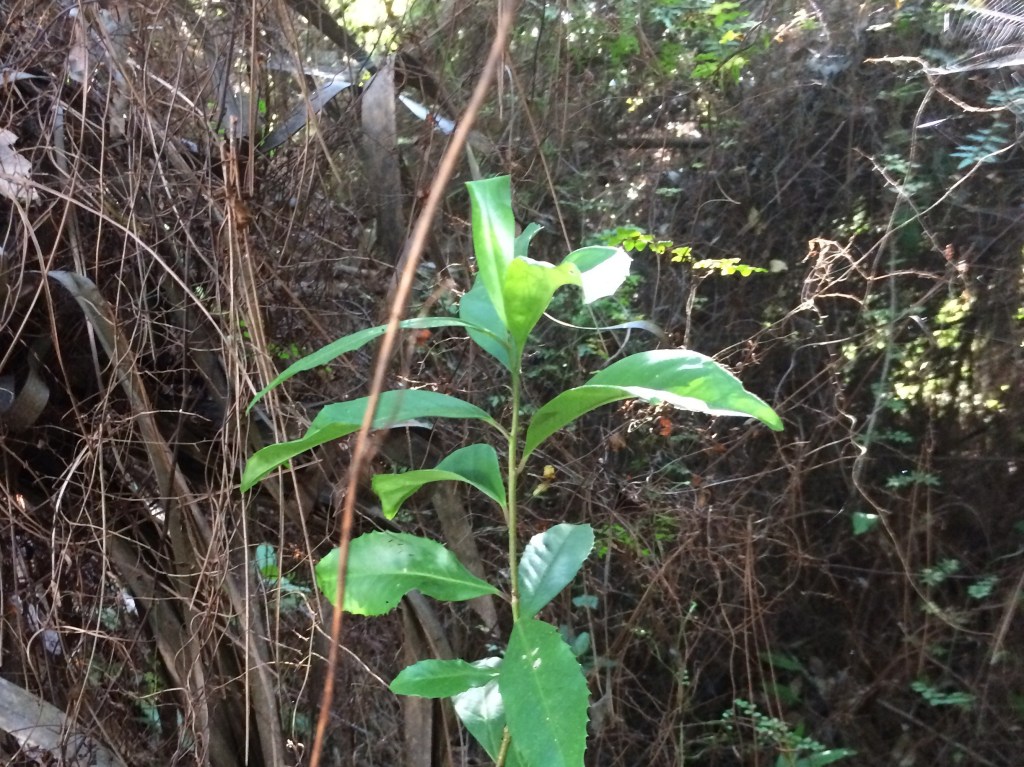
When we are choked by vines of temptation from apparent goods and false senses of material security that seek to lull us into complacency and indifference, when the tendrils of anxiety and fear squeeze at our heart and throat to keep us indecisive and unresponsive to God’s call for us to act beyond our comfort zone, to step out in love, we need to remember that we are not alone. May we call on Jesus, trust in him, reach out to our brothers and sisters in faith, so to cut away the vines and thorns, all that is not of God, that attempt to choke us. Over time our soil will become richer, the Love of the Holy Spirit will increase in our hearts, minds, and souls, we will begin to see others through God’s eyes, we will become more human, more open to a maturing relationship of communion with our loving God and Father and each other, that bears mature fruit of love, joy, peace, patience, kindness, goodness, gentleness and self control.
——————————————————————
Photo: Plant in our backyard, like us who place our trust and build our foundation in Jesus, growing and maturing free of the vines that attempt to choke it.
Pope Francis. Evanglelii Gaudium: The Joy of the Gospel. Frederick, MD: The Word Among Us, 2013. Link for online access:
http://w2.vatican.va/content/francesco/en/apost_exhortations/documents/papa-francesco_esortazione-ap_20131124_evangelii-gaudium.html
Link for Mass readings for today, Friday, July 29, 2018 http://www.usccb.org/bible/readings/072718.cfm