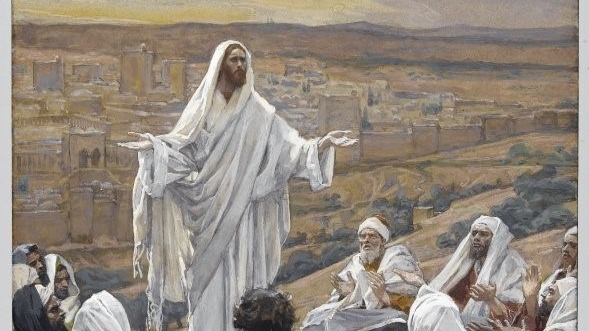
May we open our heart to the Holy Spirit and place our hand in Jesus who will lead us through the narrow gate.

“Enter through the narrow gate; for the gate is wide and the road broad that leads to destruction, and those who enter through it are many. How narrow the gate and constricted the road that leads to life. And those who find it are true” (Mt 7:13-14).

Jesus meets us where we are in our present state of life. He accepts us as we are in this very moment. At the same time, Jesus does not want us to just settle, to be minimalists and merely get by, surviving day by day, but instead he guides us to be fully actualized. He calls us to perfection, to holiness, to be saints! He sees in us, as he did in his disciples and apostles, the promise of our potential and who his Father calls us to be. We each have a unique gift or gifts to offer to the world, each and every one of us.

Entering the narrow gate means that we need to say no to those apparent goods and half truths that will in the end, burden us, weigh us down, and ultimately lead us to emptiness. So not to aimlessly stand outside, to pass through the narrow gate, we need to say yes to that which will truly bring us happiness and fulfillment. We will also need to say no to supporting our false ego and our slavery to sin; to fear, anxiety, and worry such that we turn in on ourselves. May we instead say yes to going out from ourselves and willing the good of and accompanying others.

Let us spend some quiet time in prayer today with Jesus, seeking and discerning his will and listening for his guidance. What thought burdens of worry, anxiety, or fear; pride, judgement, or prejudice; what sinful actions, habits, or addictions can we say no to and let go of? May we open our heart to the Holy Spirit to give us the courage to do so. May we place our hand in Jesus’ hand today, allow him to lead us off the broad road that leads us to sin and destruction, so to pass through the narrow gate with him that will lead us to experience the love, mercy, and grace of God Our Father. What Jesus guides us to do, he will also give us the strength and resources to bring to completion. Our completion is to be fully alive, to experience a life of joy to the full, and assist and support others in doing the same.


Photo credit: Photo by Rene Asmussen from Pexels

The Mass reading for Tuesday, June 26, 2018:

http://www.usccb.org/bible/readings/062618.cfm

May we lay down our gavels of judgment and instead accompany one another with love and mercy.

For many of us, judging one another is almost as automatic as breathing. As we encounter someone we have instant internal judgments, we judge looks, clothes, actions, inactions, homes, cars, and material items. We judge our family, spouses, friends, colleagues, classmates, leaders, enemies, celebrities and those on the peripheries. Much of what gets our attention when we take the time to think about it is what Jesus is addressing in today’s Gospel, negative judgments.

Jesus said to his disciples: How can you say to your brother, ‘Let me remove that splinter from your eye,’ while the wooden beam is in your eye? You hypocrite, remove the wooden beam from your eye first; then you will see clearly to remove the splinter from your brother’s eye” (Mt 7:4-5).

There are positive judgments that bring about effective change for the good. In a court case, our hope is that the judge is learned in the law and guides the lawyers and jury in ways of sound judgement such that justice with mercy is served. For us to do likewise in our everyday interactions with one another, Jesus shares that we need to remove the wooden beam from our eye first before we are able to remove the splinter in another.

Jesus is leading us to be transformed. We need to have a change of heart, one that is not hardened by negative judgments of others based on our biases and prejudices, but a heart softened, one that is lead by the mercy and love of Jesus. This does not mean that we accept any and all behaviors from ourselves and others. Jesus does not do this. Jesus accepts ALL people as we are and where we are, with mercy. He is willing to enter our chaos, to embrace any and ALL of us who will receive his healing embrace, and through his love Jesus accompanies and walks with us, leading us from our slavery of sin to that which is True, Good, and Beautiful.

We participate with Jesus in doing the same as we allow him to heal us from our own limitations of self centered perceptions, from our anxieties, fears, and prejudices, and so come to see others as God sees them, as human beings endowed with dignity, because ALL people have been created in the image and likeness of God. We participate in building the kingdom of heaven when we allow God to love others through us, to bestow his mercy on others through us. We participate in Jesus’ work of redemption when our judgments toward ourselves and others are not condemnations but convictions that help to empower, build and lift up our brothers and sisters. We participate in taking the log out of our own eye and assisting to remove the splinter in another’s eye when we resist imposing on another and leaving them alone to bear the weight and burden of our judgment, and instead are willing to take another by the hand and accompany them, to be yoked with them, to journey side by side together, helping each other to be transformed into who God is calling us to be.

May we lay down our gavels of judgment, bias, and prejudice today, and instead, with an open heart on fire with the love and mercy of the Holy Spirit, offer our hands to one another, and together with Jesus, hand in hand, arm in arm, be about building the kingdom of God together.


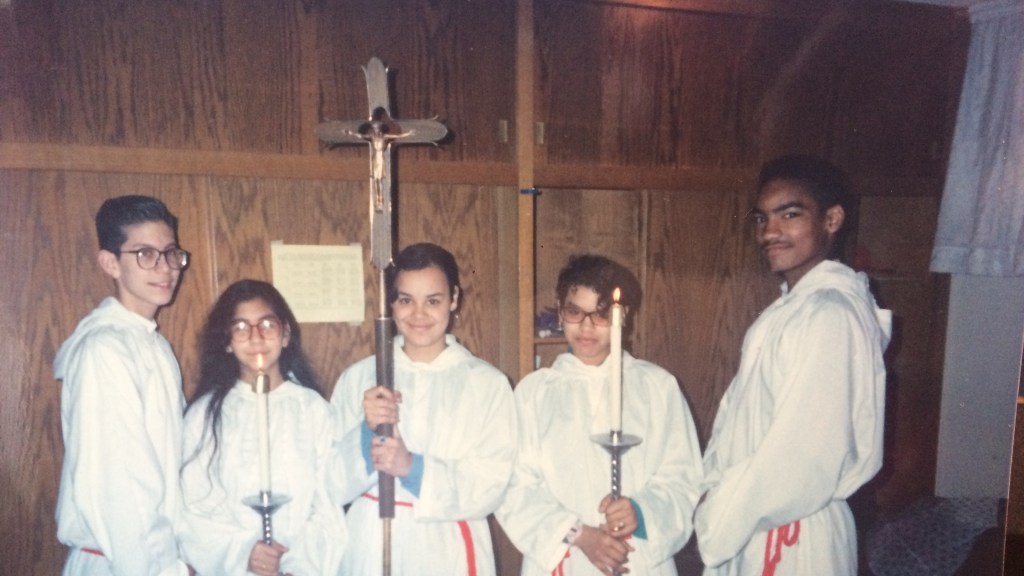
Photo: One of the altar server teams of one hundred altar servers I was blessed to train and serve with at Holy Cross Parish in the Bronx, NY, around 1991.

Link for the Mass readings for Monday, June 25, 2018:

http://www.usccb.org/bible/readings/062518.cfm


Our identity is on solid ground when we are people of integrity.

“No. He will be called John” (Lk 1:60).

With these simple words three inter-related points arise. First, Elizabeth is beginning to shift the momentum of original sin. Eve was tempted by the serpent to eat of the fruit that God had told her and Adam not too, yet she did. Adam did not support her in her dialogue but remained silent in the face of the pressure placed upon Eve, both of them slipped into sin, by not following the will of God.

At the time of the birth of Elizabeth’s son, there was cause for celebration, for Elizabeth was past child bearing years. The day had come to have him circumcised and named, her relatives and neighbors had gathered around with great excitement and there appeared to be a unanimous decision to name the boy after his father. Elizabeth did not, like Eve, cave to the pressure and temptation. Unlike Adam who lost his voice at the time he needed to speak up, Zechariah found his voice, had Elizabeth’s back and followed the will of God. Both Elizabeth and Zechariah knew what God wanted them to do, and were faithful to follow through.

The second point is already alluded to in the first, and that is how Elizabeth and Zechariah were faithful to God even amidst the familial and social pressure placed on them. We may be removed by such social pressure when naming a child, although some of us may still have experienced this pressure. Elizabeth held her ground and stood firm that the boy would be named John. Ignoring her, the people deferred to Zechariah, the boy’s father, thinking he would have more sense, but he, ignoring the paternal cultural pressure, supported Elizabeth. The point here is not so much the name, but the following of the will of God in the face of pressure to do the opposite.

This brings us to the third point and that is the maturation in moving from identity to integrity. Culture and traditions are not sacred, but God is. Elizabeth and Zechariah faced a lot of familial and social pressure to conform, yet they chose to be true to God, to be true to themselves, and they chose their integrity over their identity.

The very simple account of Elizabeth and Zechariah naming their child John in opposition to the familial and societal pressure offers for us a way to counteract the rising tide of polarization and conflicts that we face in our own country today. Identity provides safety, support, and security. It fuels one of our deepest hungers and that is to belong, to be a part of something bigger than ourselves. We can find our identity in family, friendships, our religious traditions, culture, political affiliations, common interests, clubs, activities, and hobbies. But our identity, which provides us with security, can also be a trap.

We want to belong so much, the drive is so strong, that we may be willing to make decisions, act in ways, and support others, that go against who we are, just so we can belong. We may not be true to ourselves and what we believe in to be part of the group. We may know what God wants from us, we may hear the whispers of his voice in our conscience, yet we are pulled by the louder voices of our group. We are sometimes so engrained by our identity that we are being strangled by it, instead of freed to be who God calls us to be.

Elizabeth, and Zechariah bring God to their family and neighbors by being true to who God calls them to be in the face of pressure. Many times being a person of integrity does not go so well. Their own son, who would grow to be John the Baptist, would lose his life, by speaking truth to power. But by being a person of integrity, like his parents, he would be the bridge from the old covenant to the new. Identity and tradition are important, but for identity to be true and to grow, it must be open to the truth, it must be open to integrity.

Instead of sharing what I believe or what I feel God has called me to say, instead of facing conflicts, real and/or perceived head on, there have been too many times in my life in which I have been frozen by indecision or chosen silence so to protect my identity, my ego, my false self, instead of accessing moral courage and embracing integrity. One thing that has helped me this past year is reading and studying the Gospel readings of the day. Time and again I have witnessed how Jesus is a model of integrity. Jesus embodies the moral courage that we all need today. Though more than just a model of a life well lived, more than just a word on the page, Jesus is the Word of God. Jesus is present to us now, to guide and lead us, to empower us with the same love that he embodies, such that when we say yes to him and invite him into our life, we too can be transformed to live a life of truth, moral courage, and integrity.

May we give ourselves a moment to be still today and reflect on those times in which we have chosen our identity over being people of integrity. When have we supported something we know is clearly wrong only because we are supporting our group? A good way to see this is when we judge the same act differently only based on who is doing it. Person A in my group does Act X and I defend him. Person B, who is not in my group, does Act X and I condemn her. Also, let us recall when God has inspired us to speak or act, even in simple ways of kindness and caring extended out toward another, and we refused because we feared the reactions or judgments of others.

May we follow the lead of Elizabeth and Zechariah, and their son John the Baptist from today’s Gospel and pray for one another that we may hear the word of God and act upon it. May we be able to turn away from supporting the identity of our own false self, that enslaves us through fear, so to be people of integrity and moral courage by listening to our consciences again. May we be willing to act and speak up when there are those that are belittling, demeaning, dehumanizing, and/or not respecting our dignity or the dignity of others on and individual and societal level, no matter who it is that is doing so. May we be willing ourselves to treat each other with dignity and respect, whether we are in the same group of identity or not.


Photo: accessed from http://www.pexels.com

Link for the Mass readings for Sunday, June 24, 2018:

http://www.usccb.org/bible/readings/062418-day-mass.cfm

 

Regarding immigration, we can serve our anxiety, worry, and fear or serve God and one another.

In today’s Gospel from Matthew, Jesus draws a direct correlation between our level of worry and our faith. Having faith is a common theme throughout Jesus’ teaching. How many times have we read or heard, “O you of little faith” (Mt 6:30). At its core faith is that we trust what Jesus says is true. If we are feeling anxious or worried our focus is dwelling on the past, rehashing something we did or did not do, not sure if we made the right decision, or we are anxious about the future, what might be. We also may react to another’s actions or words, stay fixated or focused on them, and/or stay stuck in our emotions of the situation.

In each of these occasions we are not focusing on God, we are not trusting in him, we are exercising little faith because our focus is on our self. Jesus is telling us that, “No one can serve two masters” (Mt 6:24). Either we place our self first or we place God first. Jesus is guiding us to put God first in our lives and to trust in him.

Anxiety, worry, and fear, can be debilitating and paralyzing. So many of us deal with it to some extent. What many families are now experiencing though, those fleeing their homes, making the perilous journey to get to what many believe to be a land of promise and hope, then to find that they are turned away, arrested or separated, some 1,800 plus children not knowing if they will ever be able to see their parents again, is terrifying and traumatic. The anxieties, worries, and fears I have experienced in my life pale in comparison.

The other side of the coin, are the anxieties, worries, and fears that have and contribute to this situation. Through the history of our country too many have placed their trust and faith in anxiety, worry, and fear. Native Americans, African Americans, Irish, Germans, Catholics, Japanese, and now Latinos have been demeaned, dehumanized, and feared, instead of heard and encountered. Difference and diversity, terrorists, increased violence, job loss, out right self interests, prejudice and bigotry have fed and continue to feed the dark side of our fallen nature.

Jesus’ words provide a starting point for shifting the momentum of the cycle of enslavement to our anxieties, worries, fears, and prejudices. We need to be aware of and turn away from them and instead, “seek first the Kingdom of God and his righteousness, and all these things will be given you besides” (Mt 6:33). There is a way that we can bring about immigration reform, but we must begin by acknowledging that those seeking to come to our country are human beings, we need to trust that God will provide for all who have need, and lead us to live in community. This starting point also needs to be true for the rich diversity of people who already live in this country now.

The greatest perpetuation of injustice is that too many of us isolate ourselves from one another. We isolate ourselves in our own tribes and camps, we resist embracing the gift of our diversity and so do not get to know one another, we give in to the fears that support our prejudices, we don’t want to rock the boat or deal with conflict head on, so we don’t speak up or out, we want someone else to fix the problem. When the storm comes we tend to want to run away from it. Instead we need to be like the buffalo that used to roam the great plains in vast numbers. When the storm was building over the plains, they would run into the storm, knowing that as they did so, they would get through it quicker.

May we embrace our faith in Jesus so to face our own storms of anxiety, worry, and fear when they arise, trust in God, and together face them. In this way, we will resist division and instead work for unity, resist the language of dehumanization and hate, and instead promote solidarity and love. May we trust and embrace the courage to come out from hiding in the shadows of our anxiety, worries, and fear, and instead hold high the flame of the Holy Spirit so to light a path of hope that is grounded in our faith, that what we do the least of our brothers and sisters we do to Jesus. May we begin today to embrace our mutual gift of humanity and diversity.


Photo: My first communion preparation class, Bronx, NY early 90’s.

Link for the Mass readings for Saturday, June 23, 2018:

http://www.usccb.org/bible/readings/062318.cfm

Being co-redeemers with Jesus in this life so to prepare for eternity in the next!

We have been in our present home here in Palm Beach Gardens, Florida for just about twenty years. This summer we are in the midst of house renovations. It is amazing how fast time has gone, but also how much updating our house needs! We have been tearing up rugs, sealing leaks and filling cracks in the floor, dusting, spackling, sanding, and painting. We have realized that we have been weighed down with that which we gathered, saved, and held on to more than is necessary and have begun to purge. In the same time period our three children have all grown and are now all living in California. Also, on a sadder note our three Golden Retrievers are no longer with us, JoAnn’s mother and two of her aunts, and all of my grandparents have also died.

This is not meant to be a Debbie Downer of a reflection this morning. These opening thoughts are just a practical assessment of the first section of our Gospel from Matthew this morning:

Jesus said to his disciples: “Do not store up for yourselves treasures on earth, where moth and decay destroy, and thieves break in and steal. But store up treasures in heaven, where neither moth nor decay destroys, nor thieves break in and steal. For where your treasure is, there also will your heart be” (Mt 6:19-21). Jesus is helping his disciples to be aware of the reality of our world. All that exists is finite and material. Each thing, each being, has a beginning and an end. We need to resist the temptation to be attached to anything, even to our family and friends, because in this life nothing lasts forever.

The danger with not placing attachment in material things is that we may be drawn to the opposite extreme of placing no value in created things, thinking that we can destroy and abuse the environment, because it will not last anyway. We can also be tempted to see all things not spiritual as corrupt and bad, even our material reality as human beings, such that our soul is imprisoned until we die. This extreme will not bring us happiness, joy or fulfillment either.

Today may we seek to live a balanced life of recognizing that all that is material and finite has a time and a season, while at the same time is part of God’s plan. May we seek to be participants in God’s eternal plan of salvation, enjoy the wonders and gifts of his creation, but resist being attached to them beyond their time. In this way, we can resist holding on and clutching to the material and finite, so to be less apt to be weighed down by them and freer to embrace the steady move of the Holy Spirit, who is leading us to change and to mature in our relationship with our loving God and Father and one another.

Knowing that our time here on earth is limited, may we resist taking one another for granted or worse belittling, demeaning, and dehumanizing one another. Instead may we empower and show greater appreciation for each other. May we strive to be present and accompany one another. May be kinder, more supportive, and encourage one another. May we let go of attachments so that we may let those petty things go and embrace the love that Jesus inspires us to live, so to be there for one another through thick and thin.

May we set our sights on the promised land of heaven, embrace the truth that we are called to be co-redeemers with Jesus, so that we may help and be there for one another now in this life as we journey together so to “store up treasures in heaven where neither moth nor decay destroys, nor thieves break in and steal” (Mt 6:20).


CN grads heading into the summer to store up treasures in heaven!

Link for the Mass readings for Friday, June 22, 2018:

http://www.usccb.org/bible/readings/bible/matthew/6:19

Praying the Our Father with Jesus, mindfully.

Prayer is not so much about bending God’s will to our will, but it is about our transformation and conformation, a freeing ourselves from the sole focus on ourselves as the center of the universe. The world actually does not revolve around us. But we are invited to build a relationship with the One who is the creator and sustainer of all that exists.

Jesus guides his disciples on this point when he teaches them how to pray. Jesus said to his disciples: “In praying, do not babble like the pagans, who think that they will be heard because of their many words. Do not be like them. Your Father knows what you need before you ask him” (Mt 6:7-8). Jesus is sharing that words matter and have meaning in everyday life as well as in prayer. The words that we speak are to be transformative, not just mindlessly evoked or invoked. Formulaic expressions and the mere volume of words means very little compared to a few words said with clear intent, focus, and in a mindful way.

Jesus is helping us to understand that the form or the words do not so much matter as understanding why we pray. We pray to deepen and develop our relationship with the trinitarian communion of God the Father, God the Son, and God the Holy Spirit. The very desire to pray is a prayer in itself, because we are hearing the invitation of God to be one with him. The first step is to acknowledge this invitation and then to turn our heart and mind to God. Thomas Dubay, in his book, Fire Within, paraphrases St. Teresa of Avila, the 16th century doctor of the Church, in saying that “one vocal prayer, even so little as one petition of the Our Father, if well said, is better than many recited thoughtlessly or hurriedly” (Dubay 1989, 76).

Reciting the Our Father, or Lord’s Prayer, that Jesus shares with his disciples in today’s Gospel of Matthew can be a struggle, because the biggest challenge to a life of prayer in the beginning is taming, what Buddhists call, the “monkey mind”. Our thoughts continually are active and random, distracting and leading us away from our intended course when undisciplined. To overcome this challenge we can return to St Teresa again.

When we begin to pray, St. Teresa of Avila suggests that we begin “with self-examination and the sign of the Cross” (Dubay 1989, 77). In this way we can bring to awareness some issues, struggles, temptations, and sins that we have been dealing with. We can settle into them, instead of run from them. In so doing, we bring our self, as we are, into the presence of the Trinity. By then making the sign of the Cross, we receive and experience the love, acceptance, and mercy of God and recognize that we are loved as we are, and that we are not alone because we belong and are a part of this infinite community of love. In this simple gesture we are also uniting our body, mind, and soul with the One who will lead us in our prayer.

The next step is to imagine that Jesus is with us to guide and lead us in our prayer, just as he did in today’s Gospel account (Mt 6:9-15). “Imagine that this Lord Himself is at your side and see how lovingly and how humbly he is teaching you” (Dubay 1989, 77). By mindfully engaging in these two beginning steps, we slow ourselves down from our pace of running from ourselves, we become still, we are able to breath, and allow ourselves to experience the presence of Jesus.

From this point imagine Jesus teaching you the Our Father as if for the first time, as he did his disciples. Go slowly, one word, one verse at a time, allow Jesus to not only share the words again with you, but also to insert his commentary as to what each of them mean. In this way we begin to discipline and turn our mind to God such that we can receive the blessing of his mercy and love. “Focusing on the indwelling presence, says Teresa, is for wandering minds ‘one of the best ways of concentrating the mind’ in prayer” (Dubay 1989, 77).


Photo: James Tissot, The Lord’s Prayer by Online Collection of Brooklyn Museum; Photo: Brooklyn Museum, 2006, 00.159.167_PS1.jpg, Public Domain, https://commons.wikimedia.org/w/index.php?curid=10904489

Dubay, S.M., Thomas. Fire Within: St. Teresa of Avila, St. John of the Cross, and the Gospel on Prayer. San Francisco: Ignatius, 1989.

Link for the Mass readings for Thursday, June 21, 2018:

http://www.usccb.org/bible/readings/062118.cfm


Let us not be hypocrites, but disciples of Jesus.

Jesus continues his Sermon on the Mount today. We have been graced thus far with the teachings of the Beatitudes, being salt and light, as well as the six antithesis we have been reflecting upon over the past week. Today, Jesus presents common practices of living a life of faith. The key point he is making though has again to do with our end goal. As discussed yesterday, as his disciples we are called to be “perfect just as [our] heavenly Father is perfect” (Mt 5:48). Again perfection here is that our telios, or end goal, is to be one with God. We are striving to become holy, to be saints, for the purpose of deepening our bond and relationship with God.

Our being perfected in Jesus is a process whereby we become less and Jesus becomes more. What decreases is our focus on self, especially the ego self, our sense of self-centeredness. Jesus provides for us three ways in which we can practice drawing closer into communion with God and one another. We are to give alms, pray, and fast. We may remember these being the three pillars of Lent that we put extra emphasis on during that penitential season.

Jesus cautions his disciples and us. When we can give alms, pray, and fast, our intent must be properly ordered. If we give alms with the intention to “win the praise of others” (Mt 6:2), pray in a public display “so that others may see” us (Mt 6:5), and in our fasting “look gloomy” and “neglect [our] appearance, so [we] may appear to others to be fasting” (Mt 6:16), we are hypocrites, because in each of these actions, we are not seeking to improve our relationship with God, nor to build up his kingdom. The intent is to build up our own pride and ego, the focus is on us.

We are called to give of ourselves to others in a service of love, so that others may be empowered, strengthened, and grow in their faith life, so they too may join us in building up God’s kingdom. We are to seek Jesus in prayer with the intent of receiving the purifying fire of the Holy Spirit that we may be purged of that which feeds our false self so we can be freed of the dross of our accumulated sin, our imperfections, and that which we are attached to. In our time of prayer and examination of conscience, Jesus reveals to us that which we have an unhealthy attachment too, that which keeps our focus on ourselves instead of God. It is to these areas that we can fast from. In this act of the will, we choose God over self and continue to mature into who he calls us to be.

May we make some time to pray today and ask Jesus to reveal to us where it is that we are putting ourselves before God, what patterns and habits of sin keep us bound to our own pride and prejudices, and what is it that we are attached to, again that is enslaving us and keeping us from being free to be who God calls us to be. Prayer, fasting, and almsgiving is not only for Lent. There are many people that need God’s support and help right now. We are to be his hands and feet.

Let us not be hypocrites, but disciples. May we listen to our consciences, resist the temptation of indifference, and pray for the those unjustly detained and separated. May we also seek through action how we may be of help to so many being interned and caged. May we pray and serve to counteract the no tolerance policy enacted by Attorney General Jeff Sessions. We need to speak up for the many who do not have a voice, and call out these actions of President Trump and his administration for what they are: sinful, inhumane, degrading and immoral.

Using the Bible to support dehumanization was done to condone slavery, and it was used to justify the tearing away of native American children from their parents. That the Trump administration would do so again is nauseating and infuriating. Also, not allowing reporters or congressional representatives in to these camps to report on the conditions of our brothers and sisters, infants and children taken and isolated from their parents and being kept in secret locations is unconscionable and dictatorial.

Let us pray and act. I posted yesterday, June 20, a link from Fr. James Martin on my Facebook page highlighting options of steps we can be engaged in to provide help. Please pray and act as you feel led by God to do so. This policy can be stopped by President Trump today. The separation of parents and their children must stop today. The reuniting of those families separated must begin today.


Photo: credit Getty/John Moore accessed:

https://www.salon.com/2018/06/14/cut-trump-supporters-off-the-horror-of-kids-taken-from-immigrant-parents-demands-personal-action/

Link for the Mass readings for Wednesday, June 20, 2018:

http://www.usccb.org/bible/readings/062018.cfm

Proverbs 22:22-23

“Injure not the poor because they are poor, nor crush the needy at the gate; For the Lord will defend their cause, and will plunder the lives of those who plunder them.”
– Proverbs 22:22-23
The Lord will free those who have no one to help them.
  • He himself will come to save the poor.

Midafternoon reading and response from the Liturgy of the Hours, Tuesday, Week III.

Photo: Canopy of the grandfather oak. When we first moved to East Windsor in 1970, this was a fully mature oak, and there were no other trees even close to it. It is still standing strong these 48 years later.

Deuteronomy 15:7-8

“If one of your kinsmen in any community is in need in the land which the Lord, your God, is giving you, you shall not harden your heart nor close your hand to him in his need. Instead, you shall open your hand to him and freely  lend him enough to meet his need.”
– Deuteronomy 15:7-8, Midday reading from the Liturgy of the Hours

Photo: Base of the grandfather oak

Jeremiah 22:3

“Do what is right and just. Rescue the victim from the hand of the oppressor. Do not wrong or oppress the resident alien, the orphan, or the widow, and do not shed innocent blood.”
– Jeremiah 22:3, Midmorning reading from the Liturgy of the Hour

Photo: path leading to grandfather oak behind my parent’s house in CT.