Resisting being defined by our identity and risking to live a life of integrity

In our growing global and increasingly interacting world, a sense of pluralism, the recognition and affirmation of diversity and peaceful coexistence has become more and more of an ideal. In and of itself, the embracing of diversity is good. Especially when we have and continue to experience and see such atrocities committed in the name of “tribalism”. What can be a dark side of pluralism though, is that for the sake of getting along we are not true to who we are, we limit our public discourse so as not to offend.

Identity is also not to be held up as the sole model either. Because identity has a dark side as well in that we can easily slip into a defensive posture when we feel our identity is threatened. This is why we are told that if you want to have a conflict free conversation you may want to avoid speaking about politics, religion, and I forget the third. The reason is that in these areas we identify ourselves with our personal beliefs and if someone critiques or criticizes our beliefs we feel personally threatened, and more often than not the dialogue devolves into talking at and over each other.

These thoughts lead me to the opening verses in today’s Gospel from John: Jesus said to Thomas, “I am the way and the truth and the life. No one comes to the Father except through me. If you know me, then you will also know my Father. From now on you do know him and have seen him” (Jn 14:6-7). This may not appear to be a pluralistically sensitive comment if wanting to keep calm at the dinner table. Though it is a statement of truth.

The statement that could raise the hackles of those who are not Christian is “No one comes to the Father except through me.” This may appear at face value to be a very arrogant statement. Unless, Jesus is who he says he is, the Son of God, the Second Person of the Trinity. If Jesus is God, then of course to get to God you will be going through Jesus. Jesus does not say that you have to be a Christian to get to God.

Regarding interfaith dialogue the Catholic Church has come far regarding some dehumanizing stances from the past to embrace a truer interpretation of Jesus’ statement. The Vatican II document, Nostra Aetate, meaning in our time, the first lines of the document, states that the Catholic Church “rejects nothing of what is true and holy… She has a high regard for the manner of life and conduct, the precepts and doctrines which, although differing in many ways from her own teaching, nevertheless reflect a ray of that truth which enlightens all…”

The place to enter dialogue is not to avoid sharing about the truth of our beliefs, but to be able to reclaim the ability to share clearly what we believe and be willing to allow someone else to do the same. We have lost the ability to have a good argument or debate that is founded in the respect and dignity of the person first, an openness and understanding for different and diverse opinions and beliefs, grounded in the ultimate goal of learning and growing from one another.

We can reclaim the gift of dialogue if we are willing to let go of the need to talk at others, to be right, and entrench ourselves in our positions, and instead seek to be more grounded in integrity instead of identity. To grow as a person of integrity means developing the ability to think critically and with a more nuanced outlook, resisting absolutes and black and white thinking. Another line from Nostra Aetate states: “Let Christians, while witnessing to their own faith and way of life, acknowledge, preserve and encourage the spiritual and moral truths found among non-Christians, also their social life and culture.”

Being a person of integrity means we stand up for the dignity of another person because they are a human being, not because they belong to the same gender, political party, religion, or tribe. This is what the parable of the Good Samaritan was all about. Being a person of integrity means we have the courage to hold someone accountable and refuse to look the other way just because they are of the same gender, political party, religion, or tribe. Being a person of integrity means saying what we believe, while at the same time allowing another to do the same and respecting our differences while at the same time being able to share them, agreeing to disagree, and finding common ground where we can. In this way we are more open to growing and broadening our understanding of the people and wonder of the world around us.

Being a person of integrity is not easy. To mature in this way demands courage to speak in the midst of our fear of conflict, of offending, of being wrong. Though to strive for it is worth the effort, for we resist the slow death of cowardice that eats at our soul and experience the soaring heights of joy when we are true to who we are and can be. Let us pray for each other today for the discernment to see what ways we have not been true to who God calls us to be and be willing to risk striving to be people of integrity.


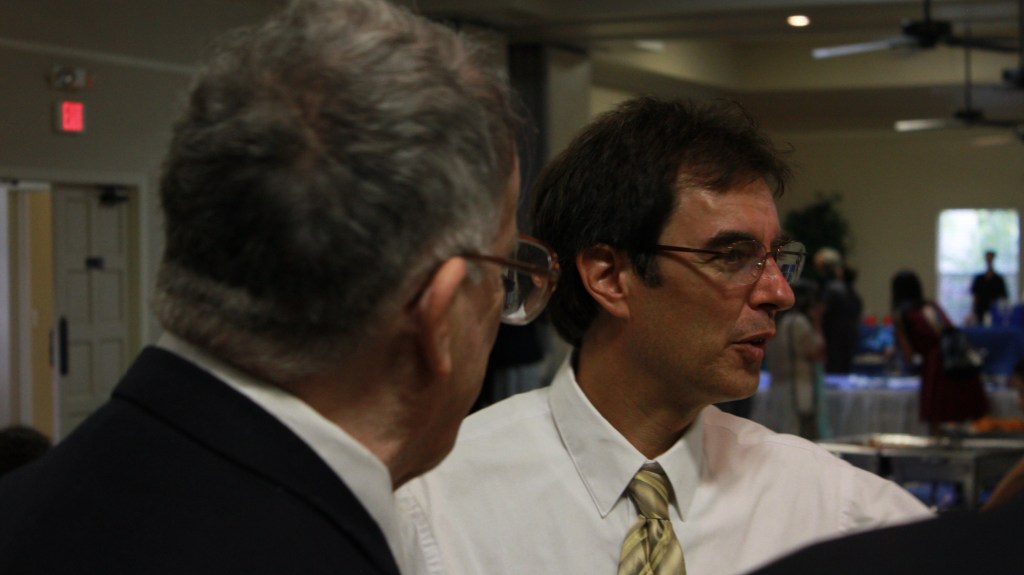
Photo: Far to go but striving to be a person of integrity

Nostra Aetate, Declaration on the Relation of the Church to non-Christian Religions, October 28, 1965. Tr. in Vatican Council II: Vol. I: The Conciliar and Post Conciliar Documents, Costello Publishing, 2004.

Link for the Mass readings for Thursday, May 3, 2018:

http://www.usccb.org/bible/readings/050318.cfm

Connected to Jesus the Vine, we will bear fruit that lasts

In today’s Gospel reading from John we return again to the imagery Jesus used this past Sunday, that of the vine and the branches. As the branch of the vine matures, it begins to look more like the vine itself. As it remains connected, is sustained by the nourishment provided, and protected by the vine grower, the branches become more and more conformed to the vine. This is also true in the event that a branch not originally attached to the vine is grafted to it. Over time, the branches are almost indistinguishable from the vine itself.

Our hope, as disciples of Jesus, no matter what our background, culture, gender, ethnicity, or race will be the same. We are to be one as the Son and the Father are one. As St Paul has written to the Churches in Galatia and Collosse: In Christ there is neither Jew or Greek, circumcision or uncircumcision, male or female, barbarian, Scythian, slave or free because we are all one in Christ (cf. Galatians 3:28, Colossians 3:11).

We are not to be automatons, cyborg, ants, all following mindlessly. It means the opposite, the more we are conformed to Jesus, the more we come to know him and so know our self. We begin to let go of the pressures to conform to that which stunts our growth and begin to embrace who we are, the truth of our reality and dignity. That sense of being fully who we are that sometimes just wants to burst out is allowed to be free when we die to our false self and live in Christ.

Let us resist turning in on ourselves, for if we are disconnecting from the vine, we are detached from the very source of our life. Just as the body will suffer without water regularly, so our soul will suffer if we are separated from the source and foundation, the living spring of our sustenance. Remaining attached to Jesus the vine, means more than just surviving  but maturing and living our life to the full, with joy that reaches out beyond ourselves to others, bearing fruit to share.

We can do so by putting the words of St Paul into action today. “Put on then, as God’s chosen ones, holy and beloved, heartfelt compassion, kindness, humility, gentleness, and patience, bearing with one another and forgiving one another, if one has a grievance against another; as the Lord has forgiven you, so must you also do. And over all these put on love, that is, the bond of perfection. And let the peace of Christ control your hearts, the peace into which you were also called in one body. And be thankful” (Colossians 3:12-15).


Photo accessed: https://www.pexels.com/photo/abundance-alcohol-berries-berry-357742/

Link for the Mass readings for Wednesday, May 2, 2018:

http://www.usccb.org/bible/readings/050218.cfm


Jesus offers us peace, do we want it?

Have you ever wondered why there is so much violence? How many countries, including our own, which were founded on the forceable taking of lands and oppression of aboriginal peoples? Has there ever been a time without war? How many of our youth and citizens have to die from gun violence and mass murders? Road rage, domestic abuse, human trafficking, terrorism – foreign and domestic, and the myriad of random acts of violence are a daily occurrence.
We often hear good will speeches, petitions and intercessions ringing from our pulpits and prayer groups, participate and see people march, and vote for change. There are those working in the trenches, putting their own lives at risk, matching their words and their deeds, yet do any of these efforts make a difference?
Amidst our own experiences, directly and indirectly, and with the constant temptation of cynicism biting at our heels, the words of Jesus are proclaimed in today’s Gospel from John: “Peace I leave with you; my peace I give to you” (Jn 14:27).
The peace that surpasses all understanding, the peace that is not of this world, has been and continues to be offered to us as a gift. Many have indeed said, :”If there is a God, well then, why doesn’t he do anything?” He has. The reality is, the peace that God shares through his Son, is one person at a time. This is why when he resurrected he only appeared to those he chose and not the whole world. Even if he had, these experiences, in time, would have been attributed to mere myth and legend. Jesus must be encountered and build his relationship with each generation. What we pass on as disciples, after encountering him for ourselves, are the ways for others to open their hearts and minds to receive him and enter into their own relationship with Jesus, to accept the gift of his grace that he offers.
The peace that Jesus offers is not some abstract formula, the command to love in not some pie in the sky universal love for all. The acts of peace and love Jesus shares throughout the Gospel are very concrete, individual and personal. Jesus interacts with people as people, not as numbers. He interacts and directs us to do the same, by encountering, accompanying, and loving a person. The real question is not why isn’t God doing anything? The real question is why have we left the gift that he has given unwrapped?
If we want peace, it begins with us. Our heart and mind must be open to want it, to embrace it, to live it in the most minute of details. We are able to receive the gift of peace Jesus offers when we are willing to let go of our weapons of hate, prejudice, cynicism, racism, paternalism, and the like. God created us as beings who are interconnected with one another, which means that what one does affects all, the good and the bad alike. If we want peace, let us spend the beginning, middle, and end of the day opening our heart and mind seeking forgiveness and so better to receive the peace that Jesus offers us, and put it into practice each time we are tempted to do otherwise. Let us “beat our swords into plowshares and our spears into pruning hooks” (cf. Isaiah 2:4).
When we get cut off in traffic, may we extend a gesture in the sign of the cross offering a blessing to be with the person so he or she may slow down and drive safe. When someone says or acts in a way that gets under our skin, may we take a breath, pray for patience and understanding, as we resist the temptation to react. When we make a mistake, let us resist beating ourselves up over the process and instead look to learn from how we have miscalculated.
There are so many ways we contribute to the violence in our world, there are so many ways we contribute to peace in the world. What we need to decide today, is how and where do we want to contribute in our realm of influence? Do we want to receive the peace that Jesus gives and put it into practice now, with each person we encounter? Can we really bring about world peace? Not in some abstract form, for all people, for all time. Yes we can, if we are willing to repent from our contributions to violence, if we are willing to offer one smile, one random act of kindness, one understanding and encouraging word, even to someone who we consider an enemy, one person at a time.

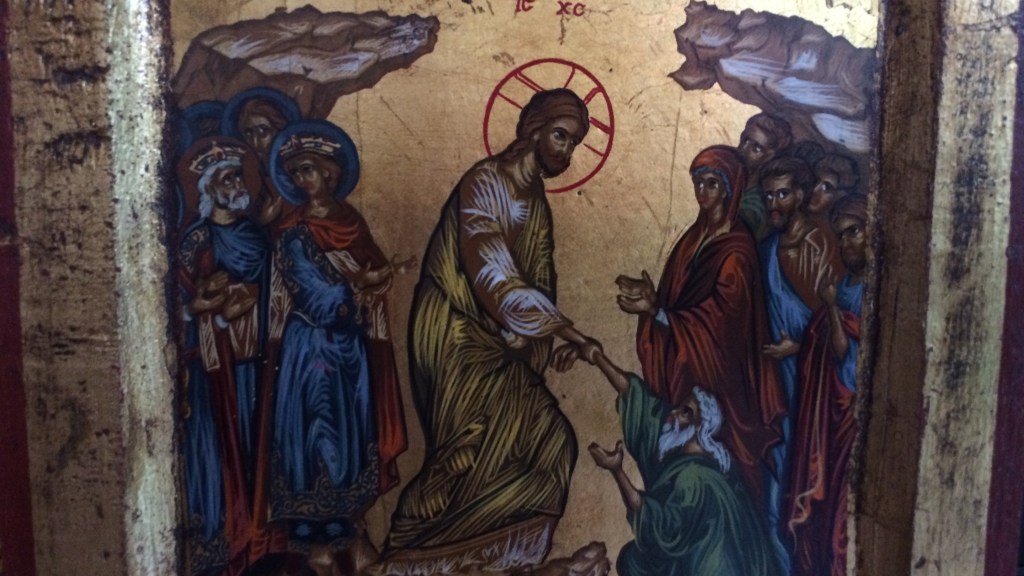
Photo: Of my Eastern Orthodox icon of the Resurrection of Jesus destroying the gates of Hell, and saving our ancestral parents, Adam and Eve, and so us! Do we want to be saved? Do we want his peace? Grasp the hand of Jesus today extended out to us.
Link for the Mass reading for Tuesday, May 1, 2018:
http://www.usccb.org/bible/readings/050118.cfm

Loving AND following the Commandments

Two points jump out of the Gospel of John today: commandments and love. How are each of these related to living life as a disciple? Often, many who hear the word commandments, often react and are immediately put off. There goes the Church again telling me what I can and cannot do. Yet Jesus is connecting the following of his commandments to love.
Now love is another word that evokes reactions. One reason is that, even though the English language has a plethora of words to utilize and choose from, there is only one word for love and it is interpreted in many ways. In Ancient Greek, there are four words that are used to connote love. There is eros, which has do to with attraction. It is the beginning stage of love, because we are drawn out of ourselves as we are attracted to another. The next word for love is philios, which has to do with friendship. This is the love between friends. If our love matures it moves from attraction to friendship. The third word is storge, or the deeper love shared with family members. The fourth word is agape, which is unconditional love.
Jesus sharing that we are to follow commandments is not the dictate of a tyrant. He is providing the boundaries and parameters for us to grow and mature as people who love, who, in the words of St Thomas Aquinas, will the good of the other, as other. As human beings we are social beings. We want to belong, to be accepted, and to be a part of. We seek meaning, purpose and fulfillment in life. This is best done through cooperation and collaboration with God and with one another.
If we operate from a self centered posture in which we are only turned in on our self, and we only seek to manipulate and get from others, instead of working for consensus and sharing a common vision with others, we will ultimately be empty with the exchange on any level, because we will be left wanting more. This is true because once the immediacy of the stimulation, whether material, sexual, drugs, or alcohol, ends, so does the experience of the feeling. Some happiness may linger from the effect, but we will never be filled or satisfied from finite things, so we will seek more and more, until the pursuit of the instant and constant gratification ensnares us and we are entangled in the web of addiction.
The commandments, grounded in love, are meant to provide boundaries for us, training wheels, and to keep us free from enslavement to sin, while at the same time help us to be persons who mature to be other centered instead of self centered. They are meant to be a means of freedom for excellence such that we can become who we desire to be and who God calls us to be. God is not in competition with us. He is our biggest fan, and his glory is the human being fully actualized, fully alive.
Commandments and morality imposed without law is a bludgeon. Love and mercy without accountability and justice becomes enabling. Jesus provides the blueprint for a balanced both/and approach. May we seek this day for opportunities to be loving guides, to align ourselves with the Holy Spirit, who is the Love expressed and shared between the Father and the Son, seeking where we can improve our lives so to be more mindful and whole, to be honest with our weaknesses and where we need to seek forgiveness, while at the same time being understanding with others, meeting them where they are at and encouraging and walking with them such that we can support each other in the truth of who we are called to be.
———————————————————–
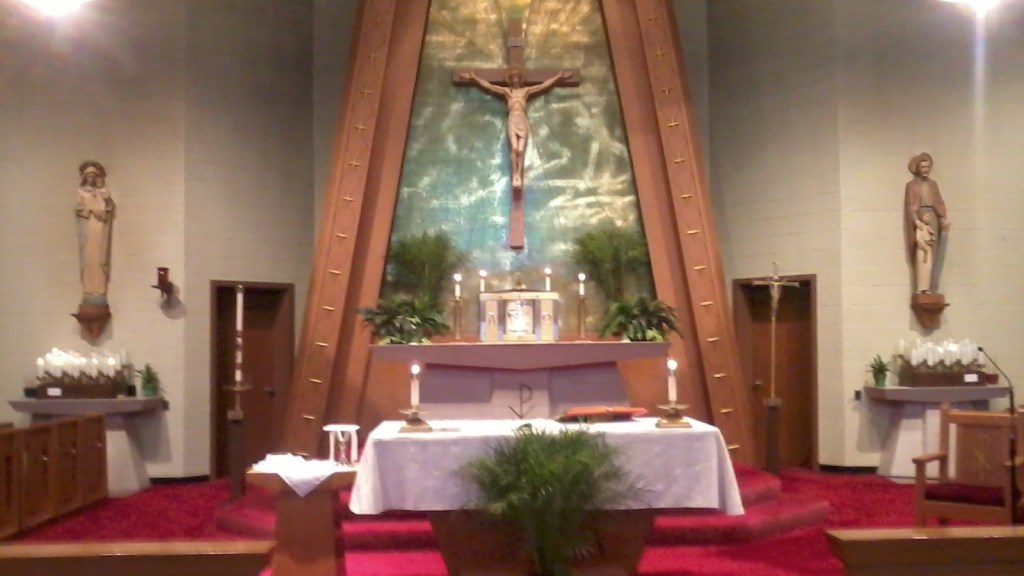
Photo: Sanctuary of St Philip Catholic Church, East Windsor, CT, where I received my First Holy Communion – The Mass a beautiful expression of the both/and of Love and Commandment
Link for the Mass readings for Monday, April 30, 2018:
http://www.usccb.org/bible/readings/043018.cfm


Each of us have our own unique journeys, but none of us have to walk it alone.

John recalls for us in today’s Gospel the imagery of the vine and the branches when he records Jesus as saying, “I am the vine and you are the branches” (Jn 15:5). Jesus used this imagery to show the interconnectedness that his disciples and us today share with him, God, one another, and all of humanity. God is the vine grower, he is our Creator; Jesus is the vine, he supplies our sustenance and nourishment; and we are the branches, we exist, mature, and bear fruit as long as we are connected to the vine and are shaped and cared for by the vine grower.
We are created by God, we are one with Christ, each of us are unique and individual branches, yet at the same time we are interconnected to each other through our connection to the vine. God, the vine grower, provides the nutrients to the soil, cares for the vine, maintains and prunes the branches and protects the branches from being broken or stolen. The vine receives the nutrients and water from the roots and supplies the nourishment needed to each of the branches.
This imagery becomes relevant and practical, when we recognize that the goal of our connection to Jesus is that we are not to merely exist and go through the motions each day until one day we die. We are not only to survive, but we are to thrive. The goal of any vine grower in planting a vine is that it will bear fruit. God within himself as a divine communion of Father, Son, and Holy Spirit, is totally self sufficient, yet he created us to share in his divine life. We are to be participants in the majesty of his creation.
We are to participate in the divine life of his Son, we are to bear fruit. Our sin, is our turning away, our rejecting the life to Jesus working in our life. When we sin we turn in on our self, and in so doing cut our self off from the very source and sustenance of our being. We still may have life in this situation, but we are limiting our self from divine assistance that is available to us.
You might say, “I know atheists that are happy and joyful and appear to be fulfilled.” I do not disagree with you. God has created us with a soul, he created us to be in communion with him, he has created us as a living desire and hunger to be in communion with him and one another, and this is true for the atheist and believer alike. People can still answer and respond to God’s leading and guidance even though they may not be aware or define in any way that they are following God’s invitation.
Some atheists may be responding better to the life of Christ than we practicing Christians. Blessed John Cardinal Newman calls the conscience the “Aboriginal Vicar of Christ”. This is where God communicates with us, engages us, and guides us. We say yes or no in our own way. The mystery of God’s creation and communion is a wonder and a joy to behold. How we interact with him is unique and a gift of free will.
Looking back at my life’s journey, my own stepping stones, I can see times where I have said yes and no to God. The times I have said yes, I have found more fulfillment. Through my Middle School years, to the best of my recollection, we were cultural Catholics, but I led a pretty much secular life. My joys and pursuits were self motivated, self focused, and pretty much turned within myself. Any external interests revolved around sports, a few friends, school, movies and the like. Through high school and into college I began to feel a draw to seek more. I became interested in my native American background and spirituality, the environment, while at the same time began to be active in Christianity through the Congregational Church and some non denominational experiences.
After college I became more engaged in environmental work with the National Audubon Society as an environmental educator, I became more engaged and involved in native American culture, practice and spirituality, as well as Assembly of God/Pentecostal church and returning to the Catholicism of my early years. A summer in 1989 or 1990 led to a month on the Pine Ridge and Rosebud reservations. When I returned I experienced a ten day silent Carmelite retreat. Both were powerful experiences.
At that point my life I was at a crossroad. The short version is that I followed the Catholic road more intensely than the Lakota, and entered the Franciscans of Holy Name for two years, before taking a leave of absence, and after two years decided not to return. I went back to Audubon and nursing home work, and three years later met, JoAnn, and her three children. We were married in May of 1996. We had both attended at different times before we knew each other, Calvary Christian Chapel, an Assemblies of God Church in Massachusetts, so we returned there together, I attended Catholic Church less and less until we moved to Florida.
In Florida, we found a Congregational Church to attend, but all the while, I felt a continual pull to return to the Catholic Church which happened around thirteen years ago. JoAnn and I have been attending St Peter Catholic Church ever since. In 2013 I was ordained a permanent deacon and I presently teach at Cardinal Newman HS.
This is just one journey through the winding roads to where I find myself today, the vine grower has had his hand in guiding, protecting and shaping me. Jesus has been my source and life. Each year I have felt closer to him, more fulfilled in my relationships and life, and continually moving from just mere existing, to living a life of fulfillment and joy. Each of us are on our own journey, though we are all connected, we do not journey alone.
Jesus is the vine and we are the branches. All of us are connected and called by God to bear fruit to make a difference and contribute to the Good, the True, and the Beautiful in our world, through embracing our own unique passions and joys. May we spend time in prayer today, praying that each of us, as well as those in our realm of influence, and all people may say yes to who God calls us to be, that we may not merely exist, but life lives of fulfillment, meaning, and a sense of purpose. May we be present to one another in our personal interactions so to be agents of healing, accompaniment, encouragement, empowerment, and support.

Link for the Mass reading for Sunday, April 29, 2018:
http://www.usccb.org/bible/readings/042918.cfm


Jesus invites us to be one with his Father through the Love of the Holy Spirit

In our reading from the Gospel of John today, Jesus is explaining to Philip how he and God the Father are one. When Philip asks Jesus to show him the Father, Jesus responds: “Have I been with you for so long a time and you still do not know me, Philip? Whoever has seen me has seen the Father” (Jn 14:9). Even though Philip had lived with Jesus, experienced the authority of his teachings, witnessed his works of healing and exorcism, witnessed to the inclusiveness of his ministry, he, as we, struggle with comprehending what Jesus was talking about regarding the unity between God and Jesus.
One of the reasons is that God is God and we are not. God is not one being among many, he is not even the Supreme Being, nor is God even in the genus of being. God so transcends our reality and sphere of understanding that any words we say about him are going to be limited. God is Infinite Act, God simply is. We are finite. This does not mean that God is an impersonal force. God transcends all of his creation, while at the same time is the source and life of all that exists. He is closer to us than we are to ourselves, each and every one of us.
God came closer still when, in the Person of his Son, he came to dwell among us. This is what Jesus meant when he said to Philip that when he saw him he saw God. Each are distinct but because of their eternal nature they are also, as we say in the Nicene Creed each Sunday, consubstantial, they are of one and the same substance.
The Son came to be one with us while remaining fully divine and in full communion with his Father, so we can be one with him and experience the intimate relationship that they share. We participate in the life of Jesus because he became human, and as human beings, God created each of us as being interconnected with one another. So what happens to one of us, happens to all of us. Through our Baptism and participation in the Sacraments, we participate and become conformed to the Body of Christ so to encounter Jesus in an even deeper intimacy and share in the divine Communion between God the Father and God the Son, and the Love shared between them who is God the Holy Spirit.
This wonderful gift of relational communion with the Holy Trinity, is not just for us alone as some treasure to sit on, as some secret knowledge to be shared with only a few chosen ones. This is a universal message to be shared with all. As we grow in our relationship and participation with God, we are to make him known to others. We are able to do so through our participation in the life of Jesus. As Jesus said to Philip, “[W]hoever believes in me will do the works that I do, and will do greater ones than these, because I am going to the Father” (Jn 14:12). Jesus works, loves, and serves through us as the Father did through him.
That may sound intimidating, but each of us are given a particular charism, a ministry of service to build up the kingdom of God. The key is to believe in Jesus and seek his guidance so that he can help us to discern how best we can serve him and build up his Body. The key to those who were living saints, were that they came to know that one thing that God called them to do. They then surrendered all to their vocation. This is not just for clergy, this is for each and every person on this planet. The only requirement is that we say yes to the invitation of relationship to experience the love of Holy Spirit God he freely offers and in so doing we find meaning and fulfillment in our lives.
May we embrace today the reality that the God of all creation loves each and every one of us more than we can ever imagine. May we embrace the unique relationship he calls us to participate in, which is the Trinitarian Communion. May we embrace this unique blessing so to open our hearts and minds to the service and ministry he calls us to through our participation in the life of Jesus the Christ the Son of the Living God through the Love of the Holy Spirit.

Photo Credit: https://www.pexels.com/photo/night-milky-way-stars-galaxy-8952/
Link for the Mass reading for Saturday, April 28, 2018:
http://www.usccb.org/bible/readings/042818.cfm

Feeling some anxiety, stressed, or just overwhelmed? Trust in Jesus!

Our days are so full of activities, conflicts, health issues, technological stimulation, 24/7 news cycles, social media interaction, that if we do not have the proper foundation and orientation, we can feel stretched, hollow, and/or fatigued. One day can seem to blend into another, and another, and another. The image of being on a hamster wheel or an unending treadmill hovers before our eyes, when we actually do take a minute to breath. Anxiety, worry, stress, fear, prescriptions, and addictions all appear to be on the rise and swirling out of control.
Is there an answer to this hyper pace or are we doomed to just keep going until the wheels fall off? The opening verse in today’s reading provides an antidote when we are feeling any or all of the above.
Jesus said to his disciples: “Do not let your hearts be troubled. You have faith in God; have faith also in me” (Jn 14:1).
We are invited to place our trust in God and Jesus. By putting them first does not mean that the externals to our life will take an abrupt turn for the better, but what it does mean is that we will have support, and divine assistance. The disciples found this out when they were suffering in the midst of a sudden sea squall, taking on water as the waves grew higher. They awoke Jesus, terrified. They turned to Jesus, who awoke and with a word, he calmed the sea (cf. Mk 4:35-41).
Jesus may or may not calm the sea of our trials and tribulations, but what he will do is be present with us through our storms in life and we can trust in him that he will guide us through. As we grow more confident in our trust in Jesus, knowing that no matter who or what comes at us, he will be there to assist us, there will be more peace, more calm within – no Prozac or Zoloft required. The ultimate assurance that Jesus provides is that when we surrender our life to him we belong to him, we are not alone or orphaned. He gave his life for us, to redeem and save us so that we can be assured that when we place our trust in him our home for eternity is assured.
If we are struggling on any level and are seeking to build our trust and faith in Jesus, we do need to realize that this takes time. We need to daily ask Jesus for help, seek his discernment about where we can make changes in our life, and make periodic efforts to stop in our day to be still. This time does not need to be long, three to five minutes periodically through the day can do wonders. On the surface level, by stopping for five minutes to pray and breath, we get off the wheel, we step out of survival and reaction mode, so we can then make more mindful decisions, we can see that we truly have options.
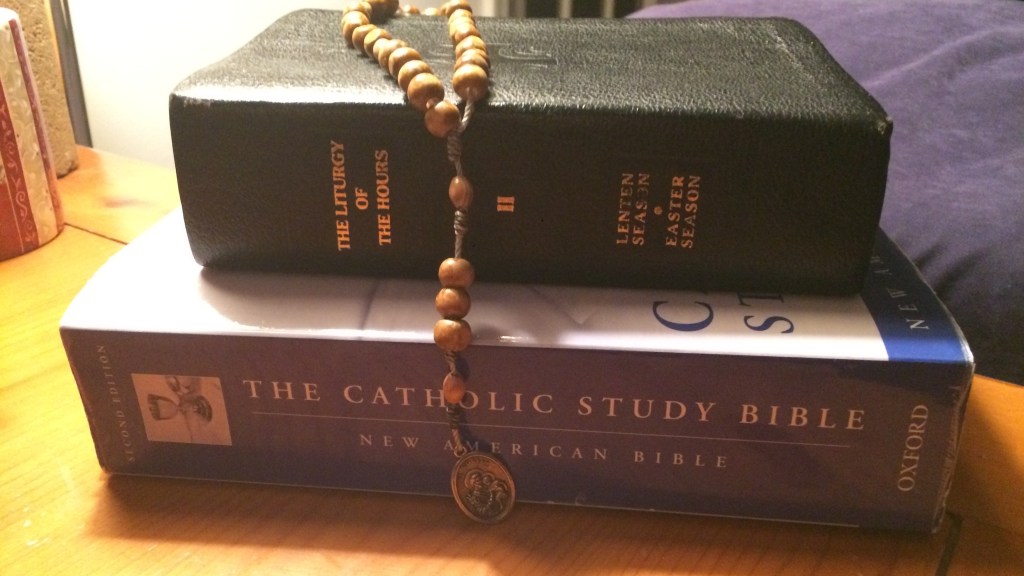
For me the Liturgy of the Hours has been an anchor. I stop to pray throughout the day, some days better than others, some days less rushed than others, but each day I make the time. It has helped me through some experiences when I have felt stretched, and wondered if taking the time to pray was really the most sensible choice, and time and again it has been! The Rosary is also a great way to get into God’s word by meditating on the mysteries of the life of Jesus. If you are not able to pray the whole Rosary in one sitting, periodically pray a decade at key points throughout the day, first thing in the morning, mid-morning, mid-day, afternoon and evening. Reading for a few minutes from the Bible during the same time frame 3-5 times throughout the day, or once in the morning and then returning to meditate on the same verse or verses throughout the day.
These are just a few of the many ways to stop the madness, and to connect with the power, the love, and the grace of Jesus. He is present for us, he will guide us, let us have faith and trust in Jesus, for he is  “the way and the truth and the life” (Jn 14:6).

Photo: Bible, Breviary, and Rosary, my anchors for helping me to trust Jesus and put God first
Link for the Mass reading for Friday, April 27, 2018:
http://www.usccb.org/bible/readings/042718.cfm


Willing to serve along with Jesus? No menial task too small, no person too other.

Today’s Gospel from John begins as Jesus had just finished washing the feet of his disciples. Jesus then said, “Amen, amen, I say to you, no slave is greater than his master
nor any messenger greater than the one who sent him” (Jn 13:16). Jesus not only taught the truth that God the Father sent his Son to serve and not be served, he modeled this practice consistently.
From his conception, gestation, and birth, the Son of God came to be human in the very simplest of conditions and endured the hardships of those on the margins early on. Joseph, Mary, and Jesus were political refugees very soon after his birth. The young family was forced to flee from Bethlehem to Egypt. When Herod the Great died they returned to Nazareth, and other than the incident in the Temple, we hear nothing about the life of Jesus until he begins his public ministry. The most likely reason for this was that there was nothing to tell. Jesus most likely apprenticed with Joseph, in the trade of a simple tektōn, a woodworker, which was pretty low on the rung of the social ladder.
Through the short time of his ministry, Jesus modeled for his disciples what a follower of his entailed and what it meant to be one of his successors. To follow in his footsteps they would need to participate in servant leadership. There is no task too menial, that we can’t roll up our sleeves and dive in to help. There is no person too other that we can’t assist when they are in a need.
A good prayer and meditation for us today is to ask Jesus to reveal for us how we have resisted his urgings in the past regarding serving others in our realm of influence and interaction, as well as thinking or believing that what he was asking us was beneath us. Have there been people we refused to reach out to for similar reasons? For those ways in which we have withdrawn within ourselves may we ask for his forgiveness. If we start to notice a habitual pattern of resistance we may want to participate in the Sacrament of Reconciliation.
Being willing to allow Jesus to shed some light on our lack of embracing opportunities to serve is a good place to begin. Renewed with his forgiveness and healing touch, may we ask Jesus to guide us today to be bearers of the grace and mercy we have received from him. May we ask to be open to each of the people and/or tasks that God will place before us, the discernment to know his will, and the clarity and courage to act as his servant with humility and without hesitation.

Photo: Grounds work during my novitiate year with the Franciscans in Brookline, MA.
Link for the Mass reading for Thursday, April 26, 2018:
http://www.usccb.org/bible/readings/042618.cfm

“Go into the whole world and proclaim the Gospel to every creature”

Jesus appeared to the Eleven and said to them: “Go into the whole world and proclaim the Gospel to every creature” (Mk 16:15). Jesus is once again claiming who he is: Kyrios – Lord. The word Gospel comes from the Greek word, euangelion, meaning good news, but the one who proclaimed this good news during the time of Jesus was the emperor. Caesar would send his emissaries to announce such things as a great victory or his birthday. What Mark conveys at the very first line and here at the ending of his Gospel, is that Jesus is Lord!
This is true for us as well. Whenever we are dismissed from Mass, one of the dismissal lines I use most often is, “Go and announce the Gospel of the Lord.” This is to echo the command of Jesus for all of us to proclaim the Gospel in our everyday experiences and encounters.
We are able to proclaim the Gospel first and foremost by believing that Jesus is the Christ, the Son of God, our Savior and Lord. He has risen! He has risen indeed! He is the first born of the new creation. This is something to get excited about, something to fill us with joy. We are an Alleluia People, not a Grumpy Gus people. Once we remind ourselves what we believe and who we are then we need to remember to tell our faces when we leave our door.
The most powerful witness we can offer is to seek opportunities to think, act, speak about and toward others with kindness. When we catch the eye of another offer a smile. We can also say hello or offer a hand shake, a fist bump, a high five or a hug. We do need to be aware of other’s boundaries and space at the same time. If someone is not open, respect their boundaries, we are not giving of ourselves to get kindness in return.
We seek instead to spread the Gospel, which means share the love of Jesus, meaning we seek to will their good. May we accept and accompany others as Jesus does. He meets us, accepts us and loves us, for who we are and as we are. May we seek to be kind and gracious in our interactions with each person we meet. Remember those key words of please, thank you, and I forgive you, whether in a store, restaurant, bank, convenience store, on the sidewalk, in traffic, or online. Remember God gave us two ears and one mouth for a reason and that is, it is better to listen first and speak second.
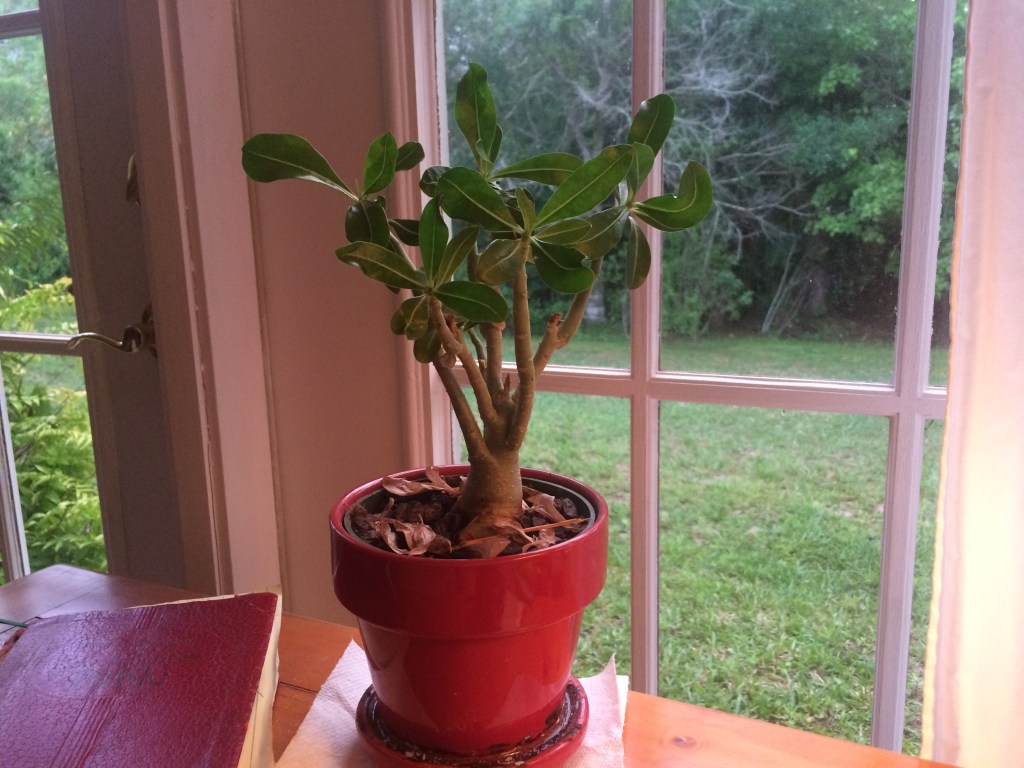
Believing in Jesus, embracing his love and message, and putting into practice each of these seemingly small actions with great love is a wonderful way to begin to “Go into the whole world and proclaim the Gospel to every creature” (Mk 16:15). I might add, “every creature” is in this statement, all of the above applies to animals and plants as well as people. Yes, I high five my desert rose!

Photo: Desert Rose that I saved about a year and a half ago. It was down to one last leaf when I brought it home. Some water, sunlight, and a few high fives and voila! No flower buds yet, but some good healthy leaves.
Link for the Mass reading for Wednesday, April 25, 2018:
http://www.usccb.org/bible/readings/042518.cfm

No one can take us out of Jesus’ hand.

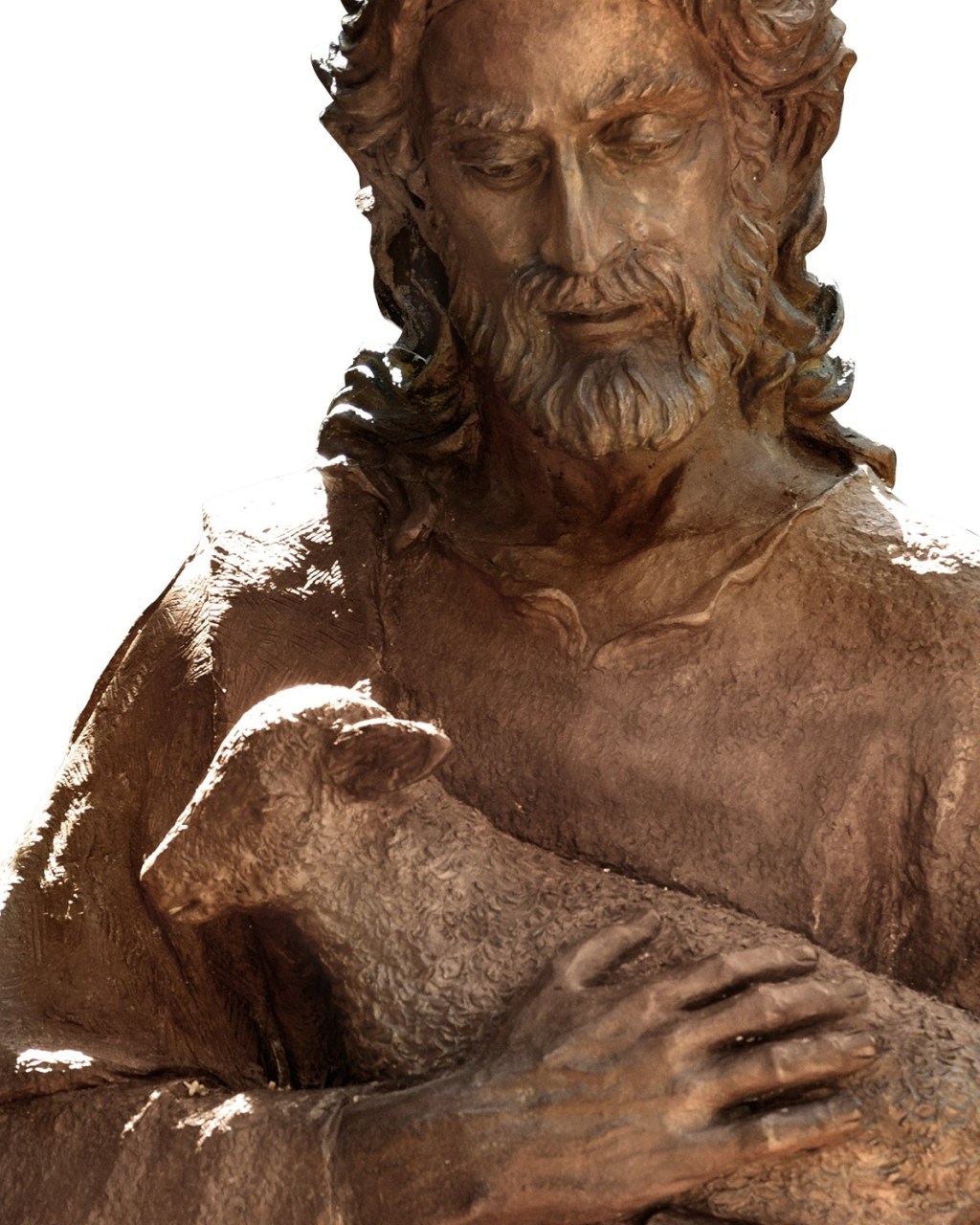
Jesus continues to present the imagery of the shepherd in today’s Gospel reading from John. He presents an assurance for security and protection that is to be found for those that are in his fold when he says, “No one can take them out of my hand. My Father, who has given them to me, is greater than all, and no one can take them out of the Father’s hand. The Father and I are one” (Jn 10:28-30). How does one enter the fold of the Good Shepherd? All who hear his voice and follow him will be known by him and so be a part of his flock.
Yet, there are those that hear his voice and do not recognize the Shepherd. They do not follow him and so are not known by him, although he seeks them out. They may know about the Shepherd, have heard of him, but do not know him. Their hearts and minds are closed to Jesus. They do not believe in his miracles, his exorcisms, his teachings, and the question of those opposing him in today’s reading is, “If you are the Messiah, tell us plainly” (Jn 10:24). Jesus did just that by saying that he and the Father are one. The response for the forthright comment of Jesus is that the Jews pick up rocks to throw at him (see Jn 10:31).
Jesus offers, free of conditions, the gift of relationship with him, and his Father, to experience the love shared between them, the Holy Spirit. Jesus is completely open as to who he is, who we are, and who we can become in participation with him. Those who say no to this invitation do so for their own reasons; some being, a demand for proof, a listing of the terms and conditions on their part that need to be met first, assurances sought for and/or excuses offered. Just as Jesus invites us to freely come to him, he will only come so far as we are willing to receive him. He does not conform to us or our will.  Jesus does not need us, he loves us.
Even we who have said yes, only go so far. We hedge our bets, dip our toes into the water, and maybe go in ankle deep, but not too many of us are willing to relinquish control and surrender fully all at once. We too see the promise Jesus offers, eternal life, true, but also a life of meaning and fulfillment now. A perfect life? No, there will continue to be challenges, because Jesus’ voice continues to call us to follow him to go deeper, to seek freedom from our anxieties, fears, weaknesses. He urges us to face conflicts, to be true in the midst of temptations, and to preach and stand up for the Gospel in and out of season. Through all our experiences, the ups and downs, the only assurance we often may have is to trust in Jesus.
No matter what we face today or tomorrow, we can be assured that Jesus will never let us go and no one can take us out of his hand. We can walk forward trusting, that Jesus our Good Shepherd, will be there to guide and protect us as long as we are willing to listen to his voice.

Photo: accessed at https://www.pexels.com/photo/man-holding-sheep-statuette-161289/
Link for the Mass readings for Tuesday, April 24, 2018:
http://www.usccb.org/bible/readings/042418.cfm