
Give me a sign or may it be done to me according to your will?
“Give me a sign!”
Often, when we ask for a sign, we have a preconceived notion of what we are seeking and we want God’s stamp of approval on it. The impetus is coming from us, seeking to bend the will of God to our will. More often times than not this approach will end in frustration. The Pharisees in today’s account are asking for a sign. Jesus has already been preaching with authority, healing, casting out unclean spirits and demons, encountering the unclean and restoring them to the community and right worship, and this is not enough?
We can understand how: He sighed from the depth of his spirit and said, “Why does this generation seek a sign? Amen, I say to you, no sign will be given to this generation.” (Mk 8:12). The Pharisees minds were set. Jesus knew there was nothing he could say or do to prove to them he was who he said he was; the kingdom of God at hand. If they had not eyes to see and ears to hear there was no argument, point, or sign that would have changed their minds. Jesus sighed from the depths of his spirit, because their hearts were hardened such that they were closing themselves off from the gift of the grace he sought to share. So he then got into the boat to go to the other shore, to share his message with others: “This is the time of fulfillment. The kingdom of heaven is at hand. Repent and believe in the gospel” (Mk 1:15).
The question for us today is do we believe that this statement is still true, that Jesus is who he says he is; do we believe that he is the way, the truth, and the life? Do we seek to bend God’s will to our will or seek to align our will with his? The woman with the hemorrhage for twelve years, the woman whose daughter was possessed, the friends with the man with the withered hand, and the leper, did not ask for a sign, they asked for a healing. They trusted, believed, and risked to get closer to Jesus to encounter him despite the barriers in place to prevent them. In each case Jesus recognized their faith and each received the healing they sought.
In our discernment we need to be aware of our intent. There is a subtle distinction, but it is important. Are we seeking proof, a sign, as Zechariah did when he asked, “How shall I know this” (Lk 1:18), when told of the coming of his son John, or are we placing ourselves in a posture of believing but seeking to understand as Mary did when she asked, “How can this be” (Lk 1:34)? Are we demanding proof, a three point plan, from God before we follow his lead, or do we trust his invitation, and seek to understand how he wants us to act, knowing he will reveal what we need to do each step of the way? Often times, if we knew the end result of his original request, we often would not think we could accomplish what he invited us to do. That is the point, apart from God we can’t do it, we would not be able to accomplish the goal without participating with him, and our doubt would crush our spirit before we even started.
Let us embrace a posture of faith seeking understanding today. May we seek to align our will with God’s and place ourselves in his care, trusting he has our best interest in mind. May we make time to be still and enter a place of prayer to open our heart and mind to the leading of the Holy Spirit. May we then come to a place of confidence so to say in the words of Mary, “May it be done to me according to your word” (Lk 1:38), then arise to grasp the hand of her Son, Jesus, and face head on that which is before us, to accomplish that which he calls us to do, knowing that with Jesus, we can overcome any obstacle that is placed before us.
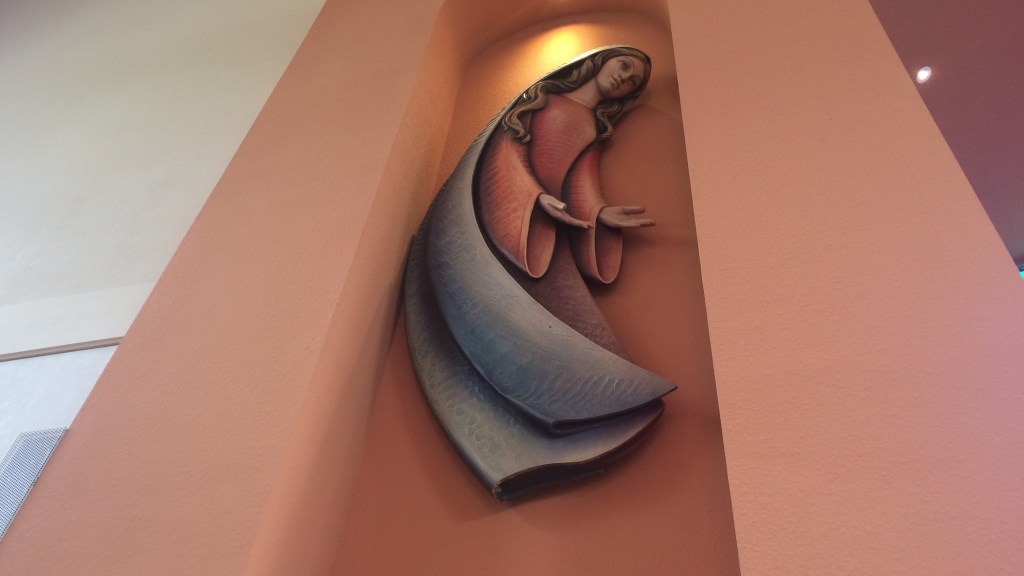
Photo: Mary in the Chapel of St Anthony, St Thomas University, Miami Shores, FL
Link for the Mass readings for Monday, February 12, 2018:
http://www.usccb.org/bible/readings/021218.cfm

Jesus: compassion in action!
Moved with pity, he stretched out his hand, touched him, and said to him, “I do will it. Be made clean” (Mk 1:41). Jesus felt compassion when he heard the plea of the leper. He went out from himself and did the unthinkable and touched the leper. Jesus saw not a leper but a brother. Jesus met the person before him and in an act of love gave him what he had not experienced in who knows how long, human touch.
When is the last time we have been moved with pity, with compassion, to suffer with and feel the pain of another? In so many ways we are like the leper, starving for love and affection. Too many of us are living a life of isolation and aloneness. We are starving to be heard, to be acknowledged, to be touched, to be loved. So it is no wonder anxiety disorders, addiction, and unhealthy practices are on the rise.
Jesus knows and has experienced the loneliness we all feel in our hearts. He feels our distance and hunger. He seeks to draw close to us as he did with his brother the leper. The Son of God entered our human condition and encountered us to experience the fullness of our brokenness as well as help us to see the promise of our potential, the fullness of who we really can be. Jesus encountered people, he did not see them as other. He seeks to encounter us, to draw close, to touch and us to heal us.
May we follow the lead of Jesus and make an effort today to see each other as brothers and sisters. No matter who we come across may we not avert our eye but catch an eye and smile. In that simple act we acknowledge to that person that they do exist. Offer a hand shake or hug of embrace. As social beings we long to be touched. In our hyper sexualized culture, we need to be models of chaste expressions of love. Let us also resist talking at or over each other, seeking to fix each other, and instead be present to each other in our pain, be willing to accompany each other through our struggles. Seek to forgive someone we may have been holding a grudge and ask for forgiveness from someone we have hurt. In these simple ways we can begin to encounter one another again, to draw close as Jesus did, to heal and build up the wounded Body of Christ.
Photo: CN students: Compassion in Action!
Link for the Mass readings for Sunday, February 10, 2018:
Jesus asks us, “What do we have, what can we offer?”
As Christians we are called to be disciples of Jesus, to learn his teachings and follow his ways. We are also called to be apostles in that we are to go out, proclaim and share who is to others, that he is who he said he is. Often when we are reminded of this message though, we may feel inadequate, question what it is that we can even possibly offer in an effort to help build the kingdom of God. We may feel we have nothing to share, nothing to give, nothing to say, or that what the Lord asks of us, we do not know how to accomplish.
The disciples express similar feelings today for the latter point. As the thousands who had just listened to him for three days are readying to depart, Jesus shows concern that they are hungry and some may collapse on their way home. The disciples look about bewildered as to how they could possibly feed the vast crowd. Then Jesus asked, “How many loaves do you have” (Mk 8:5)? They respond that they had seven loaves and two fish. Jesus would go on to not only feed the whole multitude gathered, seven baskets of bread fragments were left over.
We indeed may not know how to take active steps to live our faith, we may not be aware of how to begin, or we may have actually been engaged in service, in our vocation, but start to coast, and need to continue to strive to mature as a disciple and apostle. Each day a supportive way to start is to place ourselves in the presence of Jesus. If we have trouble visualizing him, we can look at a statue we may have, a picture, or icon. Then take some deep breaths and meditate on your present life condition, and assess where there is need in your own life as well as those of others. To be aware as Jesus was of those in need. Once you are able to identify a concern, listen to Jesus ask you as he did his disciples, “What do you have, what can you offer?”
You may not have an immediate answer. Stay with the question for a period of time, take it with you through the day if need be. Resist looking for the big response, the grand plan. Ask yourself what you can offer no matter how small. What you give to Jesus in service and participation with him he can multiply and bring about amazing results. The disciples only gave him seven loaves and two fish, what seemed insignificant to feed the thousands, and yet, Jesus multiplied them to feed them all with seven baskets left over. Jesus provides, let us trust and participate with him to spread the glory of his kingdom.
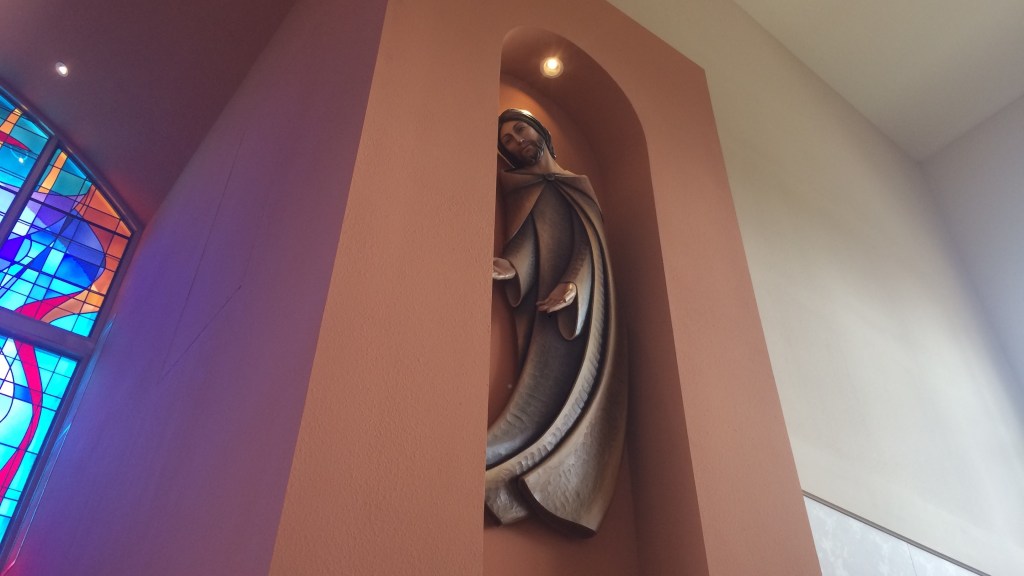
Photo: Statue of Jesus in the Chapel of St Anthony at St Thomas University, Miami Gardens, FL
Link for the Mass readings for Saturday, February 10, 2018:
http://www.usccb.org/bible/readings/021018.cfm
We are not alone in our suffering!
Those who witnessed Jesus healing the man who was deaf with a speech impediment grasped something more than just the healing when they stated: “He has done all things well. He makes the deaf hear and the mute speak” (Mk 7:37). With these words they are acknowledging the deliverance of Israel by the Lord, promised by the prophet Isaiah, when he mentioned how, “the eyes of the blind will be opened, the ears of the deaf will be cleared” (Isaiah 35:5).
The beauty of this healing may be missed by us in the modern age because of the graphic nature of the details used by Mark. Jesus places his fingers in the man’s ears, spits into his own hands and then touches the man’s tongue. Jesus is mixing his own saliva with this man in need of healing. We don’t even share drinks from the same container anymore like we used to when we were kids!
Jesus is showing the intimacy of communion that he offers us. He gave this man the very essence of his own being that it would be mingled with this man. This is a physical teaching, an image or icon, of how the Son of God, in no way diminishing the fullness of his divinity, entered into the very real corporality of our humanity. He became one with us so that we can become one with him. This was true then and it is still true for us today!
We all suffer with physical, emotional, psychological, and spiritual trials. But we also suffer from not being able to hear God’s word, and are so mute in speaking his word. Jesus, even if he does not provide a healing or an immediate solution to a trial, though he may, is present in our lives. We are invited to consciously resist the temptation to avoid our suffering, pain, or challenges that face us and instead are invited to deal with and enter into them. We are not expected to do this alone, but to bring our need for healing to Jesus. In this way we are aligning our suffering with his on the Cross. While at the same time when we also choose to offer up our pain and suffering on behalf of another, we participate in redemptive suffering. Others can experience relief and healing from our sacrifice in participations with Jesus.
This act of the will gives meaning to our suffering such that we do not endure what we are going through in vain. May we embrace, head on, that which is presented before us, actualizing the guidance of Jesus as well as the advances of modern medicine, science, and psychology, embracing a posture that engages both faith and reason. Our approach will be best if we are more mindful and balanced with our discernment. Just masking struggles without dealing with the root cause will only prolong and possibly worsen the condition.
Jesus is still healing today and does so most powerfully when we are willing to be healed to hear his word, speak his word, and love one another. In this way he also heals others through us. What greater way can we show our love than to consciously offer up our suffering for the benefit of one another. We are called to love one another as he has loved us, he who gave his life on the Cross for us, so that we may experience the joy that he seeks to place within us and that our joy may be complete (cf. Jn 15:11-13).
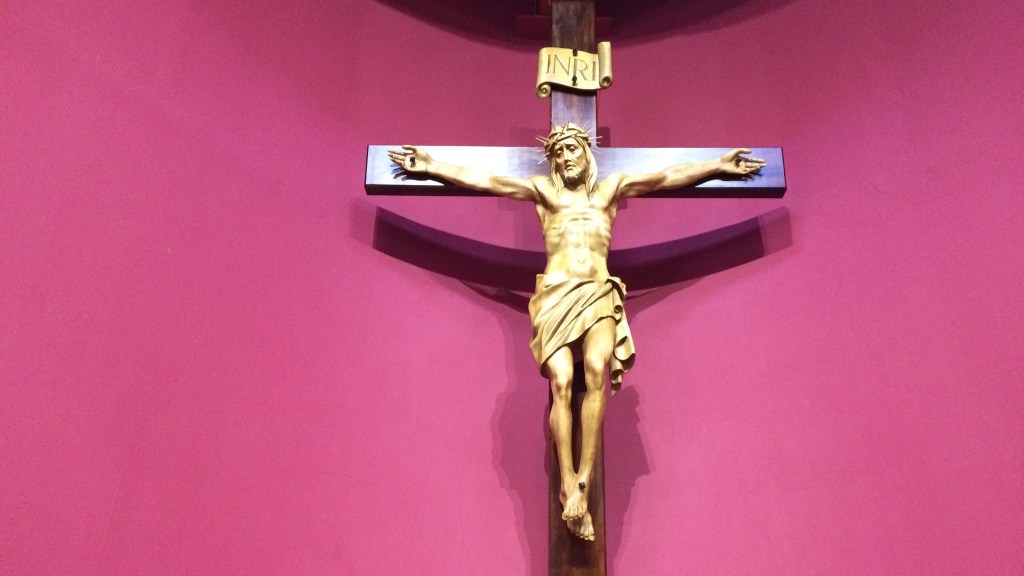
Photo: Crucifix in the main sanctuary at Mary Immaculate Catholic Church, West Palm Beach, FL
Link for the Mass reading for Friday, February 9, 2018:
http://www.usccb.org/bible/readings/020918.cfm
Have the courage to believe and have faith in Jesus
In today’s encounter between Jesus and the Syrophoenician woman we can observe again the crossing of societal norms by both the woman and Jesus. The woman, very much like the woman who had been hemorrhaging for twelve years, was desperate and approached Jesus. She was willing to risk breaking the social taboo of speaking with Jesus so that her daughter could be healed.
Jesus meets her with the derogatory language of equating her with a dog, considered one of the most unclean of animals by Jews: “Let the children be fed first. For it is not right to take the food of the children and throw it to the dogs” (Mk 7:27). Jesus was to indeed come first to the Jews and then share his message with the Gentiles. This woman would have none of that, she wasn’t leaving without a healing for her daughter, even if that meant she was putting her life in danger. Her retort, “Lord, even the dogs under the table eat the children’s scraps”, emphasized this point. It was also the key that opened the door for the disciples and us to witness a consistent pattern with Jesus.
We saw the same situation with the woman with the hemorrhage (cf. Mk 5:25-34) in that both women had the faith and courage to approach Jesus. The ending is also the same for this woman as with the Roman centurion in Matthew and Luke, where Jesus heals from afar. What is important to Jesus is the person’s faith and belief that Jesus was who he said he was.
Do we believe as these two women did, as the centurion did? Are we willing to risk to cross our own societal pressures to draw closer to Jesus? When we let nothing hinder our coming to Jesus, including relinquishing the reigns of being our own masters, acknowledging that God is God and we are not, believing that Jesus is truly the Son of God and that he is still present and active in our lives, miracles do happen. Jesus said that if we have faith but the size of the mustard seed, we can move mountains (cf. Mt 17:20).
If you or someone close to you are dealing with some roadblocks or challenges, if something is keeping you from making a deeper commitment to surrendering your life to Jesus, if there are opposing forces that feel as big as mountains, take the risk. Bring your tribulations to him, lay your burdens at his feet, and take his hand. With Jesus all things are possible, we just need to have the courage to believe and have faith that Jesus is who he says he is.
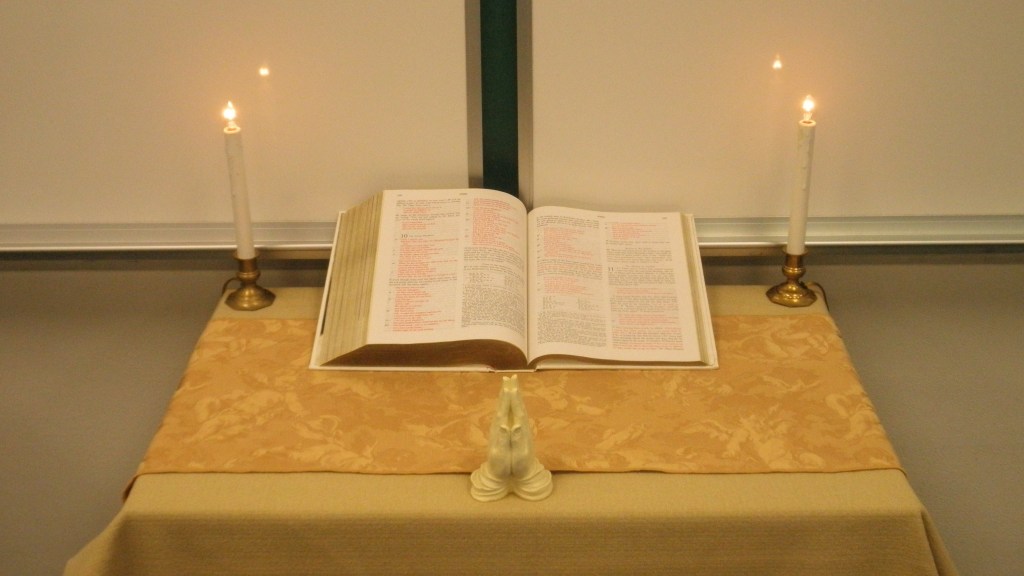
Photo: Small chapel at the front of my classroom at Cardinal Newman. May the light of the Gospel guide us each day!
Link for the Mass reading for Thursday, February 7, 2018:
http://www.usccb.org/bible/readings/020818.cfm
“Let us encourage each other while it is still today” – Hebrews 3:13
“[W]hat comes out of the man, that is what defiles him” (Mk 7:20). Jesus offers a list in today’s gospel of what can be unleashed from within and then directed out toward another. These are examples of what defile us, because at some level, we make the decision to think about, speak about, and put into action those thoughts, words, and actions.
To resist the temptation to defile ourselves and others, we can follow the lead of the writer from the letter to the Hebrews who offered the Church in Rome a wonderful verse, which I pray every morning: “Encourage each other daily while it is still today” (Hebrews 3:13). There are many that we will encounter or hear about each day that are going to do the exact opposite. May our goal be to resist spending any time or energy in supporting any thoughts, words, or actions that demean, belittle, or dehumanize. We can call those out who do so, stand up for those impoverished from these attacks who do not have a voice, but must not succumb, engage, or in any way be lowered to the negativity unleashed. Otherwise we become an agent in perpetuating the vileness and poison that seeps all over our discourse.
Our thoughts, words, and actions matter because we are all interconnected, and even what we ruminate on is projected on our faces and directed out toward another, we don’t even have to say a thing. Thoughts entertained lead to words and actions that wound. We need to approach each day more mindfully in such a way that we resist reacting, and instead think and pray about our response. The only time our silence can be harmful, is when we do not convict others in their disregard of the dignity of the person.
Let us choose this day to align our thoughts, words, and actions with those of Jesus. We can follow St Mother Teresa of Calcutta’s five finger gospel as a reminder: “You did it to me.” What we do to the least of our brothers and sisters, we do to Jesus (cf. Mt 25:35-45). May we resist defiling ourselves and others such that we never let evil talk pass our lips and instead think, speak, and act in a ways that empower, convict, and build up others. May we choose to forgive the negativity hurled at us, and meet it with a posture of compassion that seeks to understand the perspective of the hurler. May we strive to love each other, to will each other’s good.
Knowing we will not be able to do this alone, we need to remember to call on Jesus, to ask for his strength, courage, and love to empower us, that we may resist opportunities to defile and even in the midst of other’s acts of dehumanization, such that we may be a vehicle of transformation, so to shine the light of his love in dark places.
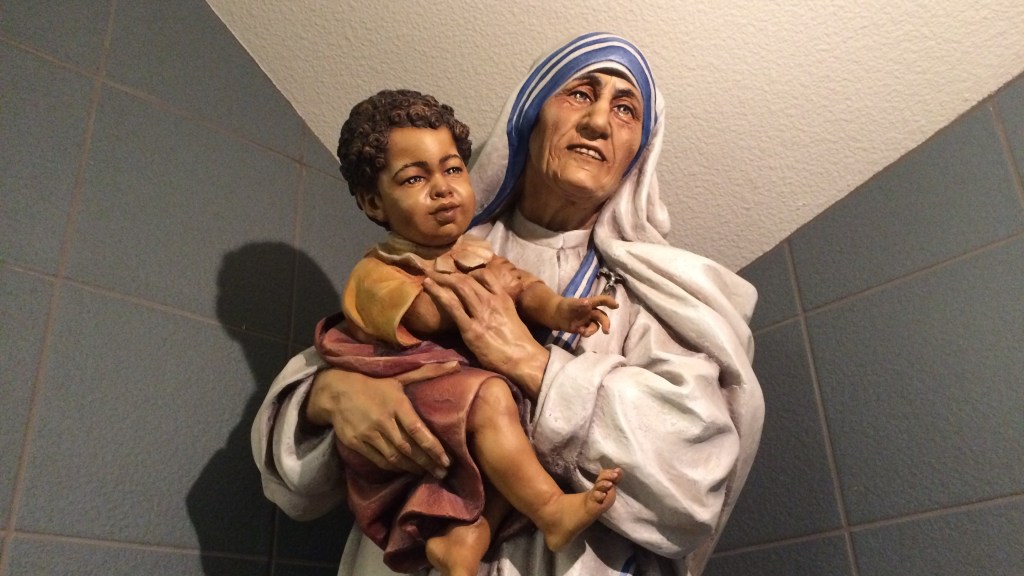
Photo: St Mother Teresa of Calcutta, in main sanctuary at St Peter Catholic Church
Link for the Mass readings for Wednesday, February 7, 2018:
http://www.usccb.org/bible/readings/020718.cfm

Love of hockey, others, and God
Jesus reacted to the criticism of not observing ritual washing prior to eating leveled at him from the Pharisees and scribes by recalling the tradition of the Prophets through the words of Isaiah: “This people honors me with their lips, but their hearts are far from me” (Mk 7:6). Jesus states that following the law for the law’s sake is an empty act. What is important is encountering God, experiencing his love and forgiveness, so as to be able to glorify him by serving others, thereby bringing others into communion with him. Jesus is challenging a hyper scrupulosity for the exactitude of the rules for rules sake, and instead inviting those he teaches to be humble servants of God. Just laws or practices are those that are enacted with love to build up and empower others through discipline that leads away from enslavement to sin, and instead leads to freedom for excellence, to joy, toward a heart on fire with love for relationship with God.
There needs to be a proper balance with the rule of law. Just as with any game we play, there are rules and regulations, their are referees and officials to keep order to the game. When the rules enforced encroach on the flow of the game, such that they stunt the natural flow, and limit the freedom of play, the game breaks down. When the rules are consistent for both sides, provide the structure and boundaries that limit abuse, empower the game to flourish, and the players experience the freedom to actualize their potential, there is the an experience of the true, the good, and the beautiful.
The first time I saw people skate, I was totally enthralled. I think I was seven. My father was working on a carpentry project at our local ice rink and I tagged along. We weren’t there to skate, but I refused to leave until he took me on the ice. My feet were small and so the only size skates they had for me were figure skates, it didn’t matter. The experience was a dismal failure because I hadn’t a clue what I was doing, but in short order, I learned the rules of balance, shifting weight, how to stop and what a toe kick was and was not for. Soon I had the freedom not only to skate, but to join a hockey team. The freedom and joy I felt any time I played hockey, any time I skated, I still carry with me to this day.
This is the gift of the Church when we are at our best. In each interaction, we resist the temptation to support negative prejudgments, and instead risk to engage, to go out of ourselves toward another. I risked taking to the ice that day, failed, but enjoyed the process, and got up again and again and learned. As we mature spiritually we learn what the unconditional love of Jesus is, which is to will the good of one another, accepting one another as we are, such that in each of our interactions we establish boundaries and parameters that show mutual respect for the dignity of each person involved.
We are going to make mistakes, as I did when I tripped over my toe kick, didn’t keep my stick on the ice when skating toward the net, but we learn and adjust. As we journey each day we make choices regarding how we treat one another, these are the boundaries and rules we establish to set a foundation for healthy relationships and actualizing who we are called to be. Our starting point with each encounter ought to be first a willingness to help others come to know Jesus, not prevent them from experiencing his invitation of love, mercy and blessing, and then be willing to accompany one another along the journey with the end goal being the freedom to experience the ultimate joy of the full communion we have been created for, which is to become one with our loving God and Father.
Photo: About eight or nine, living the dream!
Link for the Mass readings for Tuesday, February 6, 2108:
http://www.usccb.org/bible/readings/020618.cfm

Jesus is present, when we are willing to be near, in proximity with one other
“Whatever villages or towns or countryside he entered, they laid the sick in the marketplaces and begged him that they might touch only the tassel on his cloak; and as many as touched it were healed” (Mk 6:56).
The people of Jesus’ time were in need of healing, hungry to draw closer to God, often searching, wandering, and wounded. This is still true today. Though Jesus is not as visible to us as he was to those at Gennesaret, he is just as present if not closer. We who receive Jesus in his Word proclaimed and we who receive his Body and Blood, we who receive his healing, mercy and grace are sent forth to bring Jesus to others. This is true for our Protestant brothers and sisters as well, who have received his Word proclaimed.
We are not to go home as if nothing of any significance just happened in our gathering as the Mystical Body of Christ, we are not to walk around with an air of superiority over others, we are not to judge and condemn people as other, we are not to refuse to help people because we feel they deserve the condition they are in, that they are illegal, that they choose their lifestyle, that they are lazy and just need to pull themselves up by their own bootstraps. We are not to be indifferent to the plight of others.
We acknowledge the ministry of the saints throughout the history of the Church because they encountered the Resurrected Jesus still present in the world, through the Eucharist, through his Word, and through their seeing him in the distressing disguise of the poor and one another. They did as Jesus did when he got off the boat at Gennesaret. They met those in their realm of influence, were present to them in their need, and brought them to encounter Jesus.
Pope Francis was asked in an interview by Fr. Antonio Spadaro, S.J., in 2013, “What does the church need most at this historic moment?” And Pope Francis answered, “that the thing the church needs most today is the ability to heal wounds and to warm the hearts of the faithful; it needs nearness, proximity. I see the church as a field hospital after battle.” We need to be “near”, in the same “proximity”. He did not say that the Church is to prevent others from coming to Jesus, but we need to bear Christ to one another: “The church sometimes has locked itself up in small things, in small-minded rules. The most important thing is the first proclamation: Jesus Christ has saved you. And the ministers of the church must be ministers of mercy above all.”
Jesus, the Apostles, his disciples, and those who have followed him through the ages, saints canonized and not: St Lawrence, St Elizabeth of Hungary, St Martin de Porres, St Peter Claver, St Elizabeth Ann Seton, St Vincent de Paul, Dorothy Day, St Charles de Foucault, and St Mother Teresa, have done just that. They have made themselves present, come near, and brought the healing power of the love, mercy, and forgiveness of Jesus to those in their midst. They have resisted to make someone as other, they have refused to be indifferent to the needs of those in their midst. We are invited to do the same.
May we too, in the words of Pope Francis, go out to “heal the wounds and to warm the hearts of the faithful” by being willing to be near to accompany others in their sorrows, anxiety, trials, and tribulations. People are really hurting, so let us embrace the significance of encountering the Mystical Body of Christ in our worship, to go forth in humility willing to serve our brothers and sisters. Let us repent from and be willing to change our defensive postures of indifference, judgment, prejudice, and condemnation. Let us be willing to have a heart and mind of compassion and so be present, offer support and guidance, allow God’s mercy, love, and forgiveness to flow through us as we assist those that are vulnerable, outcast, shunned, and on the outside looking in. Not to prevent people from coming to Jesus, but by providing a means to encounter him.
Photo: Class of 2017 expressing nearness and proximity!
Spadaro, S.J., Antonio. “A Big Heart Open to God: An interview with Pope Francis”. America Magazine. September 30, 2013 Issue. https://www.americamagazine.org/faith/2013/09/30/big-heart-open-god-interview-pope-francis
Link for Mass readings for Monday, February 4, 2018:
http://www.usccb.org/bible/readings/020518.cfm

 Spiritual Stepping Stones