

Please forgive me.
Peter approached Jesus and asked him, “Lord, if my brother sins against me, how often must I forgive him? As many as seven times” (Mt 18:21)?
Peter’s initial question of asking to forgive seven times may sound pretty generous to us, because the usual question most of us ask is, “Do I have to forgive at all?” Many of us do not do forgiveness well, even if we look at it as a virtue. If someone says to us they are sorry, do we reply, “I forgive you?” Often our automatic response is, “That’s alright”, “It’s ok”, or “No problem”. When we are convicted of a mistake, error or offense, do we ask for forgiveness or operate from a defensive posture to explain why we did what we did, or defend what we did as right, not willing to admit any inappropriate action?
We are very habitual creatures, and much of what I shared above is learned behavior. We are conditioned and shaped from our youth. That is why when we hear Jesus’ answer to Peter, “I say to you, not seven times but seventy-seven times”, we may dismiss Jesus’ statement as mission impossible. Another thought that may come to our minds are those cases or positions in which we feel justified in our stance of unforgiveness. Jesus is yet again raising the bar for us.
We are to strive to forgive as our heavenly Father forgives. Forgive the same person seventy-seven times? Yes. If someone is seeking forgiveness, we are called to forgive. Jesus does not mean that we don’t hold people accountable, remain in a dangerous or life threatening situation, or enable people in their self-destructive behavior. Forgiveness has to do with not holding on to the hurt, not allowing the offense to fester as a grudge that builds to hate and negative or violent behavior. Forgiveness is also not a curse but a blessing. For when we forgive, it is an antidote to the poison someone has injected us with. If we refuse to forgive, we allow the person who has injured us to do so over and over again, for by being unwilling to forgive we allow that poison to fester.
If you are struggling with holding onto a grudge and/or past hurts. One approach that may be helpful is to visualize yourself approaching the person you have the issue with and saying to them, “I forgive you”. You may also find it helpful to visualize Jesus standing beside you while you do this exercise. Repeat the process each day in your time of prayer until you start to feel yourself coming to a place of forgiveness, and can imagine that reconciliation is indeed possible.
If you find visualizing difficult, sit down and talk to Jesus. Be honest with him, tell him the situation and that you do not want to forgive the person. Then ask for Jesus to help you. Embrace the sacrament of Reconciliation and confess your unwillingness to forgive. When ready, determine how best to reach out to the person to say that you forgive them; a phone call, letter, email, text message, or in person.
A third idea that may work is to write the person a letter, whether you send it or not. Each of these are practical ways to approach a great gift that Jesus offers us, to forgive seventy-seven times, or to forgive each and every time we are given the opportunity to do so.
We don’t do forgiveness well. But with Jesus, we can begin again. Let us practice saying each morning, “Please forgive me, (Name)” and think of a few thoughts, words, or actions you need to be forgiven for. Then say, “I forgive you (Name), for…” and think of a few words, actions, or inactions to insert. Also, Jesus gave us a pretty good prayer: “Forgive us our trespasses as we forgive those who trespass against us.” We are not alone. Remember, Jesus asked God to forgive those who crucified him. We can ask God to forgive those who have offended, hurt, or abused us. Then we can actually move to the point where we begin to develop the freedom to say to others, “I forgive you”, and “Please forgive me.”
Photo: By Albrecht Dürer – Praying Hands – gwGj6BUX8D5Kug at Google Cultural Institute maximum zoom level, Public Domain, https://commons.wikimedia.org/w/index.php?curid=21792217
Link for the Mass reading for Thursday, August 16, 2018: http://www.usccb.org/bible/readings/081618.cfm

May we reflect the light of Mary’s Son as she did!
“For at the moment the sound of your greeting reached my ears, the infant in my womb leaped for joy” (Lk 1:44).
When we experience great joy we want to share it with others, just as Mary did when she conceived Jesus through the power of the Holy Spirit and also heard that Elizabeth was also with child. When we unite with those we love we leap for joy, sometimes literally, as John did in the womb!
There was no one on this earth closer to Jesus than Mary. She bore him, nursed him, raised him, initiated, in motherly fashion, his public ministry, held him in her arms as he was taken down from the cross, and she was with the Apostles in the upper room when the Holy Spirit descended upon them. Mary, like Jesus, was also Immaculately conceived. When her time came to leave this life, who better than Mary to have experienced the “singular participation in her Son’s resurrection and an anticipation of the resurrection of other Christians” (Catechism of the Catholic Church 1997, 966)?
Today we celebrate the official dogmatic constitution issued by Pope Pius XII in 1950, the Assumption of Mary, a special grace she received from her Son. Today is a day of joy! Jesus is the promise and Mary is the hope that we will live eternally with our heavenly Father, for Mary is now where we will one day be, body and soul. This is a day to celebrate!
Jesus and Mary have undone the sin of Adam and Eve. They, in their continual faithful life of saying yes to the will of God, opened up heaven for us. In our darkest trials, when the storm clouds of injustice gather, when a situation or conflict does not appear to be getting any better, when death may be imminent, and/or when a loved one has died, even then, death does not have the last word.
There is hope, because there is a light that shines in the darkness when we echo Mary’s song, “My soul proclaims the greatness of the Lord; my spirit rejoices in God my Savior. For he has looked upon his handmaid’s lowliness; behold, from now on will all ages call me blessed.” (Lk 1:46-48). God is ever faithful and present to us in his mercy. May we, like Mary, ponder the wonderful gifts of our Father’s love, mercy, and the bestowal of his grace. May we also, like Mary, reflect the light of her Son as we experience the foretaste of heaven. Let us go forward today with haste as beacons of joy and actually leap with joy!
Holy Mary, Mother of God, pray for us now and at the hour of our death!
Photo: bright clouds country from Pexels.com
For the readings of the Mass for Wednesday, August 15, 2018: http://www.usccb.org/bible/readings/081518-day-mass.cfm

Turn and become like children.
“Amen, I say to you, unless you turn and become like children, you will not enter the Kingdom of heaven. Whoever becomes humble like this child is the greatest in the Kingdom of heaven. And whoever receives one child such as this in my name receives me (Mt 18:3-5).
The above response Jesus gave was to the disciples question regarding who is the greatest in heaven. Jesus offers an unexpected response, as children had no esteem, honor, or greatness in his society. Jesus was not pointing out so much the innocence of children, but emphasizing that children were completely dependent on others for the very survival.
If we are to embark or stay on the journey that will lead us to the Kingdom of heaven, we need to do the same. We need to give our control and apparent, self sufficiency over to God and place our dependence on him alone. We need to depend on God as would an infant or young child does on their parent.
Very young children have also not developed a defensive filter and they say what is on their mind, often with precise insights! How often do we do the opposite by automatically responding in a defensive manner or fearing an ulterior motive from the question? Jesus has taught us that our yes is to be yes, and our no is to be no, and anything more is from the evil one (cf. Mt 5:37). As his disciples, Jesus calls us to be humble, to admit to our sins, our mistakes, to confess, correct and learn from them.
May we turn away from that which we place before God, those biases and idols that can lead us down the path of prejudice; the allures of material, apparent goods and our own self-centered postures, that so often lead to the imprisonment of addiction. Instead, may we “become like children”. May we depend more on God, surrender our control, and place our trust in him. By doing so, we can build a firmer foundation of truth and humility. We will begin to find that we will be more satisfied, fulfilled, and begin to be less defensive and more present to those in need.
We are all wounded, a bit beaten up, emotionally, physically, and spiritually, and in need of God’s healing. Yet, instead of reacting defensively or taking offense, by aligning ourselves with God and asking him to love others through us, we can be more understanding, loving and empowering. We could all use a little more support, empathy, and kindness. May we begin to be a little more present, a healing balm for one another today, for whoever receives one child such as this in Jesus’ name receives him (cf. Mt 18:5).
Photo: Me and my nephew Nicholas about 18-19 years ago. He is now 22. Please join me in prayer that in the name and power of Jesus, Nick may be freed and healed from the battering cycle of addiction. If you know of anyone struggling with addiction, add their name here and we can join in praying together for the healing of so many who are shackled and needing to be set free! Thank you.
Link for the Mass reading for Tuesday, August 14, 2018: http://www.usccb.org/bible/readings/081418.cfm
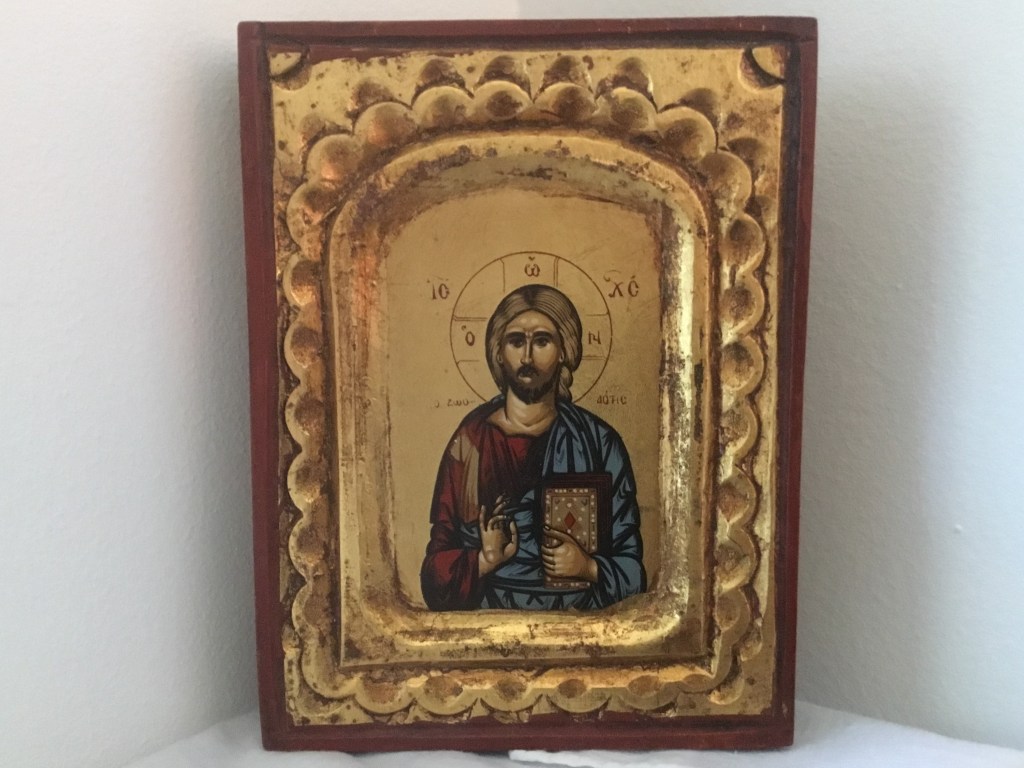
Jesus matters
Jesus said to them, “The Son of Man is to be handed over to men, and they will kill him, and he will be raised on the third day.” And they were overwhelmed with grief (Mt 17:22-23).
This is the second time in the Gospel of Matthew that Jesus shares with his disciples about his passion. They are overwhelmed with grief, because their focus is on the first part of Jesus’ statement that he will be handed over to death. They do not understand the second part about how he will be raised on the third day. How could they? There was no point of reference for the disciples.
For us today, we can read these statements and gloss over them a bit too easily because we celebrate Easter each year, we celebrate that Jesus has risen, but do we really take in what that means for our lives? Does the fact, the reality, that Jesus has conquered death and become the first born of the new creation really matter to us?
The life, death, and resurrection of Jesus matters! The missing piece may be that we just need to learn to recognize his guiding voice in our lives. He understands each of our struggles and tribulations, our sins and our failings, as well as our deepest hopes and dreams. Jesus also knows how best to communicate with us because he meets us where we are and will walk with us. Jesus will help us to bear our crosses, he will help us to see our sins and repent from them, and he will give us the encouragement, guidance and tools to actualize our hopes and dreams. May we turn to him today with trust and hope, let us listen for his voice in the stillness of our hearts, and say yes to the invitation for a new life that he offers us today.
Photo of an icon of Jesus my Aunt Nicky gave me.
Link for the Mass readings for Monday, August 13, 2018: http://www.usccb.org/bible/readings/081318.cfm

God is here for us, no matter what!
In our first reading from the first Book of Kings we hear that Elijah is sitting under a broom tree asking God to take his life. How is it that Elijah, one of the greatest prophets in the Old Testament, is sitting there asking God to take his life?
This is especially surprising, since just in the chapter before, CH 18 of 1 Kings, there is the account of the powerful story of a showdown of faith between Elijah and the 450 prophets of Baal, who he humiliates and has put to death. Yet when news reaches Ahab and Jezebel, the king and queen of Israel, Jezebel sends word to Elijah that she has called for his death. Elijah is running for his life from Queen Jezebel.
Yet in Elijah’s fear and despondency, God leads Elijah to a broom tree, one of the few types of bushes that grew tall enough to provide shade in the Palestinian desert. Elijah is then awaken to find a hearth cake and a jug of water. An angel of the Lord is also sent to encourage Elijah to eat and drink. God provides for Elijah in his time of need. If we read on we will see how God helps to restore Elijah’s courage and deepen his faith in God.
In our Gospel today we continue with chapter 6 of John. To quickly summarize some of the key points of what we have heard from the past few Sundays. Jesus has miraculously fed the five thousand, they sought to make him king, Jesus retreated from them, and they would track him and his apostles down the next day. Jesus then began his Bread of Life Discourse.
Jesus is the One from above, the One who has seen and has been sent by the Father, the One who is fully divine, as well as fully human speaking to those who have come to him. He has responded to the people’s request regarding how they were to “accomplish the works of God” and his response was that they are to believe in him, he who had been sent by God. They were to “work for food that endures for eternal life, which the Son of Man will give”. Jesus himself, as he did with the multiplication, will provide the food that will endure for eternal life. Jesus shared that he is this food, the bread from heaven, that will give life to the world.
What Jesus has shared thus far and what he shares in today’s Gospel has been given to him to say from his Father and is for everyone who is willing to accept his invitation. Then he adds: “I am the living bread that came down from heaven; whoever eats this bread will live forever; and the bread that I will give is my Flesh for the life of the world” (Jn 6:51).
It is at this moment in his presentation that Jesus and his followers come to a crossroads. Jesus has been talking about the reality that he is the bread of life, which his listeners are struggling to understand, yet, they are willing to follow along to see where he is going. Once he states, at the end of today’s reading, that this bread “is my Flesh”, those in the crowd who only the day before sought to unanimously make him king by popular acclamation, with these three words began to grow very uncomfortable.
This discourse is moving away from a figurative discussion to a more dramatic and concrete presentation with horrific implications. After an initial gasp or two, some murmuring would have begun, centering around such questions such as:
“Did he really just say he would give us his flesh?”
“Is he equating himself with the bread from heaven, and the bread he is offering is his flesh?”
“Is he saying what I think he is saying?”
Yes! The Son is saying all these things because the Father has given all that he is, holding nothing back, emptying himself into the Son. The Son has received all that the Father is and returns himself, giving all that he is, holding back nothing to the Father. This eternal communion of Love shared between the Father and the Son is the Holy Spirit. Jesus is offering all that he is to his disciples and to us, FOR OUR CONSUMPTION. He is holding nothing back of himself in his offer.
We are invited to this intimacy of relationship, to receive all that Jesus is. We are invited to participate in the divine communion of Love, the Holy Trinity.
God provided shade, a cake, and water for Elijah, Jesus provided the multiplication of the loaves and fish for the multitude, now Jesus is stating that he will provide his very self. Jesus is stating that God is present for us, no matter what.
Here is a true story that may help us to get a glimpse of the depths of God’s love for us.
On December 7, 1988 an earthquake devastated the northwestern section of Armenia, killing an estimated 25,000 persons. In one small town, directly after the earthquake, a father rushed to his son’s school only to find that the school had been flattened and there was no sign of life.
But he had no thought of turning back. He had often told his son, “No matter what, I’ll always be there for you when you need me!”
Though the prospects appeared hopeless, he began feverishly removing rubble from where he believed his son’s classroom had been. Other forlorn parents only wailed hopelessly. “My son!” “My daughter!” Some told the father to go home, that there was no chance that any of the pupils could be alive. To which this loving father replied, “I made my son a promise that I’d be there for him anytime he needed me. I must continue to dig.”
Courageously, he proceeded alone. No one volunteered to help him. He simply had to know for himself: “Is my boy alive or is he dead?”
With strength and endurance beyond himself, the faithful, loving father continued to dig… for 8 hours… for 12 hours… 24 hours… 36 hours. Then in the 38th hour, as he heaved away a heavy piece of rubble, he heard voices. “Armand!” he screamed.
A child’s voice responded: “Dad! It’s me,… Armand!” Then, “I told the other kids not to worry. I told ’em that if you were alive, you’d save me, and when you saved me, they’d be saved. You promised you would always be there for me! You did it, Dad!”
Moments later, the dad was helping his son Armand and 13 other frightened, hungry, thirsty boys and girls climb out of the debris. Free at last! When the building collapsed, these children had been spared in a tent-like pocket. The father lovingly carried his son home to his mother, where he was given the care he needed.
When the townspeople praised Armand’s dad, his explanation was, “I promised my son, ‘No matter what, I’ll be there for you!'”
This is what Jesus is saying to those gathered around him in today’s Gospel. This is what Jesus is saying to us today. My Father is here for you. I and the Father are one, and I will not leave you orphans, I will give you my very self to eat, so that as I and the Father are one, we too can be one.
No matter what we are going through, no matter who has let us down, Jesus is here for us. We can come anytime, receive him in the Mass, look at him as he looks at us from the tabernacle, but also in our everyday lives and interactions with one another Jesus is present.
We will receive Jesus in the Eucharist today so to be more conformed to him, but this is not just for ourselves. This is so that we may go and bring Jesus to others in our lives. We do this by following Paul’s guidance to the Ephesians from our second reading.
– Put away falsehood and speak the truth
– Be angry but do not sin, do not let the sun set on your anger
– Do not steal but do honest work so to share with one who has need
– No foul or evil language is to come out of our mouths, but we are only to say the good things people need to hear
– All bitterness, fury, anger, shouting, and reviling must be removed from you, along with all malice
– be kind to one another, compassionate, forgiving one another as God has forgiven you in Christ.
Like Armand’s Dad, no matter what, God is here for us, just exponentially multiply his presence. God loves us more than we can ever mess up, more than we can ever imagine. May we turn back to him, let us receive Jesus today, let us receive and savor his love today in the depths of our minds, hearts, and souls. May we go forth to be imitators of God, as beloved children, and live in love and share his love with one another.
Photo: Artistic representation of the Shroud of Turin
Link for the Mass reading for Sunday, August 12, 2018: http://www.usccb.org/bible/readings/081218.cfm

Believe in Jesus and have faith.
Then the disciples approached Jesus in private and said, “Why could we not drive it out?” He said to them, “Because of your little faith.” (Mt 17:19-20).
How do the disciples get from this recurring theme of having little faith in the Gospel accounts to Peter healing a crippled beggar by saying with boldness, “I have neither silver nor gold, but what I do have I give you: in the name of Jesus Christ the Nazorean, [rise and] walk” (Acts 3:6)?
A helpful definition “is to say that faith always entails a relationship between persons which stands or falls with the credibility of the person who is believed” (Rahner and Vorgrimler 1965, 164). Faith is not just an intellectual exercise, it is a lived experience. Christian faith is the absolute conviction, belief, and relationship experienced with Jesus the Christ. The disciples learned from Jesus but more importantly developed an intimate relationship with him, such that the love they received and shared became so strong that there was no more room for doubt, distraction and/or fear, such that they would align themselves with the will of God and do what Jesus did and by his power working through them they would do even greater deeds than he (cf. Jn 14:12-14)!
We are invited to do the same. If we only read the Gospels or hear them read at Church we may know something about Jesus, but our life will for the most part remain unchanged. But when we read, meditate and pray with the Gospels and put into practice what we read, we will encounter Jesus as did his disciples and we will come to know and develop a relationship with Jesus and be conformed to him. In this way, we are not just reading a dead letter but encountering the living Word, the Son of God, who invites us to share in the infinite dance of Love that he participates in with God the Father and God the Holy Spirit.
As our relationship and intimacy with Jesus grows and matures we too will be able to say with conviction the words of Paul: “I live by faith in the Son of God who has loved me and given himself up for me” (Galatians 2:20).
———————————————————————–
Painting credit: CB Chambers, Sacred Heart of Jesus, gift given to me by Jim and Christine Zoeller, now hangs in my classroom at CN!
Link for the Mass readings for Saturday, August 11, 2018: http://www.usccb.org/bible/readings/081118.cfm
Rahner, Karl and Vorgrimler, Herbert. Theological Dictionary. New York: Herder and Herder, 1965.

May we die to ourselves, so to will the good of others.
Jesus said to his disciples: “Amen, amen, I say to you, unless a grain of wheat falls to the ground and dies, it remains just a grain of wheat; but if it dies, it produces much fruit. (Jn:12:24).
In reading this verse, I was transported back to Middle School. Our sixth-grade class was dismissed to head to the cafeteria for the Science Fair. As I drew closer I could hear some unintelligible chanting going on. Of course, I was curious and craned my neck to see over the other students filing in as we entered our destination. I drew closer to see a circle of kids chanting and circling. I stopped as I heard muffled groans and then saw one of my friends standing in the center of the circle, his forearms pulled up to cover his face. No one was laying a hand on him, but the heckling and chanting was inflicting its damage. I froze not knowing what to do or how to act.
I don’t remember how the situation was resolved, but I remember how bad I felt that day, and still do for not doing anything. I also withdrew from my friend when I saw him later that because I felt so bad for not speaking up or stepping in. I wasn’t there for him, I didn’t provide any comfort, because I was still only thinking of myself and not his feelings.That day, I remained just a grain of wheat. I was unwilling, unable to die to myself, unwilling to stand up for my friend or provide any comfort.
When we find ourselves in such situations, when another human being’s dignity is being diminished, Jesus reminds us that we are not to love our life, assess our own self-interest first, or we will lose it. Instead we are to love, to will the good of the other, to hate our life in this world so as to preserve it for eternal life (cf. Jn 12:25) By building a foundation of thinking of the other first instead of ourselves we will be in a better position to serve as Jesus did.
May we pray for each other today, asking Jesus to give us the eyes to see and the ears to hear those who are demeaned, belittled, or dehumanized. May we draw on the strength of the Holy Spirit, so to act with courage, to be that grain of wheat that dies to our own self-centered and fallen self, such that we are not just silent bystanders. May we who have been blessed by God the Father, stand up and speak up for the dignity of those who are vulnerable, who do not have access, or the avenue to speak up for themselves.
May we grow and mature as stalks of wheat to bear the fruit as God’s mouthpiece, speaking truth to power, working to change systems in our culture and society that oppress and devalue others, and preventing further attacks on the dignity of the person. As we strive for change within ourselves, others, and society, may we at the same time accompany and provide support, person to person, for those who have been ignored, disrespected, devalued, objectified, or abused in any way within our realm of influence.
———————————————————————–
Photo: agriculture-cereal-clouds-39015 from pixabay.com
Link for the Mass readings for Friday, August 10, 2018:
http://www.usccb.org/bible/readings/bible/john/12:24

We are not defined by our mistakes, but by Jesus Christ!
Peter shows, as he did when he walked and then sank in the water, how our faith journey can be compared to a rollercoaster ride of ups and downs, sometimes more intense than others. As expressed time and again in the Gospels, Peter provides examples of taking a step forward and two steps back.
In today’s Gospel from John, Peter, still called Simon at this time, exemplified this balancing act of our growth process as he first answered Jesus’ question as to who Jesus was when he stated that, “You are the Christ, the Son of the living God” (John 16:16). Jesus not only commended Simon for being open to sharing this revelation given to him by God the Father, but also added, “And so I say to you, you are Peter, and upon this rock I will build my Church, and the gates of the netherworld shall not prevail against it” (John 16:17-18).
Name changes were common when there was a significant change in one’s life throughout the Bible. We can see evidence of this in the examples of Abram, changing his name to Abraham, Sarai to Sarah, and Jacob to Israel, just to name a few. Without a doubt, this event was a significant giant step forward for Simon Peter!
Yet, just as Peter reached the heights of theological insight he would just as quickly come crashing down again as he cut his teacher off, for when Jesus began to share with his disciples about how he would suffer, be killed, and rise again on the third day, Peter took Jesus aside and began to rebuke him, “God forbid, Lord! No such thing shall ever happen to you.” He turned and said to Peter, “Get behind me, Satan! You are an obstacle to me. You are thinking not as God does, but as human beings do” (John 16:22-23).
From being called the rock upon which Jesus would build his Church in one instant, to being called Satan in the next, Peter’s experiences offer some solace for us on our own faith journeys. Peter apprenticed with Jesus and as in any learning experience, he made mistakes. We need to realize that in our spiritual life this is going to happen to us as well. We will have days when we feel the joy of the Holy Spirit filling our soul, and yet in the next instant we may feel empty. We may have clear discernment and direction and then feel indecisive and confused. Some days our prayer is fruitful and we feel energized and other days we may experience dryness and that we are just going through the motions.
Jesus’ admonition of Peter to get behind him was not the end of the story. In fact, it would get worse when Peter denied Jesus three times! Yet, Peter persisted, Jesus time and again gave him an opportunity to repent, to start over. After his resurrection Jesus asked Peter three times if Peter loved him, and three times, the third a bit exasperated, Peter said yes, undoing the travesty of his denials. After the Ascension of Jesus Peter lead the early Church and gave the ultimate witness and measure of his spiritual growth and maturity by giving his life.
We too will have fits and starts along the way, but the key is to remain faithful to the journey. To continue to dust ourselves off when we have fallen down and be willing to learn from our mistakes, seek the help and support of Jesus and one another, and be willing to begin again.
The Good News for us today, is that we are not defined by our mistakes or our worst moments. We are defined by Jesus the Christ, the Son of the living God!
Photo: Beach clouds sun from Pixabay.com
Link for the Mass readings for Thursday, August 9, 2018:
http://www.usccb.org/bible/readings/080918.cfm
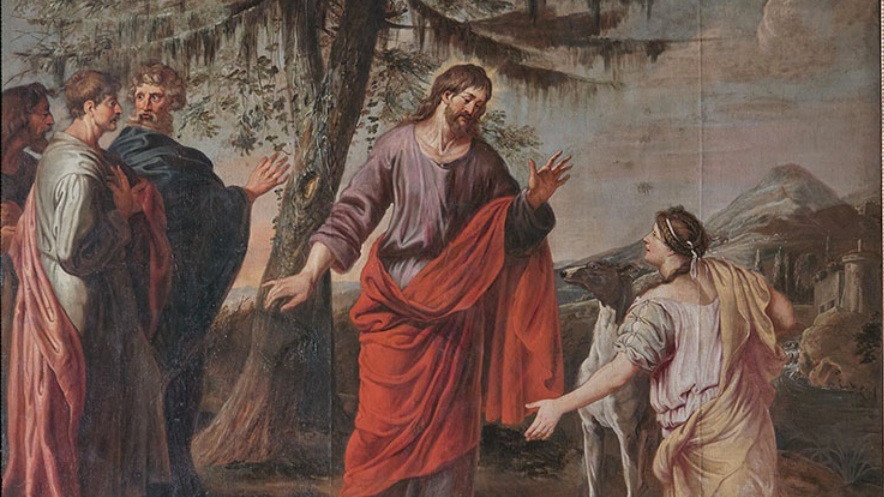
“Woman, great is your faith!”
He said in reply, “I was sent only to the lost sheep of the house of Israel.” But the woman came and did him homage, saying, “Lord, help me.” He said in reply, “It is not right to take the food of the children and throw it to the dogs.” (Mt 15:23-24).
I would encourage you to read in full Matthew 15:21-28 to get the full feel of this Gospel account. (If needed, see the link below).
Jesus’ reaction in this scene does not appear to be consistent with how he has acted toward others who have approached him in the past. Is he just having a bad day and taking it out on this woman? Is his reaction because she is a woman and a Gentile at that? I don’t believe either case to be true.
Jesus has seen his disciples time and again attempting to turn people away, just as recently when the five thousand were hungry and they were ready to send them to the nearby villages, knowing the hour was late to get their food. Jesus was also tired that day too, all but spent, yet even so, I am sure that he did not check to see who were the card-carrying Jews among those gathered, but instead fed all that were present.
In today’s recording of Matthew, I wonder if Jesus was not so much testing the woman’s faith, as much as he was testing the faith and the response of his disciples. The woman was calling for help. Would the disciples offer to provide her support, following the lead of Jesus who they have observed so many times before? Jesus remained silent to her initial plea for help. What did the disciples do? They asked Jesus to send her away. Jesus appeared to support their indifference when he justified his non-response by stating that he was sent to the lost sheep of Israel, clearly she was of another fold.
Again, the disciples did not step up to defend the woman in need. Maybe they even egged Jesus on. The woman persisted. She came forward and knelt before Jesus imploring him to help her and Jesus met her with a degrading slur, referring to the woman as a dog. The disciples would now certainly appeal to Jesus for mercy, right? Nothing. Nada. His apostles stayed silent, or worse they may have even started to have a good laugh at her expense.
The woman did not back down, she remained resilient in her effort because her daughter needed her help and she would not be turned away. She did not react or get defensive, but returned with her own retort, by stating, “Please, Lord, for even the dogs eat the scraps that fall from the table of their masters” (Mt 15:27). Jesus then upended the whole scene and shared that the woman was the one who had great faith! A woman, a Gentile, not his disciples.
Those who have great faith are the ones who believe and act on that belief. Coming up with excuses to support our indifference or to turn away people in need is not faith. Those who are aware of the need of another and are willing to take the risk, make the effort to reach out and help, are those who show great faith. How would we have acted in this same scenario? I invite you to read Matthew’s account again in full a few times, and imagine yourself in the scene.
With honesty, let us assess where we find ourselves in the scene? Are we aghast at Jesus’ initial responses, do we stay silent or speak up for the woman? Do we add our own insults? If we are going through a trial as did the woman, do we have her persistence, determination, and resilience, resisting to be turned away or lose our cool, but remaining laser focused on our goal, not willing to give up?
Can we recall times when we did not recognize the need of others or respect the dignity of others because we perceived them as different or other than us? Were there times when we have or supported others who loosed derogatory or dehumanizing speech or actions behind other’s backs or directly? Have we defended, justified, or rationalized our gossip, prejudices, or hurtful behavior?
If so, may we seek God’s forgiveness, and if possible reach out to apologize to those we have directly or indirectly hurt. May we commit today to follow the guidance that St. Paul offered to the members of his Church at Ephesus: “No foul language should come out of your mouths, but only such as is good for needed edification, that it may impart grace to those who hear. And do not grieve the holy Spirit of God, with which you were sealed for the day of redemption. All bitterness, fury, anger, shouting, and reviling must be removed from you, along with all malice. [And] be kind to one another, compassionate, forgiving one another as God has forgiven you in Christ” (Ephesians 4:29-32).
May we ask Jesus for his guidance and courage so to be filled with his love and grace such that our thoughts, words, actions, and facial features may be more empowering, supportive, encouraging, kind, and loving today and each day. As we reach out to respect the dignity, especially, of those we have considered different or other, we too may hear Jesus say to us, as he did to the Canaanite woman, “Great is your faith!”
———————————————————————–
Picture: By Michael Angelo Immenraet – http://www.unionskirche-retten.de/seiten/bildpatenschaft/bild-18.php, Public Domain, https://commons.wikimedia.org/w/index.php?curid=37307817
Mass Readings for today, Wednesday, August 8, 2018: http://www.usccb.org/bible/readings/080818.cfm

